


A man waves an American flag during a rally against California’s stay at home orders in San Diego on April 18, 2020.Ariana Drehsler / AFP – Getty Images
Governors across the country on Sunday criticized President Donald Trump’s expression of solidarity with those protesting various state-issued stay-at-home orders, saying his comments are “dangerous” and “don’t make any sense.”
“I don’t know any other way to characterize it, when we have an order from governors, both Republicans and Democrats, that basically are designed to protect people’s health, literally their lives, to have a president of the United States basically encourage insubordination, to encourage illegal activity,” Washington Gov. Jay Inslee, a Democrat, told ABC’s “This Week,” adding, “To have an American president to encourage people to violate the law, I can’t remember any time during my time in America where we have seen such a thing.”
Inslee said Trump’s comments were “dangerous” because they “can inspire people to ignore things that actually can save their lives.” Trump’s promotion of the protesters was “hobbling our national efforts to protect people from this terrible virus.”
“And it is doubly frustrating to us governor because this is such a schizophrenia, because the president basically is asking people: Please ignore Dr. Fauci and Dr. Birx. Please ignore my own guidelines that I set forth, because those guidelines made very clear, if you read them — and I don’t know if the president did or not — but, if you read them, it made very clear that you cannot open up Michigan today or Virginia,” Inslee said. “Under those guidelines, you need to see a decline in the infections and fatalities. And that simply has not happened yet.”
The past week saw an increasing number of protests across the country where demonstrators railed against the coronavirus restrictions that health experts say are necessary to curtail the spread of the virus.
The protesters have said they believe the shutdowns, which have harmed business and stunted leisure activity, have gone too far, especially in areas that haven’t seen major outbreaks like those in New York City and Detroit. But health experts have warned it won’t take much for a relatively unaffected place to become a hot spot, as just one infected person is able to spread the virus to several others.
The demonstrations have been small for the most part. A Gallup poll conducted earlier this month found that just 20 percent of Americans would like to see an immediate return to normal, while 71 percent prefer to wait and see how the outbreak develops. That includes just 31 percent of Republicans who want to see an immediate return as well as 23 percent of small town and rural-dwelling respondents.
The protests, which have been promoted in large Facebook groups with names such as “Michiganders Against Excessive Quarantine” and “ReOpen NC,” have seen a large pro-Trump contingency, with demonstrators wearing and waving Make America Great Again gear, as well as “Don’t Tread on Me” flags. Protests, like “Operation Gridlock” in Michigan, the largest of the demonstrations so far, have been organized and promoted by leading conservatives. Some have even been seen waving Confederate flags at the rallies.
The rallies have led to crowds gathering in close proximity, with many participants forgoing masks and violating social distancing guidelines that have been put in place.
Late last week, Trump cheered the effort to “LIBERATE” Michigan, Minnesota and Virginia, three states with Democratic governors. He defended those tweets Friday, saying that he thinks some states stay-at-home orders “are too tough,” adding he feels “very comfortable” with his tweets.
“These are people expressing their views,” he said. “I see where they are and I see the way they’re working. They seem to be very responsible people to me, but it’s — you know, they’ve been treated a little bit rough.”
The administration last week released guidelines for how states can begin easing restrictions, recommending a multi-stage process that includes robust testing. Governors on Sunday said Trump’s encouragement of the protesters was confusing considering the new guidelines.
Maryland Gov. Larry Hogan, a Republican, told CNN’s “State of the Union” his state is “doing everything we possibly can to reopen in a safe manner,” but “I don’t think it’s helpful to encourage demonstrations and encourage people to go against the president’s own policy.”


“The president’s policy says you can’t start to reopen under his plan until you have declining numbers for 14 days, which those states and my state do not have,” he said. “So then to go encourage people to go protest the plan you just made recommendations on Thursday — it just doesn’t make any sense. We’re sending completely conflicting messages out to the governors and to the people as if we should ignore federal policy and federal recommendations.”
Speaking with NBC’s “Meet the Press,” Ohio Gov. Mike DeWine, a Republican, said he’s asked protesters to “observe social distancing” and “we’re all big believers in the First Amendment.”
“They were protesting against me yesterday and that’s just fine,” he said. “They have every right to do that. We’re going to do what we think is right, what I think is right, which is try to open this economy but do it very, very carefully so we don’t get a lot of people killed. But we have to come back and we’re aiming to do that May 1. It’s very consistent … with the very thoughtful plan the president laid out.”
Virginia Gov. Ralph Northam, a Democrat, told CNN that Trump was focusing on protests after being “unable to deliver on tests.”
“And this is not the time for protest,” Northam said after Trump encouraged gun rights activists in his state. “This is not the time for divisiveness. This is time for leadership that will stand up and provide empathy, that will understand what’s going on in this country of ours with this pandemic. It’s the time for truth. And it’s the time to bring people together.”
A new NBC News / Wall Street Journal poll conducted just before the announcement of the administration’s new reopening guidelines showed that 58 percent of registered voters are more concerned that America will “move too quickly in loosening restrictions” and cost more lives than they are about the country taking too long to loosen the orders. Meanwhile, earlier last week, Trump said he was “not going to put pressure on any governor to open.”
Speaking with “Fox News Sunday,” Vice President Mike Pence addressed Trump’s encouragement of the protests, saying “no one in America wants to reopen this country more than” Trump, and that “when the president speaks about re-opening America it’s all about encouraging governors, as soon as they determine as most proper and most appropriate to be able to do that and do that quickly.”
Pence told “Meet the Press” that the U.S. has “to make sure the cure isn’t worse than the disease,” and that there are “real costs” to staying shut down, pointing to business closures and health risks tied to isolation.
Michigan Gov. Gretchen Whitmer, who has instituted one of the most restrictive stay-at-home orders as her state deals with one of the worst outbreaks in the U.S., told “Meet the Press” on Sunday she stood by the measure.
“Michigan right now has the third-highest number of death from COVID-19, and yet we’re the 10th largest state,” she said. “We have a disproportionate problem in the state of Michigan. And so we could take the same action that other states have, but it doesn’t rise to the challenge we’re confronting. And that’s precisely why we have to take a more aggressive stand.”
“Who among us wouldn’t rather forgo jet skiing or boating right now it’s going to save your grandparent or your neighbor’s life,” she later told CNN. “And that’s precisely what the trade-off is in this moment.”
Two epidemiologists, writing an op-ed together in The New York Times on Wednesday, are suggesting that earlier efforts to mitigate the spread of the novel coronavirus — even implementing social distancing measures by just a week or two — could have saved tens of thousands of American lives.
Britta Jewell, a research fellow in the department of infectious disease epidemiology at Imperial College, London, and Nicholas Jewell, chair of biostatistics and epidemiology at London School of Hygiene and Tropical Medicine (and also a professor at the University of California, Berkeley), wrote in their opinion piece that earlier action could have been beneficial.
Tactics for dealing with COVID-19 and other diseases where there isn’t an effective treatment, much less a vaccine to prevent their spread, require intervention methods that “go back to the basics,” the researchers wrote, noting that social distancing measures (like limiting large gathering sizes or closing schools) must be implemented in those cases.
Even with the advisory in place, the White House did not order any state or municipality to quarantine or make a blanket stay-in-place proclamation for the nation at large. A few days later, California became the first state to issue such an order, followed by 14 other states over the next five days.
Both authors stated that their research models suggest, had the Trump administration acted earlier in deeming social distancing measures necessary to prevent the spread of COVID-19, thousands of lives could have been saved.
Current models forecast over 60,000 Americans may die from COVID-19 by August. Had social distancing measures been pushed by Trump a week prior, however, the researchers concluded that the number could have been just 23,000 — nearly a 60 percent drop in current death estimates. A decision to implement those measures two weeks earlier than when the president’s recommendations were made would have dropped estimates down by 90 percent.
Noting that modeling estimates aren’t always a “crystal ball,” and that their numbers could be off, the researchers maintain that “What matters more is the relative effect of moving earlier rather than later in trying to contain the spread.”
In other words, had the Trump administration taken things more seriously, the number of Americans who are likely to die from the disease could be starkly smaller.
“Whatever the final death toll is in the United States, the cost of waiting will be enormous, a tragic consequence of the exponential spread of the virus early in the epidemic,” they added in their op-ed piece.
Indeed, the week or so prior to Trump issuing his social distancing recommendations, the president was making a number of statements suggesting he didn’t see the crisis as being all that important or that such actions were warranted. On March 9, for example, Trump sent out a tweet in which he expressed a desire to resist calls for distancing measures, comparing such actions as being out of line for what we do during flu season each year, and thus unnecessary for COVID-19.
“Nothing is shut down, life & the economy go on” when flu season occurs, Trump pointed out.
Also on March 9, Trump sent out a separate tweet to his followers insinuating that fears about coronavirus were nothing more than mere partisan statements against him.
“The Fake News Media and their partner, the Democrat Party, is doing everything within its semi-considerable power (it used to be greater!) to inflame the CoronaVirus situation, far beyond what the facts would warrant,” Trump said, citing the words of Surgeon General Jerome Adams that week, who said, “The risk is low to the average American.”
In the finest traditions of Abraham Lincoln and Franklin Roosevelt — two of the U.S.’s most noteworthy wartime presidents — Donald Trump, the coronavirus “war” “president,” yesterday accused the state of New York of padding its coronavirus death toll, after New York revised its numbers to reflect thousands who died of COVID-19 before it had a name.
We’ve gone from “Fourscore and seven years ago” to “Nothing to fear but fear itself” to “Everything we have is documented and reported great,” which is how Trump responded to New York’s revised numbers. And you wonder why a new poll shows that 45 percent of Fox News viewers believe the coronavirus death toll numbers are inflated. The president said so!
Meanwhile, back in the middle of March when the COVID crisis was first beginning to roar but could have been better contained, the White House realized it had a shortage of face masks for its staff. This set off a scramble to get masks from Taiwan roundabout the 14th of that month. “At the time, the U.S. government was discouraging the public from wearing masks, saying that healthy people didn’t need them,” reports The Washington Post.
“A protest movement is taking hold targeting states that have extended social-distancing rules, closed schools, and restricted access to large religious gatherings,” reports The Daily Beast. “And it’s being fed by loyalists and political allies of President Donald Trump.”
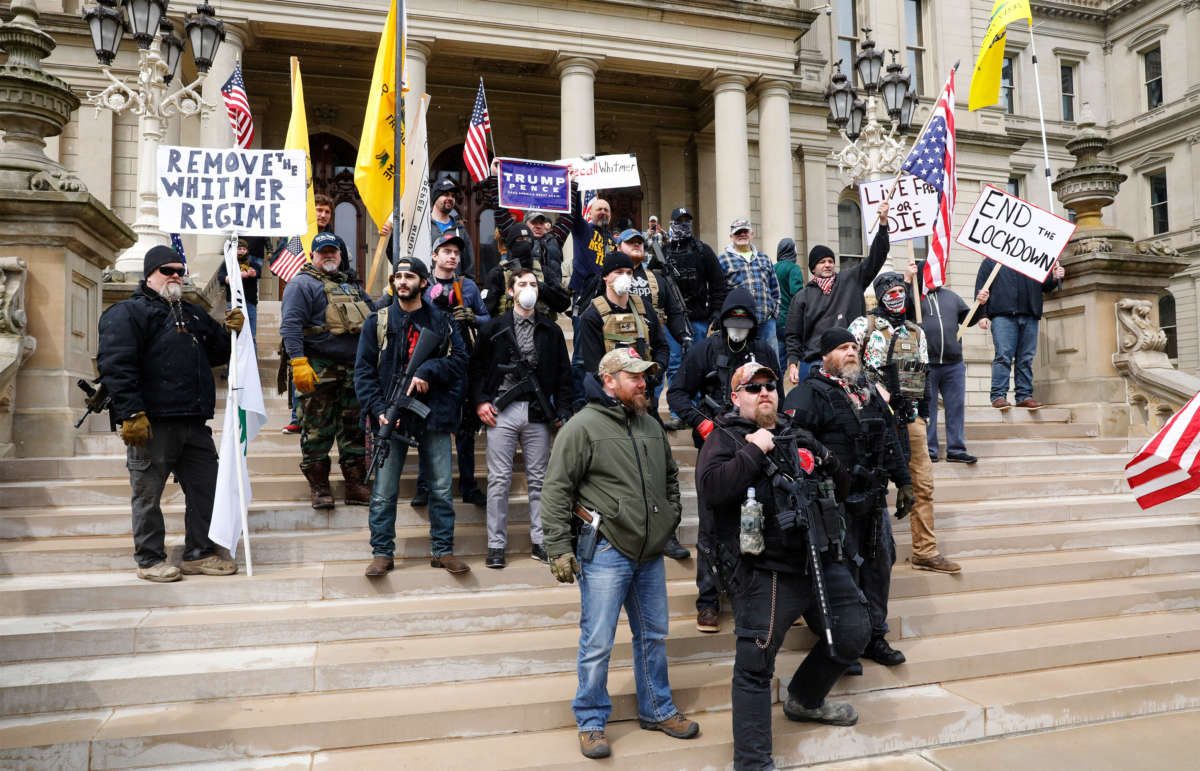
These pro-Trump protests have been popping up in Idaho, North Carolina, Oklahoma, and other states that have not yet felt the full brunt of the pandemic. The most vivid example to date came just yesterday in Michigan, where thousands of right-wing protesters — a number of them packing AR-15s — swarmed the capitol building in Lansing to protest Gov. Gretchen Whitmer’s stay-at-home order. “Lock her up!” they chanted, because of course they did.
While Trump himself is largely responsible for this incredibly dangerous burst of deeply misplaced faux-patriotism, his ideological allies have been busy online. A misinformation-laden video denouncing Anthony Fauci, for now the other face of the daily coronavirus briefings, has gone viral with more than 6 million views. It accuses Fauci and others of being part of the “Deep State,” Trump’s favorite rhetorical target. Given Trump’s recent unsubtle hints that Fauci is telling too much truth, the appearance of this video puts one in mind of the old saying about how there are no accidents in politics.
Evangelical churches have been filled to capacity with Trump supporters who have been led to believe that these stay-at-home orders issued by state governors are an attack on their constitutional right to gather in worship as they please. Evangelicals, of course, have been the unshakable bedrock beneath Trump’s dwindling base of support.
Jerry Falwell Jr., president of the evangelical Christian crown jewel Liberty University, has been ardent in his outspoken belief that COVID is nothing to fear and a plot to undermine Trump. “Since March 29, when the first case was diagnosed in a Liberty student living off-campus, confirmed coronavirus cases in the Central Virginia health district, which surrounds Lynchburg and Liberty, have grown from seven to 78, reports The New York Times. “One person has died.”
Even as Trump’s most ardent supporters crush themselves together to protest necessary coronavirus restraints, COVID hotspots have begun to bloom in regions that have been, to date, the geographic core of his support.
Nebraska, Idaho, South Dakota and other rural farm belt states are experiencing spikes in confirmed COVID cases. In Nebraska alone, the state’s health department reports a 30 percent increase in cases over the last three days. That is the accelerating curve New York, Massachusetts and Washington State can tell Nebraska all about.
The so-called “curve” of cases does appear to be flattening nationally because a majority of people, especially in urban areas, are devoutly complying with the strictures of social distancing. There are about 30,000 new cases every day right now; the number is no longer accelerating, but is still horrifying to contemplate.
What happens when this thing really and truly burns through rural America? It has already begun, and because of all those Trump supporters standing shoulder to shoulder at capitols and churches to shout their defiance of science and the “Deep State” into the virus-polluted air, it will get worse.
It will get worse within days, if the pattern holds, and there is no reason to expect otherwise. The match has been lit. In two weeks, these rural areas — which have lost so many of their hospitals thanks to decades of conservative budget cuts — are going to be locked into the same nightmare the urban areas have been dealing with since March, but with far less medical infrastructure prepared to confront it.
It begs the deadly, wretched question: How many Trump voters are going to die between now and November? How many people who listened to their president and his Fox News mouthpieces, who jammed the Michigan capitol steps and the megachurches on Easter because the president said it was safe, will be dead by June?
Quite a lot, I fear. This is the very living essence of tragedy and farce. Trump has labored mightily to convince his people that this is all some sort of ruse to keep him from being re-elected, and millions of those people have swallowed it whole.
This is a snake eating its own tail in real time while the snake-handler-in-chief cheers it on … except we are not talking about snakes. These are people, all of whom are somebody’s children, many of whom have children. They trusted Donald Trump, and that will get many of them killed while subsequently prolonging a pandemic that has already infected 2 million people worldwide.
I wonder if they will still think it was worth it come the summertime. I wonder if they will want a word with Mr. Trump once the virus he called a hoax has its way with them.
Sign up for our special edition newsletter to get a daily update on the coronavirus pandemic.
President Trump on Sunday night retweeted a post that called for the ousting of Dr. Anthony Fauci after the infectious disease specialist appeared on CNN.
The tweet from DeAnna Lorraine, a former GOP candidate for Congress, included the hashtag #FireFauci and referred to Fauci’s concession that more lives could have been saved if the US had acted sooner to stop the spread of coronavirus.
“Sorry Fake News, it’s all on tape,” Trump wrote, insisting his travel ban was the action needed to stem the virus. “I banned China long before people spoke up.”
Earlier on Sunday, Fauci appeared on CNN’s “State of the Union” and acknowledged the country “could’ve saved lives” if it had started mitigation efforts earlier.
“You know, Jake, as I have said many times, we look at it from a pure health standpoint,” Fauci told host Jake Tapper.
“We make a recommendation. Often, the recommendation is taken. Sometimes it’s not. But we — it is what it is. We are where we are right now.”
 Donald J. Trump
✔@realDonaldTrump
Sorry Fake News, it’s all on tape. I banned China long before people spoke up. Thank you @OANN https://twitter.com/deanna4congress/status/1249457858686656512 …
DeAnna Lorraine
✔@DeAnna4Congress
Fauci is now saying that had Trump listened to the medical experts earlier he could’ve saved more lives.
Fauci was telling people on February 29th that there was nothing to worry about and it posed no threat to the US public at large.
Time to #FireFauci…
Lorraine’s tweet was critical of Fauci’s cable news appearance and used the hashtag #FireFauci to encourage Trump’s fanbase to add the medical expert to the president’s list of perceived enemies.
“Fauci is now saying that had Trump listened to the medical experts earlier he could’ve saved more lives,” wrote Lorraine.
“Fauci was telling people on February 29th that there was nothing to worry about and it posed no threat to the US public at large,” she continued. “Time to #FireFauci.”
https://nypost.com/2020/04/13/trump-retweets-post-about-firing-dr-anthony-fauci/

https://www.theguardian.com/news/audio/2020/mar/19/how-donald-trump-changed-course-on-coronavirus
Donald Trump has moved from dismissing coronavirus as similar to the winter flu that would disappear in the spring to declaring a national emergency. But did his administration’s initial response waste valuable time? World affairs editor Julian Borger reports from Washington DC
Donald Trump’s initial response to the coronavirus crisis was to play down its significance and tell the public that the approaching warmer weather was likely to see an end to the virus. But since then his tone has markedly changed and he has declared a national emergency.
The Guardian’s world affairs editor Julian Borger tells Rachel Humphreys that delays and faults with the US coronavirus testing system has set the response back considerably. Now, as the pandemic takes hold, the country is battling to keep its economy afloat with a possible trillion-dollar stimulus as entire industries fight for survival.
Donald Trump has moved from dismissing coronavirus as similar to the winter flu that would disappear in the spring to declaring a national emergency. But did his administration’s initial response waste valuable time? World affairs editor Julian Borger reports from Washington DC

A Brazilian official who met and dined with President Donald Trump at Mar-a-Lago over the weekend has tested positive for coronavirus, according to media reports Thursday — but Trump said he’s “not concerned.”
The official, Fabio Wajngarten, posted an Instagram image of him posing with Trump and Vice President Mike Pence, who is leading the White House’s coronavirus task force.
“I did hear something about that,” Trump told reporters Thursday, when asked about the matter. “We had dinner together in Florida at Mar-a-Lago with the entire delegation. I don’t know, if the press [said he was there, then] he was there.”
Trump appeared to shift his focus to Brazil’s president, Jair Bolsonaro, as he continued his response.
“But we did nothing very unusual. We sat next to each other for a period of time, had a great conversation. He’s doing a terrific job in Brazil, and we’ll find out what happens. I guess they’re being tested right now?” Trump said.
Pressed for comment on the report, Trump added: “Let’s put it this way, I’m not concerned.”
This is breaking news. Please check back for updates.
Presidents always take credit for the positive things that happen on their watch, but Donald Trump has gone to a whole new level. He endlessly touted the “best economy ever,” even though, under his watch, we just saw the continuation of trends from the Barack Obama years.
There was a modest pickup in GDP growth, with the average for the first three years of the Trump administration being 2.5 percent, compared to an average of 2.3 percent in the last three years of the Obama administration. By contrast, the pace of job growth slowed, from 224,000 to 182,000 over the same period.
There was little change in most other macroeconomic variables between the two administrations, as we saw the gradual improvement in the labor market under the Obama years continue into the Trump years. That meant things were getting better on the whole. However, the hundreds of thousands of people who lost health insurance in the Trump years are likely to disagree with his boasts of the best economy ever, as are people facing crushing student loan debt.
But this is all past tense. One problem for those who want to take credit for everything good that happens on their watch is that they also have to take responsibility for the bad things that happen. In that sense, coronavirus completely belongs to Trump, although unlike the path of the economy, he really does bear responsibility.
At the most basic level, the epidemic itself was hardly a surprise. It was first reported in China in December of last year.
A serious president would have been taking the lead in organizing an international response. But Trump was busy doing other things. In addition to his golf games, Trump was holding campaign rallies and fundraisers around the country. When he wasn’t traveling, he was busy on Twitter making boasts about the economy, lying about his poll results and directing schoolyard taunts against his political opponents. With such a busy schedule, how could we expect Trump to have time to worry about a pandemic?
It gets worse. Trump had dismantled the Centers for Disease Control and Prevention’s (CDC) team to deal with pandemics. The CDC was also coping with Trump budget cuts, and is facing another cut of 16 percent slated for next year.
Trump also attacked those who tried to warn of the risks of the virus. He claimed the whole thing was a Democratic hoax, and said that the United States had 15 cases and that the number would fall quickly.
He then went full Trumpian in his management style, pushing aside the public health experts at the CDC, and putting Vice President Mike Pence in charge of protecting the country from the pandemic. Pence’s main credentials for this task are a disbelief in science (he doesn’t believe in evolution or global warming) and a failed effort to stem the spread of AIDS when he was governor of Indiana.
Trump also attempted to clamp down on any accurate, concrete information that would contradict his “no-big-deal” story. He required that Pence clear all statements from the CDC. Using his famed vindictiveness, he also retaliated against a Health and Human Services whistleblower who reported that people exposed to coronavirus on a cruise ship were greeted by health care workers without protective gear or training.
In short, the fact that we are likely facing a serious pandemic, unlike any we have seen in more than a century, is 100 percent Trump’s fault. Because of his vanity and ineptitude, people will die, and many more will get sick. It is very likely that we will face a recession as people cancel travel plans and are reluctant to go out to restaurants, sporting events and other public places.
At this point, we can only speculate how bad things will get. But let us say it loud and clear: “Thank you, President Trump!”

President Donald Trump said Friday that Democrats are using the virulent coronavirus as a “hoax” to damage him and his administration.
“The Democrats are politicizing the coronavirus,” he said from a campaign rally in North Charleston, South Carolina.
“One of my people came up to me and said ‘Mr. President they tried to beat you on Russia, Russia, Russia. That didn’t work out too well.’ They couldn’t do it. They tried the impeachment hoax that was on a perfect conversation,” he continued.
“This is their new hoax,” he said, referring to the coronavirus.
The disease, which originated in Wuhan, China, has now killed more than 2,800 people worldwide and infected more than 80,000. The latest reports from the World Health Organization show the pace of new cases in China slowing, but jumping in South Korea, Japan, Italy, and Iran.
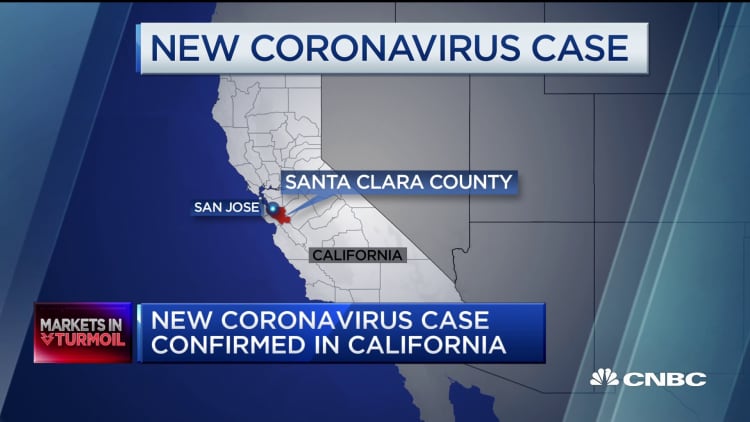
In the U.S., the Santa Clara Public Health Department announced a third case of coronavirus in the county Friday evening. The announcement brings the total number of confirmed coronavirus cases in California to 10 and the total number of cases in the U.S. to 63, most of which were passengers on the Diamond Princess cruise ship and evacuees from Wuhan.
“We are magnificently organized with the best professionals in the world,” Trump said of the administration’s preparations to help contain the spread of the virus.
“We have to take it very, very seriously … We are preparing for the worst,” he continued. “My administration has taken the most aggressive action in modern history to prevent the spread of this illness in the United States. We are ready. We are ready. Totally ready.”
In other headlines, a Google employee tested positive for the coronavirus, the company said Friday. New Zealand and Nigeria reported overnight their first coronavirus cases.
“We will do everything in our power to keep the infection and those carrying the infection from entering our country. We have no choice,” Trump said. “Whether it’s the virus we’re talking about or many other public health threats, the Democrat policy of open borders is a direct threat to the health and wellbeing of all Americans.”

Scientists at an Antarctic research station recently recorded a one-day air temperature of just under 70 degrees, a balmy afternoon in a region of the world unaccustomed to them. In fact, as far as researchers can tell, it has never been that warm in Antarctica before. The record was set against an increasingly scary global backdrop of rising temperatures and seas; more powerful storms, droughts and floods; a reduced Arctic ice cap, and accelerated melting and movement of glaciers around the globe — including Antarctica.
The culprit behind this crisis is the nearly 200 years that humans have spent burning fossil fuels — primarily coal and oil — for energy. So it was mildly heartening to see that BP, the London-based oil and gas giant, has promised to achieve “net-zero emissions” for its operations by 2050. That doesn’t mean BP is getting out of the oil-and-gas business. Rather, the corporation pledged to eliminate some emissions from its drilling, processing and business operations, and to compensate for others through investments in green technologies, reforestation projects and similar offset strategies. The announcement followed earlier pledges by such European-based oil companies as Royal Dutch Shell, Total and Equino to reduce emissions from their operations, though the BP pledge goes further.
None, of course, goes far enough. And new BP CEO Bernard Looney acknowledged the corporation had not settled on a strategy to achieve its net-zero emissions goal. Those details will come in September.
But at least the goal was set, which is far more than has been done by American-based oil companies like ExxonMobil and Chevron, which have acknowledged the role of greenhouse gas emissions in propelling climate change but have done little to address their contribution. Both are part of the corporate-driven Oil and Gas Climate Initiative, whose stated purpose is to reduce “our collective methane emissions by more than one-third” by essentially stopping leaks and moving the captured methane to where it could be burned.
Of course, baby steps by a handful of oil and gas companies aren’t going to do much to combat overall emissions. Similarly, the Trillion Trees Initiative, which President Trump touted in his State of the Union address, won’t do an awful lot, either. In fact, it’s one of those fig-leaf solutions that offers a pretense of significant action against global warming while ignoring the most pressing problem — the burning of fossil fuels in the first place.
Which is not to suggest that reforestation is a bad idea; in fact, continued forest clearing in the Amazon is exacerbating global warming and must stop. Because forests store carbon, restoring them could help capture and slow the accretion of carbon in the atmosphere, where it traps heat. One study found that the Earth’s ecosystems could handle an additional 25% of forests above what it holds now (though increased droughts and desertification related to climate change could whittle away at that), compensating for about 20 years of human-produced carbon. So large-scale reforestation falls in the category of “couldn’t hurt.”
Nevertheless, far, far more needs to be done, beginning with converting our global reliance on energy from fossil fuels to renewables as fast as is humanly possible. The best way to reduce carbon in the atmosphere is to not put it there in the first place.
So in that regard, the danger of the Trillion Trees Initiative is that pro-oil business conservatives will wave it around as a solution to global warming. But that’s like someone hoping to lose a lot of weight by taking daily walks while still eating the same calorie-rich foods.
The nation, and the world, need sober and aggressive policy changes if we are to stand any chance of mitigating the worst effects of global warming. Despite heightened awareness and national pledges under the 2015 Paris Agreement to try to limit global warming to 1.5 degrees Celsius (2.7 degrees Fahrenheit) above pre-industrial levels, global carbon emissions continue to rise. It will be expensive to adapt to the new climate reality and to fundamentally change the way humankind produces and uses energy, but it must be done before the supposedly most intelligent of the animal species manages through greed and willful ignorance to propel the collapse of global ecosystems.
 Exposing the Big Game