Democratic presidential candidates take the stage at the beginning of the Democratic presidential debate at the Fox Theatre on July 30, 2019, in Detroit, Michigan.SCOTT OLSON / GETTY IMAGES
In my bleaker and more cynical moments, I wonder if the TV networks are doing this deliberately. The next big DNC-sanctioned Democratic presidential confab, broadcast this time by ABC and Univision, is taking place Thursday night in Houston. Like the other elaborately failed debate formats so far, this one will also feature 10 candidates vying for attention on the same platform, except for three hours instead of two.
“Each candidate will have one minute and 15 seconds to directly respond to questions from moderators,” reportsTime, “and 45 seconds to respond to follow-up questions and rebuttals. Candidates will give opening statements, but no closing statements.”
Spiffy. There were gusts of relief sighed across the land when it was announced the debate would not be broken up into two back-to-back nights, but I did not share in the sentiment. Allowing even one more candidate to participate would have indeed necessitated two nights, but those two nights would have featured five or six candidates each, instead of Thursday’s clotted 10-candidate format I have come to detest and abhor.
Despite the fact that, once again, the Democrats are putting the equivalent of an entire college lacrosse team before the cameras, the dynamics between the candidates will be worth watching.
ABC has placed Joe Biden front and center on the debate stage, directly between the podiums to be occupied by Elizabeth Warren and Bernie Sanders. Given the operatic, bloody-eyed debacle that was Biden’s showing at the recent CNN climate town hall, and that his frontrunner status is about as firm as pudding on a Houston sidewalk in high summer, the pressure on him will be extreme. The speed-dating format may shield him for a time, but I strongly suspect Jojo will not enjoy the overall experience. If he has another bad night, watch for the vultures to begin circling his campaign bus.
As for the other participants — Kamala Harris, Beto O’Rourke, Cory Booker, Pete Buttigieg, Andrew Yang, Julián Castro and Amy Klobuchar — the night will be yet another chapter in their ongoing quest for relevance. All seven continue to poll in single digits, and between the established establishment candidate (Biden) and the two progressive standard-bearers (Sanders and Warren), there isn’t much room for any of them to stand out in a campaign-salvaging manner.
As for the topics that are sure to get short shrift in the 10-person format, the recent spate of massacres will likely bring gun reform to the fore. Donald Trump’s astonishing cruelty toward Dorian refugees from the Bahamas will certainly inspire a discussion on immigration. If the previous debates are any guide, climate change, foreign policy and Trump himself will also be featured on the spinning roulette wheel of topics.
Like as not, however, health care reform will again be a major topic. It will be featured prominently, I believe, because it is important, and because it allows the corporate media moderators to say “raise your taxes!” to Medicare for All advocates like Sanders 400 times within the confines of time restrictions that thwart proper explanations for why this is actually OK.
Speaking of health care in the U.S., a little girl from Sudbury, Massachusetts, fell suddenly ill on September 3, and was rushed to Boston Children’s Hospital for treatment. She was diagnosed with Eastern equine encephalitis (EEE), a mosquito-borne illness climate scientists have warned will become more prominent and dangerous with the ongoing onset of climate disruption. She remains in critical condition as of this writing.
To offset expenses, her parents initiated a GoFundMe campaign to help raise money for her medical care. “She remains in the ICU,” reads the fundraising request, “and while the family has a full medical insurance plan through their employer, the out-of-pocket medical costs will be massive.” As of Tuesday morning, according to the Boston Globe, the appeal had generated more than $88,000.
Here we have a heartwarming story of basic human compassion, of a community rallying to support one of its most vulnerable members, right? I see it differently. In fact, stories like this — meant to flood the heart with joyful tears — make me scream in my soul.
This is not an uplifting story about people helping other people. That is what it is framed to sound like, even as it is framed to sound like something perfectly normal and ordinary. It is a story of last-ditch desperation, one of millions taking place every single day.
It is the thoroughly commonplace tale of a family that has been financially subsumed by a sudden illness, even as they are in possession of full medical coverage, who require the largesse of strangers to run the expensive gauntlet of our for-profit medical industry.
This child should be getting treatment for free, or at least at minimal expense to her family, as should every person who falls ill in this country, because health care is a human right enshrined on the hood ornament of our founding documents: “Life, Liberty and the Pursuit of Happiness.” Try locating any of those when you are sick — and broke because you are sick.
The people who have donated to this fund are to be commended, don’t get me wrong, because we are all screwed if we don’t help each other survive the lethal cruelty of late-stage U.S.-style capitalism. The fact that this little girl could very well die if strangers don’t pony up to cover her astronomical medical bills, however, is what’s wrong with how we do medicine in this country. Stories like this one are octaves in the dying wail of a carnivorous paradigm that needs to be shattered and buried under salted earth before it kills us all.
Please remember this story as you watch the debate on Thursday night. Remember that the stakes are human lives. The stakes are us.
I don’t imagine the debate format will properly encompass the health care crisis, or any of the others. That, right there, is the problem.
Donald Trump’s tenure in the White House, along with the Republican Party’s reign in Congress, will be an unmitigated disaster for the environment. A witch hunt is already underway for federal employees who support the science of climate change. Protections for the 640 million acres of public land you and I own in this country are already being stripped away. Oil and gas extraction on public land is expected to be deregulated, and even coal—a heavily polluting, inefficient energy source the market has rendered obsolete—may see reinvestment. A victim of all of those programs, and even the target of specific GOP plans for eradication? The gray wolf, only recently reintroduced to western states to help check overpopulated elk and deer and restore balance to the natural food chain there.
Update: On January 17, 2017, Republican Senators introduced a bill nicknamed, “The War on Wolves Act.” If passed S.164 will not only remove ESA protections from wolves in Minnesota, Michigan, Wisconsin and Wyoming, but it will also strip citizens of the right to challenge it in court.
Where the Wolf Stands Today
It’s important to understand that the gray wolf, as a species, is not under threat overall—it’s just specific populations of wolves in certain geographic areas. There are approximately 60,000 wolves living in the wilds of Alaska and Canada. Those will only suffer the general impact of anti-environment policies, accelerated climate change, and habitat loss.
It’s the wolf populations reintroduced to the American West that GOP policy is directly targeting.
There’s also a population of more than 3,500 gray wolves in and around the Great Lakes—in Wisconsin, Michigan, and Minnesota—that, to a lesser extent, is also threatened.
Wolves were first brought back to the West in 1995, when 66 were brought from Canada to Yellowstone National Park and Idaho. The Northern Rocky Mountain Wolf Recovery Plan also allowed for the natural southern dispersal of other wolf populations from Canada. Since then, the species has spread to Montana, Wyoming, Washington, and Oregon, and now there’s even a single pack living in Northern California. The population of wolves in those states is approaching 1,700—a huge success story for conservationists, albeit one that’s still ongoing. Wolves numbered 2 million on this continent just a couple hundred years ago but were killed off as modern civilization expanded westward.
As part of the reintroduction, the burgeoning population of gray wolves in the West was initially protected by the Endangered Species Act. Largely due to the controversial nature of the wolf reintroduction that we’ll get to a little later, however, those protections have variously been repealed, replaced, and repealed again at federal and local levels. Wolf populations have returned to just 10 percent of their original range in the West, making their existence there still tenuous and dependent on some sort of protection.
Watch: How Wolves Change Rivers
Why We Need Wolves
As an apex predator, wolves create a trophic cascade of benefits in their ecosystem, restoring balance the whole way down the food chain. (This process is explained very well in the video embedded above.)
In Yellowstone, for instance, the reintroduction of wolves corrected an imbalance caused by the unchecked expansion of ungulates. Historically, wolves kept the elk population in balance in that area; without them, the elk became too numerous and their movements too static. Grasslands were overgrazed. Willows, cottonwood, and aspen were damaged, destroying the riparian habitats of beavers, songbirds, otters, muskrats, ducks, fish, reptiles, and amphibians. Wolves fixed that. They also checked the population of coyotes, which preyed heavily on small animals. So those populations returned, too, along with the birds of prey that feed on them. The revitalized shrubbery produced more berries, expanding the bear population. The entire ecosystem benefited and was returned to balance by the mere reintroduction of a handful of wolves. It’s that whole circle of life thing that Elton John once sang about in that Disney movie.
Can wolves restore balance to ecosystems elsewhere in their historic range? This study, published in the scientific journal Trends in Ecology and Evolution, suggests they can, and that they may also enable the successful coexistence of invasive species with their native counterparts. The study argues that allowing the return of apex predators like the wolf may be much cheaper than trying to manage these environments through human methods.
Need a dollar amount to define their value? Wolves bring in more than $35 million a year of tourist spending to the Yellowstone area. Local businesses benefit from the mere presence of wolves.
Why Republicans Are Afraid of the Big Bad Wolf
Wolves kill and eat stuff. As described above, that’s their job. Things they like to kill and eat include things people like to kill and eat—primarily deer and elk, but also sometimes sheep and cattle. Which makes us rivals. Between 1995 and 2005, wolves killed 213 cattle and 173 sheep in Wyoming. The elk population has also fallen since the reintroduction of wolves, though drought, disease, and hunting also play a role. There were 17,000 elk in the park when the reintroduction began. Today there are 4,844.
Perhaps due to an exaggerated presence of wolves in nursery rhymes and fairy tales, we humans also find them scary. There have been only six documented fatalities due to wild wolves (two of which were rabid) in North America in the past 100 years. The number of people killed by wolves pales in comparison to the number of people who die each year due to, say, bee stings (in the United States, that’s 100 people every year). Others complain that the loss of livestock hurts ranchers’ livelihood, even though state governments compensate ranchers for any losses. Still others lament the decrease in lucrative guided elk hunts in wolf states, though that has largely been attributed to an increase in out-of-state tag prices.
Politicians from rural areas have been pressured to address those unsubstantiated fears of their constituents, but that doesn’t come close to explaining the scale of the GOP’s war on wolves. The 114th Congress (2015–17) introduced 20 bills targeted at eliminating protections for the gray wolf alone. The Center for Biological Diversity (CBD) called it “the most anti-wildlife Congress we’ve ever had.” Until the 115th, that is.
Why exhaust so much time and energy attacking a single species? The real answer is that the protections wolves require in the West can run counter to the interests of industrial agriculture businesses and the oil and gas industry, both of which want to operate on land that is currently subject to protection because it’s wolf habitat.
The CBD has tracked donations from those industries to Congress and compared them with the number of bills introduced that threaten the Endangered Species Act (ESA). As campaign donations from the oil and gas industry and industrial agriculture have increased, so too have legislative assaults on the ESA. Because wolves have large ranges, the ESA may prevent energy extraction or industrial farming across larger areas than some other species. That explains the focus on removing the wolf’s protections.
Campaign donations to Congress versus anti-ESA bills. Confused by the huge uptick in bills coming after the increase in donations? Remember that these are campaign donations, and the bills they buy only come after the congressmen and senators are elected. America! (Illustration: CBD)
How Republicans Will Kill the Wolf
In 1973, partly motivated by the plight of the bald eagle, President Richard Nixon called on Congress to take action to protect species on the verge of extinction. Congress created the Endangered Species Act by a nearly unanimous vote. Bald eagle populations have since increased from a low of 417 mating pairs to more than 11,000 today. That species was delisted (removed from the ESA’s protections) in 2007, although it remains subject to other protections as our national bird. Today, the ESA protects more than 1,600 endangered plants and animals.
Not every animal protected by the ESA is a success story. Due to the precarious nature of many of the species it protects, delistings are infrequent. Take, for instance, the case of the Death Valley pupfish. Only a handful exist in two ponds in Death Valley National Park. Totally isolated, it’s obviously unrealistic to expect that the species will ever expand its population enough that it will ever be considered anything but endangered. Does the pupfish deserve our protection? Environmentalists would say yes. And the law has prevented extinction for 99 percent of the species it protects. But Republicans argue no, because only 1 percent have been rehabilitated.
“It has never been used for the rehabilitation of species. It’s been used for control of the land,” argues House National Resources Committee Chairman Rob Bishop (R-Utah). He has stated that he “would love to invalidate” the ESA.
A representative survey of registered voters across the United States conducted in 2015 found that 90 percent supported the ESA.
The Associated Press reports that congressional Republicans are preparing to amend the ESA, transforming it “from a tool to protect huge areas of habitat for imperiled species into little more than limits on hunting for protected animals.”
The wolf’s protection under the ESA has always been precarious. Due to the politically charged nature of their reintroduction, initial population targets that would trigger a delisting were set incredibly low—just 150 in Idaho, for instance. That didn’t sound like a viable population to wolf advocates, so, since the species started triggering delistings shortly after its reintroduction, its status has bounced back and forth both nationally and locally in a process of litigation and lawsuits so confusing and asinine that I’ll spare you a recap of it here.
To the best of my understanding, wolves are currently protected by the ESAeverywhere in the lower 48 with the exception of Montana, Idaho, and the eastern third of both Washington and Oregon. In large part, those protections are thanks to lawsuits conducted by environmental organizations like the CBD. Acknowledging that, Republican lawmakers have begun introducing anti-wolf laws as riders on essential budget bills, disturbingly including language that prevents legal challenge.
Trump has yet to go on the record about either the ESA or wolves, but he does oppose environmental policies that get in the way of drilling. It’s not expected that he’d veto any legislation designed to weaken or repeal the ESA or any riders intended to remove wolf protection. Trump’s nominee for interior secretary, Ryan Zinke, who will manage the U.S. Fish and Wildlife Service, which administers ESA programs, once sent out a Christmas card featuring a dead wolf. Last year, Zinke co-sponsored a bill designed to remove federal protections for wolves. It looks like the anti-wolf, anti-ESA Republican Congress is finally getting both the president it needs to rubber stamp this legislation, combined with an administrator of the Department of the Interior prepared to carry it out.
In addition to both that rollback of the ESA and likely direct challenges to the wolf’s inclusion in it, wolves are under threat from the GOP’s plan to steal our public lands. Like all wild animals, wolves need habitat to survive. Development of resource extraction on those lands will further threaten them.
This was the Christmas card Trump’s pick for interior secretary sent out in 2011. Note the dead wolf.(Illustration: Office of Ryan Zinke)
What You Can Do About It
Well, you could start by not voting for politicians who drum up support based on manufactured and exaggerated populist issues, and then work to steal from you once they’re in office. Like the public land heist, the war on wolves is another great example of that. If killing wolves results in increased wolf conflict for farmers, if wolves pose virtually no risk to human life, and if they’re essential to ecosystem rehabilitation in the West while bringing in tens of millions in tourist dollars, then remind me why we’re going to spend a bunch of taxpayer money killing them? Especially when 90 percent of us support the ESA. And you can stop voting for these jerks and enabling this behavior just because you think they’ll lower your taxes. They won’t.
In the meantime, you can call and write your congressional representatives. Tell them you support the ESA, you don’t want them to steal our land, and that you oppose any legislation intended to remove wolf protection. While you’re at it, maybe ask them to start working in your interest, too.
You can also donate to organizations like the Center for Biological Diversityand Defenders of Wildlife. They’re the ones who will be fighting this legislation as much as possible through this historic assault on our environment, our wildlife, and our natural heritage.
The Trump administration has drastically weakened the Endangered Species Act, one of our nation’s longest-standing environmental protection laws.
They’re taking away protections for endangered and threatened wildlife in order to pave the way for more drilling, mining, and development in our nation’s most pristine wildlife areas.
We cannot let this stand. Together, we can build the momentum to force the Trump administration to back down and restore the protections that they’re taking away.
Add your name to condemn the Trump administration’s attacks on the Endangered Species Act today!
The lawsuit, filed in San Francisco federal court, seeks an updated environmental analysis of the program, which kills thousands of the state’s native animals. The program targets carnivores like coyotes and foxes that are important for balanced ecosystems.
“Wildlife Services’ cruel killing practices are ineffective, inhumane and totally out of touch with science,” said Collette Adkins, a Center for Biological Diversity attorney representing the conservation groups involved in the lawsuit. “Nonlethal methods of addressing wildlife conflicts are proven to work. We’re suing the agency to force a closer look at alternatives to its damaging mass-extermination program.”
Today’s lawsuit targets Wildlife Services’ Sacramento District program. The district includes Colusa, El Dorado, Lake, Marin, Napa, Placer, Sacramento, Solano, Sonoma and Yolo counties.
Wildlife Services is a multimillion-dollar federal program that uses painful leghold traps, strangulation snares, poisons, aerial gunning, killing pups in their dens and other inhumane practices to kill wild animals including wolves, coyotes, bears, cougars and birds. Most of the killing is done in response to requests from the agriculture industry.
In 2018 Wildlife Services reported killing nearly 1.5 million native animals nationwide. That year in California, the program reported killing 26,441 native animals, including 3,826 coyotes, 859 beavers, 170 foxes, 83 mountain lions and 105 black bears. The 5,675 birds killed in 2018 in California included ducks, egrets, hawks, owls and doves.
Pets and protected wildlife like gray wolves, San Joaquin kit foxes, California condors and eagles are also at risk of being killed accidentally due to the program’s indiscriminate methods.
“Wild animals in California are entitled to legal protection from cruel, indiscriminate killing methods that fail to meaningfully reduce conflicts between wild and domestic animals,” said Stephen Wells, executive director for the Animal Legal Defense Fund. “Wildlife Services must update its practices to reflect current science that supports non-lethal approaches to minimizing conflicts.”
“For far too long Wildlife Services has been running roughshod over our nation’s wildlife with almost no accountability and with very little transparency,” said Camilla Fox, founder and executive director of Project Coyote. “It’s time for a full accounting of this agency’s impact on the environment and on target and non-target animals. Slaughtering thousands of wild animals at the behest of ranchers when there are more effective and humane methods of protecting livestock is irresponsible and reprehensible.”
The National Environmental Policy Act requires Wildlife Services to rigorously examine the environmental effects of killing wildlife and to consider alternatives, such as those that rely on proven nonlethal methods to avoid wildlife conflicts.
The Sacramento District’s existing environmental analysis is more than 20 years old. The complaint filed today says Wildlife Services must use recent information to analyze its impacts on the environment and California’s unique wild places.
Background
In response to a 2017 lawsuit filed by wildlife advocacy groups, Wildlife Services agreed to implement numerous protections for wildlife in its North District, including a ban on traps and aerial gunning in designated wilderness areas.
That successful lawsuit covered Butte, Del Norte, Glenn, Humboldt, Lassen, Mendocino, Modoc, Nevada, Plumas, Shasta, Sierra, Siskiyou, Sutter, Tehama, Trinity and Yuba counties.
Last year Siskiyou Countyagreedto reexamine its contract with Wildlife Services amid pressure from the animal-protection and conservation coalition, while Shasta County cancelled its contract with Wildlife Services. In 2017 a California court ruled in favor of the coalition, finding that Monterey County must conduct an environmental review before renewing its contract with Wildlife Services. In 2000 Marin County severed its contract with Wildlife Services after public outcry over the use of deadly poisons.
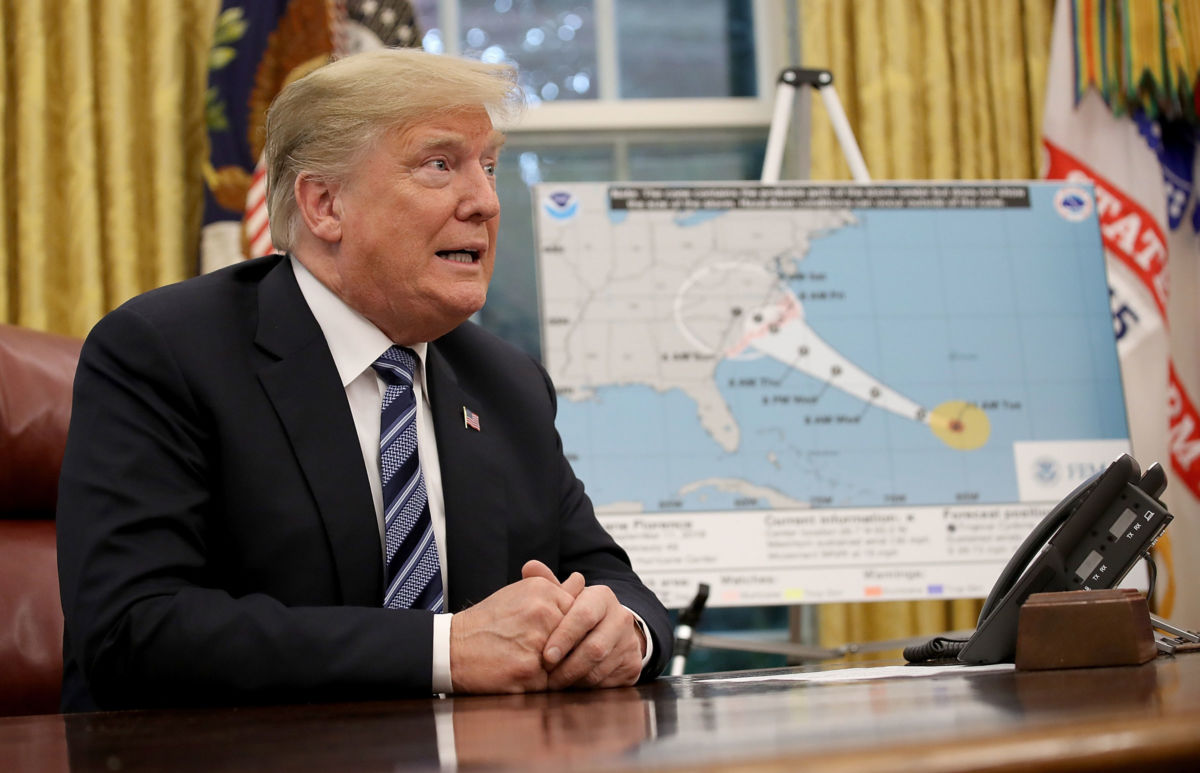
As he refuses to take action to combat the climate crisis, which scientists say is making extreme weather events more intense and devastating, President Donald Trump reportedly suggested deploying America’s vast nuclear arsenal to stop hurricanes from reaching the United States.
Axios reported Sunday that Trump asked, “Why don’t we nuke them?” during a hurricane briefing in the White House.
“They start forming off the coast of Africa, as they’re moving across the Atlantic, we drop a bomb inside the eye of the hurricane and it disrupts it. Why can’t we do that?” Trump said, according to Axios, which cited sources who heard the president’s remarks.
“Trump also raised the idea in another conversation with a senior administration official,” Axios reported. “A 2017 NSC memo describes that second conversation, in which Trump asked whether the administration should bomb hurricanes to stop them from hitting the homeland. A source briefed on the NSC memo said it does not contain the word ‘nuclear’; it just says the president talked about bombing hurricanes.”
In a tweet Monday morning, Trump called Axios‘s story “fake news” and said he never raised the idea of bombing hurricanes, which commentators described as “dangerously moronic” and “absolutely nuts.”
Donald J. Trump
✔@realDonaldTrump
The story by Axios that President Trump wanted to blow up large hurricanes with nuclear weapons prior to reaching shore is ridiculous. I never said this. Just more FAKE NEWS!
The National Oceanic and Atmospheric Administration (NOAA) has a page on its website dedicated to addressing the question, “Why don’t we try to destroy tropical cyclones by nuking them?”
“During each hurricane season, there always appear suggestions that one should simply use nuclear weapons to try and destroy the storms,” the page reads. “Apart from the fact that this might not even alter the storm, this approach neglects the problem that the released radioactive fallout would fairly quickly move with the tradewinds to affect land areas and cause devastating environmental problems.”
“Needless to say,” NOAA concludes, “this is not a good idea.”
Environmentalists were quick to ridicule the president’s reported suggestion and demand action to confront the climate crisis and protect vulnerable communities from extreme weather events.
“We cannot believe we have to say this but elected officials should get their climate policy recommendations from frontline communities and science, not the movie Sharknado,” tweeted 350.org. “What if instead of dropping nuclear bombs on hurricanes we just passed a Green New Deal and made fossil fuel billionaires pay for the devastation of climate disasters?”
President Trump’s pick for leading a climate change panel is notorious for denying the science behind human-caused global warming. We dive into the counter-arguments on climate change
.USA TODAY, Just the FAQs
BIARRITZ, France – President Donald Trump skipped a G-7 session focused on climate and biodiversity that was attended by other world leaders Monday.
When U.S. reporters were ushered into the working session on climate, biodiversity and oceans taking place at the G-7 they saw an empty chair where Trump usually sits. The rest of the G-7 leaders were present.
White House press secretary Stephanie Grisham said the president had other scheduled meetings “so a senior member of the administration attended in his stead.”
Trump has reportedly told aides that the meeting of world leaders has focused too intensely on climate and other environmental issues. White House officials have said the president wants the meeting to deal more with economic issues, and Trump pushed for and secured a session on Saturday focused on the global economy.
Trump has been at odds with other members of the G-7 specifically on climate after he announced in 2017 that the U.S. would formally withdraw from the Paris climate agreement. Then candidate Trump promised to withdraw the U.S. from the accord.
In a (clearly snarky) statement, Kielsen pointed out that Leifr “The Lucky” Eiríksson was the first European to settle America, and as a consequence Greenland has a prior claim on the country. “So it’s only natural for the Greenlandic nation to get USA back.”
Asked about the price, the premier said that they haven’t decided on a specific price yet, but that the vast debt of the US would be taken into consideration. And if Trump is included in the deal, then the price would be even lower.
I should make a point of note here that while everyone seems to want to claim Leifr for themselves (the US even celebrates his birthday as a means to celebrate its ties with Norway), Leifr was an Icelander. Although part of his childhood was spent in Greenland (and as an adult he spent a period working for the Norwegian court), he – like his father – was born in Iceland, at Haukadalrin in Breiðafjörður. Other contenders for the title of first in the sagas include Bjarni Herjólfsson, also an Icelander, and two anonymous men — also likely Icelanders. Iceland was not a part of Norway or any other country.
What I’m saying is, Iceland surely could put a bid on the US too. 😉 Hmm….
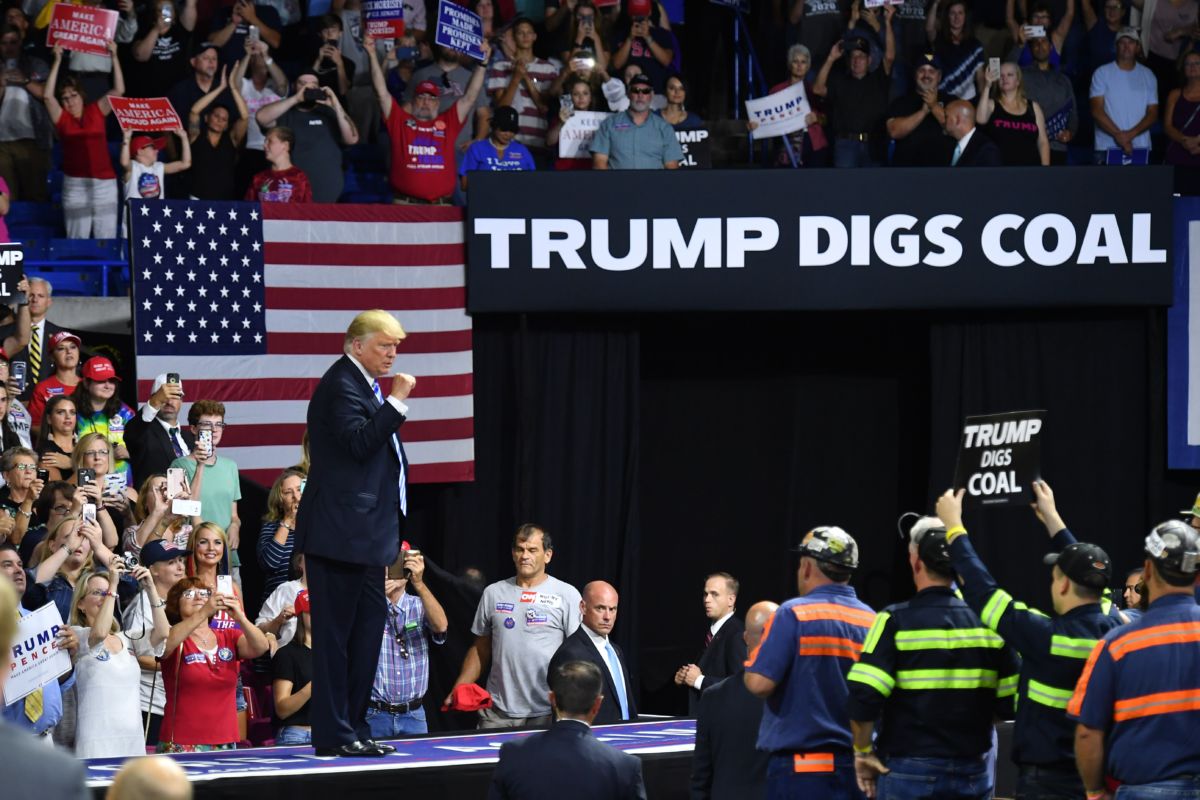
President Trump salutes his supporters at a political rally at the Charleston Civic Center in Charleston, West Virginia, on August 21, 2018.MANDEL NGAN / AFP / GETTY IMAGES
The Trump administration’s recent announcement of rule changes to the Endangered Species Act (ESA) will blow a hole through protections that have been crucial to preventing extinctions and to helping the recovery of many threatened species. The changes, announced by the Interior Department’s, Fish and Wildlife Service (FWS) and National Marine Fisheries Service, will take effect in September.
About 1,600 plant and animal species in the U.S. are listed under the ESA. It’s been estimated the ESA has prevented 227 species from going extinct. It has a 99 percent success ratio, meaning only 10 species ever listed have gone extinct. According to a recent study, 77 percent of once-endangered marine mammals and sea turtles protected by the ESA are now recovering. Without the ESA, it is very likely many iconic as well as many lesser-known species would have disappeared forever. Among others, the ESA is believed to have saved the bald eagle, the monk seal, the leatherback sea turtle, the grizzly bear, the gray wolf, the California condor, the snowy plover, and humpback and gray whales. It is also protecting plant, insect and other species that are vital parts of natural ecosystems.
These changes to the ESA will damage the act’s ability to protect species in a number of ways.
First, a blanket rule automatically extending endangered species protections to newly designated threatened species has been torpedoed. Only threatened species that have special rules set up for them will now receive the greater protections given to endangered species. States could now open hunting or trapping seasons or allow other means that kill off threatened species. Noah Greenwald, endangered species director of the Center for Biological Diversity (CBD), told Truthout that there is currently a backlog of around 500 species before the FWS under consideration for threatened status. As a result of the changes he said, “Threatened species really won’t have any protections at all” making threatened status an “almost meaningless designation.”
The new rules change the establishment of critical habitat that is crucial for the survival of threatened species.
If a species is impacted by climate change but not primarily by habitat destruction, the new rules won’t designate critical habitat, even though climate change-threatened species need more habitat protection, not less, Greenwald said. “The rules also make it harder to designate unoccupied habitat. So both of these things are very bad for climate change-impacted species because there’s a decent chance they’ll have to move.”
Unoccupied habitat is habitat not yet occupied by the species but that would be beneficial to a species and could help it survive if a species were forced to move, by say, climate change. Scientists have already documented the migration of species northward and to new habitats as a result of climate change, so the need for critical habitat designations isn’t just theoretical.
Greenwald pointed up the example of the wolverine. Only about 300 wolverines are estimated to be left in the wild in the U.S. They are dwindling, particularly as a result of climate disruption lessening mountain snowfall. Wolverines are currently up for a listing decision and are likely to be given threatened status but no designated physical habitat under the new rules. Greenwald says wolverines are affected by winter sports and things like ski resort development because they rely on spring snowfall at high elevations for denning. But since it’s hard to predict exactly how various habitats will be impacted by climate change, the animals are unlikely to be given critical habitat designation now by the FWS rule changes.
Environmental groups are also condemning the ESA changes because they remove language requiring that decisions on protecting species be based solely on science “without reference to possible economic or other impacts of determination.” The new rules allow economic calculations to be made in considering protection of species. This could open the door to weighing those costs against protecting a species. For instance, when deciding whether protecting a certain species threatened by logging of old growth forest is outweighed by the economic benefit of logging. FWS Assistant Director Gary Frazer insisted science would remain the sole basis of determining protections, but the whole attempt to weaken the ESA for many years (mainly by Republicans) has always sought to open the door to overrule protecting species in favor of big capitalist business interests like logging and fossil fuel extraction.
Trump officials are trying to cover over their true intentions by speaking of “updating” or even “improving” the Act. Interior Department head David Bernhardt, a longtime ESA opponent and advocate for coal and oil interests, now claims to just make the ESA more “clear and efficient” to “ensure it remains effective in achieving its ultimate goal — recovery of our rarest species.”
Jacob Malcom of Defenders of Wildlife doesn’t buy it. “They’re going to make these arguments because that’s the only way they’re going to have any traction in trying to defend them, but they’re simply not true,” he told Truthout.
Greenwald concurs. “They say they’re going to rely on the best scientific information in making their decisions but what’s the point of doing the economic analysis?” he told Truthout. Greenwald said these changes will also create pressure by large monied interests to list species as threatened instead of endangered, because they will get less habitat protection. Republicans in Congress like John Barrasso,who have conducted a years-long attempt to undermine and do away with ESA protections, also see these changes as a “good start” and a gateway to even more drastic gutting of the Act, while claiming to “update” and “strengthen” it.
Facing criticism for the rule changes, Trump officials have simply doubled down on their assault on species, denying endangered protections to six more species on August 14.
CBD, Earthjustice and the attorneys general of California and Massachusetts have announced they will go to court to stop the rule changes.
Extinction and the Larger Ecological Crisis
The assault on the ESA happens at a moment of global mass extinction and climate crises. It will further that crisis unless prevented.
“When we’re seeing this kind of crisis … we should be strengthening laws we know are effective at saving species,” Malcom told Truthout. “Instead, the Trump administration is doing the opposite. They are weakening the rules, making it easier for harm to happen to these species and ultimately to drive species closer to extinction.”
In May, the Intergovernmental Science-Policy Platform on Biodiversity and Ecosystem Services (IPBES) reported that up to 1 million species are threatened with extinction. The report said “nature is declining globally at rates unprecedented in human history — and the rate of species extinctions is accelerating, with grave impacts on people around the world now likely.”
According to the report, three-quarters of the land-based environment and about 66 percent of the marine environment have now been significantly altered by human actions, and land-based habitats have fallen by 20 percent. Approximately 40 percent of amphibian species, 33 percent of reef-forming corals and a third of all marine mammals are threatened. Scientists have also been finding evidence of a collapse of insects in certain places, leading to fears of an apocalypse at the base of the food chain.
About one-fourth of the global land area is “traditionally owned, managed, used or occupied by Indigenous Peoples.” And areas with large concentrations of Indigenous Peoples and many of the world’s poorest people are now “projected to experience significant negative effects from global changes in climate, biodiversity, ecosystem functions and nature’s contributions to people.” IPBES Chair Robert Watson said, “We are eroding the very foundations of our economies, livelihoods, food security, health and quality of life worldwide.”
The gutting of the ESA happens against a backdrop of other human-caused catastrophes that has been escalating with shocking rapidity and scope, this summer especially.
This July ranked as the hottest month ever recorded. An intense heat wave scorched the northern hemisphere, causing between 12 and 24 billion tons of Greenland’s ice to melt in a single day. Scientists said the melt was reaching levels climate models hadn’t predicted until 2070. In the Arctic, extremely hot temperatures and resulting drought set off massive wildfires that are visible from space. In vast regions of Siberia, the smoke got so bad that, mixed with dark clouds, it caused the sun to “disappear,” as also happened last summer. Now residents talk about this as the sun “going off.” Waters are so warm in some Alaskan rivers that salmon are literally being killed off.
The increased warming of the Arctic is causing a feedback loop releasing even more greenhouse gases by melting frozen permafrost. “Arctic permafrost isn’t thawing gradually, as scientists once predicted,” reports National Geographic. “Geologically speaking, it’s thawing almost overnight.”
If fossil fuel burning isn’t dramatically altered, in a few decades, emissions of carbon and methane from melting permafrost will contribute as much to greenhouse emissions as that of China, currently the world’s largest emitter. Meanwhile, in the Bering Sea, warming ocean waters are triggering ecological disaster, killing off seabirds, seals, walruses and whales at rates not seen before. Rick Thoman, a scientist with the Alaska Center for Climate Assessment and Policy, said at a public forum in Nome, Alaska, “We’re not approaching the cliff. We’ve fallen off it.”
Trump’s Multileveled and Criminal War on Nature
Given the cataclysm already engulfing the globe, emergency measures are needed to address the crisis.
Nothing like this is occurring, and in the U.S., Trump is instead barreling ahead in ways that will further destroy species and ecosystems to increase profitability for capitalism with what could rightfully be called life-destroying criminality.
A report in Scientific American details how the Trump administration is “torpedoing climate science.” Another report reveals that after meeting with Alaska Gov. Mike Dunleavy, Trump personally intervened with the Environmental Protection Agency (EPA) to force a withdrawal of opposition to the proposed Pebble Gold and Copper Mine that will likely devastate the habitat of the world’s richest and most pristine remaining salmon run, in Bristol Bay, Alaska. Trump’s Interior Department is also being exposed for suppressing science in an environmental assessment of drilling plans in the Arctic National Wildlife Refuge’s coastal plain. Government scientists warning of the likely damage to caribou, polar bears and Native communities are being disregarded.
And on another front, Trump’s EPA has continued to refuse to stop the use of dangerous pesticides that are killing endangered plants and animals, including important pollinators. In the case of the pesticide chlorpyrifos, which has been shown to cause neurological and developmental damage to humans and animals, the EPA reversed a ban on its use even though the agency knew it could jeopardize the existence of almost 1,400 endangered plants and animals.
In July, Trump gave a speech on what he claimed were the great achievements of his government on the environment, including how under him, the U.S. has the world’s cleanest air and water. However, as Brett Hartl, government affairs director of the Center for Biological Diversity told Truthout, “Since he’s been elected, the air has gotten dirtier, the water has gotten dirtier, the amount of enforcement of our environmental laws has dropped off a cliff so polluters are getting away with much more, and they’re cutting the science and the staff to do the basic research to monitor the air and water.”
The CBD has filed 151 lawsuits to date challenging the Trump administration’s moves that would cause damage to the environment, species and people. The scope of the CBD lawsuits is remarkable, and reviewing them is an excellent way to take in the awful reality of what the regime is attempting to do and the legal attempts to stop this. Hartl said that a number of the lawsuits and legal actions filed by CBD and others have met with success; for instance, blocking Trump moves to open up Arctic waters for drilling, stopping the Keystone XL Pipeline for a time, stopping construction of an open-pit copper mine in Arizona, and winning protected status for a number of species.
The Trump regime is not only a threat to endangered species, but to all species — including our own. Preventing mass extinction and addressing the climate crisis is a global imperative, and time is short.
Trump’s U.S. Environmental Protection Agency (EPA) has reversed a decision made last week to reauthorize the use of deadly cyanide traps used to kill wild animals that threaten agriculture, the Associated Press reported Thursday.
The traps, officially called M-44s but nicknamed “cyanide bombs,” are spring-loaded devices that kill their targets with a discharge of sodium cyanide, according to The Guardian. They are used by the U.S. Department of Agriculture’s (USDA) Wildlife Services to kill animals like foxes and coyotes that farmers and ranchers consider pests. But critics say that they cause long-term pollution and harm more than their intended targets, even killing pets and injuring humans, HuffPost explained.
“I am announcing a withdrawal of EPA’s interim registration review decision on sodium cyanide, the compound used in M-44 devices to control wild predators,” EPA Administrator Andrew Wheeler said in a statement released Thursday.
Kierán Suckling@KieranSuckling
Great News: Under withering public criticism, the @EPA today withdrew its August 10th approval of wildlife-killing cyanide bombs.
Feds killed 6,579 foxes, coyotes, bears, racoons, dogs, etc. with them in 2018; 13,232 in 2017. Decline due to suits by @CenterForBioDiv@wildearthguard@HumaneSociety requiring new federal review. https://www.nytimes.com/2019/08/10/us/cyanide-bombs-animals-trump-administration.html …
The agency’s decision last week to allow continued use of the traps until a study on their impacts was completed in 2021 sparked a firestorm of complaints. The Center for Biological Diversity (CBD) told HuffPost that 99.9 percent of all comments sent to the EPA about the traps opposed them.
“I’m thrilled that the EPA just reversed its wrongheaded decision to reauthorize deadly cyanide traps,” CBD Carnivore Conservation Director Collette Adkins said in a statement to HuffPost. “So many people expressed their outrage, and the EPA seems to be listening. I hope the feds finally recognize the need for a permanent ban to protect people, pets and imperiled wildlife from this poison.”
Predator Defense Executive Director Brooks Fahy also credited public outrage with the EPA’s reversal.
“Obviously somebody at EPA is paying attention to the public’s concerns about cyanide bombs,” Fahy said in a statement reported by The Guardian. “It would appear they’re responding to public outrage over the interim decision from last week. Our phone has been ringing off the hook from concerned citizens regarding their greenlight to continue using these horrific devices. We’ll have to see how this plays out.”
The traps are deadly to both their intended and unintended targets. Of the more than 1.5 million native wild animals killed by Wildlife Services in 2018, around 6,500 of them were killed by the traps. In 2017, the traps killed around 13,200 wild animals, the Associated Press reported.
In one tragic incident recounted by HuffPost, one of the traps went off in Pocatello, Idaho in 2017 while 14-year-old Canyon Mansfield was walking his dog Casey. Casey died, and Mansfield was rushed to the hospital. He eventually recovered, and his parents are suing the USDA.
Wildlife Services stopped using the traps in Idaho after the incident, and in Colorado following a lawsuit. Cyanide bombs are currently banned in Oregon.
Washington, DC August 13, 2019 – Under orders from the Trump Administration, the National Park Service is reviewing all hunting and fishing restrictions that are stricter than state game laws, according to documents obtained by Public Employees for Environmental Responsibility (PEER). The Department of Interior, the parent organization for NPS, has ordered that all federal hunting and fishing restrictions on Interior lands not anchored in statute be rescinded.
While hunting is banned in most national parks, some 76 of the total 419 NPS units allow some form of recreational, subsistence, or tribal hunting. However, the park units that do allow hunting, the largest of which are in Alaska, cover more than 60% of the national park system. At the same time, more than 85% of park units with fish (213 in all) are open to fishing.
In response to a September 2018 order from then-Interior Secretary Ryan Zinke, NPS and the other Interior agencies compiled their hunting and fishing rules that differ from state game laws. The NPS compilation lists 19 parks with hunting rules more restrictive than state hunting provisions and 32 park units with more restrictive fishing rules.
“National parks should not be reduced to game farms,” stated PEER Executive Director Tim Whitehouse, noting that state game rules are often designed to maximize state license revenue rather than protect wildlife populations. “The emerging pattern is Trump keeping federal lands while divesting federal management of those lands.”
The restrictions recounted by NPS serve a variety of conservation interests, such as –
Averting gunshot accidents near visitor centers and other high visitation developed areas;
Preventing introduction or spread of invasive species, by restricting use of live bait; and
Protecting wildlife from unsporting or excessive practices, such as hunting with dog packs on islands, baiting of bears and other wildlife, and use of certain traps.
The NPS is still analyzing these rules and has yet to rescind any. Meanwhile, Interior Secretary David Bernhardt is now touting as one of the key accomplishments of his tenure that the U.S. Fish & Wildlife Service will open to hunting and fishing or lift restrictions on 89 of its units – 75 national wildlife refuges and 15 national fishing hatcheries – for the 2019-2020 season.
“All this talk about empowering the field and having decisions made on the ground is proving to be pure baloney,” Whitehouse added, noting that PEER is tracking impacts from these mass rule relaxations. “Unfortunately, the Trump administration has reduced wildlife management to an ideological reflex, abdicating any stewardship of federal wildlife.”
Read NPS memo summarizing hunting and fishing rules
See parks with hunting restrictions
View parks with fishing restrictions
Look at the Zinke order
Scan repeal of hunting and fishing rules in 89 refuges and hatcheries
Examine repeal of Alaska park and refuge protections










 Exposing the Big Game