EPA investigates Utahn’s poisoning – 4 years after device shot cyanide in his face

This is an archived article that was published on sltrib.com in 2008, and information in the article may be outdated. It is provided only for personal research purposes and may not be reprinted.
Published January 18, 2008

The U.S. Environmental Protection Agency has begun an investigation into the poisoning four years ago of a Vernal man who touched what he thought was a survey stake, only to get a blast of sodium cyanide to his face and chest.

The cyanide device, called an M-44, is used by the federal government to kill predators. The poisoning has left Dennis Slaugh with severe health problems, his wife, Dorothy Slaugh, said Thursday.

And it has reignited a campaign to ban all predator poisoning on federal lands.

EPA investigator Michael Burgin visited the Slaugh home Monday for a two-hour meeting, which Slaugh said she taped with Burgin’s knowledge. The special investigator was looking into why federal agencies did not follow up on the Slaughs’ original reports, she said.

Democratic Rep. Peter DeFazio of Oregon pushed for the investigation at the request of Predator Defense, a national wildlife advocacy group based in Eugene, Ore.

“He has been a really good ally trying to get these weapons banned permanently so no one will have to suffer the way my husband has suffered,” Slaugh said of DeFazio.

Dennis Slaugh and his brother were riding all-terrain vehicles on U.S. Bureau of Land Management land in Cowboy Canyon near Bonanza in 2003 when Slaugh noticed what he thought was a survey stake. He reached to brush it off and it fell over. When he picked it up, it exploded, sending a cloud ofgranules into his nose, mouth and eyes.

The M-44 device was spring-loaded to shoot poison into a predator’s mouth. The U.S. Department of Agriculture’s Wildlife Services Program is the only agency allowed to use the M-44 to poison coyotes and dogs to prevent livestock loss.

But when the Slaughs told the USDA and the BLM about their experience, the agencies denied responsibility and eventually informed them the statute of limitations on the family’s claims had run out.

“We were just asking for compensation. We’ve got medical bills. They just flat denied everything,” Dorothy Slaugh said.

On Monday, she said, Burgin told her that time on the claim would run out in May.

Cyanide clings to iron in the blood system and slowly depletes the heart and other muscles of oxygen.

Dennis Slaugh, 65, has extremely high blood pressure, difficulty breathing, vomits almost daily and can no longer work as a Caterpillar D8 driver for Uintah County because he is too weak to climb up into the machine’s rungs.

The couple, avid ATV riders and campers, have owned Mountain High Power Sports in Vernal for 35 years. “We’re fine, we’re OK. It’s just taken a lot out of him,” Dorothy Slaugh said.

Brooks Fahy, executive director of Predator Defense, said his organization started the push to ban all predator poisoning on federal lands in 1994, when a woman was poisoned while trying to resuscitate her dog after the animal bit an M-44 a USDA employee had set on her private property at the request of a tenant farmer.

DeFazio has been an ally since then, Fahy said.

In late November, DeFazio prodded the EPA with a letter that Fahy said was “instrumental” in finally getting federal action on the Slaughs’ claim.

The congressman is sponsoring a bill in the House to ban all predator poisons.
Wildlife officials move forward to lift wolf protections

http://magicvalley.com/news/local/wildlife-officials-move-forward-to-lift-oregon-wolf-protections/article_dc880fff-7524-58d5-8d5d-53773be7428f.html

By Associated Press    April 25, 2015

 PORTLAND — Wildlife officials have moved forward with the process that could remove the gray wolf from the state’s endangered species list.

The decision Friday by the Oregon Fish and Wildlife Commission came as the number of wolves and breeding pairs have increased in the state. By 2014, there were 77 wolves in 15 known packs.

The state’s conservation goal was to have four breeding pairs for three consecutive years, a goal that was reached earlier this year.

The commission will look at two options: delisting the wolves statewide and partially, in eastern Oregon only. The option of not delisting also remains.

State delisting would not impact a federal endangered listing that includes the state’s western two-thirds.

Commissioners will draft a proposal by June and vote on it in August.

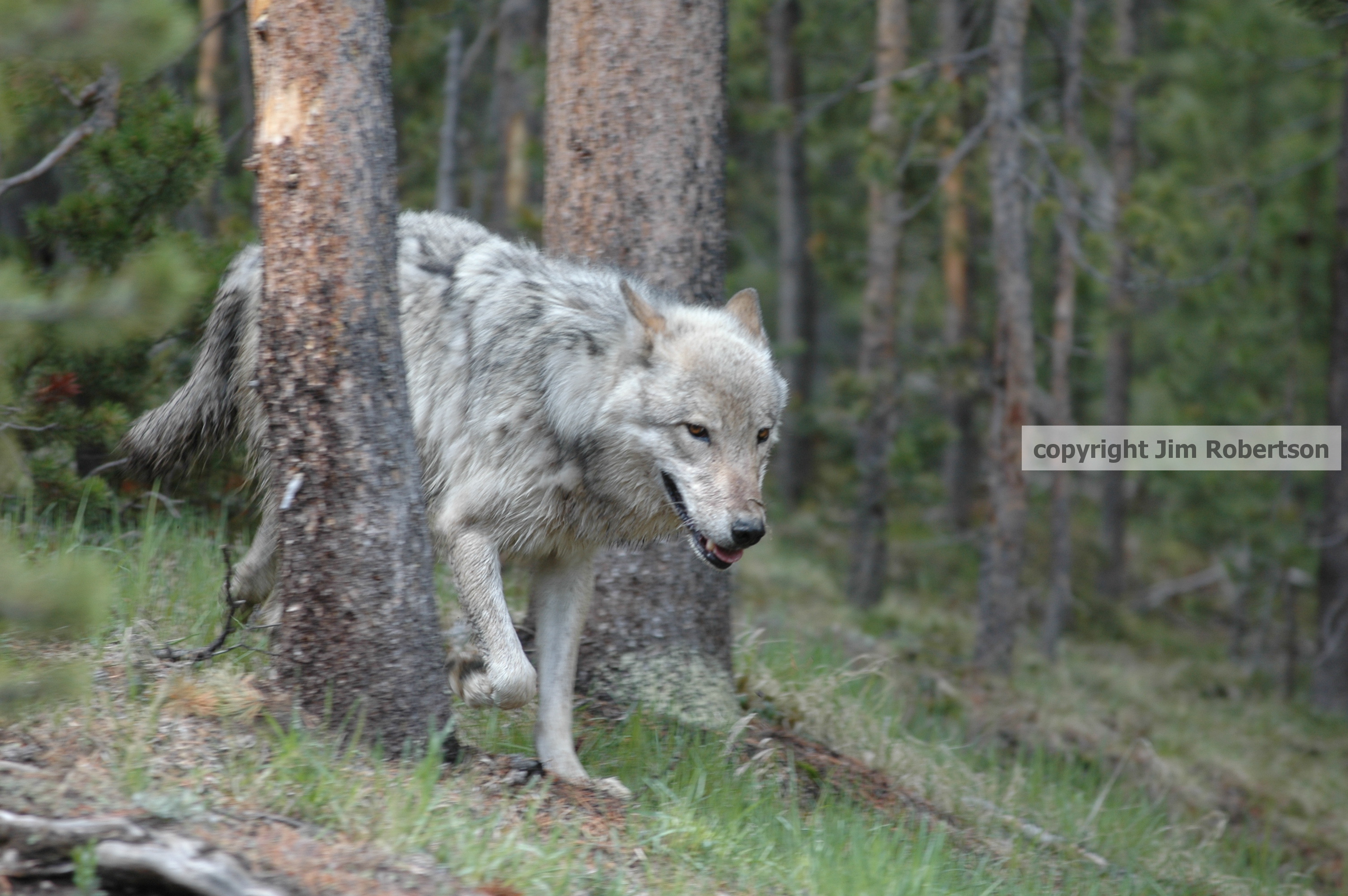
copyrighted Hayden wolf walking

Bill Proposed to Remove Wolf Protection in UT, OR, and WA

http://newsradio1310.com/bill-proposed-to-remove-wolf-protection-in-ut-or-and-wa/

YAKIMA, Wash. (AP) — Republican U.S. Rep. Dan Newhouse has introduced a bill to remove the gray wolf from Endangered Species Act protections in Washington, Oregon and Utah.

The freshman lawmaker says removing wolves from the list is “long overdue” and would allow state wildlife officials to manage wolves more effectively.

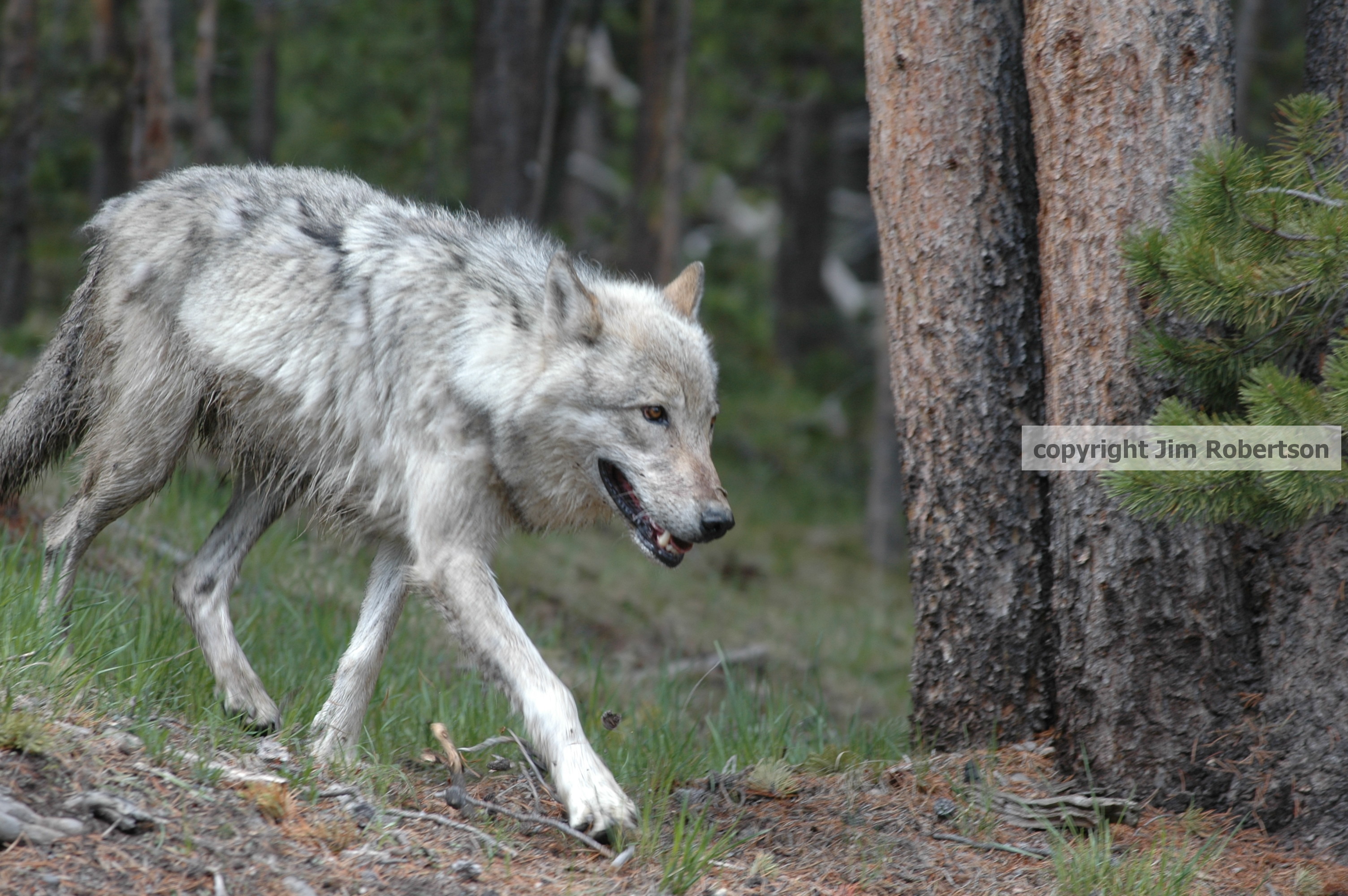
The Yakima Herald-Republic reports his bill would also prevent states fromcopyrighted Hayden wolf in lodgepoles providing protections to wolves that are stronger than those found in the federal Endangered Species Act.

A spokesman for Conservation Northwest, which works on wolf recovery issues, calls the bill disappointing. Chase Gunnell says there are only a few wolves receiving federal protection in Washington and Oregon

Read More: Bill Proposed to Remove Wolf Protection in UT, OR, and WA | http://newsradio1310.com/bill-proposed-to-remove-wolf-protection-in-ut-or-and-wa/?trackback=tsmclip


Lessons From the Brief, Lonesome Life of Echo the Wolf

by Shelby Kinney-Lang

February 18, 2015 at 8:40
Photo from the Arrizona Game and Fish Department shows the wolf spotted on the Kaibab Plateau

Even true stories about wolves sound like fables.

Last October, an animal appearing to be a gray wolf showed up on the Kaibab Plateau in Arizona, just north of the Grand Canyon National Park. At first, no one was sure what, exactly, the “wolflike animal” was, but if, as suspected, it was a gray wolf that had migrated from the northern Rockies, it would have been the first time since the 1940s one had set foot in the Grand Canyon. Although there were once an estimated 2 million gray wolves across the continent, humans hunted and poisoned them to the point of oblivion. But thanks to federal protections under the Endangered Species Act (ESA), since the 1970s, gray wolf populations have slightly rebounded. After reintroducing 60 Canadian wolves in Yellowstone in 1995, the U.S. Fish and Wildlife Service (FWS) estimate their population is now up to about 1,500 animals across Montana, Idaho, and Wyoming.

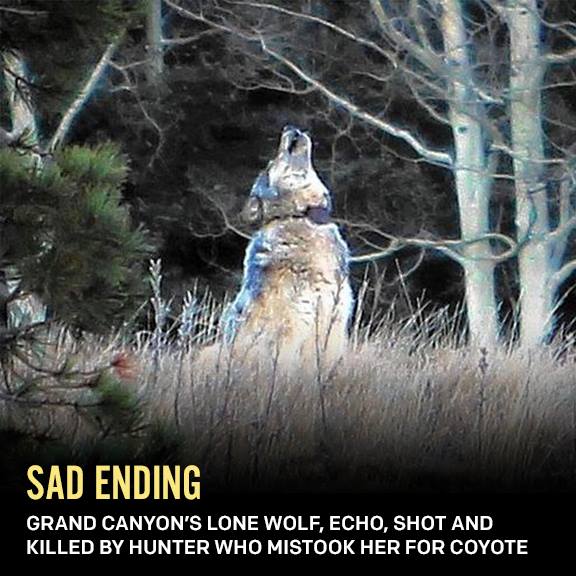
People reported sightings of the Grand Canyon creature through November and December and heard her howls across the forest. Scientists analyzed her poop and confirmed it: she was a gray wolf from the northern Rockies, 450 miles north, first collared near Cody, WY in January 2014. The itinerant, lonesome wolf seized the imagination of the nation and then the world. In a contest for school children, she was given the nickname “Echo.”

In late December, a hunter shot and killed a wolf near Beaver, Utah, thinking it was a coyote. (The state of Utah permits bounty hunting for coyotes, $50 a head.) Federal agencies refused to say whether the dead wolf was the same one from the Grand Canyon.

That is, until last week. Genetic testing by the FWS confirms Echo was shot dead.

More: http://magazine.good.is/articles/death-of-echo-the-grand-canyon-wolf

It’s Official: Wolf Killed in Utah Was Animal From Rare Arizona Sighting

http://abcnews.go.com/Technology/wireStory/mistakenly-killed-wolf-animal-rare-arizona-sighting-28890684

A gray wolf that was shot by a hunter in Utah was the same one spotted in the Grand Canyon area last year, federal wildlife officials said Wednesday.

The 3-year-old female wolf — named “Echo” in a nationwide student contest — captured the attention of wildlife advocates across the county because it was the first wolf seen in the Grand Canyon in 70 years.

The U.S. Fish and Wildlife Service did DNA tests to confirm the wolf killed in late December by a Utah hunter who said he thought he was shooting a coyote was the same one that was seen roaming the Grand Canyon’s North Rim and nearby forest in October and November, said agency spokesman Steve Segin.

Geneticists at the University of Idaho compared DNA taken from the northern gray wolf killed in southwestern Utah with scat samples taken from the wolf seen near the Grand Canyon last fall.

The hunter who killed the wolf called Utah state officials in December and said he mistook the wolf for a coyote, said Utah Division of Wildlife Resources spokesman Mark Hadley. The man, whose name was not released, said he didn’t realize his mistake until he came up on the dead animal. In Utah, anybody can hunt coyotes.

The state handed over its initial findings of what happened to U.S. Fish and Wildlife, Hadley said. That investigation is ongoing and could take weeks or months to complete, Segin said. It’s not clear yet what penalties the hunter could face for killing the animal.

Wolves are protected in Utah under the Endangered Species Act.

Wildlife advocacy groups have called the wolf’s death heartbreaking and say they want the hunter prosecuted. They said the animal could have helped wolves naturally recover in remote regions of Utah and neighboring states.

“Wolves and coyotes are distinguishable if one pauses for a second before pulling a trigger,” said Michael Robinson with the Center for Biological Diversity. “There are consequences for pulling the trigger when you don’t know what you’re aiming at. It’s important to have justice for this animal.”

Wolves and coyotes often have similar coloring, but wolves are usually twice as large as coyotes, said Kim Hersey, mammal conservation coordinator with Utah Division of Wildlife Resources. Wolves also have longer legs, bigger feet and rounder ears and snouts, she said.

But, Hersey says how well a person could distinguish between the two would depend on the lighting, the distance and how much experience a hunter has comparing the two animals.

The wolf had worn a radio collar since January 2014.

Wolves can travel thousands of miles for food and mates. Gray wolves had been spotted as far south as Colorado until the Arizona wolf was confirmed. Gray wolves last were seen in the Grand Canyon area in the 1940s.

In recent years, the Fish and Wildlife Service lifted protections for the wolves in the Northern Rockies and western Great Lakes. But a federal judge recently reinstated the protections after wildlife advocates in Wyoming sued.

The Center for Biological Diversity has documented 11 cases since 1981 where hunters told wildlife officials they had shot a wolf thinking it was a coyote.

10906075_10155034869550301_2511370178161460178_n

Wolf populations in Northern Rockies states Down 6%

April 5, 2014 by 

Associated Press

Gray wolf numbers in the Northern Rockies have declined about 6 percent from 2011, according to the U.S. Fish and Wildlife Service. Congress removed the wolves from the federal endangered species list in 2011. A state-by-state breakdown of year-end 2013 minimum wolf count and percentage change over two years:

–Idaho: 659 wolves; down 14 percent

–Montana: 627 wolves, down 4 percent

–Oregon: 61 wolves; up 110 percent(asterisk)

–Utah: 0 wolves; no change

–Washington: 38 wolves; up 46 percent(asterisk)

–Wyoming: 306 wolves, down 7 percent

–NORTHERN ROCKIES TOTAL: 1,691 wolves; down 6 percent

(asterisk)includes wolves only in eastern portion of state

Source

copyrighted wolf in river

No Surprise: Utah Farm Bureau urges delisting of wolves

528624c939a88_preview-620

http://www.heraldextra.com/news/local/utah-farm-bureau-urges-delisting-of-wolves/article_9c0648fa-a703-5f47-9bbe-be1d55a5400b.html

by Caleb Warnock

“The Endangered Species Act, if you look at the numbers, is a colossal failure,” said Leland Hogan, president of the Utah Farm Bureau Federation, in the latest issue of Utah Farm Bureau News magazine.

There are no wolves in Utah, but that doesn’t put a damper on the debate over their potential future in the state, should they ever appear here.

The federal government has oversight of all gray wolves in the U.S. because they are listed as endangered species. Now the feds are proposing to delist gray wolves and turn their management over to states, which in Utah would likely make it legal to shoot wolves, should they cross the border.

Because wolves prey on livestock, there is no love lost between the creatures and the Farm Bureau.

There has only been a single confirmed wolf sighting in Utah’s modern history. On November 30, 2002, a wolf from Yellowstone’s Lamar Valley was captured in Morgan County and returned to Yellowstone.

Since that day, there “have been a few border incursions, as extreme northern Utah is not far from Wyoming wolf range,” said John Shivik of the Division of Wildlife Resources, who oversees the management of large predators in Utah. “There is no evidence, however, that wolves have taken up residence in Utah.”

Hogan and the Farm Bureau are calling the Endangered Species Act a waste of taxpayer cash. In the UFB article, he calls wolves both “sinister” and “marauding.”

“Since its enactment in 1973, only about 20 out of nearly 2,000 endangered or threatened species — about 1 percent of the total — have been declared recovered, despite spending hundreds of millions of taxpayer dollars,” said Hogan in UFB magazine. “The draft rule being proposed by the agency would remove the gray wolf from the Endangered Species List in the continental 48 states and turn over wolf management to the states. We support the Service’s proposal to delist the gray wolf; however, we do not support listing the Mexican wolf as an endangered subspecies. In addition, Utah Farm Bureau calls on the federal government to turn management of wolves to the states.”

The Farm Bureau is not alone in its ideas for wolf management. The leadership of the Utah Division of Wildlife Resources, Gov. Gary Herbert and Utah’s congressional delegation “have repeatedly requested delisting throughout Utah,” said Shivik.

As for the Mexican wolf, their “core population did not range farther north than central Arizona and New Mexico, and Utah maintains that Mexican wolf recovery areas should not include any parts of Utah,” Shivik said.

The Mexican wolf is a unique subspecies that occurred in Mexico and parts of the southwestern United States.

Even when wolves are sighted in Utah, the state maintains some skepticism, based on experience.

“Coyotes and domestic dogs are often confused with wolves on the landscape, especially after news reports cause interest in the subject,” said Shivik. “Some people have hybrid or domestic dogs that very strongly resemble wolves, which adds to the confusion too. Division biologists receive hundreds of reports every year, but less than 3 percent are even potentially wolves.”

So if you think you saw a wolf, should you, well, cry wolf?

“If it is near a town, or not particularly afraid of humans, it may be best to call the local animal control officers,” said Shivik.

Utah hunting group reports death threats after supporting hunter who posed with lion

http://www.foxnews.com/us/2013/11/27/utah-hunting-group-claims-death-threats-after-supporting-hunter-who-posed-with/

Published November 27, 2013/
FoxNews.com

The leader of a pro-hunting group in Utah said he has received death threats from animal rights advocates after voicing support for a hunter who posted a picture of herself earlier this month smiling next to the carcass of a male lion during a hunting trip to South Africa.

Jason Fackrell, the founder of Hunters Against PETA, told KSL.com that one comment said, “I wish to have some money to kill you myself.” Another comment, the station reported, talked about killing Melissa Bachman, the hunter who posted the picture.

Fackrell described the torment he faced. He said he had to move, had his contact information posted online by hackers and has seen family members threatened in the past.

He expressed his dismay that about “90 percent of the population eats meat, but it’s OK to threaten the life of a human being that kills an animal.”

He has not reported the recent threat to the FBI, the report said. But highlighted what he sees as a double standard.

“I’ve never seen hunters threaten the lives of animal rights activists because they don’t like hunting, so there definitely is a double standard.”

PETA responded to KSL.com’s report and said it opposes violence. The report noted that PETA is not connected to the alleged threats on Fackrell.

Meanwhile, more than 375,000 people signed a petition to ban Bachman, the host of “Winchester Deadly Passion,” from gaining entry again into South Africa.

trophy

Some in Utah Welcome Wolves

http://www.sltrib.com/sltrib/opinion/56862219-82/wolves-friend-nature-peace.html.csp

Letter: Welcome wolves

First Published Sep 14 2013 01:01 am • Last Updated Sep 14 2013 01:01 am

Re “Wolves need protection to fully recover” (Opinion, Sept. 7): I wish to thank authors Peter Metcalf and Doug Tompkins for their timely commentary in support of keeping wolves protected under the Endangered Species Act.

No other creature has been more reviled or ruthlessly persecuted than the wolf; or for so little reason. Wolves are nature’s police force. They keep prey species fit and ecosystems healthy. In a deep sense they are the best friend that deer and elk ever had because they are partners in the dance of evolution.

I find it fascinating that the domestic dog, human beings’ best friend, is loved above all other animals, while its progenitor the wolf is feared and hated more than all other animals. Surely this reveals more about people’s insecurities than it does about wolves.

To make peace with wolves is to make peace with nature, and so also with ourselves. Utah wants wolves. Let’s not shut the door on them. Let’s welcome them back home.

Kirk Robinson

Salt Lake City

Hunter gores himself on antler of elk he killed

It’s not like you have to search for these type of articles on hunting accidents–they’re in the news every day. This was sent to me by an alert reader who saw the elk as the ultimate victim of the one-sided sporting event.

Even the Associated Press saw the potential for divine justice here, opening their story with the line:

An elk slain in Utah had its last revenge when its antler punctured

Wildlife Photography ©Jim Robertson, 2013.

Wildlife Photography ©Jim Robertson, 2013.

the neck of the hunter who’d brought him down.

The Associated Press

VERNAL, Utah —
An elk slain in Utah had its last revenge when its antler punctured the neck of the hunter who’d brought him down.

The Salt Lake Tribune reports (http://bit.ly/15L3B5p ) the 51-year-old hunter snagged the elk Saturday east of Vernal.

Uintah County Undersheriff John Laursen says the man was trying to roll the 600- to 700-pound animal over when the antler stabbed him behind his jaw.

Deputies say the hunter called for help and told dispatchers he was having trouble breathing.

Rescuers airlifted the man to the hospital, and crews put a tube into his trachea to keep it open.

Laursen says the hunter was later flown to a different hospital for surgery, and was expected to make a full recovery.

Information from: The Salt Lake Tribune, http://www.sltrib.com