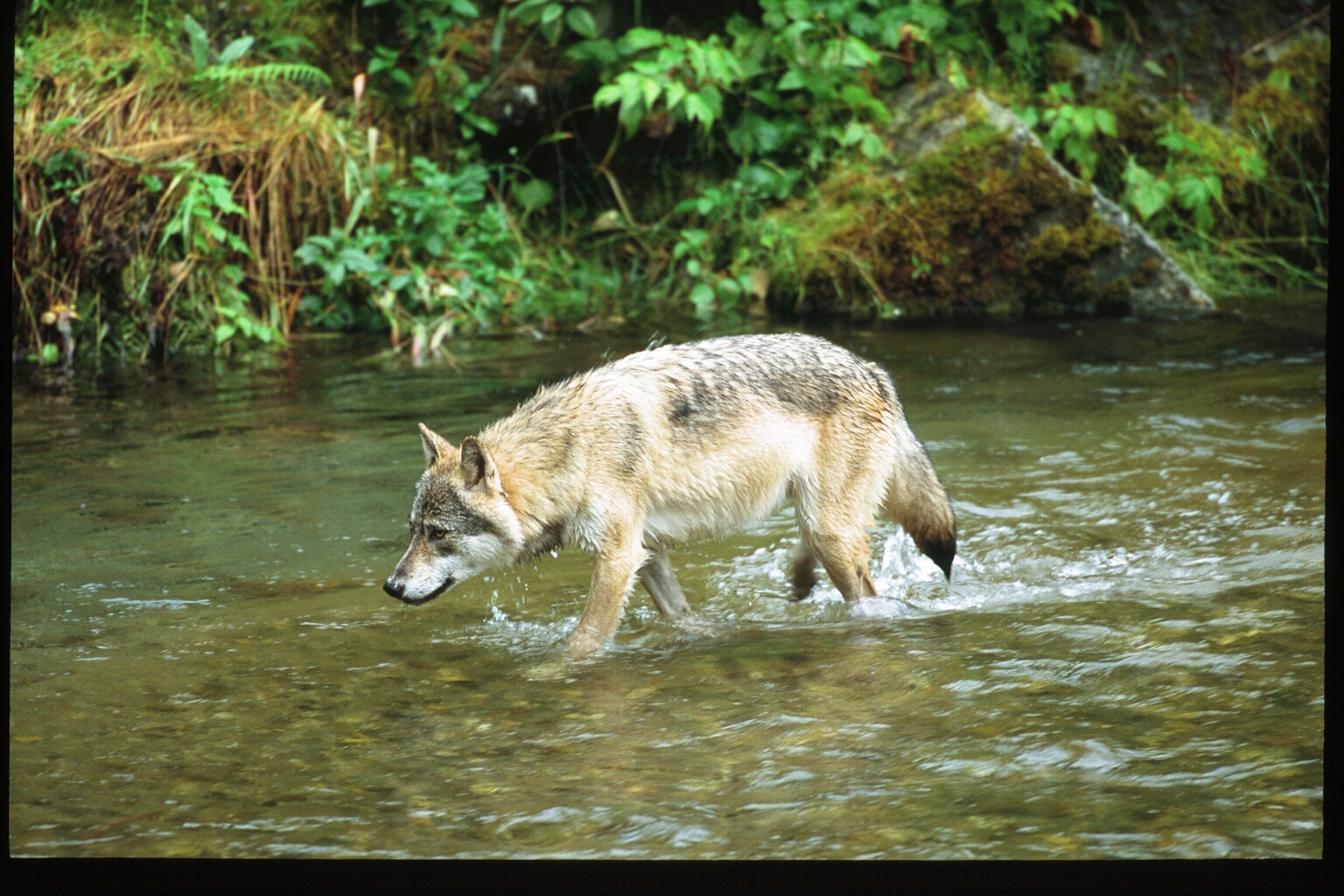
Salt Lake Tribune Extols Value of wolves

http://www.sltrib.com/sltrib/opinion/56437820-82/wolf-gray-wolves-management.html.csp

Value of wolves

Feds must maintain some oversight

Jun 10 2013

The image of the government declaring “Mission Accomplished” is etched in Americans’ minds, and not in a good way. Just as former President George W. Bush was wrong when he made that announcement about the Iraq war, the feds might well be wrong in declaring the gray wolf no longer in need of protection in the West.

The U.S. Fish and Wildlife Service says the mission of recovering populations of the gray wolf, which once roamed throughout the United States, has been successful, and the top predator can now fend for himself. Considering that the illogical and irrational attitudes toward the wolf that resulted in its extermination in the West nearly a century ago remain, the agency may be acting too soon.

The FWS has concluded the current number of gray wolves in the lower 48 states no longer qualifies it for listing under the Endangered Species Act, but rightly recommended the Mexican gray wolf remain listed as an endangered subspecies.

The FWS will open a 90-day comment period on the proposal to seek additional scientific, commercial and technical information.

Advocates for delisting the wolf say management decisions should be made at the state level, not by federal agencies, now that the reintroduction process is complete. The problem with state-level decisions is that in the minds of many officials, “management” of the wolf is synonymous with “eradicating” the animal. For example, Wyoming’s proposed management plan essentially allowed anyone to shoot any wolf on sight for any reason. That’s not management.

Maintaining wildlife populations for human hunters and protecting livestock are the primary objectives of most local officials and ranchers, who still see the wolf as, at best, an unnecessary nuisance, and, at worst, an evil demon bent on wiping out whole herds of cattle and sheep. In reality, wolves improve the ecosystems they share with elk, moose and deer, as scientific research has shown in the greater Yellowstone ecosystem since their reintroduction.

Ranchers are compensated for livestock predation by wolves under the Endangered Species Act. Will that compensation be continued if the predators are delisted? If not, and even in some cases if so, it will be open season on wolves wherever livestock graze.

The recovery of the gray wolf in the West is a dramatic success story. When the animal is delisted as an endangered species, the federal government should continue to monitor its management by states, or it could disappear once again.

Wildlife Photography Copyright Jim Robertson

Wildlife Photography Copyright Jim Robertson

Utah Leads the Pack of Anti-Wolf A-Holes

Before news of a full federal wolf delisting even came off the presses, anti-wolf assholes from the wolfless state of Utah are front and center, spouting their bullshit lines to the press. And the feeble-minded mainstream media are gobbling it up…

In an article just out entitled, “Feds want to remove gray wolf from endangered species list,” Salt Lake City’s Desert News opened with the cutesy lead-in: “Top Utah politicians are howling with delight over a federal proposal to remove the gray wolf from protections under the Endangered Species Act, while advocates are growling in disgust.”

Followed by a quote from Sen. Orrin Hatch, R-Utah, “I appreciate the Fish and Wildlife Service hearing our concerns and making this right decision…An unmanaged wolf population threatens livestock and native wildlife, and threatens our communities. I know that our wildlife managers in Utah and throughout the West are fully capable of managing the wolf populations in a way that benefits all.”

That benefits “all”? What about the wolves? Or wolf advocates? Bob Brister with the Utah Environmental Congress was quoted next, trying to counter the senator’s hype:

“We are deeply disappointed with the Obama administration’s decision to delist the gray wolves in the West. State wildlife management agencies have proven to be either incapable or disinclined to manage wolves in an ecologically responsible and humane way.”

Another Utah anti-wolf fanatic, Rep. Rob Bishop, R-Utah, said the decision by the agency is long overdue. “For quite some time, the gray wolf has been ‘recovered’ and the issues with their being listed as an endangered species has limited states from employing responsible management practices, thus allowing the wolves to terrorize public land users and other animal species.”

If the agency ultimately chooses to delist the wolf, management of the species will be rightfully put in the hands of the states, Bishop said.

“I am pleased that states will now be able to actively manage the gray wolf population in a way that is beneficial to the wolf population as well as public land users, the sportsmen’s community, and all those whose livelihoods have been impacted by the current listing,” he said.

[Again, how does active “management” benefit wolves?]

Brister, however, said the decision makes no sense, especially given that Utah has no verified wolf population.

“We have been campaigning for the last three years to get the wolves back into Utah, so this is very disappointing to us,” he said.

The service will have a 90-day comment period on both of its proposals, but the date has not been determined.

___________

You can read the full article here: http://www.deseretnews.com/article/865581317/Feds-want-to-remove-gray-wolf-from-endangered-species-list.html

Stay tuned to this blog for a updates on the public comment period…

copyrighted-wolf-argument-settled


6,000 coyotes killed in Utah’s bounty program

“Can they demonstrate that the bounty hunt actually helped boost mule deer populations? I think they’d be hard pressed to show this.” –- Camilla Fox, executive director, Project Coyote

Take the poll: http://www.ksl.com/?sid=25052737&nid=148&fm=most_popular&s_cid=popular-4
Are coyote bounties a good thing for Utah?
Results so far:
1. Yes 67% (3218)
2. No 33% (1573)
Total Votes: 4791

6,000 coyotes killed in Utah’s bounty program
By Grant Olsen, ksl.com Contributor May 6th, 2013

SALT LAKE CITY — More than 6,000 dead coyotes have been redeemed by hunters since Utah’s Division of Wildlife Resources launched its coyote bounty program last September.

The DWR hopes its ambitious plan will eliminate a significant portion of the state’s coyote population, which in turn will benefit the deer herds on which they prey. Officially known as the Predator Control Program, the incentive-based program pays hunters $50 for every coyote they kill.

Other states have implemented bounty programs over the years, but rarely on this scale. Even the New York Times has taken note of Utah’s Predator Control Program, calling it “one of the nation’s largest hunter-based efforts to manage predatory wildlife.”

John Shivik, mammals coordinator for the Division of Wildlife Resources, is proud of how his team worked together to start the Predator Control Program from scratch and get it “up and running so quickly.”

While few can argue that the Predator Control Program enjoyed a smooth launch, the effect it has had on wildlife is debatable. Camilla Fox, executive director of Project Coyote, says that the Predator Control Program is “ecologically reckless, economically unjustifiable and ethically reprehensible.”

According to Fox, most government agencies acknowledge that coyote bounties are not only ineffective at reducing coyote populations, but are often counterproductive. She asserts that decades of research suggests that the systematic killing of coyotes increases reproduction, immigration and survival.

Dr. Robert Crabtree, founder of the Yellowstone Ecological Research Center, agrees with this perspective. “It cannot be over-emphasized how powerfully coyote populations compensate for population reductions,” he says.

Fox maintains that there is “no science that demonstrates that bounty programs are effective at reducing coyote populations over the long-term.” She questions the DWR’s methods and how it will measure the program’s success. “Can they demonstrate that the bounty hunt actually helped boost mule deer populations? I think they’d be hard pressed to show this.”

According to Shivik, the DWR has been “collecting what looks like it will be excellent data to help us evaluate how effective our efforts are.” He says it’s too early to assess the program’s impact and that the biggest challenge his team faces is identifying the deer populations that are most affected by coyotes, because the DWR is “trying to be as efficient and effective as possible with our resources.”

The topic of resources brings up another criticism that bounty programs often face — that they are susceptible to fraud. When all that is required for a payout is portions of a carcass (such as paws, jaws or ears), it’s difficult for authorities to be sure the coyotes weren’t killed in other parts of the country. The DWR attempts to address this by requiring hunters to document the date and location of each kill before paying a bounty, but critics point out that the information could easily be fabricated.

An example of this kind of fraud reportedly occurred in Canada when Saskatchewan offered a coyote bounty. To collect the $20 bounty, hunters were required to remove the paws from every coyote killed and give them to authorities. As a result, piles of dead coyotes were found in other parts of the country with their paws cut off. More than 70,000 coyotes were killed as part of Saskatchewan’s bounty program and it’s impossible to know how many were killed elsewhere and then illegally redeemed in the province.
Fox points to these past problems as proof that bounty programs are a waste of money. “These programs are very often fraught with illicit activity,” she says. “I would ask: How many of the coyote body parts turned in for the $50 bounty were actually killed in other states?”

Despite these lingering questions, Utah’s Predator Control Program has received enthusiastic support from many local hunters. You can learn more about the program and register for the bounty by visiting the official website at http://www.wildlife.utah.gov/predators.

Wildlife Photography ©Jim Robertson, 2013.

Wildlife Photography ©Jim Robertson, 2013.

How Much Are WE Willing to Tolerate?

For the first decade or so after their reintroduction to Yellowstone and central Idaho in 1996, the Federal Endangered Species Act safeguarded wolves from overzealous hunters and trappers, but as the director of the USFWS pointed out, the ESA is “not an animal protection act.” Blanket protection of any non-human animal goes against the grain of our political agencies, which are ultimately only answerable to the one species with the any hope of representation—Homo sapiens.

The right of an American species not to be hunted to extinction is a relatively new advancement. At present, it‘s about the only right extended to the nonhumans in this, the land of the free. Now that wolves are off the Endangered Species list in any state with even a minor population, the feds plan to remove them from the U.S. list completely, casting any pioneering individual or would-be wolf pack to the mercy (or lack thereof) of whichever state is fortunate enough to be graced by their presence.

An organized bunch of thugs, anti-wolf fanatics have been on point, lying in wait for the day wolves lose all protection and are deemed “fair game” for their killing pleasure. Lately a deceptively named hate-group calling itself “Big Game Forever” has been luring Utah state funds away from essentials such as schools and into their anti-wolf agenda. Just recently they leached $300,000 for their campaign against wolves in that currently wolf-less state.

Others, such as South Dakota, have hastily re-classified wolves from the status of protected to “varmint,” in the event that any lost wolf happens by. Even “progressive” Washington state jumped on the bandwagon, allowing people to kill wolves without permit and changing the wolf’s status to “big game,” ahead of their anticipated complete removal from federal ESA protection.

A classic example of what will happen the minute wolves lose federal protections was made clear yesterday as Washington state lawmakers approved “Emergency Rule WAC 232-36-05100B Killing wildlife causing private property damage” which includes the following provisions:

1) An owner of domestic animals, including livestock, the owner’s immediate family member, the agent of an owner, or the owner’s documented employee may kill one gray wolf (Canis lupus) without a permit issued by the director, regardless of its state classification, if the wolf is attacking their domestic animals.

(a) This section applies to the area of the state where the gray wolf is not listed as endangered or threatened under the federal endangered species act.
(b) Any wolf killed under this authority must be reported to the department within twenty-four hours.
(c) The wolf carcass must be surrendered to the department.
(d) The owner of the domestic animal must grant or assist the department in gaining access to the property where the wolf was killed for the purposes of data collection or incident investigation.

(2) If the department finds that a private citizen killed a gray wolf that was not attacking a domestic animal, or that the killing was not consistent with this rule, then that person may be prosecuted for unlawful taking of endangered wildlife under RCW 77.15.120.

The “Emergency Rule” is bad enough as it stands, but if ESA wolf protections are lifted nationwide (as is currently planned), points (1a) and (2) will be moot—there won’t be any area of the state safe for wolves, nor any “endangered wildlife” designation to discourage poaching. This is why the wolves, though arguably “recovered” in some areas, need to remain under federal ESA protection nationwide.

We can’t let them lose what little protection they still have in this country. While the U.S. Fish and Wildlife Service forge ahead with their plan for full removal of wolves from the ESA, we need to continue to press our new Interior Secretary Sally Jewell for both their continued protection as well as the re-listing of wolves in those states where out-of-control culling is driving them back to the brink of oblivion.

Washington’s “emergency” rule was crafted in response to a letter from ten state legislators urging their Fish and Wildlife Commission to act quickly “to maintain social tolerance for gray wolves in northeast Washington in the timeliest manner for residents.”
Hmm, killing wolves to “maintain tolerance,” where have I heard that before? Oh that’s right, it was from wildlife snuff film producer and wolf-hunter Randy Newberg who told NPR News that wolf hunts in Wyoming, Montana and Idaho are easing the animosity many local people feel toward the predator. “Having these hunting seasons has provided a level of tolerance again,” Newberg told NPR.

Let me get this straight, in order to placate and appease good ol’ boys and get them to put up with the presence of one of North America’s most historically embattled endangered species, we have to let them kill some of them once in a while? Wolf hunting and trapping are just a salve—a bit of revenge-killing for them–why not let them have their fun? By this logic, they should also be entitled to shoot an Indian every so often (like their forefathers who tried to wipe them out), to help promote tolerance and social acceptance.

It’s time to remind our politicians that the wolf-killing Calvary is about as outnumbered by those of us who appreciate wolves as General Custer was at the Battle of Little Bighorn.

What’s happening now in Washington is just how it started out in other states whose wolf-killing policies are now completely out of control. Washington wolf proponents need to realize that their wildlife policy-makers will continue to up the ante each time we accept the new status quo.

The question is, how much of a wolf-kill massacre are we willing to tolerate before we go on the warpath?
Text and Wildlife Photography ©Jim Robertson, 2013. All Rights Reserved

Text and Wildlife Photography ©Jim Robertson, 2013. All Rights Reserved
Don’t Let Orrin Hatch His Evil Plan

It appears certain U.S. Legislators won’t be satisfied until wolves in America are a thing of the past once again . An article entitled “Hatch, fellow senators petition to end gray wolves’ protected status” in ksl news, Utah, begins:

Led by Utah Sen. Orrin Hatch, 72 senators and representatives formally asked the U.S. Fish and Wildlife Service Monday to delist the gray wolf from the Endangered Species Act. The request in a letter sent to the agency argues that the gray wolf is no longer an endangered species and that uncontrolled gray wolf population growth is a threat to other indigenous wildlife as well as the hunting and ranching industries.

It’s almost laughable that Senator Hatch and his cronies expect us to believe they suddenly care so much about “indigenous wildlife” since—if allowed to hatch—Orrin Hatch’s half-baked, half-witted plan to delist wolves would effectively seal the fate of one the countries most endangered native species.

According to their letter, “State governments are fully qualified to responsibly manage wolf populations…” Sorry senators, nothing we’ve seen so far backs that statement up; it’s simply not true. Now, if the quote was “State governments are fully qualified to irresponsibly wipe out their wolf populations,” then I’d have to agree.

Sixty-five Republicans and seven Democrats signed the Hatch’s evil anti-wolf plan, including every congressman from Utah.

Wednesday’s official request was in response to a March 4 letter sent by 52 federal lawmakers requesting that gray wolves keep their protected status. Environmental groups say the government has its priorities wrong and some are even threatening to sue for a reversal if a delisting goes into effect.

“We believe national delisting would be premature,” said Adam Roberts, executive vice president of Born Free USA, a wildlife advocacy group. “When you have a species that varies greatly from region to region, it’s very dangerous to remove protection nationwide. It puts a bounty on wolves, including where there haven’t been healthy population levels. … Once there’s a market, wolves aren’t safe anywhere.”

Derek Goldman, a field representative for the Endangered Species Coalition, believes a nationwide delisting would be an unnecessary blanket solution. He said stable wolf populations are isolated to areas where their endangered status has already been lifted. “It seems really preposterous to delist wolves where they are barely making a comeback and where there are still great, natural habitats for them,” Goldman said.

And as Howling for Justice posted this morning: Can you imagine the carnage if wolves were systematically delisted across the lower 48? They can’t catch a break now, when they’re federally protected. The USFWS has no reason to take this action against wolves. Wolf recovery is not even close to being accomplished and in fact it’s going in reverse due to USFWS removing their federal protections and turning them over to hostile state management. The pressure to delist is coming from the rabid wolf haters, who believe “the only good wolf is a dead wolf”. Where is the science in that USFWS? I won’t hold my breath waiting for an answer.

And USA Today reports:

“Environmentalists band together to defend gray wolves”

A U.S. Fish and Wildlife report last year proposed dropping wolves from the endangered list in most areas where they’re known not to live, triggering an outcry.

CHEYENNE, Wyo. (AP) — Western environmental groups say they’re alarmed that the U.S. Fish and Wildlife Service is considering a plan to end federal protections for gray wolves in vast areas where the animals no longer exist.

The groups say ending federal protections would keep wolves from expanding their range back into states that could support them, including Colorado and California.

“As a matter of principle, I just think it’s wrong,” said Jay Tutchton, a Colorado lawyer with the group WildEarth Guardians.

Tutchton’s group has sued over recent action to end federal protections for wolves in Wyoming. Wolves in most of the “Cowboy State” are classified as unprotected predators and scores have been killed since federal protections ended last fall.

“The Endangered Species Act was designed to protect species, including in places where they no longer reside,” Tutchton said. “You were supposed to try to recover them, not throw in the towel.”

The Fish and Wildlife Service could announce as soon as this spring whether it will propose a blanket delisting of wolves in most of the lower 48 states. Wolves in the Northern Rockies and around the Great Lakes, where reintroduced populations are well-established, are already off the Endangered Species List.
Go Here to urge the President not to allow the removal of wolves from the Endangered Species List.

copyrighted Hayden wolf in lodgepoles