The Roots of My Misanthropy

I am not a hate-filled person by nature, but I have what I consider a realistic view of Homo sapiens as a technologically over-evolved—yet morally under-evolved—ape that supersedes any blind allegiance to the species I might otherwise ascribe to. My disdain for humanity—hereby referred to as my misanthropy—knows no borders, boundaries, colors or cultures, aside perhaps from the emerging culture of do-no-harm veganism.

I’m not so enamored by the modest achievements and advancements we hear so much about that I don’t clearly see that mankind’s ultimate claim to fame is the “undoing” of the most incredible and diverse epoch in the history of life on earth.

My misanthropy is not aimed at individuals per se, but at an entire misguided species of animal with an arrogance so all-consuming that it views itself as separate—and above—the rest of the animal kingdom.

It’s not like humans can’t afford a little resentment once in a while, there are entire religions built specifically on the worship of mankind and its father figure—the maker made in the image of man. But sometimes someone needs to step back and see this species in perspective…

Ever since hominids first climbed down out of the trees and started clubbing their fellow animals, humanoids have been on a mission to claim the planet as their own. No other species could ever live up to man’s over-inflated self-image; therefore they became meat. Or if not meat, a servant or slave in one way or another.  If their flesh isn’t considered tasty, they’re put to use as beasts of burden, held captive for amusement or as literal guinea pigs to test drugs and torturous procedures for the perpetual prolongation of human life. Those who don’t prove themselves useful are deemed “pests” and slated for eradication.

Because, for whatever rationale, the human species sees itself as the top dog—all others: the underlings. My misanthropy is not really about a hate of humanity. I just tend to root for the underdog.

Text and Photography ©Jim Robertson, 2013. All Rights Reserved

Text and Photography ©Jim Robertson, 2013. All Rights Reserved

We’re All Individuals

[This goes for observing animals in the wild as well.]

August letter by Robert Grillo, Free from harm.org

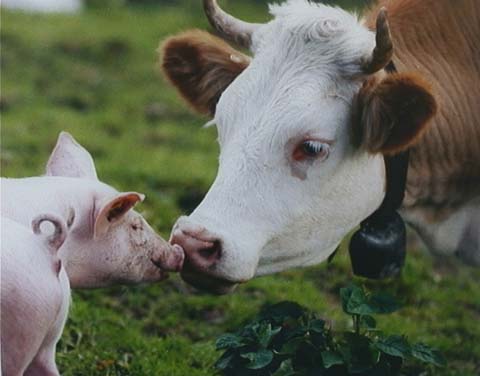
Visiting a sanctuary is a vastly different experience than visiting a farm. Farms value animals to the extent that they produce a profitable product via their flesh, mammary gland secretions or ovulation. Visiting animals on farms does not produce any “breakthrough” in our understanding of animals. On the contrary, most people simply walk away from a farm reaffirming what they have been taught: animals don’t object to being used as resources. It’s natural and sanctified by ancient traditions. Somehow, we rationalize, animals have passively accepted their lot in life. On farms, we view meek or fearful animals from a distance or on the other side of an electrical fence, typically in herds or flocks with ear tags (numbers instead of names), and under conditions which generally repress their ability to express themselves as individuals.

Yet, each animal is a self-aware individual with a unique personality – a complex of experiences, interests, emotions, thoughts, memories, likes, dislikes, desires, joys, fears, loves, families, friends, losses and pains. How do we know this? From sanctuaries and from science.

On a sanctuary, animals are individuals who, like human beings, have intrinsic value and who have no expectations placed on them. The owners are replaced by guardians who provide a caring environment that empowers them with the confidence to more authentically express their true selves. People can walk away from sanctuaries often with a “breakthrough” understanding. They recognize that these individuals are vastly more expressive, more sophisticated than their repressed counterparts on farms. They see much of themselves in these animals. They realize that the stereotypes they’ve come to believe all of their lives are based on prejudice.

Every animal-eating culture around the world has developed, over the course of centuries, a set of oppressive beliefs and traditions to deny animals – not only their identity as individuals – but also the right to exist itself, with the exception of their abbreviated lives as a human resource. Humans treated this way are appropriately called slaves. Humans killed in the manner in which animals are slaughtered is appropriately called an atrocity.

“Many who readily condemn human victimization as “heinous” or “evil” regard moralistic language as sensational or overly emotional when it is applied to atrocities against nonhumans. They prefer to couch nonhuman exploitation and murder in culinary, recreational, or other nonmoralistic terms. That way they avoid acknowledging immorality. Among others, Nazi vivisectors used the quantitative language of experimentation for human, as well as nonhuman, vivisection. Slaveholders have used the economic language of farming for nonhuman and human enslavement.” – Joan Dunayer, from her essay entitled English and Speciesism.

Many people will never have an opportunity to visit a sanctuary in person. The virtual visit we are developing for our online community is the next best thing to being there, providing a powerful way for potentially millions of people to reconnect with animals.

524958_3325028303604_654533903_n

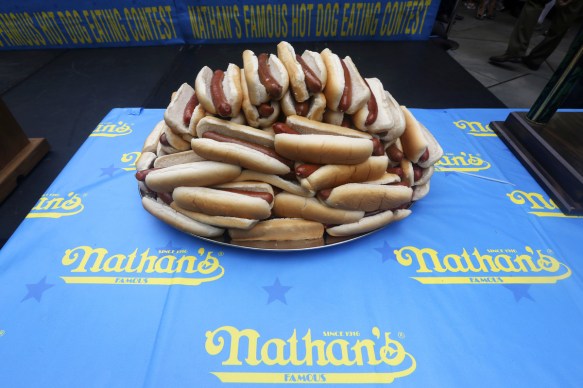
What Does 69 Hot Dogs Look Like?

In addition to fireworks and Budweiser, hot dogs make up the third element of the traditional trifecta of American freedom, based on Fourth of July celebrations in recent years. And some people like to really go all out.

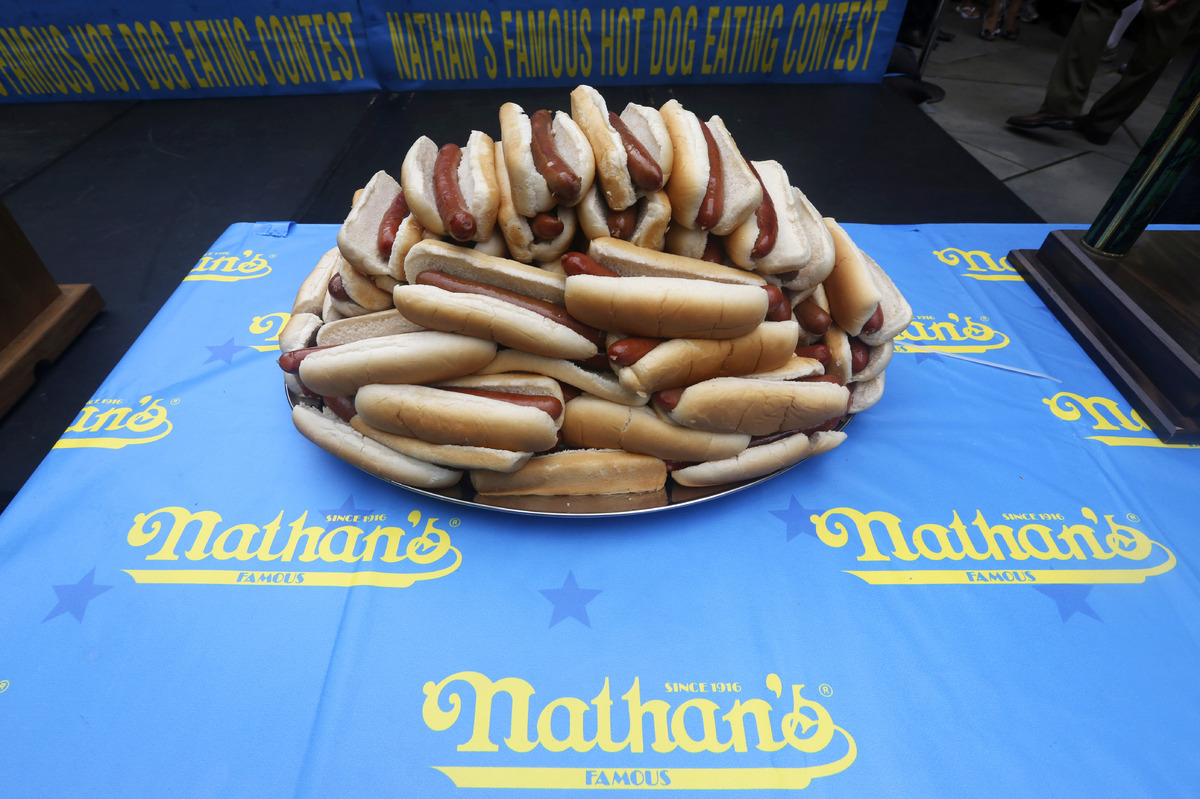
Just today, 29 year old Joey Chestnut (known in hot dog eating circles as “Jaws”) broke his own record of 68 franks and scored his 7th straight win at Nathan’s Coney Island hot dog eating contest, choking down  69 of the putrid meat-pups.

(Chestnut is not expected to reach 30.)

According to the Huffington Posts’ Weird News, “In the world of competitive eating, the Nathan’s hot dog eating contest is the gut-busting and artery-clogging equivalent of the Super Bowl. It’s by far, the most coveted eat-off.”

Only in America.

Seasoned spectators in the standing room only crowd watched from just out of range of any potential projectile vomitter in the competition.

Huff Post goes on to say, “Chestnut was expected to easily defend his title. Supporters carried him to the stage before the event in a mustard-yellow chair like an Egyptian pharaoh.”

(No doubt he was carried away on a stretcher.)

Here’s what 69 hot dogs looks like:
slide_306804_2657046_free


Now that’s a fuck of a lot of wieners! I mean, where does he put it all? The guy must be the carrion-eaters’ equivalent of Linda Lovelace.

Still want to know more about hot dogs?

Treehugger.com’s Melisa Breyer tells us: What’s Really Inside? Shocking Anatomy of a Hot Dog

Last year, Americans purchased more than 700 million packages of hot dogs at retail stores (and that’s excluding sales from Wal-Mart, which doesn’t report numbers). Figure in restaurants, food carts, circuses, ballparks and the like, and that’s a lot of dogs. In fact, the National Hot Dog and Sausage Council estimates that Americans consume 20 billion hot dogs annually.

The country’s most beloved tube of meat is Sara Lee’s Ball Park brand, which eclipsed sales of Oscar Mayer in 2010. Other media outlets have pulled back the curtain on hot dog ingredients in the past — and since we’re at the start of prime hot dog season, it seems as good a time as any to take another look at the who’s who of hot dog ingredients.

So without further ado, before the Fourth of July grills are aflame, here’s the skinny on America’s winning wiener, the Original Ball Park frank:

Mechanically separated turkey: Looking more like strawberry frosting than blended meat and bone bits, the USDA defines mechanically separated poultry (MSP) as “a paste-like and batter-like poultry product produced by forcing bones, with attached edible tissue, through a sieve or similar device under high pressure to separate bone from the edible tissue.” Hot dogs can contain any amount of mechanically separated chicken or turkey.

Pork: According to 1994 USDA rules, any meat labeled as the meat it is can be taken off the bone by advanced meat recovery (AMR) machinery that “separates meat from bone by scraping, shaving, or pressing the meat from the bone without breaking or grinding the bone.”

Water The USDA states that hot dogs must contain less than 10 percent water.

Corn syrup: A combo of cornstarch and acids, corn syrup is used as a thickener and sweetener, as MSNBC notes — it contains no nutrients but does add extra calories.

Beef: In 2004, to protect consumers against Bovine Spongiform Encephalopathy (mad cow disease), mechanically separated beef was considered inedible and prohibited for use as human food, so be glad you won’t be finding it in your dog.

Salt: Hot dogs are salty, that’s part of their job. And in fact, each one has about 480 milligrams, the rough equivalent of 20 percent of your recommended daily allowance.

Potassium lactate: This hydroscopic, white, odorless solid is prepared commercially by the neutralization of lactic acid with potassium hydroxide. The FDA allows its use as as a flavor enhancer, flavoring agent, humectant, pH control agent, and for inhibiting the growth of certain pathogens.

Sodium phosphates: Any of three sodium salt of phosphoric acids that can be used as a food preservative or to add texture — because texture is important when you’re eating a tube of meat paste.

Flavorings: Under current FDA guidelines, most flavoring agents allowed to be listed as “flavor” rather specified individually, so, this remains a bit of a mystery.

Beef stock: You know the drill: Boiled water with pieces of muscle, bones, joints, connective tissue and other scraps of the carcass.

Sodium diacetate: This is a molecular compound of acetic acid, sodium acetate, and water of hydration. The FDA allows its use as an antimicrobial agent, a flavoring agent and adjuvant, a pH control agent, and as an inhibitor of the growth of certain pathogens.

Sodium erythorbate: A sodium salt of erythorbic acid, it is often used as a preservative and helps meat-based products keep their rosy hue. Side effects have been reported, such as dizziness, gastrointestinal issues, headaches and on occasion, kidney stones.

Maltodextrin: Basically, a filler and/or thickening agent used in processed foods, it’s a compound made from cooked starch, corn, or wheat.

Sodium nitrate: This common preservative helps preserve the red color of cured meat — although studies have shown that consuming sodium nitrite may increase cancer risk and trigger migraines. Animal studies have linked sodium nitrates to an increased risk of cancer.

Extractives of paprika: An oil-based extract from the paprika plant — natural ingredient! — used for color and longer shelf life.

For natural, organic hot dogs that have a minimal ingredient list, try hot dogs from Applegate Farms or other all-natural meat makers.

Honor Thy Father and Mother—Especially When They’re Right

Last August I wrote a post titled “Honor Thy Father and Mother, Except When They Misbehave,” wherein I argued to those who say, “But my father was a hunter!” Well, so? Look at all the other outdated activities or attitudes we’ve turned our backs on—slavery, racism, sexism all went out of fashion without anyone arguing, “But my father was a racist, sexist, slave owner!” What’s so sacred about hunting that makes it any harder to kiss goodbye than any of our parent’s other wrong-headed behaviors?

On the other hand, I feel sorry for today’s youth whose parents lived during more enlightened times; they really have to work at finding things to rebel about. Lately we’ve been seeing a disturbing new trend: some of today’s young people, who were raised in caring homes by non-hunting parents, are embracing hunting out of some kind of misguided sense rebellion for rebellion’s sake.

Hey kids, if you feel an overwhelming urge to lash out against your parents, please don’t take it out on the animals. Turning to hunting does not make you hip, it makes you an animal abuser, like the budding future serial killer who throws rocks at birds or smashes frogs on the pavement.

(Note to prospective parents: Don’t fool yourself into thinking you can bring a new human into this world and expect to shape their way of thinking—it doesn’t often work out the way you might hope).

As I blogged in a post last July entitled, “The ‘Euphoria’ of Killing,” one young female hipster in her 20s, who decided to go against her progressive parents’ wishes and take up hunting for the first time, wrote of her first kill: “It felt incredible. It really felt pure. Like euphoria to me. It was just this amazing rush of excitement and pride and relief, and I know this word gets overused a lot, but it was empowering. I didn’t believe I had it in me to do that. It shocked me.”

Sure, it’s always shocking when someone learns they get a thrill out of killing. There’s nothing like getting in touch with your inner psychopath, I guess. The hedonistic huntress goes on to relate that she was surprised she didn’t feel much guilt afterwards… Though rarer than their male counterparts, female psychopaths share the same trademark characteristics: a lack of empathy, remorse or guilt.

Part of the case for killing made by modern-day barbarians (or “foodies,” as they sometimes refer to themselves) is that hunting wildlife is a “sustainable” way to feed oneself. The problem is, there’s more than just ONE self in need of feeding.

Since these issues keep coming up, I’m going to share yet another paragraph from an earlier post, this one depicting what would happen on “The Day Seven Billion People Decided to Hunt Their Own Dinner:”

By the end of the day, the bloodlust is satiated, but the Earth is virtually a lifeless wasteland; every animal species has been hunted practically to extinction. Only now do the masses look around for a fresh, new answer. They’re ready to listen to a vision for a truly sustainable future that doesn’t involve killing animals for their dinner.

304224_10150323421256188_1151389461_n

Hope for a Humane and Environmentally Sane Future

The following is my review of a new book published by Earth Books

Often, over the years, I’ve thought about taking on the task of chronicling the ways in which humankind is destroying the Earth, and how we need to change to survive as a species. Now, equally sensing the dire need for such a book, long-time animal activist, Will Anderson, has risen to the challenge with his new book, This is Hope: Green Vegans and the New Human Ecology.

I have to admit, the title, This is Hope, sounded to me like it could be almost, well, overly-hopeful. But in fact the book takes a hard, realistic look at where we’re headed if we don’t make some major changes in our destructive ways, our eating habits and our view of non-human animals as commodities. For instance, Anderson doesn’t buy into the increasingly popular fallacy that hunting can somehow be sustainable in this rapidly growing human world. Not only does he take on hunting, and those groups who promote it, he employs the term “neo-predation” for the myriad of ways in which the modern world disrupts biodiversity—to the peril of all who share the Earth.

And the author does not fall prey to the politically correct notion that human overpopulation is an overstated myth. Instead we learn that as environmentally-conscious, green vegans who truly want to see a future for all life on the planet, addressing and reversing our overpopulation is a must.

If we are willing to embrace Will Anderson’s prescription for a “new human ecology,” there truly could be hope for the future. As Anderson puts it, “The new human ecology can be the transformation of human behavior all of Earth has waited for.” Some of the positive results he foresees from this transformation include:

• Vast landscapes subjected to grazing and growing food for livestock are released from animal agriculture.
• Some of that land will be banked and rotated with other croplands. Soil erosion and pollution are sharply reduced. Sustainably grown, organic food becomes more reliably available.
• Conceivably, fewer people on Earth and the efficiency of botanical agriculture will allow lower food prices and raise food availability.
• We will reduce our greenhouse gas emissions immediately by 18% to 51%.
• Other human pressures on ecosystems decrease and allow them to trend toward recovery.
• Vegan diets will create better human health. This should result in lower health care costs.
• We stop the intentional impregnation of billions of domesticated individuals from other species, the torment of their enslavement and denial of their innate needs, and their early, violent deaths.
• The science and implementation of wildlife and habitat management is transformed…control by the small minority of people who hunt, fish and trap is ended.
• Livestock fences will be removed. Wild herds of indigenous wildlife can reoccupy habitat and have room to migrate long distances. Ecosystem keystone species like black-tailed prairie dogs will not be cruelly persecuted on behalf of animal agriculture.
• There are no new ghost nets, those fishing nets that break away from vessels, drift with oceanic currents, and continue to trap fish, turtles, marine birds, and marine mammals.
• We stop bottom trawling that destroys sea bed marine ecosystems. Since vegan human ecology does not require fish, it ends the trashing of millions of tons of unwanted bycatch (non-targeted species), eliminates shark-finning that is decimating shark populations, stops the killing of octopi, and ends the drowning of dolphins and turtles.
• We finally create a moral code of behavior that is based upon biocentric innate value; it is more consistently applied to all individuals of all species and ecosystems.

Photograph ©Jim Robertson

Photograph ©Jim Robertson

Silly Humans, Carrion is For Carnivores

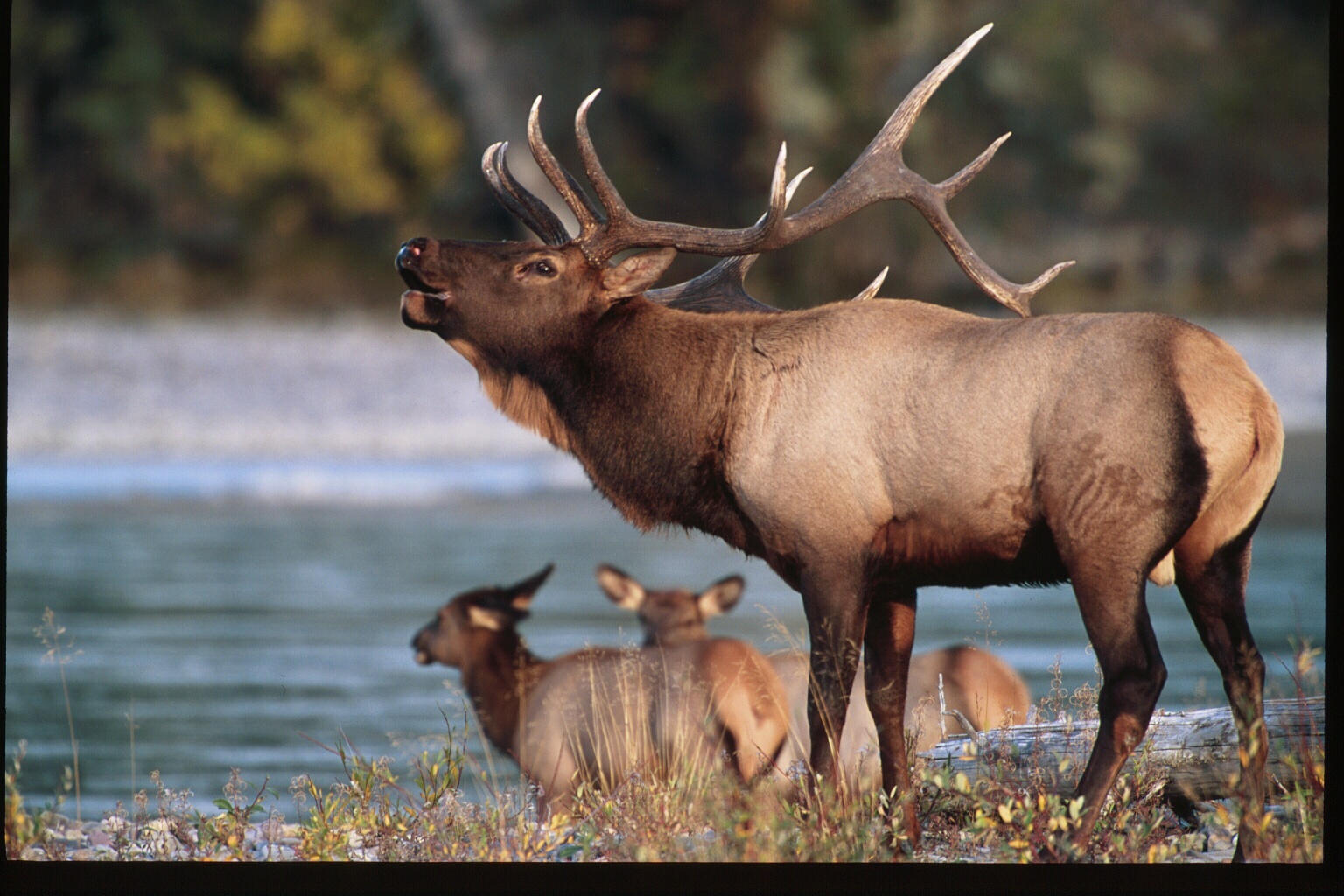
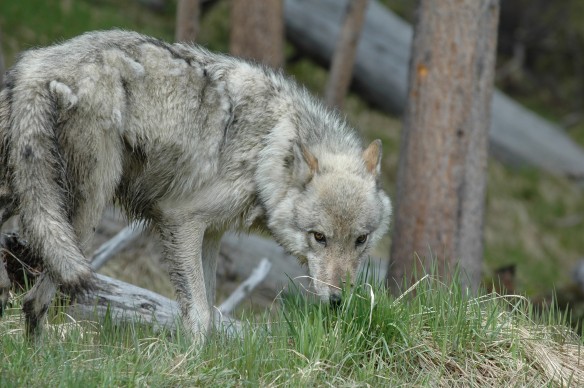
Never before in the history of mammals have seven billion large, terrestrial, meat-eating members of one species ever single-handedly laid waste to so much of the Earth’s biodiversity. Human carnivorousness is killing the planet one species at a time, one ecosystem after another; one bison at a time, one wolf after another.

Every time you order a steak or grill a hamburger, you legitimize bison and wolf culling for the sake of livestock growers. If you really want to save the wolves and the bison, go vegan! And urge your friends and family and neighbors and co-workers to do the same.

Tell it to the world—it’s time to leave the predating to the predators!

Human beings can live much healthier on a plant-based diet, as their primate cousins always have. True carnivores, such as wolves, coyotes, cougars, marine mammals or members of the weasel family have to eat meat to survive. If you’re not willing to go vegan for your own health perhaps you could do it for the health of the planet; if not for the sake of the animals you eat, maybe for all the other species affected by your bill of fare.

Text and Wildlife Photography© Jim Robertson

Text and Wildlife Photography© Jim Robertson

Forget the Calendar

According to the calendar, today’s my 52nd birthday. It’s hard to believe; I don’t feel any older than I was on the day I stopped eating meat and dairy 15 years ago. Though my choice to go vegan was for the sake of the animals—whose misery and death I was no longer willing to be a part of—the karmic reward (so to speak) has been the arrest of some of the detrimental conditions common among people in my alleged age group and a slowing down of the aging process all living things are subject to.

Unlike vegetables, fruits, nuts, grains and legumes, which can be kept as fresh as the day they were picked, meat begins to decompose the minute an animal is killed and their blood stops flowing. Any hunter or backyard butcher knows it’s a race against time to preserve dead meat before it spoils or is taken over by parasites (the microscopic kind as opposed to the human ones).Meanwhile, if not performed with great care, the morbid act of “gutting” an animal can spread E. coli and other intestinal nasties onto the “food.”

No matter how freshly killed the host animal was, their flesh is a product of death. It stands to reason that eating dead flesh cells, which contain no fiber and literally rot in the colon, will adversely affect whosoever consumes them. That’s why most herbivores live twice as long as the carnivorous species. And it’s why people who eschew meat and dairy* can potentially prolong their lives and find themselves feeling much more youthful and vital than most of their meat and dairy-eating counterparts.

*(For its part, dairy is rife with mucus forming pus—creating a favorable environment for respiratory contagions—as well as animal fat and acidic animal protein that leaches calcium from adult bones, while eggs are notoriously high in cholesterol.)

There’s a lot of truth in the saying, “You’re as young as you feel.” Forget the calendar, I don’t feel any older than 37. I can walk just as far, ski just as hard and chop as much wood as I did back then. I have just as much strength and stamina and am every bit as active in all ways—perhaps even more so, since I’ve had a decade and a half to recover from the ill effects of eating animal products.

Text and Wildlife Photography ©Jim Robertson

The Last “Traditional” Thanksgiving

In the beginning, God created turkeys…well, that’s not exactly true—turkeys evolved in North and Central America somewhere in the neighborhood of twelve million years ago, during the Miocene/early Pliocene epoch—but it makes for a good story.

Turkeys are intelligent, highly social and easily distressed when isolated or kept from their familiar surroundings. Adults can differentiate between friends and possible foe, and have been known to go into attack mode to drive off outsiders. Benjamin Franklin described the turkey as “a Bird of Courage, and would not hesitate to attack a Grenadier of the British Guards who should presume to invade his Farm Yard with a red Coat on.”

Their size, showy feathers and territorial disposition make turkeys an easy target for anyone with a weapon and an unwholesome urge to kill. Native Americans have a long history of feasting on turkeys that began well before the first Thanksgiving—the California turkey was hunted to extinction over 10,000 years ago. Meanwhile, modern human’s industrialized abuse of turkeys is nothing short of barbaric. Man has become so proficient at playing God with the turkey that nowadays the once proudly feathered bird is hardly recognizable. The vast majority of domesticated turkeys are bred to have white feathers because their pin feathers are less visible to the feaster when the carcass is “dressed” (glib jargon meaning butchered and mechanically plucked).

Any compassionate creator would be appalled by the unimaginable scale of institutionalized abuse of turkeys on factory farms or even on pseudo “free range” feel-good farms. Yet, each year turkeys are depicted—appearing at ease or even pleased with their plight—in inane commercials meant to soothe any holiday shopper who may have inadvertently stumbled onto the ugly truth about the suffering and cruelty inherent in the meat industry.

If you’re feasting on the flesh of one of the 45 million turkeys slaughtered this Thanksgiving season, please take a minute to consider the unnecessary suffering your meal caused and make this your last “traditional” Turkey-kill Day. Next year, try celebrating the life of the turkey while you feast on Tofurky or Field Roast, cranberries, candied yams, mashed potatoes, dressing, pumpkin pie and all the other tasty non-animal fixin’s. You may end up stuffed, but at least a bird won’t have to be.

Text and Wildlife Photography ©Jim Robertson, 2012. All Rights Reserved

.

Ryan Choses Vegan as Speechwriter

Fair warning to voters: If you start hearing Paul Ryan waxing poetic about mercy and compassion, those aren’t his words but rather the words written for him by animal welfare author, vegan and former George W. Bush speechwriter, Mathew Scully.

According to an article in the Daily Caller, “Republican vice presidential nominee Paul Ryan has tapped renowned speechwriter Matthew Scully to assist with campaign communications in the lead up to the GOP convention in Tampa, Florida. …

“He’s a Catholic vegan: Scully, who investigated meat-processing plants and factory farms during his stint in journalism, wrote a book arguing for the better treatment of animals called Dominion: The Power of Man, the Suffering of Animals, and The Call to Mercy. A Catholic like Ryan, Scully believes that the Bible’s injunction for man to “have dominion” over other species requires us to treat all living things with respect — and extends that philosophy to personally abstain from eating meat.”

Of course, diehard bowhunter, Paul Ryan is light years from abstaining from meat and must think men, including rapists, have “dominion” over women too (but not the respectful, merciful kind of dominion Scully suggests for animals). Ryan was also in the news today for having co-sponsored a legislation with the now infamous Todd Aiken aimed at redefining rape and forcing women to turn an unwanted pregnancy into an unwanted and possibly unloved child.

Paul Ryan is shown here indicating just how much compassion and mercy bowhunters like him really have for animals…

Save the Wolves, Go Vegan!

If you really want to save the wolves, go vegan! And urge your friends and family and neighbors and co-workers to do the same. Tell it to the world: Eating meat is killing the planet, one wolf at a time; one species at a time; one ecosystem after another. Every time you order a steak or grill a hamburger, you legitimize wolf-culling for the sake of livestock growers. And every time you purchase a hunting license, you validate wolf trapping for the sake of elk hunters. To game managers, every action, right down to your purchase of ammo and cammo at Outdoor World is a show of support for their policies.

By now, you regular readers of this blog are probably thinking to yourself, “Well, duh…tell me something I don’t know.” But you might be surprised just how many people who advocated for the reintroduction of wolves eat meat like there’s no tomorrow. Comfortable in their justification, they reason that cows are “domesticated” or “dumb” and therefore bred for slaughter. This post is for them. Their beef comes from a feedlot (as far as they know) and not out on the open range, where wolves are being killed. Others pride themselves on eating only “grass-fed” beef, yet somehow they don’t see how their food choice helps lead to a policy of “controlling” wolves.

And how many hunters can honestly say that they don’t mind sharing their elk or deer with the likes of wolves, cougars or coyotes. Meanwhile, mainstream environmental groups and their members cling to the notion of “sustainable” beef (surely some of the ranchers and hunters out there can afford to look the other way when desperate wolves come around hoping for a quick meal to stave off their hunger pangs).

Rather than continually trying to revise your rationale, wouldn’t it be easier just to remove yourself from the equation and leave the predating to the predators? Human beings can live much healthier on a plant-based diet, like their primate cousins always have. True carnivores, such as wolves, coyotes, cougars, marine mammals or members of the weasel family have to eat meat to survive. If you’re not willing to go vegan for the sake of the animals you eat, maybe you should think of the other animals affected by your bill of fare.

Now, if Mitt Romney had chosen a vegan, instead of a diehard bowhunter like Ryan for a running mate, he might have gotten my vote.

Text and Wildlife Photography Copyright Jim Robertson