


Tue., July 7, 2020
https://www.spokesman.com/stories/2020/jul/07/powered-by-plants-no-bones-about-it-a-meatless-wor/
By Jonathan GloverFor The Spokesman-Review Twitter Facebook Email Reddit
Have you checked on your vegan friend lately?
Try looking on cloud nine, just down the road from El Dorado, a few miles past the pot of gold at the end of the rainbow.
Odds are, they’re still there – in paradise. Why? Because a pro-plant-based hashtag was trending on Twitter. Trending – during COVID-19, police brutality, protesting and heartache, on a platform subjugated by a sniveling, angry man in the high castle: #theendofmeatishere.
It all started when the New York Times story – aptly headlined “The End of Meat Is Here” – was able to briefly capture the ADHD-ridden spotlight of modern social media, leading to a whirlwind of pro- and (mostly) anti-vegan sentiment.
It did what others before it were unable: It succinctly and methodically laid out all the benefits of a plant-based diet while simultaneously dismantling several myths. Such as that we need animal protein (we don’t), or that farmers would suffer most if we allowed the factory farming system to collapse (they wouldn’t).
The part that struck me most, though, was its assertion around meat’s role in COVID-19 – and how the pandemic might not exist without it. According to the Centers for Disease Control and Prevention, 3 of 4 new or emerging infectious diseases are zoonotic – meaning they spread from animal to human, the primary avenue being consumption.
Remember the 2002 SARS outbreak? The World Health Organization linked it to some sort of animal, though its origin is uncertain. How about the bird flu? Swine flu? A mystery their source is not.
What’s more, our broken relationship with animal consumption keeps finding its way into our other foods. In 2018, the Food and Drug Administration investigated factory-farmed cows as a source of a massive E. coli contamination of lettuce. E. coli is a bacterium that primarily lives in intestines.
According to a study of U.S. Department of Agriculture data on factory farms in Yuma County in Arizona by foodandwaterwatch.org, “Samples of nearby irrigation canal water tested positive for the same strain of E. coli that caused the outbreak. The canal is close to a CAFO that can hold more than 100,000 head of cattle at any one time.”
And while the industry has discovered clever workarounds for E. coli in the beef itself – mostly by washing the meat in ammonia before it’s shipped – we still deal with massive food recalls like clockwork.
That’s all to say, we can


‘This isn’t vegan food just for vegans, it’s vegan food for everyone’MARIA CHIORANDOJUL 1, 2020
https://www.plantbasednews.org/lifestyle/fried-chicken-brand-vegan-fast-food-outlet

A London-based fried chicken brand is opening a vegan fast-food eatery, after its plant-based menu proved extremely popular beyond the team’s ‘wildest dreams’.
Coqfighter will open its plant-based outlet – Mercy Burger – on July 4 in Boxpark, Shoreditch.
According to an Instagram post announcing the opening, the team revealed that Mercy Burger’s menu will feature fried chick’n sandwiches, burgers, sides, and milkshakes.https://www.instagram.com/p/CB5qSYuJ4Nh/embed/captioned/?cr=1&v=12&wp=658&rd=https%3A%2F%2Fwww.plantbasednews.org&rp=%2Flifestyle%2Ffried-chicken-brand-vegan-fast-food-outlet#%7B%22ci%22%3A0%2C%22os%22%3A3222109.675%7D
Coqfighter co-founder Deacon Rose told BigHospitality that the team is opening Mercy Burger following the success of Coqfighter’s vegan menu in early 2019, saying ‘its popularity has gone beyond our wildest dreams’.
“This isn’t vegan food just for vegans, it’s vegan food for everyone. We set out to prove that fast food staples can taste just as good and be just as indulgent when they are plant-based,” he added.
“Whether someone is vegan, looking to reduce their meat consumption, or just curious, we want Mercy Burger to be their guilt-free burger restaurant of choice.”
By Sarah Treanor and Elizabeth HotsonBBC News
https://www.bbc.com/news/business-53052856

“Ma po tofu has to be a favourite,” says David Yeung, a smile evident in his voice. “It’s very spicy, a little bit numbing, and usually sprinkled with minced pork.”
Hong Kong-based Mr Yeung is the founder of OmniPork, part of the environmentally focused venture Green Monday. OmniPork is a plant-based meat alternative that is now on the menu in many of Hong Kong’s trendiest restaurants, hotels and bars.
A vegetarian of two decades, he’s explaining how substitute meat is not just a market for the North American brands like Impossible Foods, and Beyond Meat, which have become well known for their burgers. He says the Asian market is hungry for home grown meat alternatives.
“Almost everywhere in Asia – Japan, Korea, Vietnam, Thailand, Singapore, especially mainland China – the number one meat is pork. The only exceptions are Muslim countries.”
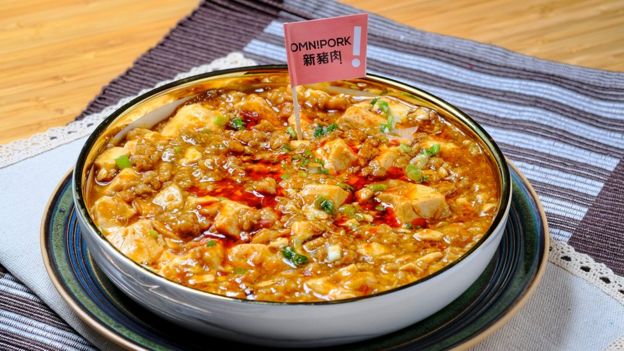
Indeed, China loves pork. The country of almost 1.4 billion consumes more pork per capita than any other nation.
Half of the world’s pork is eaten in China, and the acceleration has been rapid. In the 1960s China annually consumed less than 5kg per capita. By the late 1980s this was 20kg and has since tripled to over 60kg, according to UN figures.
But the mass-market meat industry has brought with it some very pressing problems, not least, disease. In 2019 African swine fever led to the mass slaughter of pigs in China, and prices rose 25-30%.
And this week, a new strain of flu with “pandemic potential” has also been identified in pigs within China.
This has thrown a sharp focus on meat supply chains and production, something the coronavirus pandemic has intensified.
Localised outbreaks of coronavirus have been appearing across the globe in meat-processing companies, even where infection rates in the general population are low. It’s not entirely clear as to why.
Covid-19, environmental issues and growing health concerns in a nation with increasingly high rates of obesity, have all encouraged a new wave of plant protein firms to develop new products.
For example, Beijing-based Zhenmeat is looking at 3D printing elements of its products to mimic bone or muscle.

“We eat a lot of different parts of the pig. The Chinese consumer loves different parts for different dishes but we are focusing in on Szechuan hot pot,” says chief executive Vincent Lu.
Zhenmeat is throwing its marketing behind one product in particular, created with the Institute of Alternative Protein in Beijing, a meat-free alternative to pork tenderloin, which is popular in hot pot.
It is a very specific cut of pork and style of cooking. But Mr Lu says it’s all part of the firm’s strategy. “If you look at the US market, consumers love burgers. So what kind of product do consumers love in the Chinese market? Hot pot is the most loved dish.”
But none of this innovation comes cheaply.
Matilda Ho is the founder of Bits x Bites, China’s first food technology venture capital group. She has backed four different protein companies, from plant-based to cell-based.

“We are just at the beginning,” she says. “But will the one-off purchase for the novelty value translate into repeat purchase and product loyalty? That’s the big question. In cities like Shanghai, Beijing and Chengdu, consumers are known to be eager experimenters when it comes to new food trends. But only a few will turn into behaviour change.”
Ms Ho also says it is easy to overstate climate worries as a reason for Chinese consumers to switch from animal protein.
“Taste will always be the driver for consumers to convert their behaviour. It won’t be environmental concerns.”
Shaun Rein, managing director of the China Market Research Group in Shanghai, says the market is still small but there is potential, given the open-minded nature of Chinese cookery and a willingness of shoppers to experiment.
“Chinese consumers are indeed always looking for alternative sources of protein. We think the market for plant-based meat is about $910m (£730m) and will grow about 20-25% annually. There’s a lot of excitement about these ‘fake’ meats, but the market is fairly small.”
But price is a big driver when it comes to long-term change, he adds. “When we interviewed blue-collar workers one of their main concerns was the price. The big winner could be ‘fake’ meat, or it could be seafood.”
Bruce Friedrich is the co-founder of the Good Food Institute, which researches and promotes meat alternatives. He is convinced the price issue will be solved. “While the plant-based meat costs a little bit more than regular meat it will be for people who are interested in looking at the way industrial animal meat is produced.
“But if you can make crops which mimic the way meat tastes and smells and looks, and scale that up, it will become cheaper than animal meat. Then it becomes not just for vegetarians and ‘flexitarians’ (those who cut meat consumption by going meat-free on certain days) but for everybody.”
Maria Lettini is executive director of FAIRR, a global network of investors concerned with issues surrounding intensive animal agriculture. She says with Covid-19, we are likely to have to pay more for our meat in the future.
“How are we going to make this system [of meat production] safe, how are we going to make it more resilient – without that coming at some kind of cost or investment?
“I don’t think meat at our grocery stores is being correctly valued. We probably need to be spending more to be able to consume it as much as we are.”
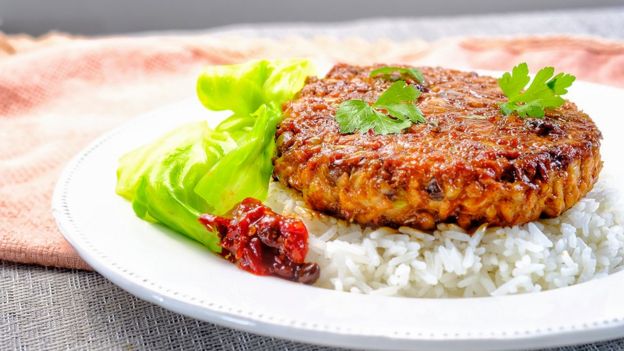
David Yeung of OmniPork says that his product is comparable on price. It now appears on UK brand Pizza Express’s products in Hong Kong, and Taco Bell branches in Asia. These are big names, but will this new breed of protein pretenders become mainstream any time soon?
Mr Yeung doesn’t expect everyone to become vegan, but insists “we are on a ramp-up for the whole industry” and that Asia is leading this change.
“This isn’t just about consumer trends, it’s about climate change, the pandemic, swine fever. Governments will have to look at this, not just as consumer choice or a trend – but about sustainability of the planet.”
 Exposing the Big Game