Exposing the Big Game

Forget Hunters' Feeble Rationalizations and Trust Your Gut Feelings: Making Sport of Killing Is Not Healthy Human Behavior

Exposing the Big Game

Faux Meat versus Dead Meat

, by Karen Davis

Grocery store shelves filled with packaged meats
Photo Credit: Evan Sung for The New York Times

Karen’s comment received 62 Recommended responses, placing it among the most recommended comments addressing Fake Meat vs. Real Meat in The New York Times, Dec. 4, 2019: “Millennials are gobbling down plant-based burgers, prompting meat producers to question the health benefits of ‘ultra-processed imitations.’”

New York Times Comment Section Dec. 4

Between plant-based meat and animal-derived meat, “fake” meat wins hands down. Plant-based meat is a slaughter-free product for which no animal has to suffer and die miserably and no human being has to do the dirtiest, most depressing work in the world.

Plant-powered meat does not pass intestinal bacteria such as Salmonella, Campylobacter, Listeria, and E coli into human handlers and consumers of animal products. When these intestinal bacteria appear on lettuce and other plant produce, it’s the result of animal agribusiness contamination. Chicken is the biggest source of food poisoning, and animals raised in cesspool conditions and fed horrible diets are not healthy no matter how pro-animal meat industry proponents try to lie about it. People who choose plant-based over animal products are making the right choice.

Probably only raw, organic foods are perfectly healthy for human consumption, but to complain that processed plant-based products are not perfectly healthy is ridiculous, especially compared to the standard Western diet. The terrible effects of this diet are well-documented: obesity, high blood pressure, Type-2 diabetes, heart failure, and food-borne illnesses. — Karen Davis, PhD, President, United Poultry Concerns

Vegan Police Approved
Beth Clifton collage

What Can I Do?

Support the Plant-Powered Food Revolution! Buy animal-free foods – organic, raw, cooked, processed, all of these – and help put an end to slaughterhouses. Post comments and write letters to the editor in support of animal-free cuisine. Talk to people. The current trend toward plant-powered foods must grow, and we who care about animals, who have lit the plant-powered fire, must maintain the momentum through our food purchases, cooking skills, animal advocacy and education!

UPC Vegan Recipes


JOAQUIN PHOENIX-BACKED ANIMAL-RIGHTS FILM PREMIERES IN TEXAS

https://vegnews.com/2019/10/joaquin-phoenix-backed-animal-rights-film-premieres-in-texas

VegNews.TheAnimalPeople

New documentary The Animal People focuses on the journey of six activists branded as terrorists after protesting against animal testing.


1,686 Shares    

New documentary The Animal People will make its world premiere at the Austin Film Festival on Saturday, October 26. Executively produced by vegan actor and Joker star Joaquin Phoenix, the film is produced by CSI  star Jorja Fox and directed by Cassandra Suchan (Rock The Bells) and Dennis Henry Hennelly (Bold Native)The Animal People follows a group of six activists from the United States arm of British animal-rights group Stop Huntingdon Animal Cruelty (SHAC) who were surveilled by the Federal Bureau of Investigations (FBI) and ultimately indicted as domestic terrorists for leading protests against Huntingdon Life Sciences, a major animal-testing company. The FBI used its surveillance of the activists as a model for targeting later movements such as Occupy Wall Street and Black Lives Matter. Prior to the activists’ indictments, the US Congress rewrote laws to bend to corporate pressure, potentially weakening the free-speech rights of all Americans. “This film is about much more than just this case,” Phoenix said. “It’s about fundamental questions concerning free speech, social change, and corporate power that have never been more urgently relevant in our world.” The Animal People features interviews with the six activists spanning more than a decade and aims to illustrate the result of activism being classified as terrorism when insitutions of power are involved.

Want more of today’s best plant-based news, recipes, and lifestyle?
Get our award-winning magazine!

SUBSCRIBE

Fossil Records Indicate Early Humans Hunted 25-Foot Giant Paramecium And Other Mega-Protista To Extinction

[WARNING! This is another piece of satire–this time by the Onion. There were never any giant one-celled creatures (except on Star Trek), but if there were you can bet that humans would have hunted them to extinction…]

SPOKANE, WA—Confirming long-held suspicions about the diminutive size of modern-day bacteria, paleontologists at Gonzaga University engaged in an intensive study of the fossil record announced Friday that they had found overwhelming evidence supporting the theory that early humans hunted the 25-foot paramecium and other mega-Protista to extinction. “According to our findings, early humans would routinely hunt giant amoeba, feasting on their cytoplasm and utilizing all organelle parts in the making of tools and garments,” said head researcher Dr. Lorraine Logan, clarifying that the building-sized bacteria had no natural predators, rendering them easy targets for early man armed with rudimentary flint hunting weapons. “My team uncovered the fossilized remains of a masta-paramecium whose cell wall had been pierced with almost two dozen arrows and whose Golgi apparatus had been painstakingly removed with obsidian knives, presumably to fashion into rope and bowstrings. We can also say with some certainty that early man harvested the mega-Protista’s cilia, which grew to impressive lengths in their prehistoric form.” Researchers also found a fossilized paramecium containing fragments of human bone, suggesting that the single-huge-celled organisms regularly fought back.


Impossible Burger Approved To Be Sold In Stores

After receiving regulatory approval from the FDA, the plant-based Impossible Burger has been approved to be sold in supermarkets nationwide, offering an option for environmentally conscious consumers looking for a burger substitute. What do you think?

“It’s like we’re living in the future: an agency that approves the safety of food!”

ARUN TUCKER • TONTINE ARRANGER

“This is pointless until someone invents a vegetarian bun.”

SABRINA HARMON • WISHBONE SPLITTER

“Wow, if you told me 20 years ago that one day we’d be eating plants, I would have called you crazy.”

CORDELIA MERCADO • SHOE REHABILITATOR

BEYOND MEAT’S VEGAN BURGERS COULD CHANGE THE WAY WE THINK ABOUT MASCULINITY

hamburger
Reuters/Lucy Nicholson
Changing minds, one meatless patty at a time.

Beyond Meat wants to change the way we eat. That means the plant-based protein company, currently in the midst of planning an initial public offering expected to put its value at $1.2 billion, needs to ensure that its products appeal to all kinds of people—including men.

That’s a tall order, given that meat-eating has long been associatedwith masculinity. And so the Los Angeles-based company, in its mission to make meatless choices mainstream, has leaned into the manliness of a hearty, red-liquid-dripping burger (even if that liquid isn’t blood). Its marketing strategies avoid potentially off-putting words like “vegan” or “veggie burger.” As Fast Company’s Rina Raphael puts it, both Beyond Meat and its biggest meatless competitor, Impossible Foods, “entice men where they can be found—in sports, at popular burger joints, and in the BBQ meat section at stores.”

Beyond Meat’s Instagram feed features endorsements from the NBA’s Kyrie Irving and Chris Paul (both also investors), while promoting deals with fast-food joints such as Del Taco and Carl’s Jr. (You can also chow down on an Impossible Burger at White Castle and Red Robin.) And both Beyond Meat and Impossible Foods both boast that their burgers “bleed,” a choice that serves no purpose other than to more closely imitate the viscerally satisfying, caveman-like experience of biting into a juicy beef patty.

The strategy is a practical one: Rather than trying to push men to eat less meat and embrace plant-based diets, Beyond Meat and Impossible Foods want to expand the definition of what meat is. “What consumers value about meat has nothing to do with how it’s made,” Impossible Foods CEO Patrick Brown told Quartz last year. “I mean, animals have just been the technology we have used up until now to produce meat, which is a food that is defined by its flavor profile, its sensory profile, its nutrition, utility, and stuff like that.”

If Beyond Meat and Impossible Foods succeed in instilling this new idea of meat, the cultural link between meat and masculinity may well remain intact. “We can’t just eat our way out of toxic masculinity,” says Max Elder, the research director at the Institute for the Future, a nonprofit research center in Silicon Valley.

Elder, who has a background in food ethics, thinks Beyond Meat and Impossible Foods won’t necessarily challenge gender norms. He points out that because these companies emphasize how similar their products are to meat in taste and texture, they may be less likely to make people question their meat-eating habits and engage in deeper reflections about the relationship between food and gender.

“Are these plant-based meat alternatives sufficiently different that they will challenge existing ideologies?” he asks. “I’m sort of skeptical that we can both preserve everything that these companies want from meat, and get rid of everything these companies don’t want from meat at the same time.”

But there’s also a far more optimistic possibility—that the rise of meatless meat could be part and parcel of a broader cultural shift. Whether this will happen turns on a question of causality. We know that ideology shapes our behaviors. But can changing our behaviors—say, by chowing down on a meatless burger that looks and tastes just like a regular one—shift our ideology over time?

The social pressure to eat meat

The gender politics of meat-eating can be traced all the way back to the Bronze Age. One 2017 analysis of the bones of 175 people who lived in China found that both men and women ate a combination of meat and grains during the Neolithic period. But by the Bronze Age, meat was off the menu for women—a change that corresponded with a downgrade in women’s social status. Meanwhile, the Book of Leviticus details how sacrificial meat was reserved for priests and the sons of Aaron, as Carol J. Adams explains in her 1990 book The Sexual Politics of Meat.

In the modern era, women in wealthy countries have far greater access to meat. Nonetheless, eating meat continues to be seen as a particularly macho thing to do, a concept that shows up everywhere from Hungry-Man frozen dinners to macho fast-food ads and Jordan Peterson’s all-meat diet (a mode of eating so on-brand with the controversial psychologist’s vigorous defense of the patriarchal orderthat it verges on self-parody).

There are certainly plenty of men today who have no qualms about swapping out steak or pulled pork for legumes, eggs, fish, and tofu. But research shows that making vegetarian choices still carries a certain gendered stigma. One 2011 study by researchers at the University of British Columbia, published in the journal Appetite, found that people who eat vegetarian diets are perceived as both “more virtuous and less masculine” than their meat-eating peers.

“Manhood is still considered a precarious state, easily lost and requiring constant validation,” the researchers note—and because social conditioning has taught us that meat-eating is manly, ordering steak at a dinner date is a way to reaffirm one’s strength and virility.

And so, at a time when scientists and public-health experts are urging people around the world to eat less meat (pdf) because of health and environmental concerns, some men have been loathe to change their habits. One nationally representative survey (pdf) of over 1,000 Americans, published in the journal Public Health Nutrition, found that men were less likely than women to reduce their meat consumption and more likely to say that meat was part of a healthy diet and that meals were boring, incomplete, or insufficiently filling without meat.

Emma Roe, an associate professor in human geography at the University of Southampton in the UK, suggests that the key to changing this mindset is to normalize vegetarian choices for men.

“Even men who don’t like meat, men who find it upsets their digestion, or have been asked by the doctor to eat less meat, still find it hard to choose the vegetarian option in public around other men,” she writes in a blog post. “What we have discovered is that many men are interested in eating less meat, they just need social permission to do so.” She suggests that the more meatless options become widely available in everyday spaces—at fast-food restaurants and neighborhood cookouts—the less stigma men will feel about giving beef a pass.

Changing minds, one meatless patty at a time

Whatever an individual’s motivation for cutting back on meat, it’s likely to have health benefits. A 2017 article, published in the journal Gender, Place, and Culture, also suggests that when men change their meat-eating habits, they can wind up changing gender norms in their social circles.

Doing vegetarianism in interactions drives social change, contributing to the de-linking of meat from gender hegemony,” writes researcher Anne DeLessio-Parson, who conducted interviews with 23 male and female pescetarians and vegetarians in La Plata, Argentina.

In a culture where meat-heavy asados play a huge role in national identity, the men in the interviews said they’d faced some pushback after going vegetarian. But they fought back, pushing an alternative model of masculinity in the process. “Armed with moral clarity, science, and ‘rational’ arguments, they confronted meat-eaters,” DeLessio-Parson reports. “They redefined meat-eating as a behavior that communicates weakness, rather than strength, and once established, gained respect and in some cases even admiration from others.”

Moreover, she notes that on a practical level, men who become vegetarian upset the traditional gendered division of space at an asado, in which men cook meat on the grill while women prepare salads inside. “If a vegetarian man does not want to be ‘complicit’ and see meat on the grill, where should he go? Will he be accepted in the kitchen, where women traditionally prepare salads? What happens when everyone heads for the shared table?”

One needn’t rely on men giving up meat entirely in order to see how more men eating plant-based meat could spark bigger shifts in gender roles and relations. As Adams explains in a blog post, popular culture often suggests that “refusing meat raises questions about one’s masculinity and sexuality.” She cites a German ad campaign that proposed the slogan “tofu is gay meat” and a Brooklyn deli that peddled a vegetarian sandwich called the “Gayboy.” Similarly, Michael Ian Black recounts in a New York Times op-ed being called “soy boy” as a slur insulting his manhood, after he posted a thread about masculinity on Twitter.

A son who grows up watching his father tucking into a crunchy salad or a vegan sausage, however, receives at least some level of indoctrination against such stereotypes. That’s a big deal, given that boys are still growing up with a rigid model of masculinity. In a 2018 nationally representative survey (pdf) of 1,000 kids between the ages of 10 and 19, for example, conducted by Plan International USA, an overwhelming 82% of boys said that they had heard someone criticize a boy for “acting like a girl.” Parents play a big role in socializing their children’s ideas about gender, according a 2018 briefpublished in the Journal of Adolescent Health—a power that can be used for good or for ill.

Similarly, a man who feels perfectly comfortable ordering a meatless burger in front of his friends at a restaurant signals to his peers that it’s all right to deviate from strict gender norms—in eating habits, yes, but perhaps in other ways, too.

On that front, Elder says there’s reason for optimism. “Insofar as Beyond Meat is creating the permission space for eaters to interrogate their food in a new way, I’m hopeful and I’m happy,” he says. Most problems with our current food system, he notes, can be traced back to a lack of critical thinking about the alternative possibilities we might explore. The marketing around Beyond Meat, Impossible Foods, and other plant-based and “clean meat” options will play a crucial role in determining the kinds of conversations we have about meat and masculinity, Elder added.

A recent Carl’s Jr. ad for Beyond Meat burgers may offer a hint at what we can expect. For years, Carl’s Jr. was known for its highly sexualized ads featuring Paris HiltonKate Upton, and other scantily-clothed actresses and models biting into burgers—messaging that promoted the idea that “women, like chicken and steak, exist to be salivated over and consumed by men,” as Deena Shanker wrote for Quartz.

In 2017, the company announced that it was forgoing this kind of advertising—not because of any ideological awakening, but simply because sex wasn’t selling the way it used to. Its Beyond Meat spot, which debuted earlier this year, offers insight into its new direction.

In the advertisement, the camera zooms out from a closeup of a tough, grizzled cowboy to reveal that he’s in the midst of a beachside yoga class, a Carl’s Jr. Beyond Famous Star (a burger made with a Beyond Meat patty) by his side. “When the wagon of change comes, you ride along with it,” he declares, striking a warrior pose. While he’s surrounded mostly by women in the yoga class, there are at least one or two men in the mix with him.

The message is clear: The tough cowboy can eat meatless burgers and do yoga, and still be himself.

Much like Carl’s Jr., the ad isn’t perfect. It doesn’t erase the sexist history of the fast-food chain or meat in general. And guys like this cowboy—that is, men who are looking to cut back on meat—are still in the minority. But hey: It’s a start.

Beyond Meat is going public. Investors are betting on a new future for food.

Plant-based meat products might fix our food system.

Beyond Meat breakfast sausage.
 Beyond Meat

Beyond Meat, the plant-based meat company, is going public next week.

The company sells burgers that contain no meat, but taste like they do. Its stated goal is to fix our food system. Its initial public offering (IPO) is the latest sign that alt-meat is going mainstream — and that’s a big deal.

It’s been a good few years for Beyond Meat. National chains including Del Taco, Carl’s Jr., and T.G.I. Friday’s have started carrying their products. They’ve also found their way onto grocery store shelves at Whole Foods, Kroger, and Target. In total, Beyond Meat says its products are available in more than 35,000 outlets, from hotels and college campuses to grocery stores and sports stadiums. Sales have been growing fast — last year the company reported revenues of $87.9 million, up from $32.6 million in 2017.

Now, the company has filed with the Securities and Exchange Commission for an IPO, scheduled for next week. They’ll sell shares in the company for between $19 and $21 per share, allowing them to raise $183 million for additional manufacturing facilities, research and development, and sales. If their stock sells at the high end of that, the company would be valued at $1.2 billion. They’ll be listed on NASDAQ as BYND.

Founded in 2009 by CEO Ethan Brown, the Los Angeles-based company’s products first hit supermarket shelves in 2013. Its rapid rise — food is not an easy industry to break into — reflects intense consumer demand and investor interest in meat alternatives. The company has never been profitable, and lost $29 million in 2018, but its rapidly growing revenues made it a good bet to many investors — as did its positioning on the frontier of a transformation of our food system.

“Beyond Meat was the first company to really set its sights on creating meat from plants that could compete on the basis of the things that meat eaters like about meat,” Bruce Friedrich of the Good Food Institute, which works on policy and investment surrounding meat alternatives, told me. “Before Beyond Meat and Impossible Foods, there was really this sense that plant-based foods was for vegetarians. People like Ethan Brown said, ‘No, we can make plant-based foods that meat eaters like just as much.’”

Plant-based meat alternatives are getting big

There’s a lot wrong with our food system. Producing meat by raising animals on factory farms produces tons of greenhouse gases, and many analysts think we can’t tackle climate change without tackling the enormous emissions that go into agriculture. Animals in close quarters are fed low-dose antibiotics constantly so they don’t make one another sick, which contributes to antibiotic resistance, a huge threat on the horizon for public health. And animals on factory farms are routinely subjected to intense cruelty and conditions that disgust the average American consumer.

That’s what inspired people to start working on meat alternatives — and it may be what’s inspiring the consumer enthusiasm that has buoyed them in recent years. Products like veggie burgers, fake chicken, and soy and almond milk are growing in popularity and market share — and even better, they’re getting tastier and harder to distinguish from animal products.

New breakthroughs in food science have made it easier to imitate the flavor and texture of real meat. While early veggie burgers were almost exclusively purchased by vegetarians, Brown says that 93 percent of Beyond Meat customers buy regular meat too — suggesting the company has succeeded at making something that appeals to meat eaters.

Beyond Meat was among the pioneers of this new generation of plant-based meat, which aimed to replace bean-based veggie burgers marketed mostly to vegans. Now, they’ll be the first plant-based meat company to have an IPO. It’s a remarkable success for the company. It’s also remarkable because food companies rarely go public, Friedrich told me: “The food industry is highly centralized, and most exits are mergers or acquisitions by large food conglomerates.”

Last year, there were rumors that industry giant (and Beyond Meat investor) Tyson Foods was considering buying the company. Beyond Meat stayed independent, though. A few months later, the company added the chief financial officers of Coca-Cola and of Twitter to their board, signaling that it was getting the expertise on-board that it needed to become a huge public company.

The rest of the plant-based meat industry has been thriving too. Qdoba announced last week that it would be serving Beyond Meat competitor Impossible Foods. Earlier in April, Burger King launched the Impossible Whopper. Industry giants Tyson and Purdue are pursuing their own plant-based product lines. A few years ago, the Impossible Burger was available in a handful of restaurants — now it can be found in more than 5,000.

“There’s a sense that there’s a movement going on that’s much bigger than any one company,” Brown told Vox two weeks ago.

The interesting thing about that movement is that plant-based meats don’t have to displace all animal meats in order to make a big difference. Every burger replaced with a Beyond Burger has an impact on CO2 emissions, demand for factory farming, and demand for antibiotics. The more the plant-based meat industry grows, the more those impacts will be visible — and that might, in turn, itself fuel more interest in plant-based meats. Beyond Burger’s team doesn’t just believe they’ve found a niche — they say they’ve figured out the “Future of Protein.” Here’s hoping they’re right.

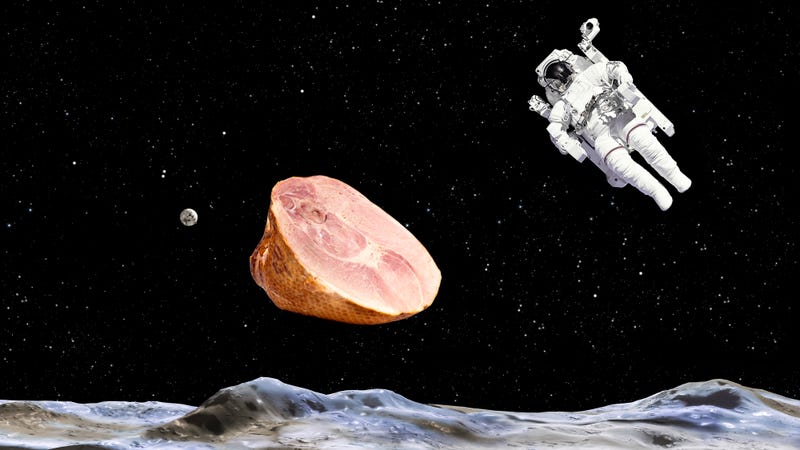
Easter ham denied to International Space Station

haminspace.jpg
Photo: Zenobillis, pamela_d_mcadams (iStock)

Despite humanity’s compulsion to probe ever-deeper into outer space, progress remains slow. After all, to even send an individual into orbit requires millions of dollars, years of training, and countless experiments to ensure their safety. That’s all willing that everything goes according to plan once the launch countdown hits zero. And once there, those who do have the rare privilege of living among the stars are left to balance their research obligations with retaining a sense of humanity.

And dear reader, The Takeout would now like to ask in that same spirit: Is a humanity bereft of holiday ham still human at all?

As Easter Sunday draws near, an Associated Press article about the launch of food and test/repair equipment for the International Space Station includes details about the more than 800 pre-packaged meals sent to the six current residents of the International Space Station, aboard the Cygnus capsule:

NASA also packed more than 800 meals for the six station residents. Their holiday choices include pork chops with gravy, smoked turkey, potatoes au gratin, lemon meringue pudding and apricot cobbler.

Great! NASA’s really playing the hits with this spread. But let’s keep the focus where it matters: the ham. What’s an Easter without ham? Do the geniuses aboard the ISS also get shipments of O’Doul’s for St. Patrick’s Day?

Good people of Earth. Those six intrepid explorers are up there now. Along with the food, we also sent them 40 rats (for a vaccination experiment) and “free-flying robots.” Technology has evolved far enough that we as a species are capable of sending rats and what we assume are three copies of EVE from Wall-E to the ISS. And still, no ham.

To deny these brave individuals their ham is to spit upon the spirit of discovery and collaboration in which the ISS was assembled. You may quote The Takeout on this.

The Onion on: Plant-Based Meat Vs. Lab-Grown Meat

For those seeking to eat less actual meat for health or ethical reasons but still wanting to experience the taste of meat, plant-based meat substitutes and meat grown in a lab can offer alternatives. The Onion breaks down the differences between plant-based meat and lab-grown meat.


Benefits:

Plant-based meat: Humane way to get doctor-recommended daily meat taste

Lab-grown meat: More natural than current meat products


Taste:

Plant-based meat: Approximate

Lab-grown meat: Hubristic


Cost:

Plant-based meat: Too expensive

Lab-grown meat: Way too expensive


Biggest Advantage:

Plant-based meat: Lets you feel superior to humans who eat animals

Lab-grown meat: Lets you feel superior to gods who create animals


Good With Ranch?:

Plant-based meat: Nah

Lab-grown meat: Not really


Number Of People Switching To It:

Plant-based meat: Not nearly enough to meaningfully help environment

Lab-grown meat: Not nearly enough to meaningfully help environment

Deadly pig virus threatens China’s $128 billion pork industry

LINKEDINCOMMENTMORE

Scientists and officials in China are trying to isolate a deadly pig virus potentially threatening the nation’s pork industry.

According to Reuters, an outbreak of African swine fever was discovered on a farm in inner Mongolia. Eight pigs died and 14 more were infected.

Since August 1, the virus has spread to seven provinces in China, reports Bloomberg. About 40,000 pigs have died, disrupting a pork industry valued at $128 billion.

China has introduced several new rules to attempt to curb the spread of the virus. Reuters reports Chinese officials have banned transporting live hogs or pig products from areas bordering a province with an outbreak.

More: 458 pigs found hoarded on Kentucky farm will be euthanized if not rescued, nonprofit says

More: U.S. slaps tariffs on another $200 billion in Chinese goods as trade tensions escalate

China also introduced bans on feeding kitchen waste or using feed from pig blood, reports Reuters.

African swine fever is a virus affecting pigs. There is currently no vaccine to combat the disease, reports Bloomberg. The virus does not affect humans.

Last month, the U.N.’s Food and Agriculture Association warned the outbreak could move to neighboring countries in Asia, reports The Associated Press