Exposing the Big Game

Forget Hunters' Feeble Rationalizations and Trust Your Gut Feelings: Making Sport of Killing Is Not Healthy Human Behavior

Exposing the Big Game

“Clean Meat” Hoax Website Now Posted

Clean Meat Hoax

A banana on the floor with title: Clean Meat Hoax (Don't fall for it)

http://upc-online.org/diet/190401_clean_meat-hoax_website_now_posted-check_it_out.html

Dear Friends,

Philosophy professor and animal rights advocate, John Sanbonmatsu, has launched a new website where concerns about “clean meat” are being aired. Proponents of clean meat technology, also called “cell-based meat” and “cellular agriculture,” are predicting, in the words of Paul Shapiro’s 2018 book Clean Meat, that “growing meat without animals will revolutionize dinner and the world.”

Clean meat is still in the research & development phase. It is not available in stores or restaurants. Eventually, however, it will be, though on what scale, in what variety, and at what price remains to be seen.

Technical and regulatory hurdles aside, questions are being asked, including: will people who eat animals buy clean meat? If so, will they like it well enough to choose it over slaughterhouse flesh? Will the commercialization of clean meat actually reduce the numbers of chickens, fish and other animals currently suffering and dying for meateaters? Or will clean meat end up as nothing more than just another food choice for the human omnivore, with little or no effect on the numbers of animals suffering and dying for cuisine, and with little or no effect on how humanity views and treats our fellow creatures?

Of concern to many of us is that clean meat is being promoted by the Good Food Institute and its allies as a response to the “fact” that human “nature” is incapable of not eating meat; therefore, the only choice is to grow cellular meat to satisfy the growing human population and reduce the destructive environmental effects of industrialized animal farming.

Many of us are pushing back against the claim that plant-powered foods will never satisfy most people. Current growth of the vegan food market suggests otherwise. Contrary to some assertions that vegan advocacy has already failed, within the mere 40 or so years of vegan advocacy, incredible progress has been made and encouragingly continues. Plant-powered foods are not just a fad – they’re a growing trend. One reason for this is the increasingly sophisticated taste, texture, and variety of products that resemble, but are free from, animal bodies.

I am pleased to present Clean Meat Hoax to our readers and to contribute to the conversation. At this point, I am neither radically for nor against clean meat, except to say that if it could significantly eliminate animals from being born into the misery and murder of meat, this, in my view, would be 100 percent better than the daily global holocaust of animals.

At the same time, as contributors to Clean Meat Hoax point out, and I am one of them, the issue is ethically complicated. If this potentially animal-free technology could help liberate animals from the plate and from the belittling attitudes most people hold about the individuals they carelessly consume, then I would welcome it. But if all it does is add one more option to the smorgasbord of omnivorous “food” choices, then it is just another tedium that sows depression and despair, particularly when (former) animal advocates insist that ethical advocacy for animals “doesn’t work.” – Karen Davis

In what is apparently not an April Fools’ joke, Impossible Foods and Burger King are launching an Impossible Whopper

Impossible Foods

The meat substitute manufacturer Impossible Foods  and fast food giantBurger King are launching an Impossible Whopper.

According to a report in The New York Times, Burger King is launching the Impossible Whopper in stores in the St. Louis area with plans for a broader rollout later — and not as part of some elaborate April Fools’ Day prank.

Burger King isn’t the first fast food chain to bring an Impossible burger to market. That’d be White Castle, which is selling Impossible sliders at stores in the Northeast.

But Burger King would certainly be the biggest slinger of ground beef to go with a meatless patty maker.

Impossible’s largest competition in the meat-substitute market, the publicly traded purveyor of purely beef-free patties, Beyond Meat,  has a similar deal with Carl’s Jr. for its own version of a beef-less burger.

The Silicon Valley-based Impossible Foods has been on a roll. They introduced a new version of their burger to much fanfare at the Consumer Electronics Show earlier this year, and have been locking in deals with higher-end fast casual restaurants and now large international fast food chains.

In the eight years since the company raised its first $7 million investment from Khosla Ventures, Impossible Foods has managed to amass more than $389 million in financing — including a convertible note last year from the Singaporean global investment powerhouse Temasek (which is backed by the Singaporean government) and the Chinese investment fund Sailing Capital (a state-owned investment fund backed by the Communist Party-owned Chinese financial services firm, Shanghai International Group).

It remains to be seen if this is a harbinger of things to come for Burger King and whether the fast food giant will embrace other alternative meat companies like the providers of fake chicken or cellular-based meat substitutes like Memphis Meats.

Red Robin Gives Impossible Burger Its Largest Rollout Yet

The plant-based “meat” brand is also available at White Castle and other select restaurants.

Play Video

YOU MIGHT LIKE
QUESTLOVE LAUNCHES VEGETARIAN CHEESESTEAK WITH IMPOSSIBLE FOODS
WHEN WAS THE LAST TIME YOU BOUGHT MILK?
PEOPLE REVEAL THEIR FOOD-RELATED DATING DEAL-BREAKERS

The plant-based “meat” brand is also available at White Castle and other select restaurants.

BRIDGET HALLINAN 

Updated March 25, 2019

So far, 2019 has been a pretty big year for plant-based food—in January alone, Impossible Foods debuted a revamped formula with the “Impossible Burger 2.0” at CES in Las Vegas, Carl’s Jr. put the Beyond Burger on its menu (for a limited time), and Impossible’s founder and CEO, Pat Brown, even teased out the idea of a plant-based beef steak. Today, that trend continues with the announcement that Red Robin has officially inked a deal with Impossible Foods. Starting next month, the restaurant chain will add an Impossible Cheeseburger to the menu at all 570 of its locations across the U.S, according to a statement.

“Our fans expect variety, creativity and culinary innovation at Red Robin, so it was important for us to offer a plant-based option that appeals to traditional burger lovers, flexitarians and everyone craving a delicious burger,” Jonathan Muhtar, executive vice president and chief concept officer at Red Robin, said in the statement.

Impossible Burger
ROBYN BECK/Getty Images

The partnership makes Red Robin the largest restaurant group worldwide to carry Impossible’s plant-based meat, and diners can order the burgers starting April 1 (no, it’s not an April Fools’ prank). As for the burger’s preparation? Think standard cheeseburger: topped with your choice of cheese, as well as pickle relish, red onions, pickles, lettuce, tomatoes, and mayo (you can customize it to your liking). You also have the option to substitute the Impossible patty for any other Red Robin burger on the menu—an Impossible Sautéed ‘Shroom burger (Swiss cheese, garlic-and-Parmesan sautéed mushrooms) sounds pretty good by us. And of course, burgers are served with Red Robin’s signature bottomless steak fries. If there isn’t a Red Robin near you, you can find Impossible burgers at Umami Burger, White Castle (in slider form), and Muscle Maker Grill, among other restaurants — in total, over 5,000 across the U.S., Hong Kong, and Macau serve the plant-based patty, according to the Impossible site.

Impossible Foods Lands Another Restaurant Chain Partner

Red Robin has bought into the vegan burger craze. The casual dining chain, known for its menu featuring dozens of gourmet burger iterations, has partnered with Impossible Foods to launch the Impossible Cheeseburger, its first foray into plant-based protein burgers. The new menu item will be available across all of Red Robin’s 570 locations in the U.S. starting on April 1.

The deal with Red Robin marks the largest restaurant chain partnership that Impossible Foods has locked in to date. The company also signed on to produce its signature plant-based protein for all 377 White Castle locations in the U.S. last fall.

“Red Robin takes meat seriously — and it’s a major endorsement that the Impossible Cheeseburger is now part of Red Robin’s justifiably famous menu,” Lisa Will, Impossible Foods’ vice president of sales, said in a statement.

A WELCOME SALES BOOST

From Red Robin’s perspective, the chain could use the attention that a popular new menu item launch could bring. Red Robin has been struggling to pull its sales up for multiple quarters, feeling the pressure from operational inefficiencies and being slow to adapt to new digital sales channels, including online ordering and delivery.

In the fourth quarter of 2018, Red Robin reported a 4.5 percent decline in comparable store sales and a 4.4 percent decline in comparable guest count at its restaurants, compared to the same period in the prior year. Total revenue was down 10.8 percent in the quarter.

“2018 was, in sum, a very disappointing year for us,” Red Robin CEO Denny Marie Post told investors on the company’s most recent earnings call. “It brought a lot of hard-earned learning, which we are using to urgently set new plans to turn our performance around.”

A SUCCESSFUL NEW RECIPE

Impossible Foods debuted Impossible Burger 2.0, a revamped version of the original faux meat burger, at the Consumer Electronics Show in Las Vegas earlier this year. The new recipe was cited as the reason that Red Robin’s culinary team chose to work with Impossible Foods to develop a vegan burger offering.

The Impossible Burger is now on the menu at over 5,000 restaurant locations in the U.S., due in part to a distribution partnership with DOT Foods. Impossible Foods is planning to launch a packaged version of the burger in grocery stores later this year.

The company has also hit its fair share of obstacles as it has grown. Impossible Foods announced its first voluntary recall last week over a piece of plastic found in a shipment of its Impossible Burger mix, and the U.S. Food and Drug Administration has repeatedly investigated the faux meat company over its central recipe ingredient, the “heme” compound.

The suspicious attention has been enough to turn some restaurant chains to Impossible Foods’ direct competitor, Beyond Meat. The plant-based protein purveyor has signed large restaurant chains including Carl’s Jr. and A&W as its partners, already has a grocery distribution deal in place, and has put its Beyond Burger on the menu at upwards of 11,000 restaurants in the U.S. due to an exclusive distribution deal with foodservice giant Sysco. Beyond Meat filed to go public late last year.

MORNINGSTAR FARMS GOES VEGAN, SPARING 300 MILLION EGGS ANNUALLY 

The Kellogg’s-owned veggie brand debuts a vegan “Cheezeburger” to kick off its journey to becoming 100-percent vegan in the next three years.


24942 Shares    
VegNews.BabyChick

Vegetarian brand MorningStar Farms—a subsidiary of the Kellogg Company—will transition to becoming a fully vegan company by 2021. According to the brand, the move will spare 300 million egg whites annually and its fully vegan line will be available to 25,000 restaurants and eating establishments within K-12 schools, universities, and hospitals nationwide. To celebrate its transformation, the brand will unveil a vegan Cheezeburger (its vegan Meat Lovers quarter-pound burger topped with plant-based cheddar cheese) during the upcoming trade show Natural Products Expo West. “This is a very exciting opportunity for us. By making this change, MorningStar Farms favorites can be enjoyed by even more people at home and on-the-go who strive to add plant-based proteins to their plate,” Mel Cash, Head of Global Marketing, Plant Based Protein at Kellogg Company, said. “This will also help us further our commitment to a greener world by helping to reduce the water waste, land usage, and carbon emissions associated with egg production.” Last year, MorningStar Farms removed all animal products from its “Chik’N” line—which includes Buffalo Wings, Chik’N Nuggets, Buffalo Chik Patties, and Original Chik Patties. Currently, the brand’s portfolio is 50-percent vegan with plans to increase its vegan offerings to comprise 65 percent of its product line by the end of 2019.

Why I’m Still Vegan and Wish You Were Too


As people are deciding daily, there are countless good reasons to go vegan, but the core motive for me hasn’t changed since I finally saw the light 20+ years ago. I don’t eat animals because of the mindless atrocities and injustices that so many millions and billions of non-humans are subjected to each and every day of the year.

It’s true, going vegan is healthier for us and the planet, and we wouldn’t be in this runaway climate change predicament if humans weren’t such a successful, over-crowded carnivore. But even as things seem dire for the future of humans’ survival, thoughts of eating the flesh of others is as repugnant and repulsive as ever for this thinking, feeling human being.

It may not save the planet or end all suffering if I bow out of hedonistic carnivism, but it makes my conscience that much clearer each time my hunger is assuaged without resorting to causing unnecessary suffering.

Hope of saving the planet aside, part of the reason I wish our species would wake up from their self-inflicted universal nightmare and decide to stop killing and eating animals is simply the respect I could have for my fellow humans if they could collectively realize there was no future in this race to prove we are the worst blight the Earth has ever seen. No plague of locusts or termites has ever been so destructive as to cause their own ultimate demise; and no team of Tyrannosaurus could ever match runaway humans’ impact on all other life.

Whether we want to keep living or just be able to live with ourselves, it’s time for humans to lay down their arms and proclaim their love for Mother Earth and all her inhabitants. The time for proving we can be the worst tyrant is over—now we should try to prove we deserve to live yet another glorious day.

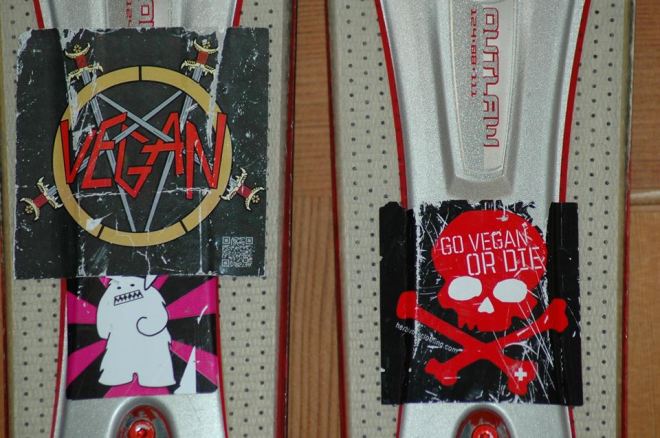
To be brutally honest with you, I don’t really care what you do to yourselves. That’s not the point. On my skis is a sticker modeled after an anti-smoking slogan that reads: “Go Vegan or Die.” It’s not so much of a warning to spoil your fun as a plea for the sake of others…

Climate Friendly Diets Are Healthier

Eating less red meat and more plant-based protein is better for the climate and for people’s health.

By Alexa Lardieri, Staff WriterJan. 24, 2019, at 6:00 a.m.
A healthy vegan/vegetarian lunch bowl of salads, grains, seeds, vegetables, avocado slices and a rich peanut-miso sauce.

A low-carbon diet consists of less red meat and dairy, and more beans, whole grains and plant-based proteins.(ENRIQUE DÍAZ/7CERO/GETTY IMAGES)

PEOPLE WHO FOLLOW A planet-friendly, diet eat healthier than those who don’t.

Food production is a major contributor to climate change, and a study published Thursday in the American Journal of Clinical Nutrition found that people who adhere to a climate-friendly diet, one that has a lower carbon footprint, eat healthier than those who don’t.

Diego Rose, lead author and a professor of nutrition and food security at Tulane University’s School of Public Health and Tropical Medicine, said in a press release that people who follow a diet that has a low carbon footprint “were eating less red meat and dairy, which contribute to a larger share of greenhouse gas emissions and are high in saturated fat, and consuming more healthful foods like poultry, whole grains and plant-based proteins.”

Researchers examined the diets of 16,000 Americans and ranked them by the amount of greenhouse gas emissions per 1,000 calories consumed. They also rated the nutritional value of the diets using the U.S. Healthy Eating Index.

The study discovered that people following diets that had a low carbon footprint ate an overall healthier diet. However, these diets did contain some low-emission foods that aren’t healthy, such as sugars and refined grains, the press release states. Additionally, the climate-friendly diets also contained lower amounts of important nutrients, such as iron, calcium and vitamin D.

Diets that had the most impact on the planet accounted for five times the emissions of those in the lowest-impact group. The diets consisted of more beef, veal, pork, game, dairy and solid fats per 1,000 calories than the diets with low carbon footprint.

Martin Heller, co-author and researcher with the University of Michigan’s Sustainable Systems Center at the School for Environment and Sustainability, tells U.S. News that adopting a diet with a low carbon footprint is “beneficial for health and the environment” and that it doesn’t take drastic measures to make a difference.

RELATED CONTENT

Scientists Push Vegetarian Diet to Save the…

Heller says that one of the biggest changes people can make is to replace beef with plant-based alternatives, such as beans, peas and lentils, as well as meat alternatives, even choosing chicken over beef “is a significant benefit.”

The reason is that the production of red meat has one of the largest effects on the environment due to the amount of work it takes to produce it. A cow requires a lot more resources than a chicken, or plants, to produce the same amount of calories. Cows require much more feed, and they produce methane, mostly in the form of burps, which is a powerful greenhouse gas.

Rose echoed this sentiment in the press release, saying that Americans can have both “healthier diets and reduce our food-related emissions,” and doing so “doesn’t require the extreme of eliminating food entirely.” Just a small shift from red meat to chicken “could reduce our carbon footprint and improve our health at the same time.”

No Tolerance for Cruelty

by Jim Robertson

Just as the abolitionists had an agenda to see an end to human slavery or the suffragettes had an agenda to see that women get the right to vote and are treated as equals, there is a vegan/animal rights agenda to see that non-humans are free from exploitation and abuse.

It’s not that we expect to give animals “human rights” or the literal right to vote (people seem to have a hard enough time with those hanging chads), but their interests should be considered whenever our actions affect them. At the very least our fellow animals deserve to be free from forced insemination, mutilation, and concentration-camp-like confinement throughout life and in the cattle-cars on their way to an early, horrific death at the slaughterhouse.

To those who say “I respect your decision to eat vegan. Now it’s time for you to respect the rest of our rights to eat what we want!!!” This situation is similar to an abolitionist being told by a slave owner that he respects the right not to have slaves, so the abolitionist should respect the right to keep people enslaved.

Veganism is in no way comparable to a religion, any more than abolitionism or the women‘s rights movement were religions.

In both of those cases, as with veganism/animal rights, the proponents of those progressive causes were desperately trying to convince people that it is wrong to consider others as mere property. And as with those other movements, people involved with wanting to end the property status of animals adhere to many different religions or none at all.

Most vegans are keenly aware that we all evolved from the same animal origins and realize that we have more similarities than differences. And as far as the idea that vegans want to see everyone convert to veganism–well, ultimately that’s true, in the same way that abolitionists wanted everyone to free their slaves or suffragettes wanted everyone to see that women deserved equal rights.

Some say that we should have tolerance for those who choose to eat meat in the same way that they have tolerance for us choosing not to eat meat. But it should be obvious that there is a major difference between tolerating the consumption of food that is the result of animal suffering, and tolerating the food choices of those who do not consume sentient beings.

Intolerant is what the Japanese accused non-whaling nations of being towards them and their “right” to harpoon, butcher and eat whales and dolphins. The Koreans who literally torture dogs to death and boil cats alive in the belief that doing so makes them taste better and/or improves their medicinal value, call you intolerant when you oppose their cruel customs. Some Europeans have accused animal advocates of intolerance for working to end their practice of force-feeding geese and ducks for fois grais, or to ban the slaughter of horses for human consumption.

In this country people like to think that the animals they buy in restaurants or in cellophane packaging have been treated well and killed humanely, because after all, this is a civilized country. Unfortunately, animals forced to live on factory farms would not think of our culture as civilized any more than dogs and cats would in Korea, or dolphins off the coast of Japan, or ducks, geese and horses in France.

The fact is you can’t house and slaughter 350,000,000 turkeys and 9,000.000.000 pigs, cows, chickens, sheep and other animals per year in a manner that would even remotely pass for humane.

No one should be expected to tolerate cruelty to animals who are capable of suffering any more than they should be expected to tolerate cruelty to humans.

Turkeys – Who Are They, and Why Should We Care?

Turkeys – Who Are They, and Why Should We Care?

By Karen Davis, PhD, President of United Poultry Concerns

This article was originally published on Independent Media Institute’s
EcoWatch, November 19, 2018
<https://go.ind.media/webmail/546932/286201367/9137f77f3a46bc4317a5f70473f7d186fc463786df10f782af2de0b0fc3905a3>
.

We adopted Amelia as a young turkey into our sanctuary from a local farmer.
She
lived with us for five years until her legs gave out and we had to call our
veterinarian to put her to rest surrounded by her friends in the yard. Until
then she hung out happily with the chickens and ducks, and when people
visited,
she’d fan out her white tail feathers and stroll amiably beside them.

Amelia chose a leafy spot to lay her eggs in, and there she would sit
quietly in
the spring and early summer. Evenings, she loved being outside with the
ducks,
poking around until the last glimmer of sinking sunlight. At last, she and
they
would amble into their house and join the chickens who were perched for the
night.

I believe Amelia would have made a wonderful mother, but our sanctuary
policy
does not allow bringing new birds into the world from which ours is a
refuge.
That said, it helps to know that turkeys are excellent mothers and that in
nature, the young birds, known as poults, stay close to her for nearly half
a
year. In nature, when the maternal family is on the move and one of her
poults
peeps his or her distress, the mother bird clucks reassuringly, and if the
peeping persists, she rushes to comfort her little one.

When her poults grow tired and cold, they tell her so, and she crouches to
warm
and comfort them under her great, enveloping wings. If, when traveling as a
unit
through the woods and fields, a youngster happens to stray, intent on his
own
pursuit, on discovering that he is alone, the poult straightens up, looks
keenly
about, listens intently, and calls anxiously to his mother. Biologists call
this
a “lost call” – the call of the frightened young turkey upon perceiving
that he
is alone. When the mother bird answers her errant youngster’s searching
cry, he
calls back to her in relief, opens up his wings, flaps them joyfully, and
runs
to rejoin his family.

In nature, baby turkeys start talking to their mother while they are still
inside their eggs nestled with their brothers and sisters in the deep
warmth of
her feathers. They know her and her voice and each other long before they
hatch.
Whenever I think of turkeys in the mechanical incubators and the
beak-mutilation
“servicing” rooms, and all the horrors that follow, I imagine the lost
calls of
all the turkeys that will never be answered. For them, there will never be a
joyous flapping of wings or a family reunited and on the move in the wooded
places they so love to explore.

Sanctuary workers like myself who’ve come to know turkeys bred for the meat
industry know that these birds have not lost their ancestral desire to
perch,
mate, walk, run, and be sociable – and even to swim. We know that their
inability to mate properly does not result from a loss of desire to do so,
but
from human-caused disabilities, including the fact that their claws and
much of
their beaks were cut off or burned off at the hatchery, making it hard for
them
to hold on to anything. Like Amelia, they’re susceptible to painful
degenerative
leg disorders that limit their spontaneous activity and cause them to age
long
before their natural 15-year lifespan.

Turkeys are emotional birds whose moods can be seen in their demeanor and
in the
pulsing colors of their faces, which turn blue, purple or red depending on
what
they are feeling. An emotional behavior in turkeys is the “great wake” a
group
will hold over a fallen companion in the natural world and on factory farms.
When, as frequently happens on factory farms, a bird has a convulsive heart
attack, several others will surround their dead companion and suddenly die
themselves, suggesting a sensibility toward one another that should awaken
us to
how terribly we treat them, and make us stop.

Observers have marveled at the great speed of sound transplantation from one
bird to another within a flock at a moment’s danger, and the pronounced
degree
of simultaneous gobbling of adult male turkeys in proximity to one another.
One
bird having begun, the others follow him so quickly that the human ear
cannot
figure which bird launched the chorus or caused it to cease.

Turkeys love to play and have fun. In *Illumination in the Flatwoods: A
Season*
*with the Wild Turkey*, naturalist Joe Hutto describes how on August
mornings his
three-month-old turkeys, on seeing him, would drop down from their roosting
limbs where they had sat ‘softly chattering” in the dawn, “stretch their
wings
and do their strange little dance, a joyful happy dance, expressing an
exuberance.”

A witness who chanced upon an evening dance of adult turkeys wrote of
hearing
them calling. No, he said, they were not calling strayed members of their
flock.
They were just having “a twilight frolic before going to roost. They kept
dashing at one another in mock anger, stridently calling all the while. . .
.
Their notes were bold and clear.”

For about five minutes, according to this witness, the turkeys “played on
the
brown pine-straw floor of the forest, then as if at a signal, they assumed a
sudden stealth and stole off in the glimmering shadows.”

We once had two female turkeys in our sanctuary, Mila and Priscilla. Though
the
same age of a few months old, they were very different from each other.
Mila was
gentle and pacific, whereas Priscilla was moody with emotional burdens
including
anger. When Priscilla got into her angry mood, her head pulsed purple
colors and
her yelps sounded a warning as she glared at my husband and me with combat
in
her demeanor, ready to charge and perhaps bite us.

What stopped her was Mila, Perking up her head at the signals, Mila would
enter
directly into the path between Priscilla and us, and block her. She would
tread
back and forth in front of Priscilla, uttering soft pleading yelps as if
beseeching her not to charge. Sure enough, Priscilla would gradually calm
down
in response to the peacemaker’s inhibiting signals.

Turkeys come into the nation’s consciousness as caricatures and corpses at
Thanksgiving, and then they’re forgotten until the next year rolls around.
Yet
turkeys are being slaughtered every single day of the year, much more often
than
for Thanksgiving alone, for which 45 million birds die. For thousands of
turkeys
– 242.5 thousand were slaughtered in 2017 in the United States, according
to the
National Turkey Federation – every single day is “Thanksgiving,” a
never-ending
harvest of horror.

Instead of calling Thanksgiving “Turkey Day,” let’s make it a turkey-free
day
and show our thanks by making peace with our feathered friends.

___________________________

Source of Annual U.S. Turkey Slaughter Statistics: National Turkey
Federation <http://www.eatturkey.com/why-turkey/stats>.

*Karen Davis, Ph.D <https://www.upc-online.org/karenbio.htm>. is the
president and founder of United Poultry Concerns, a*
*nonprofit organization and sanctuary for chickens in Virginia that
promotes the*
*compassionate and respectful treatment of domestic fowl. Karen is the
author of*
*More Than A Meal: The Turkey in History, Myth, Ritual, and Reality
<
https://www.upc-online.org/turkeys/more_than_a_meal.pdf>, Prisoned
<
https://www.amazon.com/Prisoned-Chickens-Poisoned-Eggs-Industry-ebook/dp/B00HZVA9XA/>*
*Chickens, Poisoned Eggs: An Inside Look at the Modern Poultry Industry
<
https://www.amazon.com/Prisoned-Chickens-Poisoned-Eggs-Industry-ebook/dp/B00HZVA9XA/>,
and The
<
https://www.amazon.com/Holocaust-Henmaids-Tale-Comparing-Atrocities-ebook/dp/B004W9C5B2/>*
*Holocaust and the Henmaid’s Tale: A Case for Comparing Atrocities
<
https://www.amazon.com/Holocaust-Henmaids-Tale-Comparing-Atrocities-ebook/dp/B004W9C5B2/>.
She has been*
*inducted into the National Animal Rights Hall of Fame for Outstanding*
*Contributions to Animal Liberation.*


United Poultry Concerns is a nonprofit organization that promotes
the compassionate and respectful treatment of domestic fowl.
Don’t just switch from beef to chicken. Go Vegan.
http://www.UPC-online.org/ http://www.twitter.com/upcnews
http://www.facebook.com/UnitedPoultryConcerns

View this article online
<http://upc-online.org/turkeys/181119_turkeys-who_are_they_and_why_should_we_care.html