On May 1st, dozens of conservationists and animal rights activists staged a rally in Times Square to help members of the public connect the dots between eating animals and pandemics. Their message was simple: “Eating Animals Causes Pandemics.” The New York City rally was one of approximately 60 that took place in 20 countries around the world in support of International Pandemic Outreach Day.https://www.youtube.com/embed/M_AfsUPXW1k?feature=oembed
The Eating Animals Causes Pandemics campaign is a collaboration among animal rights, environmental, conservation and religious organizations. It emerged as a result of the outbreak of COVID-19, which is believed to have jumped to humans in a live animal market in China. Like many of the pandemics that preceded it, including the catastrophic Spanish Flu of 1918, COVID-19 is a zoonotic disease — one that is transmitted to humans from a non-human animal.
On International Pandemic Outreach Day, advocates in New York City spoke to hundreds of pedestrians whose attention they captured with their hazmat suits and posters. Most were not aware that outbreaks of avian flu, swine flu and a human version of mad cow disease are caused by our consumption of chickens, pigs and cows.
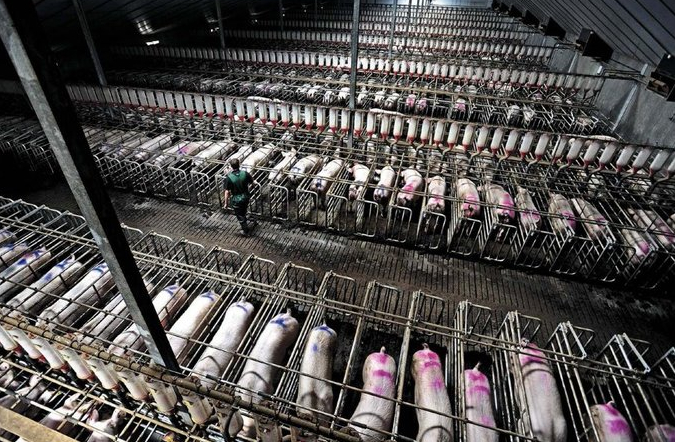
Factory farms are a breeding ground for infectious diseases, which could easily spread among the animals and, if zoonotic, to humans
The COVID-19 pandemic shined a global spotlight on the infectious disease risks associated with live animal markets, but zoonotic diseases can – and do – emerge in factory farms, slaughterhouses and any other setting where animals are intensively confined and/or slaughtered for human consumption. Dr. Michael Gregor, the author of Bird Flu: A Virus of Our Own Hatching (2016) has said, “If you actually want to create pandemics, then build factory farms.”
Conservationists and animal rights activists staged a rally in Times Square to raise awareness about the connection between eating animals and pandemics
If politicians are serious about change, they need to incentivise it, say scientists and writers
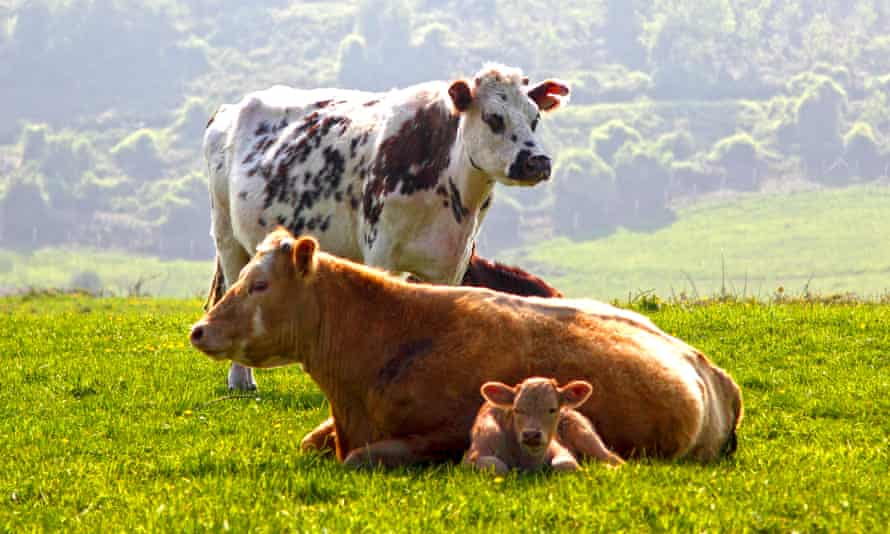
Research in 2018 showed that without meat and dairy consumption, global farmland use could be reduced by more than 75% – an area equivalent to the US, China, the EU and Australia combined – and still feed the world. Photograph: DBPITT/Getty Images/iStockphoto
The UK business secretary, Kwasi Kwarteng, is considering a “full vegan diet” to help tackle climate change, saying people will need to make lifestyle changes if the government is to meet its new emissions target of a 78% reduction on 1990 levels by 2035.
But how much difference would it make if everyone turned to a plant-based diet? Experts say changing the way we eat is necessary for the future of the planet but that government policy is needed alongside this. If politicians are serious about wanting dietary changes, they also need to incentivise it, scientists and writers add.
“Probably the most important thing to point out is that emissions are often viewed as the only metric of sustainability: they are not. Impacts of farming systems on carbon sequestration, soil acidification, water quality, and broader ecosystem services also need to be well considered,” said Matthew Harrison, systems modelling team leader at the Tasmanian Institute of Agriculture.
“There is also a need to account for farming systems that may replace livestock,” he said.
The writer and environmental campaigner George Monbiot says the numbers on the impact of going vegan are different because of what scientists measure. “There are two completely different ways look at the carbon impact of diet: one is carbon released by producing this or that food – that is ‘carbon current account’. But another one is ‘carbon capital account’, which is the carbon opportunity cost of producing this food rather than another one,” he said.
“If you are producing meat, for example, what might land be used for if you took meat away? If you are growing forests there instead or peat bog there.”
Monbiot says what we eat is a “huge issue”, alongside our transport habits. “Most of what you can do at an individual level is weak by comparison to what governments need to do … but changing diet does not. That has a major impact,” he said.
“It is easier done if the government acts to change the food system but in the absence of that, we should still try and change our diets.”
In 2018, scientists behind the most comprehensive analysis to date of the damage of farming to the planet found avoiding meat and dairy products was the single biggest way to reduce your environmental impact on the planet. The research show0ed that without meat and dairy consumption, global farmland use could be reduced by more than 75% – an area equivalent to the US, China, European Union and Australia combined – and still feed the world.
“There are lots of different sectors that have an impact on emissions and the food system is surely one of the most important ones as it is globally responsible for about a third of all greenhouse gas emissions,” said Dr Marco Springmann, senior researcher on environmental sustainability and public health at the University of Oxford.
He added that the overwhelming majority of emissions were due to foods such as beef and dairy, which “means that without changing emissions associated with those products it is hard to make progress”. He said there were no good technical solutions for the fact that “cows emit methane emissions”.
“You can change feed composition but that does not change the animal and the need to feed the animal a lot of feed product,” he said. He believes the government needs to offer price incentives for sustainable products, making beef and dairy more expensive.
Frank Mitloehner, professor and air quality extension specialist at the University of California and Davis, said putting the onus on the individual was a distraction from policy changes that are needed. He said literature suggests “going vegan for two years has the same saving impact as one flight Europe to the US would generate.”
“If we really want to make a difference in carbon emissions we need to change policy. We need to have a cost for carbon that is appropriate. We need to incentivise those who can reduce greenhouse gas emissions to do so,” he said.
He believes the most important individual choice someone can make is to “go and vote … That is number one.”
Martin Heller, a research specialist at the University of Michigan, said: “There are no silver bullets for climate change. Nothing in isolation will be ‘enough’.”
He added that studies showed that even with gracious assumptions in improvements in agricultural production, feeding an anticipated population at anticipated growing demand for animal-based foods by 2050 would occupy “all of the allowable emissions if we are to stay below a 2C temperature rise”.
“We have to change the way we eat,” he said. “That certainly isn’t saying that diet change – or even becoming vegan – will ‘save the planet’. It’s more of a necessary but not sufficient kind of thing.” He added that “these diet shifts need to come with government, corporate and every other kind of action”.
“It’s also probably naive to assume that people will just change these behaviours because it’s good for the planet. It will require directed policy, changes in the restaurant and foodservice industries,” he said.
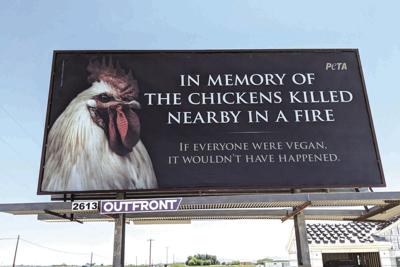
PETA erected a billboard near the main office of Hickman’s Family Farms “in memory” of the more than 165,000 birds who were killed in March in a fire at a facility owned by the company.
The billboard, at MC 85 between South 223rd and South 221st avenues, urges anyone upset by the animals’ suffering to take personal responsibility by no longer buying eggs and by going vegan.
“We’re encouraging people who were feeling sympathetic to those birds to take a look at their own actions that are also making those birds suffer on a daily basis,” said Amber Canavan, PETA senior campaigner spokesperson.
Canavan said PETA watches out for incidents in the news involving animals on farms.
“That goes for fires and transport trucks,” Canavan explained. “Transport trucks have fairly high incidents of crashes on the way to slaughterhouses, from facility to facility.
“There are least 100 a year. Many are not even reported or make it into the news. Those animals are crammed onto transport trucks, shoulder to shoulder, in there for days without food, water or rest.”
She said the public rarely thinks about animals locked behind closed doors, “out of sight, out of mind.”
“We want to make sure that they don’t just say, ‘Oh, that’s sad and go on about their day.’ We have the power to help them in many cases by not buying meat, dairy and eggs in the first place.”
PETA’s statement said hens used for egg production are confined to cramped barns, where each bird has no more than a square foot of space. Few farms install smoke detectors or fire-suppression systems.
PETA notes that going vegan spares animals immense suffering and helps prevent future epidemics and pandemics. SARS, swine flu, bird flu and COVID-19 all stemmed from confining and killing animals for food.
It can be hard to keep up with the plant-based food industry. Every month seems to bring buzzy product launches and press releases from startups about the millions of dollars they’ve raised from investors. At the same time, big-name traditional food companies continue to launch their own lines of dairy- and meat-free foods at a rapid clip.
Each year the Plant Based Foods Association and the Good Food Institute — the two main groups that advocate for meat and dairy alternatives — publish a state of the industry of sorts, analyzing how these products actually perform in grocery stores. It’s a useful zoom-out that helps put the blitz of plant-based food development into perspective.
Twice a week, we’ll send you a roundup of the best ideas and solutions for tackling the world’s biggest challenges — and how to get better at doing good. Sign up here.
Their latest report looked at 2020 sales figures and found that — as with the previous year — plant-based food retail sales grew much faster (27 percent) than the total US retail food market (15 percent). And this wasn’t just on the coasts; there was more than 25 percent growth in all US census regions.
Plant-based meat sales grew by 45 percent and plant-based milk sales were up 20 percent from 2019.
The retail market for plant-based food grew significantly from 2019 to 2020.
The growth may be eye-popping, but there’s a big caveat here: Supermarkets had an unusually good year. Early in the pandemic, panic-buying sent grocery sales surging, and earnings remained high throughout 2020 as people cooked at home more to avoid crowds and save money, giving the sales of both plant-based and animal-based foods a big bump.
Another important caveat: The plant-based food category is starting from a very low baseline. A 45 percent increase in plant-based meat sales over one year is a big deal, but it can be brought back down to earth by a grim, stubborn fact: More than 99 percent of the meat we eat in the US still comes from animals.
But this continued year-after-year growth at the very least shows there is growing demand for alternatives.
Plant-based is now more than a trend
In the mid- to late 2010s, it was common for journalists and market research groups to predict plant-based as the next big trend. Years later, it’s clear that it’s more than a trend — it’s a sizable sector of the food industry, especially alternative dairy, which is becoming less and less alternative.
Fifteen percent of fluid milk sales in retail are now plant-based, plant-based butter is at 7 percent, and plant-based coffee creamer 6 percent. Some subcategories of plant-based meat are getting more and more consumer dollars, too — for example, 2.7 percent of packaged meat sales are now plant-based. To be clear, these figures are for sales, not volume. Since plant-based products tend to cost more than their animal-derived counterparts, the actual volume of plant-based milk and packaged meat that Americans are picking up at the grocery store is likely a good amount lower than 15 percent and 2.7 percent, respectively.
Despite the relatively small share of grocery dollars spent on plant-based foods, investors are confident that alternative proteins will continue to capture more and more of the overall food industry. Last month, GFI reported that in 2020 alone, the alternative protein sector raised $3.1 billion from investors. That’s more than half of all the money raised in this space over the past decade. Much of the $3.1 billion went to big names like Impossible Foods and Oatly, but many newer companies got a boost, too.
It will take many years to see if this investment — a lot of it likely to be used on R&D — pays off, but it sets up the industry to make headway on its biggest challenges: bringing down the cost of plant-based products, making them taste better, and making them more widely available.
Better news for animals is the rise of plant-based eggs, which saw sales grow by 168 percent from 2019 to 2020. But more so than any other subcategory mentioned here, plant-based eggs were starting from an especially low baseline — Eat Just’s liquid plant-based egg only became widely available in late 2020, with practically no predecessors (or competitors).
Who’s buying plant-based food?
In addition to looking at in-store sales, PBFA and GFI also commissioned a consumer survey to look at who’s buying plant-based foods at the supermarket. They found that households with under $35,000 in income spend the least on these foods, while a little more than half of all money spent on plant-based foods comes from households making over $70,000 a year (the US median household income is $68,703).
This data underscores the importance of plant-based companies’ efforts to lower prices, and suggest that more companies ought to try to make plant-based meat as cheap as possible from the get-go, rather than creating an expensive, high-demand product at first in the hope it can scale and become affordable over time, the approach taken by most startups so far.
The survey also found that people of color overindexed on plant-based purchasing, meaning they were both more likely to buy plant-based foods and spend more on plant-based foods compared to the consumer panel, whereas white consumers underindexed.
The demographics of who’s buying plant-based foods at the grocery store.
This is not too surprising. A 2018 US Gallup poll found that nonwhite Americans were three times as likely as white Americans to identify as vegetarian, which could suggest that non-vegetarian people of color are more likely to buy plant-based food than non-vegetarian white people.
Overall, the share of households purchasing plant-based products went up only 4 percentage points since last year. Impressively, though, over half of American households reported buying a meat or dairy alternative in 2020 although only a small percentage of Americans identify as vegetarian or vegan. This could be caused, in part, by the widespread adoption of the term “plant-based” on package labeling — as opposed to “vegan” or “vegetarian” — as research has shown people are less likely to purchase food when it has a “v” word on it.
According to the report, the percentage of “plant-based” claims on packaging more than doubled last year compared to 2019. I’ve even seen this “plant-based” halo effect cross over to retail categories outside of food. Take, for example, Tide’s “plant-based” laundry detergent (I just hope nobody mistakes it for food).
It might be the case that non-vegetarians read “vegetarian” on a food package and dismiss it as something that isn’t for them, whereas “plant-based” is a more vague term, and rarely used as an identity.
The plant-based industry may be small, but that’s because it’s so new
These annual reports are released with a hefty dose of enthusiasm and optimism, which is warranted given how quickly the plant-based food sector is growing (and no surprise given the source).
But they also show just how far plant-based producers and advocates still have to go to achieve the enormous goal they’re setting out to accomplish: fundamentally changing how humanity has produced meat and milk for decades.
To do that, the plant-based food industry will need to see many consecutive years of significant growth before it can start to bring down the number of animals raised in factory farms.
That’s not happening, at least yet — meat consumption continues to rise slowly in the US while it explodes around the globe. But it’s also worth remembering that this new generation of the plant-based food industry is still in its infancy; it was only a couple of years ago when the sector’s biggest players even got their products on grocery store shelves.
It’ll be a while until we see if their efforts to transform the food industry gain serious ground. But the continual progress is encouraging.







/cdn.vox-cdn.com/uploads/chorus_image/image/69136028/GettyImages_1183778224.0.jpg)
:no_upscale()/cdn.vox-cdn.com/uploads/chorus_asset/file/22446103/Total_U.S._plant_based_food_dollar_sales_and_growth_GFI.jpg)
:no_upscale()/cdn.vox-cdn.com/uploads/chorus_asset/file/22446125/image__1_.png)


 Exposing the Big Game