Baby Steps Won’t Get Us There In Time

[In the end, the author of this lengthy article proposes what she earlier disparaged as “baby steps.”]

What if Everyone in the World Became a Vegetarian?

Vegan burgers with sweet potato and chickpeas.
Treating yourself to vegan burgers with sweet potato and chickpeas isn’t just a delicious indulgence; it could help save the planet.

Photo by Elena Veselova/Thinkstock

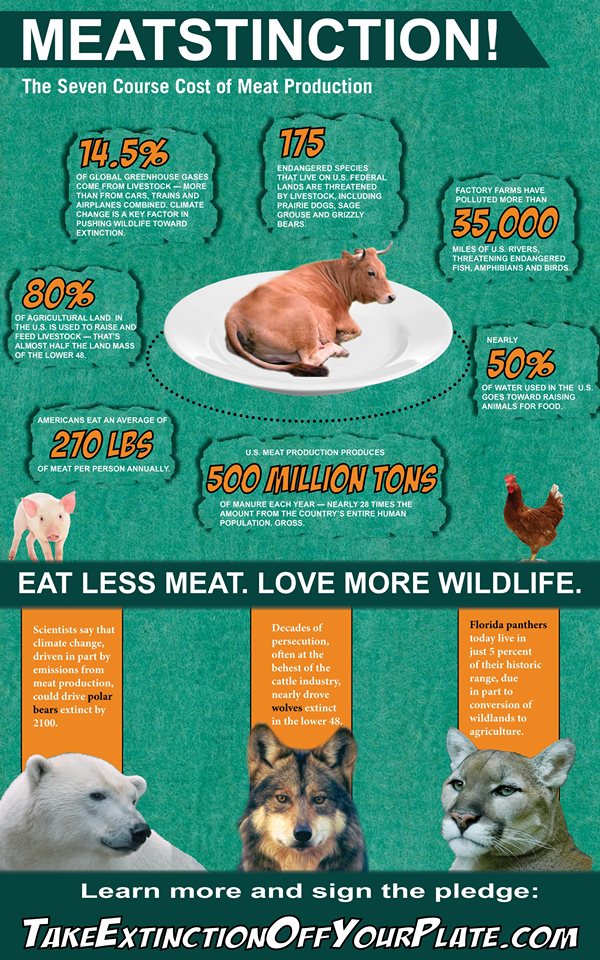
The meat industry is one of the top contributors to climate change, directly and indirectly producing about 14.5 percent of the world’s anthropogenic greenhouse gas emissions, and global meat consumption is on the rise. People generally like eating meat—when poor people start making more money, they almost invariably start buying more meat. As the population grows and eats more animal products, the consequences for climate change, pollution, and land use could be catastrophic.

Attempts to reduce meat consumption usually focus on baby steps—Meatless Monday and “vegan before 6,”passable fake chicken, andin vitro burgers. If the world is going to eat less meat, it’s going to have to be coaxed and cajoled into doing it, according to conventional wisdom.

But what if the convincing were the easy part? Suppose everyone in the world voluntarily stopped eating meat, en masse. I know it’s not actually going to happen. But the best-case scenario from a climate perspective would be if all 7 billion of us woke up one day and realized that PETA was right all along. If this collective change of spirit came to pass, like Peter Singer’s dearest fantasy come true, what would the ramifications be?

Advertisement

At least one research team has run the numbers on what global veganism would mean for the planet. In 2009 researchers from the Netherlands Environmental Assessment Agency publishedtheir projections of the greenhouse gas consequences if humanity came to eat less meat, no meat, or no animal products at all. The researchers predicted that universal veganism would reduce agriculture-related carbon emissions by 17 percent, methane emissions by 24 percent, and nitrous oxide emissions by 21 percent by 2050. Universal vegetarianism would result in similarly impressive reductions in greenhouse gas emissions. What’s more, the Dutch researchers found that worldwide vegetarianism or veganism would achieve these gains at a much lower cost than a purely energy-focused intervention involving carbon taxes and renewable energy technology. The upshot: Universal eschewal of meat wouldn’t single-handedly stave off global warming, but it would go a long way toward mitigating climate change.

Continued: http://www.slate.com/articles/health_and_science/feed_the_world/2014/05/meat_eating_and_climate_change_vegetarians_impact_on_the_economy_antibiotics.html

Noah Cared for Animals? What Heresy!

The Lessons of Noah
Darren Aronofsky dared to make his Noah care about the animals placed in his charge.

I have still not seen the new movie Noah, although I have a feeling I’m going to like it after reading about the screening party last month, an affair not quite up to the standards of the New York Post’s entertainment writer. “The buffet tables,” he reports, “were loaded with various forms of edible vegetable matter, but there was no meat . . . because director Darren Aronofsky is vegan, as was the hero of his biblical epic, as played by Russell Crowe. . . . Meat = evil. Got it. . . . I wondered, why did Noah go to all that trouble to save the animals, if not to eat at least some of them?”

Advertisement

<!– OLD AD CUTABLE AFTER GPT TEST
ord=Math.random()*10000000000000000;
window.dctile = Number(window.dctile) + 1 || 1;
document.write(‘\x3Cscript type=”text/javascript” src=”http://ad.doubleclick.net/adj/nro.com/;pos=middle;tile=4;sz=300×250;ord=&#8217; + ord + ‘;dctile=’ + dctile + ‘?”>\x3C/script>’);

–>

The Post’s reporter is used to better free food than that. Imagine the gall of Aronofsky, subjecting guests of Paramount to such privation — a whole evening without a pork loin or a bit of lamb. Usually when Hollywood figures catch grief about their causes, it’s for some glaring inconsistency with the moral ideals they urge upon others. In this case, moral consistency is the offense. The verdict on Page Six: bad manners and a boring buffet table.

A few of the more pious-sounding reviewers of Noah have likewise derided the movie as so much vegan and environmentalist propaganda, in the same exasperated tone of people not getting their accustomed fare. Russell Crowe’s Noah, writes a Washington Post columnist, is “a brooding, misanthropic vegan.” With its “anti-human-exceptionalism” themes, complains NRO’s Wesley Smith, the film could appeal only to “a small group of progressive elites and misanthropic neo-earth religionists.” So twisted is the story that “the vile villain believes it is man’s job ‘to subdue the earth’ — as he eats an animal alive with gluttonous gusto.” Meanwhile, “the ‘good guy,’ Noah, teaches that it is man’s job to ‘serve the innocent.’”

You would think that a man quoting the phrase “serve the innocent” with a sneer would pause for just a moment before going on. He might ask himself, among other questions, why animals in Scripture so often serve as the very symbols of guiltless suffering. The story of how ruin was brought upon the earth by human arrogance and depravity, moreover, is not exactly ripe material for the morally self-congratulatory themes that Aronofsky’s critics expected him to wring from it. And even at the end of the story, when we get our fresh start with the Second Covenant, that covenant is not for man alone. Some misanthropic influence decided to make it “between God and every living creature of all flesh that is upon the earth.”

I’ll leave the movie reviewing to others, but just from the standpoint of elementary morality it’s curious how Noah’s detractors keep going back to the film’s emphasis on cruelty to animals, as if it had never even occurred to them that the Lord might pay attention to such things. “The Noah movie is ugly,” warns a conservative screenwriter in The Christian Post. “It’s anti-human-exceptionalism. It’s enviro-agitprop. . . . Christians, you are tools being played if you think that this movie is anything BUT a subversion of the Biblical God and an exaltation of environmentalism and animal rights against humans.”

The same fellow gave us a “Bible-based” analysis of the script at Breitbart.com, describing the Noah character as a “vegan hippie-like gatherer of herbs.” He’s even “a bit psychotic, like an environmentalist or animal rights activist who concludes that people do not deserve to survive because of what they’ve done to the environment and to animals.” And get this: Psychotic Noah even “maintains an animal hospital to take care of wounded creatures or those who survive the evil ‘poachers’ of the land. . . . Noah is the Mother Teresa of animals.”

This shallow caviling comes at a time when, to take just one example, the elephants of the world are being butchered into oblivion by real-life evil poachers and hunters, who perhaps inspired the ones in the movie. It is a horror unfolding right now, an epic and irreversible crime against noble creatures who do not deserve such a fate. In this context, along comes Noah, the story of Creation’s second chance, showing us the hardness of heart that causes such suffering and the human compassion that alone can stop it. When did appeals for mercy to a fellow creature become “enviro-agitprop”?

We could add that in Christianity the people remembered for their kindness to animals are not considered “psychotic.” Sometimes they’re considered saints, and Francis is only the best remembered. Moses, likewise, was chosen because of his compassion for a stray lamb, and the Old Testament is filled with lovely expressions of divine solicitude for animals — who indeed, in Genesis, are “blessed” by their Maker before we even hit the scene. Far from having completely “depersonalized nature,” as that conservative screenwriter puts it on Breitbart.com, the God of Israel knows and cares about each creature He has made, and all are dear to Him for their own sakes.


Before they presume to set Aronofsky straight on the Judaeo-Christian way, his detractors could stand to learn more about it themselves. Their scoffing has the ring of injured vanity. Not enough “human exceptionalism” cowbell in the movie to drown out actual reflection on the pertinent moral themes its director has chosen to stress. If a chorus of indignant and self-satisfied derision is any measure of such a film’s artistic success, Noah seems to have hit the mark.

<!– OLD AD CUTABLE AFTER GPT TEST
ord=Math.random()*10000000000000000;
window.dctile = Number(window.dctile) + 1 || 1;
document.write(‘\x3Cscript type=”text/javascript” src=”http://ad.doubleclick.net/adj/nro.com/;pos=middle;tile=4;sz=300×250;ord=&#8217; + ord + ‘;dctile=’ + dctile + ‘?”>\x3C/script>’);

–>

Doubtless the more brutal dramas from the Bible make easier movie viewing when we can comfortably identify with the heroic figures, or at least with the innocent bystanders. Aronofsky could have flattered us along these lines, with a nice, tame tale leaving everyone to feel how special we are, how endlessly wonderful and entitled. Instead of offering up soothing spiritual bromides, however, he has evidently shown his audience respect, appealing to our conscience instead of just our self-regard. By inviting viewers to look beyond themselves, to recall the goodness and beauty of other beings and to question old cruelties of every kind, the movie has done us a service.

In this age of the merciless factory farms, inflicting boundless misery on unnumbered animals, with no regard for their dignity as living creatures, does a film director who challenges us to think about meat and its moral cost really have to explain himself? If it’s vegan propaganda that needs watching, moreover, we can start with Genesis 1:29, clear in its implication that flesh-eating is a mark of the fall and corruption of the world. When we read later on, after the deluge, that “the fear and dread of you shall be upon every beast of the earth,” does that have the ring of divine approval? Are we really to take it, as many people do in practice, as some exhortation from the Almighty to go forth and be the earth’s bullies, exploiting, destroying, and devouring as we please?

The drama of the flood and the Second Covenant is an epic of renewal, of divine concession to mankind’s incorrigible weakness and taste for violence, unfolding even as the animals are bestowed another blessing, and as the dove debuts as a symbol of peace. A more peaceful way is the whole point, which may explain why not even the most pedantic of Noah’s critics draws attention to the prophetic visions of the Old Testament, with their ideal of broken bows and reconciliation among all creatures, no violence or bloodshed but only loving kindness. A wildly impractical idea, sure; just like beating swords into plowshares, loving both our neighbor and our enemy, or, when a man asks for your coat, giving him your cloak, too.

If the Bible is your guide in these matters (and reason only points in the same direction), nothing in all its wisdom prevents anyone from witnessing for that merciful alternative in the here and now. And however blurred by the doctrines of man, there’s a good deal in Scripture to encourage the effort. Nowhere does the Lord say, “Kill this in remembrance of me.” There is no mandate to eat meat, and if there are no justifications of survival or health, either, then it’s worth asking what’s left. All sorts of fasting practices, dietary and slaughter rules, and prayers before meals still acknowledge the stain of violence. But instead of trying to sanctify the harm done, how about not harming at all? Why just say grace when we can show it?

The rankest propaganda is the kind we feed ourselves, rationalizing so many harsh things done at the expense of innocent creatures, or else finding new excuses for habits and customs we could long ago have left behind. Noah, whatever its other merits as a work of art, seems to have cast off all those excuses, steering instead toward something closer to the ideal, and there is no insult in that. Take it as a timely reminder that every one of us is free to do the same.

— Matthew Scully, a former special assistant and senior speechwriter to President George W. Bush, is the author of Dominion: The Power of Man, the Suffering of Animals, and the Call to Mercy.

Veganism: Inventing the NEW NORMAL

by Butterfies Katz


If any two words were synonymous with veganism – it would be ‘animal rights’. Since its inception in 1944, veganism has been a position of non-participation in animal exploitation. With the word ‘vegan’ becoming more popular, the meaning has become weakened, or the benefits to humans are touted more than the original intent of animal rights. ALL animals – whether human or other species – by virtue of being feeling and conscious – possess the birth right not to be bought and sold as a commodity, owned like a slave, oppressed, exploited, or attacked by humans. Animals have the inherent right not to be forcibly impregnated, have their newborn who they painfully just gave birth to – kidnapped and then killed – all socially accepted “normal” practices of the dairy industry. What society accepts as normal is in fact not normal – customary, but it’s not normal behavior to separate a newborn from his or her mother so people can drink the milk of another species; milk which is meant to grow an 80 pound calf into a 1,000 pound cow in less than a year. How normal would it appear to see a human suckling on a cow’s udders? 


An animal farmer selling cows online described my vegan views (that we don’t have a right to buy and sell a cow) as strange. I have a very different way of defining strange. Eating corpses is strange. Being entertained by animals who were forced to endure painful misery, humiliation, and captivity – horse and dog racing, animal fights, circuses, rodeos, animal acts, seaquariums, zoos – now that’s strange. What is socially accepted and passes for normal is actually cruel and callous. We need to raise the ‘normal bar’. 

Because humans are in fact animals, we are able to have empathy for fellow animals; who have many similar features. And when we empathize, we can clearly see that animals feel. They leap in joy. They speak – but like someone from another country, they speak a different language. If we tune into them and want to hear what they are saying – we can communicate and see that they feel much like we do – they want to live their lives naturally and free from harm, and protect and nurture their offspring. When we empathize, we see that animals have two eyes, a face, and a brain. They have a nervous, reproductive, digestive, circulatory, and respiratory system. They have pain receptors; and therefore feel pain as we do. Animals feel; that’s essentially what it means to be an animal. 


We have known friendship with dogs and cats, but those of us who have rescued animals of various other species – are certain that these animals are more ‘family’ than ‘food’. They’re more friends than enemies to dominate, wear their skins, hunt and hang their heads on walls as trophies. Farming, imprisoning, and anally electrocuting fur-wearing animals so we can adorn ourselves in their skins, as well as any number of business-as-usual practices presently considered ‘normal’ by society – are, in reality – savage. We can all do better. Each of us can do our part in uplifting the collective consciousness of humankind. What role could be more important for us to play in this feature film called Life? We can be forerunners, pioneers of a new world; a non-violent one…it’s what “everybody” has been wishing for ~ Peace on Earth…Goodwill to All… But to actually bring about Peace on Earth, we necessarily have to live the ideals of veganism. We can’t just say “we love animals” while we eat, wear and use products containing remnants of their tortured and mutilated bodies. We have to expand our respect for others to include anyone; any being with feelings and consciousness. 

Long-term vegans have established a way to live without directly demanding animal exploitation. For 35 years, my cosmetics and toiletries, food, clothing, and products have been free of animal ingredients nor were they tested on animals. Despicably testing products in the eyes of bunnies, forcing beagles to inhale cigarette smoke, vivisection on cats and pigs, holding primates captive and forcing them to learn what humans want them to learn, medicines tested on rats and mice and whoever else, dissecting frogs in schools – ‘animal experimentation’ is just too similar to the Tuskegee syphilis experiment; where African-American men were unknowing and did not consent to being “guinea pigs” in a lethal-to-them experiment. When humanity adopts veganism, there won’t be derogatory or speciesist words that are an abomination to the English language. For example: “guinea pigs”  or “livestock” – “the butcher” – “slaughterhouse” – “leg of lamb” – “kill two birds with one stone” –  “you rat, you dog, you animal”; as if being an animal is bad or lowly. It is a mistaken belief that animals are higher or lower – they are other species of animals, fellow Earthlings.
 
What is considered normal – is not normal. Humans have been bullies, captors, slave-masters. In Truth (with a capital T), what is really normal is the vegan concept; the perspective where every animal has the right not to be exploited or violently assaulted by humans. We can be protectors, defenders, friends to animals, rescuers – however, at the very least, people have a duty to not harm beings that are unquestionably sentient. Humans must return to the animals what is rightfully theirs. Animal rights advocates are not asking for “better treatment” or “better welfare conditions” within a system that is completely unethical. Would we ask for bigger beds in the Holocaust’s concentration camps – or – would we work to wipe out the concentration camps? We are advocating for fundamental rights of anyone sentient. We are shining a light of Truth on indefensible habits, social custom, traditions that have been accepted as the “norm”.
 
The many benefits of plant-powered living are too vast to ignore. Veganism is a solution for what ails our planet; violence and war, dwindling resources and expanding human population, lack of health and vitality, and a ‘clouded way of thinking’. The United Nations and World Watch Institute have reported that animal agriculture is the worst threat to environmental devastation and global warming. The human population is unfortunately ever-growing, and the logical way to feed all these humans is to stop syphoning most of the grain and soy crops inefficiently through animals. Theoretically, we could feed all the starving children by simply making it illegal for humans to purposely breed animals into existence. It is morally wrong to breed other animals. Plus these billions of farmed animals together are contributing greenhouse gases to global warming; more than all the transportation in the world put together, while greatly depleting and polluting our water supply. Animal agriculture is the reason for the clear cutting of Amazonian rainforest, which is the lungs of our planet.
 
Most significantly, we are misguiding the next generation that violence is normal behavior. You and I were indoctrinated since day one by society – that humans are ‘top of the food chain’, the crown of all creation, that God gave us the right to kill and eat animals, or that some animals are “pets” while others are to be ill-treated, and other falsehoods that molded all of us. The time has come for us to break the cycle and stop filling the precious innocent minds of children with the lies we were taught; lies like humans can abuse animals. Teach the next generation to respect feeling, breathing, living, and perceptually-aware animals, regardless of species. We may like to be close to a dog, while not a fish, some animals might be adorable while some look alarming – but they all deserve, at least, not to be harmed (by humans). We are reaching a point in human evolution where we are undeniably able to thrive without consuming anything animal-derived. Many plant-powered athletes, for example, the world champion extreme marathoner and vegan: Fiona Oakes and other vegan athletes – are living proof that we can more than thrive on a vegan diet. 
The reason we can legally own, enslave, buy and sell, and murder animals – is because of the almighty ‘money god’ that humans truly worship over their other deities. The profit motive supersedes what is right. However, ethics and social justice must trump immoral ways of attaining money. Slave masters were driven by their personal monetary gain only, which is comparable to animal harmers (oops farmers). Abolitionists proclaimed that money and profit are irrelevant when it comes to the objectionable behavior of owning a human being. It still holds true. We need to build a new world that is not built upon enslaving anyone sentient. Animals are individuals that should have basic rights, equally under the law, not to be a slave to a human, not to be “a someone” who is perceived and treated as “a something”, not to be a he or a she who is seen and referred to as an “it”. This objectification of other animals is to make people feel okay about their abnormal violent exploitation of others; that is socially accepted but is nonetheless wrong – even if the majority doesn’t yet see it.
 
Be vegan for ‘what is right’ – including every individual animal’s right. The vegan ideal is open to all; rich or poor, atheist or theist, young or old, any shade of skin, any nationality or ethnicity; any gender identity, anybody – everybody. Help educate others that what is presently accepted as normal; is unacceptable. Veganism has far reaching ramifications for a saner, cleaner, less violent world. Veganism is a protest to “the way it is”. Veganism is a Great Truth whose time has come. Veganism is the antidote to a world ravaged with violence. It’s a solution to our planetary problems.  Veganism is our next step. With humanity’s acceptance of vegan living, we are making history; bringing about a world where veganism is the new normal. 


I (Can’t) Accept That

Text and Wildlife Photography © Jim Robertson

Text and Wildlife Photography © Jim Robertson

Blame it on animal cruelty overload, or maybe it was the beer (I only had one, in dog years), but the other night at the annual family spring birthday party, I finally came unglued and lashed back at some glib remarks from my brother-in-law.

You see, my wife and I have been vegan for upwards of 15 years now, but we’ve managed to keep get-togethers with corpse munching, secretion gulping extended family members relatively civil—mostly because we’ve avoided talking about the subject, while they’ve “accepted” our being different.

Oh, there were a number of years when they went along with having a mostly vegan meal to humor us (except for their precious cheese). But then came the wisecracks. If there’s one thing I won’t stand for, it’s mockery from meat-eaters who can’t seem to conceive of compassion for non-human animals (besides maybe their own dog or cat).

On the night in question my sister had decided we should all bring lasagna for the birthday dinner. While they had the standard beef dish, ours was a vegan version (of course), with Daiya non-dairy cheese and Tofurky Italian sausage inside. We also had a shaker of dairy-free parmesan cheese on the table. When my sister asked what it was, my brother in law made some crack about it not being “real” and therefore did not contain the good for you things dairy supposedly has in it.

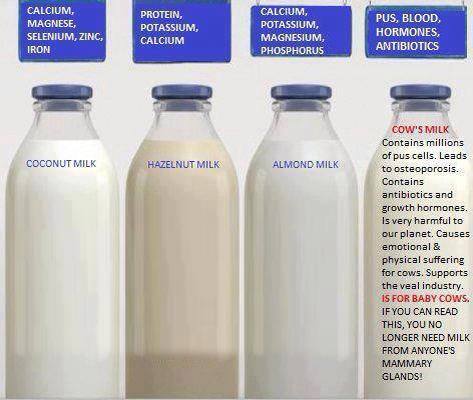
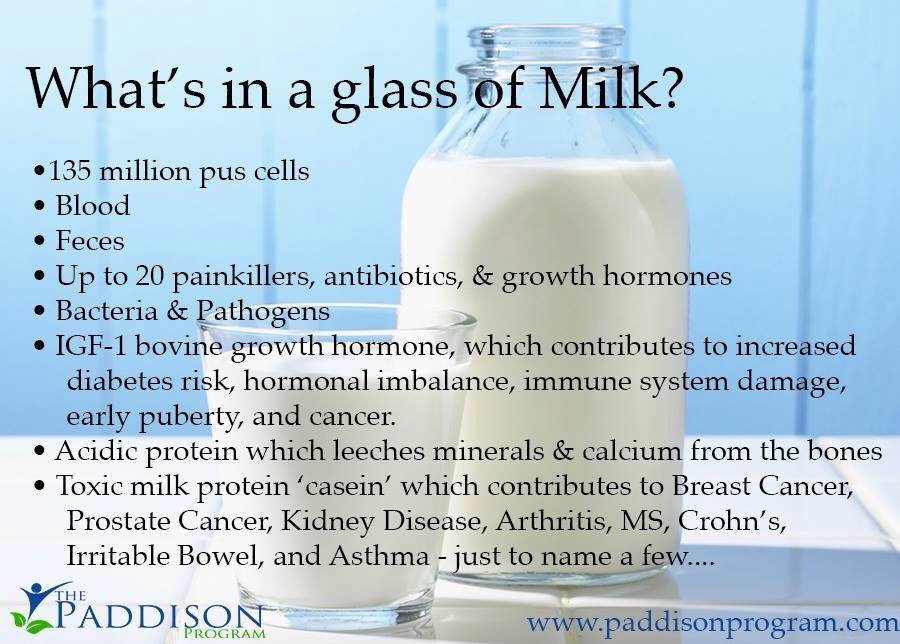
“You mean like pus?” I said, to everyone’s shock. “And then there’s the veal calf who has to suffer for every glass of milk or slice of cheese.” To that my willfully uninformed brother-in-law retorted, “I don’t have any veal in my cheese.”

“Sure you do,” I told him, “dairy cows won’t produce milk without first being impregnated—and the newborn male calves all end up dragged away from their mothers and stuck in tiny crates or chained to the floor in windowless veal barns.”

His only response? “I accept that.”

10150702_10152404415872498_866070308452200420_n

The meat industry could be driving wildlife extinct

http://www.salon.com/2014/03/21/its_not_just_cows_the_meat_industry_could_be_driving_wildlife_extinct/?source=newsletter
by Lindsay Abrams

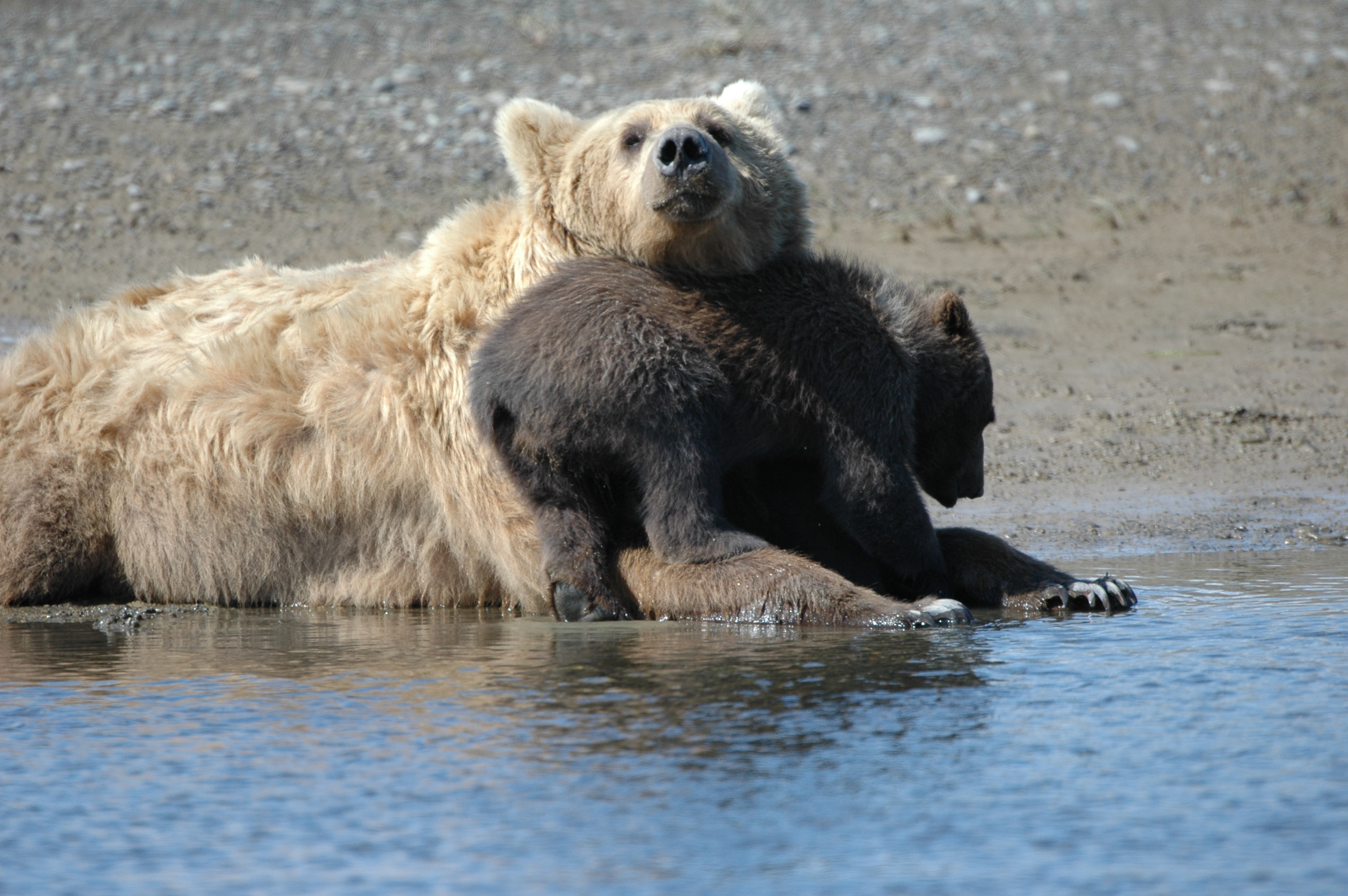
Ok, so you don’t feel bad about cows having to die in order for you to enjoy a hamburger. That’s fine — most people feel the same way. But what about the grizzly bears? Or the wolves? Or the 175 other species threatened by extinction? Would you keep eating that burger if you found out it was endangering all of those animals, too?

Well, would you?

A new campaign from the Center for Biological Diversity is presenting a broader perspective on the environmental damage wrought by the livestock industry. NPR has the scoop:

The conservation group says that some populations of grizzly bears and wolves have already been driven extinct by the livestock industry, and an additional 175 threatened or endangered species, like the prairie dog, could be next. Most of this drama is playing out on federal lands, where the needs of wildlife conflict with the needs of grazing cattle, says [population and sustainability director Stephanie Feldstein].

The federal government has for decades promoted and subsidized cattle grazing on 270 million acres of public lands in 11 Western states. According to Feldstein, one of the hot spots of livestock-wildlife conflict is predator species like wolves and bears preying on cattle.

The California grizzly subspecies, for example, was driven extinct in the 1920s by hunters assisting farmers and ranchers, according to historical documents at the University of California, Berkeley.

Ranchers also all but wiped out the Mexican gray wolf, the most endangered wolf species in the world, in the U.S. (A few survived in Mexico and in zoos, and scientists have been trying to bring them back through breeding, the group Defenders of Wildlife says.)

A study published back in January adds large carnivores, like pumas, lions and sea otters, to the list of meat industry casualties. All that, of course, comes along with the major impact our growing demand for meat has on the climate. Taken together, it’s worth considering whether that burger is, in fact, worth it.

Photo Copyright Jim Robertson

Photo Copyright Jim Robertson