No Life of Pie

Film Review and commentary by Jim Robertson

Life-of-Pi-Richard-Parker

Spoiler Alert:

If you haven’t seen the movie, Life of Pi, and you plan to, don’t read this post yet. In discussing what I feel is the story’s theme I will end up revealing some of its major plot points, and I don’t want to spoil the experience just to make a point about ethical veganism…

Still here? Ok, assuming you’ve seen the film (or read the book on which it’s based), you’ll recall that there are essentially three parts to the story, ending with what many critics felt was a disappointing and even unnecessary “alternate” account of events to explain how Pi survived such a long ordeal at sea. Personally, I didn’t find the ending a disappointment, perhaps because I may have been one of the few people who got the message the movie was trying to make. After reading dozens of reviews fawning over the special effects (the computer generated middle act was indeed amazing) and decrying the ending, I found only one review that saw it the way I did: the “alternate” story (told by Pi to a pair of Japanese Ministry of Transport officials) was really what happened.

Now, you might be thinking, why does it matter; why ruin a fun thing (especially when it looked so astounding through 3-D glasses, so I hear)? To answer that, I’m going to try to make a long story short and hit its key points (many of which were completely missed by most mainstream film critics, and movie-goers).

The film starts off with an introductory act in which we learn about the early life of the main character, Pi, through a series of flashbacks as told to a visiting writer who wants to write his biography. We are told that Pi spent his childhood trying many of the world’s religions on for size, hoping to get to know God (his atheist father tells him, “You only need to convert to three more religions, Pi, and you’ll spend your life on holiday.”) At one point he jokes that as a Catholic Hindu, “We get to feel guilty before hundreds of gods, instead of just one.”

Of note is the fact that Pi is an ethical vegetarian. He’s also fascinated by a tiger (named Richard Parker, after its captor) stuck in a zoo owned by his father. When Pi is caught trying to befriend the captive tiger, his father decides to teach him a lesson by making him watch Richard Parker kill a goat, thus instilling a morbid fear of tigers in the curious boy.

The movie’s second act begins after it’s revealed that the zoo must close and the father decides to move the animals, and his family, by ocean-going freighter across the Pacific from India to Canada. En-route, the ship is swallowed up in a massive typhoon and Pi—according to the version of the story he is telling the writer, as we witness it—is the only human to make it onto a life raft. Somehow some of the zoo animals  must have escaped their pens in the ship’s hold, and he finds himself adrift with only an injured zebra, an orangutan, a hyena and Richard Parker—the 500 pound Bengal tiger—for company.

It’s during this portion of the movie that viewers are drawn in by its startling special effects; and it’s also when the main character learns that sometimes the world is no life of pie (my interpretation of the title, as a play on the expression “easy as Pie”).

Driven  by hunger, the hyena soon feeds on the zebra and, as it turns on the orangutan, Richard Parker rushes out from under the lifeboat’s only cover (where he has stayed out of sight until now) and quickly dispatches the hyena. This chain of events is essential to the plot since, skipping ahead to the third act, it mirrors Pi’s “alternate” story: substitute the zebra for a deckhand, the orangutan for his mother, the hyena for the cook and Richard Parker for Pi’s alter-ego.

The symbolism here is that after witnessing the cook kill his mother, Pi summons his tiger-inner-self to kill the cook. And eat him. That’s right, to survive his 227 days at sea, Pi had to turn to cannibalism. Incredibly, though it’s critical to the story’s theme, nearly none of the film reviews I read even mentioned cannibalism, since most critics didn’t realize that the second “alternative” version of Pi’s plight was what must have actually happened. I thought it was pretty obvious when an adult Pi asked the writer, “So which story do you prefer?” to which the writer answered: “The one with the tiger. That’s the better story.”And so it goes with God” was Pi’s reply, meaning that, people believe what they want to believe. In order to cope with the sometimes harsh realities of life and death, in this case, resorting to cannibalism for sustenance—and still retain one’s sanity—people often cling to a fantasy world and make up stories which are easier to stomach.

Life of Pi is more than just a happy little special-effects film about a vegetarian boy and a computer-generated, 3-D tiger surviving on computer-generated, 3-D tuna and flying fish. It’s about the kind of anguish any sane person would go through when forced to eat the flesh of another human being. Perhaps the reason I could more easily relate to the story’s deeper meaning (that so many carnivorous critics failed to see) is because, having eaten only plant-based food for the past decade and a half, I feel that same sick revulsion every time I pass the meat isle in the neighborhood grocery store and imagine people actually consuming the flesh so brazenly displayed there.

264431_455824994498980_1177070538_n

Chronicling the End, Part 2

Today’s installment of Chronicling the End is also centers on the new strain of bird flu, which could play a major role in the bringing on an early demise for the species since, as Jim Pipas, virologist at the University of Pittsburgh, said: “…H7N9 is so different from influenza viruses currently circulating in the human population, humans are likely to lack an effective immune response to the virus…”

But this crisis actually has a solution—if only people are willing to forgo one of their longest-held vices—eating birds.

As CNN reports: Anne Kelso, the director of a WHO-collaborating research center, said researchers had seen a “dramatic slowdown” in human cases in Shanghai after the city’s live poultry market was shut on April 6. Describing the finding as “very encouraging,” she said evidence suggests the closure of live poultry markets is an effective way to stop the spread of the virus.

The joint inspection team from China’s National Health and Family Planning Commission and the World Health Organization also found that, so far, no migratory birds have tested positive for the virus. It said the H7N9 virus is only being found in chickens, ducks and pigeons at live poultry markets. So far there is no evidence of sustained human-to-human transmission, the authorities say.

This doesn’t have to become a pandemic, people. Let’s think outside the bucket here. The simple solution is, close the poultry markets, give up meat, and stop confining birds by the billions.

On a related not, CNN Money reports: Bird flu eats up Yum profits in China…

130423215630-yum-china-620xa

Anti-Hunt Q and A

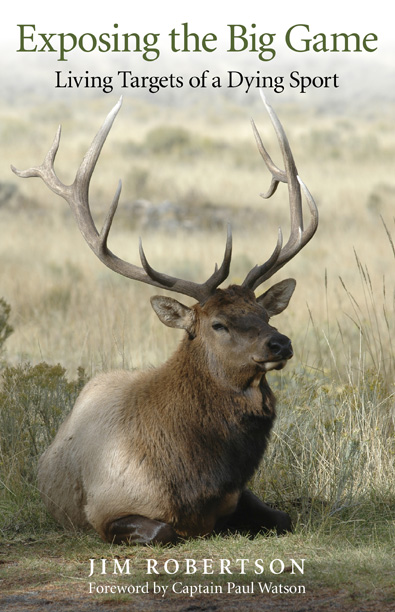
The following are my answers to interview questions posed by a journalism student who so was moved after reading my book, Exposing the Big Game: Living Targets of a Dying Sport, that she decided to undertake a project on the psychology of hunting…

1. Have you come into contact with anyone (especially hunters) who has stated that your book changed their view on the game of hunting and the mistreatment of animals?

Answer: Yes, I’ve heard from several non-hunters who have thanked me for exposing the truth about big game hunting. No longer ambivalent about the unnecessary cruelty of sport hunting, they are now active anti-hunters.

But I have yet to meet a hunter introspective enough to allow anything to change their inbred, imbedded views on killing wildlife.

2. Have you received any ‘backlash’ since publishing this book?

Answer: For what, for urging hunters and trappers to be more compassionate to our fellow beings? No, and they haven’t received any backlash from me for tormenting and killing my friends the animals (aside from my book and blog).

Deep down hunters and trappers know what they are doing is wrong; they just hope we’ll continue to let them get away with it.

3. Are you friends with anyone who avidly hunts? Do any of your family members hunt?

Answer: Unfortunately.

4. In the beginning of the book, it states that you have always been a man of compassion towards animals. Why do you think that spreading the word of being kind to animals is important?

Answer: I’m going to answer that question with another question, a couple of other questions, actually: Why did the emancipators think freeing the slaves was important? My grandmother and great aunts were suffragettes, why did they fight for women’s right to vote? Why did people push to ban kiddie porn or crush videos? Why? Because speaking out for innocent victims of exploitation is the right thing to do.

5. What do you say to those who hunt for food and not sport? Many hunters believe that it is more humane to hunt for food than it is to buy meat from a slaughter house.

Answer: First of all, most people who claim to hunt for food not sport are living far above the poverty level. They are not starving and they don’t need to kill animals to survive. They do it because they want to—it’s “fun.” In many cases they spend far more on the hunt than it would cost them to get their food from the markets where they buy their beer, tobacco and Twinkies. They can boast all they want about “using the meat”—hell, even wolf or cougar hunters will claim that they plan to eat what they kill—but they’re just trying to make their trophy hunt seem palatable to the unwary public.

And the claim that hunting is more humane than what cows go through is exaggerated at best. While there’s absolutely no denying that what cows at the slaughterhouse are forced to endure is appallingly cruel, hunters conveniently forget that the animals they stalk are stressed out from the time they hear the first gunshots fired by someone sighting in their rifles for hunting season.

The myth of that “good clean shot” is a grim fairytale in most every case. Hunters expect to have to track down and finish off an animal they’ve shot or impaled with an arrow. In reality, “game” animals probably suffer longer than those at the slaughterhouse (though this is in no way meant to condone factory farming).

When it comes right down to it, hunters don’t give a shit about being humane, or they’d quit eating meat and join the millions of people who are living proof that human beings can live longer, healthier lives if they swear off flesh foods and get their nutrients from the plant kingdom.

Text and Wildlife Photography ©Jim Robertson, 2013. All Rights Reserved

Text and Wildlife Photography ©Jim Robertson, 2013. All Rights Reserved

Forget the Calendar

According to the calendar, today’s my 52nd birthday. It’s hard to believe; I don’t feel any older than I was on the day I stopped eating meat and dairy 15 years ago. Though my choice to go vegan was for the sake of the animals—whose misery and death I was no longer willing to be a part of—the karmic reward (so to speak) has been the arrest of some of the detrimental conditions common among people in my alleged age group and a slowing down of the aging process all living things are subject to.

Unlike vegetables, fruits, nuts, grains and legumes, which can be kept as fresh as the day they were picked, meat begins to decompose the minute an animal is killed and their blood stops flowing. Any hunter or backyard butcher knows it’s a race against time to preserve dead meat before it spoils or is taken over by parasites (the microscopic kind as opposed to the human ones).Meanwhile, if not performed with great care, the morbid act of “gutting” an animal can spread E. coli and other intestinal nasties onto the “food.”

No matter how freshly killed the host animal was, their flesh is a product of death. It stands to reason that eating dead flesh cells, which contain no fiber and literally rot in the colon, will adversely affect whosoever consumes them. That’s why most herbivores live twice as long as the carnivorous species. And it’s why people who eschew meat and dairy* can potentially prolong their lives and find themselves feeling much more youthful and vital than most of their meat and dairy-eating counterparts.

*(For its part, dairy is rife with mucus forming pus—creating a favorable environment for respiratory contagions—as well as animal fat and acidic animal protein that leaches calcium from adult bones, while eggs are notoriously high in cholesterol.)

There’s a lot of truth in the saying, “You’re as young as you feel.” Forget the calendar, I don’t feel any older than 37. I can walk just as far, ski just as hard and chop as much wood as I did back then. I have just as much strength and stamina and am every bit as active in all ways—perhaps even more so, since I’ve had a decade and a half to recover from the ill effects of eating animal products.

Text and Wildlife Photography ©Jim Robertson

Vegans—Not Hunters—Are the Best Environmentalists

You’ve probably heard the cliché, “Every day is Earth Day to an environmentalist.” Well, it’s true actually, at least to a true environmentalist—the kind of person who makes daily choices based solely on their concern for our planet and the life it supports. The gal, for example, who chooses not to eat farmed animals because of the enormous amount of abuse (not to mention gargantuan carbon footprint) inherent in those Styrofoam and shrink-wrapped packages that clog the sprawling meat isles across the country; or the guy who does not hunt because wild animals are a part of the living Earth he loves and respects.

Eager to look like the sensible ones, conventional environmentalists often assume the wobbly, half-hearted stance of dismissing, rather than embracing, the animal rights movement. On the other hand, dedicated animal rights advocates don’t shy away from calling themselves environmentalists. They know that only by adopting a vegan lifestyle can one truly be an environmentalist. Vegans understand that the Earth cannot sustain billions upon billions of hungry bipedal carnivores and they recognize that the surest way to ease suffering for all is to eat lower on the food chain—in keeping with our proven primate heritage.

Absurd as it sounds to folks who really do care for the planet, certain atypically adroit sportsmen have been caught spreading the dogma that gun-toting Bambi-slayers actually have a “love for the land” and a concern for the animals they kill—that murdering animals is a wholesome Earth Day activity. Proselytizing hunter-holy-men try to downplay the obvious lethal impacts hunting has on individual animals and entire populations, wielding one of the weariest—and wackiest—of all clichés, “Hunters are the best environmentalists,” despite well-documented proof that hunting has been—and continues to be—a direct cause of extinction for untold species throughout the world.

Over-zealous hunters completely eradicated the once unimaginably abundant passenger pigeon and the Eskimo curlew (both killed en masse and sold by the cartload for pennies apiece), the Carolina parakeet (the only species of parrot native to the US) and the great auk (a flightless, North Atlantic answer to the penguin).

Hunting is the antithesis of environmentalism. The very notion of the gas-guzzling, beer-can-tossing hunter as an environmentalist is laughable even to them. Show me a hunter who is not antagonistic toward the rights of animals and I’ll show you a rare bird indeed.

     ____________________________________________________

Portions of this blog were based on excerpts from the book, Exposing the Big Game: Living Targets of a Dying Sport: http://www.earth-books.net/books/exposing-the-big-game

Image