3 black bears hit and killed in Banff in span of a week

Parks Canada says ‘unfortunate circumstances’ at play but deaths a reminder to be aware of wildlife

A black bear eats weeds at the side of a highway in this file photo. (Robson Fletcher/CBC)

Three black bears have been hit and killed by vehicles in Banff National Park in the span of a week, in what a wildlife expert describes as a series of “unfortunate circumstances.”

Dan Rafla, a human-wildlife conflict specialist with Parks Canada, says the first death happened on July 29, when a sub-adult black bear was struck and killed on the CP Rail tracks near the Banff townsite.

Then on Aug. 1, a black bear cub was hit by a transit bus on Mountain Avenue in the town.

“That was later in the night, around 11 o’clock in the evening, so it was dark,” Rafla said.

And in the early morning of Aug. 5, a vehicle hit and killed an adult black bear on the Trans-Canada Highway, just west of the Town of Banff.

Rafla said the bear had likely climbed over the wildlife fence meant to keep animals off the highway.

“Black bears are quite adept at climbing, so we assume it climbed over and unfortunately got hit when it was crossing the Trans-Canada,” he said.

‘A lot of animals on the landscape’

Bear-human conflicts tend to be more common around this time of year, Rafla added.

“We have a lot of animals on the landscape and there’s a lot of movement right now. We’re in the berry season and bears are voraciously looking for food to feed on and to put on enough weight for the winter, and they’re maybe not as attentive,” he said.

“It was maybe a bit of unfortunate circumstances to have a flurry of collisions and mortalities all within a week.”

That said, Rafla added the deaths should serve as a reminder to obey speed limits through the national park.

“There’s a reason why it’s 90 km/h and you can have wildlife on the road, despite having a fence there,” he said.

“Slowing down allows for better detection of wildlife and also better reaction time.”
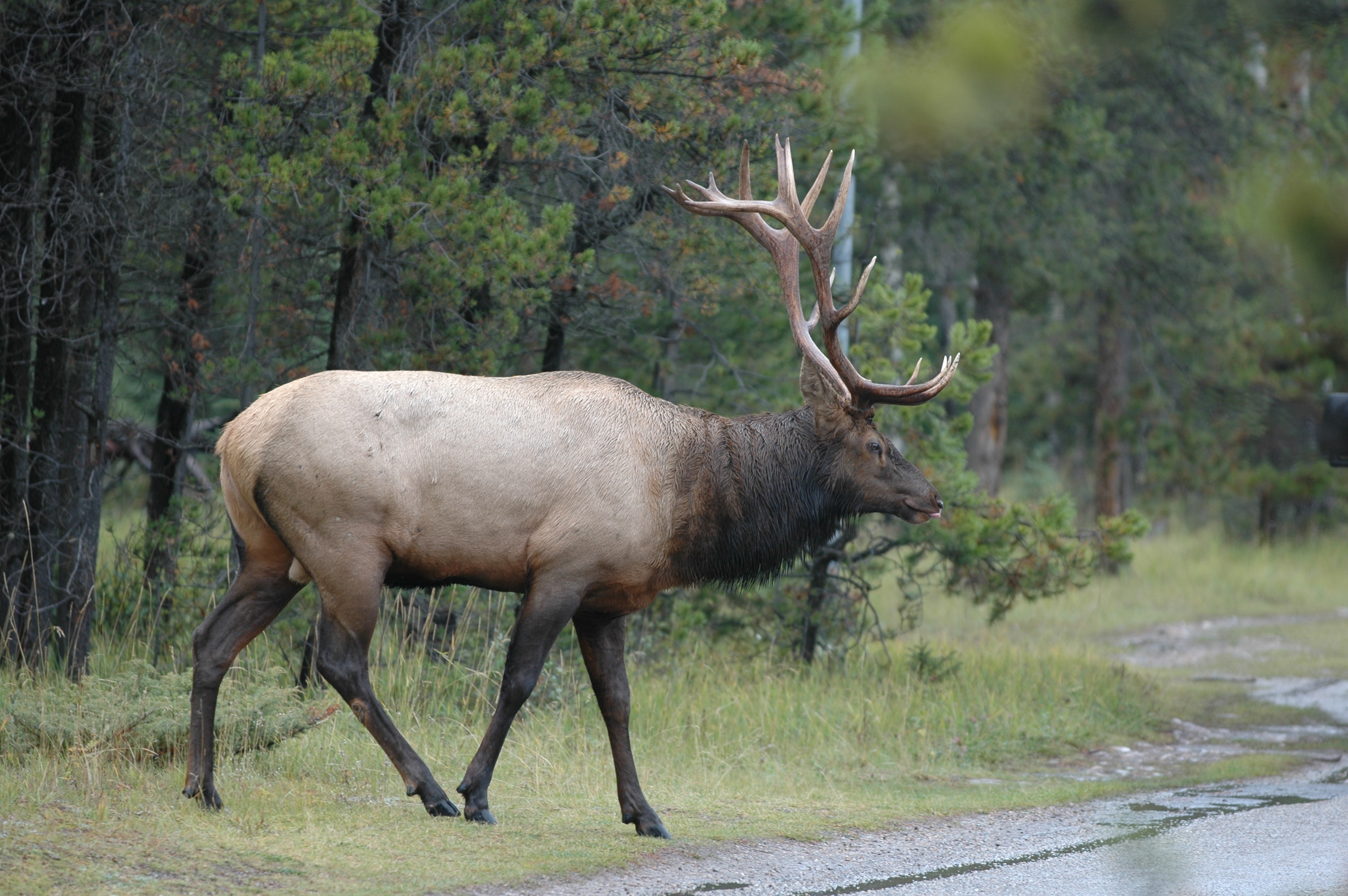
3 Vehicles Hit Herd of Elk, Media Fails to Mention Elk Casualties

The Associated Press hit a new low in reporting on an animal-related issue from a completely anthropocentric point of view. Here’s how they reported on a recent tragedy involving a group of migratory animals who dared to venture across a deadly strip of pavement created exclusively for automobiles:

http://www.komonews.com/news/local/3-vehicles-hit-herd-of-elk-on-Hwy-12-near-Satsop-240096581.html

SATSOP, Wash. – Three vehicles crashed into a large herd of elk crossing Highway 12 Monday night in Grays Harbor County at Satsop.

State troopers responded to the scene at about 9 p.m. after receiving a report of multiple collisions with an elk herd.

The Washington State Patrol says no drivers were injured in the crashes, but their vehicles didn’t fare so well.

A 2000 Dodge Dakota pickup was totaled in the crash. A 1997 Ford pickup and a 2001 Ford Expedition were damaged and had to be towed away.

Text and Wildlife Photography ©Jim Robertson, 2013. All Rights Reserved

Text and Wildlife Photography ©Jim Robertson, 2013. All Rights Reserved

_____________

And that’s it. That’s the entire extent of the article. Absolutely no mention of how well the elk herd fared.

I saw an elk get hit in the highway on Christmas night a few years back. The SUV that struck her had just passed me and somehow did not see the elk standing squarely in the middle of the road. The elk was sent into the air and landed on the opposite side of the road. No one in the vehicle was hurt, but I’m sure the owner was cursing the poor animal he ran into because she dented his car.

To the press, non-humans don’t even rate a mention, except perhaps as a “road hazard.”

On that note, here’s something I wrote back in April, 2012:

Road Hazard?

Driving to work early the other morning, I came within inches of hitting a bull elk who decided, at the last minute, to run across the highway right in front of me. Fortunately no one else was on that lonely stretch of road at the time, for if I hadn’t stomped on the brakes and cranked the wheel to the left, we would probably both be dead. I saw up close and personal how hitting an animal as large as that could do lethal damage. But the experience did not change my attitude on whether migratory wildlife should be considered a road hazard.

There’s no doubting the fact that we humans—in our full metal jacketed projectiles, lumbering headlong 60 mph through the former wilderness—are the real hazards. We’re the ones breaking nature’s rules by inventing machines that can go so fast they can put an end to anyone they run into. But, we drive like we’re saying, “We have important places to go—everyone else beware or be damned! No lowly animal better get in our way!”

If this incident had proven fatal for us, I would have wanted my epitaph to read: “I’m sorry beautiful creature. There’s nowhere I had to be that was worth the risk of ending your precious life.”