After Years of Progress, a Setback in Saving the Wolf

From the New York Times

By VERLYN KLINKENBORG

Published: June 1, 2013

The 1973 Endangered Species Act provides federal protection — breathing space, in a very real sense — to plants and animals threatened with extinction. Had this task been left to the states alone, almost none of the species that have returned to health would have done so.

But the Interior Department’s Fish and Wildlife Service now plans to remove wolves from the endangered list in all 48 contiguous states and transfer control over their fate to the states. This may save the department from running battles with Congress, state officials and hunters about protecting the wolf. Whether it will save the animal is another matter.

Thanks entirely to federal protections, wolves have rebounded remarkably in some places. There are now about 4,000 in Michigan, Minnesota and Wisconsin, and 1,600 or so more in the Rocky Mountain states of Idaho, Montana and Wyoming. Interior has gradually delisted the wolves in all these places because, it says, their numbers are enough to guarantee survival. And it is not necessary to their survival, the service says, to protect wolves elsewhere.

But many scientists argue, persuasively, that these delistings are premature — that the service is giving up on recovery before the job is done. For one thing, they note a 7 percent decline in Rocky Mountain wolves since they were delisted and controlled hunts were authorized. They also note that other recovered species — notably the bald eagle and the American alligator — were allowed to expand into much of their historical range before they were removed from the list.

The historical range of the wolf is nearly the whole contiguous United States. There is suitable habitat all across the West still unoccupied by wolves, including the Pacific Northwest, Northern California and Colorado. A recovering wolf population isn’t static. It spreads as wolves rebound. The northern Rockies and the upper Midwest are proof of that. Can wolves recover suitable parts of their historical range without federal protection? The answer is almost certainly no.

Interior’s plan has little to do with science and everything to do with politics. Congress bludgeoned President Obama’s first interior secretary, Ken Salazar, into delisting the Rocky Mountain wolf. But there is no reason his successor, Sally Jewell, has to accept a plan to delist the wolves everywhere. It is hard enough to protect species that occupy hidden ecological niches. Politics has made it harder still to protect an intelligent, adaptive predator living openly in the wild.

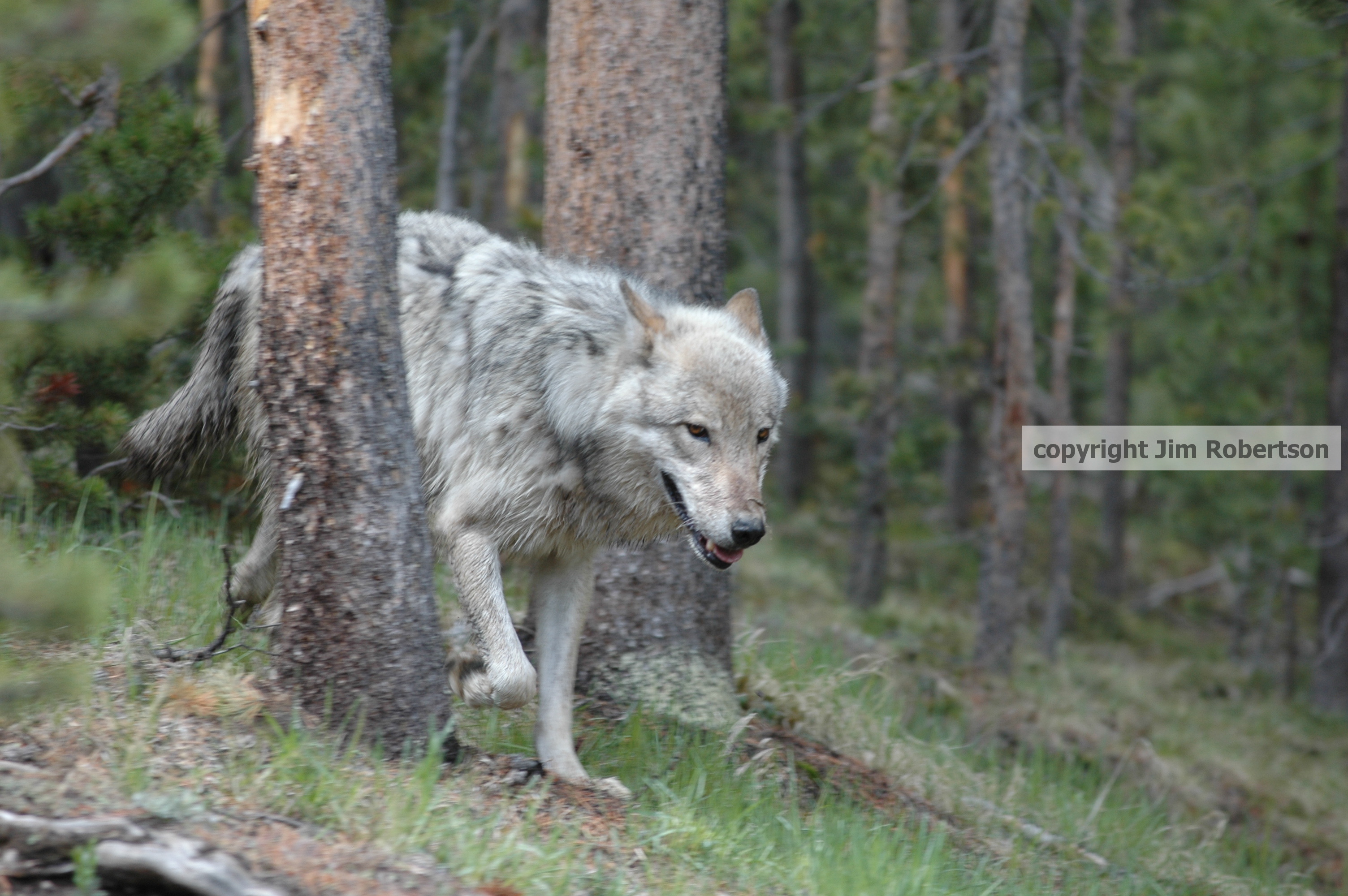
copyrighted Hayden wolf in lodgepoles

Intolerance is Sometimes the Only Humane Stance

There’s been a lot of talk about tolerance these days, but sometimes it seems only the Left side really takes the concept of peaceful acceptance to heart. Fair-minded folk are encouraged to politely tolerate each other’s differences in order to get along. But lately the anti-wolf faction has hijacked the word to justify the killing of wolves.

For example, ten Washington state legislators recently urged their Fish and Wildlife Commission to enact a policy of allowing the unpermitted killing of wolves, “to maintain social tolerance for gray wolves in northeast Washington.” And a wolf-hunter/wildlife snuff film producer told NPR News, “Having these [wolf] hunting seasons has provided a level of tolerance again.” Sorry, but I just don’t see how killing wolves promotes tolerance for them; sounds more like enmity than tolerance.

The only way I can relate is from a converse perspective: doing away with a few wolf hunters might provide some level of tolerance for them.

Still, tolerance should not be just a catchall catchword to be bandied about whenever the mood strikes—some things don’t deserve to be tolerated. No caring person should be expected to tolerate the mistreatment of others. Anyone with a sense of right and wrong should eventually come to the conclusion that intolerance is sometimes the only humane stance to take.

Intolerant is what Japanese whalers label anti-whaling groups or non-whaling nations when they question the “right” to harpoon and butcher whales or trap and slaughter dolphins. South Koreans, who literally torture dogs to death and boil cats alive in the belief that doing so makes them taste better or improves their medicinal value, call humane activists intolerant when they oppose those barbarous customs. And European and American producers of foie gras scream cultural intolerance when animal advocates work to end the bizarre practice of shoving a pipe down the throats of geese and force feeding them until their livers swell or their stomachs burst, whichever comes first.

Meanwhile hunters and trappers expect us to tolerate the torment they unleash on wolves and other wildlife. Members of a civilized society should not hesitate to take a stand against cruelty to other sentient beings—who are fully capable of suffering—in the same way they oppose cruelty to human victims.

This post includes an excerpt for the book, Exposing the Big Game; Living Targets of a Dying Sport.

Text and Wildlife Photography ©Jim Robertson, 2013. All Rights Reserved

Text and Wildlife Photography ©Jim Robertson, 2013. All Rights Reserved

Letter-length Answer to an Anti-Wolf Extremist

Dear Editor,

It was bad enough to read another damning letter from an anti-wolf extremist asking, “Is the wolf an animal we want protected in our area?” as though it’s our birthright to pick and choose which wildlife species are welcome and which are not—that kind of human arrogance is always unwelcome. But since the letter was full of hyperbole aimed at striking fear into the hearts of sport hunters, by suggesting that wolves are completely wiping out the elk in Montana, someone has to set the record straight.

Having recently lived in Montana, I’ve seen and photographed my share of wolves, but also thousands of elk and mule deer. According to a 2012 Montana Fish, Wildlife and Parks Department survey, there are 141,078 elk in the state, 55% over their “management objective” of 90,910; but rather than allowing wolves to solve their elk “problem,” they want to continue to reduce the number of both elk and wolves. That policy is not only flawed, it’s downright kill-happy.

And an alleged threat to the cattle industry is no excuse for today’s rampant killing of these important predators either. Out of the approximately 2.6 MILLION cows in Montana, only 74, or 0.0003%, were taken by wolves in 2011.

But if there has been any drop in business for Montana’s trophy elk hunting industry, it’s because wolves keep elk on the move (thus doing their job of preventing over-grazing). With elk in Montana now wilder and less complacent, the common complaint you hear from hunters is not that they’re disappearing, but that they’re gettin’ “harder to hunt.”

Text and Wildlife Photography ©Jim Robertson, 2013. All Rights Reserved

Text and Wildlife Photography ©Jim Robertson, 2013. All Rights Reserved


An Answer to an Anti-Wolf Extremist

Here’s a letter to a local Washington state newspaper from a budding anti-wolf extremist, followed by my response letter…

“Damage wolves do”
Dear Editor:
I am writing in response to Lorna Smith’s column (April 3), “Why are we so afraid of wolves?”
It’s not the wolf itself, it’s the killing they do to our deer and livestock that I’m afraid about.
I have a friend who lives in Arlie, Mont., where the wolves are abundant. He states that the wolves have completely destroyed the elk herds in his area – and are now preying on the deer.
He also states that the economy has really suffered in the area as the sportsmen are not coming to hunt anymore.
Also, there was an article in the April 2013 Western Horseman magazine. One of the featured articles was “Range Riders of the Upper Green.” The story is of Doc Foster – his main job was caring for the cattle. He states that dealing with the predator-livestock conflict took most of his time – that the wolves attack the cattle herd in a pack and focus on dragging the cattle down by the back and hindquarters. “They are killers,” Foster says. “They [wolves] eat the heart, liver and lungs and then go on.”
Is the wolf an animal we want protected in our area?
Seems like several new wolf pairs have just “arrived” in Washington state lately.
Betty Wagoner
And my response?…

Dear Editor,

It’s bad enough to read a damaging letter from an anti-wolf extremist (“Damage wolves do”) who asks, “Is the wolf an animal we want protected in our area?” as if it’s our birthright to pick and choose which species are welcome and which are not. But when the main thrust of the letter seems to be to spread disinformation—aimed at striking terror in the hearts of hunters—that “wolves have completely destroyed the elk herds” in Montana, well, someone has to set the record straight.

Having recently lived in Montana, I’ve seen and photographed my share of wolves, but also thousands of elk; and some of the mule deer herds were nearly a hundred strong in places. According to a 2012 Montana Fish, Wildlife and Parks Department survey, there are 141,078 elk in the state, 55% over their management “objective” of 90,910; but rather than allowing wolves to solve their elk “problem,” they want to reduce the number of both elk and wolves. That policy is not scientific; it’s downright kill-happy.

Meanwhile, there are currently fewer than 600 wolves in that state (hunters and trappers killed nearly 200 last season). Yet Montana wildlife officials say they are hoping to reduce the wolf population to around 450. Of course, that number does not even come close to representing a recovered state wolf population by any historical standards when you consider that 10,261 wolves were destroyed between 1884 and 1886 in Montana alone after a bounty was first initiated there—or that 380,000 wolves once roamed the lower 48.

An alleged threat to the cattle industry is certainly no excuse for today’s rampant killing of these important predators. Out of the approximately 2.6 million cattle in the state, only 74, or .0003%, were taken by wolves in 2011.

But if there has been any drop in business for the trophy elk hunting industry, it’s because wolves keep elk on the move; wilder and less complacent. In one of their most telling remarks, Montana hunters have complained that wolves make elk “too hard to hunt.” Ever their lackeys, state game managers have used that claim as an excuse to promote wolf hunting, rather than sticking up for wolves by pointing out that they are just doing their job of preventing elk from over-grazing.

So next time you hear hunters complaining about wolves, remember, it’s not because they really think wolves are going to eliminate all “their” elk—they just don’t want to have to walk too far from the pickup truck to make their kill.

Text and Wildlife Photography ©Jim Robertson, 2013. All Rights Reserved

Text and Wildlife Photography ©Jim Robertson, 2013. All Rights Reserved

How Much Are WE Willing to Tolerate?

For the first decade or so after their reintroduction to Yellowstone and central Idaho in 1996, the Federal Endangered Species Act safeguarded wolves from overzealous hunters and trappers, but as the director of the USFWS pointed out, the ESA is “not an animal protection act.” Blanket protection of any non-human animal goes against the grain of our political agencies, which are ultimately only answerable to the one species with the any hope of representation—Homo sapiens.

The right of an American species not to be hunted to extinction is a relatively new advancement. At present, it‘s about the only right extended to the nonhumans in this, the land of the free. Now that wolves are off the Endangered Species list in any state with even a minor population, the feds plan to remove them from the U.S. list completely, casting any pioneering individual or would-be wolf pack to the mercy (or lack thereof) of whichever state is fortunate enough to be graced by their presence.

An organized bunch of thugs, anti-wolf fanatics have been on point, lying in wait for the day wolves lose all protection and are deemed “fair game” for their killing pleasure. Lately a deceptively named hate-group calling itself “Big Game Forever” has been luring Utah state funds away from essentials such as schools and into their anti-wolf agenda. Just recently they leached $300,000 for their campaign against wolves in that currently wolf-less state.

Others, such as South Dakota, have hastily re-classified wolves from the status of protected to “varmint,” in the event that any lost wolf happens by. Even “progressive” Washington state jumped on the bandwagon, allowing people to kill wolves without permit and changing the wolf’s status to “big game,” ahead of their anticipated complete removal from federal ESA protection.

A classic example of what will happen the minute wolves lose federal protections was made clear yesterday as Washington state lawmakers approved “Emergency Rule WAC 232-36-05100B Killing wildlife causing private property damage” which includes the following provisions:

1) An owner of domestic animals, including livestock, the owner’s immediate family member, the agent of an owner, or the owner’s documented employee may kill one gray wolf (Canis lupus) without a permit issued by the director, regardless of its state classification, if the wolf is attacking their domestic animals.

(a) This section applies to the area of the state where the gray wolf is not listed as endangered or threatened under the federal endangered species act.
(b) Any wolf killed under this authority must be reported to the department within twenty-four hours.
(c) The wolf carcass must be surrendered to the department.
(d) The owner of the domestic animal must grant or assist the department in gaining access to the property where the wolf was killed for the purposes of data collection or incident investigation.

(2) If the department finds that a private citizen killed a gray wolf that was not attacking a domestic animal, or that the killing was not consistent with this rule, then that person may be prosecuted for unlawful taking of endangered wildlife under RCW 77.15.120.

The “Emergency Rule” is bad enough as it stands, but if ESA wolf protections are lifted nationwide (as is currently planned), points (1a) and (2) will be moot—there won’t be any area of the state safe for wolves, nor any “endangered wildlife” designation to discourage poaching. This is why the wolves, though arguably “recovered” in some areas, need to remain under federal ESA protection nationwide.

We can’t let them lose what little protection they still have in this country. While the U.S. Fish and Wildlife Service forge ahead with their plan for full removal of wolves from the ESA, we need to continue to press our new Interior Secretary Sally Jewell for both their continued protection as well as the re-listing of wolves in those states where out-of-control culling is driving them back to the brink of oblivion.

Washington’s “emergency” rule was crafted in response to a letter from ten state legislators urging their Fish and Wildlife Commission to act quickly “to maintain social tolerance for gray wolves in northeast Washington in the timeliest manner for residents.”
Hmm, killing wolves to “maintain tolerance,” where have I heard that before? Oh that’s right, it was from wildlife snuff film producer and wolf-hunter Randy Newberg who told NPR News that wolf hunts in Wyoming, Montana and Idaho are easing the animosity many local people feel toward the predator. “Having these hunting seasons has provided a level of tolerance again,” Newberg told NPR.

Let me get this straight, in order to placate and appease good ol’ boys and get them to put up with the presence of one of North America’s most historically embattled endangered species, we have to let them kill some of them once in a while? Wolf hunting and trapping are just a salve—a bit of revenge-killing for them–why not let them have their fun? By this logic, they should also be entitled to shoot an Indian every so often (like their forefathers who tried to wipe them out), to help promote tolerance and social acceptance.

It’s time to remind our politicians that the wolf-killing Calvary is about as outnumbered by those of us who appreciate wolves as General Custer was at the Battle of Little Bighorn.

What’s happening now in Washington is just how it started out in other states whose wolf-killing policies are now completely out of control. Washington wolf proponents need to realize that their wildlife policy-makers will continue to up the ante each time we accept the new status quo.

The question is, how much of a wolf-kill massacre are we willing to tolerate before we go on the warpath?

Text and Wildlife Photography ©Jim Robertson, 2013. All Rights Reserved

Text and Wildlife Photography ©Jim Robertson, 2013. All Rights Reserved

Wolves Need Their Own Untouchables

During the reign of Al Capone, when organized crime syndicates held Chicago in a stranglehold, a response team known as “The Untouchables” was formed to restore sanity to the war-torn city. With politicians and the cops in their back pockets, the crime bosses of yesteryear were able to act with impunity—to get away with murder, so to speak.

An analogous situation exists today, with anti-wolf fanatics in the role of the organized crime gangs and wolves as innocent victims. With corrupt state legislators and wildlife agencies in their pockets, organized wolf-haters are flexing their political muscles to push anti-wolf laws through everywhere the embattled canines can be found.

Some recent examples include: wolf hating troops to pressure the USFWS to delist wolves across the US., Big Game Forever, Don Peay and the Utah Legislature want to stop wolves from returning to Utah and, posted by Ralph Maughan on his website on March 26, Anti-wolf, anti-wilderness going after “pro-wolf” Washington state commissioners in hearing today…

Efforts by Washington state anti-wolf forces intercepted-

Below is an alert from anti-wolf folks in Washington State. This is an interesting example of the kind of email campaign that is being used by anti-wolf forces in a state where pro-wolf opinion is strong.

Those who support wilderness and wolves and other wildlife might want to do just the opposite of the recommendations below.
– – – – – –

Eliminate Pro-Wolf Wildlife Commissioners Now!

This is the most important thing that you can do to help hunting and the increasing wolf problem in our state. The Republicans are giving us this opportunity on a silver platter. Remember, all four guys up for confirmation on the Wildlife Commission have had a state senate hearing and they were not voted on. They can sit unconfirmed until their term expires without ever having another hearing. They don’t have to be voted on, but now they are being brought up for a vote. The Senate Natural Resources Committee Chair is bringing these guys up for hearings even though he doesn’t have to. The writing is so clear. The hunting community and ranchers are being thrown a political bone. This session Republicans were unified on gun issues. They only had two or three defecters at most on the anti-gun legislation. The GOP finally has some political clout and they are willing to do what the Democrats do – share the wealth with people that support them. I am a political realist whose passion is preserving our Second Amendment and right to hunt. Republicans in this state want to be our allies, now we have to do our part. We may never again have a chance to make a bigger splash than this. The Republicans on the committee need to hear from us and so does Hargrove. There are pro-hunting Democrats who support managing wolves 100%.

First we need to achieve our goal with each of these commissioner confirmations in committee, then the commissioners will face a vote by the full Senate. There’s a fair chance of influencing these confirmations because the full Senate did approve two of Senator Smith’s wolf bills which are now in the House. These wildlife commissioner confirmations only go before the Senate, so we do not have to worry about passing in the House. Therefore we only have two hurdles, getting the committee to vote as we would like and then getting the full Senate to vote as we would like. It’s a numbers game and it’s hard to know exactly how many messages we need to send to accomplish this goal, so we need as many messages sent as possible. Ask friends, family and any groups you belong, ask anyone you think you can convince to send email or call today.

As of Friday March 22 a Washington legislator informed us that nobody is contacting the Senate Committee regarding the confirmation of the four Wildlife Commissioners on March 26. This is the perfect chance for hunters, fishers, ranchers, and other concerned persons to have a direct impact on the Wildlife Commission. The hearing for confirmations is at 1:30 pm on March 26.

Please take 1 or 2 minutes and call or email: DO IT NOW IF YOU WANT A CHANGE!

CALL:
The committee assistant is Katharine Grimes (360) 786-7419 and ask her to forward a messages to each committee member to CONFIRM Wildlife Commissioners Mahnken and Carpenter and to OPPOSE Wildlife Commissioners Jennings and Kehne.

EMAIL: (copy and paste email list)
Kirk.Pearson@leg.wa.gov; John.Smith@leg.wa.gov; Christine.Rolfes@leg.wa.gov; Jim.Hargrove@leg.wa.gov; Mike.Hewitt@leg.wa.gov; Adam.Kline@leg.wa.gov; Linda.Parlette@leg.wa.gov;

(copy and paste subject)
Confirmation of WDFW Wildlife Commissioners

(copy and paste message or write your own)
Senate Natural Resources and Parks Committee

RE: Confirmation of WDFW Wildlife Commissioners

copyrighted-wolf-argument-settled

Wolves Getting Booted Back to the Brink

When an activist friend asked me to write an overview of the wolf situation, my first thought was: “What a daunting and extremely depressing task that would be.” But having followed the wolves’ story since long before their reintroduction to Yellowstone and the Idaho wilderness, I suppose it’s only natural that I take this on. After all, I’ve covered the issue many times in articles, on my blog, and I devoted two chapters of my book, Exposing the Big Game: Living Targets of a Dying Sport, to the plight of wolves.

At the time I wrote the book’s chapter, “From the Brink of Oblivion and Back Again,” wolves were still federally protected and their removal from the Endangered Species List was just someone’s bad idea that had yet to see its dark day—I never quite realized just how apt that title would soon be. Until recently I remained hopeful that any wolf hunting would be strictly monitored and regulated, and that abusers would be fully prosecuted. Frankly, I thought we would be a little more evolved as a species by now.

But time and again states have proven themselves unworthy by declaring open seasons on wolves, without regard for the species’ future or for the welfare of individual wolves. Indeed, the ongoing warlike attack on wolves is anything but sporting or humane, with kill methods ranging from traps and snares to aerial hunting, running them down with dogs or luring them in and sniping at entire packs with semi-automatic rifles—depending on a given state’s predilection. At the same time, many hunters and trappers go out of their way to express their hatred for wolves through horrific acts of overkill. They seem to take sick pleasure in further degrading their victims by glibly posing in morbid photos of trapped or bloodied wolves, then spreading their snuff shots across the internet, fishing for praise, while taunting wolf advocates.
Text and Wildlife Photography ©Jim Robertson, 2013. All Rights Reserved

Text and Wildlife Photography ©Jim Robertson, 2013. All Rights Reserved

For thousands of years, wolves played a central role as keepers of nature’s balance across the American landscape. Wolves are the personification of untamed wilderness; their presence is a sign of an ecosystem relatively intact.

But bigotry toward wolves has thrived across the country since colonial times and wolves have long been the object of unwarranted phobias. Today’s wolf-haters panic at the thought of natural predators competing for “their” trophy “game” animals and loath anything that might threaten their exploitive way of life. They view the federal government as the enemy in their ongoing combat against wilderness, and grasp for local control of species like wolves, who, until recently, were all but extinct in the continental U.S. Far from being their foe however, the federal government has actually been a fervent ally.

The contentious removal of wolves from the federal endangered species list—long before they were truly recovered—was a coldly calculated course set in motion by the Bush Administration, dutifully followed by the Obama Administration and rendered the law of the land through an underhanded act of Congress in 2011. This crooked covenant, conjured up for the sake of ranchers and trophy hunters, left the wolves’ fate in the custody of hostile western states…and fits right in with a centuries-old, historic norm.

In 1630, Puritans of the Massachusetts Bay Colony—known for holding the first Thanksgiving Day celebration…and Salem witch hunts—felt biblically impelled and duty-bound to “subdue the earth.” Hence, they were the first to establish a bounty on wolves. Soon the other colonies followed their example and set bounties of their own, and a systematic genocide of wolves in America spread west with the “settling” of the land.

In 1818, Ohio declared a “War of Extermination” against wolves and bears. Iowa began their wolf bounty in 1858; in 1865 and 1869 Wisconsin and Colorado followed suit. State by state wolves were shot, trapped and poisoned to extinction. As the demand for wolf pelts increased, “wolfers” began killing grazers like elk or bison and poisoning the meat as bait, decimating whole packs of unsuspecting canines in one fell swoop.

By 1872, the year President Grant created Yellowstone National Park, 100,000 wolves were being annihilated annually. 5,450 were killed in 1884 in Montana alone, after a wolf bounty was initiated there. By the end of 1886, a total of 10,261 wolves were offered up for bounty (sixteen times Montana’s 2011 population of 653 “recovered” wolves). Wyoming enacted their bounty in 1875 and in 1913 set a penalty of $300 for freeing a wolf from a trap.

Not to be outdone, the US government began a federal poisoning program in 1915 that would finish off the rest of the wolves in the region—including Yellowstone. By 1926 wolves had been completely extirpated from America’s premier national park.

Having no more regard for wolves than those who originally caused their extinctions, willfully-ignorant wolf-haters in the tri-state area of Idaho, Montana and Wyoming have not received their reintroduction with open arms but rather with loaded arms, hoping to turn the clock back to the dark ages of centuries past. The posture they assume on the subject of wolves is as warped and ill-informed as any Massachusetts witch hunter’s.

With the wolf population in the tri-state area at only a fraction of its historic sum, the federal government unceremoniously removed them from the endangered species list (and consequently from federal protection) in 2009, casting their “management” (read: eradication) into the clutches of eager states that wasted no time implementing wolf hunting seasons. Montana quickly sold 15,603 wolf permits, while their confederates in Idaho snatched up 14,000 permits to hunt the long-tormented canids.

For its part, Wyoming has stubbornly held to a policy mandating that wolves be shot on sight anytime they wander outside Yellowstone, allegedly to safeguard range cattle (who are actually 147 times more likely to fall prey to intestinal parasites). Wolves have killed a grand total of only 26 cows (out of 1.3 million head of cattle in the state). Still, the livestock industry is in control of their wolf management decisions. Though hunters there have killed 74 wolves this season, as of March 1st the state of Wyoming has expanded and extended its season indefinitely, declaring an open, year-round hunt on them. Winter, spring and summertime hunts are particularly harsh since this is when wolves are denning and raising their newborn pups.

On the other side of Yellowstone, the disingenuously but suitably named “Idaho Anti-Wolf Coalition,” backed by a well-funded trophy elk hunting industry, filed and circulated an initiative petition in 2008 calling for the removal of “all” wolves there “by whatever means necessary.” Fortunately, even in the state famous for potatoes, militias and neo-Nazi compounds, they failed to gain enough public support to move forward with their avaricious initiative. Even so, the Idaho government has been quietly carrying out the “whatever means” approach by adding aerial hunting, trapping, snaring and baiting to their wolf devastation arsenal. This last season, 169 wolves were killed by trophy hunters in Idaho, while trappers there claimed the lives of 76.

It should come as no great jolt that Idaho hunters felt they could get away with asking for the renewed obliteration of an entire species—their governor, “Butch” Otter, publicly proclaimed he hoped to be the first to shoot a wolf as soon as they lost federal ESA protection. Failing that, Otter used his gubernatorial powers to declare his state a “wolf disaster area,” granting local sheriffs’ departments the power to destroy packs whenever they please.

“Meanwhile,” according to Defenders of Wildlife’s president, Jamie Rappaport Clark, “the federal government is sitting idly by as Idaho almost singlehandedly unravels one of our nation’s greatest wildlife conservation success stories. This is totally unheard of—never before has a species climbed its way back from near extinction only to be quickly decimated once again.”

Montana started out seeming to be the sensible state, appearing almost tolerant of wolves. But between their state legislature and their wildlife policy makers, they’ve made an about face and quickly caught up with their neighbors, displaying a total disregard for the public trust doctrine which holds that wildlife, having no owners, are res communes, belonging “in common to all of the citizens.” They’ve recently passed bills barring any protected zones outside Yellowstone Park, while legalizing silencers for wolf hunting and the use of recorded calls to attract wolves, as well as allowing five wolf tags per hunter, 12 years and older. (And a new state bill is proposing lowering the legal age of hunters to nine years old.) Legislators also proposed a cap of 250 on their state wolf population. Last year’s wolf hunt kill totals for Montana were 128 wolves shot to death and 97 killed in traps.

Text and Wildlife Photography ©Jim Robertson, 2013. All Rights Reserved

Text and Wildlife Photography ©Jim Robertson, 2013. All Rights Reserved

Since Congress stripped wolves of their Endangered Species status, an estimated 1,084 wolves have been killed in the Northern Rockies. Again, that’s ONE THOUSAND AND EIGHTY-FOUR living, breathing, social, intelligent wolves killed by scornful, fearful, vengeful and boastful hunters and trappers, often in the most hideous ways imaginable.

Thanks to a federal judge’s 2010 decision, the wolf was granted a one-year stay of execution. But in 2011 our federal legislators on Capitol Hill attached a rider to a budget bill circumventing that judgment. This serpentine, backbiting end-run around science and public opinion played right into the hands of anti-wolf fanatics in Idaho and Montana and cleared the way for the bloodiest butchery of wolves in almost a century. Case in point: the opening week of Montana’s nascent hunting season on wolves saw sportsmen set up just outside the park boundary gun down every adult in Yellowstone’s well-known and much-loved Cottonwood pack, leaving their dependent pups to starve.

As if that weren’t enough, on December 6, 2012, the familiar, radio-collared alpha female of the park’s Lamar Canyon pack was shot and killed by a hunter. Suddenly the average American was aware of the atrocities of wolf hunting, yet in spite of widespread public outcry, wolf-killing states have stepped up their single-minded assault.

Wyoming’s expanded wolf-killing season is all the more tragic given that spring is the time of year that wolves are denning. As Defenders of Wildlife points out, “This expanded hunt puts the most vulnerable population of wolves – pups and pregnant or nursing mothers – in greater danger of being shot on sight. This kill-at-will approach is exactly the kind of flawed policy we knew would happen if wolves prematurely lost their Endangered Species Act protection – this is why Defenders is suing the U.S. Department of Interior to restore ESA protection for wolves in Wyoming.”

It’s not like the administration didn’t know what might happen when the fate of the wolves was turned over to states with extreme anti-wolf plans already in place. In just two years nearly 1,100 wolves have been ruthlessly murdered by hunters and trappers eager to relive the gory glory days of the 1800s.

All this is going on in spite of well-documented proof that wolves are beneficial to a given environment, and despite the fact that the majority of Americans, including most visitors to Yellowstone and the tri-state area, want to see wildlife unmolested. They are not there to hunt—the money they spend reflects their strong interest in the quiet enjoyment of nature. A 2011 National Park Service report shows that the 3,394,326 visitors to Yellowstone spent $332,975,000 in communities surrounding the park. But these figures could drop dramatically if Yellowstone wolves continue to be slaughtered.

Yellowstone is fertile ground for watching and learning about wolves. Biologists studying the Yellowstone ecosystem have found that since their reintroduction to the park, wolves have kept elk herds on the move, thus allowing over-browsed streamside riparian habitats to regenerate. Among the species that rely on a healthy riparian zone—and therefore benefit from the presence of wolves—are moose, trumpeter swans, warblers, wrens, thrushes, beavers, muskrats and the Yellowstone cutthroat trout. Everywhere they’re found, wolves play an important role in maintaining the health of ungulate herds by preying primarily on infirm or diseased animals, ensuring a healthy gene pool. And the remains of their kills provide a welcome relief for hungry scavengers, from bears to ermine to wolverines to bald eagles.

But the number of animals killed by wolves is grossly overplayed by their detractors. According to Yellowstone National Park data for 2011, project staff found that wolves barely took a bite out of Yellowstone’s rich and varied biota. And it’s long been established that wolf populations, left alone, are self-regulating; data from Yellowstone backs that up as well. Like humans, when they feel the pinch of too many of their own kind in a given area, they start to turn against one another. 2011 saw seven wolves killed in intra-pack quarrels. Yellowstone’s fluctuating wolf population has declined from 174 in 2003 to around 80 in 2012. Since then, hunters and trappers targeting wolves along the park’s borders have brought the current population down to the low 70s, as of this writing.

In addition, scientists studying the relationships between keystone predators, trophic cascades and biodiversity have found that ecosystems which include these predators have more diversity and are more resilient to climate change and stresses caused by a growing human population.

Sadly, state game departments are out of touch with these concepts. For example, according to a 2012 Montana Fish, Wildlife and Parks Department survey, there are 141,078 elk in the state, 55% over their management “objective” of 90,910; but rather than allowing wolves to solve their elk “problem,” they want to reduce the number of both elk and wolves. That policy is not scientific; it’s downright kill-happy. And an alleged threat to the cattle industry is certainly no excuse for the rampant killing of these important predators. Out of the approximately 2.6 million cattle in the state, only 74, or .0003%, were taken by wolves in 2011.

Biologist Bob Hayes, author of Wolves of the Yukon, wrote: “I spent 18 years studying the effects of lethal wolf control on prey populations. The science clearly shows killing wolves is biologically wrong. As I began to better understand the wolf, I developed a clear answer to my question about the effectiveness and moral validity of lethal wolf control programs. I can now say the benefits of broad scale killing of wolves are far from worth it…It should never happen again.”

And the late Canadian naturalist and author, R D Lawrence, stated in his book, In the Presence of Wolves: “Killing for sport, for fur, or to increase a hunter’s success by slaughtering predators is totally abhorrent to me. I deem such behavior to be barbaric, a symptom of the social sickness that causes our species to make war against itself at regular intervals with weapons whose killing capacities have increased horrendously since man first made use of the club—weapons that today are continuing to be ‘improved’.”

The 1996 reintroduction of wolves to the northern Rocky Mountains in Yellowstone and wilderness areas of Central Idaho as mandated by the Endangered Species Act–along with protections against hunting and trapping all too briefly afforded them under the ESA–gave the wolf a temporary reprieve and allowed Nature to reign again over some of her sovereign lands.

Yes, wolves are spreading out, but that doesn’t necessarily mean there are more of them; each time they find a given habitat hostile to them, they continue to branch out in search of someplace safer and more hospitable. The total wolf population of the tri-state area has fluctuated, reaching a high of around 2000 individuals. An impressive figure perhaps, unless you consider that 1,089 were killed this year (not including those killed by federal “Wildlife Services” agents); or that 10,261 wolves were destroyed between 1884 and 1886 in Montana alone; or even that 380,000 wolves once roamed the country.

While all this is going on, the Great Lakes states have been racking up a high wolf body count of their own. Wisconsin in particular seems to be bucking for a most merciless award—the cruelties they’ve unleashed on wolves are the stuff of nightmares. Though recent studies suggest wolf predation may suppress CWD (chronic wasting disease—the deer equivalent of mad cow disease), Wisconsin has spent 27 million de-populating its white-tail deer to curb CWD. To underscore the irony of this: no CWD has been detected in areas where wolves live in that state. In addition to CWD, wolves have been shown to reduce or eliminate brucellosis, ironically benefitting the very Montana ranchers who vilify them

Anti-wolf fanatics are an organized bunch of thugs. Lately a deceptively named hate-group calling itself “Big Game Forever” has been luring Utah state funds away from essentials such as schools and into their anti-wolf agenda. Just recently they leached $300,000 for their campaign against wolves in that currently wolf-less state.

States, such as South Dakota, that don’t even have wolf populations are hastily re-classifying wolves from the status of protected to “varmint,” in the event that any lost wolf happens by.  Even states as progressive as Washington are jumping on the bandwagon, allowing people to kill wolves without permit and changing the wolf’s status to “big game,” ahead of their anticipated complete removal from federal ESA protection. This can’t be allowed to happen—the minute federal protections are lifted, wolves will be fair game practically everywhere in the country!

As Aldo Leopold pointed out in 1949: “If the land mechanism as a whole is good, then every part of it is good, whether we understand it or not. If the biota, in the course of eons, has built something we like but do not understand, then who but a fool would discard seemingly useless parts? To keep every cog and wheel is the first precaution of intelligent tinkering.”

Who but a fool, indeed.

With the return of widespread wolf hunting, it will take today’s anti-wolf bigots only a few years to boot this misunderstood embodiment of wilderness back to the brink of oblivion.

________________________________________

This post includes excerpts from Exposing the Big Game: Living Targets of a Dying Sport.

Text and Wildlife Photography ©Jim Robertson, 2013. All Rights Reserved

Text and Wildlife Photography ©Jim Robertson, 2013. All Rights Reserved
Washington Another Hostile State Wanna-be

It’s clear from the irrational outbursts at a recent WDFW public meeting on wolves that Washington wants to join the ranks of the hostile, hateful anti-wolf states. At least the eastern Washington cattle ranchers do.

Here are some excerpts from an article in an eastern Washington newspaper, the Wenatchee World entitled, “Wolf management will include lethal removal, state officials say.”

(My comments are within parenthesis.)

OKANOGAN — State wildlife officials assured Okanogan County residents Thursday that some problem wolves that kill livestock will be trapped and euthanized this year.

(Is that a threat or a promise?)

“The lethal side of management is controversial, but it is a very real part of management,” Dave Ware told a standing-room-only crowd that included many cattle ranchers. The state Department of Fish and Wildlife game division manager added, “We’re trying to be more aggressive, and we’re trying to be more responsive.”

(By “responsive” he was no doubt speaking to bloodthirsty cattle ranchers, not those who suggest that wolves have their place and should be allowed to live in the state.)

Ware said his agency has also created a wildlife conflict section to stay on top of problem wolves, and has hired someone in Northeast Washington whose only focus will be on wolf conflicts.

(Sounds like some kind of a bounty hunter).

And, they will share radio-collar information about where the wolves are with ranchers who have cattle in the area.

(I knew there was a reason I hated those burdensome radio collars wolves are forced to wear; while the public is led to believe they are for “research purposes,” those collars can actually be used against the wolves by giving their locations to their sworn enemies.)

Still, more than 200 people who crowded into the Okanogan County PUD auditorium for Thursday night’s wolf meeting weren’t satisfied.

(In other words, they were out for blood.)

Some told Wildlife officials they plan to manage wolves their own way — by shooting them on sight.

(You don’t get much more hostile than that.)

An Okanogan County commissioner told them the county is interested in giving jurisdiction over the wolves to the Colville Tribes. Tribal officials last year issued nine permits to kill wolves on the Colville Indian Reservation.

(The Colvilles were the first in the state to initiate a hunting season on wolves.)

Ware said if problem wolves are located east of Highway 97 — where wolves are federally delisted — they’ll consider trapping and killing them.

(Meanwhile, the feds are planning to delist wolves elsewhere across the country—see below.)

It’s a decision that will still be made by Fish and Wildlife Director Phil Anderson, he said, but added, “Lethal removal is going to be part of that management.”

(Of course, “lethal removal” is standard practice for “wildlife managers”).

Ware also said he’s expecting the federal government to include the rest of Washington in the area where wolves are no longer protected.

(No comment).


Text and Wildlife Photography ©Jim Robertson, 2012. All Rights Reserved

Text and Wildlife Photography ©Jim Robertson, 2012. All Rights Reserved


Back To the Bad Old Days

What’s up with all the anti-wildlife legislation going on around the country these days? Everywhere you look there’s some state senator or representative introducing bills to keep non-human animals down and implement some new form of cruelty to punish them for the crime of not being born of our privileged species.

A few examples: a self-amused eastern Washington representative is calling for east-side wolves to be moved out of his district to the west side of the Cascade Mountains; at the same time Washington State politicians just introduced three bills to make it easier for ranchers to use lethal measures on wolves whenever they see fit; and of course you’ve heard that Montana’s public servants are on a rampage to get rid of their resident wolves. Now one of their legislators wants to lower the minimum hunting age for that state to nine years old.

Meanwhile, in Alaska, a senator just put forth legislation to instate a $100.00 bounty on sea otters! Never mind that these playful, aquatic mammals were nearly completely wiped out during the fur trade era, are critically endangered or extinct from much of their former range and are still listed in Alaska as Threatened or Endangered under the federal ESA, those poor, underpaid (sarcasm intended) commercial crab fishermen see them as competition. (Far from downtrodden, crabbers take pride in being the wealthiest of commercial fishermen; no doubt the senator who proposed the bounty is counting on a kickback into his campaign coffers from the crabbing industry for his otter oppression bill.)

And the list of detrimental anti-wildlife legislation goes on and on.

Is it just me, or have good ol’ boy state politicians stepped up the pace of non-human animal persecution? It’s as though they’re intentionally trying to drag us back to the bad old days of the 1800s, arguably this country’s most reckless period for uncontrolled animal exploitation—besides, perhaps, the present.

Take Action:

Not surprisingly, state legislators only take input from residents of their given state, but since there are bogus bills and measures cropping up across the country, there should be something to speak out against wherever you live. For instance, if you live in Washington State, contact your senator and urge them to oppose anti-wolf bills SB 5187, SB 5188 and SB 5193. Let them know:

  • These three bills would undermine the state’s wolf management plan by giving authority to the county legislators and local sheriffs over the state wildlife agency biologists, and would allow the public to override the state and kill wolves perceived to be a threat to livestock on public and private lands.
  • There are only 50 wolves in Washington.  Now is not the time to remove their protection.
  • Washington’s wolf management plan was created with massive public involvement and adopted unanimously by the Washington Wildlife Commission; powerful ranching advocates should not be allowed to undermine it.
Text and Wildlife Photography ©Jim Robertson, 2013. All Rights Reserved
Text and Wildlife Photography ©Jim Robertson, 2013. All Rights Reserved


Sleeping With the Enemy

Q. When are wolf advocates not really wolf advocates?

A. When they advocate for wolf hunting.

While other wildlife groups have worked to get this long-suffering species back under ESA protection, the Montana-based, Wolves of the Rockies not only told the Missoulian, “We are not advocating the end of wolf hunting,” but followed up that howler with an article in the Great Falls Tribune, in which they stated: “We at Wolves of the Rockies understand and acknowledge the importance of hunting as a tool for managing wolves, and we stand beside the ethical* hunter in doing so.”

This group asked permission to use some of my wolf photos on their Facebook page. Assuming they were on the side of the wolves, I allowed it. Given their recently stated attitude, I am forced to rescind my permission and ask them to remove my photos from their site.

Why would a wolf advocacy group publically announce their support for wolf hunting, at the risk of alienating wolf supporters and undermining the efforts of other groups fighting the barbaric treatment of wolves across the country?

This question was answered nicely (nicer than I would have) by a Facebook friend with what she  called ‘just her two cents’ (but I would argue it’s worth a lot more than that): “I’ve seen other organizations feel they have to outwardly ‘support’ hunting to get the attention of game departments, DNRs, politicians etc., in order to appear ”mainstream” & therefore afforded a sympathetic ear and/or seat at the table….I DISagree with that stance because it doesn’t work. Even if you have 100 or 1000 hunters on your side, the wildlife management system is not going to support or implement non-lethal conservation or management practices. I’ll bet Wolves of the Rockies die a little inside when they say they support hunting as a tool for wolf management, because I think in a perfect world they don’t want them hunted any more than the rest of us do. It’s too bad they have taken a position of compromise…”

I see it as kind of a, “If you can’t beat ‘em, join ‘em” approach; the same kind of thing that the Washington-based group, Conservation Northwest, pulled** during the state’s helicopter attack on the Wedge pack earlier this year. What these groups don’t realize is that when you sleep with the enemy, you don’t get just a little bit pregnant.

*see, In the Eyes of the Hunted, There’s No Such Thing as an “Ethical Hunter”

** see, Save the Wolves —Abolish Ranching and Hunting Now

And if you haven’t already, please sign these petitions to Stop Wolf Hunting in North America

and to Stop Wolf Trapping in Montana

Text and Wildlife Photography ©Jim Robertson

Text and Wildlife Photography ©Jim Robertson