Dominion fires oilfield worker after he saved 50 waterfowl

<img class="i-amphtml-intrinsic-sizer" style="max-width: 100%; display: block !important;" role="presentation" src="data:;base64,” alt=”” aria-hidden=”true” />

One of the ducks Roich has saved over the years, warming in the cab of his pickup truck after being washed clean of contaminants from an oilfield wastewater pit. (Adam Roich)

Dominion Energy fired an oilfield worker in Rock Springs after the employee saved an estimated 50 waterfowl from wastewater ponds.

Adam Roich said he’s rescued about that many waterfowl in the last five years after they landed in tainted ponds at his worksite about 50 miles south of Rock Springs. He would take the oil-slicked birds to a company facility, wash them with Dawn household soap, warm them in his truck, then set them free on clean water, he told WyoFile in an interview.

“I got fired a couple days before Christmas for rescuing these guys throughout the years,” he posted recently on Facebook above many photographs of his avian patients. “I only did what I thought was right.”

<img class="i-amphtml-intrinsic-sizer" style="max-width: 100%; display: block !important;" role="presentation" src="data:;base64,” alt=”” aria-hidden=”true” />
Adam Roich. (Adam Roich)

Dominion terminated Roich on Dec. 19 for violating company policy, according to a letter obtained by WyoFile. His firing followed an internal investigation, the seven-sentence letter read.

Dominion wouldn’t say why it fired Roich, calling the issue “an internal matter.”

“[T]he company has fully complied with the applicable laws and company policies with respect to the individual,” Dominion’s Don Porter, media relations manager, wrote WyoFile. “[W]e abide by federal regulations which direct us to notify the U.S. Fish & Wildlife Service only in the event of a bird fatality.”

Roich described a sad scene at the water’s edge: “They’d get oil on their feathers,” he said. “They’d just go to the bank and sit there. They’d freeze to death if I didn’t grab them.”

No bird rescues allowed

Four ponds, the largest about the size of a football field, dot the Canyon Creek energy field complex along the southern border of the state, Roich said. “It’s really toxic water,” he said. “Slicks of oil on them accumulate over time.”

A net covers one of them, Dominion’s Porter wrote. A BirdAvert system uses radar to deploy plastic falcons, strobes and falcon screeches to scare waterfowl away from the others.

<img class="i-amphtml-intrinsic-sizer" style="max-width: 100%; display: block !important;" role="presentation" src="data:;base64,” alt=”” aria-hidden=”true” />
A trumpeter swan in one of the oilfield ponds. (Adam Roich)

“The system doesn’t work that well,” Roich said. Dominion called the bird-scaring system “not 100% effective,” and wrote that some birds alight in the ponds anyway, landing in produced water from natural gas wells — contaminated groundwater that contains gas and other substances.

Oilfield workers at the Canyon Creek field employed their own rescue system, Roich said. “We had a net out there,” he said. “I would just net the duck or grab it.

“I would take into our facility,” he said. “I would wash it. They rode around with me in my truck loving the heat while I worked my ass off.”

At the end of the day, Roich would release the rehabilitated ducks in a freshwater pond nearby, he said. Most would fly off.

Roich contacted state wildlife officials who told him what he was doing was probably OK, he said. But Dominion wrote that such rescues by employees are not allowed.

“When this happens, Dominion Energy follows federal Migratory Bird Treaty Act-related regulations, which forbid our employees from retrieving the fowl,” Dominion’s Porter wrote WyoFile.

Roich said other workers had been rescuing ducks during his five years with the company and beyond. “Before I was there they were doing the same thing,” he said. “Others did the same, but it all got pinned on me.”

Roich said he tried to work within the system. He believes Dominion could get a permit to handle the ducks and told supervisors as much.

Federal regulations allow licensed veterinarians to rescue migratory birds without a rehabilitation permit, but they must transfer the birds to an authorized rehabilitator within 24 hours after they are stabilized.

This fall a supervisor told Roich not to rescue any more waterfowl, Roich said. “He recently ordered me to let them die and not touch them,” he wrote on Facebook. After that, “I never touched another duck,” he told WyoFile.

Dominion put him on paid leave for almost two months, Roich said. “Like I’m some criminal,” he said. He called the episode a two-month ordeal that led up to his firing.

“Then I was terminated.” Ducks were at issue, Roich said. “An HR person told me that.”

Dominion’s Porter said the company is following federal regulations.

“We did not create these rules and regulations, but we are committed to adhering to them,” he wrote. “One of Dominion Energy’s core values is ‘ethics,’ which we take seriously — especially pertaining to government regulations concerning our business operations.”

Support independent journalism — donate to WyoFile today

Dominion fired him for violating the company’s code of ethics, Roich said he was told. “I don’t think there’s anything about ducks in the code of ethics,” he said.

Roich has another job in a Rock Springs auto shop in Rock Springs, he said, but isn’t making as much as he used to in the oil patch. He believes he’s made the right decisions.

“I don’t regret it,” he said.
Be Thankful for Hunting Accidents

Text and Wildlife Photography ©Jim Robertson

Text and Wildlife Photography ©Jim Robertson

In response to a favorable comment to a post about a goose hunter who shot his 45 year old son in a hunting accident, one Facebook reader replied:

“I find it disheartening that so many anti-hunters take such psychotic joy in the death of human beings…I find this sort of cheerleading just as bad as the hunters that flaunt their kills. Show some compassion for a change.”

To which I responded, “It’s not that anti-hunters don’t have any compassion; just that their limited supply of it is focused on the original victims (in this case the geese). As police reported about the incident, ‘The two had Canadian Geese decoys spread out in front of their blind…’ Yes, this was a tragedy for the hunters…but they were out there to cause pain, suffering and death for an untold number of geese—a gentle species who care for one another and mate for life. Yesterday afternoon, after the constant blasting of shotguns earlier that day, we saw and heard a lone goose calling mournfully for its lost mate. It is not a game or a sport for the geese—is nothing short of heartbreak.

Hunting accidents are a good way to remind the public about the lethal violence inherent in the “sport” of hunting. To reach the average viewer, the media has to frame everything in the context of how it affects a person. Most people are anthropocentric and have little or no compassion for non-humans. If a human doesn’t get maimed or killed once in a while, people continue to believe the misguided notion that hunting is just a friendly, social hour for traditional family-values proponents; “ethical” conservationists (claiming to be doing the animals a favor by killing them); or worse yet, those fashionable so-called locavore foodies who think of wildlife only as a source of flesh to stuff in their trendy, goateed, hipster gob.

What real harm is there in cheering on the underdog (or deer ordsc_0112 goose or wolf) with remarks like, “What a shame,” “One less hunter out there,” “Another Darwin award,” or “Now he knows what the animals went through.” A mite insensitive, perhaps, but people’s attitudes during wartime can turn rather ugly. And make no mistake; hunting is like war to the animals and those who advocate for them. No doubt the otherwise compassionate Allies cheered as their enemies were eliminated. After all, how much compassion did Hitler and his ilk deserve anyway?

Still, in one way, devoted anti-hunters can be compared to fanatical wolf hunters who won’t be satisfied until they attain their ultimate goal: the total annihilation of their quarry. Yet anti-hunters and other compassionate misanthropists aren’t really planning to march out there and off all hunters. They know that the end of hunting won’t come about merely through  hunting accidents or people violently targeting them. There’s too much pro-hunting propaganda out there and too many hunters breeding mini-Me’s as ready-made hunting partners to one day take over the tradition.

Never mind that folks can get together in the out-of-doors to take a hike, watch birds or photograph wildlife—without taking any lives.

No, hunting isn’t going to end because of a high hunter body count. Not unless those who survive are willing to learn from others’ mistakes and lay down their weapons once and for all.

Now that’s a vision of the future to be thankful for.

DSC_0101

NY Senate Poised To Squash Plan To Kill Mute Swans

http://www.northcountrygazette.org/2014/06/06/veto_kill_plan/

By On June 6, 2014

By Anna Gufaston

For Friends Of Animals

The state’s plan to kill thousands of wild mute swans in New York – including the many that call Jamaica Bay home – by shooting or gassing them seems likely to be placed on hold, with Assembly members passing a bill last week that would delay the initiative and the state Senate poised to do the same this month.

The bill, introduced by Assemblyman Steven Cymbrowitz (D-Brooklyn), that was passed last Wednesday would establish a moratorium on the state Department of Envrionmental Conservation’s plan to declare the bird a “prohibitive invasive species” and wipe out the state’s entire mute swan population – numbering at around 2,200 – by the year 2025.

The bill also requires the DEC to hold at least two public hearings and to respond to all public comments before finalizing any management plan for mute swans. The DEC would additionally be required to prioritize non-lethal management techniques and include scientific evidence of projected and current environmental damage caused by the mute swan population.

State Sen. Tony Avella (D-Bayside) is the lead sponsor on the Senate version of the bill, which is expected to pass sometime this month.

Avella and Cymbrowitz introduced their legislation after the DEC last December made public its plan to eliminate the state’s mute swan population – which drew vehement criticism from elected officials and animal rights advocates.

“I was horrified to learn that our state wildlife agency would make such an extreme, unfounded proposal and do not believe that the DEC has provided evidence to justify the elimination of these beautiful swans,” Avella said in a previous statement.

Among those who have joined the legislators in their criticism is Friends of Animals, an animal advocacy organization that has long been protesting the proposal.

“Our New York office has been swamped with phone calls and emails from frantic New York residents horrified that mute swans may be wiped out entirely,” Friends of Animals’ New York Director Edita Birnkrant said in a previous statement.

TAKE ACTION

Please contact your NY State Senator and urge them to pass Senate Bill S.6589A–the bill that would save NY’s mute swans from being wiped. This bill passed in the Assembly last week and we need calls and emails to ensure it passes in the Senate and becomes law.

Please also contact the co-leaders of the NY Senate, Sen. Skelos at 518 455-3171 or skelos@nysenate.gov and Senator Klein at 518-455-3595 jdklein@senate.state.ny.us and tell them you want them to save our swans and pass this bill.

Swan hunting among controversial issues before Wisconsin Conservation Congress


Wildlife Photography ©Jim Robertson. All Rights Reserved

Wildlife Photography ©Jim Robertson. All Rights Reserved

A proposal to allow the hunting of tundra swans, along with a rule to allow hunters to retrieve hound dogs on private property without landowner permission, are shaping up as two of the most controversial questions before state outdoors users Monday.

The annual meetings of the Wisconsin Conservation Congress (WCC) — held simultaneously in all 72 counties — will also ask attendees about creating a hunting season for the white deer and eliminating all trapping hours restrictions.

In total, 58 questions are on the WCC spring questionnaire and results will be used to advise the Department of Natural Resources and the Natural Resources Board on policy changes. State law mandates that WCC resolutions must be considered when new legislation is written.

Many conversation groups are already raising red flags about the tundra swan hunt. The issue there is that hunters may mistake the large birds for the once endangered trumpeter swans.

Earlier this month, the Madison Audubon Society Board voted unanimously against a swan hunt because of the “high probability that trumpeter swans will be mistaken for tundra swans and killed, after Wisconsin conservationists successfully worked for many years to re-introduce trumpeters.” They are now breeding in Wisconsin and were removed from the state endangered list in 2009.

The hunt would also disrupt the spring bird-watching season and the tourism dollars it provides, Audubon warns.

The hunting dog question is causing worries for those who say it’s a trampling of property rights in the name of a limited number of bear hunters and wolf hunters who rely on dogs to track prey. Dog owners are already compensated if their animals are killed during a hunt, a controversial issue in its own right.

“Allowing hound hunters unencumbered access to private lands just because they can’t control their dogs seems to me like it would raise the ire of the citizenry at large,” says Brook Waalen, a WCC delegate from Luck in Polk County.

Waalen is among a growing number of WCC delegates representing silent sports advocates and so-called “non-consumptive” outdoor enthusiasts.

Each county gets five delegates, who are elected at the meetings and serve two-year terms on a staggered basis.

Long dominated by the “hook and bullet” crowd, the WCC is now feeling pressure from a wider outdoors constituency that wants more of a say in DNR policy. A proposal to expand hunting and trapping in state parks, along with establishing a wolf hunting season, were flashpoint issues last year that brought many to the hearings for the first time.

Last year, more than 100 environmental advocates showed up at the Polk County meeting to help elect Waalen.

Dane County and Milwaukee County in the past have elected anti-hunting activists as delegates to the Conservation Congress. Last year, wolf defender Melissa Smith was elected as a Dane County delegate.

Jason Dorgan of Blue Mounds will be seeking election Monday night as a delegate at the meeting at Middleton High School’s Performing Arts Center at 7 p.m. Dorgan enjoys running on the trails in the state parks and was upset by the proposal to expand hunting in those public areas.

“This state has 6 million acres of land for hunters and trappers to use even before the recent expansion into the state park system,” he says. “There has always been limited hunting in state parks and that has always seemed reasonable to me. “

Dorgan says as he learned more about the WCC and its interests he became more disappointed in the direction it was leading the state.

“Whether it is some of the cruel practices they condone or the lack of true land stewardship, I would like to bring another perspective to the Congress,” he says.

The swan hunting issue is a particularly tricky one.

According to the WCC ballot question, tundra swan population numbers are rising, even with hunting in other states. Tens of thousands of them migrate through Wisconsin with population counts over 30,000 on the Mississippi River.

“Wisconsin could benefit from allowing a hunt unique to very few other states,” the WCC ballot says.

The WCC maintains there is little chance of mixing up the two birds because tundra swans tend to gather in big groups on large bodies of water whereas trumpeter swans gather in smaller groups and prefer ponds or marshes.

But the Sun Prairie-based Wisconsin Wildlife Public Trust says the push to expand hunting to more and more species runs counter to the ethic of famed conservationist Aldo Leopold.

“If Aldo were to look at the ballot questions today, our guess is that he would be greatly disappointed with the current trend of the WCC in wanting to ‘take’ from land & water resources versus ‘give’ or ‘restore’ ” the group says in a posting on its website.

Read more: http://host.madison.com/news/local/writers/mike_ivey/swan-hunting-among-controversial-issues-before-wisconsin-conservation-congress/article_f2cd95dc-c19e-11e3-bf13-001a4bcf887a.html#ixzz2yhBHD5HJ


Army Corps to begin killing birds at Columbia River dam

The plan has critics.

Kierán Suckling, executive director of the Center for Biological Diversity, said there are better ways to protect the fish, such as removing the dams. “The birds are fundamentally not being killed to save the salmon,” he said. “They are being killed to keep the dams in place that are endangering the salmon.”

CLARKSTON, Wash. (AP) – The Army Corps of Engineers this spring

Photo Copyright Jim Robertson

Photo Copyright Jim Robertson

will begin killing birds at some Snake and Columbia river dams to help protect juvenile salmon and steelhead.

The agency unveiled a plan Thursday that will allow as many as 1,200 California gulls, 650 ring-billed gulls and 150 double-crested cormorants to be killed. The birds gather at the dams and feast on the migrating salmon and steelhead which bunch up there.

The Lewiston Tribune said the action will occur at McNary Dam on the Columbia River and Ice Harbor, Lower Monumental, Little Goose and Lower Granite dams on the Snake River.

The corps said birds are typically the single largest cause of juvenile salmon and steelhead mortality. A 2009 study estimated that between 4 percent and 21 percent of smolts passing through the dams were eaten by birds.

The corps has long used non-lethal methods to scare away birds.

The plan has critics.

Kierán Suckling, executive director of the Center for Biological Diversity, said there are better ways to protect the fish, such as removing the dams.

“The birds are fundamentally not being killed to save the salmon,” he said. “They are being killed to keep the dams in place that are endangering the salmon.”

Bruce Henrickson of the Army Corps in Walla Walla said the agency has been encouraged by the National Marine Fisheries Service to consider killing problem birds. He said hazing with water cannons, fire crackers and wires strung above the river that disrupt flight paths will continue to be used.

The corps contracts with the federal Wildlife Services Agency to implement the non-lethal hazing practices. The same agency will use shotguns to kill what Henrickson called problem birds or small groups of birds.

“They observe specific individual or small group behaviors, and if those birds don’t retreat from non-lethal hazing, then lethal take is considered as an option,” he said.

None of the bird species targeted for removal at the dams is listed under the Endangered Species Act but they are protected by the Migratory Bird Treaty Act. An environmental assessment found that 2,500 California gulls, 3,400 ring-billed gulls and 705 cormorants could be killed in Washington without affecting their distribution, abundance or population trends.

http://www.komonews.com/news/local/Army-Corps-to-begin-killing-birds-at-Columbia-River-dam-252917861.html

Galveston Bay Oil Spill: What We Birders Can Do

The March 22 spill of 168,000 gallons of highly toxic bunker fuel into Galveston Bay can be expected to take a huge toll on migrating, nesting, and still-wintering birds. If you want to donate money to help, Houston Audubon seems to be the go-to organization right now. But whether or not you can make a financial contribution, if you spend time on the Texas coast this spring, you can make a vitally important difference in what happens next, by submitting the sightings of every oiled bird you see into eBird. Enter the species, numbers, time, and place as always, and for each bird click “Add Details,” then click “Oiled Birds.” Provide photos whenever possible.

Even though eBird can be the perfect repository for this wealth of data, how can entering bird sightings actually help this horrible situation?

After the Exxon Valdez spill in 1989, volunteers and professionals descended upon Alaska in huge numbers. Some volunteers may have gotten in the way here and there, but with all those eyes and cameras bearing witness to the devastation, there was no way that Exxon could hide the environmental damage and the toll on wildlife. The final tally for oiled birds was between 100,000 and 250,000 oiled seabirds and at least 247 Bald Eagles. Thanks to the huge public outcry, the issue of single-hulled tankers was kept alive, and a great deal of pressure was put on Congress to enact legislation to strengthen protections for our vital waterways.

After the BP spill in 2010, I was disillusioned to see how dramatically things had changed. Only a handful of volunteers and very few professionals went to the Gulf. Marge Gibson, past president of the International Wildlife Rehabilitation Council and the woman who led the team recovering oiled Bald Eagles after the Exxon Valdez spill, was turned away from helping—literally prohibited from providing her valuable expertise—as were countless other specialists experienced in retrieving oiled pelicans and other birds along the Florida and California coasts. BP, the US Fish and Wildlife Service, conservation organizations, and the media gave out phone numbers for people to call if they wanted to help, and those of us who called were told we’d be notified if our services were necessary, but I know of no one who was ever called back. Qualified people with years of expertise in helping animals after oil spills waited for phone calls or email that never came. Marge Gibson waited for months with her bags packed.

Marge writes:

What changed between the Exxon and BP spills was that the companies learned from what they considered Exxon’s P.R. mistakes.  They learned that preventing access to the area and trying to minimize photographic evidence was the way to go.  If the public doesn’t see it, it does not exist.  Exxon has been judged severely for the Valdez accident, but in fact, after the spill they did their honest best, enlisting top scientists worldwide that were not just suits—they wore survival gear because they were physically on site—in ships and on the ground.  I was there. I worked with them.

That spill was an open book not only for the public, but for the scientists that worked on it.  B.P. decided that was not good because scientists document their work and put the data and their findings in the literature where it is available forever. The scientists who were allowed to produce studies in the aftermath of the BP spill had to sign away their rights to publish any of them for at least 5 years.

Yes, Exxon made mistakes. But it wasn’t Exxon who declared that oil companies could use single hulls again. Exxon allowed every aspect of the spill and the cleanup to be an open book. We could have learned how to reduce the potential for future spills, but all that seems to have been learned is how to do more effective cover-ups to minimize liability as much as humanly possible.

From the standpoint of wildlife conservation, the specific critical change between the 1989 Exxon spill and the 2010 BP spill is in the protocol for counting oiled animals—the only means of assessing damage to wildlife. After the Exxon spill, EVERY oiled animal that was seen was counted. Even though a quarter million oiled birds were documented, this number is considered by most authorities to be a gross underestimate, considering the huge area involved and how many birds, tiny and large, washed away undetected in the vast ocean.

With the BP spill, the new policy was to count only those oiled birds that were physically collected—picked up dead or alive. Minimizing the toll further, only a handful of people were authorized to retrieve these animals. Unauthorized people who found an oiled animal of any species were supposed to call a number and give directions to the animal, but were not allowed to not touch it or remove it under threat of heavy fines and jail.

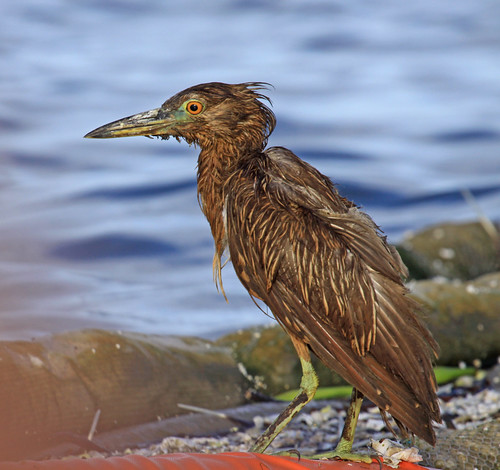
Even authorized people were prohibited from capturing any bird still capable of flight. And “flight” was defined to include even the most pathetic fluttering. This Black-crowned Night-Heron that I photographed at the edge of Cat Island in Barataria Bay after the BP spill is not included in the official count of oiled birds.

Oiled Heron

Our boat spooked it and it fluttered a few feet into the water and then struggled to shore. Our boat captain told us that because none of us were authorized to collect oiled animals, he would lose his license if we did anything to try to save it. He also said that he was prohibited from calling in people who were authorized to retrieve oiled birds because it was still “flying.” I wish I were making this up.

The timing, during nesting season, made the situation even worse. In the weeks following the explosion, birders and other experts clearly observed that 50 to 80 percent of the 10,000 breeding birds on Raccoon Island were oiled. Yet not one of those birds is included in the official count of oiled wildlife. Thanks to another bizarre rule change, people who’d been permitted to take photos and videos of nesting birds on the island before the spill were shooed away, and even those people authorized to collect wildlife were prohibited from approaching the island, ostensibly to ensure nesting success of unoiled birds. Just the oiled adult birds on Raccoon Island would have doubled the final count of oiled birds, yet not one of them, nor any of their oiled eggs and chicks, nor a single oiled bird on other nesting colonies, is included in the official total.

I rejoined ABA in the aftermath of the BP spill because ABA sponsored and provided a forum for Drew Wheelan, the only birder consistently and steadily out in the field throughout the aftermath. Drew tirelessly and against a great many forces documented everything he saw about the disaster. I spent a few weeks down there in July and August, and saw for myself that everything Drew had written about was true. As far as I’m concerned, ABA proved itself a true conservation organization by using our strength—birding expertise—to document the effects of the spill on birds.

Drew Wheelan

Some people speculate that rehabilitating oiled birds is not worth the cost and effort, when that money and energy could be going to support projects with the potential to help far greater numbers of birds. Even though I strongly believe that rehabilitating oiled birds is worth it, I agree that the subject is debatable. But the timing of the debate always seems to come right on the heels of these disasters, and following the BP spill, that debate played right into BP’s hands. Even some normally conscientious conservationists criticized the effort of retrieving these birds, presumably not realizing why retrieving these birds was so very important.

Regardless of the value of wildlife rehab, under current rules, the only oiled wildlife included in official numbers are ones that have been retrieved, dead or alive. This matters. It’s these official numbers that are used to assess damages against responsible parties. Thanks to the changes in protocol, barely 7,000 birds are in the official total of oiled wildlife after the BP spill. Just 7,000, compared to the quarter million in the official total after the Exxon Valdez spill. The National Wildlife Federation has a webpage directly comparing the two spills, but they present only the official numbers with no mention whatsoever that the method of counting changed so dramatically between the two events.

This is why it’s crucial that we birders document EVERY oiled bird. eBird is the way to do this. It will take a lot of work for scientists to identify and take out double counted birds and tease out the meaning and validity of the numbers, but only with a robust body of data can we establish with any accuracy at all the magnitude of damage from this spill.

For updates on the Galveston Bay oil spill and what you can do to help, please see Houston Audubon’s website.

To sign a petition to encourage access for rehabbers and accurate reporting of oiled birds, go here.


Meanwhile in Oklahoma…

Oklahoma hunters have already checked in 30,500 deer this season. However, that pace is slightly behind last year.

As a general rule, deer aren’t moving much around during most of the muzzleloader season, but that will soon change with the beginning of the rut, the time of year when whitetails become less cautious. Deer are now starting to move more during the day, and some bucks already have been seen trailing does.

Okla.’s 16 day deer gun season, the biggest hunting season of the year, begins the Saturday before Thanksgiving. Almost 200,000 hunters in Okla. participate in the deer gun season.

Archery deer season remains open thru Jan. 15th. [So, you can expect to see more of those arrow-impaled deer wandering around for another 2 months….]

The Okla. Dept. of Wildlife Conservation has extended the deadline for the agency’s guided youth waterfowl hunts to Nov. 21. The youth hunts are open to hunters ages 12 to 15 who have completed the hunter education course. An adult guardian must accompany the youth hunter. Many of the states wildlife refuges have guided hunts.

Wildlife Photography © Jim Robertson

Wildlife Photography © Jim Robertson