China’s Wet Markets, America’s Factory Farming

https://www.nationalreview.com/2020/04/chinas-wet-markets-americas-factory-farming-both-violate-moral-common-sense/
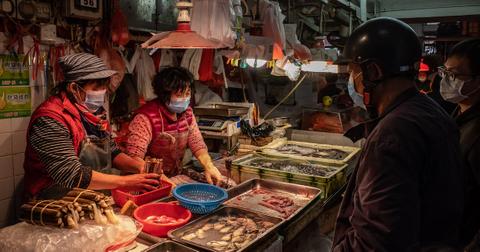
Customers select seafood at a wet market in Dandong, Liaoning Province, China, in 2017. (Philip Wen/Reuters)

They’re more alike than not in their violations of moral common sense.

NRPLUS MEMBER ARTICLE

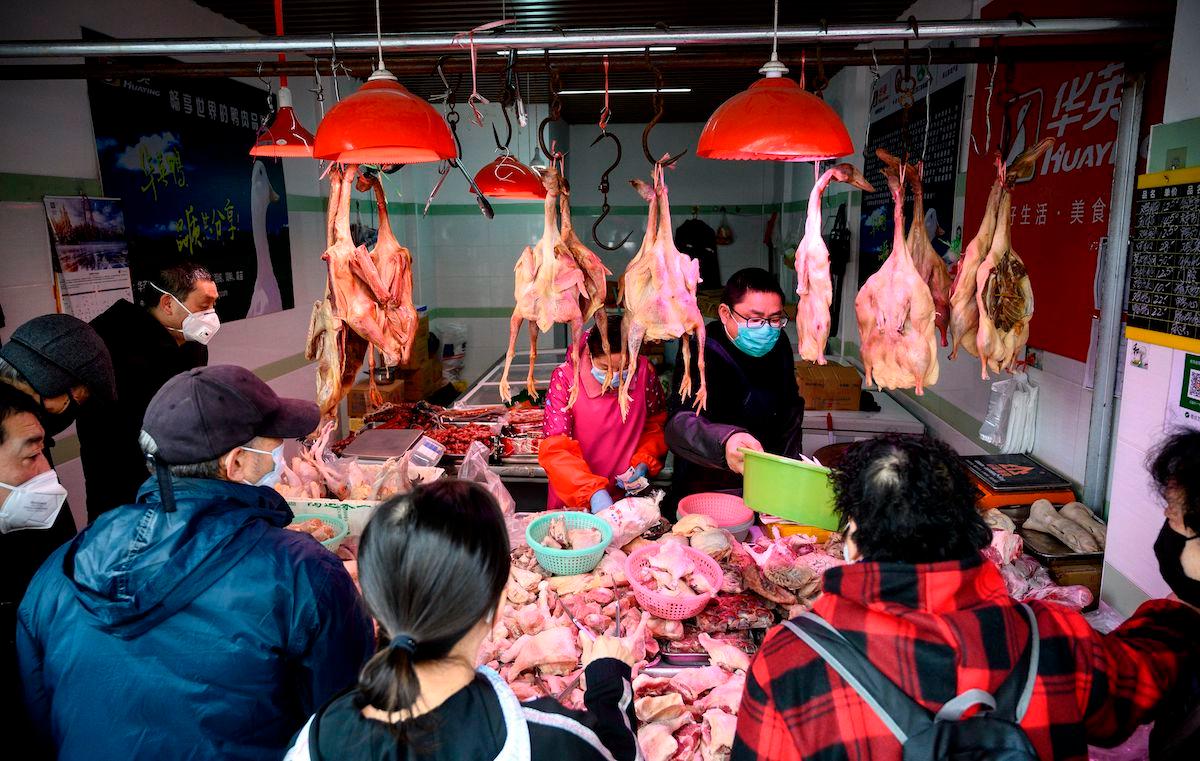
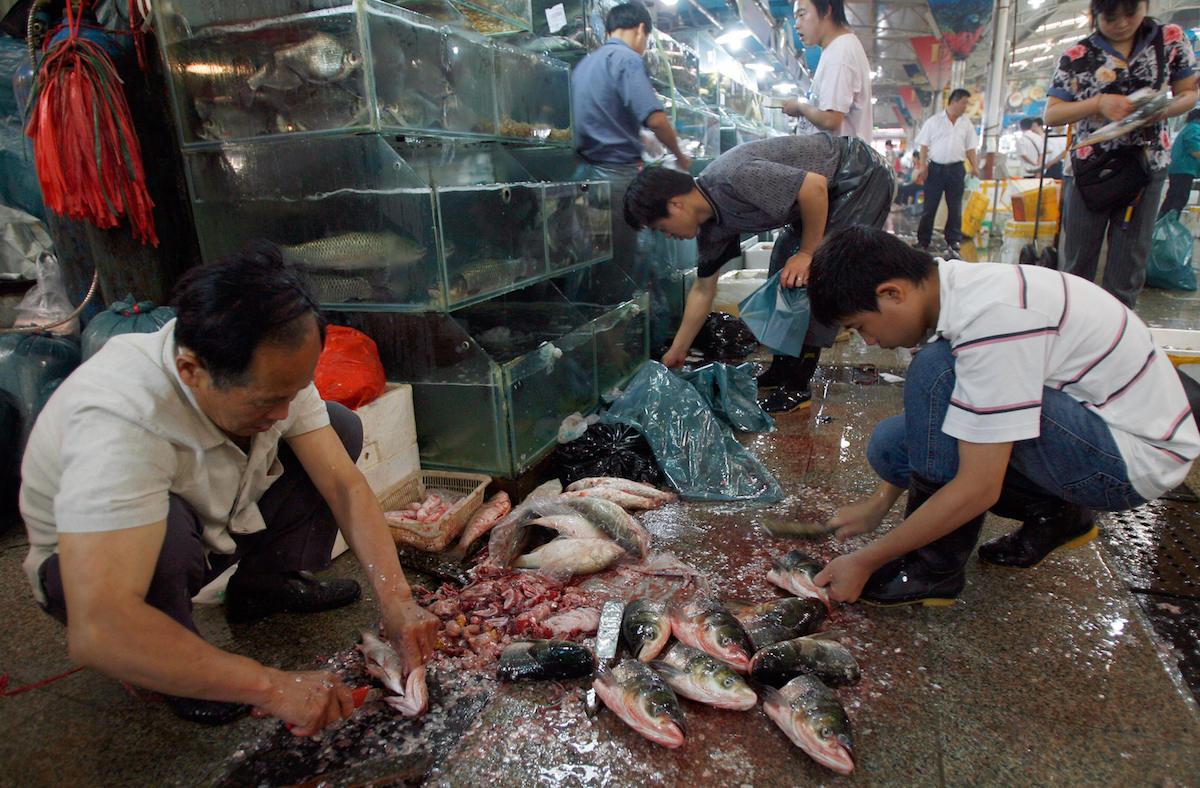
Although no government is better than China’s at making troublesome people disappear, a strange leniency has been accorded vendors at the country’s live-animal meat markets, who by most accounts gave us the pandemic and yet, reports the Daily Mail, have lately been allowed to set up shop again. China’s coronavirus lockdown is over, authorities have encouraged celebrations of “victory,” and citizens may once again go about their food shopping amid the cries and mayhem of animal slaughter. Ahh, back to normal life!In these parts, we’re told, you’re not really celebrating unless there’s bat, pangolin, cat, or dog meat on the table — the latter, notes the Daily Mail, “a traditional ‘warming’ winter dish.”  Reporter George Knowles, writing late last month, provides one of the milder accounts of scenes that will quickly exhaust anyone’s supply of culturally sensitive euphemisms, describing one of the markets — also known as “wet markets,” where both live and dead animals are on offer — in China’s southwestern city of Guilin: “Terrified dogs and cats crammed into rusty cages. Bats and scorpions offered for sale as traditional medicine. Rabbits and ducks slaughtered and skinned side by side on a stone floor covered with blood, filth, and animal remains.”

If you’re up for a few further details, we have travel writer Paula Froelich, in a recent New York Post column, recalling how in the Asian live-animal markets she has visited the doomed creatures “stare back at you.” When their turn comes, she writes,

the animals that have not yet been dispatched by the butcher’s knife make desperate bids to escape by climbing on top of each other and flopping or jumping out of their containers (to no avail). At least in the wet areas [where marine creatures are sold], the animals don’t make a sound. The screams from mammals and fowl are unbearable and heartbreaking.

The People’s Republic has supposedly banned the exotic-meat trade, and one major city, Shenzhen, has proscribed dog and cat meat as well. In reality, observes a second Daily Mail correspondent, anonymously reporting from the city of Dongguan, “the markets have gone back to operating in exactly the same way as they did before coronavirus.” Nothing has changed, except in one feature: “The only difference is that security guards try to stop anyone taking pictures, which would never have happened before.”

Lest we hope too much for some post-pandemic stirring of conscience, consider the Chinese government’s idea of a palliative for those suffering from the coronavirus. As the crisis spread, apparently some fast-thinking experts in “traditional medicine” at China’s National Health Commission turned to an ancient remedy known as Tan Re Qing, adding it to their official list of recommended treatments. The potion consists chiefly of bile extracted from bears. The more fortunate of these bears are shot in the wild for use of their gallbladders. The others, across China and Southeast Asia, are captured and “farmed” by the thousands, in a process that involves their interminable, year-after-year confinement in fit-to-size cages, interrupted only by the agonies of having the bile drained. Do an image search on “bear bile farming” sometime when you’re ready to be reminded of what hellish animal torments only human stupidity, arrogance, and selfishness could devise.

If one abomination could yield an antidote for the consequences of another, Tan Re Qing would surely be just the thing to treat a virus loosed in the pathogenic filth and blood-spilling of Wuhan’s live market. There’s actually a synthetic alternative to the bile acids, but Tradition can be everything in these matters, and devotees insist that the substance must come from a bear, even as real medical science rates the whole concoction at somewhere between needless and worthless. President Xi Jinping has promoted such traditional medicines as a “treasure of Chinese civilization.” In this case, the keys to the treasure open small, squalid cages in dark rooms, where the suffering of innocent creatures goes completely disregarded. And perhaps right there, in the willfulness and hardness of heart of all such practices, is the source of the trouble that started in China.

Already, in the Western media, chronologies of the pandemic have taken to passing over details of the live-animal markets, which have caused viral outbreaks before and would all warrant proper judgment in any case. News coverage picks up the story with the Chinese government’s cover-up of early coronavirus cases and its silencing of the heroic Wuhan doctors and nurses who tried to warn us. To brush past the live markets in fear of seeming “xenophobic,” “racist,” or unduly judgmental of other people and other ways is, however, to lose sight of perhaps the most crucial fact of all. We don’t know the endpoint of this catastrophe, but we are pretty certain that its precise point of origin was what Dr. Anthony Fauci politely calls “that unusual human–animal interface” of the live markets, which he says should all be shut down immediately — presumably including the markets quietly tolerated in our own country. In other words, the plague began with savage cruelty to animals.

Discussion of the live-animal markets is another of those points where moral common sense encounters the slavishly politically correct, though it’s not as if we’re dealing here with Asia’s most sensitive types anyway. No Western critic need worry about hurting the feelings or reputations of people who maximize the pain and stress of dogs in the belief that this freshens the flavor of the meat, and who then kill them at the market as the other dogs watch. Customers of such people aren’t likely to feel the sting of our disapproval either.

About the many customers and suppliers in Asia, and especially in China, of exotic fare, endless ancient remedies, and carvings and trinkets made of ivory, the best that can be said is that these men and women are no more representative of their nations than are the riffraff running the meat markets. Their demands and appetites have caused a merciless pillaging of wildlife across the earth — everything that moves a “living resource,” no creature rare or stealthy enough to escape their gluttony or vanity. Of late even donkeys, such peaceable and unoffending creatures, have been rounded up by the millions in Asia, Africa, the Middle East, and South America for shipment and slaughter, all to satisfy demand for yet another of China’s traditional-medicine manias.

Easy to blame for all of this is the government of China. Authorities took forever, for example, to enforce prohibitions on ivory carving, despite an unquestioned competence in carrying out swift crackdowns. And in general, at every level, the government tends to tolerate a culture of cruelty, or else to actively promote it at the prodding of lucrative industries, both legal and illicit. But the problem runs deeper than that, even as many younger Chinese, to their enormous credit, have tried to organize against the ivory trade, the wet markets, and other depravities in their midst.

In the treatment of animals and in safeguarding human health, there are elementary standards to which all must answer. The challenge to clear thinking, as Melissa Chen writes in Spectator USA,

is to avoid falling into the trap of cultural relativism. It’s perfectly appropriate to criticize China’s rampant consumption of exotic animals, lack of hygiene standards and otherwise risky behavior that puts people at risk for zoonotic infections. Until these entrenched behaviors based on cultural or magical beliefs are divorced from Chinese culture, wet wildlife markets will linger as time-bombs ready to set off the next pandemic.

Acknowledging that Western societies have every moral reason to condemn the barbarism and recklessness of the live-animal markets only invites, however, a tougher question: Do we have the moral standing? And if any of us are guilty of blind cultural prejudice or of a smug sense of superiority toward Chinese practices, a moment’s serious thought will quickly set us straight.

When the Daily Mail describes how Chinese guards at the live-animal market now “try to stop anyone from taking pictures,” who does that remind us of? How about our own livestock companies, whose entire mode of operation these days is systematic concealment by efforts to criminalize the taking of pictures in or around their factory farms and slaughterhouses? The foulest live-animal-market slayer in China, Vietnam, Laos, or elsewhere would be entitled to ask what our big corporations are afraid the public might see in photographic evidence, or what’s really the difference between his trade and theirs except walls, machinery, and public-relations departments.

If you watch online videos of the wet markets, likewise, it’s striking how the meat shoppers just go on browsing, haggling, chatting, and even laughing, some with their children along. Were it not for the horrors and whimpers in the background, the scene could be a pleasant morning at anyone’s local farmer’s market. As the camera follows them from counter to counter, you keep thinking What’s wrong with these people? — except that it’s not so easy, rationally, to find comparisons that work in our favor.

No, we in the Western world don’t get involved while grim-faced primitives execute and skin animals for meat. We have companies with people of similar temperament to handle everything for us. And there’s none of that “staring back” that the Post’s Paula Froelich describes, because, in general, we keep the sadness and desperation of those creatures as deeply suppressed from conscious thought as possible. An etiquette of denial pushes the subject away, leaving it all for others to bear. Addressing a shareholders’ meeting of Tyson Foods in 2006, one worker from a slaughterhouse in Sioux City, Iowa, unburdened himself: “The worst thing, worse than the physical danger, is the emotional toll. Pigs down on the kill floor have come up and nuzzled me like a puppy. Two minutes later I had to kill them — beat them to death with a pipe. I can’t care.”

Following the only consistent rule in both live-animal markets and industrial livestock agriculture — that the most basic animal needs are always to be subordinated to the most trivial human desires — this process yields the meats that people crave so much, old favorites like bacon, veal, steak, and lamb that customers must have, no matter how these are obtained. When the pleasures of food become an inordinate desire, forcing demands without need or limit and regardless of the moral consequences, there’s a word for that, and the fault is always easier to see in foreigners with more free-roaming tastes in flesh. But listen carefully to how these foods or other accustomed fare are spoken of in our culture, and the mindset of certain Asians — those ravenous, inflexible folks who will let nothing hinder their next serving of pangolin scales or winter dish of dog — no longer seems a world away.

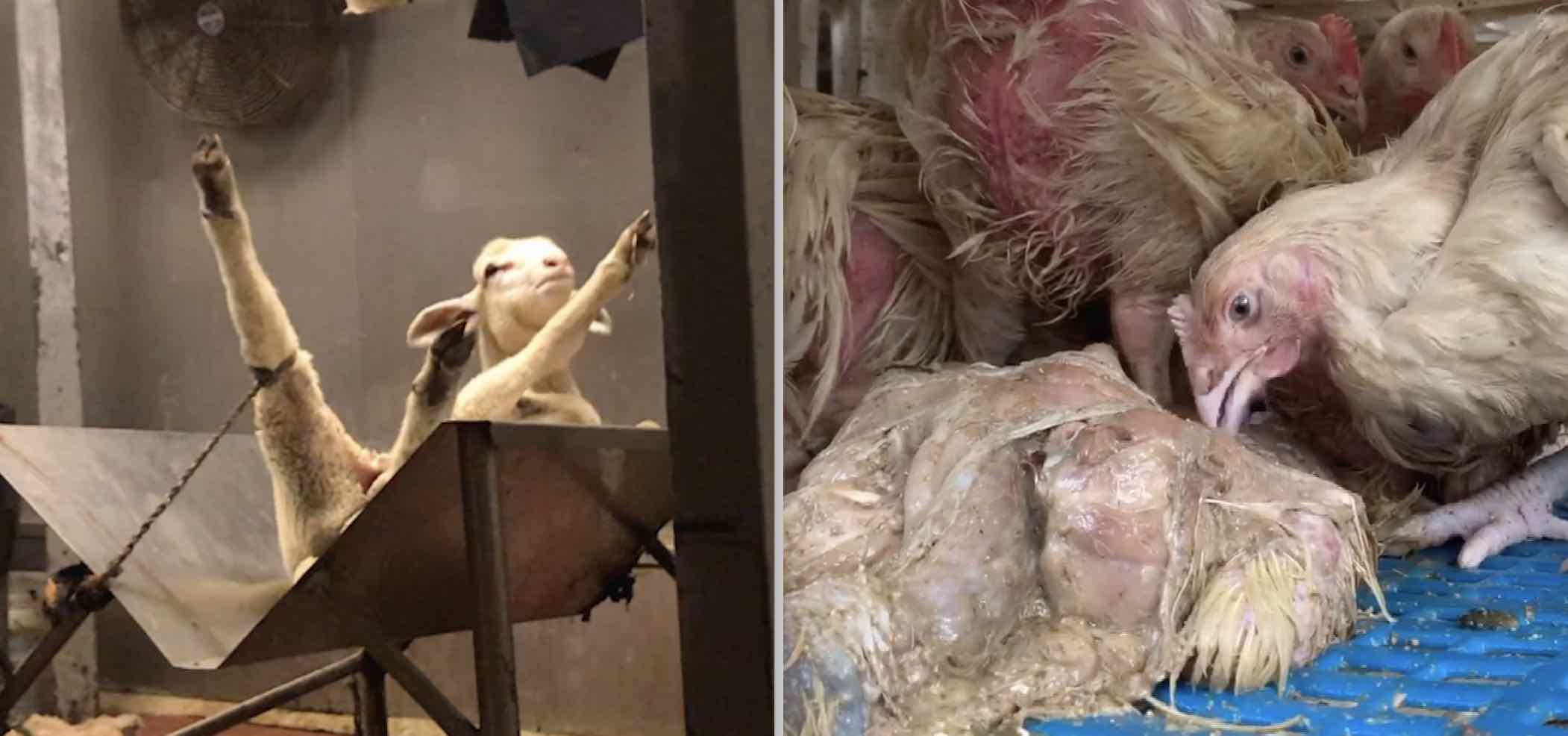
We in the West don’t eat pangolins, turtles, civets, peacocks, monkeys, horses, foxes, and wolf cubs — that’s all a plus. But for the animals we do eat, we have sprawling, toxic, industrial “mass-confinement” farms that look like concentration camps. National “herds” and “flocks” that all would expire in their misery but for a massive use of antibiotics, among other techniques, to maintain their existence amid squalor and disease — an infectious “time bomb” closer to home as bacterial and viral pathogens gain in resistance. And a whole array of other standard practices like the “intensive confinement” of pigs, in gestation cages that look borrowed from Asia’s bear-bile farms; the bulldozing of lame “downer cows”; and “maceration” of unwanted chicks, billions routinely tossed into grinders. All of which leave us very badly compromised as any model in the decent treatment of animals.

Such influence as we have, in fact, is usually nothing to be proud of. It made for a perfect partnership when, for instance, one of the most disreputable of all our factory-farming companies, Smithfield Foods, was acquired in 2013 by a Chinese firm, in keeping with some state-run, five-year plan of the People’s Republic to refine agricultural techniques and drive up meat production. Now, thanks to American innovation, Smithfield-style, the Chinese can be just as rotten to farm animals as we are — and just as sickly from buying into the worst elements of the Western diet.

In China and Southeast Asia, they have still not received our divine revelation in the West that human beings shall not eat or inflict extreme abuse on dogs but that all atrocities to pigs are as nothing. They’re moving in our culinary direction, however, and more than half the world’s factory-farmed pigs are now in China and neighboring countries. In the swine-fever contagion spreading across that region right now — addressed as usual by mass cullings: gassing tens of millions of pigs or burying them alive — our industrial animal-agriculture system is leaving its mark, while providing yet further evidence that factory farms are all pandemic risks themselves.

How many diseases, cullings, burial pits, and bans on photographing these places even at their wretched best will we need before realizing that the entire system is profoundly in error, at times even wicked, and that nothing good can ever come of it? Perhaps the live-animal markets of China, with all the danger and ruin they have spread, will help us to see those awful scenes as what they are, just variants of unnatural, unnecessary, and unworthy practices that every society and culture would be better off without.

Plagues, as we’re all discovering, have a way of prompting us to take stock of our lives and to remember what really matters. If, while we’re at, we begin to feel in this time of confinement and fear a little more regard for the lives of animals, a little more compassion, that would be at least one good sign for a post-pandemic world.
MATTHEW SCULLY is the author of DOMINION: The Power of Man, the Suffering of Animals, and the Call to Mercy. A former literary editor of National Review and senior speechwriter to President George W. Bush, he lives in Paradise Valley, Ariz.

Will Dr. Fauci Call for Closure of U.S. Wet Markets?

APRIL 7, 2020 BY 

During an interview on Fox News on April 4,  Dr. Anthony Fauci, the Director of the National Institute of Allergy and Infectious Disease, said that wet markets in “certain countries” should be shut down. While he did not specify the countries, he was referring to China, which is where COVID-19 is believed to have jumped from animal to human, and to other Asian countries that have similar wet markets that sell and slaughter live animals. Dr. Fauci made no mention of wet markets in the United States:

“I think they should shut down those things right away. It boggles my mind how, when we have so many diseases that emanate out of that unusual human/animal interface ,that we don’t just shut it down. There are certain countries in which this is very commonplace. I would like to see the rest of the world really lean with a lot of pressure on those countries that have that because what we’re going through right now is a direct result of that.”

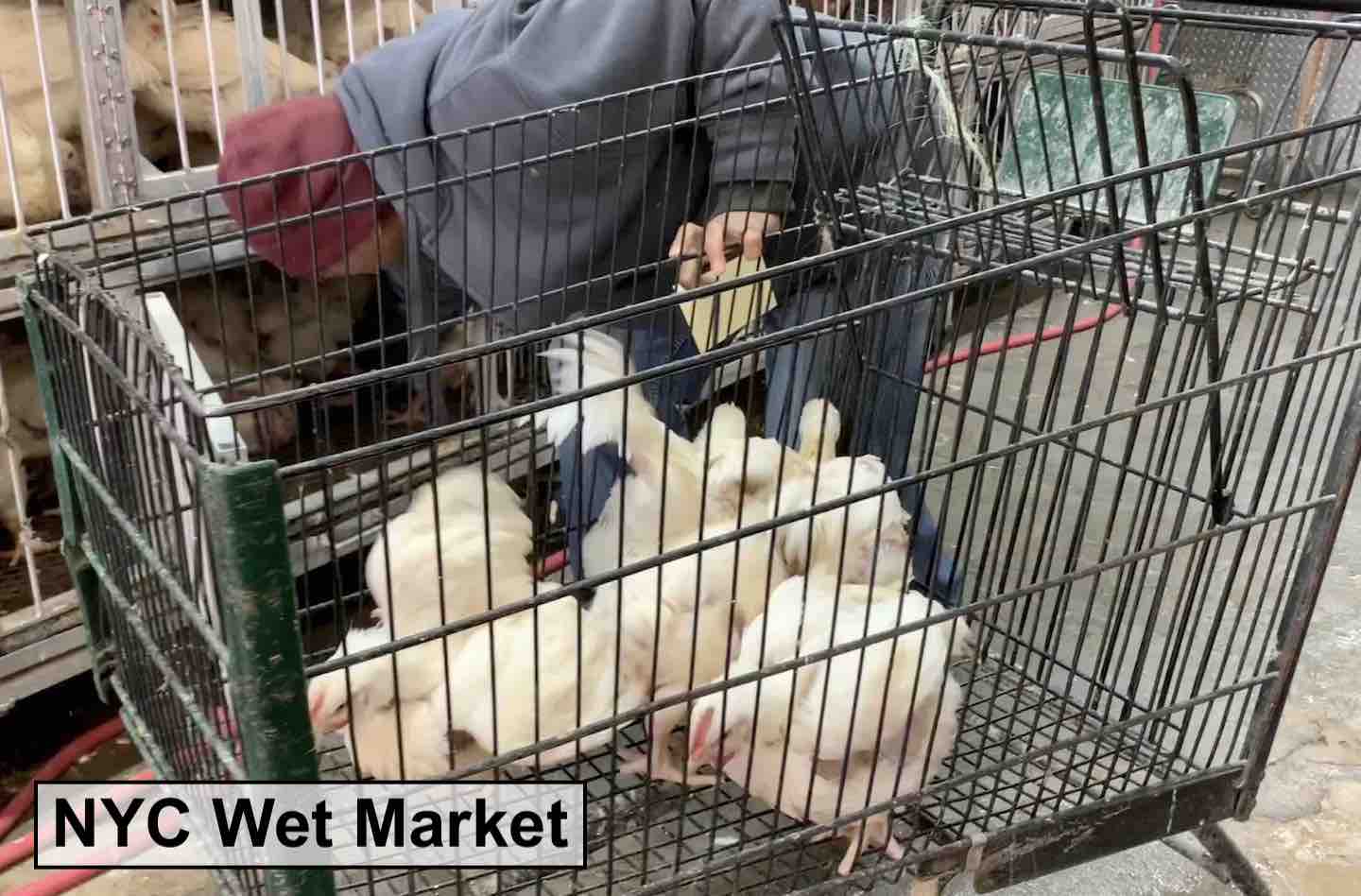
A wet market in NYC where customers, including children and the elderly, handle live animals

“Why would Dr. Fauci call on world leaders to pressure countries in Asia to shut down their wet markets without calling for the closure of live animal markets in his own country?” said Jill Carnegie, co-organizer of Slaughter Free NYC, an advocacy group working to shut down NYC’s 80+ wet markets and slaughterhouses. “Do we need to wait for an outbreak of a novel strain of bird flu or swine flu before shutting down these breeding grounds of infectious disease?”

Wet markets in NYC sell at least 10 species of live animals and slaughter them on site for their customers.

Following Dr. Fauci’s remarks, several mainstream media news outlets, including CNN, ran substantive stories in which they aired footage of Asian wet markets, but they did not not address the widespread prevalence of wet markets in the United States. Through videos, letters, petitions and social media, animal advocacy groups are working to inform both the mainstream media and Dr. Fauci of the presence of wet markets in the United States, including three in Bensonhurst, the Brooklyn neighborhood where he was raised.

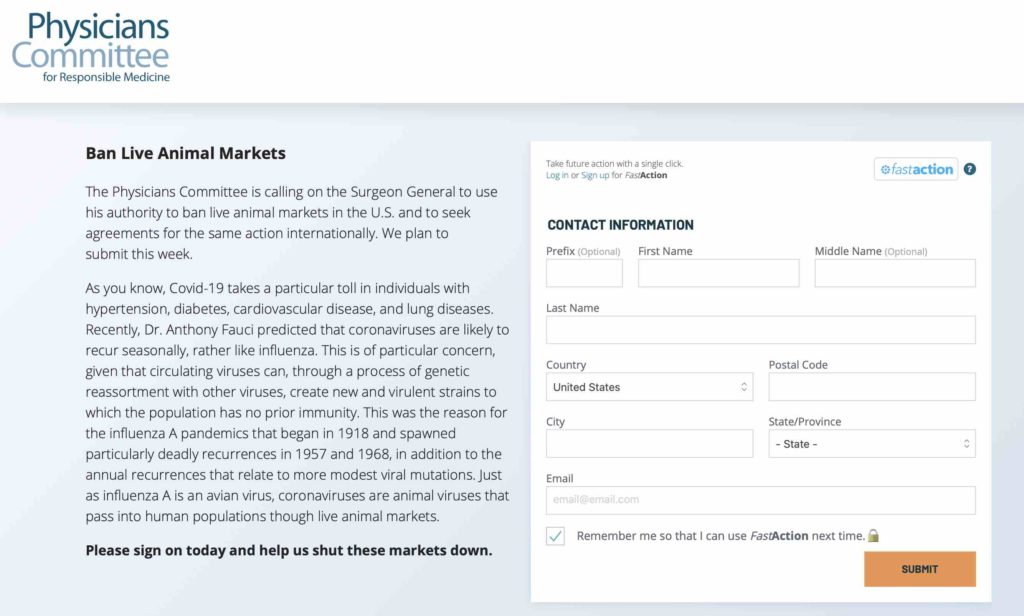
On April 7th, the Physicians Committee for Responsible Medicine (PCRM), a nonprofit health organization of 12,000 physicians, sent a letter to the U.S. Surgeon General urging him to shut down live markets in the United States:

“There must not be another pandemic. To ‘prevent the introduction, transmission, and spread of communicable diseases’ in the United States, the Surgeon General must promulgate regulations that prohibit the sale, transfer, donation, other commercial or public offering, or transportation, in interstate or intrastate commerce, of live birds, mammals, reptiles, and amphibians to retail facilities that hold live animals intended for human consumption.”

Dr. Neal Barnard, PCRM’s President, announced the news on a live webcast with TV journalist Jane Velez-Mitchell.

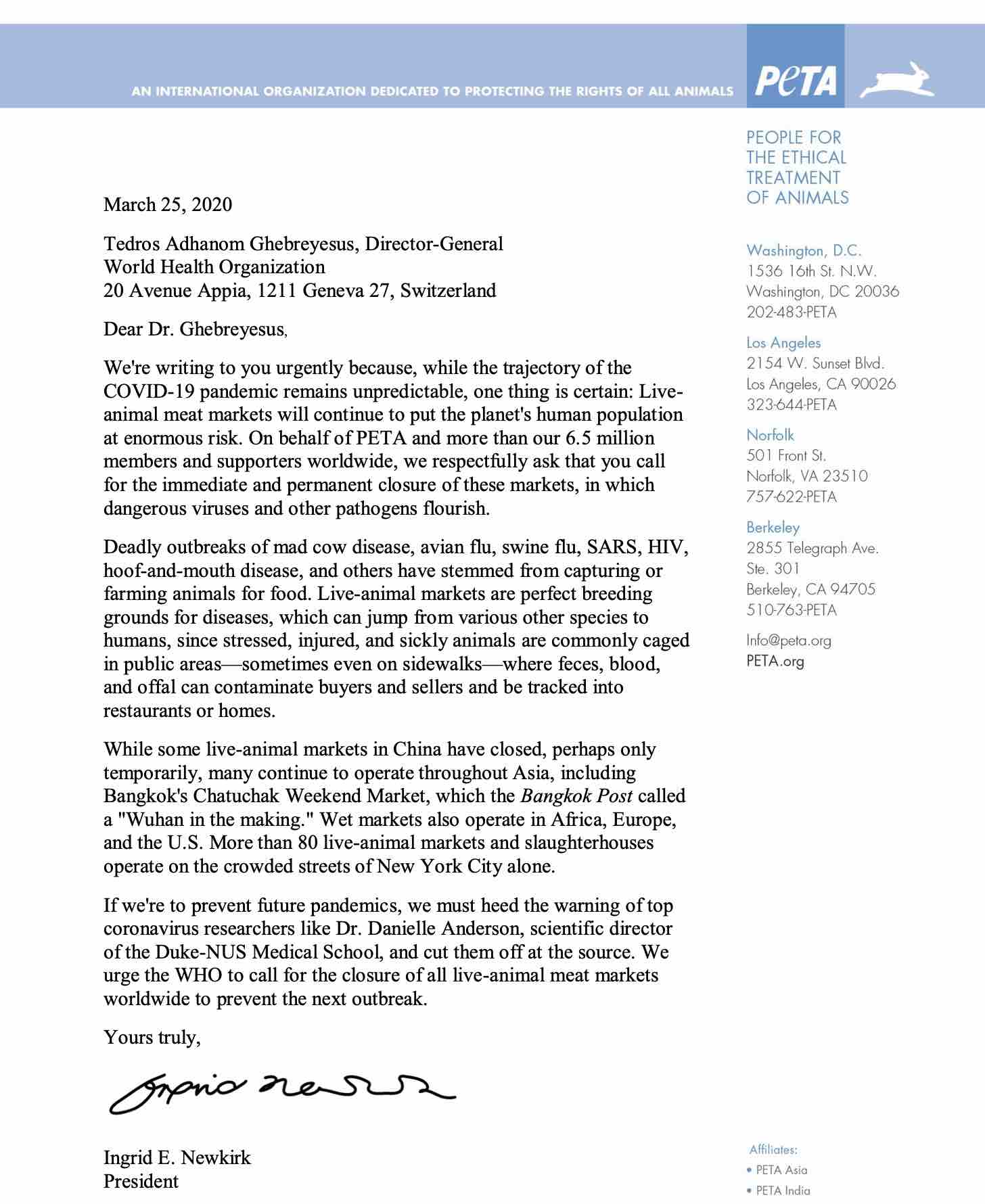
People for the Ethical Treatment of Animals (PETA) is also calling for the closure of wet markets. In a letter to Tedros Adhanom Ghebreyesus, the Director-General of the World Health Organization, PETA President Ingrid Newkirk wrote, “On behalf of PETA and our more than 6.5 million members and supporters worldwide, we respectfully ask that you call for the immediate and permanent closure of these markets, in which dangerous viruses and other pathogens flourish.

In several American cities, including New York, Chicago and Los Angeles, animal advocacy groups have been, through lobbying, litigation and protest, sounding alarm bells about the wet markets for the past several years — long before the COVID-19 outbreak. In New York City, a lawsuit filed by neighbors of one annual wet market reached New York State’s highest court. The lawyer for the plaintiffs argued that the Court should mandate that the NYPD and Dept. of Health enforce the 15 City and State laws that are violated by this wet market. The Court of Appeals judges ruled that municipalities have discretion over which of its own laws to enforce.

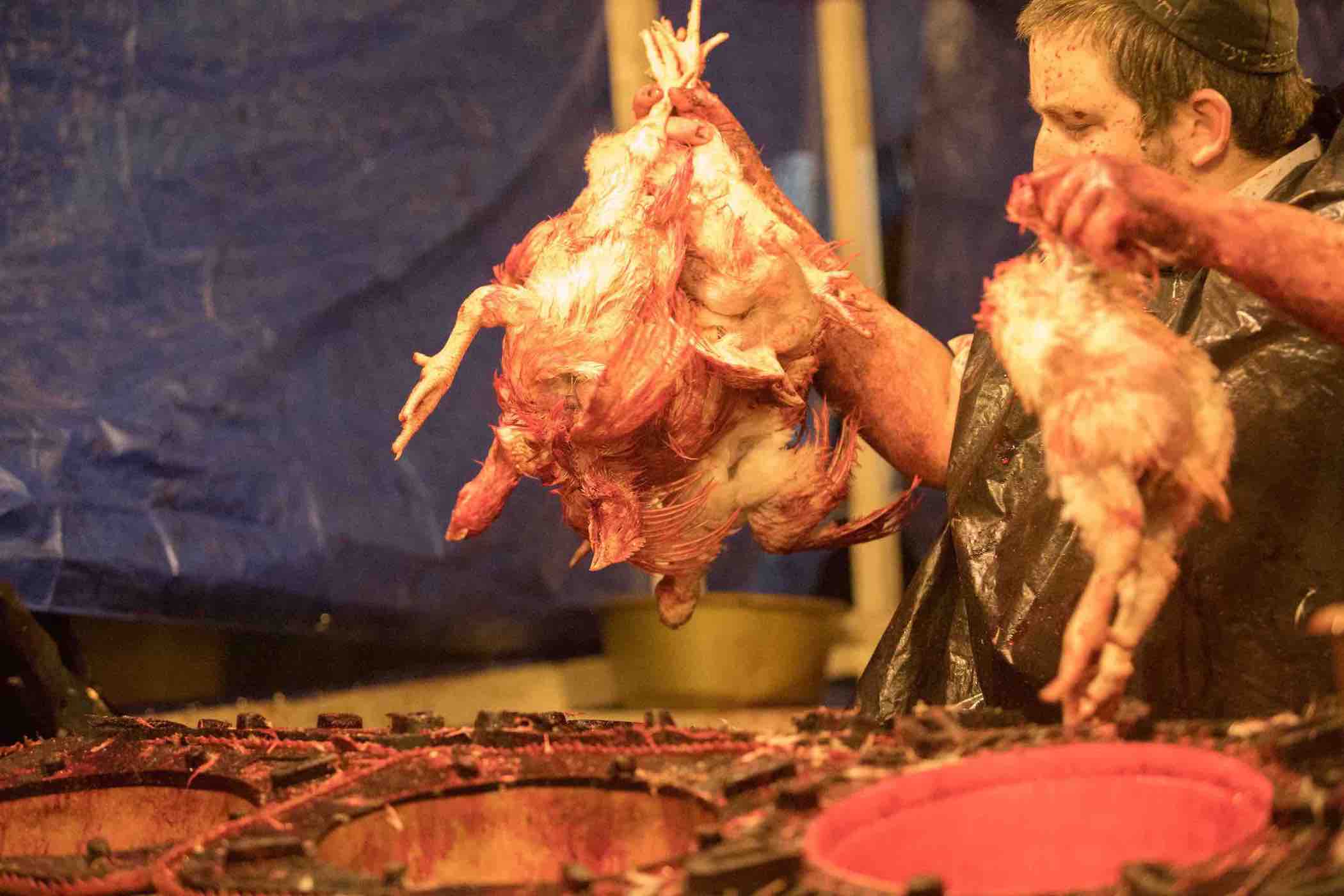
While the wet markets in the United States do not sell bats and pangolins, the animals believed to have transmitted COVID-19 to humans, they do intensively confine thousands of animals, some of whom are visibly ill, in pens and cages where customers shop. In one Brooklyn wet market, where animals are used in an annual religious sacrifice, customers handle the animals themselves — purchasing live chickens and swinging them around their heads before bringing them to a ritual slaughterer. According to a toxicologist who conducted an investigation on behalf of area residents, the wet market activities “pose a significant public health hazard.”

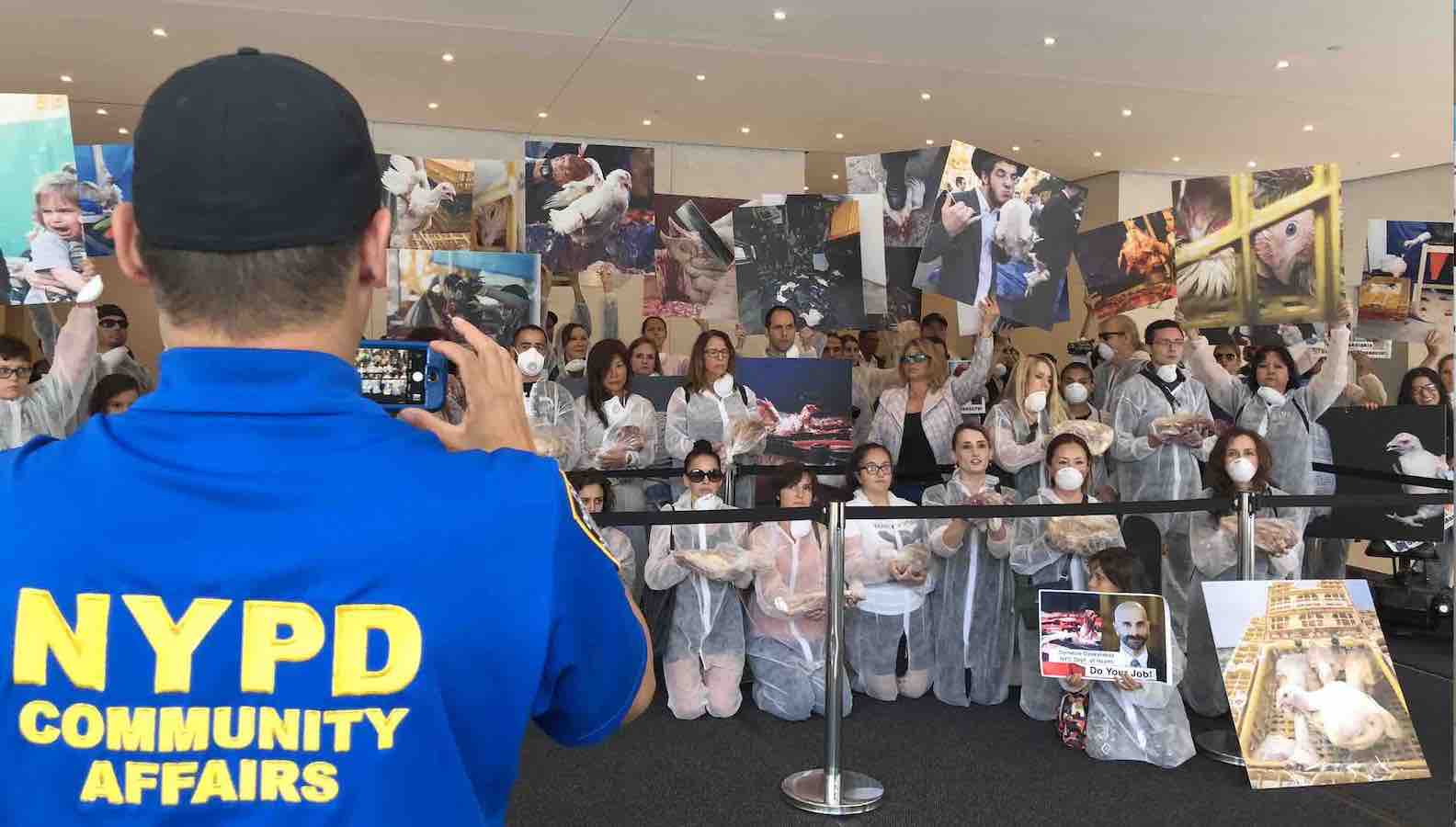
Dozens of public health and animal rights advocates occupy the New York City Dept. of Health to demand that the Deputy Commissioner of Disease Control, Dr. Demetre Daskalakis, shut down a wet market that violates seven City health codes


Ban live wild animal meat markets

Emily Beament

7th April 2020
Hundreds of wildlife groups worldwide sign open letter to WHO calling for a ban on wildlife meat trade to stop future potential global pandemics.

The World Health Organisation (WHO) should recommend governments shut down wild animal markets to prevent future pandemics, conservationists have said.

More than 200 wildlife groups across the world have signed an open letter calling on WHO to do all it can to prevent new diseases emerging from the wildlife trade and spreading into global pandemics.

The evidence suggests Covid-19 has animal origins, likely from bats, and may have come from “wet markets” where live and dead creatures are sold for eating, leading to a temporary ban on the markets by the Chinese government.

Health

Previous global epidemics including severe acute respiratory syndrome (Sars) and Ebola have also been linked to viruses that spread from animals to people.

The letter calls on WHO to recommend to governments worldwide that they bring in permanent bans on live wildlife markets and act to close down or limit trade in wildlife to reduce the threat to human health.

The groups also want the use of wildlife, including from captive-bred animals, to be “unequivocally” excluded from the organisation’s definition and endorsement of traditional medicine.

Conservationists also said the WHO should work with governments and international bodies such as the World Trade Organisation to raise awareness of the risks the wildlife trade poses to human health and society.

It should also support and encourage initiatives that deliver alternative sources of protein to people who survive on eating wild animals, in order to further reduce the risk to human health.

Business

The letter has been co-ordinated by wildlife charity Born Free and its Lion Coalition partners, and backed by organisations including the Bat Conservation Trust, International Fund for Animal Welfare (IFAW) and the Zoological Society of London (ZSL).

Dr Mark Jones, head of policy at Born Free, said markets selling live wild animals were found in many countries but had rapidly expanded and become more commercial, increasing the risks to human and animal health.

The trade in wild animals is also a major contributor to global declines in wildlife and has severe consequences for the welfare of millions of individual animals, he said.

“We need to dig deep and reset our fundamental relationship with the natural world, rethink our place in it and treat our planet and all its inhabitants with a great deal more respect, for its sake and for ours.

“Once Covid-19 is hopefully behind us, returning to business as usual cannot be an option.”

Survival

Separate research by wildlife charity WWF found high levels of public support in Asia for closing illegal and unregulated wildlife markets and the trade in wild animals.

A survey conducted in March among 5,000 participants from Hong Kong, Japan, Burma, Thailand and Vietnam found 93% supported action by their governments to eliminate illegal and unregulated markets.

Marco Lambertini, director general of WWF International, said: “People are deeply worried and would support their governments in taking action to prevent potential future global health crises originating in wildlife markets.

“Taking action now for humans as well as the many wildlife species threatened by consumption and trade is crucial for all of our survival.”

Brendan Montague, editor of The Ecologist, added: “Those of us who are in the global North need to also examine how our meat industry and its practices – such as the use of pesticides, hormones and antibiotics – are risking both biodiversity collapse and future human health crises.”

Conservation Groups and Health Experts Ask WHO to Permanently Close Live Animal Markets

wet-market-1586282627838.jpg
SOURCE: ANTHONY KWAN/GETTY IMAGES

https://www.greenmatters.com/p/wet-markets-coronavirus?fbclid=IwAR2leUmfeu7ZqeFFWi0LOAxNxd7yiH9D1EFJymr_bdk_3WLsh8BLOz5KSgo

BY 

It’s easy to see how the novel coronavirus is spreading — but do you know how the virus began?

Experts believe that the virus originated in a live animal market in Wuhan, China. Because COVID-19 is not the first infectious disease to start in one of these controversial “wet markets,” conservation and health experts are now asking the World Health Organization (WHO) to force governments to permanently close these markets around the world, in hopes of preventing another pandemic.

wet-market-2-1586282683381.jpg
SOURCE: NOEL CELIS/AFP VIA GETTY IMAGES

Like COVID-19, both SARS and the bird flu (avian influenza) originated in Chinese wet markets. And according to the letter, other significant zoonotic diseases associated with wildlife include Ebola, MERS, HIV, bovine tuberculosis, rabies, and leptospirosis; additionally, zoonotic diseases are responsible for more than 2 billion cases of human illness and more than 2 million human deaths annually.

What are wet markets?

wet-market-3-1586282725763.jpg
SOURCE: EDWARD WONG/SOUTH CHINA MORNING POST VIA GETTY IMAGES

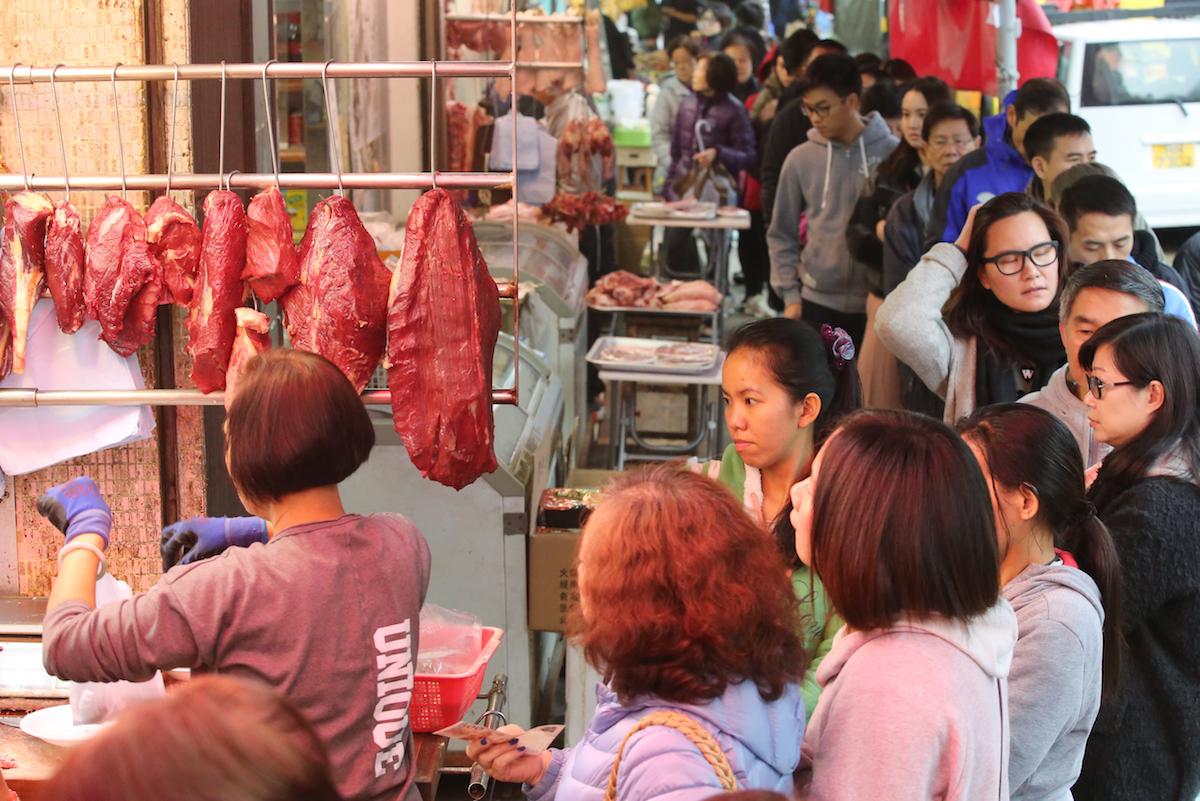
Wet markets, aka live animal markets, are marketplaces where customers can select live animals from cages, who workers then slaughter on-site for customers to take home and cook.

“You’ve got live animals, so there’s feces everywhere,” Peter Daszak, president of EcoHealth Alliance, told the Associated Press. “There’s blood because of people chopping them up.”

How did wet markets cause the coronavirus?

wet-market-4-1586282765264.jpg
SOURCE: TEH ENG KOON/AFP VIA GETTY IMAGES

Many of these markets are unregulated, meaning it’s not uncommon to find illegally-traded animals in Wuhan’s wet market cages. The lack of regulations also means that the markets are often kept in unhygienic conditions — and with wet markets putting people in close proximity with internationally-traded animals, animal waste, and animal slaughter, bacteria and viruses can easily spread.

Who wants to shut down wet markets?

Organizations to sign the letter include Animal Legal Defense Fund, Big Cat Rescue (yes, from Tiger King), Endangered Species Coalition, various chapters of Humane Society International, the Jane Goodall Institute, PETA, Pro Wildlife, Sea Shepherd, various Societies for the Prevention of Cruelty to Animals, WildAid, and more.

Other notable people who have called for a global shutdown of wet markets include Dr. Anthony Fauci, the U.S.’s top expert on infectious diseases and a leader of the White House’s coronavirus task force; Elizabeth Maruma Mrema, head of the U.N. Convention on Biological Diversity; and Jinfeng Zhou, secretary general of the China Biodiversity Conservation and Green Development Foundation.

“I think we should shut down those things right away,” Dr. Fauci recently said of wet markets on Fox & Friends, via Politico. “It boggles my mind how, when we have so many diseases that emanate out of that unusual human-animal interface, that we don’t just shut it down.”

Inside NYC’s Wet Markets – A “Ticking Time Bomb”

MARCH 30, 2020 BY  — LEAVE A COMMENT

https://theirturn.net/2020/03/30/inside-nycs-wet-markets-a-ticking-time-bomb/

The News

New York City has over 80 wet markets – businesses that sell live animals to the public and slaughter them onsite.  New York’s live animal markets are located in all five boroughs.

Since 2016, public health and animal rights advocates have been sounding alarm bells about the City’s wet markets, pleading with health officials and lawmakers to shut them down in order to prevent the transmission and spread of infectious disease. COVID-19 is believed to have been transmitted from animal to human in a wet market in Wuhan, China.

Sheep and chickens are among the approximately 10 different species of live animals sold at NYC’s wet markets

NYC’s wet markets sell approximately ten animal species, including goats, sheep, chickens, guinea hens, rabbits, pigeons, Muscovy ducks, and quail.  The animals are confined in small cages or pens where they can sicken each other and the people who work and shop there. Animal feces, body parts, feathers and blood are tracked in and out by customers and pedestrians who then carry the refuse on to the subways and into their homes, offices and communities.

Wet markets, or live animal markets, are storefront slaughterhouses that sell live animals to public and slaughter them on site

“New York City’s wet markets are a ticking time bomb,” said Jill Carnegie, a co-organizer with Slaughter Free NYC, an organization advocating to shut down wet markets and other slaughterhouses in NYC. “If avian flu or another infectious disease is transmitted to just one human, it could spread very rapidly in New York City and beyond, as we have seen with COVID-19.”

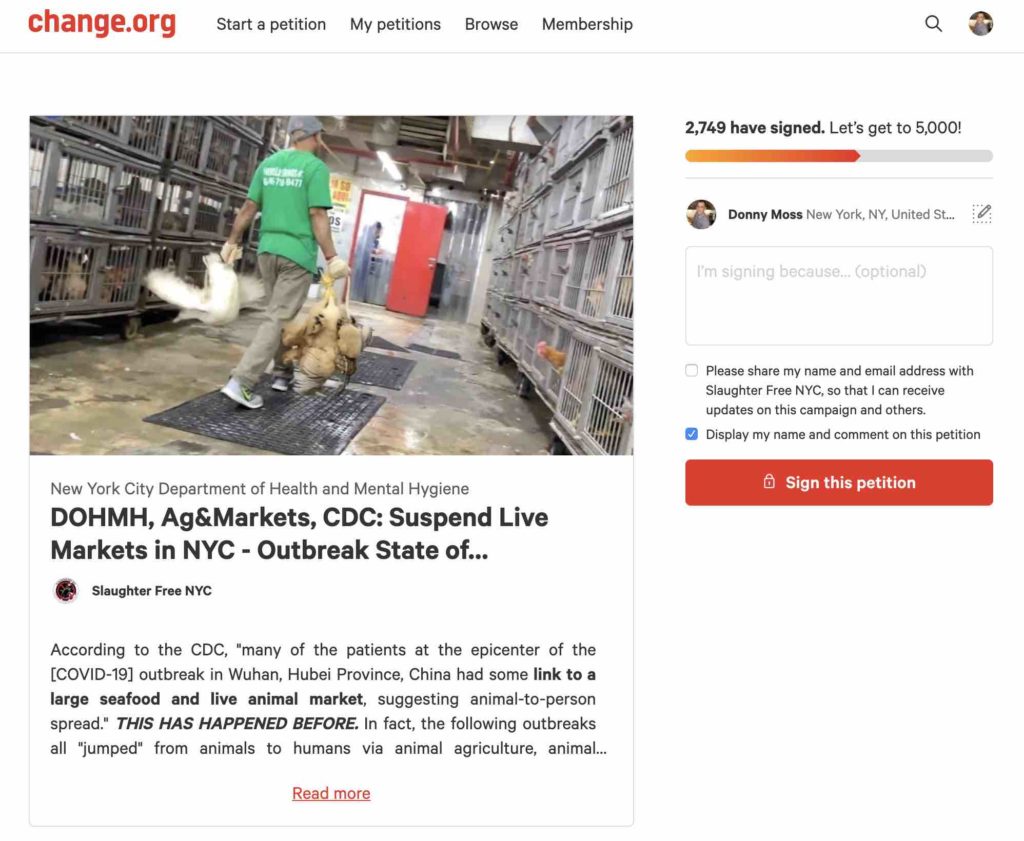
The COVID-19 pandemic has increased the advocates’ sense of urgency. Slaughter Free NYC is now asking Mayor Bill de Blasio, Health Commissioner Dr. Oxiris Barbot and Deputy Commissioner of Disease Control Dr. Demetre Daskalakis to prohibit the slaughter of live animals in the five boroughs of New York. In February, the organization launched a petition with its demand.

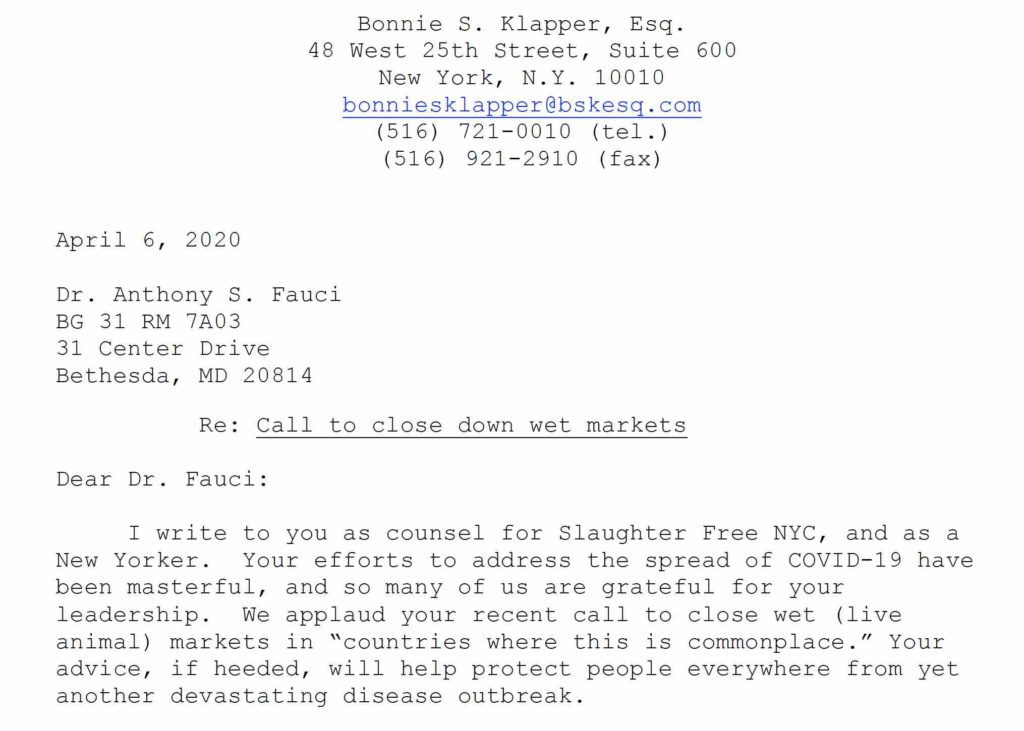
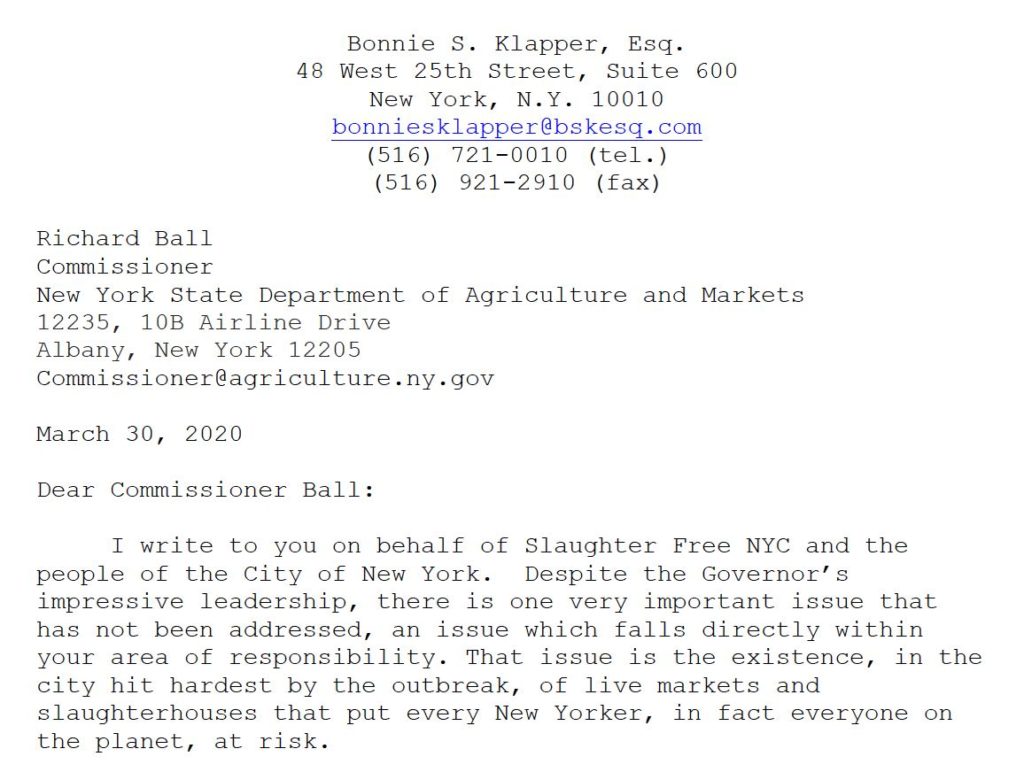
In a letter to NY Governor Andrew Cuomo and the NY State Department of Agriculture & Markets, Bonnie S. Klapper, a New York City-based attorney working on several cases involving animal agriculture, wrote that City and State health authorities are turning a blind eye to the well-documented health code violations

Click letter to view in full

The NYC Department of Health claims that it has no regulatory authority over these markets and defers to NY State Department of Agriculture & Markets, but state health officials have told me that these wet markets are never inspected unless they receive numerous complaints,” Klapper told TheirTurn. “That said, no amount of oversight can prevent disease transmission in storefront slaughterhouses where sick animals are coming into contact with humans.”

PCRM Petition to the Surgeon General to outlaw live markets in the United State

On March 25th, People for the Ethical Treatment of Animals (PETA) sent a letter to the Tedros Adhanom Ghebreyesus, the Director-General of the World Health Organization (WHO) encouraging him to call for the permanent closure of [wet] markets:  “Deadly outbreaks of mad cow disease, avian flu, swine flu, SARS, HIV, hoof-and-mouth disease and others have stemmed from capturing or farming animals for food. Live animal markets are perfect breeding grounds for diseases, which can jump from various others species to humans . . . If we’re to prevent future pandemics, we must heed the warning of top coronavirus researchers like Dr. Danielle Anderson, scientific director of the Duke-NUS Medical School, and cut them off at the source.”

In partnership with The Save Movement, an organization that stages vigils at slaughterhouses around the word, Slaughter Free NYC conducts vigils and educational outreach at New York City’s wet markets.


Firsthand Look Inside Asia’s Busiest Wet Markets

Jo-Anne McArthur / We Animals

Also see: https://www.youtube.com/watch?v=nPRkZbGvRsg

Unpacking COVID-19’s Visual Narrative 

According to a 2019 Pew Research Center studyover half of American adults consume the majority of their news from social media. Sentient Media analyzed the social media presence of three major news organizations to better understand how they’re portraying Asia’s wet markets to their followers. Here is what we found:

  • The New York Times has over 70 million followers across Facebook, Instagram, and Twitter. NYT has covered wet markets on its website, but its social media platforms are lacking in photos that show Asia’s wet markets and more specifically, photos of the animals being bought and sold at these markets. In 2006, NYT actually suggested visiting wet markets as a tourist destination.
  • The Washington Post has 23 million followers across the same three platforms. Not only are images of wet markets neglected on WashPo’s social channels, but the website’s overall coverage of wet markets is thin. One article mentions the plummeting chicken prices in India, as many consumers are no longer purchasing meat from wet markets, but not a single photo of wet markets is present. An article about the Chinese food system’s role in pandemic prevention seemed promising, but instead of gruesome wet market photos, the article displays three grinning men holding live goats in their arms. This image far from captures the fear, confusion, and pain animals endure inside wet markets.
  • HuffPost has over 11 million followers on Twitter alone and more than 23 million across all three major platforms. Unsurprisingly, on HuffPost’s social media channels, there is a severe lack of multimedia reporting on wet markets. If you search “wet markets” on HuffPost’s website, the lack of search results is also concerning. One article mentions wet markets, and even provides a photo of seafood being sold—which is commendable—but the image does not fully capture the disarray of Asia’s wildlife markets.
These three news outlets have the combined potential to reach over 116 million people—around two-thirds of the U.S. population—across three social media channels. Why aren’t news outlets using their online reach to report the truth about the live animal markets behind COVID-19?

Mainstream media can reach millions, even billions of people around the globe each day through print and online articles, blogs, and social media. Viewers trust these outlets to report the whole truth and operate in their best interests, but that is not always the case. Sentient Media believes in reporting the truth and being accountable—values we expect to share with major media outlets.

As we have seen with COVID-19 coverage, mainstream media outlets are neglecting to show a main component of why we are in the midst of a pandemic in the first place. It is time to lift the veil on Asia’s wet markets and report the uncomfortable truth.

View the photo essay here

Covering COVID-19
With the worst global pandemic we’ve seen in over a century, it’s more important than ever to make sure the truth is reported in its entirety, not just what’s convenient.

Help us share the facts during these uncertain times and make sure the world knows our species cannot survive if we continue our exploitation of the planet and nonhuman animals.

Crackdown on wet markets and illegal wildlife trade could prevent the next pandemic

by Prerna Singh Bindra on 25 March 2020

Investigations show that meat of protected turtle species is sold across the fish and meat markets of Agartala, Tripura, with just one of several markets selling atleast 4,000 turtles each year.
Demand for meat is particularly high in Bengal, Tripura and Assam; and has emptied rivers and wetlands of soft-shell turtles to the brink in river stretches across the Gangetic and the Mahanadi basin, particularly in Bihar and Bengal.
Such ‘wet markets’ selling wild meat of different species present an acute health hazard and need to be looked into urgently in the face of the COVID-19 pandemic, writes Prerna Singh Bindra in this commentary.

Leaving his stall at the Golbazar Maharajganj Fish Market in Agartala, the vendor headed out toward another shop, a hovel really, tucked between the market’s boundary wall and a stack of Styrofoam boxes. He opened one, hauling out a mutilated carcass of a peacock marked softshelled turtle (Nilssonia hurum) and chopped it into pieces for a waiting customer. Money exchanged hands. It is not kosher to quote rates of wildlife as it encourages trade and though the prices are somewhat higher than, say goat meat, by putting a price on the priceless — a rare protected Schedule I species with the level of protection accorded to a tiger — he had sold the turtle cheap. Also visible were hollowed-out shells of the soft-shelled turtle, the Indian flapshell (Lissemys punctata), another Schedule I freshwater species. Information gleaned from the traders indicated that about 4,000 turtles are sold annually in Golbazar, and they assure that any quantity required can be made available.

The quantities could be higher in Battala, another fish market in the capital of the northeast Indian state of Tripura. Here, turtle meat is sold openly and business is brisk with a stream of customers. Carcasses, mainly of the peacock marked soft-shelled turtles are chopped and sold, while a few flap about haplessly in a bit of murky water in buckets and boxes — some 100 feet away from a forest department signboard extolling saving turtles and warning about the illegal sale of its meat.
Tracing illegal turtle trade in Agartala

An investigation into the illegal turtle trade in Agartala, in February 2020, carried out with the help of local informers and investigators, revealed that protected turtle species are being sold openly and blatantly.
Indian flapshell turtle seized. Photo by Arunima Singh/Turtle Survival Alliance.

The trade has persisted for years: as per reports in 2009, 2015 and in 2017, the Bangladesh-based Creative Conservation Alliance conducted a market survey and found turtle meat in Agartala, which is close to the Bangladesh border. Bloggers have written about its open sale in fish bazars and turtle meat curry being offered in small eateries in the city over the past decade. The turtles are smuggled in from Bangladesh into Agartala; equally, turtles are smuggled out to Bangladesh, a major hub for turtle meat trade, from India.

Turtles are sourced from the Indo-Gangetic plains, mainly from Uttar Pradesh, Bihar, Uttarakhand, West Bengal; and Odisha, Andhra Pradesh in the Mahanadi basin. The scale of poaching is huge: in just one seizure over 6,400 soft shell turtles, destined for the food markets of Kolkata, were intercepted in Uttar Pradesh in January 2017. This haul was part of
14000 turtles seized in Uttar Pradesh and West Bengal in the first two weeks of 2017. A 2019 study by TRAFFIC-India found that at least 110,000
(1.1 lakh) turtles and tortoises entered the illegal trade in the 10-year period between 2009-2019.

This is the proverbial tip of the iceberg; “with seizures representing only a fraction of the actual trade,” says Saket Badola, head, TRAFFIC India. Such huge off-take is driving the species to extinction.
Shailendra Singh, director of the Turtle Survival Alliance-India Programme says that stretches of the Ganga in Bihar and downstream of the Farakka Barrage in Bengal have virtually been emptied of soft-shell turtles. The northern river terrapin Batagur baska, historically found abundantly across Orissa and West Bengal in India through Bangladesh and Myanmar, is now possibly extinct in the wild. Surveys conducted by Singh along with other colleagues, for over 12 years, have yielded one juvenile in the Indian part of Sundarbans, and two toward the Bangladesh side. Along with alteration and destruction of riverine habitats, the key cause for this functional extinction is poaching for the pot.

Yet, the vanishing of turtles inspires little concern or action, even within the conservation community, or concerned government agencies.
Raids on suspect markets are sporadic, and the follow-up, lackadaisical.
For example, over the past decade, there have been no more than five raids in Agartala and no arrests so far. The trade temporarily goes undercover, or at best cools off for a while before it is back to business as usual. Turtles are not high-profile species and hence the illicit trade flourishes off the radar at scales leading to population collapses. Agartala is a classic example, where this brisk, blatant illegal trade continues. Enforcement agencies and experts confide that the sale of turtle meat in such wet markets is rampant across the country. India is a consumer of wild meat, not just a source of illegal wildlife trade, as is traditionally believed. “In several parts of India wild meat is consumed, and sold, driven mainly by the traditional practices of unscientific beliefs,” remarks Badola.
Meat of a softshelled turtle being sold at Golbazar market in Agartala.
An investigation into the illegal turtle trade in the city in February
2020 revealed that protected turtle species are being sold openly and blatantly.

West Bengal, in particular, is a major hub, where turtle meat is a delicacy, and in high demand more so during the festive season. It’s available–on and off the counter—in fish markets across Kolkata, Howrah and Puralia. Informed sources, who wish to remain anonymous, confide that about 150 kgs of turtle meat is sold daily in haats and fish markets across the east and west Midnapore districts. Other such markets, where turtle meat is reported to be available are Patna, Munger and Muzzafarpur in Bihar; Bokaro, Jamshedpur, Ranchi and Dhanbad in Jharkhand; Gorakhpur, Mugalsarai-and Varanasi—also home to the country’s only turtle sanctuary—in Uttar Pradesh.

This is not an exhaustive list, merely indicative, of the wet markets illicitly selling turtles and occasionally other wild meat and derivatives, from porcupine quills to lizard oil to manta rays, all protected species by law.

The scale of the seizures has lent a false sense of complacency, of there being an inexhaustible ‘supply’ of turtles; the lessons of the passenger pigeon, which crashed from billions to none in a matter of 50 years, are forgotten. Closer in time, and place, is the dramatic decline by 97 to 99.9 percent of vulture population between 1992 to 2007.
Wet markets a haven for zoonotic diseases

Worrying as the specter of extinction is; an urgent, and imminent concern is the health hazard that the rampant sale of wild meat presents in view of COVID-19, with over 375,498 confirmed cases reported and
16,362 deaths from 196 countries (as of March 25, according to the World Health Organisation). While conclusive proof is yet awaited on the coronavirus’ links to a Chinese seafood market and a source animal, what we do know is that wet markets such as Wuhan, and for that matter Agartala’s Golbazar or the thousands such that exist in Asia and Africa allow for easy transmission of viruses and other pathogens from animals to humans. Such wet, grimy markets are havens for what science writer David Quammen calls the ‘spillover’ of infectious diseases from animals to humans.

This spillover, Quammen argues, happens, “because humans, as hunters and consumers of meat have placed animals in close proximity to each other and to people, giving way to disease-sharing opportunities”. It increases the risk of diseases mutating and growing more virulent as they spread. Keeping mixed species in close proximity allows for their excreta, blood, saliva and other bodily fluids to mix, facilitating easy animal to human transmission.
Illegal wildlife trade a public health, economic and existential issue

The coronavirus family is the same group of viruses responsible for the SARS epidemic of 2002-03, killing nearly 10 percent, 774 people, of those infected, though its spread was contained. Other major epidemics in the recent past include the Middle East Respiratory Syndrome (MERS) and Ebola virus disease. All have emerged through close contact of humans with wild animals, majorly through hunting, consumption or trade.

Yet, there seems to be no letup in the illegal wildlife trade, the third-largest type of illegal trade, after drugs and arms, globally, and locally.

We cannot afford to ignore the Golbazars and the Battala bazars of the world, insignificant as they may seem. Each such unsanitary and unregulated market is a risk to public health, biosafety, economic, and global security.
Battala market in Agartala. Photo by Prerna Singh Bindra.

This is not being alarmist. Reality is, when — and if — the COVID-19 goes away, there are other pathogens circulating in wild animal populations, and we continue to create conditions to allow for their mutation and easy transmission, through the illegal wildlife trade and destruction of habitats. Three-quarters of new or emerging diseases that infect humans originate in animals, as per the U.S. Centers for Disease Control and Prevention (CDC).

We cannot afford to dismiss the illegal trade of wildlife as just a matter of loss of a few animals, best left to ‘tree-huggers’ or environmentalists. We cannot afford to think of the trade only in terms of conservation; as is evident it is a public health, economic indeed an existential issue.

There has to be an immediate, urgent crackdown on such markets and on the illegal trade of wildlife. And this has to be a collective effort of forest, health, food and bio-safety authorities aided by other enforcement agencies.

It is difficult to imagine any positives of the COVID-19 pandemic, but if it serves to provide the impetus to address, and eliminate, wet markets and the flourishing illegal wildlife trade; it may well prevent the next pandemic.

https://india.mongabay.com/2020/03/commentary-crackdown-on-wet-markets-and-illegal-wildlife-trade-could-prevent-the-next-pandemic/