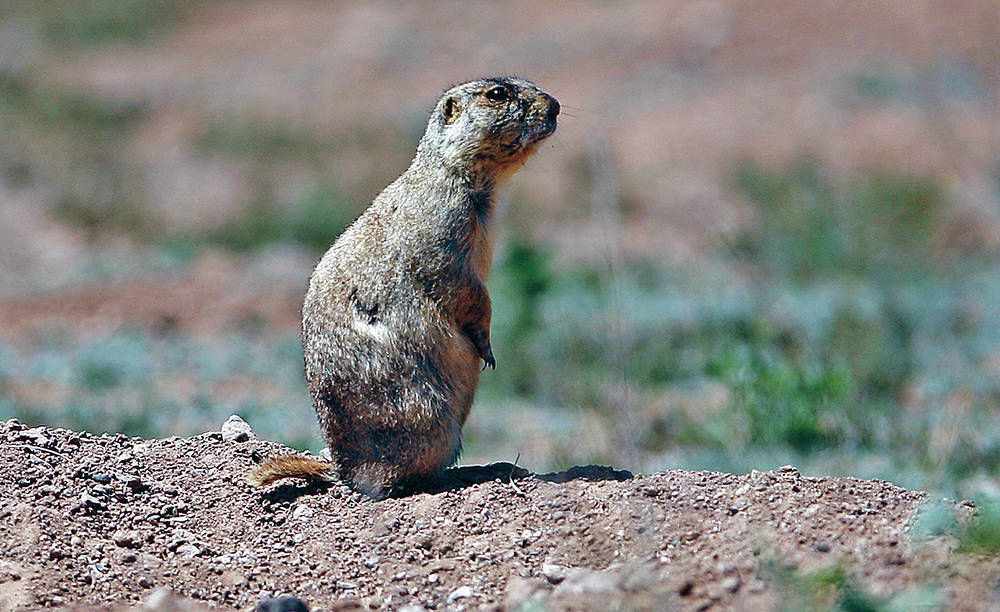
Santa Fe’s native animals are running out of time, due to massive development projects, lack of concern for local wild life, and destruction of habitat by a city government which currently cares little or nothing about remaining Nature. Increasing hot temperatures are also creating hardship for prairie dogs and the other wild animals who co-exist with them on remaining open areas within Santa Fe City/County limits.
Tag Archives: wildlife habitat
Fast food or prairie dogs? Santa Fe’s choice

There is a small area with trees next to this new fast-food wonder, where prairie dogs lived. Many people enjoyed watching them, some fed them, because this area was so denuded of vegetation, littered with human trash. These prairie dogs were refugees from other development in the area, and had no other place they could escape to when the bulldozers started. Most of them perished due to the construction. No effort was made to help them by the city.
A construction worker at the site reported to me that the city of Santa Fe “had ordered the placement of large rocks over the prairie dog holes” — most likely suffocating many of these animals.
In 2001, the city adopted a prairie dog relocation ordinance that remains part of the land-use code. Rather than killing these animals outright, the city has interpreted the ordinance as an excuse to remove prairie dogs from the city. With continued rampant sprawl, native wild animals don’t stand a chance of survival. As Santa Fe kills off prairie dogs, it also kills burrowing owls, snakes, song birds, trees, etc.
Santa Fe depends on tourism. Visitors marvel at the physical beauty, the “nature” that is still here — but it’s fast disappearing as we concrete everything over.
Mayor Alan Webber says we should be “nature-friendly.” Let’s help him do this by protecting remaining native wildlife. Now that the city of Santa Fe owns the old College of Santa Fe site, the open space should become a preserve for remaining wild species. Among the plethora of plans for the College of Santa Fe “midtown” is a trendy progressive “ecodistrict.”
The city needs to observe the following official ecodistrict guide, which should include prairie dog habitat:
Living Infrastructure
Goal: Enable flourishing ecosystems and restore natural capital.
Objectives: Healthy soils, water, trees and wildlife habitat; accessible nature; natural processes integrated into the built environment.
We must demand the city change its destructive attitude toward native wildlife in the area, protecting existing habitat and creating wildlife-friendly areas for prairie dogs and other wild species to live. The campus site is an excellent place to begin, especially since prairie dogs were poisoned there in the late 1990s. Now is our chance to correct our history of our abuse of nature. If the city of Santa Fe cannot provide protection for its native wildlife and ecosystems, it can no longer claim to be the City Different.
Rosemary Lowe is a wildlife/environmental activist and co-founder of People for Native Ecosystems, among other groups.
HUMANS TAKE UP TOO MUCH SPACE — AND IT’S AFFECTING HOW MAMMALS MOVE
Study found that human-modified landscapes shrink mammal movements by up to half
Human beings take up a lot of real estate — around 50-70 percent of the Earth’s land surface. And our increasing footprint affects how mammals of all sizes, from all over the planet, move.
A study recently published by Science found that, on average, mammals living in human-modified habitats move two to three times less far than their counterparts in areas untouched by humans.
What’s more, this pattern persists globally: from African forest elephants to white-tailed antelope squirrels in North America, the human footprint infringes upon the footprints of mammal species both big and small. The study, led by Marlee Tucker of the Senckenberg Biodiversity and Climate Research Centre in Germany, is the first of its kind to log movement behaviors for such a wide range of mammals globally.
“All organisms need space,” Bruce Patterson, a co-author of this study and MacArthur Curator of Mammals at The Field Museum in Chicago, explained. “They need space to gather their resources, find mates, and perform their ecological services.” For instance, bats need room to find and consume insects and pollinate plants (which amount to $3.5 to 50 billion worth of agricultural labor annually in the US alone), and apex predators need room to hunt and control other species’ populations.
In the study, more than 100 researchers contributed information on 803 individual mammals representing 57 species in total. Patterson offered up data on the movement of lions in a pristine wilderness area of Tsavo, Kenya. From 2002-09, he followed three lions using high-tech collars that continuously tracked individuals’ movement via GPS — the data he contributed to the Science study. One of those lions, in its natural habitat, patrolled an area twice the size of Chicago (1400 km2) to find food, attract mates, and repel intruders.
But habitat loss and fragmentation disrupt these critical animal behaviors. Clearing rainforest is an example of habitat loss — the destruction and loss of usable area for a given species. Constructing a road through the savannah, on the other hand, constitutes habitat fragmentation — the division of habitat area into smaller, discontinuous spaces. When suitable habitat spaces become too small or too isolated, animals can no longer afford to visit them, changing their space use.
As habitats become compromised, resources like food and living space that animals rely on become scarce. Sometimes, when resources are limited, animals traverse larger areas to get what they need — if there’s not enough food in a five-mile radius, they might move to a ten-mile radius. However, this study shows that on the whole, that sort of additional movement tends not to be an option — if there’s no uninterrupted landscape available, then the affected animals simply can’t live there.
To that end, the Science study found “strong negative effects of the human footprint on median and long-distance displacements of terrestrial mammals.” Patterson put it more simply: “Human dominion over Earth’s landscapes gets in the way of animals doing their thing.” Some species, like mice, can make do with less room, but animals that need lots of space, like lions, tigers, and elephants, simply can’t live in areas with lots of humans.
“It is important that animals move, because in moving they carry out important ecological functions like transporting nutrients and seeds between different areas. Additionally, mammalian movements bring different species together and thus allow for interactions in food webs that might otherwise not occur. If mammals move less this could alter any of these ecosystem functions,” says lead author Marlee Tucker.
Across the wide array of species its data encompasses, the study points to a singular, and grim, conclusion: For mammal species, the effects of habitat loss and habitat fragmentation don’t discriminate by geographic location, body size, or where that species sits on the food chain — the human footprint threatens most other mammals.
Still, Patterson remains hopeful that the Science study can guide further research and change our approach to human land use. “Ultimately, it would be good to know whether there are critical thresholds in the human footprint for the species living around us. Are there specific points beyond which resources become limiting and species are excluded?” he asked. “As we continue to transform the landscape and as the human population expands, we’re limiting the space and resources that other mammals need to live.”
As the Population of Humans Doubles, the Number of Animals Halves
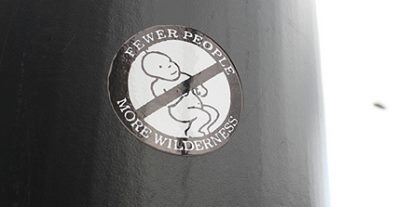
It’s unbelievable to me that in the year 2014—going on ’15—the media still does hyperbolic backflips every time some celebrity gets pregnant or decides it might be fun to become a daddy, as if human reproduction is some mysterious miracle we should all be awed by. Well, there’s only so much awe I can take before something becomes truly awful–especially in light of the fact that every new human born equates to less biodiversity for everyone.
That’s something I’ve known for a long time. Now, recent studies have officially confirmed that in the forty-six years since human overpopulation was first recognized as a serious problem, our numbers have more than doubled, while the number of naturally occurring animals is half of what it was then.
I’ve seen countless distressing instances of human “success” negating that
of the rest of Earth’s creatures. The most vivid recent example pitted a new Costco, Home Depot and the site of a soon-to-be future Walmart against an elk herd’s migration corridor. Where stately Roosevelt elk once freely travelled between protected park lands, a lit-up strip mall and associated blacktop parking lots now spell the sad end for wildlife and wilderness alike.
In a scene played over and over across anywhere USA, more land is taken up by more lanes of highway so more people can visit more superstores. More and more road-kill results finally in fatality for a few humans, and before you know it, a “cull” is implemented on whatever wild species dares to stand in the way of human “progress.”
Throughout the land you can hear the battle cry: “Out of the way, animals, we’ve got diapers and baby carriages to buy.”