Why the states have wolf management wrong

http://www.examiner.com/article/why-the-states-have-wolf-management-wrong

January 6, 2014
Cathy Taibbi|

copyrighted wolf in riverIn this Powell Tribune post, Wolf hunt ends with 24 taken, written by Gib Mathers, the big, glaring error in state wolf management is revealed.

The states, eager for revenue (gotten through the selling of hunting and trapping licenses), have gotten basic principles of wolf ‘management’ all wrong.

With wolves, ‘management’ is not as simple as removing individual bucks from a breeding population of deer – Wolves live in FAMILIES. Everything they do revolves around the well-being of their families – Including teaching their pups (who stay ‘children’, to be taught and protected, for three years), just as we teach our own children.

Wolves pass down learned information (for instance, to stay away from livestock) to their family, to their impressionable pups, in essence passing down a unique ‘culture’ of conduct and survival tools specific to each pack.

That includes respect for Man and his livestock.

Break the chain of knowledge by decimating family continuity, and you actually create problems where there hadn’t been any before.

Through hunting and trapping seasons, we rob wolves of their hard-won, hard-learned family-knowledge of how to co-exist with us.

Wolves LEARN. We don’t have to kill them. In truth, documented livestock depredation by wolves is exceedingly rare – Way behind other, routine, causes of livestock mortality such as weather and poor husbandry, for instance. Ranchers are compensated monetarily for even suspected kills by wolves, so ranchers are by no means financially harmed if a rare instance of a wolf killing livestock actually does occur.

The other lame argument is that wolves are jeopardizing herds of game (which human hunters wish to kill for fun.) Wolves will not eliminate all the game, either. If man has created enough challenges for wilderness systems that herd numbers actually do decline too much (as opposed to herd behavior changing to become more elusive targets), then the correct answer is to reduce the number of permits granted to sport hunters, for a season or two, or even three – Not to kill vital native species who have no choice but to hunt to live.

The best way to revitalize and rejuvenate a herd is to allow it to be under the management of their natural, original custodians – The wild predators, like wolves, who do not target the big, healthy and showy, with the biggest racks or heaviest pelt, in an effort to show off trophies and shore-up their fragile egos.

Wolves just want to eat. They catch what they can – the weak, the young, the old, the lame, the sick, the scrawny.

Leaving the biggest, healthiest, prettiest and best to spawn the next healthy, vital, resilient, magnificent generation.

And the carcasses they nibble on for the next few days or weeks, also feed a mind-boggling array of other creatures, from crows to beetles to foxes, and fertilize the forests and keep steams clean and fresh, and salmon populations thriving, and . . .Well, you can see how everything in nature travels in lock-step with everything else.

Human hunters don’t give much of anything back to the forest – A steaming gut-pile, perhaps. But humans do take. We take and take and leave the forest impoverished for our presence, unlike wolves, who enrich the wilderness and increase biological diversity – And beauty.

Even if wolves did pose a legitimate occasional threat, we don’t need to resort to the kind of wholesale slaughter we’re now indulging in (which is the main justification for these severe hunts – hunts which don’t afford wolves even the most basic humane considerations granted to species such as deer), including the hunting and massacre of innocent puppies still in the den, pregnant mothers, and utterly harmless (to humans and human endeavors) wolves; animals who are completely innocent and way out in the wilderness – even in protected wild lands and national parks and refuges, where wildlife is supposed to be able to exist without human interference.

Why send a lynch mob out into a national refuge to exterminate a naturally-occurring wild carnivore who, by all rights, needs to be there, fulfilling his age-old role?

Wolves are smart – We can teach them, using non-lethal means, to respect and avoid us, and our livestock.

But that doesn’t mean we will never SEE them. Just because you see a wolf doesn’t mean you, or your livestock, are even on her mind. She travels. She patrols. He explores. He hunts. He warns off rival wolves and coyotes – He has other things on his mind than harming you or your stuff.

Things like, making sure the kids are safe, or that ‘Auntie’, left in charge of the babies, is due a break.

You see, again, it’s all about family.

Wolf pups and pack members also need the option to safely disperse – Just like your son gets to date girls, move out, learn to manage his own household and find someone to fall in love with and raise his own family with – and your cousin, who finds a good job in another city, can now vacate your spare bedroom (where he’s been staying until he can get back on his feet) and move out, giving you back your space.

You all stay in touch with everyone through email and voice mail. (In the case of wolves, through scent marking and howling.) But if no one could ever move out of the family home, the family itself would wither,

Wolves need enough room and prey, enough of their own estate, to establish their own households, where they and their children can thrive, without bumping elbows with other wolves.

Is it all a ‘numbers game’? Well, think about it this way: Your third child deserves to live, grow and some day move out and find her own digs, not get shot because you’re at your family quota of two adults and 2 children.

Right?

For all these things, wolves need safe corridors bridging their family homes with other lands, other safe, wild habitats, and other wolf neighborhoods, in which to travel, to explore, test their mettle in their own territories, and find that special, genetically-unrelated someone to go through life with in a loving, mutually-supportive marriage.

That, by the way, is not a romanticized, anthropomorphic statement.

Wolves mate for life. They bond with each other, they are affectionate with each other, they protect each other and cooperate with each other. They LOVE each other, just as we love our own spouses. parents, and children.

They show altruism and tenderness, protectiveness and cooperation, just like human families.

They grieve – For weeks – when a pack member is lost.

In many ways, wolf families put human families to shame.

Is that why the very existence of wolves is seen as so threatening by some people?

‘Manage’ (shoot/trap) wolves ‘by the numbers’ and you cause disintegration of their most important social support systems, leaving grieving relatives and dependent babies behind; we (often intentionally) widow wolf parents and leave them to try to keep their families alive without help – As for single moms everywhere, it is very hard trying to raise your kids without both parents around.

That’s when many resort to less-than-ideal methods, out of desperation to survive and feed the family.

That’s when confused and frightened orphans, ill-equipped to survive without the protection and guidance of their wiser elders, can turn into the equivalent of street-gangs or vandals.

They need their families – Just as human children do – to become proper citizens.

Ethical wildlife management isn’t just ‘by the numbers’. It can’t be. Would you would want your own family arbitrarily ‘thinned’ (lethally) by an outside party, based on nothing but a heartless quota system?

With all their unique qualities, wolves can not be treated like other ‘game’ animals. Top-tier predators, whose numbers are naturally regulated by the availability and vigor of their prey, don’t need redundant management by humans. Wolves, in fact, should NOT be game animals, at all. They are not pests; They are not vermin or infestations.

They are essential and precious keystone/apex species who belong in, evolved with, and invigorate our living wilderness landscape just by being a part of it.

Wolves are, in truth, the original, supreme game and ecosystem managers of the wilderness

State wildlife management should not be about running a feedlot for the benefit of hunters, or ensuring safe and secure cattle-grazing on public lands for privately-owned livestock.

National parks and public lands are to be intact, unmarred oasis’s of authentic wilderness, lovingly protected and guarded against meddling or exploitation, for perpetuity.

Wolves and other species keeping a toehold in their rightful places in suitable areas need to be granted the right to BE and exist, as nature intended. Having shaped our herds, our biodiversity, the forests, plains and deserts, rivers and tundras, in the first place, for millenia, it should be obvious that wolves don’t just belong – They are needed.

Humans are not owners of the planet – We are fellow citizens in a tapestry of interdependent and interconnected Nations, all working in harmony to keep our precious Earth vital and alive.

But humans seem to be on a giant ego-trip, and we’re tipping the balance of everything out of whack, to where the very survival of our planet might be at stake.

It’s time for wildlife officials, and wildlife management science, to rise to the demands of integrated, holistic ecosystem management, (not ‘game ranch management’, not public lands ranching, not pandering to special interests), using our increased understanding of the emotional and psychological needs of the beings we’ve decided to preside over, to guide us – to create fully biologically diverse, functional and dynamic ecosystems that are allowed to thrive without human meddling.

One final thought: Nature does not NEED us. In fact, we all might benefit from adopting a ‘hands-off’ management style for our wild and open places. Case in point: The wolves and ecosystems that have rebounded – breathtakingly – after the old Chernobyl nuclear disaster. Here, in that abandoned kingdom, wolves, herds, even endangered species, coexist in a humbling harmony and splendor, with no people attempting to micro-manage things.

Take this message to heart – Nature can function just fine without us. All we have to do is leave her alone, and ALLOW.

Congressmen question costs, mission of Wildlife Services agency

http://www.latimes.com/nation/la-me-wildlife-killing-20140105,0,2146578.story#axzz2pXmR2tyM

By Julie Cart
January 4, 2014, 7:41 p.m.la-me-wildlife-killing-g

The U.S. Department of Agriculture’s inspector general will investigate a federal agency whose mission is to exterminate birds, coyotes, mountain lions and other animals that threaten the livelihoods of farmers and ranchers.

The investigation of U.S. Wildlife Services is to determine, among other things, “whether wildlife damage management activities were justified and effective.” Biologists have questioned the agency’s effectiveness, arguing that indiscriminately killing more than 3 million birds and other wild animals every year is often counterproductive.

Reps. Peter A. DeFazio (D-Ore.) and John Campbell (R-Irvine) requested the review, calling for a complete audit of the culture within Wildlife Services. The agency has been accused of abuses, including animal cruelty and occasional accidental killing of endangered species, family pets and other animals that weren’t targeted.

DeFazio says the time has come to revisit the agency’s mission and determine whether it makes economic and biological sense for taxpayers to underwrite a service, however necessary, that he argues should be paid for by private businesses.

“Why should taxpayers, particularly in tough times, pay to subsidize private interests?” said DeFazio, ranking Democrat on the House Committee on Natural Resources. “I have come to the conclusion that this is an agency whose time has passed.”

Wildlife Services was created in 1931 as part of the USDA’s Animal and Plant Health Inspection Service. It has wide-ranging responsibilities, including rabies testing and bird control at airport runways. But the bulk of its work is exterminating nuisance wildlife by methods that include poisoning, gassing, trapping and aerial gunning.

The agency acts as a pest management service not only for agribusiness and ranches, but also for other federal agencies, counties and homeowners who might have such problems as raccoons in an attic. Other services include protecting endangered species and maintaining game herds for hunters.

The services are free or substantially subsidized, which many private predator- and pest-control companies say unfairly undercuts their business. States and counties complain that they are responsible for an increasing share of the costs.

DeFazio and Campbell are also calling for congressional oversight hearings. DeFazio says he has spent years asking for but not receiving information from Wildlife Services, which he calls “the least accountable federal agency” he has ever seen.

He said he had to learn from the Los Angeles Times about an internal audit the agency conducted last year. The audit found the agency’s accounting practices were “unreconcilable,” lacked transparency and violated state and federal laws. Further, the audit revealed that $12 million in a special account could not be found.

“The last time I tried to get more specific financial information, they just blew me off and said they couldn’t provide that,” DeFazio said in an interview. “Yet, at the same time, they were undertaking this audit. So, the managers were, at best, disingenuous, and at worst, undertaking a coverup.”

A Wildlife Services spokeswoman said the agency had already begun to carry out changes recommended in the audit.

In response to allegations of improper behavior by agents, the spokeswoman said the department does not condone animal cruelty and that employees are trained to strictly follow state and federal wildlife laws.

Information that DeFazio’s office says Wildlife Services has refused to disclose includes the identities of its clients. DeFazio’s office has determined that the agency acts as an exterminator for golf clubs and resorts, hunting clubs, homeowners associations, paving companies and timber giants International Paper and Weyerhaeuser.

The agency’s supporters argue that the cost is appropriately borne by consumers, who value local food production. In California, many ranchers and farmers would go broke if they had to pay private companies to do the work provided free of charge by Wildlife Service agents, said Noelle G. Cremers, a lobbyist for the California Farm Bureau.

Members of Congress have heard allegations for years of improper — and in some cases, illegal — practices within Wildlife Services. Attempts at congressional investigations have been stalled by what DeFazio calls the agency’s “powerful friends” in agriculture and ranching lobbies.

Among the allegations legislators want to review are those by Gary Strader, a Wildlife Services hunter in Nevada until 2009. He alleges he was fired for reporting to superiors that colleagues had killed five mountain lions from airplanes, which is a felony. He said his supervisor told him to “mind his own business.”

Strader said the same supervisor gave similar advice when the hunter discovered that a snare he set had unintentionally killed a golden eagle. Knowing that the bird was protected under federal law, Strader called his supervisor for guidance. “He said, ‘If you think no one saw it, take a shovel and bury it,'” Strader said.

Agents are required to maintain records of their kills, but critics say those records are opaque and probably inaccurate. The official count, for instance, does not include offspring that will die after adult mountain lions or bears are killed, or coyote pups inside a den that has been gassed.

“The numbers are absolutely manipulated — gravely underestimated,” said Brooks Fahy, executive director of Predator Defense, a wildlife conservation group.

Part of the difficulty of wildlife control work is making sure the lethal methods reach only the intended targets. Cyanide traps set for coyotes can kill other animals. Many domestic dogs — thousands, by the accounting of watchdog groups — have been inadvertently poisoned by capsules meant for coyotes.

Rex Shaddox, a former Wildlife Services agent in Wyoming, said agents “were told to doctor our reports — we were not allowed to show we killed household pets.” Shaddox said he knew a rancher who kept a grisly souvenir of the agency’s collateral damage: a 10-foot chain of interconnected dog collars.

Shaddox says the agency rarely handles federally controlled poisons legally. Agents are required to post signs where pesticides and poisons are placed and maintain detailed logs. But supervisors tell them not to, Shaddox and other former agents said.

Wildlife Services agents have also been accused of animal cruelty, particularly in the use of dogs to control and kill coyotes. Last year, a Wyoming-based trapper posted photographs to his Facebook page showing his dogs savaging a coyote caught in a leg-hold trap. Other pictures showed the agent’s animals mauling bobcats and raccoons.

The agency said it was investigating.

Wildlife biologists also criticize the agency’s work, which they say ignores science. Bradley J. Bergstrom, a conservation biologist at Valdosta State University in Georgia, and other biologists at the American Society of Mammalogists say they have been frustrated by the agency’s unwillingness to share scientific data tracking the effectiveness of its approach.

For instance, Bergstrom said, eradicating coyotes from a landscape creates unintended consequences. He said a Texas study found that killing coyotes that preyed on cattle led to an increase in rodents, which prey on crops. The pest problem shifted from those who raise cattle to farmers who grow crops.

“Preemptive lethal control … makes no sense,” Bergstrom said. “It’s known as the ‘mowing the lawn’ model — you just have to keep mowing them down.” .

http://www.latimes.com/nation/la-me-wildlife-killing-20140105,0,2146578.story#ixzz2pZziBW5a

NYT Approves of Killing 3,000 Deer on Long Island

THE NEW YORK TIMES EDITORS APPROVE OF KILLING 3,000 DEER ON LONG ISLAND

by Anne Muller

When The New York Times editorial staff gives its imprimatur to an idea, policy, politician, or event, it carries a lot of weight. I’m an avid online reader of the NYT, sometimes waking at 3:45 a.m. to read the NYT in my inbox. As an anti-hunting advocate, the subject of wildlife management has been a specialty of mine for many years, so I was disappointed to read that the killing of deer was given short shrift by the Times’ editors.

There’s something wrong when the killing of 3,000 living, breathing beings is given a thumbs-up by an esteemed newspaper. I prefer to believe that the support shown for this “cull” is not a lack of ethics, but rather a lack of information about how deer populations increase. It’s important to know the truth in order to apprehend the real culprit.

To allow hunters to remove a considerable percentage of the deer population while ensuring a continuing “crop” for the next hunting season, land manipulation and hunting regulations are designed to increase their birthrate and food supply. The current goal of wildlife management agencies is to sustain hunting from season to season. (There is an exception to this form of management but it would be too lengthy to discuss here.)

Wildlife Services, which operates almost as a separate fiefdom within the USDA, benefits greatly from killing “excess” wildlife that occurs due to sloppy miscalculations by state game departments, and their indifference to wild animal suffering. It’s a win-win situation for both a state wildlife management agency and the federal Wildlife Services, but it is a huge loss for the general public, the deer, and those who love them.

Both state game agencies and Wildlife Services operate as if they were private enterprises functioning within a larger government entity, enjoying all the benefits of public money and the credibility that municipal governments attribute to them. Yet, the very survival of Wildlife Services depends on outside contracts from private or government entities; and the survival of state game departments depends on hunting license sales and excise taxes on handguns, other firearms, and ammunition used legally against wild animals and illegally against people.

While hunting has been given a pass by President Obama and other gun control proponents, there are certain fiscal inequities that need to be exposed, and opposed as vigorously as other wrong laws plaguing our society.

I wonder if those who believe that gun control is needed but hunting is okay understand that every firearm purchased and every bit of ammunition used in the killing and injury of students, theater goers, elected officials, and thousands of individuals shot in urban areas, increases the revenue of the Conservation Fund whose purpose is to fund game agencies so that they can continue to benefit from the excise taxes on weapons and ammunition. Put another way, the goal of wildlife management agencies is to increase the use of firearms and ammunition in order to collect the excise tax.

Isn’t it time to revisit the Pittman-Robertson Act, which created an insulated and circular business that cares little about how firearms are used just so long as they are used?

Wouldn’t it only be fair that funds derived from the sale of guns and ammunition be allocated to compensate victims, or their care-takers, to mitigate the impact of losses from death, injury, or property damage resulting from the use of such weapons and ammunition?

Does it really seem right that all conservation funds are used to promote hunting and more use of firearms and ammunition?

Wildlife management needs to shift from a weapons-based and hunting-based foundation to a non-consumptive, wildlife watching one. That alone will reduce the artificially increased number of deer, thus obviating the pretense of a “necessary cull” due to natural causes rather than the choreography of wildlife management agencies.

How much longer must we and wildlife suffer with our current form of wildlife management? How much longer should families of victims of gun violence be left without compensation to cover the financial burden of their loss? How much longer should the public be kept in the dark about the funding scheme of firearms use? How much longer should our wild animals suffer as a result of mismanagement and a lack of ethics regarding their welfare?

Killing the Long Island deer is wrong both morally and strategically. The real culprit is wildlife management’s connection to the firearms industry. Slaughter of these precious beings will not solve anything, but it will allow the nightmare to continue. Hunting should not be a sacred cow for gun control proponents. It’s time to take it on and change the game.

Anne Muller, VP

Committee to Abolish Sport Hunting

New Paltz, NY and Las Cruces, NM

Photo Copyright Jim Robertson

Photo Copyright Jim Robertson

Deer Hunters Would Freak if They Saw a Wolf

Despite news that wolves are starting to spread out to other states, after their re-introduction to the Tri-state area of the Northern Rockies, wolves are still extinct in most of their former range in the continental U.S. Yet, it seems there’s no shortage of deer; in fact ungulate populations have been booming since the near continent-wide extermination of wolves and other predators that left the lower 48 in ecological turmoil.

Take Oklahoma for example. According to their “local OKC weekend hunting news”:

Oklahoma’s gun season opens Saturday. The rut is expected to be going  strong across the state in the coming days. State wildlife biologists in Okla. expect the peak of the rut in most areas of the state to happen sometime before Saturday’s opening. 

Barring any major weather events that keeps hunters at home,  Saturday will be the biggest deer hunting day of the year.  More deer are taken on the opening day of gun season than on any other. The rut, the mating season of deer, is triggered primarily by moon phases. However, the rutting activity that hunters see has more to do with the weather.

The first time Oklahoma hunters checked in 100,000 deer for all  seasons combined was 13 years ago.  Since then, there have been only three years that Oklahoma’s deer harvest has not exceeded 100,000.

Wildlife biologists estimate deer hunters take about 10 percent

Photo by Jim Robertson

Photo by Jim Robertson

of the deer population during hunting seasons. This gives Oklahoma an estimated deer population about one million.

Approximately one million deer in a state as small as Oklahoma. And exactly ZERO wolves. 100,000 deer killed during hunting season, and it’s not even a dent in the deer population. Natural processes have been ousted and ignored–hunters there would freak if they if they saw a wolf. I can just hear their screams of, “Those wolves are going to eat all our game…” It’s the same story that’s going on across the country. Hunters don’t want healthy deer or elk populations, they want a surplus to justify their “harvests.”

How are Deer Managed by State Wildlife Agencies?

http://animalrights.about.com/od/wildlife/a/DeerManagement.htm

By

Most people think of wildlife management agencies as serving the ecosystem, interfering minimally and mainly to preserve wildlife. These agencies do have programs to protect endangered species and to protect habitat in general. But instead of managing wildlife solely for the optimal health of the ecosystem, state wildlife management agencies also manage wildlife for recreation. The agencies have a financial incentive to do so.

Deer as a Resource

To these agencies, deer are a resource, not sentient beings with their own inherent rights. The resource must be conserved, or used wisely, so that there will be plenty of deer for future generations of hunters. As a result, deer management is usually designed to keep the deer population high. For example, the Arizona Game and Fish Department’s mission is:

To conserve, enhance, and restore Arizona’s diverse wildlife resources and habitats through aggressive protection and management programs, and to provide wildlife resources and safe watercraft and off-highway vehicle recreation for the enjoyment, appreciation, and use by present and future generations.

The desire for a high deer population led Pennsylvania and other states to stock deer in the early 20th century.

The Wisconsin Department of Natural Resources states in their annual report: “We rank first in the country for the highest single year deer harvest on record and are number one for deer harvest over the past decade. All of us work hard to keep it that way.”

The New York Department of Environmental Conservation takes the “needs” of hunters into account when determining their goals for deer management:

The goal is to balance deer with their habitat, human land uses and recreational interests. Ecological concerns and the needs of landowners, hunters, and other interest groups must be considered.

The Pennsylvania Game Commission also considers the desires of hunters in their deer management strategy:

Managing Pennsylvania’s deer herd is an enormous undertaking that frequently includes input from everyone from hunters and naturalists to farmers, foresters and suburbanites. Each has his or her own idea about how many deer we should have. As a general rule, hunters want as many as possible. Still others, particularly people made a living from their land, prefer fewer deer. But history has shown that no one group gets its way entirely.

These are just a few examples of state wildlife management agencies stating that they manage the deer population in a way that increases recreational hunting opportunities for hunters.

Financial Incentives

Most people find it incredible that their state wildlife management agencies are trying to keep deer populations high when so many residents complain that there are too many deer, but the agencies have financial incentives for pleasing hunters. The agencies depend on sales of hunting licenses for their funding, and hunters like a high deer population. The Michigan Department of Natural Resources states on their website:

Michigan hunters have supplied millions of dollars for the development of hunting regulations based on scientific data. They have also provided funds to enforce those rules in the field. Millions of dollars have been contributed for the acquisition of land and for the improvement of deer habitat on those lands. In many cases, legislative action to protect deer, acquire land, and improve deer range has been initiated by hunters themselves. This partnership among the Michigan deer hunter, the Department of Natural Resources, and the Michigan Legislature speaks well of our ability as citizens to work together through state government to manage wildlife.

Also, the federal Pittman-Robertson Act gives money from the excise taxes on sales of guns and ammunition to state wildlife agencies to increase wildlife populations. Pittman Robertson funds can also be used for land acquisition, hunter safety education and for the construction and maintenance of target ranges. To be eligible for Pittman-Robertson funds, a state must not divert money from the sales of hunting & fishing licenses outside of the state’s wildlife management agency.

How Do The Agencies Increase the Deer Popuation?

To increase the deer population, sections of forest in state wildlife management areas are clear-cut, to create the “edge habitat” that is preferred by deer. For example, the Virginia Department of Game and Inland Fisheries recommends for deer management:

Openings in a forested area encourage the production of preferred food plants and may compensate for yearly and seasonal fluctuations in food supplies, like acorns. Natural openings in forests should be maintained. Openings of one to three acres in size should be created, and be strategically located throughout an area to provide diversity and edge.

State wildlife management lands are also sometimes leased to farmers, and the farmers are required to plant deer-preferred crops and leave a certain amount of their crops standing so that the deer will be fed and reproduce more. Sometimes, the state wildlife management agencies will plant “deer mix” themselves, to increase the deer population. For example, the Illinois Department of Natural Resources explains,

Portions of the area are managed under a farm lease program to promote upland wildlife habitat and to demonstrate the potential for producing wildlife on farm lands. Site personnel supplement natural habitats with tree and shrub plantings, native grass seedings, specialty food crop production and succession control.

Of course, animal rights activists oppose hunting and oppose wildlife management that artificially increases the deer population. As long as state wildlife agencies are funded through sales of hunting licenses and Pittman-Robertson funds, they will have an incentive to manage deer as a source of recreation and they will continue to be at odds with animal rights activists.

Cattle Ranchers Given Wolves’ GPS Coordinates

[The fox is guarding the henhouse, so to speak. And I thought those tracking collars were only meant to be used for scientific purposes…]

http://www.spokesman.com/stories/2013/nov/10/cattle-ranchers-track-wolves-with-gps-computers/

Cattle ranchers track wolves with GPS, computers

Becky Kramer The Spokesman-Review

COLVILLE – Before the sun breaks over the mountains, Leisa

Photo Copyright Jim Robertson

Photo Copyright Jim Robertson

Hill is firing up a generator in a remote cow camp in eastern Stevens County.

Soon she’ll be poring over satellite data points on her laptop, tracking the recent wanderings of a GPS-collared wolf.

Hill is a range rider whose family grazes 1,300 head of cattle in the Smackout pack’s territory. Knowing the collared wolf’s whereabouts helps her plan her day.

She’ll spend the next 12 to 16 hours visiting the scattered herd by horseback or ATV. Through the regular patrols, she’s alerting the Smackout pack that cattle aren’t easy prey.

Her work is paying off. Last year, 100 percent of the herd returned from the U.S. Forest Service allotments and private pastures that provide summer and fall forage. This year’s count isn’t final, but the tallies look promising, said Hill’s dad, John Dawson.

“We’ve lost nothing to wolves,” he said.

Hill’s range rider work is part of a pilot that involves two generations of a northeastern Washington ranch family, the state and Conservation Northwest. The aim is to keep Washington’s growing wolf population out of trouble.

Last year, government trappers and sharpshooters killed seven members of the Wedge pack for repeatedly attacking another Stevens County rancher’s cattle.

That short-term fix came at a high political price: The state Department of Fish and Wildlife received 12,000 emails about the decision, mostly in opposition. Two wolves have again been spotted in the Wedge pack’s territory, either remnants of the original pack or new wolves moving in.

It upped the ante for all sides to be proactive.

Ranchers can’t fight public opinion

Many Washington residents want wolves, said Dawson, a 70-year-old rancher whose son, Jeff, also runs a Stevens County cattle operation.

“I can’t fight that,” John Dawson said of public opinion. “You have to meet in the middle; you have no choice.

“We put most of our cattle in wolf territory for the summer,” he said. “I’ve been trying to learn as much as possible about wolves so we can meet them at the door.”

For ranchers, “it’s a new business now, a new world,” said Jay Kehne of Conservation Northwest, a Bellingham-based environmental group that works on issues across Washington and British Columbia.

Conservation Northwest supported last year’s controversial decision to remove the Wedge pack. “We wanted to do what we felt was scientifically right, what was supported by the evidence, what people knowledgeable about cattle and wolf behavior were telling us,” Kehne said.

But the organization obviously prefers preventive, nonlethal measures, he said. Conservation Northwest had talked to Alberta and Montana cattle ranchers who use range riders and was looking for Washington ranchers willing to try it. The Dawsons were interested.

Conservation Northwest helps finance three range riders in Washington – the Dawsons in Stevens County, and others in Cle Elem and Wenatchee.

Hiring a range rider costs $15,000 to $20,000 for the five-month grazing season, Kehne said. The state and individual ranchers, including Dawson, also contribute to the cost.

In addition, the state Department of Fish and Wildlife provides daily satellite downloads on GPS-collared wolves to help range riders manage the cows.

Collared wolves are known as “Judas wolves” for betraying the pack’s location.

The downloads give the wolves’ locations for the past 24 hours, though the system isn’t foolproof, said Jay Shepherd, a state wildlife conflict specialist. Dense stands of trees can block signals, and the timing of satellite orbits affects data collection.

Last winter, the state captured and collared three wolves in the Smackout pack. One of the collars has a radio-based signal that can be detected when the wolf is nearby. The other two wolves received GPS collars. One of the collars has stopped working. The remaining GPS collar is on a young male that doesn’t always stay with the pack.

Ranchers must sign an agreement to access the satellite downloads. “They understand it is sensitive data that’s not to be shared,” said Stephanie Simek, the state’s wildlife conflict section manager.

GPS tracking adds a high-tech element to modern range riding, but much of it is still grunt work. The Smackout pack’s territory covers about 400 square miles. John and Jeff Dawson’s cattle graze 10 to 15 percent of the pack’s territory, but their range encompasses the heart of it.

Leisa Hill’s work starts in early June, when the cows and calves are turned loose on Forest Service allotments and private pastures. The range riding continues through 100-degree August days and wraps up in early November after the first snowfall.

She travels nearly 1,000 miles each month by horse and ATV through thick timber to reach scattered grazing areas. She watches for bunched or nervous cows, as well as sick or injured animals that wolves might consider easy prey.

She’s also alert to patterns in the wolves’ movements. Regular visits to a particular site probably indicate the presence of a carcass.

Hill has fired noise-makers to scare off adult wolves that were in the same pasture as cows. Last year, she spotted four wolf pups on the road.

The 46-year-old prefers to stay in the background, declining to be interviewed for this story. However, “the success of this range rider program is because of Leisa,” her father said. “She knows the range and she understands cow psychology.”

Skinny calves mean a financial loss

On a recent fall morning, John Dawson drove a pickup over Forest Service roads past small clusters of Black Angus, Herefords and cream-colored Charolais cows with their calves.

The cows were just how he likes to see them: relaxed, spread out and eating. Calves should be putting on 2 to 3 pounds a day.

“When they’re not laying around, resting and eating, they’re not gaining,” he said.

Dawson heard his first wolf howl in 2011, the year before the range rider pilot started. He and his son lost seven calves that summer, though they couldn’t find the carcasses to determine cause of death.

The remaining calves were skinnier than usual. They probably spent the summer on the run from wolves, or tightly bunched together and not making good use of the forage, Dawson said. For ranchers, skinny calves can be a bigger financial blow than losing animals.

Say a rancher has 500 calves and they each come in 40 pounds lighter than normal. At a market price of $1.50 per pound, “that’s a bigger loss ($30,000) than losing seven calves, which is about a $5,000 loss,” he said.

Over the past two years, the Dawsons have seen robust weight gain in their calves. They credit the range rider program.

Earlier this year, Jeff Dawson and Shepherd, the state wildlife conflict specialist, talked with Klickitat County cattle ranchers. Wolves have been spotted in south-central Washington, and some of those ranchers are starting to experiment with range riders.

“The success the Dawsons have had has gone a long way to helping promote nonlethal means and proactive measures to reduce conflict,” said Jack Field, the Washington Cattlemen’s Association’s executive vice president.

If ranchers take extra steps to protect their animals, the public is more likely to accept the occasional need to kill wolves that repeatedly attack livestock, said Conservation Northwest’s Kehne.

John Dawson and his wife, Melva, spent decades building their ranch, working other jobs while they grew the herd. To preserve that legacy, the family was willing to try new ways of doing business, he said.

“I think (range riding) would work for a good share of other ranchers,” he said. But “they have to be open-minded enough to want it to work.”

SHARK calls for firing of Wisconsin state employees in armed raid that killed “Giggles” the baby deer

g1_zps0baf318dba1969

New video released from the raid showing scared fawn
just minutes before she was captured
Watch SHARK’s new video HERE  
Watch WISN 12’s coverage of the story HERE
This is a frame of the video the DNR took right before they captured and then killed Giggles.
SHARK has received a trove of internal documents from the Wisconsin Department of Natural Resources (DNR) regarding their July 15, 2013 armed raid on the Society of St. Francis animal shelter in Kenosha County, WI. This raid was to capture and kill a baby fawn that had been dropped off at the shelter, and who had been named “Giggles” by the shelter staff.
The DNR internal documents reveal the following:
• Though the DNR claimed in a public statement that “None of our staff take joy in these situations,” emails show that personnel were excited and looking forward to the raid. They even expressed that joy with  “smiley faced” emoticons in their email.
• The DNR violated their own plan by killing Giggles before her origin could be discovered. Instead of asking the shelter owner where Giggles came from, the DNR simply killed the fawn outright.
• The DNR charged taxpayers for snacks and potato chips for their wardens who assisted with the raid.
• Giggles was killed by having a metal bolt shot through her head.
Left: The DNR’s own records show how excited and happy they were that they were going to capture and kill a baby deer. Right: The DNR actually charged taxpayers for snacks and potato chips for the wardens, because apparently if you work for the DNR, killing a fawn makes you hungry.
The armed raid by DNR was government at its very worst. These people abused their power, they wasted taxpayer money, and they took pleasure in an outrageous raid on an animal shelter all so they could capture and kill a fawn.
The DNR claimed that Giggles was “euthanized,” but by their own admission they killed her using a bolt gun.
A bolt gun is a slaughterhouse weapon. It is brutal and ugly and the DNR’s own record shows that this defenseless, 20 pound animal died after a state employee drove a steel bolt through her head. For that reason, and everything we’ve expressed, we are calling on Governor Scott Walker to immediately fire all those who are responsible for this disaster. 
Take Action!
Please politely contact Wisconsin Governor Scott Walker and ask him to fire all of those who planned and participated in this raid, especially those who took such joy in it.
govgeneral@wisconsin.gov
(608) 266-1212

Wis. GOP efforts to expand hunting irk opponents

By TODD RICHMOND, Associated Press

Sunday, September 22, 2013

MADISON, Wis. (AP) — Wisconsin outdoorsmen spent most of the last decade chafing at the state Department of Natural Resources, accusing the agency of ruining hunting with overly strict regulations.

Republican Scott Walker told hunters on the campaign trail things would be different if he was elected governor, and two years later, it is. Walker and his fellow Republicans have reshaped Wisconsin’s outdoors scene with an intense drive to expand hunting.

Some fees have been cut, hunting and trapping in state parks is now OK, wolves are now fair game and it’s no longer necessary to shoot a doe before getting a buck. Supporters say the moves are important to shore up the $1.4 billion hunting industry as interest wanes among a younger generation.

“At the heart of it, legislators are truly trying to promote the hunting heritage, hopefully in perpetuity, so it doesn’t die on the vine,” said Sen. Neal Kedzie, R-Elkhorn, chairman of the Senate’s natural resources committee.

But conservationists and hunting opponents say Republicans and the DNR have tried so hard to please hunters they’ve forgotten non-hunters such as hikers, skiers and birdwatchers.

“I don’t really understand why, instead of promoting all these things, why aren’t they promoting tourism or photography? They’re just not diversifying at all,” said Melissa Smith, organizer of the group Friends of Wisconsin Wolves. “Can’t we encourage people to enjoy the outdoors without killing something?”

Hunting has always been part of the social and economic fabric in Wisconsin. But interest has been waning. According to DNR data, the hunting participation rate for adult males dropped 16 percent between 2000 and 2009. The youth participation rate declined about the same over that span.

DNR hunting officials cite several factors for the dropoff, including aging hunters, a perception that there’s nowhere to hunt and time-consuming video games. Hunter frustration with the DNR was intense over those years, too. They complained about the agency’s earn-a-buck regulations, which required hunters to kill antlerless deer before taking bucks. They also criticized the DNR’s plan to kill as many deer as possible in southwestern Wisconsin to slow the spread of chronic wasting disease.

DNR officials, then under Democratic Gov. Jim Doyle’s administration, said they were following science-based approaches to thin a burgeoning deer herd. But hunters said the tactics were leading to anemic hunts and the agency was ignoring them.

Since Walker and his fellow Republicans took control of state government and the DNR, they’ve eliminated earn-a-buck, created a hunter recruitment council, reduced license fees for first-time hunters and hunters who recruit others to the sport, required online hunter education courses and ended the general prohibition on hunting and trapping in state parks.

They also implemented the state’s first wolf hunt and introduced bills to establish sandhill crane, woodchuck and crossbow deer seasons as well as block local governments from restricting bow and crossbow hunting. The DNR has dusted off plans to import elk in hopes of creating a season on them and is studying how to implement mini deer hunts on private land.

GOP lawmakers and DNR officials say preserving hunting traditions ensures that money exists for conservation — license fees and federal taxes on firearms, ammunition and archery equipment helps fund habitat management — and the balance between species continues.

“When your numbers of new outdoors people … continue to go down, the way to increase those numbers is to make it more accessible,” said Rep. Joel Kleefisch, R-Oconomowoc, an avid hunter who wrote the bills for a sandhill crane season and against local restrictions on bow and crossbow hunting.

The movement has political roots, too. Walker courted hunters on the campaign trail and pro-hunting groups, including the Wisconsin Bear Hunters Association and the Wisconsin Wildlife Federation, have spent tens of thousands of dollars lobbying lawmakers since the GOP took over the Legislature in 2011.

Opposition to the sandhill crane season was so intense Republican leaders never brought the bill up for a floor vote. And hunters’ latitude in state parks won’t be unlimited; the DNR’s board is poised this week to block hunters from firing from and across state park trails and to require trappers to use dog-proof snares in the parks.

But conservationists and animal rights advocates haven’t had much success elsewhere.

A judge this spring let stand the Legislature’s provisions allowing hunters to use dogs to track wolves, a blow to a group of humane societies that argued the practice would lead to bloody wolf-dog fights in the woods. This summer the DNR rejected the Sierra Club’s request to join the committee that crafts wolf hunt policy. DNR Land Division Administrator Kurt Thiede wrote in a letter to the Wisconsin chapter’s executive director, Shahla Werner, that the committee isn’t comprised of groups that oppose wolf management since state law now calls for hunting.

Smith sent a letter to DNR Secretary Cathy Stepp this month complaining non-hunters have nowhere to enjoy nature. She suggested the DNR raise conservation dollars by offering wolf- and bear-watching tours, kayak trips and canoe outings.

“This agency is controlled by a small amount of people with very narrow interests,” she wrote. “That’s why you’re holding onto traditions that are fading away and find yourself in trouble.”

more: http://www.newstimes.com/news/science/article/Wis-GOP-efforts-to-expand-hunting-irk-opponents-4834091.php

Photo Copyright Jim Robertson

Photo Copyright Jim Robertson

State’s first hunt didn’t reduce tensions over wolves

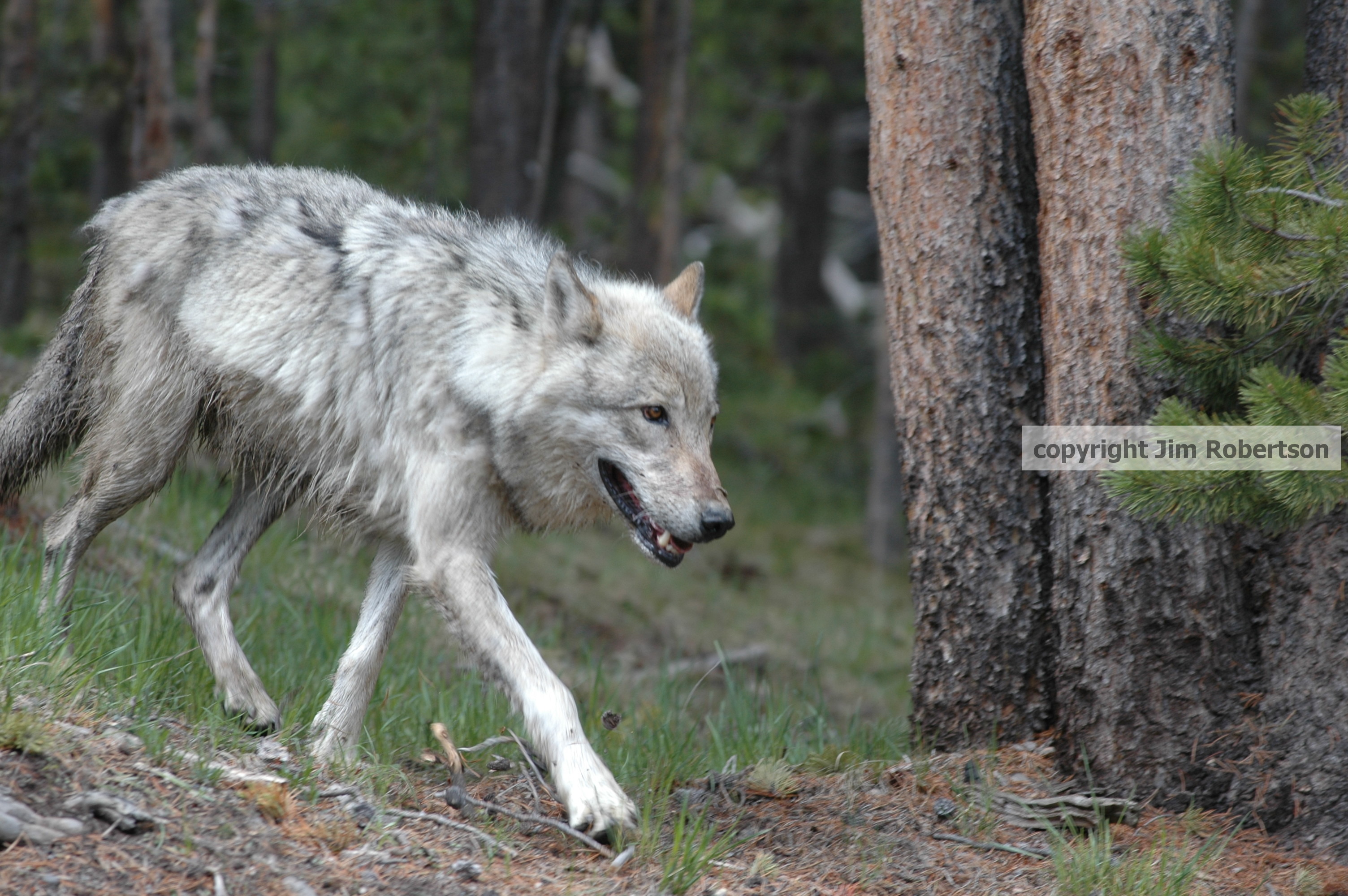
The following article proves that when Yellowstone biologist, Doug Smith, stated, “To get support for wolves, you can’t have people angry about them all the time, and so hunting is going to be part of the future of wolves in the West. We’ve got to have it if we’re going to have wolves,” he was dead wrong; and when wolf hunter Randy Newberg told NPR News, “Having these hunting seasons has provided a level ofcopyrighted Hayden wolf walking tolerance again” he was totally full of shit…

State’s first hunt didn’t reduce tensions over wolves

Last year’s first managed wolf hunt in Wisconsin history did not increase tolerance toward the animals among people who live in wolf country, a new survey by University of Wisconsin-Madison researchers shows.

With a growing wolf population, state wildlife managers and legislators who rewrote state hunting laws had hoped a hunting season would lower wolf numbers and reduce tensions over the animals.

But the survey shows this didn’t happen.

The last time the researchers surveyed public’s perception of wolves in 2009, 51% of wolf country residents said they would be more tolerant of wolves if the public could hunt them.

But in this year’s survey when asked the same question, residents in wolf country were much less accepting. The level of acceptance dropped to 36%.

When measuring the public’s attitudes in all parts of the state, 37% of the respondents said they would be more tolerant toward wolves with a public hunt. There was not a statewide comparison in 2009.

The wolf range is generally described as northern Wisconsin and the state’s central forests.

The hunt took place Oct. 15 to Dec. 23. Hunters and trappers killed 117 wolves, according to the Department of Natural Resources. The agency had set a harvest goal of 116 among non-tribal hunters and trappers.

“If one of the goals of the wolf hunt was to increase tolerance for the species, the first season did not accomplish this objective,” said Jamie Hogberg, a graduate student at the Nelson Institute for Environmental Studies.

Team led study

Hogberg was part of a team that examined public attitudes toward wolves. Others on the team were Adrian Treves, an associate professor of environmental studies; Bret Shaw, an associate professor of the Department of Life Sciences Communication; and Lisa Naughton, a professor of geography.

One possible explanation for the lack of change in public opinion is that despite the hunt, the state’s wolf population has changed little.

In April, the DNR estimated the wolf population from over-winter counts at between 809 and 831 animals in 216 packs. The previous winter’s estimate was 815 to 880 wolves in 213 packs.

The survey was sent to 1,311 people. There were 772 responses, or 59%. The vast majority — 538 — of people who responded reside in areas where wolves are present.

In January 2012, the federal government removed wolves from the list of protected animals under the Endangered Species Act in the Great Lakes states. That allowed states to manage the wolf population through hunting and trapping seasons.

The Legislature approved a wolf hunt in April 2012.

Mexican Gray Wolf Dies in Leghold Trap!

http://www.kjzz.org/content/1308/mexican-gray-wolf-dies
By: Mark Brodie on 08/20/2013

Wildlife officials said a Mexican gray wolf [one of around 50 remaining on Earth] has died in the Apache Sitgreaves National Forest. Arizona Game and Fish officials said a field team was trying to fit radio-telemetry collars on some wolves last weekend. One female yearling was caught in a padded foot trap, and the animal moved into rocky terrain on the edge of a slope. By the time crews could get to the wolf, she was no longer breathing and could not be revived.

Authorities said this is only the third time they have had a capture-related death in the 15-year history of the Mexican wolf reintroduction project in Arizona and New Mexico. The Mexican gray wolf was added to the federal endangered species list in 1976.

The federal government recently announced Arizona, New Mexico and other states would share $850,000 to help reduce conflicts between the wolves and livestock.

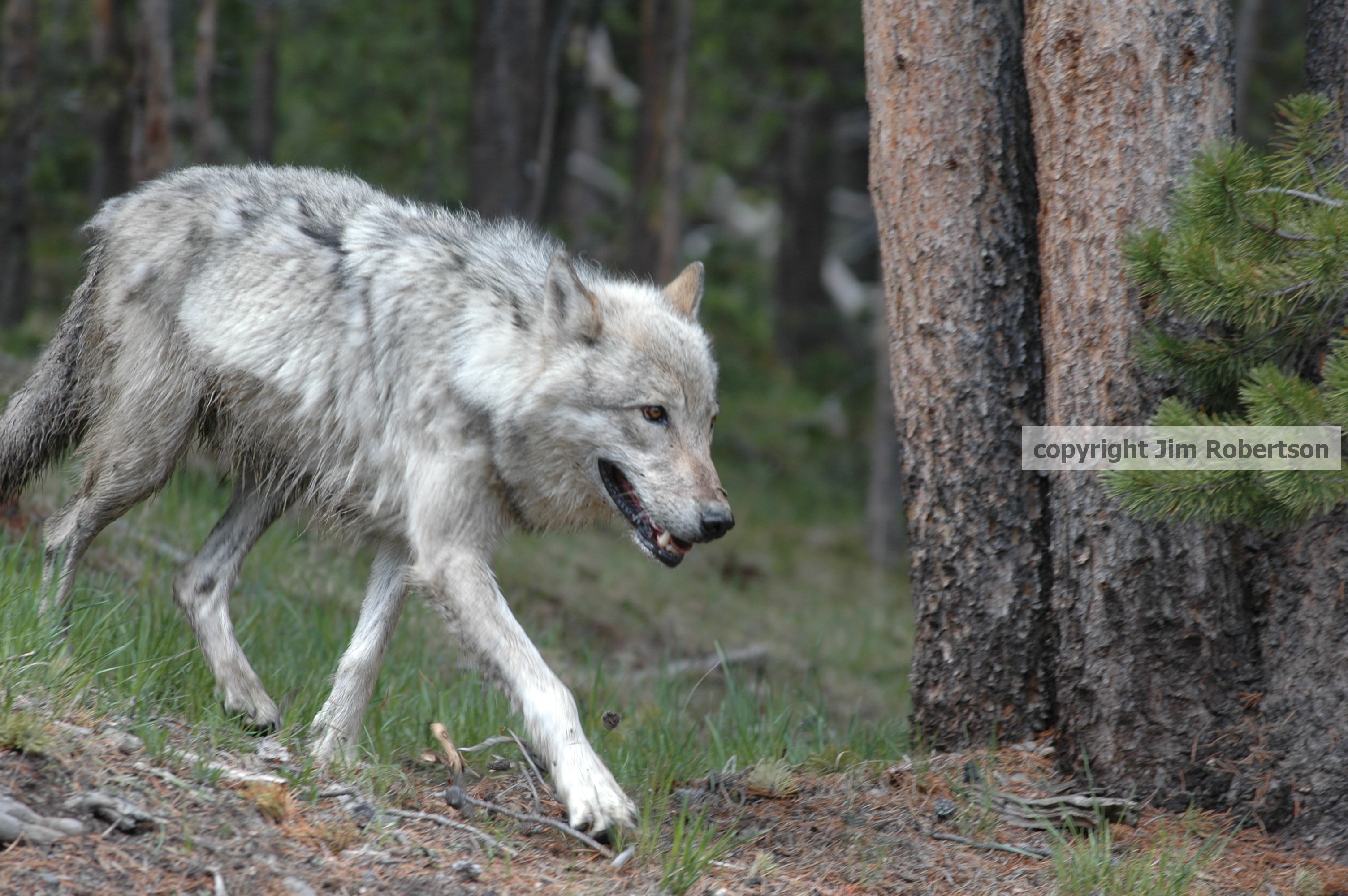
copyrighted Hayden wolf walking