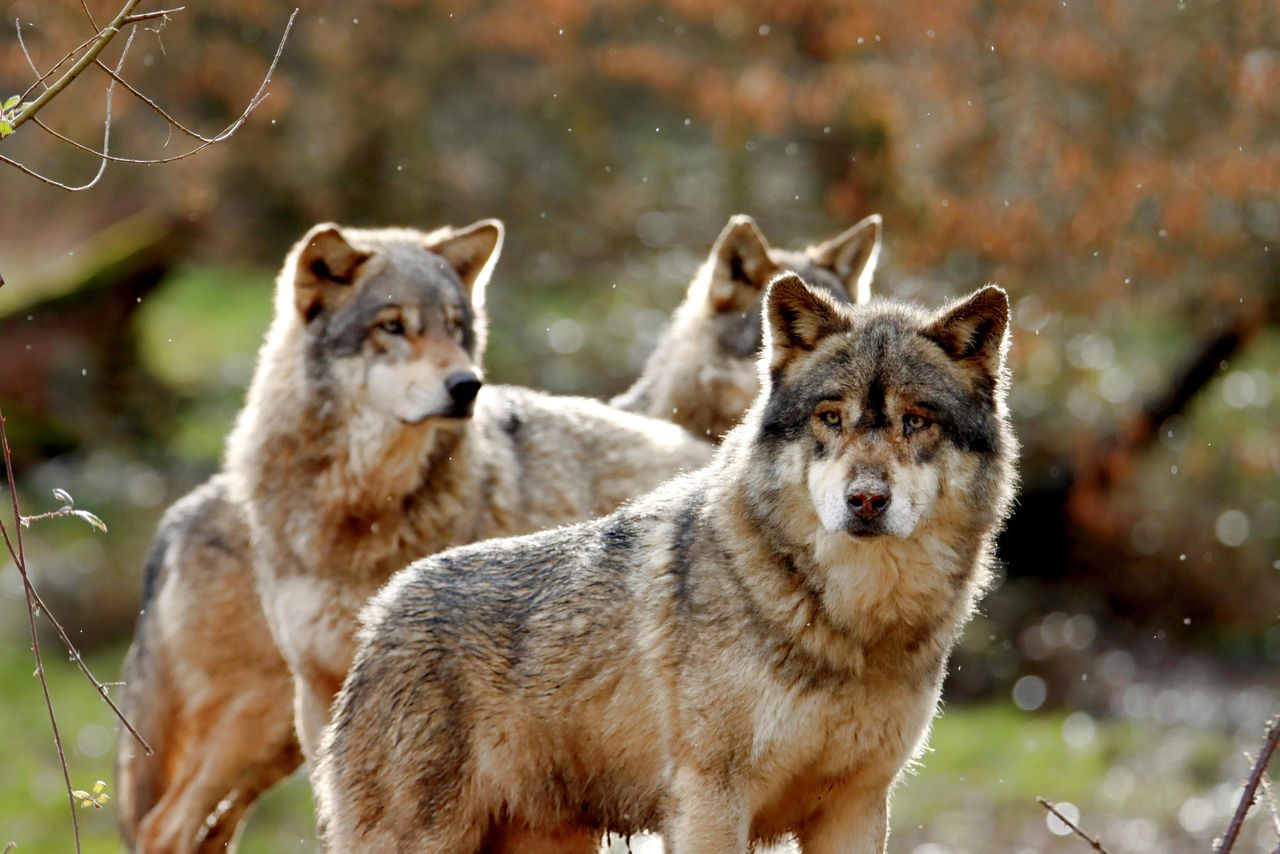
The Mistreatment of Colorado Wolves Ignores Their Emotional Needs

September 27, 2024


The Mindset of Colorado’s Wolf Snafu Needs a Pro-Wolf Reset

To date, this project cannot be called any sort of success. 

Colorado Parks and Wildlife’s unnecessary and uncompassionate dismantling of a Colorado pack of wolves sets a dire precedent.

Current management practices disregard their rich and deep emotional lives and physical and psychological wellbeing.

CPW has not uttered one compassionate word about what the deeply sentient wolves were feeling during their trap and relocate debacle during which the father wolf died and his mate and their four children were placed in captivity. 

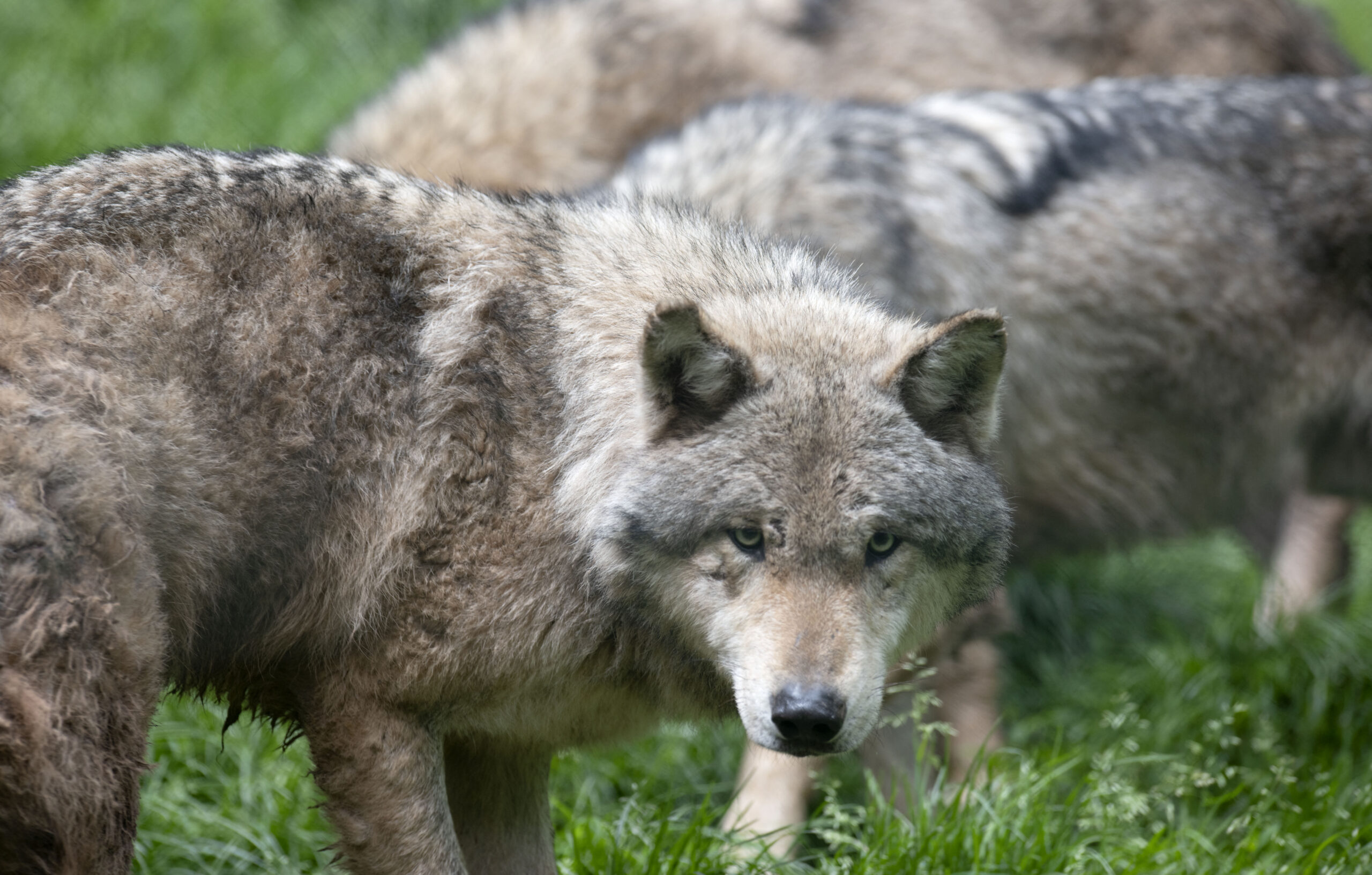
Colorado Parks and Wildlife (CPW) recently dismantled the Copper Creek pack—a family of wolves consisting of the father, mother, and their four children—because they denned on the land of a rancher who did little to nothing to deter them.1 These parents were the first breeding pair in the state and they and their children represent the DNA of Colorado’s future wolves. Doing their best to survive, they discovered the rancher’s food animals were an easy option—basically “room service”—compared to hunting wild prey. 

The problems presented here aren’t going to be isolated incidents, nor can we keep the public in the dark and hope to ignore them. Nor should we ignore what the wolves themselves are feeling as they are mistreated by humans responsible for their wellbeing. 

The Current and Ever-Changing State of Affairs

“This was—and continues to be—a complex, tragic and ultimately avoidable situation, and it’s essential that we all examine the facts and the context to prevent any similar fate for other wolves in the future.”—Kitty Block, CEO of the Humane Society of the United States, see: The tragic fate of Colorado’s Copper Creek wolf pack

Months of silence from the agency in charge and a hostile and oftentimes pessimistic media created perfect conditions for dark-age thinking and fearmongering. It’s time the voters of Colorado learn the truth about the wolves they voted to bring home. No less will do than a full accounting of the scientific and ethical missteps that led to an entirely avoidable and completely unforgivable assault on the lives of these amazing, sentient beings. 

After hearing from countless people about this entirely avoidable and unforgivable assault on the lives of these amazing sentient beings, I wanted to do my part in getting information to the public. 

Simply put, CPW’s “trap and relocate operation” fails in three ways. In the grand scheme of things, it represents a failure by its very nature: uprooting and traumatizing the lives of the pack members, just for being wolves. 

1. Scientific grounds: Science shows that interfering in the lives of these animals was most likely going to have serious negative consequences, and it did—the father died after being captured and the rest of his family are being held in captivity, the details of which remain undisclosed to the public. Even if some or all of this captive pack are released at a later date, experts fear it likely won’t be an easy transition back to the wild in what is proving to be a wolf-unfriendly state.

Of course, there is hope that those of us in the scientific community are wrong. But one thing is certain: had CPW used the “best available science,” it would not have engaged with or captured the wolves at all, instead allowing them time to adapt to their new home, with nearby ranchers doing their part to employ sensible nonlethal deterrence measures, If only, then this founding group of wolves would have been celebrated rather than scorned and ill-treated. 

Interfering in the lives of this family group also would have been discouraged had those responsible for the wellbeing of the wolves paid any attention to what scientific research has shown us about the emotional lives of these sentient beings—what they need to thrive among themselves and in the presence of humans with whom they are trying to cohabit. 

Among wolf advocates, the trap and relocation was also a failure for the precedent it set and for how it ignored what the wolves were feeling. 

2. Ethical grounds: Wolves are sentient beings, not merely objects to be moved here and there as if they aren’t impacted by what happens to them. Science shows they are, of course, extremely sensitive to changes in their social lives and where they live. They were once wild in Oregon and once wild in Colorado, and now they’ve lost their father and are being held in captivity with an uncertain fate. Surely their being trapped and relocated and the loss of their father and mate wreaks havoc with how they feel and deeply compromises their individual wellbeing. 

3. Commonsense: It was never the intent of anti-wolf ranchers to go along with the reintroduction, regardless of how often the government stepped in to offer assistance and how much it offered to pay in compensation. Reintroduction may have passed by a majority of Colorado voters, but in meeting the demands of a vocal minority, CPW has rewarded bad behavior. Within days of removing the Copper Creek pack, the same ranchers who demanded their removal began complaining that relocation wasn’t enough. And now there is a move to keep the names of complaining ranchers who ask for compensation from going public

Would you do it to your dog? Another element of commonsense rests on the fact that dogs share a common wolf ancestor and have wolf genes and wolf-like neural pathways in their brains. Commonsense and science mandate that if dogs have rich and deep emotional lives which of course they do, so too do wolves. That is an undebatable scientific fact. I’ve known a few dogs in my life named Cody, Ninja, Rascal, Sadie, and Dolly and I am sure that they and others would have suffered greatly by being treated like their wild relatives were treated. If you wouldn’t do it or allow it to be done to a dog, why would you do it or allow it to be done to a wolf?

CPW also ignore the possibility that the male died after being caught in a leg-hold trap and held in a cage because he was highly stressed and already was suffering from an injured leg. 

There is no doubt that each member of this family group has suffered greatly by being trapped and moved and by having their family uncompassionately dismantled by CPW. 

The treatment of the wolves requires a new mindset that incorporates their point of view

We now know that there is a plan to bring in around 15 more Canadian wolves in a few months. We must not lose sight of the fact that all this easily avoidable turmoil was the result of only two wolves mating to form a pack of six individuals. Is it not unreasonable to wonder how ranchers will better prepare to meet the moment when Colorado’s wolf population doubles? 

All signs point to trouble ahead as wolves try to settle into their new homes, begin competing with one another and other predators, and hopefully breed. Without a mandate for non-lethal management and the use of all available deterrents, the wolves will surely face calls for more trap and relocate operations, or worse. We can’t just move the “problem” around, as it begets more chaos. Surely, if there is a repeat of what has happened to the original group, the emotional lives of other wolves will be severely compromised. 

As Kylie Mohr writes:

“…wolves move quickly, spreading out in search of food, mates and territory. Next February, more of the newly arrived wolves might pair up and breed, forming new packs. More wolves will likely mean more wolf-human interactions — and more opportunities for both state wildlife officials and ranchers to keep what happened to Middle Park’s livestock and the Copper Creek Pack from happening again.”

The physical and emotional wellbeing of every individual wolf matters

If wolves are going to be punished and made an example of for finding the wrong food source, why bring in more? It’s a double-cross that cannot be defended scientifically, ethically, or using a healthy dose of commonsense.

People who want to see and hear (and possibly smell) wolves on Colorado’s landscapes want live, wild wolves who live wild wolf-appropriate lives, not severed family units, punished for doing things that wolves evolved to do.

The emotional lives and physical and psychological wellbeing of every single individual matters, and none are disposable simply for expressing their lupine—wolf-like—ways of being. One of the basic tenets of the ever-growing field of compassionate conservation is that the life of every individual matters because they are alive. Their inherent or intrinsic value is what counts, not their instrumental value that focuses on what they can do for us. 

All in all, conservation science must value individuals because they experience different emotions and their joys and pains are their own personal joys and pains. Individual wolves do not care if their species is on the brink and conservation efforts should be guided by compassion rather than by harming and killing. 

What the wolves think and feel matters and must be factored into how we choose to interfere in their lives. If you are outraged by how the wolves were treated you’re right on the mark. 

There are many lessons to be learned for how we choose to interact with our wild neighbors of any species. Respecting their rich and deep emotional lives is good for them and good for us and must be factored in to how humans choose to interfere in the lives of Colorado’s wolves and other animals. 

References

1) For more information, see: Colorado’s New Wolves: Why Was This Pack Decimated?Colorado’s New Family of Wild Wolves Must be CelebratedColorado Wolves: Hyped Media Derails Neighborly Coexistence; KGNU Interview: https://howonearthradio.org/archives/9710 (CPW did not reply to their request for an update on the fate of Colorado’s newly captured wolf family/); Colorado Wolves Receive Mixed Hellos and Muddy MediaWolf Packs Suffer When Humans Kill Their LeadersWhy We Misjudge Wolves, Bears, and Other Large CarnivoresThe Hidden Slippery Slopes of Animal Reintroduction ProgramsDo Individual Wolves Care if Their Species Is on the Brink?; LET’S KEEP COLORADO’S WOLVES OUT OF THE SPOTLIGHTThe Perks of Appreciating Wild Neighbors as Sentient Beings. More details can be seen here: Why was Colorado’s Precious, Promising First Wolf Pack Decimated?

Conservation Science Must Value Individuals and Anthropomorphism

Bekoff, Marc. The Emotional Lives of Animals: A Leading Scientist Explores Animal Joy, Sorrow, and Empathyand Why They Matter. New World Library, 2024. 

Mohr, Kylie. A mixed report for Colorado’s wolves. High Country News, September 19, 2024. 

Ordiz, A. et al. Large carnivore management at odds: Science or prejudice? Global Ecology and Conservation, 2014.

Image: patrice schoefolt/Pexels.

California enacts unprecedented restrictions on rat poisons in bid to protect wildlife

A mountain lion with mange.

The famed and late mountain lion known as P-22 likely developed mange as a result of rat poisoning. A new California law bans the use of anticoagulant rat poisons, with some limited exceptions.

(National Park Service)

By Lila Seidman

Staff WriterFollow

Oct. 1, 2024 3 AM PT

  • A 2023 California Department of Fish and Wildlife report found that roughly 88% of raptors and 90% of pumas tested were exposed to the poisons.
  • The law allows the poisons to be used in agricultural settings and public health emergencies.

California has become the first state in the nation to restrict use of all blood-thinning rat poisons due to their unintended effect on mountain lions, birds of prey and other animals.

Gov. Gavin Newsom recently signed a bill that expands an existing moratorium to all anticoagulant rodenticides, with only limited exceptions. The poisons prevent an animal’s blood from clotting and cause it to die from internal bleeding. When an unsuspecting mountain lion or owl gobbles a dead or sick rat — or another animal that ate a tainted rat — the toxic substance can be passed on.

Wildlife advocates hailed the new law — set to go into effect Jan. 1 — as an important step toward protecting non-target animals. However, agricultural and pest-control groups derided the measure as a potential public health issue that sidestepped the state’s regulatory process.

Climate & Environment

Newsom signs bill to ban octopus farming in California

Sept. 29, 2024

“I’m so proud that California is leading the way in protecting wildlife from these harmful and unnecessary poisons,” said J.P. Rose, urban wildlands policy director at the Center for Biological Diversity, which sponsored AB 2552. “I think we can all agree that unintentionally poisoning native wildlife is wrong.”

Advertisement

A 2023 California Department of Fish and Wildlife report found that roughly 88% of raptors and 90% of pumas tested had been exposed to the poisons. Birds of prey — and American kestrels in particular — have been significantly harmed by chlorophacinone, one of two poisons targeted in the law, according to Lisa Owens Viani, director of Raptors Are the Solution, a co-sponsor of the bill.

Megan J. Provost, president of Responsible Industry for a Sound Environment, a trade association for the specialty pesticide and fertilizer industry, which opposed the bill, pointed to its potential harm to humans.

“Effective rodenticide products are necessary for protecting the health and safety of people, structures and businesses — including those responsible for food safety — from the diseases and property damage caused by rats and other harmful rodents,” Provost said in a statement. The new law “unfortunately removes products from the pest control toolbox that are important for managing rodent infestations, leaving fewer products for effective immediate and long-term control and for managing resistance in rodents.”

She said California’s Department of Pesticide Regulation has wide latitude to evaluate pesticides for safety “so pesticide-specific legislation … that supersedes this process was unnecessary.”

The law allows the poisons to be used in agricultural settings and public health emergencies.

Owens Viani said legislation and other efforts were necessary because state pesticide regulators were unwilling to act on their own.

Advertisement

“We’re ahead of the rest of the country with these regulations, but it hasn’t been because DPR has been a willing partner,” Owens Viani said. “We’ve had to force them every step of the way.”

A spokesperson for the agency said it “has been actively evaluating risks” related to the rodenticides since 2014.

“Evaluation has included both monitoring for impacts through a partnership with the California Department of Fish and Wildlife and initiating formal reevaluation to inform future actions to mitigate risks to wildlife,” the spokesperson said in a statement.

Owens Viani said her organization has worked for about a decade on passing legislation, including two previous laws that banned other blood-thinning rat poisons. A suit her nonprofit filed against the state agency is ongoing.

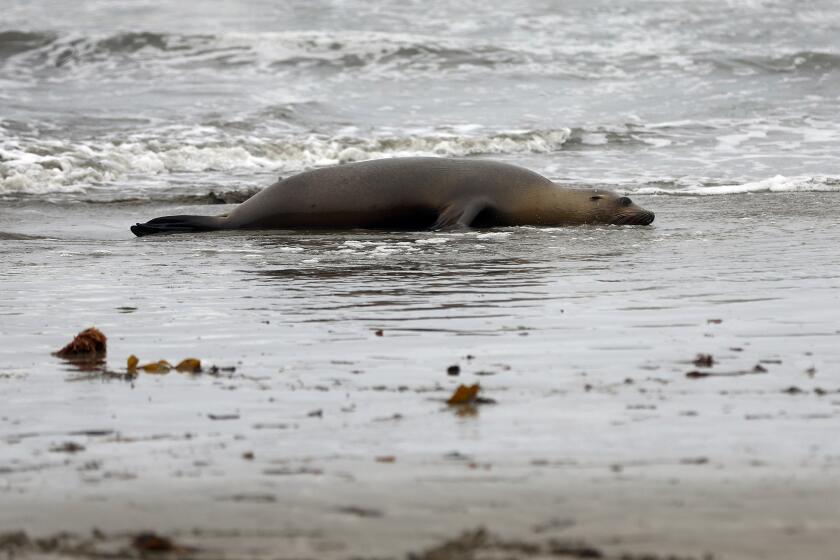
CAYUCOS, CALIFORNIA - AUGUST 05: A sick California sea lion lays on the water at Cayucos State Beach on August 05, 2024 in Cayucos, California. The Marine Mammal Center is seeing a surge of sick California sea lions washing up on Central California beaches in the past month exhibiting symptoms consistent with domoic acid poisoning, which leaves the mammals lethargic and suffering from seizures. The Marine Mammal Center, the world’s largest marine mammal hospital, typically respond to 60-80 sea lions per year impacted by the neurotoxin. Since July, 19th, they have responded to 70 calls for seal lions in distress. (Photo by Justin Sullivan/Getty Images)

Climate & Environment

Outbreak of neurotoxin killing unprecedented number of sea lions along California coast

Aug. 11, 2024

The early seeds of Owens Viani’s work on the issue began around 2011, when a neighbor ran over to tell her that Cooper’s hawk fledglings had drowned in his kiddie pool. At the time, she was studying raptors at the Golden Gate Raptor Observatory and had a hunch rat poison was involved. Tests confirmed it.

“It kept happening in my neighborhood, like people kept finding more dead hawks,” she said. They weren’t eating the bait; they were eating rats. “I knew that if people were using poison in my eco-friendly neighborhood in Berkeley, it was probably a problem everywhere. And so that’s when I decided to found my nonprofit and try to educate more people about the problem.”

Advertisement

The latest legislation, authored by Assemblymember Laura Friedman (D-Glendale), tightly restricts the use of chlorophacinone and warfarin, which are known as first-generation anticoagulant rodenticides. A law signed in 2020 put a moratorium on second-generation anticoagulant rodenticides. And last year the only other first-generation poison was added through a separate law.

The older first-generation version is slower-acting, requiring the rat to feed on the poison several times before it dies. The second-generation version is more potent, earning the moniker “one-feeding kills.”

Other states are working on similar efforts, but Owens Viani said only California has enacted a moratorium. British Columbia has placed a permanent moratorium on second-generation poisons, and the U.S. Environmental Protection Agency removed those types of poison from consumer shelves, she said.

The ban will remain in place until the state Department of Pesticide Regulation reevaluates the poisons and comes up with restrictions that meet certain criteria to protect wildlife.

The law also creates civil penalties. Anyone who sells or uses the poisons in violation of the law is subject to a fine of up to $25,000 per day for each violation.

Any money collected from violations will go to the Department of Pesticide Regulation to cover its costs in administering and enforcing the rules, and potentially other activities.

Advertisement

The department estimated the law would create a one-time cost of $258,000 and an ongoing annual cost of $193,000 to support a position “to handle anticipated increases in follow-ups and complaints associated with investigating sales and restricted materials,” according to a government analysis of the bill.

Approximately 170 Endangered southern mountain yellow-legged frogs (Rana muscosa) were released into their native habitat in the San Gabriel Mountains on Aug. 29 and 30, 2023. Animal care staff from the Los Angeles Zoo joined conservationists from the U.S. Geological Survey (USGS) to an undisclosed site to conduct the release.

Climate & Environment

Endangered frogs threatened by California wildfires once again. A rescue could be in order

Sept. 15, 2024

The analysis anticipates revenue loss of an unknown amount to the department, as well as to the California Department of Food and Agriculture’s Vertebrate Pest Control Research Advisory Committee.

The agency said it is committed to “a timely completion of its reevaluations.” Another bill signed into law this year requires that the agency share a timeline and status of all reevaluation and mitigation by the end of the year.

“The reevaluations underway include an assessment of cumulative impacts of anticoagulant rodenticides,” including first-generation varieties, the agency said in a statement, adding that it “will continue its ongoing work to address unintended wildlife exposure from first-generation and second-generation rodenticides while still retaining tools to protect public health, agriculture, critical infrastructure and the environment.”

Wildlife advocates said they compromised on certain elements of the bill as it wound through the Legislature and encountered opposition.

For example, a previous version of the bill allowed members of the public to sue bad actors for breaching the law.

Advertisement

An L.A. Times editorial from earlier this year pitched this as a powerful element of the legislation, which “could help curb the use of banned rodenticides by empowering all Californians to become enforcers.”

However, the California Chamber of Commerce called it “an expansive new private right of action that threatened businesses and created incentives for frivolous lawsuits,” and removed its opposition once the provision went away.

Owens Viani said proponents had also hoped to create buffer zones around agricultural areas, where birds of prey forage and which are part of habitat ranges for mountain lions, coyotes and other animals.

But there were other wins. Rose pointed out what he described as “exciting language … around the sentience of animals.”

The law text notes that animals “are able to subjectively feel and perceive the world around them” and that the “Legislature has an interest in ensuring that human activities are conducted in a manner that minimizes pain, stress, fear and suffering for animals and reflects their intrinsic value.”

Female Leopard Tries to Free Captured Cub; Forest Department Warns Residents

Shortly after the cub’s capture, a female leopard tried to free it by repeatedly ramming the cage, prompting Forest Department to issue safety alert.

Female Leopard Tries to Free Captured Cub; Forest Department Warns Residents

Shivraj Sanas

Published on: 

29 Aug 2024, 3:33 pm IST

Pune: In a rare occurrence, four leopards have been captured in a span of just 18 days in the Bighevasti-Katwanvasti area in Ambegaon taluka. The latest capture took place early on Thursday (August 29), when a one-and-a-half-year-old leopard cub was trapped in a cage set by the Forest Department.

Shortly after the cub’s capture, a female leopard tried to free it by repeatedly ramming the cage, prompting the Forest Department to issue a safety alert to residents.

Female Leopard Tries to Free Captured Cub; Forest Department Warns Residents

Leopard Numbers Soar to 500 in Ambegaon, Junnar, Shirur, Khed Talukas

The first leopard was captured on August 12, followed by a second, a one-year-old male, on August 18, and a third on August 25. The latest capture is the fourth in this series.

The frequency of these incidents has caused alarm among local residents, who are now worried about the continuing presence of leopards in the area.

Farmers in the area, led by Maruti Karbhari Bhor, had requested the Forest Department to set additional traps due to frequent leopard sightings.

Following the recent capture, Bhor reported witnessing a female leopard growling and hitting the cage in an attempt to rescue the trapped cub. The rescue team from the Forest Department, along with local villagers and officials, managed to take the leopard cub into custody.

Female Leopard Tries to Free Captured Cub; Forest Department Warns Residents

Panic at RIT College as Leopard Roams Campus; Search Teams Mobilized

The situation has heightened concerns among locals after a leopard killed two sheep belonging to a farmer, Santosh Patilbuwa Lokhande, late Sunday night. This incident further indicates that leopards remain active in the vicinity, leading to growing fears among residents.

Safety Alert for Residents

The Forest Department has advised residents of Bighevasti-Katwanvasti to exercise caution, especially after a female leopard showed aggressive behavior by ramming into the cage where the cub was trapped.

Given the possibility of further aggression, authorities are considering setting up more traps and have requested residents to remain alert.

Five Arrested for Illegal Wild Boar Hunting and Meat Transport in Talegaon

The team also seized a substantial quantity of wild boar meat along with the vehicle.

Illegal Wild Boar Hunting

Illegal Wild Boar HuntingThe Bridge Chronicle

Neelam Karale

Published on: 

30 Sep 2024, 10:47 am IST

Pune: The Forest Department arrested five individuals involved in the illegal hunting and transport of wild boar meat near Talegaon Dabhade, on the old Pune-Mumbai highway.

The incident unfolded when the Vadgaon Maval Forest Department received a tip-off about a group transporting wild boar meat in a car. Acting swiftly, the department conducted a raid and apprehended the suspects.

The team also seized a substantial quantity of wild boar meat along with the vehicle, with the total value of the confiscated items amounting to approximately six lakh rupees.

The arrested individuals have been identified as Maruti Shitole and Satyawan Bhoir, both hailing from Kasarsai in Mulshi, and Datta Waghmare, Sanjay Waghmare, and Sitaram Jadhav, all residents of Kade Maval.

Illegal Wild Boar Hunting

Female Leopard Tries to Free Captured Cub; Forest Department Warns Residents

The group was allegedly involved in hunting wild boar, which is a protected species under the Indian Wildlife (Protection) Act of 1972.

https://syndicatedsearch.goog/afs/ads?psid=5134551505&channel=AutoRsVariant&cx=r-10443d5c1ede938a1&fexp=95342163%2C21404%2C17301431%2C17301432%2C17301436%2C17301511%2C17301516%2C17301266%2C72717108&client=pub-0327893541412000&r=m&hl=en&rpbu=http%3A%2F%2Fgoogle.com&rpqp=q&type=3&rs_tt=c&oe=UTF-8&ie=UTF-8&format=r5&nocache=9741727718237790&num=0&output=afd_ads&domain_name=www.thebridgechronicle.com&v=3&bsl=10&pac=0&u_his=1&u_tz=-420&dt=1727718237792&u_w=1536&u_h=864&biw=1521&bih=710&psw=1521&psh=710&frm=0&uio=-&cont=autors-container-0&drt=0&jsid=csa&nfp=1&jsv=678245571&rurl=https%3A%2F%2Fwww.thebridgechronicle.com%2Fnews%2Ffive-arrested-for-illegal-wild-boar-hunting-and-meat-transport-in-talegaon&referer=https%3A%2F%2Fwww.google.com%2F

According to the Forest Department, the accused were caught near New English School on the old Pune-Mumbai highway, where they were attempting to transport the illegally obtained meat.

The Vadgaon Maval Forest Department quickly acted on the intelligence and set up a raid that led to the successful capture of the suspects. The operation was led by Range Forest Officer S.D. Vark, with additional support from Circle Forest Officer Mallinath Hiremth and a team of forest guards.

Illegal Wild Boar Hunting

Pune forest department bans photography of this migratory bird in Lonavala

The raid team included Forest Guards Devle, Daya Dome, Parmeshwar Kasule, Yogesh Kokate, SK More, Krishna Dethe, and Deepak Ubale, along with Forest Attendant Jambhulkar. 

Under the supervision of Chief Conservator of Forests N.R. Praveen, Deputy Conservator of Forests Mahadev Mohite, and Assistant Conservator of Forests Atul Jain, the team managed to prevent further transportation of the meat.

Public hearing planned for Indiana bobcat trapping proposal

play audio
Play
Bobcats were protected in Indiana until 2005, when they were removed from the state's endangered species list. (Adobe stock)
Bobcats were protected in Indiana until 2005, when they were removed from the state’s endangered species list. (Adobe stock)

Previous StoryNext Story

 Joe Ulery, Producer

 Contact

  Why you can trust Public News Service

Thursday, September 26, 2024   

Indiana is considering a limited bobcat trapping season and the Department of Natural Resources is seeking public input on the proposal.

The plan would allow trapping in about 40 southern Indiana counties starting in November 2025, with a statewide quota of 250 bobcats. Trappers would have a one-bobcat bag limit and be required to purchase a special bobcat license.

Geriann Albers, furbearer and turkey program leader for the Indiana Department of Natural Resources, said the proposal includes strict monitoring, and requires trappers to report their catches within 24 hours.

“We do have a population model for bobcats,” Albers explained. “We’re very confident with that 250 quota that it will not negatively impact bobcat populations. What that 250 was set on was the population model we have that shows that’s a sustainable level of harvest.”

Opponents argued even a limited season could threaten bobcat populations. Environmental groups, including the Humane Society, said the DNR’s population model may not fully account for the bobcat’s slow reproductive rate and threats from habitat loss. They contended reintroducing trapping could undermine years of conservation work that helped the species recover in Indiana.

Albers noted the DNR invited public feedback on the proposal.

“On that rule-making docket page the comment button is available for people to submit comments now,” Albers pointed out. “That went up pretty quickly after the meeting but the first round of comments, we haven’t scheduled yet because that usually coincides with when we do a public hearing.”

A public hearing, tentatively set for November, will offer both in-person and virtual participation options. The DNR said updates will be posted on its website.

Waterfowl hunter shoots and kills wolf near St. Germain

A man shot and killed a gray wolf Saturday morning while he and two others were waterfowl hunting near St. Germain. Two wolves reportedly approached as close as five yards to their blind.

Paul A. Smith

Milwaukee Journal Sentinel

0:50

0:50

The Department of Natural Resources is investigating an incident in which a man shot and killed a gray wolf Saturday as he and two others were waterfowl hunting on public land near St. Germain.

Chase Melton, 19, of Sugar Camp, said about 6:15 a.m. Saturday two wolves approached the hunters’ blind.

Melton was accompanied by hunters aged 14 and 13. Saturday was opening day of the 2024 Wisconsin duck hunting season in the north zone.

He initially attempted to scare the wolves off, Melton said in an interview with WJFW in Rhinelander.

“I tried making some noise, I was clapping, stomping, breaking some sticks, whatever,” Melton said.

One of the wolves got as close as 5 yards to the hunters, Melton said. “I probably could have touched it with my hand, that was extremely scary,” Melton said. “So now, we’re really panicking. We’re like alright, we’re surrounded and we have a wolf charging us right now.”

Melton said he picked up his shotgun and when one of the wolves kept coming he shot it in the head; he estimated the animal was 8 to 10 yards away.

The wolf died nearby.

Melton said it was not what he wanted but the hunters “felt harmed” so he pulled the trigger.

He called the DNR to report the incident.

An updated population estimate for gray wolves in Wisconsin is expected sometime this fall.

Randy Johnson, DNR large carnivore specialist, said Wednesday an investigation of the incident remains open so he could not provide many details.

Johnson said a DNR conservation warden and wildlife biologist traveled to the scene to investigate. They confirmed the animal was a wolf.

The gray wolf is under protections of the Endangered Species Act in Wisconsin and most other states. As a result of its status, lethal force can be used against a wolf only in defense of human life.

Get the First Nations newsletter in your inbox.

Covering the 12 Indigenous nations in Wisconsin and other tribal news.

Delivery: WedYour Email

The investigation will use information from interviews with the hunters and others in the area to try to determine if the shooting was justified.

No wolf attack on a human has been documented in Wisconsin in the modern era, according to the DNR.

However, wolves have caused reports of threats to human safety in the state.

A 2017 incident on public land in Adams County, in which a man fired a handgun at and reportedly hit a wolf that approached him, did not qualify as a wolf attack, the DNR concluded.

An investigation was not able to find the wolf; the man was not cited.

A December 2023 incident in which an Ashland County man shot and killed a wolf in his yard remains under investigation. The man reportedly claimed the wolf threatened his safety.

There have been two verified complaints of wolf threats to human safety in Wisconsin this year, according to the DNR. The incidents were reported April 30 in Washburn County and May 30 in Price County. No wolf was shot in either instance.

In another hunting-related case, a ruffed grouse hunter in October 2012 in Minnesota shot and killed a wolf that approached him and his dog. The wolf was 8 yards away when the hunter shot. He was not cited.

The most common form of wolf conflict reported in Wisconsin is with livestock producers. As of last week, 73 confirmed or probable wolf depredations were recorded this year in the state, most on livestock. Other animals killed by wolves include bear hounds and family pets.

The number of wolf depredations this year already has surpassed the annual totals in 2023 (69 confirmed or probable) and 2022 (49).

Johnson said wolf depredations are likely higher this year for multiple reasons, including a mild winter in 2023-24 that made it harder for wolves to catch their primary prey, white-tailed deer. When wolves come into spring and summer in poorer condition they are more likely to attempt to kill livestock.

In addition, lethal controls have been unavailable to wildlife staff since the February 2022 ruling that put the wolf under protections of the Endangered Species Act. Johnson said non-lethal abatement methods such as visual and auditory deterrents lose their effectiveness over time.

In April 2023, Wisconsin had 1,007 wolves in 283 packs, according to the most recent population estimate from the DNR.

An updated population estimate is expected sometime this fall.

Waterfowl hunting safety tips

The south zone duck hunting season opens Saturday in Wisconsin. Waterfowl hunters should follow best boating safety practices as they hit the water this season, according to the DNR.

The top safety tips include wearing a life jacket, avoiding overloading boats, safely transporting firearms, making sure boat lights are working, and sharing your hunting plan with someone on land, including your expected return time and location.

For 2024 waterfowl hunting regulations, visit dnr.wi.gov and search for the 2024 Wisconsin Hunting Regulations booklet.

Bobcats are still recovering in Indiana. Now trappers want to kill them.

BY 

Kitty Block

SHARE https://www.humanesociety.org/blog/indiana-bobcat-trapping-season

Bobcat in snow

Robert Yone

 / 

Alamy Stock Photo

It is the sad paradox of wildlife conservation that as soon as a species seems to make progress toward recovery from near extirpation, some people rally to be permitted to hunt and trap them again. This is exactly what’s happening in Indiana right now with the state’s only remaining native wildcat, the bobcat. 

Earlier this year, a small but powerful group of recreational fur trappers helped push a bill through the state legislature that forces the Indiana Department of Natural Resources to establish a bobcat-trapping season by July 2025. And last week, the Indiana Department of Natural Resources proposed that trappers be allowed to kill 250 of them using horrific methods including strangling neck snares and steel-jawed leghold traps, even though these small wildcats are only starting to return to their native habitats in Indiana’s woods. But there is hope: concerned residents of the state still have time to prevent even one bobcat from being killed.

The new law mandating a bobcat season allows the Department of Natural Resources flexibility in setting the quota of bobcats that can be legally killed—the agency can even set this number as low as zero. 

The Natural Resources Commission will take public comments into account before making its final decision, and they can still decide to set the quota to zero. For that to happen, though, the Commission needs to hear from Indiana residents now. The public comment period for Indiana residents is open and can be accessed by clicking “Submit Comment Here” under Bobcat Amendments at NRC: Rulemaking Docket.

This is not the first time that hunting and trapping groups in Indiana have tried to force the hand of the state to allow the killing of bobcats, but wildlife advocates have always managed to resoundingly defeat these misguided proposals. We celebrated a win in 2018, after a proposal to open a bobcat season was completely withdrawn by the Department due to overwhelming public opposition that we mobilized with strong allies in the state. A bill to open a bobcat season similarly failed in 2019. 

Unfortunately, Senate Bill 241 passed in March 2024. Bobcat sightings on trail cameras, were touted as being justification for a bobcat season; misinformation and fearmongering abounded. One proponent claimed that simply seeing a bobcat meant that there were too many, and others stated that bobcats were eating too many turkeys, despite research by the Department of Natural Resources that did not document any consumption of turkeys by bobcats. 

Powerful hunting and trapping groups lobbied hard for the bill, but Indiana residents who care about wildlife showed up in force, too. In a particularly inspiring move, students from Bloomington Montessori School traveled to the capitol to visit their state representative, respectfully telling him that they value bobcats and don’t want to see them trapped and killed. These young advocates were able to change his vote. Sadly, though, SB 241 became law despite their efforts.  

A group of children in the state capitol

Students from Bloomington Montessori School traveled to the state capitol building to convince their state representative to change his vote on a bill pushing to open a trapping season for bobcats in Indiana. 

Anne Sterling 

/ 

The HSUS

There are many reasons to oppose the bobcat-trapping season. The proposal allows the use of cable neck snares, which are intended to strangle an animal to death by slowly cutting off their air supply, leading to hours or days of suffering. These snares can also catch animals by their torsos or feet, and the cable can become deeply embedded in their skin. Snares hung on a bush or tree can be difficult for people out walking their dogs to spot. This is why snares have come to be referred to as “silent killers” of dogs; unable to cry out for help, dogs may hunker down and pass out before slowly and quietly suffocating to death without their owners being able to rescue them. And snares frequently catch nontarget wildlife such as eagles and deer fawns, as well. 

The proposal would also allow the use of steel-jawed leghold traps, contraptions that trappers bury underground and that snap shut when an animal steps on them. Like snares, leghold traps don’t discriminate, jeopardizing wild and domestic animals alike. They can cut through skin causing lacerations, and animals can damage their teeth and gums as they desperately try to free themselves. Trappers are permitted to leave traps unattended for hours; an animal caught in a leghold trap can be left to struggle for up to 24 hours, without access to water, shelter or food, until the trapper arrives to kill them by bludgeoning, strangling suffocation or shooting.

Very few Hoosiers trap (less than 0.06%). Those who do largely “enjoy” the activity as a recreational hobby or to score animal trophies. Only some of that 0.06% sell the fur skinned from trapped animals overseas in the fur markets of Europe, China or Russia. But the fur market is declining in the U.S. and worldwide as consumers demand that retailers stop selling it, and designers all over the world increasingly reject using animal fur in their products. 

Hunting, trapping and habitat loss nearly wiped out bobcats in Indiana. In the mid-1900s, the species was listed as endangered under state law, and bobcats retained this status until 2005. The protections from hunting and trapping that come with endangered species status allowed bobcats to slowly begin to recover, making their way back to landscapes that were missing the ecologically essential little carnivores. 

Most Hoosiers celebrate the return of Indiana’s only remaining native cat. Shy and elusive, bobcats are essential members of North American ecosystems who contribute to overall biodiversity and ecosystem health. Their diet consists mainly of rodents, rabbits, and squirrels, and they help clean up carcasses, helping to recycle nutrients back into soils. They can even help mitigate zoonotic diseases and chronic wasting disease. Kittens, who are playful and curious, depend on their mothers until they are about a year old. Bobcats even purr! Conflicts with bobcats and people are very rare, but Indiana residents who experience conflicts can legally obtain a permit to kill the bobcat. 

In addition to submitting written comments in the coming months, the public can address the Natural Resources Commission and the Department of Natural Resources directly. A public hearing is currently scheduled for November 14, at 5 pm EST at the Southeast-Purdue Agricultural Center in Butlerville (4425 East 350 North). It will also be livestreamed here. It is essential that Indiana animal advocates make their voices heard for bobcats. Trapping is cruel, and the only justifiable number of bobcats trapped and killed in Indiana is zero. 

Follow Kitty Block @HSUSKittyBlock.        

Protected eagles targeted in Malta

The Shift Team

September 25, 2024 17:53

A flock of 5 short-toed eagles came under fire along the Victoria lines on Tuesday as members of BirdLife Malta followed the prized birds in an attempt to prevent them from being killed.

The organisation said in a statement the shots at these birds were fired as they attempted to find a resting place for the night, with one bird being filmed as it was shot down at Bingemma, while volleys of shots at these birds were fired along Tas-Santi, Dwejra and Mtarfa into the evening.

Ads by FatChilli

Video footage of the Bingemma incident was passed on to police with a hunter identified as being the same person involved in a separate illegal hunting incident during the closed season last August.

Information about a second, separate incident was also shared with police for further investigation.

The following morning, only two eagles were seen flying out of the northern part of  the island, while searches undertaken by police are believed to have been futile.

“Despite peak migration, only two EPU units are currently operative  around the island, with occasionally a single unit struggling to keep up with  reports of illegal hunting by NGOs,” Birdlife said.

BirdLife Malta said such incidents are a direct consequence of the lack of proper governance of hunting whereby thousands of birds listed in taxidermy collections have gone unchecked for years, with recent allowances in transfers rekindling demand for such birds to become taxidermy specimens.

The organisation added that it was holding Minister Clint Camilleri politically responsible for allowing the opening of a hunting season without the necessary police resources and for allowing a system where a hunter who was caught red-handed hunting illegally is, a month later, persisting in more wildlife crime.

It also remarked on the continuing situation with hunting federations taking no responsibility for their members’ actions.

Short-toed Eagles only appear annually in few numbers between September and  November, and they are highly prized for taxidermy.

“As was the case yesterday, hunters do not hesitate to use the opportunity of an open hunting season for game birds to target protected species. A 3pm hunting curfew to protect such birds of prey on arrival was changed to 7pm  in 2015, effectively allowing hunting to coincide with the arrival of these highly protected species,” Birdlife said.

Green light to wolf protection status revision, EU countries want more flexibility for trapping and culling

European Commission proposal to downgrade wolves from “strictly protected” to “protected” species approved in COREPER. It is expected to be formally approved tomorrow by the ministers of the 27, and then the EU will request an amendment to the international Bern Convention

<img src="https://www.eunews.it/wp-content/litespeed/avatar/5d23c06eea463262126e6eca4aea1d3b.jpg?ver=1727181155&quot; alt="Simone De La Feld @SimoneDeLaFeld1” height=”80″ width=”80″ srcset=”https://www.eunews.it/wp-content/litespeed/avatar/a615b8d9e3d771c9fd3e856add6b4108.jpg?ver=1727181158 2x”> by Simone De La Feld @SimoneDeLaFeld1

 25 September 2024

in In the spotlightPolitics

(Photo by THOMAS KIENZLE / AFP)

(Photo by THOMAS KIENZLE / AFP)

Brussels – More than “Beware of the wolf,” “Wolf beware!”  It is getting closer to revising the predator’s protection status proposed by the European Commission last December from “strictly protected” to “protected” species: member state ambassadors gave their green light today (Sept. 25). Now the confirmation by the ministers of the 27, meeting tomorrow for the EU Competitiveness Council, is a mere formality.

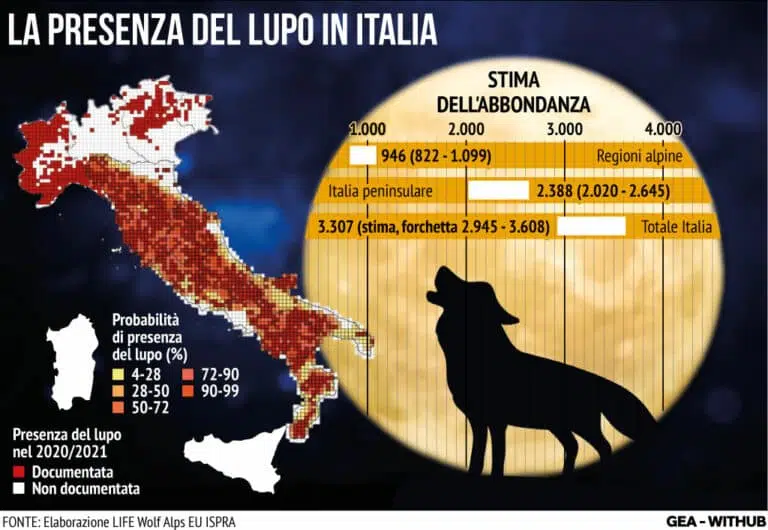
The adjustment of the protection status “will be an important step in addressing the challenges posed by the increasing wolf population while maintaining the goal of achieving a favourable conservation status for the species,” commented Adalbert Jahnz, spokesperson for the European Commission. With the downgrading to “protected species”, the now 20,000 wolves in Europe will move out of the inner circle of large carnivores protected by the Habitats Directive: the brown bear, the wolverine, the golden jackal, and the Eurasian and Iberian lynxes, for which there is a ban on deliberate killing and capture, as well as the deterioration or destruction of their breeding and resting sites in all EU territories.

European sources explain that member states will be given more flexibility to “deal with the most difficult cases of coexistence between wolves and communities in states that need it.” More room for trapping to culling, in any case already allowed by the Habitats Directive itself, allows derogating from obligations on large carnivores when measures to prevent or reduce predation risks are not enough. Reportedly, at COREPER (the body that brings together EU ambassadors), Italy supported the proposal, while only two countries opposed it, and four others chose to abstain. Not enough to block the decision made by a qualified majority. “We are waiting for formal approval by the Council, and then the EU will submit the proposal to the Standing Committee of the Bern Convention in time for the next meeting of the Committee, scheduled for the first week of December,” Jahnz announced.

Amending the international Bern Convention on the conservation of European wildlife and natural habitats, to which the EU and its member states are parties, is the “precondition for any change under EU law.” Only once the treaty has been amended can the European Commission amend the regime under the Habitats Directive.

The Convention is based on scientific data available at the time of the treaty negotiations in 1979. While the European Commission’s proposal is based on “requests that have been made to us by local and national authorities,” Jahnz pointed out, “as something necessary and useful to address the challenges posed by wolves. In September 2023, Ursula von der Leyen had invited the scientific community, local authorities, and all stakeholders to submit updated data on wolf populations and their impacts. On the basis of that “in-depth examination of the changing reality analysis,” Brussels proposed the downlisting of the species a few months later—in line with what the European Parliament called for as early as November 2022.

“A step forward that fills us with satisfaction. It is unacceptable that it has taken years to recognize a reality before everyone’s eyes,” commented the head of the Lega’s delegation in Brussels, Paolo Borchia. Fratelli d’Italia MEP Pietro Fiocchi reiterated the concept: “We are on the right track, and today’s result rewards the battles over downgrading that we have been conducting for a long time alongside Italian farmers.” The same Fiocchi who posed with a shotgun in posters for June’s European elections and former executive of the family company that produces ammunition.

Almost as playing defence, the European Commission spokesman pointed out that “the solution to all the problems posed by wolves also and above all lies in investment in appropriate damage prevention measures.” But according to WWF, the EU has taken “a grave decision that dangerously opens the door to wolf culls in Europe and ignores the call of more than 300 civil society organizations and hundreds of thousands of people who have urged governments to follow the recommendations of science and intensify efforts to foster coexistence with large carnivores through preventive measures.”English version by the Translation Service of Withub

Poachers target short-toed eagles

By

 Monique Agius

 –

September 25, 2024 4:58 PM

senter
Ritratt Sebastian Pociecha on Unsplash

A flock of 5 short-toed eagles came under fire along the Victoria lines on Tuesday, as members of BirdLife Malta chased the birds in an attempt to prevent them being killed.

Shots at these birds were fired as they attempted to find a resting place for the night with one bird being filmed as it was shot down at Bingemma, while volleys of shots at these birds were fired along Tas-Santi, Dwejra and Mtarfa into the evening.

The bird conservation group said video footage of the Bingemma incident were passed on to police with a hunter identified as being the same person involved in a separate illegal hunting incident during closed season last August.

Information pertaining to a second separate incident was also shared with police for further investigations.

Earlier this morning only two eagles were seen flying out of the northern part of the island, while searches undertaken by police are believed to so far have proven futile.

Despite peak migration, only two Environmental Protection Units within the Police Force are currently operative around the island, with occasionally a single unit struggling to keep up with reports of illegal hunting made by NGOs.

In a statement on Wednesday, BirdLife Malta said such incidents were a direct consequence of the lack of proper governance of hunting whereby thousands of birds listed in taxidermy collections have gone unchecked for years, with recent allowances in transfers rekindling a demand for such birds to become taxidermy specimens.

It also said it held Minister Clint Camilleri, an avid hunter himself, politically responsible for allowing the opening of a hunting season without the necessary police resources, and for allowing a system where a hunter who was caught red-handed hunting illegally, is a month after, persisting in more wildlife crime decimating highly protected species. It also remarked on the continuing situation with hunting federations taking no responsibility for such acts by their members.

Short-toed Eagles only appear annually in few numbers between September and November, and they are highly prized on taxidermy lists by hunters.

A 3pm hunting curfew to protect such birds of prey on arrival had been changed to 7pm in 2015, effectively allowing hunting to coincide with the arrival of these highly protected species.