We can live with wolves in the wild

http://www.duluthnewstribune.com/opinion/national-view/3660405-response-we-can-live-wolves-wild

by  Chris Albert

As much as I appreciated Sandy Updyke’s Jan. 14 column headlined, “City people don’t understand wolves” — it was refreshing to read something so thoughtful on this topic — I did have some disagreements.

As a veterinarian, I dispute her claim that foothold traps are “harmless.” Ischemia, or the lack of blood supply, is extremely painful. Depending on how long an animal is caught in a trap and depending on the trap’s tension, a foot may be damaged beyond repair. A rubber band around your finger for long enough would produce the same kind of damage (don’t try it).

Updyke also didn’t address the fear that animals face when exposed and unable to retreat or the sometimes-brutal methods of dispatch. Not to mention the fragmentation that happens to a family when a member of a social species like a wolf is taken. Traps are most certainly not harmless.

As for dogs and wolves, by far the most conflict occurs when hunting dogs are intentionally put in harm’s way. I don’t live in wolf country but have friends with pets who do. There are sensible guidelines that keep dogs safe: Don’t leave dogs outside alone, check an area with lights before sending a dog out and don’t leave out food or other attractants.

I wholeheartedly concurred that wolves are not deities or villains and that their hunting strategy is not pretty. Though why does the latter even matter? I even concur that people need to be able to shoot a wolf if it is imminently harming them or their animal.

That doesn’t seem to be what happens, though. It seems that people filled with hatred and a desire to inflict the most harm possible are turned loose on wolves to maximize destruction.

Wolf advisory boards have precious few advocates for wolves. The impact of killing a single wolf on that wolf’s family rarely if ever is considered by such boards.

We can live with wolves and other large carnivores. We can have them safely in our forests. Why would we want to? Because we will be much richer for it. It’s not only city folk who feel this way; there are plenty of people living where wolves do who want wolves free from hunting and trapping and killed only when it is truly unavoidable.

Chris Albert of Lebanon Junction, Ky., is a doctor of veterinary medicine.

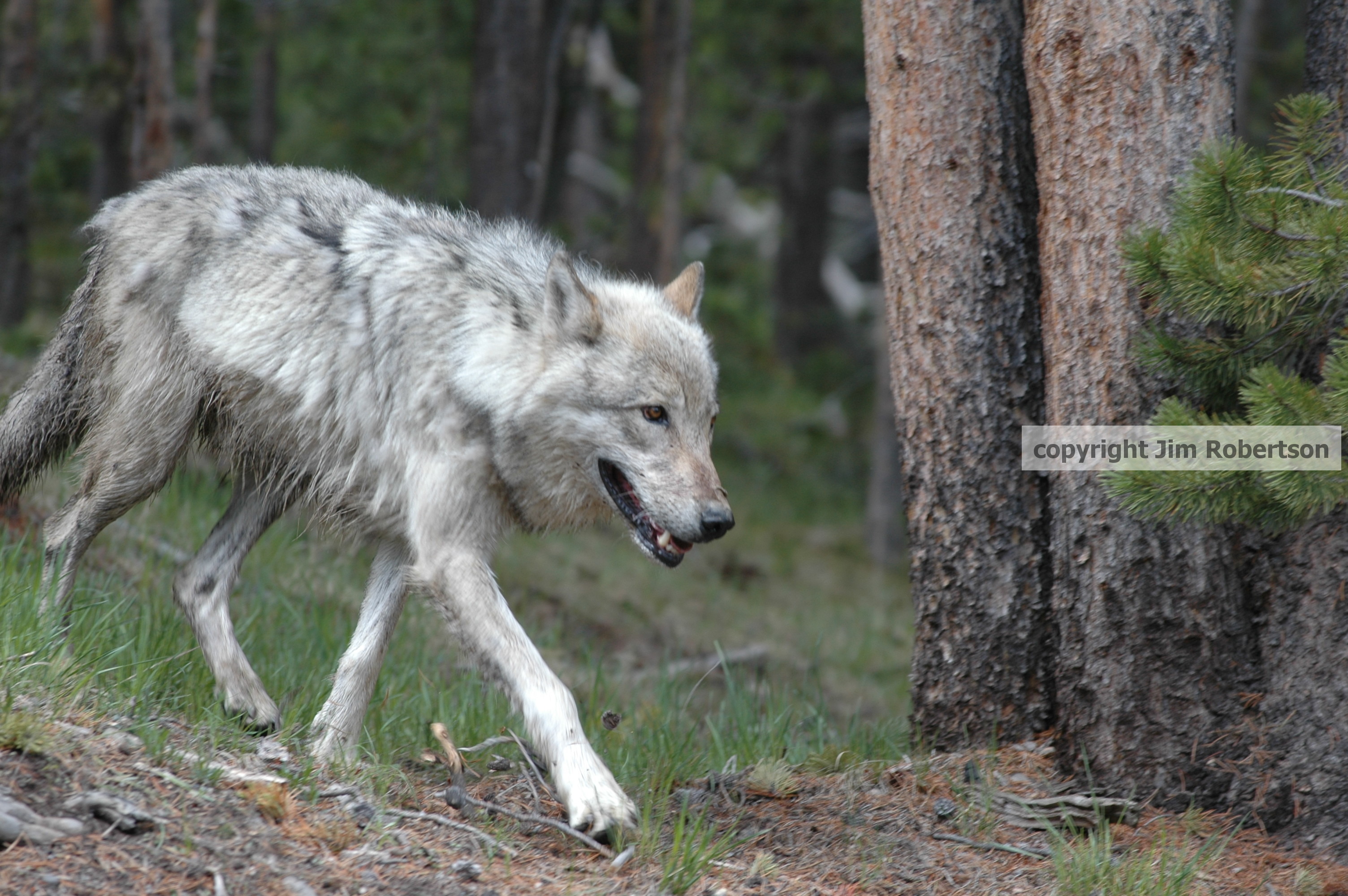
copyrighted Hayden wolf walking

Opinion: High Noon for the Gray Wolf

The return of these animals to the homes of their ancestors — however fleeting — was a result of their 40-year protection under the Endangered Species Act.

OR-7, or “Journey,” as schoolchildren named the first wolf, had been born to the Imnaha pack, the first one in Oregon for many decades. When he wandered south, his brother, OR-9, wandered east. Shortly after he crossed into Idaho (where wolves are not protected), he was shot dead. OR-7 lived on, after his repeated incursions into California (where wolves are protected), to sire a litter of pups just north of the state line. He became the subject of a documentary — in California, even a wolf can be a star.

The story of the Grand Canyon wolf, though, may be over: Three days after Christmas, it appears, she was shot and killed in Utah by a man media outlets have called a “coyote hunter.” (A DNA test is pending.)

For almost two centuries, American gray wolves, vilified in fact as well as fiction, were the victims of vicious government extermination programs. By the time the Endangered Species Act was passed, in 1973, only a few hundred of these once-great predators were left in the lower 48 states. After numerous generations of people dedicated to killing wolves on the North American continent, one generation devoted itself to letting wolves live. The animals’ number has now risen to almost 5,500, thanks to their legal protection, but they still occupy less than 5 percent of their ancient home range.

Since 1995, the act has guided efforts to raise wolves in captivity, release them, and follow them in the wild. Twenty years ago this month, the first gray wolves were reintroduced to Yellowstone National Park.

But this fragile progress has been undermined. Since 2011, the federal government has moved to remove federal protection for gray wolves in the Northern Rocky Mountains (Idaho, Montana and Wyoming) and in the western Great Lakes (Minnesota, Wisconsin and Michigan), the two population centers. Management of the species was turned over to these states, which responded with a zeal that looks like blood lust.

Relying on the greatly exaggerated excuse that wolves threaten cattle and sheep, the states opened their doors to the killing of wolves. (In some states, bait can be used to lure the animals to their deaths; in Montana, private landowners can each kill 100 wolves each year; in Wisconsin, up to six hunting dogs on a single wolf is considered fair play.) Legions of wolf killers rose to the challenge, and the toll has been devastating: In just three and a half years, at least 3,500 wolves have been mowed down.

There’s been an outcry from conservationists, ecologists and people who simply like wolves, but this has not stopped the killers. Some say wolves are a threat to their livestock investments (despite the existence of generous rancher-compensation programs in all wolf states save Alaska); others invoke fear of wolves; still others appear to revel in killing. Online, you can find pictures of wolf carcasses held up proudly as trophies and men boasting of running over wolves with their cars. Judges have started to step in. In September, a federal court decided that wolf management in Wyoming — which had allowed people to kill as many wolves as they wanted, throughout 84 percent of the state — should be returned to the federal government. In December, also in response to a lawsuit, another federal court reinstated protections for wolves in the western Great Lakes. These decisions should make clear that the states alone simply can’t be entrusted with the future of our wolves.

In Washington, the threats persist. The Fish and Wildlife Service is considering a proposal that would strip federal protection from almost all gray wolves in the lower 48 states, not just the ones in the Rockies and the Midwest. Meanwhile, right-wing Republicans in the new Congress are champing at the bit to remove the wolves from protection under the act — politics trumping science.

More: http://www.nytimes.com/2015/01/19/opinion/high-noon-for-the-gray-wolf.html?_r=0

copyrighted Hayden wolf in lodgepoles

List of all 2015 Predator hunts by State

http://coyotecontest.com/contests

2015 Predator Hunting Expo

2015 Predator Hunting Expo

Use this form to contact or inquire about:

2015 Predator Hunting Expo

Coulee Region Coyote Hunters will be holding our 2015 Predator Hunting Expo at Silent Outdoors in Sparta,Wi Jan. 10th and 11th.

Activities include:

Raffles- Mens, Womens and Children Raffles with all proceeds from raffles going to Wounded Warriors United.

Vendors- Come check out our vendors at this event.

Wounded Warriors Hunt- CRCH staff will be taking out some Wounded Vets during this event.

Coyote Tournament- Two divisions- Houndsmen- callers/trappers open to anyone.

20 years later: What if wolves weren’t reintroduced?

copyrighted wolf in water

From another list:

January 14, 2015 12:01 a.m.

The date was Jan. 14, 1995, when Moon Star Shadow, a 90-pound, silver-tipped black male, stepped out of his cage at Corn Creek and urinated, marking his new territory in Idaho.

Moon Star Shadow and three other wolves released at the edge of the Frank Church-River of No Return Wilderness were the first of 66 wolves brought to Idaho and Yellowstone National Park from Canada in 1995 and 1996.

By 2009, the wolf population had grown to more than 1,500 in Idaho, Montana and Wyoming and today has spread to Washington, Oregon and Utah — even California and Arizona.

In 2011, Congress delisted the populations in Idaho, Montana, northern Utah, western Oregon and western Washington. That removed them from protections under the Endangered Species Act and led to wolf-hunting seasons. Today more than 600 wolves are thought to live in Idaho and the haunting howl of a pack of wolves is an almost common sound in Idaho’s back country, pleasing the people who pushed to restore them.

Idaho hunters and trappers harvest hundreds of wolves every year, but many complain that traditional elk-hunting areas no longer are as productive because wolves kill, move or stress the big game.

Ranchers have the right and means to kill wolves that attack their livestock, but they remain bitter that they aren’t compensated for losses that can’t be definitively linked to wolves. Ranchers also say elk and other big game are streaming out of the backcountry to raid their pastures and haystacks as they get away from the wolves.

But what if the federal government had decided not to reintroduce wolves to Idaho and Yellowstone in 1995?

Folks who love wolves would have fewer to see or hear. And the folks who hate wolves might have fewer options to manage wolves or kill wolves that come into contact with humans and livestock.

A mind of their own

Wolf biologists and managers who led the recovery program that began a decade before the wolves were released agree that Idaho would have wolves today, possibly hundreds, even if the reintroduction never took place. But they doubt that Yellowstone National Park — the place the public associates most closely with the new population of wolves — would have a wolf population today.

Wolves were moving on their own from Canada into Montana and Idaho, beginning in the 1960s. But a lack of safe corridors for the animals between Northwest Montana and Yellowstone would have hindered or stopped natural recolonization of wolves from Canada there. Today, 400 to 450 wolves live in the greater Yellowstone ecosystem.

“There would be wolves in northwest Montana, there would be wolves in central Idaho, but I doubt we would have more than a few (scattered) in Yellowstone,” said Ed Bangs, a retired U.S. Fish and Wildlife Service gray wolf recovery coordinator in charge of the reintroduction.

They were reintroduced under a legal provision that allowed relaxed rules for an “experimental population.” That enabled federal officials to kill wolves that repeatedly attacked livestock and exempted officials from requiring that every federal action in the habitat be shown not to hurt the wolves.

That approach was based on the premise that there was no wolf population — no breeding pairs — in the areas targeted for reintroduction.

As the wolf population in British Columbia and Alberta grew in the 1980s, several packs showed up in Northwest Montana, making that area ineligible for reintroduction. Many wolf sightings also were reported in Idaho.

An Idaho plan

The drive for reintroduction in Idaho came from Republican U.S. Sen. James McClure.

McClure believed the return of the wolf to Idaho was inevitable. He wanted to put in place rules that would protect ranchers from the powers of the Endangered Species Act that restrict the killing of depradating wolves and other management. In 1988, he proposed federal legislation that would have reintroduced a few packs and stipulated that no wolves would be allowed to live outside of Yellowstone and Idaho’s wildernesses. His bill would have restricted wolf expansion more tightly than did the final reintroduction rules.

“He wasn’t a wolf-lover,” said David Mech, an internationally known wolf biologist who was one of the early voices for reintroduction.

McClure not only feared the costs to ranchers if more wolves showed up in Idaho. He believed loggers, miners and recreationalists would end up facing stricter limits under the full powers of the federal Endangered Species Act.

Ranchers weren’t convinced.

Brad Little, who today serves as Idaho’s lieutenant governor, came from a long line of sheep ranchers. In 1988, he was active with the Idaho Woolgrowers and an opponent to McClure’s bill, which went nowhere because of strong opposition from Wyoming ranchers and lawmakers.

“He was pretty darned convinced that his bill would have been far and away superior to what we eventually got,” Little said.

The return of wolves forced Little, like most ranchers, to change the way he operates. He gave up private grazing leases in the Cascade area due to the rate of depredation on his cattle. But he said ranchers in Custer and Lemhi counties that deal with the largest wolf populations have had the hardest time maintaining their livelihoods.

“The central Idaho ranchers are in the same place that the West Coast loggers were with the spotted owl,” Little said.

‘The sweet spot’

Suzanne Stone, now with Defenders of Wildlife, was contracted by the U.S. Fish and Wildlife in the early 1990s to look for wolves in central Idaho.

Stone soon learned how difficult life would be for wolves in Idaho, both then and now. Biologist Steve Fritts was teaching her to howl in 1991 near Warm Lake east of Cascade.

“On my second howl, we literally (had) rifle bullets go over our heads so close I could hear them whistle,” Stone said.

She wanted reintroduction to be called augmentation, because she knew wolves already were living in Idaho. But she also believes that if the naturally moving wolves had been given the full protection of the Endangered Species Act, we would have wolves in Idaho, Yellowstone and at least Wyoming without reintroduction.

The wolf recovery program today would not be as divisive, Bangs said, had the delisting occurred several years earlier — before wolf populations had reached their peak and affected so much livestock and big game.

“We lost the hunting constituency because of that,” he said.

Steve Alder agrees.

Alder heads Idaho for Wildlife — the group that sponsored this month’s wolf- and coyote-hunting derby in Salmon.

“From our perspective, (the delay in delisting) really got people rallied,” he said.

So what ended up happening?

Wolves captured in northern Alberta were released Jan. 14, 1995, after a federal judge lifted a temporary restraining order.

In Idaho, the 35 wolves simply were released from cages into the wild.

At Yellowstone, packs captured together were kept in enclosures to allow the animals to acclimate to their new environs. The enclosures were opened in March and the wolves reluctantly left to take over their new home. More wolves were released in 1996.

From the beginning, Idaho’s great wolf habitat — lots of undeveloped spaces and lots of food such as elk and moose — meant that the wolf population grew faster here than anywhere else.

By 2001, the Idaho population had reached the 10 to 15 breeding pairs that federal biologists said was necessary for recovery.

After years of debate, lawsuits and failed efforts to remove Idaho wolves from protections under the Endangered Species Act, Idaho Rep. Mike Simpson added a rider to a fast-track federal budget bill in 2011. The rider inserted language to allow Idaho and Montana to manage

Some MT Wolf Hunt/Trap Stats

copyrighted wolf in river

MT: Lincoln County bagging fair share of wolves

 Justin Steck
The Western News

Ninety-six wolves have been taken, with eight harvested by trapping, during Montana’s wolf hunting and trapping season.

In region one, which encompasses Lincoln County, 30 wolves have been taken by hunting and two have been trapped. Those numbers were from John Fraley at Montana Fish Wildlife & Parks office in Kalispell.

Montana wolf trapping season got underway on Dec. 15 and will run until Feb 28. Archery season for wolves ran from Sept. 6-14, and general rifle season began Sept.15 and continues until Mar. 15.

Local taxidermist Gerry Mercer said trapping season starts to take-off when the snow falls and it starts to get cold, which should be soon. Last year he had a dozen wolves come through his shop.

According to 2013 numbers from Montana Fish Wildlife & Parks, the total number of wolves taken during the season was 230, 143 were hunted and 87 trapped.

Wolf Management Units 100 and 101, which include Lincoln County and a portion of Flathead County, were the areas with the highest numbers of harvested wolves in the state. The number of wolves taken in those two areas was 28 in 100 and 38 in 101.

Last year 24,479 wolf licenses were issued, 22,169 of those were to Montana residents.

Senate Bill 200 is a new bill that allows for landowners in Wolf Management Units 200, 400, 310 and 390 to take up to 100 wolves total that may potentially be a threat to humans, livestock or dogs. The quota will be examined in four 25-wolf increments throughout the year, with increases needing to be approved by Fish Wildlife & Parks.

The first fair chase wolf hunting season in Montana was 2009. Before then, no rules existed to regulate the number or means by which wolves could be taken. That year 60 wolves were taken during the season lasting from Oct. 25 to Nov. 15.

In 2011, the number of wolves harvested rose to 166. The total number of wolves killed during the 2012 season fell to 128.

Court challenges barred the 2010 wolf hunting season.

Source

No Wolves Killed in Contest Means Too Many Wolves Already Killed

Hunters here need to get a life. For over a week now, I’ve been receiving comments about the wolf/coyote contest hunt addressed in the January 2nd article, “ID Gun Nuts Start New Year With Three-Day Mass Slaughter Of Wolves And Coyotes.”   

I don’t know if it’s the insinuation that they might be “gun nuts” (I would think they’d gladly fess up to that) or what, but long after the derby has played itself out, they’re still trying to get their vitriolic comments approved. So far, over 500 of their 180,000+ viewers have left comments that will never see the light of day (except in the occasional post like this one, meant to expose just how malicious they really are).

And they really do all sound alike—believe me when I say you’d never want to sit through 500 of their repetitive statements, such as the ever-popular catch phrase:

“Smoke a pack a day!”NT wolf bumpr stickr

It wasn’t funny the day the first guy blurted it out and it just gets more tedious—and more carcinogenic—with each repeated use. However, it does point out their universal sentiment about doing away with wolves at every chance they get. With all the anti-wolf mawkishness it’s hard to imagine there are many wolves left in Idaho. Each licensed hunter there can legally kill up to five wolves per season and trap and an additional five individuals, so recovering wolves would conceivably have suffered considerable losses by now.

But these would-be commenters seem keenly concerned about controlling the wolves’ population (as if they need it) while at the same time, indifferent about their own. Here are some of their views on the subject of overpopulation:

“There is nothing wrong with the killing of these animals it’s a all in an order to control population.”

“Their numbers are unsustainable. Wolves will kill for the thrill and not just because they are hungry.”

“haha kill them all! Wolves are one of the biggest problems we have in Idaho, wyoming and Montana!”

“if we don’t thin out these packs it could turn bad for everyone they are already over populated…” 

And yet, according to post-contest articles like, “Wolf Population Unaltered By Controversial Hunt,” “Nobody even saw a track. We had fresh snow, and we were just in shock,” Alder said. “No sightings, no tracks.” He noted that there was an increase in coyote captures this year—30, compared with 21 during last year’s derby.

Not to give them credit for achieving anything whatsoever, but it would seem wolf-killers have been proactive about gettin’‘er done well before the contest’s start date.

The article goes on to say, “One team of hunters killed 12 coyotes over three days and sold their pelts to a fur buyer who attended the event. The team walked away with a $1,000 cash prize for most coyotes killed.

“Thirty coyotes were killed during the three-day hunt, and—for the second consecutive year—zero wolves.”

The derby, organized by executive director of Idaho for Wildlife Steve Alder, was created to help curb predator populations.

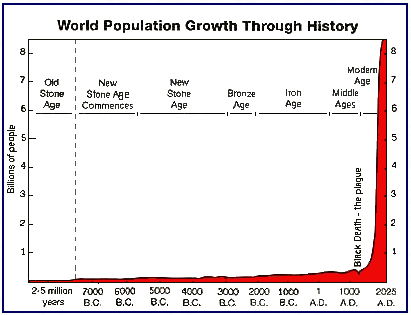
Considering the burgeoning human population, Alder and his ilk would do well to look in the mirror before calling any kettles black. Are they blissfully ignorant of the fact that another human is born every eight seconds in this country alone? Meanwhile, 350,000 humans are born each and every day worldwide.

How many of them will grow up to be predator hunters? Talk about “unsustainable” numbers. This isn’t just about them or their rancher buddies. This is about a world-wide loss of biodiversity—their part in the sixth mass extinction. It’s really not something to be glib over or proud of.

world-population-through-history-to-2025

Hunt or be Hunted?

And the hits just keep on coming. Yet again today I find comments from hunters on the pre-coyote/wolf-kill-contest post that really seemed to get their goat, the article, https://exposingthebiggame.wordpress.com/2015/01/02/id-gun-nuts-start-new-year-with-three-day-mass-slaughter-of-wolves-and-coyotes/ was posted over a week ago, and still the hunters are coming up with (unapproved) comments such as this one from today (printed verbatim):

…”‘Hunt or be hunted’ all u tree hungers don’t understand… if we don’t thin out these packs it could turn bad for everyone they are already over populated… if we left the wolves an coyotes alone next thing u know are children’s an even adults we become hunted and killed by them it’s called animal control an besides the department of wildlife knows when they will.need to shut the hunting down all it is ‘control of the packs’”

10885301_1568094566769883_1971170912125979956_n


Environmentalists Couldn’t Stop the Slaughter at Idaho’s Annual Coyote and Wolf Derby

http://www.thewildlifenews.com/2015/01/07/environmentalists-couldnt-stop-the-slaughter-at-idahos-annual-coyote-and-wolf-derby/

Environmentalists Couldn’t Stop the Slaughter at Idaho’s Annual Coyote and Wolf Derby

Last year I learned that anti-predator activists were organizing a predator killing derby to take place in Salmon, Idaho – a place smack dab amidst one of the largest and most breathtakingly diverse public landscapes in the country. A few of us infiltrated the event with the aim of exposing the extent of the depravity to the public (See: VICE: How to Kill a Wolf), and hopefully aiding any litigation and legislative efforts that may follow in the future with factual support.

This year the event garnered a great deal more attention from the environmental community. Lawsuits were filed but, unfortunately, the existing state of the law has yet to secure protections that would effectively curtail this very public wanton infliction of suffering, destruction of life, and appalling disregard for the potential impacts to ecological communities inhabiting this profound public landscape.

A brilliant and courageous group of activists (including: Stephany Seay of Buffalo Field Campaign, a person whose adept insights and experience working with BFC largely provided the model and know-how for this year’s effort; Ritchie Eppink of the ACLU of Idaho, a person and organization that has ably protected Idaho citizens’ rights to practice journalism, expression, and the full suite of constitutionally protected methods of civic engagement; Lynne Stone of the Boulder White Clouds Council, who first blew the horn on last year’s derby, organized information, and whose years on the ground advocating for wolves on the landscape at issue provided invaluable support; among others) came together and committed to bear witness the events that would transpire during the derby again, this time with a very particular aim: We would counter their heavily armed violence and hate openly – with cameras, with light.

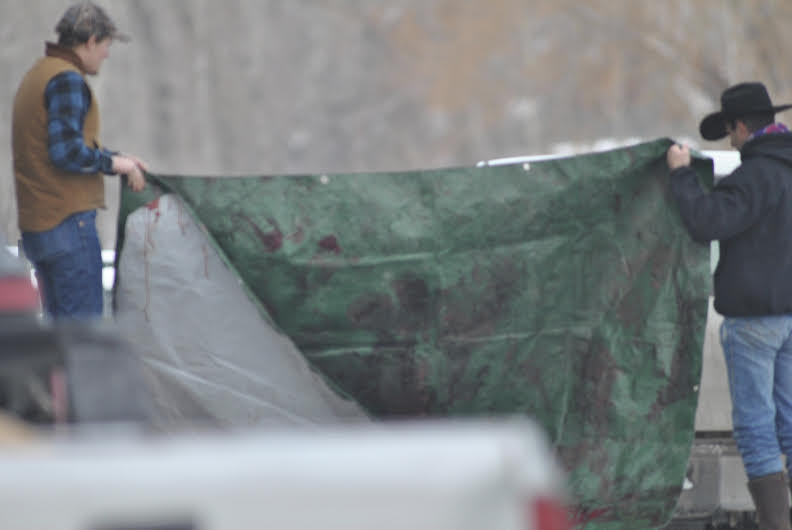
Derby participants attempt to obscure line of sight with tarp. Photo: wildlandsdefense.org

On the third day of the wolf-killing contest, an earthquake shook the mountains near Salmon, Idaho. “It’s Mother Earth revolting against the cruelty, the violence, the madness, of what’s happening here,” said Brian Ertz, president of the nonprofit advocacy group Wildlands Defense.

Read about the rest in VICE.  Environmentalists Couldn’t Stop the Slaughter at Idaho’s Annual Coyote and Wolf Derby – VICE Magazine – by Christopher Ketcham

January 6, 2015

On the third day of the wolf-killing contest, an earthquake shook the mountains near Salmon, Idaho. “It’s Mother Earth revolting against the cruelty, the violence, the madness, of what’s happening here,” said Brian Ertz, president of the nonprofit advocacy group Wildlands Defense. A year ago this week, Ertz and I went undercover for VICE in Salmon to infiltrate that town’s annual Coyote and Wolf Derby, an event as primitive as it sounds: Dozens of contestants compete to mow down as many coyotes and wolves as quickly as possible, piling up the cadavers in their trucks, vying for $1,000 prizes for most animals killed. Kids as young as ten are invited to join in the slaughter with their families, with special awards handed out to the children who shed the most blood.

This is not hunting for meat. It is not hunting to prevent threats to human safety. It is killing for the sake of killing. To join in the derby was an unnerving experience for me, an immersion into the ugly side of rural mountain folkways in the American West.

I had thought, quixotically, that exposure of Salmon’s atavistic blood rites in an international magazine would have helped put an end to it. After all, much of the derby hunt occurs on federal public land, which is subject to federal law and oversight by agents of the Forest Service and the Bureau of Land Management. A year later, however, the derby was on again, and with great fanfare. Government regulators had done nothing to stop it, and environmental groups had failed to galvanize public opinion against it. The event’s organizer, the ironically named Idaho for Wildlife, had announced, proudly, that the derby would be expanded to four days from the previous year’s two. By the end of day one, derby-goers brought in 17 coyotes to a warehouse in Salmon where their bodies were measured, weighed, and skinned, the pelts sold to fur buyers on hand for the nightly bringing-in of the dead.

Not a single representative from the environmental groups that had publicly criticized the derby—and litigated unsuccessfully to shut it down—showed up to confront the bands of hunters. The sole exception was the ad hoc crew of eight hungry young activists that Ertz, 32, had organized, among them a staff member of the ACLU of Idaho, Ritchie Eppink, who joined in the mission as a legal observer, and Stephany Seay, media director of the Buffalo Field Campaign in Montana.

There was good reason to shy away from confrontation: The folks in Salmon hate environmentalists. It’s a small town, and the people, thin-lipped and narrow-eyed, easily sniff out strangers. On the first day of the derby, Thursday, Ertz stood at a gas station in Salmon when a local ranch hand approached to offer a warning. “All these people know you’re here,” said the man, according to Ertz, “and they’re gonna be looking for you. I’d keep your head down, and, if I were you, I’d get out altogether because what they’re gonna do to you ain’t good.” By Friday, one of the activists had fled a hotel in Salmon after Idaho for Wildlife organizers called the owner and warned about environmentalists holing up there.

I asked Ertz why he was taking the risk when he could’ve tried again to go undercover. Last year, disguised as hunters in camouflage, rifles on our backs, blood thirst in our mouths, we had been welcomed in Salmon. This year, he and his colleagues broke up into teams of two; armed with video cameras, they trawled the hills in their cars to document the slaughter for a future lawsuit.

“The objective,” said Ertz, “is to be very much in their face, to let them know we’re out here on patrol, looking for violations of federal law. We want to project the image that we could be anywhere, everywhere.”

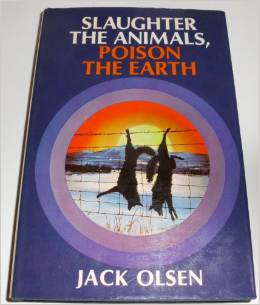
A related objective was to stand in open defiance of what Ertz described as “a culture of death.” Salmon, like many small towns in the rural West, is a ranching society. Ranchers who run their cattle on the open range have historically regarded wild predators not as majestic creatures but as vermin to be exterminated. Investigative journalist Jack Olsen, writing in his 1971 Slaughter the Earth...book Slaughter the Animals, Poison the Earth , concluded that the livestock industry’s hatred of predators—wolves and coyotes foremost, but also cougars, black bears, grizzlies, wolverines, lynx, bobcats, hawks, eagles, and on and on—went “so far beyond the dimensions of reality as to be almost pathological in origin.” Indeed, the desire to annihilate the enemy is not based on a rational assessment of the threat to cows and sheep. The number of rangeland livestock lost each year to carnivore depredations is insignificant—less than a half of a percent, according to the Department of Agriculture.

“These people honestly believe that sterilizing the landscape of predators will enrich their economy and preserve their culture,” says Ertz. “Events like the derby validate those who have been conditioned to believe that their way of life, or more accurately their way of death, is under assault by environmentalists. They’ve got a point. Americans in general are becoming more compassionate toward nonhuman animals, and our appreciation of ecology and the contributions of wildlife communities is growing. This awareness and compassion threatens any culture that predicates itself on wanton destruction and an appalling disregard for the suffering of sentient beings.”

By the final day, Sunday, the hunters had killed 30 coyotes, according to the event’s Facebook page. (No wolves were taken, either by trap or gunfire.) At the awards ceremony that afternoon, Ertz’s crew in separate parties attempted to enter the warehouse where the cadavers had been hung on meat hooks. One of the teams, which included Eppink of the ACLU, carried a hidden camera. They were stopped by an imperious little man in a big cowboy hat. “Are you guys entered in the contest?” he asked.

“No, we just came to see the ceremony,” said Eppink.

“Out!” said the cowboy. “There’s all kinds of animal terrorists here taking pictures and harassing us!”

When Natalie Ertz, Brian’s sister, approached to capture the spectacle of the awards with her Nikon, one of the members of Idaho for Wildlife, a woman with funny blackened teeth named Billiejo Beck, cut off her passage. “No cameras—this is private property,” she said.

“What are you hiding?” asked Natalie.

“Absolutely nothing,” said Beck.

“Where’s the property line?”

Beck pointed beyond the fencing of the parking lot, and yelled for assistance to a county sheriff who was standing nearby. So Natalie and her brother and the rest of the crew stood at the fence line. Natalie howled three times like a wolf and smiled.

When Beck again emerged, Natalie called to her: “Billiejo! I’d love to talk to you. What does wildlife mean to Idaho for Wildlife? What does wilderness mean? Wolves and coyotes are wildlife! Where’s your ethical line in killing?”

There was no response. “Why won’t you talk to me if you’re so proud of what you’re doing?”

The protesters had a partial view into the warehouse—they could spy the coyotes tossed from trucks and hung on the hooks—but Beck at last placed a bloody tarp across the doorway to obscure the line of sight.

“It’s no different from last year,” said Brian Ertz, “except in one way: This year they were forced to hide their carnival. This year they feared the cameras and scurried like cockroaches to avoid the light.”

This year, in other words, there was shame. That’s progress.

Christopher Ketcham is a contributing editor at Harper’s magazine. Write him at Cketcham99@mindspring.com.

http://www.vice.com/read/environmentalists-couldnt-stop-the-inhumane-slaughter-at-idahos-annual-wolf-and-coyote-derby


Another Day, Another 50,000 Hunter-views

…many of whom still think they’re welcome here.

Here are a couple of their choice comments from today:

“Hunting had been a “sport” since the the 14th century… And it’s going to be around in 2015 too.”

“So what do you suggest?… Control the human population limiting each family to one child so we stop ‘encroaching’ animal habitat?”

Sorry to the rest of you to have to repeat myself, but to all the hunters visiting this blog site, hoping to leave a comment or two (or five) in defense of coyote/wolf contest hunts, go away—you weren’t invited! Some troll must have posted a link to this onto one of your evil pro-kill sites and you’ve apparently followed it back to a blog site dedicated to the defense of wildlife.

Now you think you have the First Amendment right to comment on the merits of predator killing. Well, you don’t—not here anyway. If you would have bothered to read this blog’s “About” page, you would have learned that it’s not a chat room or message board for those wanting to argue the supposed merits of animal exploitation or to defend the act of hunting or trapping in any way.

It’s not just you; in the spirit of fairness I eighty-six all comments from all types of hunters or trappers.

Believe it or not, some people might not be interested in your opinion in support of killing. I know I’m not. I’ve heard it all before, ad nauseam.

When I shared the article, “Idaho Gun Nuts Start New Year with Three-Day Mass Slaughter of Wolves and Coyotes,” I provided a link http://news360.com/article/272715208/# to the source right at the top of the page. Maybe readers there want to hear what you have to say, but this site is strictly on the side of the animals.

Again, you weren’t invited here, and if you’re on the side of killing, you’re not welcome here. No new comments are being approved, so don’t bother leaving one.

10616612_10152350306096218_4761797786719948975_n

Animal Lovers: Don’t Hesitate to Feel Your Hate

Text and Wildlife Photography ©Jim Robertson, 2014. All Rights Reserved

Text and Wildlife Photography ©Jim Robertson, 2014. All Rights Reserved

Living in Earth’s out-of-the-way places, surrounded by prime wildlife habitat (as I’ve always chosen to do), an advocate must eventually make a choice—either stand with your wildlife friends, or join in the “fun” (made increasingly more popular by repulsive “reality” shows like Duck Dynasty and so many evil others) and go around shooting everything you see.

I made my choice long ago and decided the only way to live in such a wildlife-war-torn area is to have as little to do with the people as possible. To quote Sea Shepherd’s Captain Paul Watson, referring to his native land, coastal New Brunswick, Canada (where clubbing baby seals is the local pastime), “Love the country, hate the people.”

Author Farley Mowat, another selfless Canadian animal advocate in league with Captain Watson, ultimately came around to that same sentiment in A Whale for the Killing. The 1972 book is an autobiographical account of Mowat’s moving to Newfoundland because of his love for the land and the sea, only to find himself at odds with herring fishermen who made sport of shooting at an 80-ton fin whale trapped in a lagoon by the tide. Although he had started off thinking folks around there were a quaint and pleasant lot, he grew increasingly bitter over the attitudes of so many of the locals who, in turn, resented him for “interfering” by trying to save the stranded leviathan.

Mowat wrote, “My journal notes reflect my sense of bewilderment and loss. ‘…they’re essentially good people. I know that, but what sickens me is their simple failure to resist the impulse of savagery…they seem to be just as capable of being utterly loathsome as the bastards from the cities with their high-powered rifles and telescopic sights and their mindless compulsion to slaughter everything alive, from squirrels to elephants…I admired them so much because I saw them as a natural people, living in at least some degree of harmony with the natural world. Now they seem nauseatingly anxious to renounce all that and throw themselves into the stinking quagmire of our society which has perverted everything natural within itself, and is now busy destroying everything natural outside itself. How can they be so bloody stupid? How could I have been so bloody stupid?’”

Farley Mowat ends the chapter with another line I can well relate to: “I had withdrawn my compassion from them…now I bestowed it all upon the whale.”

Having recently finished reading, Give a Boy a Gun, by Jack Olsen (author of the pro-coyote/anti-trapping book, Slaughter the Animals, Poison the Earth—an appropriate addition to his numerous other true-crime works), I’m still puzzled by that book’s similar underlying question: How could so many people be so stupid as to think so highly of Claude Dallas Jr., a killer whose crimes included poaching, trapping out of season and the shooting of two Idaho Department of Fish and Game agents? Apparently the majority of people in cattle country there think nothing of the prolonged suffering of a bobcat, coyote or trappers’ other non-human victims, and accept people at the shallowest of face-value (except game wardens out to uphold the few laws animals have on their side).

In civilized society we’ve been brought up not to hate other people. Tolerance is the buzz word and that’s supposed to go for everyone, even if they choose to kill the animals you care about. It’s not like animals are people, right? Well, that’s debatable; besides, there’s only so much tolerance to go around. I love the wilderness and the wild things who live there. But can you really love something, without at the same time, hating those who threaten its very existence?

Every morning I’m reminded how much I hate the local duck and goose hunters, for example. At first light this time of year, before I can even think about how much I love living where flocks of migratory geese spend the winter, the sound of shotgun fire rings out to remind me of those whom I hate—the ones who make sport of killing creatures more noble, magnanimous and intelligent than they could ever hope to be.

If it’s not okay to hate the people who kill your friends for sport, who can you hate? And don’t think for a second that hunters, no matter how the schmooze, don’t hate you or anyone who might be out to spoil their fun by trying to ban contest hunts, or otherwise exposing their sadism.

1598558_10152837672323554_7131931279073962386_oIdaho’s ongoing Predator Hunting Contest and Fur Rendezvous, organized by a group ironically calling itself “Idaho for Wildlife” (more appropriate names would either be, Idaho against Wildlife, or Extremist Idahoans for the Destruction of Wildlife) claims as part of their second mission, “To fight against all legal and legislative attempts by the animal rights and anti-gun organizations who are attempting to take away our rights and freedoms under the constitution of the United States of America.” Apparently somebody is confusing the Second Amendment with the right to kill non-human animals for sport.

Now, you may have grown up to songs with lyrics like, “Come on people now, smile on your brother, everybody get together, try to love one another right now,” or just heard phrases like, “feel the love,” “love thy neighbor” “blah, blah, blah.” Bullshit! If your neighbor is out mowing down coyotes or wolves for fun or cash prizes—or blasting into flocks of geese for sport—they need to know how deeply you hate them.

But hate is such a negative emotion; it’s not good for your chakras, or whatever they say. Well, sometimes the animals need our outrage, our lividness, our hate. It’s a war, after all, and the other side is winning, partly because we resist the urge to embrace our hatred. How can you fight a war and not feel hate for your enemy?

Yet it shouldn’t be seen as desperate words coming from some lone, animal-loving whacko. As long as the laws are on their side and they think society shares their view of animals as objects, they’ll be encouraged to keep up the killing.

In other words, “Come on people now…Everybody get together, try to hate coyote hunters right now. Right now. Right Now!

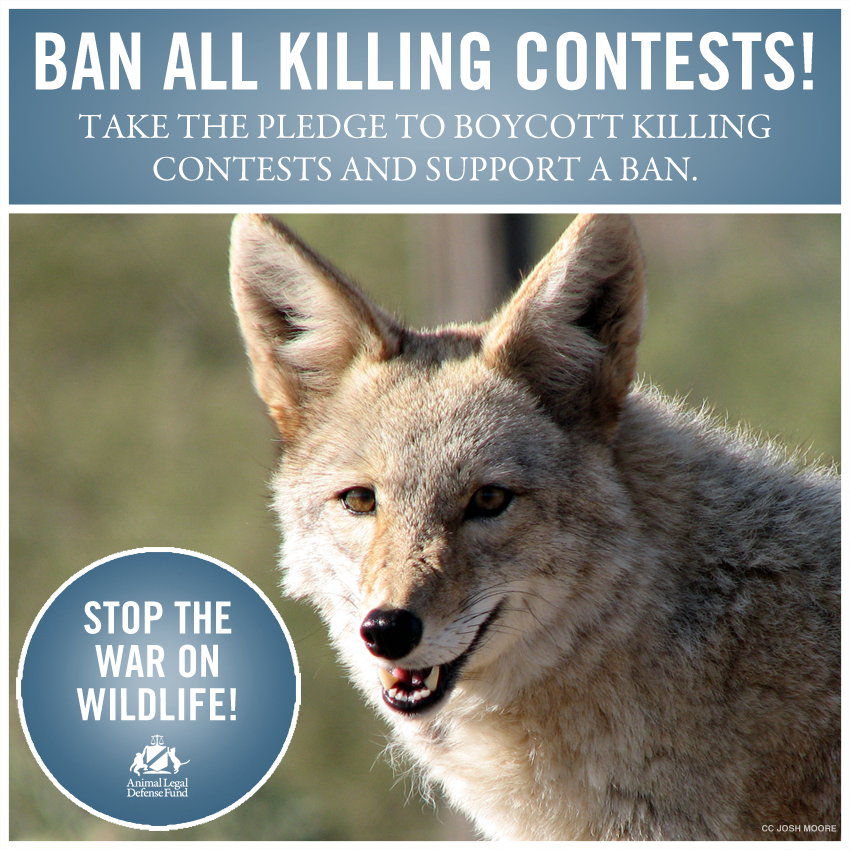
coyote contest kill