Activists Protest Killing Wolves to Boost Elk Numbers

http://magicvalley.com/lifestyles/recreation/activists-protest-killing-wolves-to-boost-elk-numbers/article_8c3c5232-7e77-11e3-b7f0-0019bb2963f4.html

By BRIAN SMITH

BOISE • Have some “grit” and stop “exterminating” Idaho’s wolves.

That was Pam Marcum’s message to Idaho Fish and Game commissioners Wednesday night.

Marcum’s charge was echoed by numerous other biologists, wildlife advocates and enthusiasts, many of whom questioned the science and ethics behind Fish and Game’s predator management plan.

Many locals complained that the commission was solely focused on boosting elk populations and keeping hunters happy instead of balancing the state’s wildlife. Some said wolves can have a positive impact on the ecosystem, despite hunters’ claims to the contrary.

“Use peer-reviewed science, not political science,” Marcum said.

Several hunters spoke in support of state wolf control. Stabe Hedges said it was upsetting to see so many people supporting an animal that harms Idaho’s economy. He advocated for increased wolf hunting opportunities.

“I personally would like to see the numbers of wolves reduced by 40 or 50 percent,” Hedges said. “I would like to see some of the elk numbers rebound. I hiked 32 miles this year before I saw a single elk, and that’s a vast difference from years gone by.”

The public comment hearing preceded today’s annual commission meeting, which was open to the public.

The commission is set to hear a legislative update and presentations from Fish and Game staff on wildlife such as elk, turkeys, chinook salmon and deer today. Later in the day, it will hear a budget preview and a report on a wildlife collision reduction project.

At 9:35 a.m., the commission is to consider approving its new elk management plan. The plan, last updated in 1999, is a guide for season-to-season management of the state’s many herds.

The plan also addresses changes in elk habitat, how growing elk populations damage crops, and how to more aggressively target predators such as bears, mountain lions and wolves.

Idaho Conservation Leauge’s John Robison said his organization is “deeply concerned” about the elk management plan and its impacts on wolves.

Robison asked for a show of hands from the audience to see who was angered by a recent pack killing at state expense in the Frank Church-River of No Return Wilderness. Most people in the packed room raised their hands.

“We believe that this unprecedented public outcry about this decision should force the commission to stop and reassess its approach on wolves, wilderness and predators,” he said.

The commission also should reduce its wolf-trapping program, said Ken Cole, a National Environmental Policty Act coordinator with the Western Watersheds Project. It should require trappers to check their snares more often, he said.

“These animals should not be out there suffering for more than 72 hours,” he said.

Not so — the areas where wolf trapping is allowed should be expanded in southern Idaho, said Pat Carney, president of the Idaho Trappers Association.

“Instead of the state having to pay trappers to go in and trap these other wolves, it would be better if locals could go in and do it instead of having tax dollars pay for it,” Carney said.

The decision to kill wolves in wilderness areas doesn’t make sense “economically and ecologically,” said Jennifer Pierce, an associate professor of geosciences at Boise State University.

“As scientists who have worked in the Frank Church area for decades, the eradication of large predators from this ecosystem is potentially detrimental to all parts of the ecosystem,” she said. “Was there a science-based rationale for killing wolves in wilderness? If so, what was it?”

copyrighted wolf in river

Why the states have wolf management wrong

http://www.examiner.com/article/why-the-states-have-wolf-management-wrong

January 6, 2014
Cathy Taibbi|
copyrighted wolf in riverIn this Powell Tribune post, Wolf hunt ends with 24 taken, written by Gib Mathers, the big, glaring error in state wolf management is revealed.

The states, eager for revenue (gotten through the selling of hunting and trapping licenses), have gotten basic principles of wolf ‘management’ all wrong.

With wolves, ‘management’ is not as simple as removing individual bucks from a breeding population of deer – Wolves live in FAMILIES. Everything they do revolves around the well-being of their families – Including teaching their pups (who stay ‘children’, to be taught and protected, for three years), just as we teach our own children.

Wolves pass down learned information (for instance, to stay away from livestock) to their family, to their impressionable pups, in essence passing down a unique ‘culture’ of conduct and survival tools specific to each pack.

That includes respect for Man and his livestock.

Break the chain of knowledge by decimating family continuity, and you actually create problems where there hadn’t been any before.

Through hunting and trapping seasons, we rob wolves of their hard-won, hard-learned family-knowledge of how to co-exist with us.

Wolves LEARN. We don’t have to kill them. In truth, documented livestock depredation by wolves is exceedingly rare – Way behind other, routine, causes of livestock mortality such as weather and poor husbandry, for instance. Ranchers are compensated monetarily for even suspected kills by wolves, so ranchers are by no means financially harmed if a rare instance of a wolf killing livestock actually does occur.

The other lame argument is that wolves are jeopardizing herds of game (which human hunters wish to kill for fun.) Wolves will not eliminate all the game, either. If man has created enough challenges for wilderness systems that herd numbers actually do decline too much (as opposed to herd behavior changing to become more elusive targets), then the correct answer is to reduce the number of permits granted to sport hunters, for a season or two, or even three – Not to kill vital native species who have no choice but to hunt to live.

The best way to revitalize and rejuvenate a herd is to allow it to be under the management of their natural, original custodians – The wild predators, like wolves, who do not target the big, healthy and showy, with the biggest racks or heaviest pelt, in an effort to show off trophies and shore-up their fragile egos.

Wolves just want to eat. They catch what they can – the weak, the young, the old, the lame, the sick, the scrawny.

Leaving the biggest, healthiest, prettiest and best to spawn the next healthy, vital, resilient, magnificent generation.

And the carcasses they nibble on for the next few days or weeks, also feed a mind-boggling array of other creatures, from crows to beetles to foxes, and fertilize the forests and keep steams clean and fresh, and salmon populations thriving, and . . .Well, you can see how everything in nature travels in lock-step with everything else.

Human hunters don’t give much of anything back to the forest – A steaming gut-pile, perhaps. But humans do take. We take and take and leave the forest impoverished for our presence, unlike wolves, who enrich the wilderness and increase biological diversity – And beauty.

Even if wolves did pose a legitimate occasional threat, we don’t need to resort to the kind of wholesale slaughter we’re now indulging in (which is the main justification for these severe hunts – hunts which don’t afford wolves even the most basic humane considerations granted to species such as deer), including the hunting and massacre of innocent puppies still in the den, pregnant mothers, and utterly harmless (to humans and human endeavors) wolves; animals who are completely innocent and way out in the wilderness – even in protected wild lands and national parks and refuges, where wildlife is supposed to be able to exist without human interference.

Why send a lynch mob out into a national refuge to exterminate a naturally-occurring wild carnivore who, by all rights, needs to be there, fulfilling his age-old role?

Wolves are smart – We can teach them, using non-lethal means, to respect and avoid us, and our livestock.

But that doesn’t mean we will never SEE them. Just because you see a wolf doesn’t mean you, or your livestock, are even on her mind. She travels. She patrols. He explores. He hunts. He warns off rival wolves and coyotes – He has other things on his mind than harming you or your stuff.

Things like, making sure the kids are safe, or that ‘Auntie’, left in charge of the babies, is due a break.

You see, again, it’s all about family.

Wolf pups and pack members also need the option to safely disperse – Just like your son gets to date girls, move out, learn to manage his own household and find someone to fall in love with and raise his own family with – and your cousin, who finds a good job in another city, can now vacate your spare bedroom (where he’s been staying until he can get back on his feet) and move out, giving you back your space.

You all stay in touch with everyone through email and voice mail. (In the case of wolves, through scent marking and howling.) But if no one could ever move out of the family home, the family itself would wither,

Wolves need enough room and prey, enough of their own estate, to establish their own households, where they and their children can thrive, without bumping elbows with other wolves.

Is it all a ‘numbers game’? Well, think about it this way: Your third child deserves to live, grow and some day move out and find her own digs, not get shot because you’re at your family quota of two adults and 2 children.

Right?

For all these things, wolves need safe corridors bridging their family homes with other lands, other safe, wild habitats, and other wolf neighborhoods, in which to travel, to explore, test their mettle in their own territories, and find that special, genetically-unrelated someone to go through life with in a loving, mutually-supportive marriage.

That, by the way, is not a romanticized, anthropomorphic statement.

Wolves mate for life. They bond with each other, they are affectionate with each other, they protect each other and cooperate with each other. They LOVE each other, just as we love our own spouses. parents, and children.

They show altruism and tenderness, protectiveness and cooperation, just like human families.

They grieve – For weeks – when a pack member is lost.

In many ways, wolf families put human families to shame.

Is that why the very existence of wolves is seen as so threatening by some people?

‘Manage’ (shoot/trap) wolves ‘by the numbers’ and you cause disintegration of their most important social support systems, leaving grieving relatives and dependent babies behind; we (often intentionally) widow wolf parents and leave them to try to keep their families alive without help – As for single moms everywhere, it is very hard trying to raise your kids without both parents around.

That’s when many resort to less-than-ideal methods, out of desperation to survive and feed the family.

That’s when confused and frightened orphans, ill-equipped to survive without the protection and guidance of their wiser elders, can turn into the equivalent of street-gangs or vandals.

They need their families – Just as human children do – to become proper citizens.

Ethical wildlife management isn’t just ‘by the numbers’. It can’t be. Would you would want your own family arbitrarily ‘thinned’ (lethally) by an outside party, based on nothing but a heartless quota system?

With all their unique qualities, wolves can not be treated like other ‘game’ animals. Top-tier predators, whose numbers are naturally regulated by the availability and vigor of their prey, don’t need redundant management by humans. Wolves, in fact, should NOT be game animals, at all. They are not pests; They are not vermin or infestations.

They are essential and precious keystone/apex species who belong in, evolved with, and invigorate our living wilderness landscape just by being a part of it.

Wolves are, in truth, the original, supreme game and ecosystem managers of the wilderness

State wildlife management should not be about running a feedlot for the benefit of hunters, or ensuring safe and secure cattle-grazing on public lands for privately-owned livestock.

National parks and public lands are to be intact, unmarred oasis’s of authentic wilderness, lovingly protected and guarded against meddling or exploitation, for perpetuity.

Wolves and other species keeping a toehold in their rightful places in suitable areas need to be granted the right to BE and exist, as nature intended. Having shaped our herds, our biodiversity, the forests, plains and deserts, rivers and tundras, in the first place, for millenia, it should be obvious that wolves don’t just belong – They are needed.

Humans are not owners of the planet – We are fellow citizens in a tapestry of interdependent and interconnected Nations, all working in harmony to keep our precious Earth vital and alive.

But humans seem to be on a giant ego-trip, and we’re tipping the balance of everything out of whack, to where the very survival of our planet might be at stake.

It’s time for wildlife officials, and wildlife management science, to rise to the demands of integrated, holistic ecosystem management, (not ‘game ranch management’, not public lands ranching, not pandering to special interests), using our increased understanding of the emotional and psychological needs of the beings we’ve decided to preside over, to guide us – to create fully biologically diverse, functional and dynamic ecosystems that are allowed to thrive without human meddling.

One final thought: Nature does not NEED us. In fact, we all might benefit from adopting a ‘hands-off’ management style for our wild and open places. Case in point: The wolves and ecosystems that have rebounded – breathtakingly – after the old Chernobyl nuclear disaster. Here, in that abandoned kingdom, wolves, herds, even endangered species, coexist in a humbling harmony and splendor, with no people attempting to micro-manage things.

Take this message to heart – Nature can function just fine without us. All we have to do is leave her alone, and ALLOW.

Rewrite of species-protection law seen in move to take wolves off the U.S. list

http://www.minnpost.com/earth-journal/2014/01/rewrite-species-protection-law-seen-move-take-wolves-us-list

By Ron Meador | 01/07/14

It is difficult to think of a species whose conservation has inspired disputes more bitter and ceaseless than those that swirl around the gray wolf.

From the journal “Conservation Letters” comes a compelling academic critique of the U.S. Fish and Wildlife Service‘s evolving enforcement of the Endangered Species Act, through some key rewriting of policy that might appeal to satirists like George Orwell or Joseph Heller.

The paper, published last week in the journal’s “Policy Perspectives” section, is focused largely on the service’s announcement that it will remove gray wolves from federal protection throughout the lower 48 states, following earlier “de-listings” in Minnesota, Wisconsin and Michigan, Wyoming and Idaho (as well as states of the northern Rocky Mountains and a scattering of others with few if any wolves).

But the authors — including Sherry Enzler of the University of Minnesota and John Vucetich of Michigan Technological University, who directs the wolf-moose population study on Isle Royale — argue that the service’s reasoning in support of its decision on gray wolves changes its application of the landmark wildlife law in two ways that effectively repeal it:

  • First, by redefining the Endangered Species Act’s notion of natural range from the territory a species historically inhabited to the territory it currently occupies.
  • Second, by deciding that human activity — especially intolerant activity — in portions of a species’ range can justify reclassification of those areas under the ESA as habitat no longer suitable for threatened animals and plants.

Or, as Orwell might have it, a creature’s natural habitat is natural no longer once the creature is driven out. For his part, Heller might see it as another Catch-22: The ESA exists to protect plants and animals from eradication by humans, except in those areas where humans prefer to eradicate them.

Clear phrasing in the law

Perhaps the ESA’s most important single passage is its clear, plain-language definition of an endangered species as one “in danger of extinction throughout all or a significant portion of its range” (emphasis added).

That wording may seem obvious today, but as the law moved toward passage in 1973 it was a significant and deliberate broadening from earlier species-protection laws, especially on what the paper’s authors call the “SPR phrase” italicized above.

Drawing on statements from U.S. Sen. John Tunney, the California Democrat who was a key author of the ESA and the legislation’s floor manager in the Senate, the paper notes his explanation that “a species might be considered endangered or threatened and require protection in most states even though it may securely inhabit others.”

This, too, seems commonsensical and until recently, the paper says, the Fish And Wildlife Service considered a species’ range to be both its current and historic territory — even, at times, resisting pressures to narrow its focus to current territory only.

But now the FWS seeks to redefine the gray wolf’s range as the territory it currently inhabits, and to declare the rest of its former territory as “unsuitable habitat” because people will no longer tolerate wolves there.

How wolves got on list

To understand the significance of this shift, consider that if the newer definition had been in use when wolves were initially listed for ESA protection in 1978 — just five years after Congress passed the law with barely a dissenting vote — they might not have qualified.

At that point, wolves were known to inhabit only two small territories in the lower 48 states — one in the Boundary Waters Canoe Area Wilderness and adjacent Superior National Forest, the other on Isle Royale.

These remnant populations totalling a few hundred wolves, though tiny, appeared to be stable and possibly growing slightly because of wilderness protections. And at that point, of course, Isle Royale had been in their “historic range” for less than three decades.

Today, the paper asserts, federal protections have restored wolves to about 15 percent of their historic U.S. range outside Alaska. Whether an 85 percent loss qualifies as a “significant portion” of that range is, I suppose, a matter of opinion. In the opinion of the paper’s authors,

Although prescribing a precise value to the SPR phrase is challenging, acknowledging egregious violations is not. Today, wolves occupy approximately 15% of their historic range within the conterminous United States. To conclude that this condition satisfies the requirement represented by the SPR phrases sets an extremely low bar for species recovery.

As for redefining “range,”

Interpreting range to mean “current range” is functionally identical to striking the SPR phrase  from the ESA’s definition of endangerment and narrowing the definition to being “in danger of extinction [everywhere].”

Effect on other species

It is difficult to think of a species whose conservation has inspired disputes more bitter and ceaseless than those that swirl around the gray wolf, with the possible exception of the grizzly bear in portions of the American West.

But the FWS reasoning under challenge in this paper could just have easily been applied in the past — or, more important, applied in the future — to the detriment of such recovered species as bald eagles, whooping cranes and peregrine falcons, not to mention the Kirtland’s warbler, the southern sea otter, the Virginia big-eared bat and the black-footed ferret.

And it is thinking of those species, along with some 2,000 others still listed, that makes one wonder what coherent philosophy or policy of conservation can justify a redefinition of “suitable habitat” to exclude places made inhospitable by human activity.

Indeed, as the authors point out,

In most cases, species are listed as endangered because current range has been reduced by human actions. The ESA is intended to mitigate such reductions in range, not merely describe them.

As such, a sensible interpretation of range in the SPR phrase is historic range that is currently suitable or can be made suitable by removing or sufficiently mitigating threats to the species.

One always wants to hope that sound science underlies federal policy decisions in these matters. Indeed, we appear to be entering an era of changing climate in which habitats are likely to be remade by forces well beyond the science of mitigation and the capabilities of wildlife managers, regardless of the level of empowerment they may choose to find within the ESA or settled case law.

But with regard to gray wolves, climate is not the critical issue. Human persecution is. And here, too, the authors challenge FWS’s fulfillment of their obligations under the ESA, in a section headed “The science of intolerance” (citations omitted):

A central tenet of the proposed delisting rule is: “the primary determinant of the long-term conservation of  gray wolves will likely be human attitudes toward this predator.”

Although bound by the ESA to base its listing and delisting decisions on the best available science, the FWS does not refer to any of the scientific literature on human attitudes toward wolves to justify its determination….

The proposed rule also asserts that delisting wolves at this time is critical for maintaining wolf recovery because “keeping wolf populations within the limits of human tolerance” requires humans be allowed to hunt entrap wolves. The best available science does not support this contention.

Indeed, a recent review found no evidence for the claim that the rates of poaching changed with higher quotas of legal harvest, and the recent longitudinal analysis found attitudes toward wolves were more negative during a period of legal lethal control than when the wolves were listed under the ESA … .

Ultimately, there is no empirical support for the notion that continued listing would result in a backlash against wolves.


Connections of animal and human suffering

http://www.stltoday.com/lifestyles/pets/dr-fox/connections-of-animal-and-human-suffering/article_0d7de883-b56e-587a-bc67-516db2cddce1.html

by Dr. Michael Fox

Dear Readers • Humans, like other animals, have so-called mirror neurons in their brains that instantly process the emotional state of another deciphered through their facial expressions, vocalizations and body language. This happens to facilitate communication and appropriate action/reaction.

When signals of distress and suffering are processed, empathetic concern is evoked, as is fear. Sociopaths and psychopaths may respectively feel nothing or some perverse pleasure. Empathetic concern, which can include sympathy, outrage, remorse, anger, guilt and disbelief, can lead to denial or appropriate action to help, save, protect and defend by direct action.

While the print and TV media increasingly limit public exposure to extreme human suffering, there are even greater limits imposed, at least in America, on showing documented cruelties and suffering of animals. Ironically, some newspapers —1474693_10202436592133870_578596781_n including my local edition — have no qualms publishing photographs of a 12-year-old girl with a deer she had shot and a wildlife biology student grinning with a wolf he had shot draped around his shoulders. This establishes a culturally accepted norm, but images of animal suffering and cruelty — of animals in traps, in factory livestock and fur farms, puppy mills and slaughterhouses — are rarely shown by the mass media. We should ask why, and who is protecting whom.

Censorship of animal cruelty and suffering by the mass media parallels the atrocious record of state and federal law enforcement agencies of anti-cruelty laws. Janelle Dixon, president and CEO of the Minneapolis Animal Humane Society, recently reported how her organization spent $225,000 caring for dogs from a puppy mill, while the operator of this commercial dog breeding operation received a charge of a year’s probation, a 90-day suspended jail sentence and a $50 fine.

Clearly, America must wipe its mirror clean when it comes to animal and human suffering caused by how, as a culture, we choose to do our business. And the media must begin to act responsibly rather than entertain, distract and continue to promote consumerism and biased information.

New Rules Would Allow Montana Landowners to Shoot, Trap More Wolves

http://switchboard.nrdc.org/blogs/zstrong/new_rules_would_allow_montana.html

This originally appeared on The Wildlife News.

copyrighted wolf in riverLast week, more than a million Americans registered their opposition to the U.S. Fish and Wildlife Service’s (FWS) proposed plan to remove Endangered Species Act protections from gray wolves in most of the lower-48 states. This was the largest number of comments ever submitted on a federal action involving endangered species.

One of the reasons so many of us oppose the plan is because removing federal protections from wolves means handing their management over to state governments and wildlife agencies. Unfortunately, many states have demonstrated hostility toward wolf conservation, such as with overly aggressive hunting and trapping seasons, the designation of “predator zones” where wolves may be killed year-round without a permit, and large appropriations of taxpayer dollars doled out to anti-wolf lobbyists. If states are allowed to take the reins now, before wolves have had a chance to recover in places like the Pacific West, southern Rockies, and northern New England, wolves may never get the chance.

Continuing the disturbing pattern of state aggression toward wolves, Montana’s Fish, Wildlife and Parks (“FWP”) Commission recently proposed several amendments to the state’s wolf management rules that would greatly expand the circumstances under which landowners could legally kill wolves on their property. NRDC testified against, and submitted a letter opposing, many of the proposed changes, because they are unnecessary, impossibly vague, and would result in the trapping and killing of many non-threatening, non-offending wolves and other animals.

For example, one of the proposed amendments would allow landowners to kill any wolf, anytime, anywhere on their property, without a permit, whenever the wolf constitutes a “potential threat” to humans or domestic animals. Yet the amendment does not define “potential threat” or provide any clear examples of when a wolf is or is not acting “potentially threatening.” This is a big problem because some landowners (as one sitting next to me loudly announced during a recent public hearing) consider all wolves on their property “potential threats”—despite, for example, the fact that wolves commonly travel near and among livestock while completely ignoring them.

And even if “potential threat” was clearly defined, such a rule would be unnecessary. Montana law already allows a person to kill a wolf if it is “attacking, killing, or threatening to kill” a person, dog, or livestock, or to receive a 45-day kill permit for a wolf that has already done so. Further, the state pays ranchers the full market value of livestock losses when government investigators confirm, or even think it was probable, that the animal was killed by a wolf. These measures already safeguard ranchers and their property; allowing “potentially threatening” wolves to also be killed seems more a guise for further reducing the state’s wolf population than providing needed assistance to landowners.

Another amendment would allow landowners with a kill permit to use foothold traps to kill wolves that have attacked livestock. Such an amendment is unnecessary, because kill permits already allow landowners to shoot these wolves. Further, foothold traps are non-selective, and would be more likely to capture a non-threatening, non-offending animal than a specific wolf. In fact, foothold traps are so indiscriminate, and cause such prolonged pain and suffering, that they have been banned in more than 80 countries, and banned or severely restricted in several U.S. states.

Allowing the use of foothold traps could also result in the capture and killing of threatened and endangered species such as wolverines, lynx and grizzly bears, as well as black bears, deer, elk, moose, mountain lions, eagles, and, yes, landowners’ own dogs and livestock—the very animals these traps would supposedly be protecting. The odds of incidental captures would be particularly high, given that landowners would be allowed to leave these traps out a full month and a half after the livestock attack had occurred.

A third amendment would remove the requirement that FWP set quotas during the wolf hunting and trapping seasons. Quotas, when used properly, help ensure against hunters and trappers killing unsustainable numbers of wolves, entire packs, wolves that primarily inhabit protected areas, and wolves that pose little or no threat to domestic animals (such as wolves that reside in wilderness areas or in places where little or no grazing occurs). Given that this year FWP extended the season by two months, increased the number of wolves one could kill from one to five, and authorized the use of electronic calls (some of which mimic the cries of pups), it should be proposing to institute more quotas, not fewer.

Like FWS’ proposed “delisting,” the FWP Commission’s proposed amendments are simply not rooted in science or conservation. Instead, ironically, two agencies tasked with recovering and sustaining healthy wolf populations have manufactured the species’ newest threats. Both proposals should be dropped, and conversations begun anew about new ways to conserve and manage, not kill, these animals. Let’s discuss how to treat them as they deserve to be treated—not as saints, not as demons, but, very simply, as the wild, intelligent, ecologically critical creatures that they are.

Ranchers Insistence On Cheap Grazing Keeps Wolf Population In The Crosshairs

http://www.forbes.com/sites/jamesmcwilliams/2013/11/05/ranchers-insistence-on-cheap-grazing-keeps-wolf-population-in-the-crosshairs/

by James McWilliams

If the October headlines were any indication, the quickest way for a wolf to make the news is to get shot. The Jackson Hole News and Guide reported the story of a Wyoming hunter who bagged a wolf, strapped him atop his SUV, and paraded his trophy through Town Square. A Montana landowner shot what he thought was a wolf (it turned out to be a dog hybrid) amid concerns that the beast was harassing house cats. The Ecologist speculated that hunters were chasing wolves from Oregon, where hunting them is illegal, into Idaho, where it’s not, before delivering fatal doses of “lead poisoning.”

Predictably, these cases raise the hackles of animal right advocates and conservationists alike. Both groups typically view hunting wolves as a fundamental threat to a wolf population that, after a history of near extermination, is struggling to survive reintegration into the Northern Rockies. According to Michael Robinson, a conservation advocate with the Center for Biological Diversity, “Hunting is now taking a significant toll on wolf populations.”

While the anger directed toward irresponsible wolf hunters makes perfect sense, it should not obscure the essential reason for the wolf wars in the first place: livestock. Michael Wise, a history professor at the University of North Texas and the author of a forthcoming book on wolves on the Canadian border, says that “The challenge of wolf recovery is reintegrating the animals within a region that was transformed by industrial agriculture during the carnivore’s sixty-year absence.” Protecting migration corridors, expanding habitats, and fostering genetic diversity are integral to this goal. But, as Wise notes, “Opposing the wolf hunts does not address these larger issues.”

Understanding what would address these larger issues requires momentarily looking backward. Historically speaking, wolves got the shaft. When Lewis and Clark explored the American west at the dawn of the nineteenth century, thousands of wolves thrived across the Northern Rockies. Lewis admiringly called them “the shepherds of the buffalo.”

But the systemic destruction and commodification of their natural prey–including the buffalo, deer, elk, antelope, and bighorn sheep–as well as the subsequent replacement of wild animals with domesticated livestock, effectively transformed wolves–who wasted no time attacking helpless livestock–from innocent wildlife into guilty predators. Federally sponsored extermination programs–which included the U.S. Bureau of Biological Survey (later the U.S. Fish and Wildlife Service) hiring hunters to kill wolves en masse–succeeded so well that wolf numbers dropped to virtually nil by 1930. In such ways was the West won. (A similar battle continues, to an extent, in the attempt to remove wild horses today).

Six decades later, buffeted by the Endangered Species Act of 1973 and the emergence of a modern environmental movement, conservationists were working diligently to restore wolves to their former climes. But the livestock industry had, throughout the century, radically altered the old terrain, not to mention the rules governing it. Twentieth-century grazing practices denatured the wolf’s traditional habitat, reducing the landscape to ruins while securing ranchers’ presumed right to continue exploiting the wild west for tame animals. Michael Robinson, noting that the process of land degradation began in the nineteenth century, puts it this way: ”the west was picked clean of anything of value.”

Cattle had indeed wrecked havoc. They destroyed watersheds, trampled riparian vegetation, and turned grasslands to hardpan, triggering severe erosion. To top it off, the livestock industry spent the twentieth century securing cheap access to public lands through thousands of grazing permits now granted by the Bureau of Land Management and the U.S. Forest Service. Today, ranchers enjoy tax-supported access to 270 million acres of public land. Seventy-three percent of publicly-owned land in the west is currently grazed by privately owned livestock. Some of that grazing might be done responsibly. Most of it, according to the BLM itself, is definitely not.

No matter what the quality of prevailing grazing practices, one thing remains the same as it did a century ago: ranchers have a clear incentive to kill wolves. As environmental groups worked to form a united front in support of wolf reintegration in the mid-1990s, anti-wolf advocates articulated their opinions with vicious clarity. Hank Fischer, author of Wolf Wars and an advocate of wolf reintroduction, recalled the arguments he confronted as he pushed the pro-wolf agenda in Montana. “The Wolf is the Saddam Hussein of the Animal World,” read the placard of one protester. “How Would You Like to Have Your Ass Eaten by a Wolf?,” asked another.

Politically sanctioned release of pent-up vituperation against wolves came in 2012. It was then when gray wolves were completely removed from endangered species lists. Hunting season commenced with a bang in Idaho, Montana, and Wyoming. Recreational hunters and ranchers–not to mention the federal Wildlife Services–have since shot hundreds of wolves that ostensibly posed a threat to livestock. At times, such as last week, hunts have evinced grotesque, vigilante-like displays. According to James William Gibson, writing in The Earth Island Journal, “The Northern Rockies have become an unsupervised playpen for reactionaries to act out warrior fantasies against demonic wolves, coastal elites, and idiotic environmentalists.”

Fortunately, as the debate over wolf hunting rages, cooler heads are trying to prevail. Camilla Fox , Executive Director of Project Coyote, an organization dedicated to the peaceful coexistence of humans and animals, advocates policies that promote, in her words, “predator conservation and stewardship.”

Working closely with ranchers, she encourages them to have “tolerance and acceptance of wolves on the landscape.” She highlights several non-lethal methods of management, including using guard animals (such as Great Pyrenees and llamas) to deter wolves and coyotes from attacking livestock, better fencing, range-riders, fladry (flags that whip and flap in the wind), and grazing allotment buyouts, a solution that allows private parties to pay ranchers to relinquish their grazing permits. Project Coyote’s work has already had a dramatically successful impact on resolving conflicts between sheep owners and coyotes in Marin County, California.

Whatever techniques are eventually used to keep wolves off the headlines and in the wilderness, critics of wolf hunting should not lose sight of the fact that, while hunters are an easy (and perhaps legitimate) target for their ire, a lead poisoned wolf in 2013 is ultimately the victim of a century of disastrous decisions regarding land use–specifically, the use of livestock on the landscape. Eliminating grazing permits for western cattle ranchers would negatively impact no more than 10 percent of the beef industry in the United States. Ten percent! Seems a modest tonnage of flesh to sacrifice in order to save a species that symbolizes the beautiful essence of a landscape we have lost.

As Camilla Fox notes, “they do a lot better when we leave them alone.”

copyrighted Hayden wolf in lodgepoles

Stop the exterminat​ion of Idaho wolf packs!

A hit man sent by the Idaho Department of Fish and Game may be the last thing the Monumental and Golden Creek wolf packs will see before they die.

Yes, you read that correctly.

The U.S Forest Service (USFS) has ignored their own wilderness management policy and allowed the Idaho Department of Fish and Game (IDFG) to send a trapper out to exterminate two wolf packs deep within the vast Frank Church-River of No Return Wilderness.

This is a massive betrayal of the public trust. Tell the USFS, the agency in charge of protecting this Wilderness Area, to immediately stop the wolf eradication program in the Frank Church-River of No Return Wilderness area.

The future of wolves in Idaho is grim if we don’t act against their brutal anti-wolf agenda. In 2012, IDFG funded the aerial killing of 14 wolves, paying a bounty of $1600 per dead wolf. And now the Forest Service is letting it happen – against their own policies.

Enough is enough. Tell the USFS that their reckless decision to allow entire wolf packs to be exterminated in a protected wilderness area is unconscionable.

There isn’t any time to lose – as you read this, the state’s hit man is out laying his traps which by Idaho law can be left unchecked for up to 72 hours – leaving anything caught to bleed to death or succumb to exposure while waiting to be shot by the returning trapper.

This is going on as we speak – time is of the essence.

Please, take action immediately! Tell the USFS that it’s their duty to protect the wild in Wilderness Areas – and they must stop this reckless wolf extermination!

Thank you for all that you do.

https://secure.defenders.org/site/Advocacy?cmd=display&page=UserAction&id=2679

528624c939a88_preview-620

Controversial Idaho hunting contest ends with no wolves killed

http://www.reuters.com/article/2013/12/31/us-usa-hunt-idaho-idUSBRE9BU02J20131231

By Laura Zuckerman

SALMON, Idaho Tue Dec 31, 2013

(Reuters) – A controversial hunting contest in Idaho targeting wolves and coyotes has ended with nearly two dozen coyotes killed but no wolves shot, though rancor over the event remains undiminished.

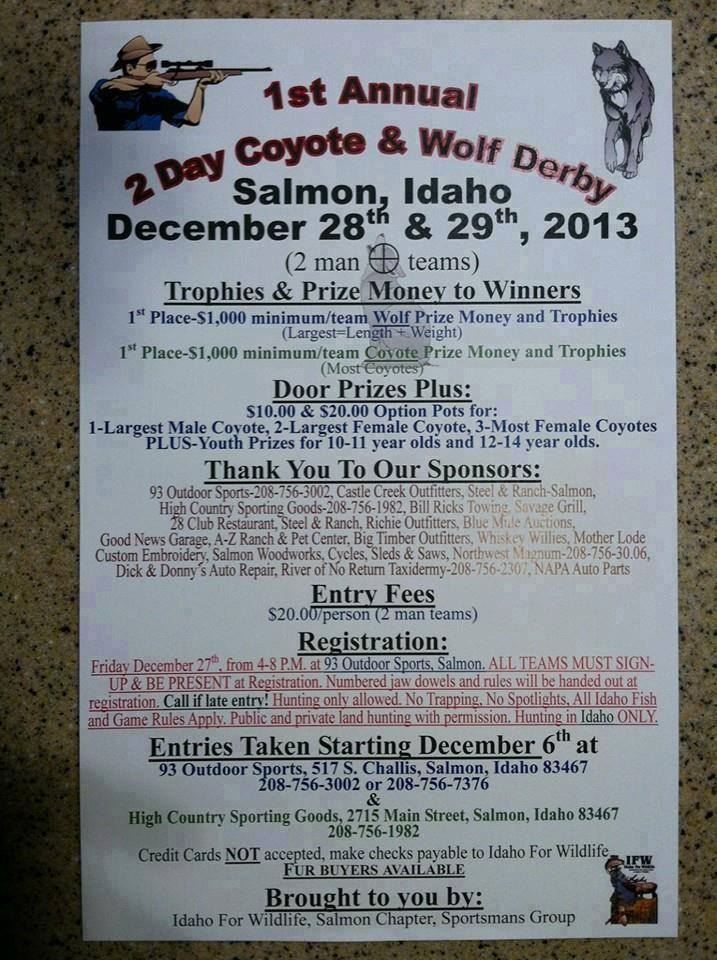
The coyote and wolf derby was promoted by ranchers and hunting enthusiasts as a form of family recreation aimed at reducing the number of predators threatening livestock and big-game animals like elk prized by hunters. It was condemned by conservationists as cruel and unsportsmanlike.

The weekend hunt on national forest land ringing the Idaho mountain town of Salmon drew 250 contestants seeking cash and trophies in categories ranging from bagging the largest wolf to shooting the most female coyotes. Children as young as 10 were invited to compete in a youth division.

The event was sponsored by Idaho for Wildlife, which fights “all radical anti-hunting and anti-gun environmentalists,” according to its executive3b. Fur buyer dumps coyote in rig director Steve Alder.

Adler said none of the teams managed to kill a wolf, but 23 coyotes were killed, making it a far cry from the “wolf killing spree” predicted by opponents.

“It shows hunting is not an effective tool to eliminate wolves. We’re going to have to take more aggressive action,” Alder said.

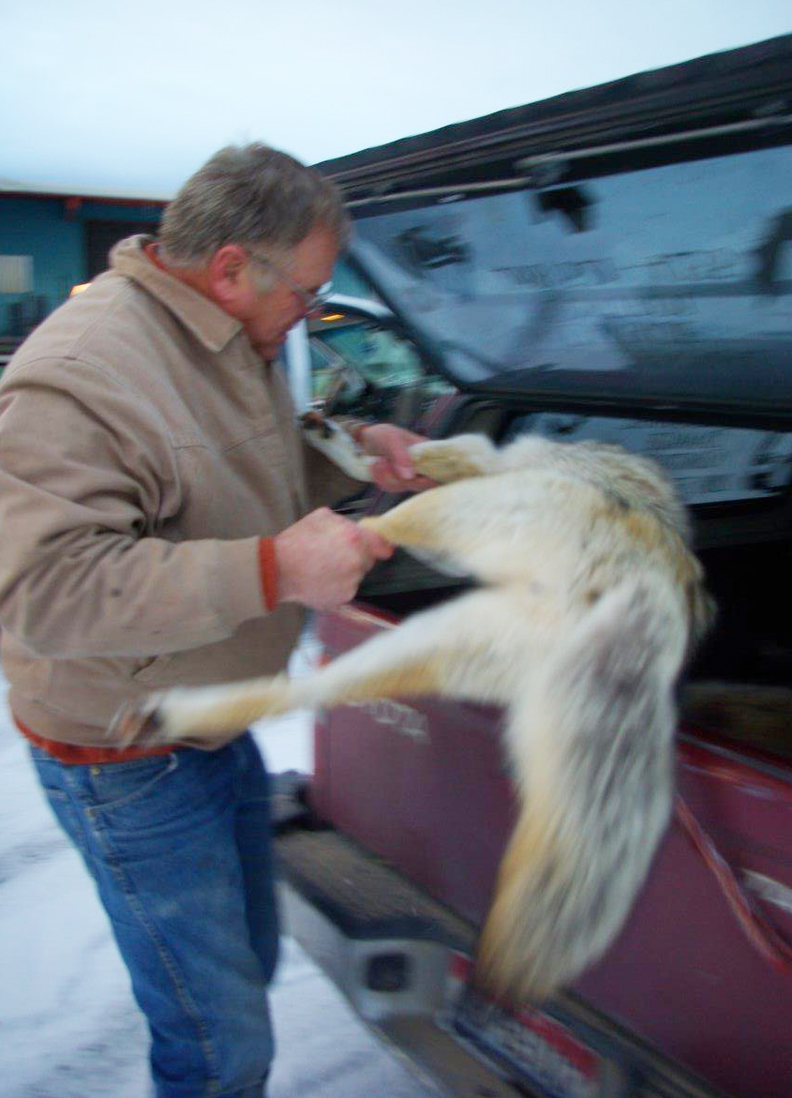
Hunters brought coyote carcasses to Salmon to be measured and counted and potentially sold to fur buyers. Several carcasses were piled in the back of pickup trucks.

Some contestants said they were disappointed at not bagging any wolves, and expressed frustration with opponents of the event.

“We’ll only have agreement with environmentalists when we kill all the wolves here,” said Jeremiah Martin, a hunter from Salmon.

Jim Robertson-wolf-copyrightOnline petitions criticizing the contest garnered tens of thousands of signatures and opponents have threatened a boycott of Idaho’s famous potatoes.

The derby is thought to have been the first statewide competitive wolf shoot in the continental United States since 1974, when gray wolves in the Lower 48 came under the federal Endangered Species Act protections after being hunted, trapped and poisoned to near extinction.

Wolves in the Northern Rockies, including Idaho, and in the western Great Lakes, lost the protection of the act in recent years as states pushed for hunting and trapping rights. The Obama administration is now proposing to strip wolves of federal safeguards nationwide.

Coyotes are considered pests and are allowed to be shot on sight in much of the U.S. West.

On Friday, a U.S. judge rejected a request by conservation groups to block the Idaho hunt, which was staged on a national forest near where federal wildlife managers reintroduced wolves to the Rocky Mountain West in the mid-1990s.

WildEarth Guardians and others had argued that the U.S. Forest Service did not issue proper permits for the event, but the judge said the contest was similar to activities like picnicking that do not require such special permits.

Bethany Cotton, wildlife program manager for WildEarth Guardians, said the legal battle will go on.

“A killing contest has no place on public lands,” she said.

(Reporting by Laura Zuckerman; Editing by Steve Gorman and David Brunnstrom)

Aftermath of Idaho Wolf Derby For Residents

1504081_10151720580422554_1839644173_n

http://www.kmvt.com/news/latest/Two-Day-Idaho-Wolf-Derby-Concludes-237916091.html

By Rachel Holt

Dec 29, 2013

Salmon, Idaho ( KMVT-TV / KTWT-TV )

The town of Salmon is a quiet community.

However, that seemingly changed overnight as the Idaho Wolf Derby thrust the area into the national spotlight.

Protesters angered by the killing of wolves, using drastic measures to try to stop the event.

Resident Theresa Butt states, “my friend got threatened. When we are getting people threatening to come into town and kill people, there is a problem. My friend Jen Larson, someone called and said they would like to hang their entire family up by a noose. Because they own the Savage Grill and sponsored a legal hunt. What’s wrong with that?”

Dave Larson, Jen’s husband, adds, “some extremists can say some things… do we have our guard up? Absolutely. They threatened my family, our business, our employees, our way of life. A guy stands up to that. You keep your guard up and you’re aware of it.”

Jen adds, “we’re just here to make a living and support the community. We don’t want all the wolf lovers to hate us. It’s just crazy– in the last two weeks we have found out there are some crazy people out there, on both sides of it.”

At the conclusion of the two day event, no wolves were actually killed but 21 coyotes were harvested.

Tom Curet, regional supervisor at Idaho Fish and Game, says, “people raised their concerns and from a biological perspective this derby is very closely managed and it’s something that can be supported by the wolves and coyotes and it will have minimal impact.”

While the impact on the wildlife was minimal, some residents feel for the town of Salmon, the damage has been done.

Butt says, “one of the things we’re really concerned about is how we’re being represented in the press. We’re not a bunch of hillbillies running around shooting guns for fun. We are concerned that our animals that we live on, that we have to eat to survive, are being killed by these wolves. We have a legal right to hunt them.”

[So do the wolves. It seems to me that if there were so many wolves out there taking elk, one of them would have been shot during their contest hunt.]