How Low Will You Go, Montana?

Why is it that snares are acceptable for wolves, but when an eagle  dies in one the USFWS offers a $2,500.00 reward?

Alaskan-Wolf-Snare_med

From Defenders of Wildlife:  Wolf-haters in Montana have introduced a bill to legalize a long list of deplorable acts.

This bill, SB 397 would:
•Allow wolves to be choked to death in neck snares, killed in traps and hunted for 10 months of the year, including during breeding, pregnancy, denning and pup-rearing seasons;
•Make it legal to lure wolves into traps using dead wolves – including dead pack and family members; and
•Allow an unlimited amount of wolves to be killed in a given season.
If this bill passes, it will be legal in Montana to use snares to choke a wolf to death and then leave its body out as bait to try to kill more wolves in its pack.

You have to ask — Who does that?

Only the Beginning

The Montana assault on wolves is not an isolated incident. It is only one facet of a well-funded, highly-coordinated and unrelenting effort by wolf-haters to significantly reduce the number of wolves and strip federal protection from most of them in the lower 48 states.

Just last week, anti-wolf lobbyists in Washington DC secured 72 Congressional signatures on a letter to U.S. Fish and Wildlife Service Director Dan Ashe demanding that wolves in the Lower 48 be completely delisted under the Endangered Species Act (ESA).

It was a chilling show of force by the anti-wolf lobby, and a reminder of what we are up against. Montana is a textbook case of what can happen when wolf management is turned over to a state that is politically dominated by anti-wolf interests.

Thanks to you and thousands of other wildlife lovers, the “kill wolves lobby” can be stopped, but make no mistake – we are in the fight of our lives for America’s wolves.

Our team is working long hours in Montana, across the Northern Rockies and here in Washington, D.C. to:
•Organize and mobilize local activists to fight appalling state measures like SB 397;
•Provide expert testimony at legislative hearings – these measures are not only reprehensible, they are based on politics, not science;
•Garner support for wolves on Capitol Hill. More than 50 members of Congress signed a letter demanding continued federal protection for wolves; and
•Mobilize online support from hundreds of thousands of people like you. Those letters, calls and emails do make a difference!

I won’t lie. We’re up against formidable foes who will stop at nothing to open America’s wolves up to unconscionable assault.

Don’t Let Orrin Hatch His Evil Plan

It appears certain U.S. Legislators won’t be satisfied until wolves in America are a thing of the past once again . An article entitled “Hatch, fellow senators petition to end gray wolves’ protected status” in ksl news, Utah, begins:

Led by Utah Sen. Orrin Hatch, 72 senators and representatives formally asked the U.S. Fish and Wildlife Service Monday to delist the gray wolf from the Endangered Species Act. The request in a letter sent to the agency argues that the gray wolf is no longer an endangered species and that uncontrolled gray wolf population growth is a threat to other indigenous wildlife as well as the hunting and ranching industries.

It’s almost laughable that Senator Hatch and his cronies expect us to believe they suddenly care so much about “indigenous wildlife” since—if allowed to hatch—Orrin Hatch’s half-baked, half-witted plan to delist wolves would effectively seal the fate of one the countries most endangered native species.

According to their letter, “State governments are fully qualified to responsibly manage wolf populations…” Sorry senators, nothing we’ve seen so far backs that statement up; it’s simply not true. Now, if the quote was “State governments are fully qualified to irresponsibly wipe out their wolf populations,” then I’d have to agree.

Sixty-five Republicans and seven Democrats signed the Hatch’s evil anti-wolf plan, including every congressman from Utah.

Wednesday’s official request was in response to a March 4 letter sent by 52 federal lawmakers requesting that gray wolves keep their protected status. Environmental groups say the government has its priorities wrong and some are even threatening to sue for a reversal if a delisting goes into effect.

“We believe national delisting would be premature,” said Adam Roberts, executive vice president of Born Free USA, a wildlife advocacy group. “When you have a species that varies greatly from region to region, it’s very dangerous to remove protection nationwide. It puts a bounty on wolves, including where there haven’t been healthy population levels. … Once there’s a market, wolves aren’t safe anywhere.”

Derek Goldman, a field representative for the Endangered Species Coalition, believes a nationwide delisting would be an unnecessary blanket solution. He said stable wolf populations are isolated to areas where their endangered status has already been lifted. “It seems really preposterous to delist wolves where they are barely making a comeback and where there are still great, natural habitats for them,” Goldman said.

And as Howling for Justice posted this morning: Can you imagine the carnage if wolves were systematically delisted across the lower 48? They can’t catch a break now, when they’re federally protected. The USFWS has no reason to take this action against wolves. Wolf recovery is not even close to being accomplished and in fact it’s going in reverse due to USFWS removing their federal protections and turning them over to hostile state management. The pressure to delist is coming from the rabid wolf haters, who believe “the only good wolf is a dead wolf”. Where is the science in that USFWS? I won’t hold my breath waiting for an answer.

And USA Today reports:

“Environmentalists band together to defend gray wolves”

A U.S. Fish and Wildlife report last year proposed dropping wolves from the endangered list in most areas where they’re known not to live, triggering an outcry.

CHEYENNE, Wyo. (AP) — Western environmental groups say they’re alarmed that the U.S. Fish and Wildlife Service is considering a plan to end federal protections for gray wolves in vast areas where the animals no longer exist.

The groups say ending federal protections would keep wolves from expanding their range back into states that could support them, including Colorado and California.

“As a matter of principle, I just think it’s wrong,” said Jay Tutchton, a Colorado lawyer with the group WildEarth Guardians.

Tutchton’s group has sued over recent action to end federal protections for wolves in Wyoming. Wolves in most of the “Cowboy State” are classified as unprotected predators and scores have been killed since federal protections ended last fall.

“The Endangered Species Act was designed to protect species, including in places where they no longer reside,” Tutchton said. “You were supposed to try to recover them, not throw in the towel.”

The Fish and Wildlife Service could announce as soon as this spring whether it will propose a blanket delisting of wolves in most of the lower 48 states. Wolves in the Northern Rockies and around the Great Lakes, where reintroduced populations are well-established, are already off the Endangered Species List.
Go Here to urge the President not to allow the removal of wolves from the Endangered Species List.

copyrighted Hayden wolf in lodgepoles

Wolves Need Their Own Untouchables

During the reign of Al Capone, when organized crime syndicates held Chicago in a stranglehold, a response team known as “The Untouchables” was formed to restore sanity to the war-torn city. With politicians and the cops in their back pockets, the crime bosses of yesteryear were able to act with impunity—to get away with murder, so to speak.

An analogous situation exists today, with anti-wolf fanatics in the role of the organized crime gangs and wolves as innocent victims. With corrupt state legislators and wildlife agencies in their pockets, organized wolf-haters are flexing their political muscles to push anti-wolf laws through everywhere the embattled canines can be found.

Some recent examples include: wolf hating troops to pressure the USFWS to delist wolves across the US., Big Game Forever, Don Peay and the Utah Legislature want to stop wolves from returning to Utah and, posted by Ralph Maughan on his website on March 26, Anti-wolf, anti-wilderness going after “pro-wolf” Washington state commissioners in hearing today…

Efforts by Washington state anti-wolf forces intercepted-

Below is an alert from anti-wolf folks in Washington State. This is an interesting example of the kind of email campaign that is being used by anti-wolf forces in a state where pro-wolf opinion is strong.

Those who support wilderness and wolves and other wildlife might want to do just the opposite of the recommendations below.
– – – – – –

Eliminate Pro-Wolf Wildlife Commissioners Now!

This is the most important thing that you can do to help hunting and the increasing wolf problem in our state. The Republicans are giving us this opportunity on a silver platter. Remember, all four guys up for confirmation on the Wildlife Commission have had a state senate hearing and they were not voted on. They can sit unconfirmed until their term expires without ever having another hearing. They don’t have to be voted on, but now they are being brought up for a vote. The Senate Natural Resources Committee Chair is bringing these guys up for hearings even though he doesn’t have to. The writing is so clear. The hunting community and ranchers are being thrown a political bone. This session Republicans were unified on gun issues. They only had two or three defecters at most on the anti-gun legislation. The GOP finally has some political clout and they are willing to do what the Democrats do – share the wealth with people that support them. I am a political realist whose passion is preserving our Second Amendment and right to hunt. Republicans in this state want to be our allies, now we have to do our part. We may never again have a chance to make a bigger splash than this. The Republicans on the committee need to hear from us and so does Hargrove. There are pro-hunting Democrats who support managing wolves 100%.

First we need to achieve our goal with each of these commissioner confirmations in committee, then the commissioners will face a vote by the full Senate. There’s a fair chance of influencing these confirmations because the full Senate did approve two of Senator Smith’s wolf bills which are now in the House. These wildlife commissioner confirmations only go before the Senate, so we do not have to worry about passing in the House. Therefore we only have two hurdles, getting the committee to vote as we would like and then getting the full Senate to vote as we would like. It’s a numbers game and it’s hard to know exactly how many messages we need to send to accomplish this goal, so we need as many messages sent as possible. Ask friends, family and any groups you belong, ask anyone you think you can convince to send email or call today.

As of Friday March 22 a Washington legislator informed us that nobody is contacting the Senate Committee regarding the confirmation of the four Wildlife Commissioners on March 26. This is the perfect chance for hunters, fishers, ranchers, and other concerned persons to have a direct impact on the Wildlife Commission. The hearing for confirmations is at 1:30 pm on March 26.

Please take 1 or 2 minutes and call or email: DO IT NOW IF YOU WANT A CHANGE!

CALL:
The committee assistant is Katharine Grimes (360) 786-7419 and ask her to forward a messages to each committee member to CONFIRM Wildlife Commissioners Mahnken and Carpenter and to OPPOSE Wildlife Commissioners Jennings and Kehne.

EMAIL: (copy and paste email list)
Kirk.Pearson@leg.wa.gov; John.Smith@leg.wa.gov; Christine.Rolfes@leg.wa.gov; Jim.Hargrove@leg.wa.gov; Mike.Hewitt@leg.wa.gov; Adam.Kline@leg.wa.gov; Linda.Parlette@leg.wa.gov;

(copy and paste subject)
Confirmation of WDFW Wildlife Commissioners

(copy and paste message or write your own)
Senate Natural Resources and Parks Committee

RE: Confirmation of WDFW Wildlife Commissioners

copyrighted-wolf-argument-settled

I’m About Sick of Control Freaks

What the hell’s going on with state lawmakers and wildlife agencies lately? With just a cursory glance at the headlines this morning I counted at least a half dozen cases of puffed-up politicians overstepping their bounds by offering up some non-human species to appease the bloodlust of a few of their freakiest constituents.
Headlines like “State lawmaker wants open season on woodchucks,” about Wisconsin state representative, Andre Jacque (R-De Pere), who is pedaling a bill that would remove woodchucks from Wisconsin’s protected species list and allow people to kill an unlimited number of them during a season that would run nearly year-round. Jacque said woodchucks are abundant and a “nuisance.”

Though newspaper journalists are, as a rule, impartial, the article’s reporter couldn’t help but see the disturbing trend going on across the dairy state:

Deer, bears, wolves, mourning doves, even wild pigs – if it walks, crawls or flies in Wisconsin, hunters can probably shoot it. Now a state lawmaker wants to declare open season on one more animal: the wily woodchuck.

The bill represents another expansion of hunting rights in Wisconsin and promises to reignite a years-old debate over whether hunters really need another target species. Attempts over the last decade to create hunts for feral cats and mourning doves, the state’s symbol of peace, drew fierce opposition. The state’s new wolf season sent animal lovers into a rage last year and an attempt to create a sandhill crane hunt last spring went nowhere after opponents mounted an intense campaign to stop it. Woodchucks, also known as groundhogs, aren’t as near and dear to Wisconsinites’ hearts as wolves, mourning doves and cranes.

Here’s an idea, why not let their “nuisance” wolves control the “nuisance” woodchucks? Predators like wolves and coyotes have been in charge of “controlling” woodchucks, beavers, prairie dogs, ground squirrels and other scary rodents for thousands of centuries. But I guess letting nature take care of itself would cheat hunters and other human control freaks out of some of their coveted “shooting opportunities.”

Meanwhile, a Spokane Spokesman Review article, “Idaho sets 2013 big-game hunting seasons, rules,” reports: permits for antlerless elk hunting will be increased statewide under the 2013 hunting seasons for deer, elk, pronghorn, black bear, mountain lion and gray wolf adopted today in Boise by the Fish and Game Commission. The new seasons also include an increase in pronghorn tags and expanded wolf hunting and trapping seasons. Wolf hunting on private lands in the Idaho Panhandle will be allowed year round.

Again, like in Wisconsin, Montana and so many other trigger-happy western states, populations of both wolves and deer or elk are slated for reduction. It seems the work of control freaks is never ending.

Since they don’t have any wolves to scapegoat, wildlife policy-makers in Utah are setting a $50.00 bounty on coyotes, presumably to keep in practice.
And in Oklahoma, spring youth turkey season will begins today for youth hunters ages 17 and younger. Turkeys won’t be safe in that state until sometime in May.

Also in Oklahoma hunting news, on Wednesday 1200 students and 64 teams from Oklahoma high schools, middle schools and elementary schools will convene at the OKC State Fairgrounds to compete in the state’s ninth archery championship tournament. Archery in the Schools has become the most popular educational program the Okla. Dept. of Wildlife “Conservation” has ever introduced. More than 400 schools and almost 50,000 students in Oklahoma are taking an eight week archery session taught indirectly by the Oklahoma Wildlife Department.

Now, I like to shoot arrows at straw bales as much as the next guy, but you know it doesn’t end there for most of these Okies. Sure enough, the success of their archery program has inspired the Oklahoma Wildlife Dept. to introduce other courses in schools such as hunter education, bow hunting and fishing. And this spring the Wildlife Dept. will introduce a scholastic shooting sports program in several pilot schools.…

I could go on, but trying to keep up with every state’s new anti-wildlife programs is really getting to be a nuisance.

 Text and Wildlife Photography ©Jim Robertson, 2013. All Rights Reserved


Text and Wildlife Photography ©Jim Robertson, 2013. All Rights Reserved

Wolves Getting Booted Back to the Brink

When an activist friend asked me to write an overview of the wolf situation, my first thought was: “What a daunting and extremely depressing task that would be.” But having followed the wolves’ story since long before their reintroduction to Yellowstone and the Idaho wilderness, I suppose it’s only natural that I take this on. After all, I’ve covered the issue many times in articles, on my blog, and I devoted two chapters of my book, Exposing the Big Game: Living Targets of a Dying Sport, to the plight of wolves.

At the time I wrote the book’s chapter, “From the Brink of Oblivion and Back Again,” wolves were still federally protected and their removal from the Endangered Species List was just someone’s bad idea that had yet to see its dark day—I never quite realized just how apt that title would soon be. Until recently I remained hopeful that any wolf hunting would be strictly monitored and regulated, and that abusers would be fully prosecuted. Frankly, I thought we would be a little more evolved as a species by now.

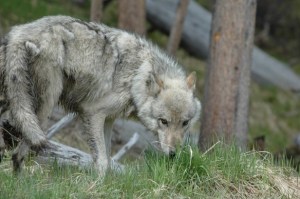
But time and again states have proven themselves unworthy by declaring open seasons on wolves, without regard for the species’ future or for the welfare of individual wolves. Indeed, the ongoing warlike attack on wolves is anything but sporting or humane, with kill methods ranging from traps and snares to aerial hunting, running them down with dogs or luring them in and sniping at entire packs with semi-automatic rifles—depending on a given state’s predilection. At the same time, many hunters and trappers go out of their way to express their hatred for wolves through horrific acts of overkill. They seem to take sick pleasure in further degrading their victims by glibly posing in morbid photos of trapped or bloodied wolves, then spreading their snuff shots across the internet, fishing for praise, while taunting wolf advocates.
Text and Wildlife Photography ©Jim Robertson, 2013. All Rights Reserved

Text and Wildlife Photography ©Jim Robertson, 2013. All Rights Reserved

For thousands of years, wolves played a central role as keepers of nature’s balance across the American landscape. Wolves are the personification of untamed wilderness; their presence is a sign of an ecosystem relatively intact.

But bigotry toward wolves has thrived across the country since colonial times and wolves have long been the object of unwarranted phobias. Today’s wolf-haters panic at the thought of natural predators competing for “their” trophy “game” animals and loath anything that might threaten their exploitive way of life. They view the federal government as the enemy in their ongoing combat against wilderness, and grasp for local control of species like wolves, who, until recently, were all but extinct in the continental U.S. Far from being their foe however, the federal government has actually been a fervent ally.

The contentious removal of wolves from the federal endangered species list—long before they were truly recovered—was a coldly calculated course set in motion by the Bush Administration, dutifully followed by the Obama Administration and rendered the law of the land through an underhanded act of Congress in 2011. This crooked covenant, conjured up for the sake of ranchers and trophy hunters, left the wolves’ fate in the custody of hostile western states…and fits right in with a centuries-old, historic norm.

In 1630, Puritans of the Massachusetts Bay Colony—known for holding the first Thanksgiving Day celebration…and Salem witch hunts—felt biblically impelled and duty-bound to “subdue the earth.” Hence, they were the first to establish a bounty on wolves. Soon the other colonies followed their example and set bounties of their own, and a systematic genocide of wolves in America spread west with the “settling” of the land.

In 1818, Ohio declared a “War of Extermination” against wolves and bears. Iowa began their wolf bounty in 1858; in 1865 and 1869 Wisconsin and Colorado followed suit. State by state wolves were shot, trapped and poisoned to extinction. As the demand for wolf pelts increased, “wolfers” began killing grazers like elk or bison and poisoning the meat as bait, decimating whole packs of unsuspecting canines in one fell swoop.

By 1872, the year President Grant created Yellowstone National Park, 100,000 wolves were being annihilated annually. 5,450 were killed in 1884 in Montana alone, after a wolf bounty was initiated there. By the end of 1886, a total of 10,261 wolves were offered up for bounty (sixteen times Montana’s 2011 population of 653 “recovered” wolves). Wyoming enacted their bounty in 1875 and in 1913 set a penalty of $300 for freeing a wolf from a trap.

Not to be outdone, the US government began a federal poisoning program in 1915 that would finish off the rest of the wolves in the region—including Yellowstone. By 1926 wolves had been completely extirpated from America’s premier national park.

Having no more regard for wolves than those who originally caused their extinctions, willfully-ignorant wolf-haters in the tri-state area of Idaho, Montana and Wyoming have not received their reintroduction with open arms but rather with loaded arms, hoping to turn the clock back to the dark ages of centuries past. The posture they assume on the subject of wolves is as warped and ill-informed as any Massachusetts witch hunter’s.

With the wolf population in the tri-state area at only a fraction of its historic sum, the federal government unceremoniously removed them from the endangered species list (and consequently from federal protection) in 2009, casting their “management” (read: eradication) into the clutches of eager states that wasted no time implementing wolf hunting seasons. Montana quickly sold 15,603 wolf permits, while their confederates in Idaho snatched up 14,000 permits to hunt the long-tormented canids.

For its part, Wyoming has stubbornly held to a policy mandating that wolves be shot on sight anytime they wander outside Yellowstone, allegedly to safeguard range cattle (who are actually 147 times more likely to fall prey to intestinal parasites). Wolves have killed a grand total of only 26 cows (out of 1.3 million head of cattle in the state). Still, the livestock industry is in control of their wolf management decisions. Though hunters there have killed 74 wolves this season, as of March 1st the state of Wyoming has expanded and extended its season indefinitely, declaring an open, year-round hunt on them. Winter, spring and summertime hunts are particularly harsh since this is when wolves are denning and raising their newborn pups.

On the other side of Yellowstone, the disingenuously but suitably named “Idaho Anti-Wolf Coalition,” backed by a well-funded trophy elk hunting industry, filed and circulated an initiative petition in 2008 calling for the removal of “all” wolves there “by whatever means necessary.” Fortunately, even in the state famous for potatoes, militias and neo-Nazi compounds, they failed to gain enough public support to move forward with their avaricious initiative. Even so, the Idaho government has been quietly carrying out the “whatever means” approach by adding aerial hunting, trapping, snaring and baiting to their wolf devastation arsenal. This last season, 169 wolves were killed by trophy hunters in Idaho, while trappers there claimed the lives of 76.

It should come as no great jolt that Idaho hunters felt they could get away with asking for the renewed obliteration of an entire species—their governor, “Butch” Otter, publicly proclaimed he hoped to be the first to shoot a wolf as soon as they lost federal ESA protection. Failing that, Otter used his gubernatorial powers to declare his state a “wolf disaster area,” granting local sheriffs’ departments the power to destroy packs whenever they please.

“Meanwhile,” according to Defenders of Wildlife’s president, Jamie Rappaport Clark, “the federal government is sitting idly by as Idaho almost singlehandedly unravels one of our nation’s greatest wildlife conservation success stories. This is totally unheard of—never before has a species climbed its way back from near extinction only to be quickly decimated once again.”

Montana started out seeming to be the sensible state, appearing almost tolerant of wolves. But between their state legislature and their wildlife policy makers, they’ve made an about face and quickly caught up with their neighbors, displaying a total disregard for the public trust doctrine which holds that wildlife, having no owners, are res communes, belonging “in common to all of the citizens.” They’ve recently passed bills barring any protected zones outside Yellowstone Park, while legalizing silencers for wolf hunting and the use of recorded calls to attract wolves, as well as allowing five wolf tags per hunter, 12 years and older. (And a new state bill is proposing lowering the legal age of hunters to nine years old.) Legislators also proposed a cap of 250 on their state wolf population. Last year’s wolf hunt kill totals for Montana were 128 wolves shot to death and 97 killed in traps.

Text and Wildlife Photography ©Jim Robertson, 2013. All Rights Reserved

Text and Wildlife Photography ©Jim Robertson, 2013. All Rights Reserved

Since Congress stripped wolves of their Endangered Species status, an estimated 1,084 wolves have been killed in the Northern Rockies. Again, that’s ONE THOUSAND AND EIGHTY-FOUR living, breathing, social, intelligent wolves killed by scornful, fearful, vengeful and boastful hunters and trappers, often in the most hideous ways imaginable.

Thanks to a federal judge’s 2010 decision, the wolf was granted a one-year stay of execution. But in 2011 our federal legislators on Capitol Hill attached a rider to a budget bill circumventing that judgment. This serpentine, backbiting end-run around science and public opinion played right into the hands of anti-wolf fanatics in Idaho and Montana and cleared the way for the bloodiest butchery of wolves in almost a century. Case in point: the opening week of Montana’s nascent hunting season on wolves saw sportsmen set up just outside the park boundary gun down every adult in Yellowstone’s well-known and much-loved Cottonwood pack, leaving their dependent pups to starve.

As if that weren’t enough, on December 6, 2012, the familiar, radio-collared alpha female of the park’s Lamar Canyon pack was shot and killed by a hunter. Suddenly the average American was aware of the atrocities of wolf hunting, yet in spite of widespread public outcry, wolf-killing states have stepped up their single-minded assault.

Wyoming’s expanded wolf-killing season is all the more tragic given that spring is the time of year that wolves are denning. As Defenders of Wildlife points out, “This expanded hunt puts the most vulnerable population of wolves – pups and pregnant or nursing mothers – in greater danger of being shot on sight. This kill-at-will approach is exactly the kind of flawed policy we knew would happen if wolves prematurely lost their Endangered Species Act protection – this is why Defenders is suing the U.S. Department of Interior to restore ESA protection for wolves in Wyoming.”

It’s not like the administration didn’t know what might happen when the fate of the wolves was turned over to states with extreme anti-wolf plans already in place. In just two years nearly 1,100 wolves have been ruthlessly murdered by hunters and trappers eager to relive the gory glory days of the 1800s.

All this is going on in spite of well-documented proof that wolves are beneficial to a given environment, and despite the fact that the majority of Americans, including most visitors to Yellowstone and the tri-state area, want to see wildlife unmolested. They are not there to hunt—the money they spend reflects their strong interest in the quiet enjoyment of nature. A 2011 National Park Service report shows that the 3,394,326 visitors to Yellowstone spent $332,975,000 in communities surrounding the park. But these figures could drop dramatically if Yellowstone wolves continue to be slaughtered.

Yellowstone is fertile ground for watching and learning about wolves. Biologists studying the Yellowstone ecosystem have found that since their reintroduction to the park, wolves have kept elk herds on the move, thus allowing over-browsed streamside riparian habitats to regenerate. Among the species that rely on a healthy riparian zone—and therefore benefit from the presence of wolves—are moose, trumpeter swans, warblers, wrens, thrushes, beavers, muskrats and the Yellowstone cutthroat trout. Everywhere they’re found, wolves play an important role in maintaining the health of ungulate herds by preying primarily on infirm or diseased animals, ensuring a healthy gene pool. And the remains of their kills provide a welcome relief for hungry scavengers, from bears to ermine to wolverines to bald eagles.

But the number of animals killed by wolves is grossly overplayed by their detractors. According to Yellowstone National Park data for 2011, project staff found that wolves barely took a bite out of Yellowstone’s rich and varied biota. And it’s long been established that wolf populations, left alone, are self-regulating; data from Yellowstone backs that up as well. Like humans, when they feel the pinch of too many of their own kind in a given area, they start to turn against one another. 2011 saw seven wolves killed in intra-pack quarrels. Yellowstone’s fluctuating wolf population has declined from 174 in 2003 to around 80 in 2012. Since then, hunters and trappers targeting wolves along the park’s borders have brought the current population down to the low 70s, as of this writing.

In addition, scientists studying the relationships between keystone predators, trophic cascades and biodiversity have found that ecosystems which include these predators have more diversity and are more resilient to climate change and stresses caused by a growing human population.

Sadly, state game departments are out of touch with these concepts. For example, according to a 2012 Montana Fish, Wildlife and Parks Department survey, there are 141,078 elk in the state, 55% over their management “objective” of 90,910; but rather than allowing wolves to solve their elk “problem,” they want to reduce the number of both elk and wolves. That policy is not scientific; it’s downright kill-happy. And an alleged threat to the cattle industry is certainly no excuse for the rampant killing of these important predators. Out of the approximately 2.6 million cattle in the state, only 74, or .0003%, were taken by wolves in 2011.

Biologist Bob Hayes, author of Wolves of the Yukon, wrote: “I spent 18 years studying the effects of lethal wolf control on prey populations. The science clearly shows killing wolves is biologically wrong. As I began to better understand the wolf, I developed a clear answer to my question about the effectiveness and moral validity of lethal wolf control programs. I can now say the benefits of broad scale killing of wolves are far from worth it…It should never happen again.”

And the late Canadian naturalist and author, R D Lawrence, stated in his book, In the Presence of Wolves: “Killing for sport, for fur, or to increase a hunter’s success by slaughtering predators is totally abhorrent to me. I deem such behavior to be barbaric, a symptom of the social sickness that causes our species to make war against itself at regular intervals with weapons whose killing capacities have increased horrendously since man first made use of the club—weapons that today are continuing to be ‘improved’.”

The 1996 reintroduction of wolves to the northern Rocky Mountains in Yellowstone and wilderness areas of Central Idaho as mandated by the Endangered Species Act–along with protections against hunting and trapping all too briefly afforded them under the ESA–gave the wolf a temporary reprieve and allowed Nature to reign again over some of her sovereign lands.

Yes, wolves are spreading out, but that doesn’t necessarily mean there are more of them; each time they find a given habitat hostile to them, they continue to branch out in search of someplace safer and more hospitable. The total wolf population of the tri-state area has fluctuated, reaching a high of around 2000 individuals. An impressive figure perhaps, unless you consider that 1,089 were killed this year (not including those killed by federal “Wildlife Services” agents); or that 10,261 wolves were destroyed between 1884 and 1886 in Montana alone; or even that 380,000 wolves once roamed the country.

While all this is going on, the Great Lakes states have been racking up a high wolf body count of their own. Wisconsin in particular seems to be bucking for a most merciless award—the cruelties they’ve unleashed on wolves are the stuff of nightmares. Though recent studies suggest wolf predation may suppress CWD (chronic wasting disease—the deer equivalent of mad cow disease), Wisconsin has spent 27 million de-populating its white-tail deer to curb CWD. To underscore the irony of this: no CWD has been detected in areas where wolves live in that state. In addition to CWD, wolves have been shown to reduce or eliminate brucellosis, ironically benefitting the very Montana ranchers who vilify them

Anti-wolf fanatics are an organized bunch of thugs. Lately a deceptively named hate-group calling itself “Big Game Forever” has been luring Utah state funds away from essentials such as schools and into their anti-wolf agenda. Just recently they leached $300,000 for their campaign against wolves in that currently wolf-less state.

States, such as South Dakota, that don’t even have wolf populations are hastily re-classifying wolves from the status of protected to “varmint,” in the event that any lost wolf happens by.  Even states as progressive as Washington are jumping on the bandwagon, allowing people to kill wolves without permit and changing the wolf’s status to “big game,” ahead of their anticipated complete removal from federal ESA protection. This can’t be allowed to happen—the minute federal protections are lifted, wolves will be fair game practically everywhere in the country!

As Aldo Leopold pointed out in 1949: “If the land mechanism as a whole is good, then every part of it is good, whether we understand it or not. If the biota, in the course of eons, has built something we like but do not understand, then who but a fool would discard seemingly useless parts? To keep every cog and wheel is the first precaution of intelligent tinkering.”

Who but a fool, indeed.

With the return of widespread wolf hunting, it will take today’s anti-wolf bigots only a few years to boot this misunderstood embodiment of wilderness back to the brink of oblivion.

________________________________________

This post includes excerpts from Exposing the Big Game: Living Targets of a Dying Sport.

Text and Wildlife Photography ©Jim Robertson, 2013. All Rights Reserved

Text and Wildlife Photography ©Jim Robertson, 2013. All Rights Reserved

Inside the Wolf Hunter’s Mind

My book, Exposing the Big Game: Living Targets of a Dying Sport, includes a chapter in which I peered “Inside the Hunter’s Mind.” What I saw was a selfish, self-serving, self-important braggart with a self-esteem problem.

But, when I try to envision what goes on in the mind of a wolf hunter, or trapper, my first impression is of an empty space—as devoid of substance as their heart evidently is. To actually imagine what kind of warped thinking goes on in their head is mind-boggling. But, as with every sadistic killer, there must be a motive for their unjust acts.

In considering why they would take so much anger and hatred out on wolves, it’s clear that it couldn’t stem only from superstition like the wolf-haters of centuries past. We must not forget that it’s not really the wolves themselves that these people hate, but the idea of a species killed off by their forefathers now being protected by more evolved people who want to make amends for the damage done by those seeking to “settle” the land and “subdue the Earth.”

Modern day wolf haters don’t have a phobia of wolves—instead they’re paranoid of any kind of government control of their perceived “right” to exploit the land and wildlife as they see fit. When they act out their murderous fantasies, they’re not just killing wolves, they’re trying to assert their power and reclaim their supposed birthright.

So next time you see another tweaked and twisted photo of a wolf-killer with an overblown sense of entitlement posing over a dead wolf, remember that it’s not just the wolves they hate—it’s anyone who stands in the way of their getting whatever they want handed to them on a silver platter.

Text and Wildlife Photography ©Jim Robertson, 2013. All Rights Reserved
Text and Wildlife Photography ©Jim Robertson, 2013. All Rights Reserved
Petition to Keep Michigan Wolves Protected

Action Alert from the HSUS

It’s devastating to watch. In just one year, wolves have taken one brutal hit after another.

First, wolves were stripped of their federal protections under the Endangered Species Act. Then, state by state, Idaho, Minnesota, Montana, Wisconsin, and Wyoming all opened fire on these majestic animals. Now, Michigan may be just months away from joining in the bloodletting.

Keep Michigan Wolves Protected is a coalition racing to collect 225,000 signatures by March 27 to put a referendum on the 2014 ballot. If the signatures are collected, we will automatically stop the Michigan wolf hunts through November 2014, an effort that would save as many as 500 wolf lives from pointless trophy hunting.

But we’re running out of time.

There is just more than one week left, and we haven’t reached our goal of 225,000 signatures. Can you help us put more people on the ground by making a donation of $25 — or whatever you can afford — today?

Just 50 years ago, these beautiful, shy, highly intelligent animals were pushed to the brink of extinction by the very same cruel and unsporting practices that are threatening them today. When it comes to wolves, our nation is going backward — and we must act now. Help us in this race against time for America’s remaining wolves — donate today.

Keep Michigan Wolves Protected is working day and night to reverse the fate of America’s wolves. Every dollar raised will help in the fight to stop the senseless killing of this iconic species.

The future of our wolves is at stake.

More Sick Ideas From Idaho

Proposed Idaho legislation could let ranchers use dogs as live bait to kill wolves

Article from:

http://www.9news.com

Wolves were protected by the Endangered Species Act until December 2011. Wolves are now off that list because their population in North America has improved. However, their removal from the endangered species list makes it no longer illegal to kill a wolf.

“We killed wolves, we reintroduced wolves, and now they’ve been removed from the Endangered Species Act,” Marc Bekoff, professor emeritus of Ecology and Evolutionary Biology at University of Colorado-Boulder, said. “So there’s a real ethical dilemma here. You kill animals and you bring them back and then you kill them again and so it’s a waste of time, a lot of person power and money.”

Siddoway, who proposed the Wolf Depredation Control bill, is a sheep rancher. The bill would amend existing Idaho laws relating to the control of wolves and would give more freedom to ranchers.

Under the measure, if a wolf killed livestock, the rancher could hunt down the wolf and kill it without a permit within 30 days of the livestock attack. Bekoff has studied coyotes for years and says it takes a long time for a person to be able to reliably identify a wolf or coyote that they’ve seen.

“It’s going to result in mass killing of wolves because people will say, ‘Well, the wolf came in and I just killed the wolf who came in,’ but they’ll have no evidence of that at all,” Bekoff said.

The proposed legislation would allow ranchers to use a number of different ways to kill the wolves, like using live bait to bring the wolf to a particular area to be killed. Domestic dogs, sheep and goats are some of the examples cited of what could be used as live bait.

“From a dog’s perspective, being used as bait would be a terrifying experience,” Bekoff said. “They would know that there’s danger out there. It would be terrifying and, physiologically, it could kill them. It’s known that animals under these conditions lose weight, they stop eating, just imagine yourself being used as bait.”

Members of Idaho’s livestock industry believe the bill is needed to control the predators. Many ranchers at the hearing Monday supported the bill, saying they’ve lost thousands of dollars worth of cattle from wolves.

“I applaud this bill, the Idaho Wool Growers Association certainly is in support of this,” Harry Soulen, Idaho sheep and cattle rancher, said. “We need all the tools out there that are available to us to hopefully curtail some of our losses.”

The legislation would also allow ranchers to use a number of different ways to kill the wolves, including the use of night-vision scopes to shoot the wolves and even the use of an airplane to shoot the animals from the air.

As it stands now in Idaho, an animal that is killed by a wolf has to be verified by state officials before any action can take place. Because the legislation faced only a hearing Monday, there was no vote on it. The committee will take this bill up again on Wednesday.

“I think this bill could pass in the state of Idaho which is notorious for killing wolves,” Bekoff said. “I’m holding my breath that it won’t but in some ways after reading some of the comments in the newspaper articles about it, and just seeing the zeal with which these legislators are going after it, I think it’s got a good chance of passing.”

(KUSA-TV © 2012 Multimedia Holdings Corporation)

Vote NO for Wolves

ACTION ALERT !
Please click on this link, http://www.ironmountaindailynews.com/ and at the lower left column of page vote “NO!” on this poll asking if a Michigan should have a wolf hunt.
Unfortunately there isn’t a “Hell No!” category…
Wolf Photo Copyright Jim Robertson

Wolf Photo Copyright Jim Robertson

Who’s the “Varmint?”

Who the fuck do the South Dakotians (or South Dakotites, or whatever the hell they’re called) think they are, labeling wolves “varmints”? Last week, their state legislators passed a bill to reclassify wolves from protected to “varmint,” lumping them in with coyotes, foxes, skunks, gophers, ground squirrels, chipmunks, jackrabbits, marmots, porcupines, crows, and prairie dogs, all of whom were native to the state before modern humans came along and branded them with that degrading epithet.

The reclassification of wolves in South Dakota seems a bit hasty, as there are currently no known wolves living there. Sure, they occasionally pass through the state in search of greener, or wilder, pastures. Three such adventuresome lone wolves (probably young males) were killed in different parts of the state in 2012—one was hit by a car near Pine Ridge, one died in a lethal trap set for coyotes and another was shot outside the town of Custer, in a case of “mistaken identity” (mistaken, no doubt, for a coyote—a “varmint” species which can be killed on sight year-round).

Wolf advocates should know that the malicious evil the wolves have been forced to endure at the hands of humans for the past couple of years is the same kind of brutality coyotes have suffered from the get go. Now, with their reclassification, anyone with a South Dakota hunting license that allows them to shoot predators will be able to shoot wolves too.

There isn’t a more arrogant term than “varmint” for a species far better suited to life on the open plains and prairies than humans could ever hope to be.

Var•mint
noun. Informal [vahr-muhnt] Chiefly Southern and Mid-U.S.
Definition:
a. One that is considered undesirable, obnoxious, or troublesome.
b. An objectionable or undesirable animal, usually predatory, as a coyote or bobcat.
c. A despicable, obnoxious, or annoying person.

Considering the kind of mindset displayed in the following quote, “My only real regret, is that there aren’t more days in the week and more hours in a day and more days off to hunt coyotes!” the burning question is, who’s the real varmint?

The quote is from one of the operators of “Varmint Safari.”

To give you an idea what kind of people hunt “varmints,” below are their ads for a series of hunting videos this particular brand of varmint sells.

(Note the comment, “Filmed almost entirely on public land” as well as their unabashed exuberance in stating, “Hundreds of spectacular kills”)…

Four great varmint hunting videos!
Varmint Safari 4 features:
• 90 minutes of action packed coyote hunts!
• 40 kills by recreational callers just like you!

Varmint Safari 3 features:
• Western Rock Chuck hunting at its finest!
• Filmed almost entirely on public land

Varmint Safari II features:
• 3 Hours of solid varmint hunting action!
• Coyotes, Prairie Dogs, Chucks, Rabbits

Varmint Safari features:
• 2 Hours of hunting and information!
• Hundreds of spectacular kills!

Still not sure who the varmints are? See Definition c., above.

Text and Wildlife Photography ©Jim Robertson, 2013. All Rights Reserved
Text and Wildlife Photography ©Jim Robertson, 2013. All Rights Reserved