“EXPOSED: USDA’s Secret War on Wildlife”

http://www.predatordefense.org/exposed/

In our newest film you’ll see three former federal agents and a Congressman blow the whistle on the USDA’s barbaric and wasteful Wildlife Services program and expose the government’s secret war on wildlife.

Dec. 1, 2013 – An agency within the USDA called Wildlife Services—a misnamed entity if there ever was one—has been having their way for almost a century, killing over 100,000 native predators and millions of birds each year, as well as maiming, poisoning, and brutalizing countless pets. They have also seriously harmed more than a few humans. And they apparently think they are going to continue getting away with it.

But in our new documentary, EXPOSED: USDA’s Secret War on Wildlife, whistle-blowers go on the record showing Wildlife Services for what it really is—an unaccountable, out-of-control, wildlife killing machine that acts at the bidding of corporate agriculture and the hunting lobby, all with taxpayer dollars.

Our call for reforming this rogue agency is getting serious attention. A teaser of EXPOSED was just featured on CNN Headline News and is slated for an upcoming special segment. We’re also working to get a CBS “60 Minutes” exposé.

In January 2014 we’ll kick off a nationwide film screening tour. Whistleblower Rex Shaddox will attend some of our screenings, including one planned for members of Congress at the Capital building in D.C. We hope to have other speakers tour with us if we can raise enough funds.

Watch EXPOSED online and donate here: http://www.predatordefense.org/exposed/

http://www.youtube.com/watch?feature=player_embedded&v=qSV8pRLkdKI

Coyote photo Copyright Jim Robertson

Coyote photo Copyright Jim Robertson

Pure Propaganda: N.M. students take refuge in bus stop ‘kid cages’ as gray wolf population soars

Kid cage at school bus stop.Kid cage at school bus stop.

    By Valerie Richardson

The Washington Times

Thursday, November 28, 2013

DENVER — Canadian gray wolves are by all accounts thriving in the Northern Rocky Mountains and Great Lakes region, but getting the wolf’s removal from the Endangered Species List won’t be easy.

Even as children in rural New Mexico take refuge from wolves in “kid cages” at school bus stops, wildlife lovers and environmentalists are fighting tooth and nail the proposal by the Fish and Wildlife Service to delist the species.

Read more: http://www.washingtontimes.com/news/2013/nov/28/wolves-no-longer-endangered-but-friends-fight-thei/#ixzz2mFO57EJI Follow us: @washtimes on Twitter


A Hastings-led howl against protecting wolves

http://blog.seattlepi.com/seattlepolitics/2013/11/15/a-hastings-led-howl-against-protecting-wolves/

Friday, November 15, 2013 by: Joel Connelly

Seventy-five members of Congress are demanding that the Obama administration end all protection of the gray wolf as “endangered” or “threatened” under the federal Endangered Species Act, in an effort organized by Rep. Doc Hastings, R-Washington.

The U.S. Fish and Wildlife Service has already de-listed wolves in the Northern Rocky Mountains — leading to big, officially encouraged wolf kills, particularly in Idaho — and in the Great Lakes States.

Wolves have moved south from protected lands on the U.S.-Canada border to repopulate the Washington Cascades.  e Teanaway wolf pack in the Cascade Mountains. (Photo courtesy of Conservation Northwest).

The gray wolf has moved south from protected lands on the U.S.-Canada border to repopulate the Washington Cascades, including the Teanaway Valley. (Photo courtesy of Conservation Northwest).

In Washington, wolves are still under federal protection in the Cascades, but not in the Kettle Range and Selkirk Mountains of Northeast Washington. There, they receive state protection, which is under attack by conservative state legislators.

The lawmakers’ letter uses age-old arguments for removing protection so that wolves can be killed.

“Since wolves were first provided protection under the ESA, uncontrolled and unmanaged growth of wolf populations has resulted in devastating impacts on hunting and ranching and tragic damages to historically strong and healthy herds of moose, elk, bighorn sheep and mule deer,” they wrote in the letter to Dan Ashe, director of the U.S. Fish & Wildlife Service.

Mitch Friedman, executive director of Conservation Northwest, a Washington-based group that has championed wolf recovery, scoffed at the letter’s assertions.

“It’s surprising Little Red Riding Hood isn’t mentioned,” said Friedman.

“The letter acknowledges that ‘federal policy must be based on best available science,’ then goes on to make the false and hyperbolic claim about ‘devastating impacts’ on fishing and ranching,” Friedman added. “Throughout wolf territory, game populations are generally at or above levels desired by state managers.

“These Tea Party legislators have so proven Congress that they’ve resorted to attempting policy by press release.  Their letter is off enough on matters of law, science and facts.”

Rep. Doc Hastings, R-Wash.: Bipartisan legislation to expand the Alpine Lakes Wilderness and protect the Middle Fork-Snoqualmie River, in eastern King County, can't get the time of day in his committee..

Rep. Doc Hastings, R-Wash.: He is lead on a letter, signed by 75 members of Congress, demanding an end to all federal protection of wolves under the Endangered Species Act.

Hastings is chairman of the House Natural Resources Committee.  Rep. Cathy McMorris-Rodgers, R-Wash., who also signed the letter, is a member of the House Republican Leadership.

The gray wolf has returned to Washington’s mountains in recent year.  A killing spree by three Okanogan County residents — who were caught and prosecuted under federal law — nearly destroyed one pack that had established itself in the upper Methow Valley of the North Cascades.

Other packs have located in the upper Teanaway Valley, in the Cascades north of Cle Elum, as well as in northeast Washington.  A majority of the state’s wolf population has the misfortune to live in congressional districts represented by Hastings and McMorris Rodgers.

The letter asking for de-listing of wolves is signed by a who’s-who of Tea Party members in Congress, including such luminaries as Rep. Michele Bachmann, R-Minnesota, Sen. Mike Lee, R-Utah, Rep. Steve Stockman, R-Texas and Rep. Raul Labrador, R-Idaho.

A pair of conservative House Democrats, Reps. Collin Peterson of Minnesota and Jim Matheson of Utah, signed the letter.

The letter also opposes a proposal to list the rare Mexican wolf, found in the Southwest, as a subspecies under the Endangered Species Act. Such a listing would have a “Severe impact on private landowners, including ranchers” in Arizona and New Mexico, the lawmakers claim.

“We believe that state governments are fully qualified to responsibly manage wolf populations and are better able to meet the needs of local communities and wildlife populations,” said the letter.

Friedman argued the reverse, saying that Hastings and his allies are grandstanding and doing nothing to encourage cooperation between local communities and conservation groups.

“Real ranchers and communities — including in Eastern Washington — are stepping up to work with groups like ours on practices that allow wolves and livestock to share the land,” he said.

“There are ways that Doc Hastings and Cathy McMorris Rodgers could help, but I’m still waiting for their call.”

Former USFWS Whistleblower Says Wolves Illegally Introduced

Just FYI, so you know this is out there…

Non Native Wolves Illegally
Introduced, Says Whistleblower
Former USFWS Official Speaks of Malfeasance, Misappropriated Funds, and Transplanting Wrong Subspecies to Yellowstone

11/04/13

BY QUINCY ORHAI

Half a century after the last native Northern Rocky Mountain Timber Wolf, Canis lupus irremotus, was said to be hunted to extinction locally by public and private efforts, the U.S. Fish & Wildlife Service, in 1995, under then Director Mollie Beattie, presided over the introduction of the Canadian Gray Wolf, Canis lupus occidentalis, into the Northern Rocky Mountain eco-system.

According to whistleblower Jim Beers (former USFWS Chief of National Wildlife Refuge Operations), after Congress denied funding for his agency to carry out the Northern Rockies Wolf Recovery Project, the agency acted illegally as it brought the Canadian wolves into the Yellowstone ecosystem.

Speaking in Bozeman in May 2010, at the Gran Tree Inn, before Congress on wolf recovery issues in 1998 and 1999, and in October 2013 to the Montana Pioneer, Beers insisted that, after Congress denied USFWS funding for wolf recovery, the agency illegally expropriated Pitman-Robertson funds (federal excise taxes required by law to be distributed to the states as reimburse-ments), helping themselves to tens of millions of dollars.

When contacted by the Montana Pioneer for this article, Beers further stated, “The General Accoun-ting Office verified that at least $45 to $60 million was taken, diverted, by USFWS from P-R funds.”

Beers went on to say that the Pittman-Robertson excise taxes, by law, could only be used by State wildlife agencies for their wildlife restoration projects. “These funds were then used primarily…to pay bonuses to top USFWS managers that had no right to such funds [and] to trap wolves in Canada, import them, and release them into Yellowstone National Park.”

Beers, a 32-year veteran USFWS biologist, whose job included overseeing the Pitman-Robertson funds, alleges that the agency misapprori-ated monies for the trapping and transportation of Canadian wolves into the U.S. To conceal its misuse of the funds spent on the project, the true number of wolves imported, and the subspecies brought in, USFWS intentionally did not file mandatory paperwork, according to Beers, that would have established a paper trail. Or, he speculates, somehow that paperwork mysteriously disappeared.

Beers also alleges USFWS failed to file an appropriate and accurate Environmental Impact Statement. In recent comments to the Montana Pioneer, he elaborated, saying, “The EIS was and remains a document of lies, misinformation and woefully incomplete coverage of the matter.”

In print and in public speaking engagements, Beers has claimed the Wolf Recovery Project deliberately dismissed established wolf science and research, including known wolf depredation impacts on livestock and wildlife, and ignored the dangers parasites and diseases carried by wolves present to wildlife, livestock, pets, and humans.

The Canadian Gray Wolf, introduced into Yellowstone Park by USFWS 18 years ago, is widely described in scientific literature as thirty to fifty percent larger than the said-to-be extinct local native timber wolf. The initial 14 and subsequent transplanted wolves were captured in Canada, although wolves that were more genetically similar were available from surplus populations in Minnesota, as reveal-ed by the Smithsonian Institution, in a scholarly work titled: Physiological Basis for Establishing a Northern Rocky Mountain DPS [Distinct Population Segment Area].

The importation of Canadian Gray Wolves was criticized at the time by American biologists who believed the larger wolves would kill more elk, a position many now say has proved correct, and that the introduction of a non-native sub-species was of questionable legality when the smaller-sized native populations were beginning to recover naturally, on their own, positions similar to those advanced by the Farm Bureau’s of Idaho, Wyoming and Montana.

Although the official position of the government is that native wolves were locally extinct, according to Dr. Ralph Maughan, professor emeritus of political science at Idaho State University, with specialties in natural resource politics and public opinion, USFWS reported 48 native wild wolves in Montana in 1994, the year before the controversial introduction of the Canadian Gray Wolf into Yellowstone National Park—mostly timber wolves traveling down from Canada.

On his website, The Wildlife News, Maughan writes: “It’s reasonable to assume that without reintroduction, wolves would have naturally reestablished themselves in most of Montana [under the protection of the Endangered Species Act], but migration would have been slow with a lot of wolves up north before they made it to Yellowstone and Wyoming. Because these wolves were fully ‘endangered,’ rules governing them would have been a lot more strict than with those finally reintroduced in 1995.”

However, the larger and more aggressive central and northern Alberta, Canada wolves USFWS introduced here eliminated any survival chance of native wolves [as a result of competition or elimination], as USFWS knowingly violated the Endangered Species Act, according to Maughnan.
It was and is common scientific knowledge that the native male wolf (Canis lupus irremotus) of the Northern Rockies averaged 90 to 95 pounds at maturity. The wolf USFWS brought in as a replace-ment was a noticeably larger wolf (Canis lupus occidentalis) from north-central Alberta, with mature males topping 140 pounds, and some specimens weighing up to 175 pounds.

According to the Smithsonian study, the native wolf, which local residents claimed existed in small pockets in wilderness areas in the 1990s, generally roamed an area of about 100 square miles, hunting alone or in small groups of 4 or 5 at most. The non-native Canadian gray wolves USFWS introduced to the region typically hunted 300 or more square miles back in their home range, with packs often numbering 20 or more.

Under the direction of Mollie Beattie, USFWS developed the Environmental Impact Statement for the reintroduction of wolves. That EIS made a number of assumptions about bringing wolves back to Yellowstone and the Northern Rockies. Almost none of those assumptions has proven to be correct, according to Toby Bridges of the Montana Chapter of Sportsmen for Fish and Wildlife. Writing in 2010, on the group’s website, Bridges says: “Instead of getting just the 150 wolves Montanans agreed to back in the mid 1990s, the state is now home to likely 1,000 to 1,200 wolves… This year a minimum of 43,500 elk will be eaten alive or killed and left behind by wolves in the Northern Rockies…”

Bridges also states that “The U.S. Fish and Wildlife Service manipulated science, and replaced the native wolf of this region with a totally non-native…larger…and more aggressive wolf, and has consistently underestimated wolf numbers by half or one third of actual numbers.”

According to USFWS, “As of December 31, 2012, the most recent minimum wolf population size determined for Montana was 625 wolves in 147 packs, 37 of which were confirmed breeding pairs.”

Those numbers are inaccurate, says Bridges, because for the annual wolf count USFWS typically ignores wolf sightings by anyone except agency biologists, who are understaffed. Also, wolves typically are active in timbered areas where they are impossible to count from the air, says Bridges. Thus, the deceptive wording of the report: “minimum wolf population size determined.”

Norm Colbert, a veteran wildlife tracker who lives near Nye, Mont., in the area of the Rosebud wolf pack, told the Pioneer in February 2012 that at least several wolves comprised the nearby local pack, based on his repeated sightings of tracks and wolf related activity, while the official count listed the Rosebud pack as having consisted of only two wolves, a discrepancy, accoridng to Colbert’s estimates, that may fall 300 percent short of the actual number of wolves in the pack.
According to Bridges, writing on LoboWatch, in an article titled Voodoo Math Still Haunts Montana Wolf Control: “Other well respected wolf biologists have claimed that ‘real wolf biology’ and ‘real wolf reproductive rates,’ and allowing for natural and man induced mortality, puts the current wolf population somewhere much closer to the 2,000 mark. The sportsmen of this state, based on the degree of damage done to elk and other big game populations, say it’s even higher—perhaps as many as 3,000 wolves.”

One thing is clear to local ranchers losing livestock, and to local big game guides losing elk-hunting clients—the northern Yellowstone elk herd has declined by 80 percent from the 19,000 elk of 1995 (according to a Feb. 2013 aerial survey by the Montana Department of Fish, Wildlife and Parks and the National Park Service), that 1995 number of elk having been part of the justification for bringing wolves to Yellowstone in the first place.

What was not made clear at the time of the Canadian Wolf introduction, according to wolf critic Bridges, writing on Lobo Watch, was that “The reality of living with wolves is that wolves are extremely non-discriminating predators, killing just about anything that gets in front of them—the young, the healthy, the pregnant and the prime…the sick and weak.”
Bridges charges that “agenda driven biologists” within wildlife agencies avoid acknowledging that each “average” wolf accounts for the loss of some 25, or so, big game animals (or head of livestock) annually, just for sustenance, that each “average” wolf also kills just about as much game, known as “surplus killing,” without eating the kill, and that wolves are the primary carrier of the Echinococcus granulosus tapeworm, a parasite that infects game, pets, and humans with Hydatid cysts “that in turn makes these living things sick and weak.”

In the recent documentary film Crying Wolf, Exposing the Wolf Reintroduction to Yellowstone National Park, David Allen, President of the Rocky Mountain Elk Foundation, takes the issue a step further, stating, “The Northern Yellowstone elk herd was the showcase herd in the world…I believe that the reintroduction of wolves is, in many ways, an assault on the sportsmen and hunting culture. The North American model of wildlife conservation is built around the sportsman, since the days of Teddy Roosevelt. We have the most bountiful, successful wildlife resources in the world.”

With Crying Wolf, filmmaker Jeffrey King depicts the introduction of non-native Canadian gray wolves into the Northern Rockies ecosystem as destroying the livelihood of back-country residents by deva-stating free range ranching. According to the ranchers interviewed in the documentary, it is fast becoming uneconomical to raise livestock in areas where wolf packs range, and big game hunting and guiding opportunities and occupations are quickly disappearing from the rural Northern Rockies.

Veteran wolf biologist, John Gunson, formerly with the Alberta Fish and Wildlife Division, and also featured in Crying Wolf, echoed the concerns of sportsmen regarding elk hunting, saying, pointedly, “Really, there isn’t any room for harvest by man if you have a healthy wolf population.”

Regarding the introduction of wolves to the Northern Rockies, Ed Bangs, former Northern Rockies Wolf Recovery Coordinator for the U.S. Fish and Wildlife Service, is quoted as saying the following on the Montana Fish, Wildlife and Parks website, separating wolf science from wolf ideology: “Wolves and wolf management have nothing to do with wolves. I think the folks who didn’t like them still don’t like them, and the folks who did like them still do. Wolves are mainly a symbolic issue that relates to core human values…I think the only reason wolf reintroduction finally happened was that people with different values moved to Montana and diluted the strong agricultural influence. Plus, the economy changed from straight agriculture and natural resource consumption to areas such as tourism.”

A Bit of Animal Trivia

Everyone likes a bit of trivia. Well, maybe not everyone; you may be the one person who doesn’t. Come to think of it, I don’t really enjoy trivia all that much myself. But anyway, like it or not, here’s some trivia for you…

1) What is the fastest growing bone tissue on Earth?
Answer:  Deer antlers

2) Which wild animal carries a dominant gene affecting their appearance that was acquired from their domesticated cousins?
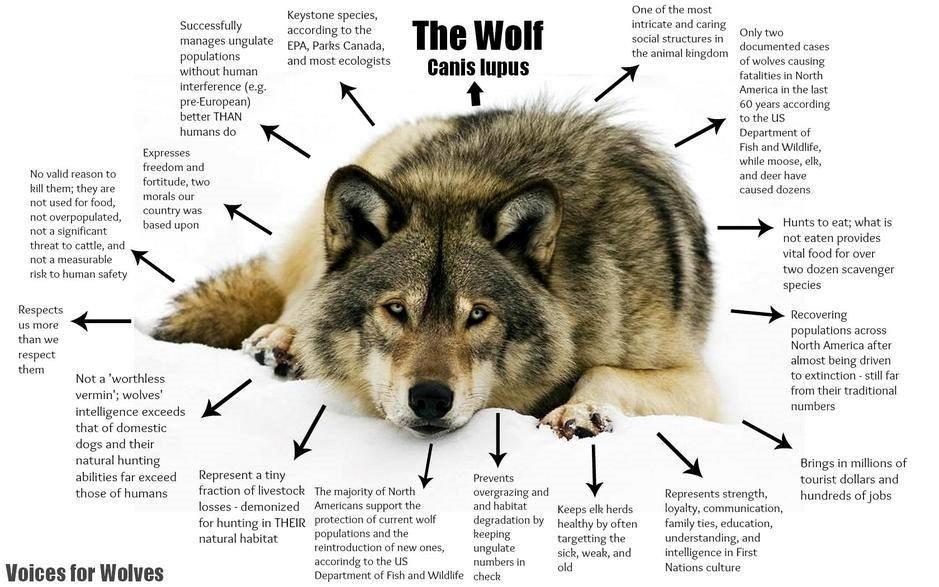
Answer: Wolves. The wolf got their gene for black fur (found nearly exclusively in North American wolves) from dogs brought over with the earliest people to inhabit this continent.

3) What animal can detect odors up to 5 miles away; can hear both low and high frequency sounds beyond human capabilities and has 360 degree panoramic vision?
Answer: Cows. They also form friendships and are devoted mothers and will walk upwards of five miles in search of their calves.

4) A few centuries ago, this animals’ droppings were considered the best available fertilizer and therefore were protected by armed guards?
Answer: Pigeons

5) Which marine animal can live up to 100 years, uses complicated signals to establish social relationships, and sometimes travels hand in hand, the old leading the young?
Answer: Lobsters

6) When this animal gets injured or sick, his or her mate, and sometimes a comrade or two, will stay by their side until they are able to recover or pass on.
Answer: Canada goose

7) Which animal has the ability to learn the precise details of an area of over 1000 acres?
Answer: The turkey

8) Which dog breed was an American favorite in the early 20th century, featured as a child’s best friend and constant companion on TV and in movies, and can now be found in hospitals and nursing homes as a registered therapy animal?
Answer: The Pit Bull Terrier

9) What creature has some so paranoid that they’ve had protective enclosures—modeled after shark cages—built at school bus stops?
Answer: The Mexican Wolf in Catron County, New Mexico

10) Which animal species secretly communicates with one another through their flatulence?
Answer: Herring. Many species of fish have devised creative forms of communication and recent research has shown fish have a more complex nervous system than was previously accepted.

Bonus Question) While so many others dwindle, which group of animals has been steadily on the increase over  the years, now surpassing 150 billion?
Answer: Those consumed by humans each year.

turkey-factory-farming

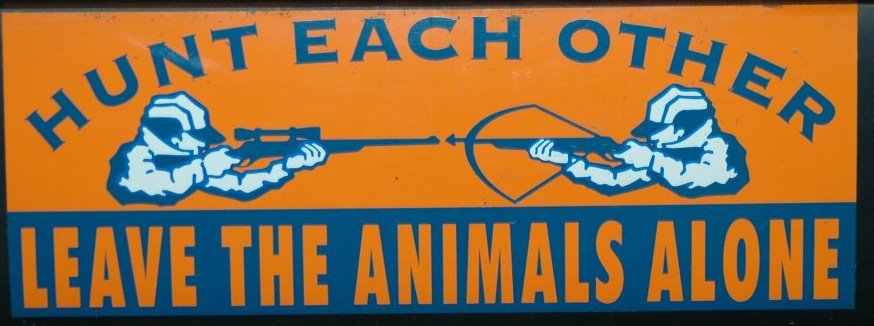
Hunt the Hunters Hunting Licenses

Satire, by Jim Robertson (with a nod to the late Cleveland Amory, author of Mankind?: Our Incredible War on Wildlife and founder of the Hunt the Hunters300807_10150348639491188_858580348_n Hunt Club):
In a comment on one of the many tragic hunting accidents I’ve blogged about lately, a gentle reader mentioned there should be a hunt the hunters hunting season, to which another compassionate soul replied, “I’d contribute to that.”

We’ve all heard (ad nauseam) hunters boast that their license fees pay for wildlife programs, implying that it entitles them to kill the subjects of their alleged generosity—of course hunters don’t contribute out of the kindness of their hearts or their profound love for living animals. This got me to thinking we need a non-hunter license and tag system that emulates hunter tags, to finally put to rest this notion that hunters alone pay for wildlife through their consumptive use licenses. There have been some good ideas out there about this; people have floated the notion of a non-hunters duck stamp, for instance, but those have yet to really take off.

Perhaps it’s because non-hunters wouldn’t get anything tangible for their money. Sure, they could bring back a photo or wonderful memories of the amazing wildlife they saw at a quiet slice of heaven preserved for the wild non-human species of the Earth. But how does that really compare to the kind of meaty trophy a hunter takes home with him? (Sorry, or her; I keep forgetting that women are now being lured into the blood sport.) Hunters can pet and fondle the bodies of their dead victims, and even ingest certain parts they don’t plan to mount on the wall.

The only way a non-hunter can have such a tactile experience is if they can actually bring their “harvests” home with them. Granted, a human carcass doesn’t have the popular appeal of say, a mounted deer, elk, moose, goose, sheep or bear, but to the one who made that good, clean kill shot, it’s a symbol of their prowess and their mighty-yet-selfless effort to thin the hunter herd.

Fortunately, state game departments have given us a model to go by. State residents’ licenses would be kept at an affordable price, while out of state hunter hunters would have to contribute more to the coffers. Logically, someone would have to be hired to insure there were plenty of hunters out there to harvest; and who better for that job than the experienced wildlife “managers.” After all, they’ve been doing their darnedest to recruit more hunters for years now.

Tags for different breeds of hunters could emulate hunting tags for specific non-human animal species. (For those unsure of which sub-species of hunter they’re aiming at, watch for the post, “A Field Guide to North American Hunters” coming soon.) Obviously a tag for the average Elmer would cost less than a tag for a globe-trotting trophy hunter.

Since they’re among the most sadistic, and are the least likely to lay down their weapons and make peace with the animals willingly, out-of-state hunting licenses to hunt wolf hunters will hereby be reduced from $250 to $50. And wolf hunter tags for residents will be similarly underpriced at around $15, since the goal is ultimately to eliminate that breed altogether.

574922_10150775941916188_960382052_n

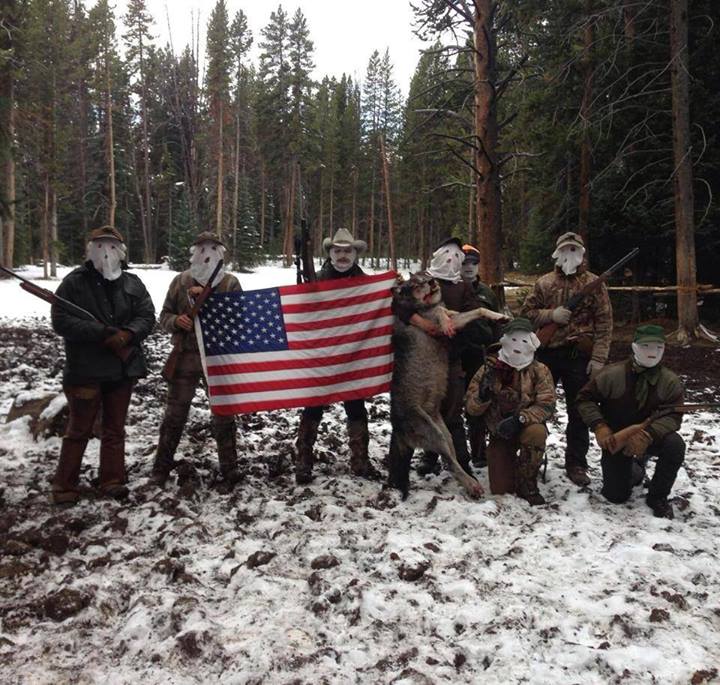
“Sportsmen” Against Wolves: “Wyoming is fed up”

(Or did they mean to say, “overfed”?) Who do these people remind you of? (Hint: 3 letters, starting with K and ending with K.) Look at them hiding behind their Halloween masks. Sorry kids, we’re all out of candy; time to grow up. Note to wolf lovers: before you put a bead on the next childish bully wearing a white sheet over his face, you might want to wait until after the children’s holiday promoting that kind of thing is over. https://www.facebook.com/photo.php?fbid=564330240283396

1384140_564330240283396_857016214_n

‘Wolf’ shot by Lolo resident was a dog hybrid

Wolf-dog hybrid shot

2013-10-24 missoulian.com

3 hours ago  •  By Rob Chaney

LOLO – What appeared to be a white wolf threatening a Lolo resident’s horses on Sunday was really something else.

“It turned out to be a wolf-dog hybrid,” Montana Fish, Wildlife and Parks wolf biologist Liz Bradley said on Wednesday. “It looked very wolfy, but it was neutered.”

The landowner shot and killed the dog after seeing it eyeing his horses Sunday morning. Bradley said she also got reports from a resident in Florence of a similar animal chasing her house cat up a tree.

“It’s a concern if somebody is releasing hybrids in the area,” she said. “Sometimes they can be more troublesome than wolves. They come a lot closer to people and can be dangerous.”

Bradley said she hadn’t had any other wolf incidents reported near homes in the Missoula or Bitterroot valleys this fall.

However, hunters have killed 12 wolves in FWP Region 2 since the 2013 season started on Sept. 15. The kills have been in the Bitterroot, lower Clark Fork River drainage and in the Blackfoot River drainage.

Statewide, hunters have taken 36 wolves this season. That number should grow rapidly when general big-game season opens Saturday.

In past seasons, most wolves have been shot by deer and elk hunters who encounter them by chance. Wolf hunting in Montana requires a $19, over-the-counter license.

FWP updates wolf hunting results online daily at fwp.mt.gov/hunting/planahunt/huntingGuides/wolf.

_________________

[I don’t normally peruse the comments section in newspaper articles like this (my stomach is queasy enough already lately). This kind of comment is the reason why]:

onetwopunch – 4 hours ago As a hunter and an anti wolf advocate [hmm, he comes right out and admits it] I am pleased to see that even the hybrids are being shot here. I don’t own a ranch but my elk [what makes them “his” elk?] are suffering and it makes it really hard for us hunters to sell out of state hunters Montana elk when the dang wolfs [by “wolfs,” I assume he means “wolves”] are eating them up!! outfitting is one of the most important industries in Montana and we don’t need stupid wolfs killing off our children and our elk. Get with it Missoula and join us in eradicating these vermin! At $2000.00 per elf [by “elf;” I assume he meant “elk”;)] we cannot afford to lose any to predators.