Some People Simply Like to Kill Other Animals

In the title of an October 2nd post to his blog column in Psychology Today, University of Colorado evolutionary biology professor Marc Bekoff, PhD, asked, “Do Some People Simply Like to Kill Other Animals?”

The answer seems to me a foregone conclusion.

Bekoff writes, “Many know that Mark Zuckerberg, founder of Facebook, made a pledge in May 2011 only to eat meat he hunted so that he could be ‘thankful for the food I have to eat.’ Of course, it’s not obvious that he has to eat other animals… Surely, in the arena of who, not what, winds up in our mouth, Mr. Zuckerberg and others are not my moral compass. It’s always good to remember that a significant percentage of the food we eat was once sentient beings who cared deeply about what happened to them and to their friends and family. They should be referred to as “who” not “that” or “what.” So, when someone wants to talk about a meal it’s a matter of who’s for dinner, not what’s for dinner.”

His post included the subheading, “‘Ethical hunting’ raises numerous difficult and sticky issues,” about which Bekoff states, “I see no reason to kill other animals for a meal that isn’t needed. Every time I read an essay about “ethical hunting” it makes me reflect on a number of different and challenging issues. One that comes up time and time again is that maybe some people simply like to kill other animals and then offer a wide variety of excuses about their lust for blood (consider also the unrelenting war on wildlife including the wanton killing of wolves, the man who used a trapped wolf for target practice…)”

Sea Shepherd’s Captain Paul Watson backs up the assertion that some people enjoy killing other animals, “Behind all the chit-chat of conservation and tradition is the plain simple fact that trophy hunters like to kill living things.”

But no one makes the case as clearly as hunters themselves. One anonymous thrill-killer recently posted the following shocking admission to an animal advocacy site: “What i like to do as a hunter is go in the woods and kill everything possible and let my dogs chew on it. I once shot a deer and it layed in the creek and i had to shoot it again in the head while it was crying and it kicked me lol when i stuck my knife in its belly so my brother cut its throat it was soo funny. Me and my uncle was guttin one he told me to hold its head and when i did he pushed on its belly and made it bahh at me and scared the crap out of me haha. Hunting is awesome like when you see a herd of deer and just start firing right in the middle and then go and see how many different blood trails there are.”

Prairie dog hunting is a popular “sport” that can in no way be defended as “ethical” or necessary for subsistence (people don’t eat them). Private ranches offer “sportsmen” the chance to kill prairie dogs to their heart’s content—for a fee. The following is an ad for a typical prairie dog hunting excursion: “We approach the edge of a prairie dog town and set up and shoot for an hour or two or until the prairie dogs start getting scarce, then we pull up and drive over the hill and continue prairie dog hunting…after you get tired of the carnage, it‘s also fun to try shots over 1000 yards.”

Note that the ad uses the word “fun,” laying to rest any doubt that they enjoy the killing. So, why shouldn’t people be allowed to have their fun? Beyond the obvious answer that their animal victims are not enjoying this “sporting” behavior, society at large should discourage this kind of conduct for public safety reasons.

Keith Hunter Jesperson’s history of aggression toward animals began when he was only six. An avid hunter and part-time serial killer, Jesperson got his first taste of killing living beings by bashing in the heads of gophers. He discovered that he enjoyed it. Later, while living with his parents in a mobile home park in Washington State, he started killing larger animals. He would beat stray dogs and cats to death with a shovel, strangle them with his bare hands, or shoot them with his BB gun. His proud father bragged to others about how Keith had gotten rid of the stray cats and dogs in the trailer park.

“All this did is spawn in me the urge to kill again,” Jesperson told an interviewer. “I began to think of what it would be like to kill a human being. The thought stayed with me for years, until one night it happened. I killed a woman by beating her almost to death and finished her off by strangulation,” he said.

Keith Jesperson is by no means the first hunter to go on to become a serial killer of humans. As long as we enshrine hunting in books, magazines, cable TV shows and acts of Congress, there will always be people wanting to expand their species hit list to include our own.

Text and Wildlife Photography ©Jim Robertson

Ignorance is Such Selfish Bliss

Practically every day I receive ignorant comments from hunters which reinforce my theory that—despite their overweening attitude—their understanding of the science of biology is inherently lacking. Just yesterday I trash-canned a comment from a defensive sportsman who obliviously declared, “You might be related to primates, but I’m not,” before going on to accuse me of being ignorant!

Another well-worn classic hunter excuse I hear on a weekly basis—one that must be a contender for the top ten feeblest rationalizations for hunting of all time—is some variation of the ridiculous notion that, “Our sharp teeth are proof that we’re meant to be carnivores.” I could go on all day refuting this absurd figment, but I don’t want to bore the educated reader with something so off-base. (If you happen to be one of those who consider that statement an accepted truth, please take some time to look it up and learn a little about physical anthropology and humankind’s ancestry.)

The history of how Homo sapiens became the species we are today harkens back a bit farther than 10,000 years (as young-Earth creationists believe) or even 100,000 years, as those who tout the caveman diet might suppose. Every species here today has an extensive backstory. As you may well know, we all started out as sea creatures at one time (long before the first biped sharpened the first stone for butchering carrion).

During the reign of the dinosaurs, all of us mammals were rodent-sized creatures who scurried about and tried to stay out from under foot. After the extinction spasm that ended the dinosaur’s days, mammals had a chance to flourish and diversify. Some went through more radical changes than others.

Whales were once wolf-like mammals that returned to the sea between 60 and 37 million years ago, in the early Eocene epoch, eventually becoming the largest animal ever to grace the oceans or the Earth. In terms of physical changes, our species’ story is nowhere near as dramatic as that of the whales. But as far as our impact on all other life forms, it’s a doozy.

No other species of animal has come from such humble beginnings as a tree shrew, progressed through the monkey-types and on to forest-dwelling apes, only to climb down out of the acacia and kill off the largest, mightiest or most numerous of species. But rather than weighing on our species’ collective conscience, it’s gone to our collective head, in the form of an over-inflated ego that is a key trait of the genus Homo. No other species can claim responsibility for changing the Earth’s climate to the detriment of all life or—Homo sapiens’ crowning achievement—causing a planet-wide mass extinction event.

As blissful as it must be to have our collective head in the clouds, when it comes to human origins, it’s critical that we come down to Earth once in a while and keep ourselves informed of reality, lest ignorance facilitate our own demise.

Text and Wildlife Photography ©Jim Robertson

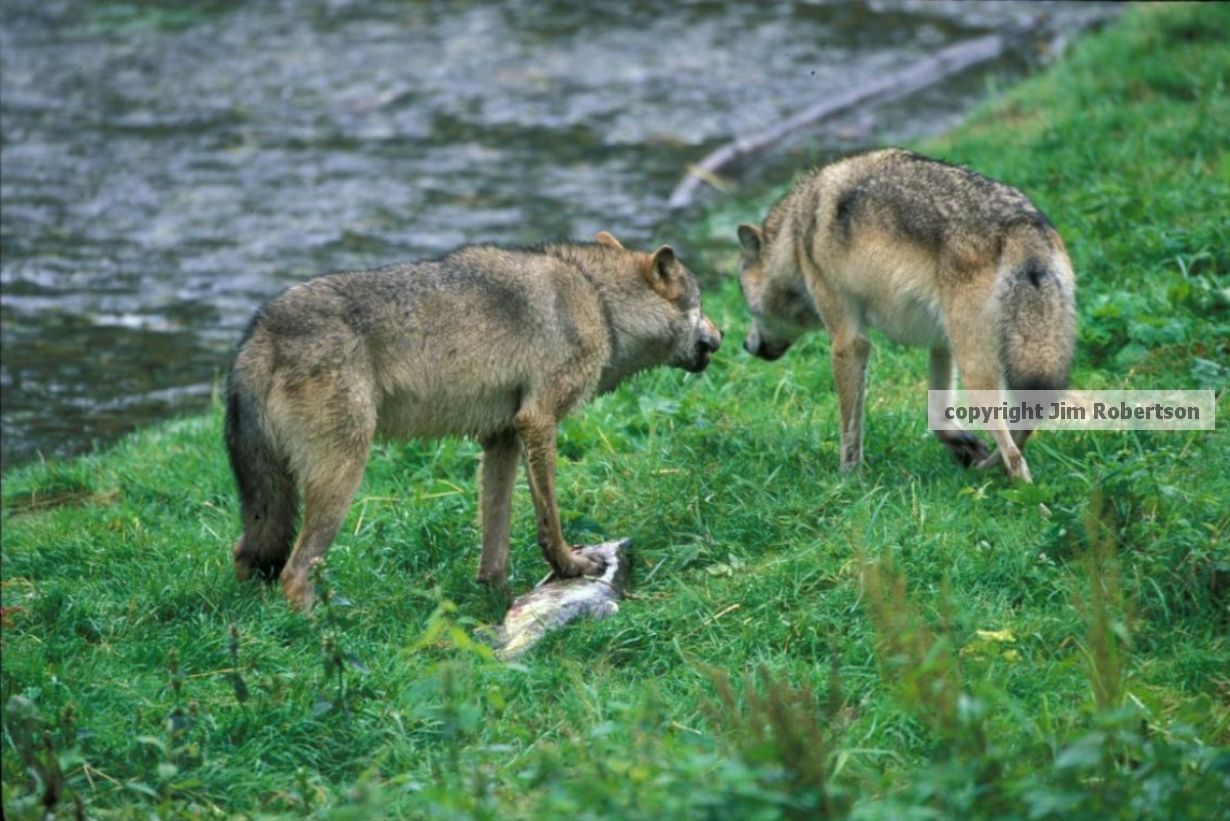
The Wolf was Better off Endangered

Paradoxical as it may seem, wolves were better off endangered.  Not as a species perhaps, but to the individual wolf stuck for days in a steel-jawed leg-hold trap, or to the pack forced to dodge a hail of gunfire from cammo-clad snipers and a volley of arrows from a phalanx of archers, it must feel like the misguided war on wolves has begun anew.

Now that they have been declared “recovered” here, wolves are again under threat of the trap and rifle just as they were during the environmentally reckless Nineteenth Century.

By 1872, the year President Grant created Yellowstone National Park (in part to protect “game” species like elk from wanton destruction by overeager hunters), 100,000 wolves were being annihilated annually. 5450 were killed in 1884 in Montana alone, after a wolf bounty was initiated there. Wyoming enacted their bounty in 1875 and in 1913 set a penalty of $300 for freeing a wolf from a trap.

Though the federal Endangered Species Act safeguarded wolves from overzealous state hunting and trapping laws, as the director of the USFWS pointed out, the ESA is “not an animal protection act.”

The right of an American species not to be hunted to extinction is a relatively new advancement. At present, it‘s about the only right extended to the nonhumans in this, the land of the free. Alas, the river of speciesism still runs deeper than the Potomac at spring breakup.

Founding father and second US president, John Adams, may, or may not, have believed that all men were created equal, but he clearly took a dim view of the wildlife native to our formerly pristine land. In 1756 he openly expressed his scorn for the world his ancestors had strived to transform: “Then, the whole continent was one continued dismal wilderness, the haunt of wolves and bears and more savage men…Then our rivers flowed through gloomy deserts and offensive swamps.“

Unfortunately for any animal not blessed enough to be born human, our unalienable rights to life and liberty were specific initially only to white males, next, to all males and then to all human animals regardless of gender or sexual orientation but as yet do not extend to the nonhuman animals with whom we share this planet.

Our lawmakers have had a sad history of turning a blind eye to the most basic rights of those who differ from us primarily in that all four of their limbs are used for walking and they don‘t wax the hair off their backs. This seems a little biased when you consider that in terms of social skills, devotion to family and intellect relevant to survival animals, like wolves, are every bit our equals.

Why is this happening? So that “sportsmen” can claim all the “game” species for themselves. The return to full-scale wolf hunting gives today‘s anti-wolf bigots their chance to drive this misunderstood embodiment of wilderness back to the brink of oblivion.

____________________________________________

Portions of this post were excerpted from the book, Exposing the Big Game: Living Targets of a Dying Sport

Text and Wildlife Photography ©Jim Robertson

Montana Wolf Trappers Will Cause Pain and Suffering

A wolf is a highly intelligent and social sentient being. The amount of torture that trapped wolves are subjected to is immeasurable. Yet, despite massive public input in defense of wolves, the Montana state Fish, Wildlife and Parks Department (FWP) just added them to their long list of species that can be “lawfully” targeted by trappers. Ignoring record-breaking outcry, the FWP Commissioners have approved their wildlife agency’s extreme “bag limit” of two wolves tortured to death per trapper, in addition to the ones they’re already allowed to hunt. What this means is that each individual “sportsman” can legally kill THREE wolves – two by trapping and one by shooting.

Anyone who has seen the harrowing ordeal suffered by an animal caught in a leg-hold trap would be appalled and outraged that trapping is still legal in states like Montana. But trappers have no qualms about the cruelty they inflict. Just ask the vice president of the Montana Trappers Association:

“We trappers do cause pain and suffering to animals and apologize to no one.” Guys like this must have an over-inflated sense of entitlement to publically blurt out something this shallow, narcissistic and utterly absent of regret.

Not to suggest they’re psychopaths or anything, but grandiosity and the lack of remorse, guilt or empathy are all key traits of psychopathy…

If society were ever to practice pre-emptive incarceration based on a given person’s potential to do harm to others, trappers would be the first to go.

For more info on the approved wolf hunting/trapping proposal, see: http://helenair.com/news/local/govt-and-politics/fwp-allows-trapping-of-wolves/article_fd2d21f2-ccb1-11e1-a3ce-001a4bcf887a.html

If you’re not happy about this, MONTANA’S GOVERNOR BRIAN SCHWEITZER would love to hear about it. He can be reached at: 406-444-3111 – or via Email:  governor@mt.gov

Photos Copyright Jim Robertson