Exposing the Big Game

Forget Hunters' Feeble Rationalizations and Trust Your Gut Feelings: Making Sport of Killing Is Not Healthy Human Behavior

Exposing the Big Game

Hunters and severe winters — not wolves — key to Wisconsin’s deer numbers

http://www.jsonline.com/story/sports/columnists/paul-smith/2017/08/23/smith-hunters-and-severe-winters-not-wolves-key-wisconsins-deer-numbers/591607001/

, Milwaukee Journal Sentine lPublished 5:57 p.m. CT Aug. 23, 2017

When it comes to gray wolves and white-tailed deer, there are enough deep-seated beliefs to fill the Dells of the Wisconsin River.

Some of them, like many of the acts in the nearby town, are based more on fiction than fact.—

Here’s one: The wolves are killing all the deer in northern Wisconsin.

It’s not a new refrain, but it’s one I continue to hear from some of my hunting colleagues each year.

Now in late summer 2017, as bucks begin to lose their velvet and wolf pups start to venture out more with adults, conditions are ripe to discuss trends in both species.

In a word, both are “up.”

There are 480,273 deer in the 18-county northern forest management zone, according to the 2017 pre-hunt population estimate from the Department of Natural Resources.

The 2017 number represents an 18% year-over-year increase.

The population of wolves, as you may know, is at an all-time high in Wisconsin. The DNR in June reported a record high of at least 925 wolves, most of which are in northern Wisconsin.

The latest wolf report represents a 6% increase from 2015-’16 and a 24% rise from 2014-’15.

So the two iconic wildlife species have been increasing in number across Wisconsin’s Northwoods.

Why? And how can it be? If wolves are at an all-time high – and if they “eat all the deer” – shouldn’t the deer herd at least be falling?

A look at the data and management related to each species can be illuminating.

The wolf population has increased largely due to a December 2014 federal judge’s decision that placed the western Great Lakes population under protections of the Endangered Species Act. The ruling has prevented state officials from holding public hunting and trapping seasons or using other lethal means to manage the species.

Deer have been increasing partly due to protection, too. For the last several years, the number of antlerless deer permits has been significantly reduced in northern units. Some counties have allowed zero.

With more female deer allowed to live and reproduce, the population assumed an upward trajectory.

Mother Nature is the other primary factor allowing deer herd growth in the north. The last three years have been marked by “soft” winters, including the fourth (2015-’16) and sixth (2016-’17) mildest on record since 1960, according to the DNR’s Winter Severity Index.

In contrast, two very rough winters took a toll on the deer herd in 2011-’12 and 2012-’13. The 2011-’12 winter was the third most severe on record; the following year was especially tough on deer since winter conditions lasted into May.

The milder winters have been reflected in recent years in higher fawn-doe ratios and a higher proportion of yearling bucks with forked antlers, according to DNR big game ecologist Kevin Wallenfang.

Another factor – habitat – likely has improved marginally in northern Wisconsin in recent years due to some changes in forestry practices. But it’s harder to quantify and likely takes longer to show its effects on the deer herd.

I find the status of both species particularly interesting now, as wolf numbers have climbed to a record high.

Wolves obviously eat deer. According to most experts, an adult wolf will consume the equivalent of 20 adult-sized deer annually.

But when compared to other sources of deer mortality in Wisconsin, wolves rank down the list.

I ran the numbers and trends past David Mech, senior research scientist with the U.S. Geological Survey in St. Paul, Minn. Mech has studied wolves for 59 years and is considered an expert on the species and its effect on plant and animal communities.

“Under these current Wisconsin regulations and conditions, wolves are apparently not a competitor, or aren’t really having that much of an impact (on deer),” Mech said.

The leading causes of deer mortality in the state, as Wisconsin wildlife managers have long said, are human hunters and severe winters.

A 2009 DNR document ranked the deer kill in Wisconsin’s northern and central forest regions this way: 122,000 deer killed by hunters (bow and gun), about 50,000 due to winter stress (the range could vary widely), 33,000 to black bears, 16,000 to coyotes, 13,000 to motor vehicles, 13,000 to wolves and 6,000 to bobcats.

The trends over the last few years in northern Wisconsin are clear.

When I was in Bayfield and Sawyer counties in May for the Governors Fishing Opener, I counted 72 deer on an evening drive from Cable to Hayward.

The conditions reminded me of the plethora of deer I used to see in the area in the mid to late 1990s.

Wolves are up in number. Deer are too.

Humans and Mother Nature have far more control over deer populations than wolves ever will.

I’m hoping my hunting buddies read this. But as always, I’ll be happy to tell them in person.

Pass it along to your friends, too.

As we move forward with management plans on both species, it’s important to bring as many facts to the debate as possible.

Oregon’s responsibility for wolves: Letter to the editor

The Oregon Department of Fish and Wildlife has gone astray and Gov. Kate Brown needs to pay attention. When the private property of livestock on our public lands takes precedence over Oregon’s wildlife, the agency has lost sight of its mission: “To protect and enhance Oregon’s fish and wildlife and their habitats for the use and enjoyment by present and future generations.”

Oregon’s young people expect the agency overseeing wolves on our public lands to be protecting them, not killing them. Some of the Harl Butte wolves are being killed on our public lands. This is a travesty. A travesty because the lives of a few of Oregon’s 1.3 million cows are more highly valued than the lives of our small native wolf population. Our public lands are not the sole property of ranchers. They belong to our wildlife and to all Oregonians.

The decision to kill these wolves is also a travesty because it is based on an outdated wolf plan lacking emphasis on non-lethal methods or conservation. The plan was to be reviewed and revised in 2015. It still has not been completed. In 2015, ODFW chose instead to decrease protection by delisting our wolves as a state endangered species.

Gov. Brown needs to hold the fish and wildlife department accountable for its tactics and insist it gets back on track with its mission. No new killings should be allowed under these outdated rules.

Joanie Beldin, North Portland

Wolf That Bit Thurston County Boy Relocated to Sanctuary

    • By Amelia Dickson / The Olympian
    • Jun 20, 2017


 A female wolf that bit off part of a 3-year-old Thurston County boy’s arm in April has been relocated to an out-of-state wildlife sanctuary, along with her pups and her Alaskan malamute mate.

The puppies were born in Thurston County Animal Services’ custody after the adult animals were seized following the attack, said Animal Services Director Ric Torgerson.

“Typically, in a lot of these situations, they end up euthanized,” Torgerson said. “It’s hard to find homes for them. They were lucky in this case.”

Torgerson said tests confirm that the female is 100 percent wolf, and the male is a malamute. That makes the puppies a wolf-dog hybrid.

“In this state, wolf hybrids are considered to be dogs, but they behave differently than dogs in many situations,” Torgerson said.

It’s not legal in Washington to privately own or breed wolves.

But the animals’ former owner, Rick Miracle, said the female, named Cheyenne, isn’t a full-blooded wolf. He calls her a “high-content wolf-dog,” and said that her wolf content is so high that the dog portion wouldn’t register on a test. He said that Cheyenne isn’t mean, she’s just extremely food-motivated.

“She’s not aggressive in a mean way,” Miracle said. “She just liked food.”

He believes that the boy was trying to feed Cheyenne a piece of pizza when he was attacked.

The malamute is named Ed, he said.

A Thurston County Sheriff’s Office report says deputies responded to Miracle’s home, located on the 7000 block of Meridian Road Southeast, at about 3:15 p.m. April 3. Multiple people had called 911 and reported that an animal had bitten off part of a child’s arm.

The boy was flown to Harborview Medical Center and survived his injuries. Information about the boy is limited because he is a minor. However, the Sheriff’s Office report requested that Child Protective Services be contacted regarding the incident.

“Entering the property, I could see that there was a large wooden cage with metal wiring just outside of the main entrance of the property, inside the fenced area,” wrote Deputy Evan Cofer in his report. “Inside the cage were two wolf/malamute breed dogs. At the entrance to the cage was a large amount of blood where one of the two animals has bitten (the child’s) lower right arm off. There was a blood trail from the cage leading into the house.”

Miracle told deputies he had been renting a room to the boy and his mother, a 31-year-old Thurston County woman. The woman reported that she was in her bedroom at the time of the attack, and she thought one of the other tenants was watching the child. The other tenant had been in her own bedroom, according to the report.

No adults witnessed the attack.

Miracle told deputies that he warned both the child and his mother to stay away from the cage, according to court documents.

Ed and Cheyenne, who was pregnant at the time of the attack, spent all of their time in a large enclosure on Miracle’s property. Their former owner said it wasn’t because they posed a risk to humans.

“It’s not that I think my dogs are dangerous,” Miracle said. “It’s that they’re animals. An animal is unpredictable no matter what.”

However, Miracle said he has a German shepherd that is allowed to roam his property.

Ed and Cheyenne aren’t the first of Miracle’s animals to end up at a sanctuary. Angel, Zoe and Lakota reside at Wolf Haven International, located near Tenino. State law allows wolves to reside at sanctuaries like Wolf Haven.

Wolf Haven’s website describes Lakota as a “male gray wolf who was privately owned in Washington state. After he escaped from his backyard enclosure and ran through a nearby town, Lakota was nearly euthanized.”

A blog post penned by Wolf Haven’s Communications Director Kim Young and Sanctuary Director Wendy Spencer explained that both Angel and Zoe were rescued from “deplorable conditions” earlier this year.

The post alleges that Angel was purchased by a local wolf-dog breeder, and that he decided to “get rid of her” after she went six years without producing offspring. Zoe was the runt of an unrelated half-wolf litter and was housed with her mother. The two animals fought for dominance, the post says.

Miracle said the animals were his, and he always took good care of them. He said he gave Angel, Zoe and Lakota to Wolf Haven “because they really wanted them.”

But why breed wolf-dogs? Miracle said he had one as a boy, and it was a wonderful animal. When he moved from Georgia to Washington state several years ago, breeding wolf-dogs seemed like the right fit.

“When I think of the Northwest, I think of living free and John Denver,” Miracle said. “My intention was never to be the guy who stuck out like a sore thumb and got all this attention.”

Wolves get comfortable with Mount Spokane

http://www.union-bulletin.com/things_to_do/diversions/wolves-get-comfortable-with-mount-spokane/article_25847b82-52a9-11e7-8a21-affedc2e06e8.html

  • Rich Landers Spokesman-Review
  • Jun 18, 2017

SPOKANE — For the second consecutive year, a Spokane man’s motion-activated trail camera has captured an image of what appears to be a gray wolf in Mount Spokane State Park. Wolves are protected by state rules as endangered species in Washington.

The photo gives more credence to sightings of wolves and wolf tracks that cross-country skiers have been reporting with more frequency for several years.

However, Washington wolf biologists have not confirmed the sightings as anything more than wolves passing through.

The most recent image was captured at 11:58 a.m. on March 30 by a trail cam. Hank Seipp said he just retrieved the images this week because he doesn’t ski and had to wait until mountain snow had melted. The camera was set up just outside of the downhill ski area, he said.

Seipp, who put out a trail cam that photographed a darker wolf last summer near the Nordic skiing trails, also snapped recent photos of tracks in the mud and scats that also appear to be from a wolf.

“We have not been able to confirm any pack activity at Mount Spokane despite the fact that we have been running cameras in that area for a couple of years now,” said Trent Roussin, Washington Department of Fish and Wildlife wolf biologist.

“We do occasionally get a photo of a disperser traveling through, but have yet to document multiple individuals traveling together or consistent use of the area, both of which are indicators of any potential pack activity.”

“A radio-collared wolf that came through Mount Spokane a few years ago was from the Diamond Pack in Pend Oreille County,” said Madonna Luers, department spokeswoman.

Roussin said the department is interested in any information the public can offer about wolf activity that might lead to confirmation of a new pack.

Gray wolves were reintroduced to the Northern Rockies with releases in Yellowstone and central Idaho in 1995 and 1996. However, wolves already were moving in on their own from Canada, most notably into Glacier National Park.

The wolves recolonizing Washington stem from wolves dispersing for more than a decade from Idaho, Montana, Oregon and Canada.

The wolves are thriving, agency officials say, expanding on their population from a few scattered sightings approximately 13 years ago to 19 confirmed packs in Washington at the end of 2016.

Wolves are protected by federal endangered species protections in the western two-thirds of Washington. Wolves in the eastern third of Washington, as well as in Idaho and Montana, have been federally declassified.

However, wolves are protected statewide by Washington’s endangered species rules and managed by a citizen-drafted wolf management plan that establishes guidelines for their recovery and eventual declassification.

Once a threshold of packs is achieved in regions across the state, wolves would be open to more management options, much as they are in Idaho, including the possibility of limited hunting.

The bulk of Washington’s wolf packs currently are in the northeastern corner of the state.

Steve Christensen, Mount Spokane State Park manager, reacted to last year’s wolf photo by looking at the positive side: “Now there’s one more reason for people to keep their dogs on leash while in the park.”

Confirmation of wolves in the Mount Spokane area serves as another warning for people living outside the park to be more proactive and protective of their pets and domestic animals, state wildlife managers say. Information can be found on the Washington Department of Fish and Wildlife website.

“We have not had any confirmed wolf depredations around Mount Spokane, and really haven’t gotten many, if any, reports of any problems caused by wolves,” Roussin said.

“I think it is safe to say that wolves from both Washington and Idaho could occasionally be roaming in Mount Spokane State Park. We know that dispersers can disperse at any time of the year, and could really be anywhere.”

Oregon’s wolf management plan may come to resemble Idaho’s

http://www.capitalpress.com/Oregon/20170531/oregons-wolf-management-plan-may-come-to-resemble-idahos

Idaho has seven times as many wolves and allows hunting and trapping in addition to “lethal control” for livestock and ungulate losses.
Eric MortensonCapital Press

Published on May 31, 2017 12:19PM

Last changed on May 31, 2017 9:00PM

Two adult wolves from the Walla Walla Pack were caught on remote trail camera Jan. 16, 2016 in northern Umatilla County. The Oregon Department of Fish and Wildlife Commission is considering changes to the state’s wolf management plan.

COURTESY OREGON DEPARTMENT OF FISH AND GAME

Two adult wolves from the Walla Walla Pack were caught on remote trail camera Jan. 16, 2016 in northern Umatilla County. The Oregon Department of Fish and Wildlife Commission is considering changes to the state’s wolf management plan.

The Oregon Department of Fish and Wildlife Commission heard from dozens of people with diametrically opposed views when it took its wolf plan review on the road to hearings in Klamath Falls and Portland this spring. When the commission sits down with ODFW staff June 8 in Salem, members will sift those viewpoints with their own to determine how the state will manage a top predator that wasn’t here when the plan was first adopted a dozen years ago. Adoption of a five-year plan is expected late this year.

Potential changes are on the distant horizon. Ultimately, the state will decide whether wolves are hunted like cougars and bears, whether USDA’s APHIS Wildlife Services — loathed by conservation groups — will investigate livestock attacks, whether to give livestock producers more leeway to kill wolves, whether to set population caps, and more.

A glimpse of where Oregon’s wolf management may be headed in years to come might be found in Idaho, which was the source of the first wolves to enter Oregon and has much more experience balancing the presence of an apex predator with the interests and economic well-being of hunters and livestock producers.

Idaho has an estimated 800 wolves — probably more — and has actively managed them since federal officials took wolves off the endangered species list statewide in 2011.

Compared to Oregon, which documented 112 wolves at the end of 2016, Idaho’s numbers are staggering.

In 2015, hunters and trappers legally killed 256 wolves in Idaho, the same number as in 2014. Another 75 wolves were “lethally controlled.” Of those, 54 were killed in response to livestock depredations or by producers protecting herds. Another 21 wolves were taken out to protect deer and elk populations in Northern Idaho.

In all, Idaho documented 358 wolf deaths in 2015; two fewer than in 2014. Figures for 2016 were not available.

According to Idaho Fish and Game, the number of sheep and cattle killed by wolves has been “stable to declining” since the state began allowing hunting in 2009. In 2015, wolves killed 44 cattle, 134 sheep, three dogs and a horse.

Fish and Game Director Virgil Moore has described Idaho’s wolf population as healthy and sustainable.

Department spokesman Mike Keckler said the state has proven it can manage wolves in balance with livestock and prey species.

“There’s no doubt state management of wolves has been a success in Idaho,” Keckler said. “We remove wolves when they cause problems, we’re not afraid to do that. We move quickly when problems occur.”

The thought of Oregon adopting such an attitude doesn’t sit well with conservation groups.

“This is not Idaho,” Cascadia Wildlands legal director Nick Cady said pointedly during ODFW’s May 19 hearing in Portland.

Cascadia Wildlands and Oregon Wild warn the state shouldn’t loosen its wolf management rules. Rob Klavins, Oregon Wild’s field coordinator in Northeast Oregon, said Oregon’s adherence to its adopted plan was one of the reasons there wasn’t more of an outcry when the department shot four members of the Imnaha Pack in 2016.

During the Klamath Falls and Portland ODFW hearings, representatives from the Oregon Cattlemen’s Association, Oregon Hunters Association and Oregon Farm Bureau urged changes.

Among other things, producers say ODFW staff is spread too thin and sometimes can’t respond quickly to wolf attacks. They favor allowing Wildlife Services to investigate livestock attacks as well, and make the call on whether wolves were responsible. They oppose a draft plan proposal to change the lethal control standard to three confirmed depredations or one confirmed and four “probable” attacks within a 12 month period. The current standard is two confirmed depredations or one confirmed and three attempted attacks, with no time period set.

Todd Nash, a Wallowa County commissioner and the Cattlemen’s Association wolf chair, said a neighbor has eight cows. If wolves kill three in one night, he asked during the Portland hearing, does the producer have to endure two more attacks before lethal control is taken?

The groups also believe ODFW should continue collaring wolves, and should set a population cap for wolves in Oregon.

ODFW Director Curt Melcher said the commission heard good points from all sides.

“Even though folks don’t agree, they all got along just fine,” he said. “It was a respectful process. The other remarkable thing is that nobody is saying there shouldn’t be any wolves in Oregon. That wasn’t the case not too long ago. Everybody recognizes we’re going to have wolves in Oregon and we’re going to have to manage them.”

The draft plan allows killing wolves for chronic depredation of livestock and in localized cases where they’re depleting deer and elk populations. Eventually, Melcher said Oregon might reach a point in the future where hunting becomes a part of wolf population management, as it is with other game animals. He said the original plan drafters also anticipated wolf management, including lethal control, becoming more routine. It is logical for Wildlife Services to help on depredation investigations he said. As wolves increase in number and geographical range, investigations become a workload management issue for ODFW, he said.

“I think we’ve done a good job so far,” he said. “We’ve navigated through potentially difficult waters and in large part have done it efficiently.”

Study: To Mitigate Problem Predators, Give Wolves More Space, Tolerance

http://klcc.org/post/study-mitigate-problem-predators-give-wolves-more-space-tolerance

MAY 23, 2017

Wolves mostly make the news when they are in conflict with livestock and that’s part of the reason they were once removed from the Western landscape. But a new study shows wolves play an important role, whether we like it or not.

It’s not just wolves that prey on livestock.

“Worldwide, smaller meso-predators like coyotes, jackals and such, actually themselves prey pretty heavily on livestock and can cause a lot of economic damage,” Aaron Wirsing of the University of Washington said.

Wirsing co-authored a new study in the journal Nature Communications. He said current land management policies don’t offer apex predators enough space, but that doesn’t mean he wants to see wolves roaming rampant across North America.

“We need to allow predators to occupy more landscapes than just remote, protected areas,” Wirsing said. “On the other hand, we also need to heavily manage them, recognizing that they do conflict with people.”

That conflict made headlines last summer, when members of the Profanity Peak wolf pack killed four calves in Northeastern Washington. In response, Washington’s Department of Fish decided to shoot members of that pack from a helicopter.

“Historically, our model has been almost a postage stamp model where we protect certain areas and try to maintain intact assemblages of animals,” Wirsing said. “But we have a problem of scale.”

So, for example, areas protected for wildlife and public use might seem large from a human perspective, but what humans ay not consider is wolves can range up to 1,000 miles.

And it’s not only in the forest. Wirsing said wolves also roam the sage brush landscape in the central Northwest.

The study made use of bounty hunting data to show ecosystems function similarly in both Europe and Australia as well.

Copyright 2017 NWNews. To see more, visit NWNews.

Wolf-like golden jackal discovered in northern Germany

http://www.dw.com/en/wolf-like-golden-jackal-discovered-in-northern-germany/a-38977624

Golden jackals, similar to small grey wolves, have been making their way across Europe into new territory. A German farmer is claiming compensation after the protected, wolf-like predator killed a sheep.

Canis aureus (picture-alliance/dpa/Nationalpark Bayerischer Wald/LfU)A golden jackal was photographed by a camera trap in Bavaria in 2012

For the first time, golden jackals have been detected in the northern German state of Schleswig-Holstein, which borders Denmark, authorities announced this week. The animals are originally native to the Balkans, but have slowly spread to areas they never previously settled, such as northern Italy, eastern Austria and Hungary.

After three sheep were attacked by an animal in the region of Dithmarschen on the North Sea coast this month, authorities first suspected a wolf. A DNA sample, however, revealed the culprit to be a golden jackal (Canis aureus), the state ministry for the environment announced.

The predators are smaller and more slender than gray wolves and normally weigh 8 to 10 kilograms (17 to 22 pounds), while especially large specimens can reach 15 kilograms, according to the ministry. They are protected by German federal regulations.

One of the sheep died following the incident, meaning the farmer can claim compensation. Authorities pay farmers damages when wolves, which are also protected in Germany, kill their livestock.

Spreading north

Despite the name, golden jackals are believed to be more closely related to gray wolves and coyotes than to the black-backed and side-striped jackal species native to Africa.

Portrait of a golden jackal in Rajasthan, India (picture-alliance/blickwinkel/W. Layer)Golden jackals have been spreading through Europe to regions where they never previously lived

Individual specimens have been sporadically detected in Switzerland and Germany over the past few years, the ministry said. In the summer of 2000, evidence of their presence was first discovered in a southern part of Brandenburg state. Specimens popped up in Bavaria in 2012, in Hessen in 2013 and in Mecklenburg-Vorpommern and Lower Saxony in 2016, gradually moving north.

Europe’s northernmost population of golden jackals is in Denmark. The ministry said it could not accurately determine if the latest findings were evidence of Danish jackals colonizing Schleswig-Holstein.

The animals usually live in pairs and occupy fixed territories of about 3 square kilometers (1 square mile).

They tend to feed on insects, rodents, birds and amphibians but can also eat smaller mammals such as hares and rabbits, rare deer, and their offspring.

This week in southern Germany a golden jackal was struck on the highway near Freising, which is close to Munich airport.

Yellowstone wolf family tree and genealogy available online

BILLINGS, Mont. (AP) — Her parents may have been killed by her mate and his family. Her daughter was shot. Now she’s dead and her killing is under investigation.

Although the details may sound like the story line for a soap opera, a Shakespearean play or even the historical dirty deeds of Europe’s competing monarchies, it’s actually the tale of one of Yellowstone National Park’s well-known wolves — the white alpha female of the Canyon pack. Now, details of the park’s individual wolves and their inter-relatedness can be found in one place: online at Ancestry.com, a website formerly reserved for rooting out human family trees.

“People love their wolves,” said Jim Halfpenny, the founder of the Yellowstone Wolf Genealogy Family Tree.

That’s a sentiment Yellowstone officials have recognized, as well.

“I am amazed at the interest level in Yellowstone wolves,” said biologist Doug Smith, who leads the Yellowstone Wolf Project. “It’s insatiable.”

He noted that questionnaires distributed by the park in the early 2000s revealed that about 300,000 come to Yellowstone hoping to see wolves. Park interpreters annually talk to anywhere from 30,000 to 50,000 people a year about wolves.

It’s easy to see why there’s such an interest, Smith told The Billings Gazette.

“If you come to Yellowstone and put in a few days, you can see a wolf — and that’s pretty remarkable.”

The popularity of his genealogy charts became apparent to Halfpenny, a Gardiner-based biologist, after he started recording the lineage of Yellowstone’s wolves when they were first reintroduced to the park in 1995 and 1996.

“Through the years I’ve produced these laminated charts, selling about 4,000 a year,” he said. Now folks can order them online.

He updates the data yearly, using information gathered from multiple sources, including the Yellowstone Wolf Project. That’s no small task considering there can be more than 100 wolves scattered across the park’s 2.2 million acres (890,308 hectares) each year. At their population peak there were more than 170 wolves inside Yellowstone.

“We started out trying to do it by volunteers, and it was too overwhelming,” Halfpenny said.

So using a Kickstarter project to fund development — 273 people contributed more than $26,000 — Halfpenny was able to “put online the lives, pedigrees and genealogy of the Yellowstone wolves for access of all fans,” according to the website. The digital information is “enormous in scope and the first of its kind in the world.”

Those interested can go to www.wolfgenes.info to learn more about the project. Perusing Ancestry.com requires the payment of a membership fee. The information is also now available on a cellphone app allowing wolf devotees to carry the data with them into the field.

Smith said he hadn’t been able to check out the website yet but noted that building family trees and genealogy for wolves that have never been captured and had their DNA tested — such as the white alpha female from the Canyon pack — means some of the data isn’t scientifically valid. Each year about 40 percent of Yellowstone’s wolves are captured and have DNA samples taken.

“For scientific purposes, this probably is not the place to go,” Smith said. “For avid wolf watchers this is great. And he’s probably right most of the time.”

But the park has to be more conservative in its approach to linking individuals, he added.

Halfpenny admitted that observations by even hardcore wolf watchers are sometimes incorrect. For example, a wolf spotted in 2007 was believed to be a female. When found dead it turned out the wolf was a male.

Although the stories of known wolves are presented on the website, Halfpenny said it is the “interconnections that are just amazing” to him.

Take the earlier mentioned alpha female of the Canyon pack as an example. She was found seriously injured inside the park near Gardiner on April 11.

Park officials euthanized the white wolf because her injuries were so severe.

A necropsy later revealed she had been shot. Two $5,000 rewards, one from the National Park Service and another from a private group, have been offered for information leading to the arrest and conviction of the wolf’s killer.

Even before her tragic death, the 12-year-old wolf had led a life worthy of an epic poem. Two years after being born into the Hayden pack her parents were killed by the rival Mollie’s pack. This is known as intraspecific mortality, when wolves kill wolves, and accounts for about 42 percent of all wolf deaths in Yellowstone — more than any other single factor.

The white female is believed to have later bred with an unknown black wolf from Mollie’s pack — the same wolves that had killed her parents.

For some reason the white alpha female’s first pairing didn’t last, and she found a new mate, who also was a member of the Mollie’s pack — 712M. Together with another Mollie’s male in 2008 they formed the Canyon pack in the center of the park.

It took two years for the Canyon pack to successfully raise a litter of three pups past a year old. One would later become the white alpha female of the Wapiti Lake pack who would eventually displace her own parents from their Canyon pack homeland.

In 2011 the Canyon pack produced two more pups, one of which was a female that seemed especially enamored with her father, earning her the nickname Daddy’s Girl. At age 2 this female wolf was shot by a rancher north of Gardiner.

“In 2016 this amazing alpha pair produced two more pups in their new denning area at the advanced ages of 11 and 10 (the Canyon Alpha Female was the older of the two),” according to the Yellowstone Wolf Genealogy site. “2016 also represented another milestone: the Canyon Alpha Female and 712M had been together as an alpha pair for eight years, making them the longest mated pair on record for Yellowstone wolves.” The female is believed to have given birth to at least 13 pups over the course of her life.

There’s rarely a happy ending in a wolf’s short life, though. Rejected by her own pack this past winter, the alpha female was seen roaming the Gardiner area alone, sometimes feeding on roadkill. Her mate, “712M was last seen in January 2017 just east of Mammoth Hot Springs. He would be 11 years old in April 2017,” the website noted.

The oldest known wolf in Yellowstone, 478F, lived to age 12.5. The average lifespan for park wolves is two to three years.

“I’m fascinated with it, following the family lines,” Halfpenny said.

The intrigues include female wolves mating with their fathers, grandfathers and even brothers.

“There are all sorts of complexities to this,” he said.

For each wolf recorded on the website there is a life story to be read, as well as facts and a photo gallery if shots are available. Adapting such complex family relations to a website was a challenge since the Ancestry.com formula was set up for humans who give birth to about one offspring a year, not 4.4 a year, which is the average litter size for Yellowstone wolves.

“So we had to work around problems like that,” Halfpenny said.

He compared the information to tracking the Smith family tree for all of North America.

‘White Lady’ wolf shot dead prompts Yellowstone reward

http://www.bbc.com/news/world-us-canada-39930372

  • 15 May 2017
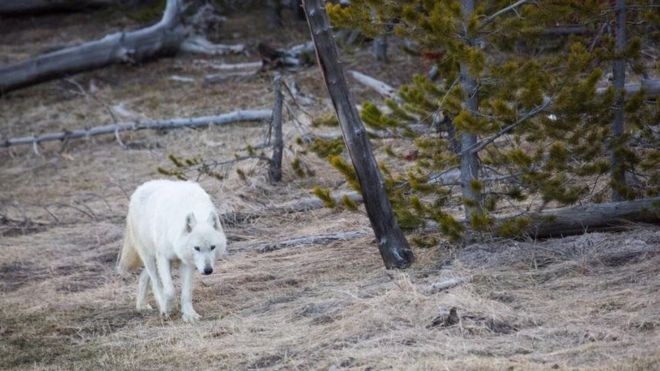
  • White LadyImage copyrightYELLOWSTONE NATIONAL PARK
Image captionThe so-called White Lady was a hit with tourists

A $5,000 (£3,900) reward has been put up for information on how a rare white wolf at Yellowstone National Park was shot dead.

The female was one of three white wolves in the park and had 14 living pups, wildlife officials say.

The reward comes after initial results of a necropsy show the so-called White Lady was shot around 10 April.

“She was one of the most recognisable wolves and sought after by visitors to view and photograph,” the park said.

“Due to the serious nature of this incident, a reward of up to $5,000 is offered for information leading to the arrest and conviction of the individual(s) responsible for this criminal act,” said Yellowstone National Park Superintendent Dan Wenk.

At 12 years old, she had lived for more than twice the average lifespan of a wolf in Yellowstone, officials say.

The Canyon Pack Alpha, as she was known to wildlife researchers (and as The White Lady to tourists), was found by hikers on 11 April.

Wildlife officials were not able to save its life, and the wolf was put down.

Her remains were brought to a US Fish & Wildlife Service Forensics Laboratory in Oregon for a necropsy, where officials determined that it had been mortally wounded by a hunter’s rifle.

As of 2014, researchers had documented at least 104 wolves in 11 packs located within the park.

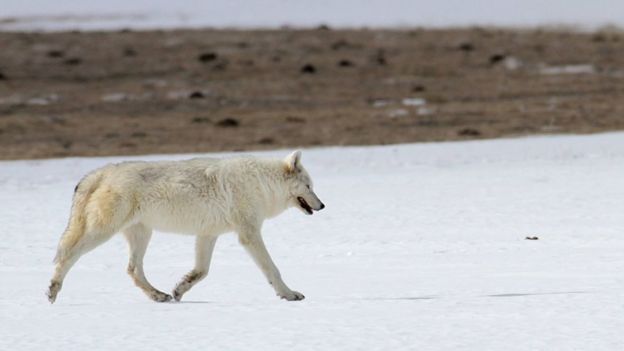
White wolfImage copyrightYELLOWSTONE/ FACEBOOK
Image captionShe had birthed 20 cubs, 14 of which lived past the age of one

The wolves were reintroduced in Yellowstone in 1995, having been eradicated by hunters.

Advocates of wolves say the presence of predators helps balance the ecosystem, and leads to healthier populations of other wild animals.

Opponents say they are a threat to humans, pets and livestock.


Read more

Media captionHere’s how the bison have been reintroduced into the wild

Wolves can be shot on sight in most of Wyoming after state takes over management

Wyoming assumed management once again of wolves within its borders on Tuesday, and those apex predators wandering outside the northwest corner of the state can be shot on sight.

The Circuit Court of Appeals in Washington, D.C., entered its final order in favor of Wyoming in a lawsuit that landed wolves back on the endangered species list in 2014. The court announced in early March that it had upheld the state’s plan but had not issued its final order.

Tuesday’s decision is what Wyoming wolf managers hope is the last legal battle in a roller-coaster legal process.

“All indications are that this decision shows once again that Wyoming’s plan is a sound management plan,” said Brian Nesvik, chief of the Wyoming Game and Fish Department’s wildlife division. “They will remain in the hands of state management. For Wyoming this is, again, this is a time for us to celebrate. This is a good thing for Wyoming to be able to take on another wildlife resource.”

No changes were made to Wyoming’s wolf management plan from when the state oversaw the carnivores between 2012 and 2014, Nesvik said.

That means Wyoming will manage the 100 wolves and 10 breeding pairs outside of Yellowstone National Park and the Wind River Reservation.

Wolves in 85 percent of the state are considered a predator and can be shot on sight, similar to coyotes. They are classified as a trophy animal in the northwest corner of the state and subject to fall hunting seasons. Those seasons have not yet been set, Nesvik said, adding that wolves in those areas cannot be hunted right now. The Wyoming Game and Fish Commission will set those seasons after a public comment period.

A coalition of environmental groups sued Wyoming in 2012 over the state’s management plan. A representative for the group said in early March the coalition was disappointed with the D.C. court’s ruling, said Tim Preso, an attorney for Earthjustice, a nonprofit law firm representing Defenders of Wildlife and several other environmental groups who filed suit against the state.

Earthjustice’s lawyers argued, essentially, that Wyoming’s plan to maintain a buffer of more wolves than the required amount was not legally binding and insufficient under the Endangered Species Act. The court ruled that Wyoming’s plan was adequate, and environmental groups did not appeal the decision.

Preliminary estimates showed Wyoming had about 240 wolves at the end of 2016, Tyler Abbott, Wyoming field supervisor for the U.S. Fish and Wildlife Service, told the Star-Tribune in March.

The feds killed about 115 wolves in 2016 because of livestock depredations, he said. In 2015, the service killed about 54 wolves.

Because of the high number of wolves killed by the Fish and Wildlife Service, Nesvik estimates hunting season quotas this fall will be similar to those before wolves went back on the list.

In 2012, 42 wolves were killed by hunters in the state’s trophy area and 25 were killed in the rest of the state. The next year, 24 wolves were shot in the trophy area and 39 taken in the rest of the state.

Gov. Matt Mead expressed his satisfaction with the court’s decision in a news release sent Tuesday evening.

“I am delighted that the Circuit Court recognized Wyoming’s commitment to manage a recovered wolf population,” Mead said. “Our wolf management plan is a result of years of hard work by people across Wyoming. We recognize the need to maintain a healthy wolf population.”

Wolves were reintroduced into Yellowstone in 1995. They have been off the endangered species list in Montana and Idaho since 2011.