Killing of wolf pack leads to death threats

http://www.therepublic.com/2016/08/31/wa-wolves-killing-4/

SEATTLE — The killing of a pack of wolves in northeastern Washington to protect cattle is producing death threats for people on both sides of the emotional issue, The Seattle Times (http://bit.ly/2ceSsb9) reported Wednesday.

Researcher Rob Wielgus of Washington State University this week declined further comment on the pending elimination of the Profanity Peak pack by hunters for the Washington Department of Fish and Wildlife, citing the death threats.

“My friends in WDFW have received death threats . It’s gone tooooo far,” Wielgus wrote in an email to the newspaper.

Last week, state Rep. Joel Kretz, R-Wauconda, told the newspaper that cattle producers also were receiving death threats in the wake of the controversy.

Wielgus said last week the conflict with wolves was inevitable because one of the ranchers involved had turned out his cattle on top of a known wolf den. Wielgus was challenged on that claim Monday afternoon by Conservation Northwest, a nonprofit environmental group, which said it heard the cattle were turned out five miles away from the den and that the den was not in use.

Asked to respond Monday, Wielgus wrote: “I can’t understand this . of course the den was in use and I have many photos of cattle on den. What gives?”

In a later email, he wrote that Donny Martorello, the state’s wolf-policy lead, told him the cattle were turned out five miles away and moved to the den site later.

Officials for Washington State University on Wednesday issued a statement disavowing Wielgus’ original comments regarding the wolf den.

“Some of Dr. Wielgus’ statements in regard to this controversial issue have been both inaccurate and inappropriate,” Washington State University said in the press release.

“As such, they have contributed substantially to the growing anger and confusion about this significant wildlife management issue,” the Pullman-based school said. “The statements do not in any way represent the views or position of Washington State University or the WSU College of Agricultural, Human, and Natural Resources Sciences. These statements are disavowed by our institutions.”

Wielgus is an associate professor and director of the Large Carnivore Conservation Lab at WSU.

Martorello did not return phone calls, and neither did the rancher, who grazes cattle on public land in the Colville National Forest.

That rancher and another producer with cattle near the Profanity Peak pack had been taking steps recommended by the department to avoid conflict with wolves, Martorello has said, from deploying range riders to picking up carcasses to avoid attracting wolves, and turning out calves when they were bigger and more mature. He praised the ranchers’ cooperation.

Jack Field, vice president of the Washington Cattlemen’s Association, said Tuesday he sees steady progress in acceptance among ranchers in working with the department and using nonlethal methods to avoid conflict with wolves.

Many producers, he noted, are successfully operating in what is once again wolf country, after the carnivores’ more than century-long absence.

Wolves were exterminated in Washington in the early 1900s — in part by ranchers to keep them away from sheep and cattle. Wolves began recolonizing the state in 2008, when the first packs were confirmed in Washington, from populations in Idaho and British Columbia.

There were about 90 wolves in the state as of early 2016, most of them documented in packs in northeastern Washington.

Since mid-July, WDFW has confirmed that wolves from the Profanity Peak pack have killed or injured six cattle and probably five others. The state’s policy authorizes “lethal removal” after confirming that wolves have preyed on livestock at least four times in one calendar year, or six times in two consecutive years.

Department staff had killed six of the 11 members of the Profanity Peak wolf pack as of last Friday. Remaining were two radio-collared adults, used by the department to track the wolves, and several pups.


Information from: The Seattle Times, http://www.seattletimes.com

Wolf Supporters to Rally in Olympia to Protest Killing of Profanity Peak Pack


http://www.biologicaldiversity.org/news/press_releases/2016/wolf-08-30-2016.html

Media Advisory, August 31, 2016


OLYMPIA, Wash.— Wildlife supporters, including several conservation groups, will rally Thursday at noon in Olympia to mourn the loss of Washington’s Profanity Peak pack and to call on the Washington Department of Fish and Wildlife to stop killing the public’s wolves on public lands to benefit the private ranching industry.

The agency has already killed at least six of the pack’s 11 members and aims to eradicate the entire pack, including five 4-month-old pups. The wolves are being targeted for conflicts with livestock on federal public lands after a rancher moved his cattle into an area known to be a den and rendezvous site for the pack.

What: Members of the public, including members of multiple conservation organizations representing thousands of Washington residents, will rally at Washington Department of Fish and Wildlife headquarters to mourn the loss of the Profanity Peak wolf family and to send a clear message that state residents want the agency to protect Washington’s endangered wolves, not kill them on public lands to benefit irresponsible ranchers.

When: Noon to 2 p.m., Thursday, Sept. 1.

Where: The sidewalk and parking lot in front of the main entrance to the headquarters building of the Washington Department of Fish and Wildlife, at 1111 Washington Street, SE, Olympia, WA 98501.

Visuals: Attendees will hoist posters and banners with messages in support of protecting wolves from irresponsible ranchers; images of killed wolves will be displayed on the ground. Speakers will include Amaroq Weiss, West Coast wolf organizer at the Center for Biological Diversity; Brooks Fahy, executive director for Predator Defense; Paul Ruprecht, staff attorney for Western Watersheds Project; and several citizen-activists.

The Center for Biological Diversity is a national, nonprofit conservation organization with more than 1.1 million members and online activists dedicated to the protection of endangered species and wild places.

Predator Defense is a national nonprofit advocacy organization working to protect native predators and end America’s war on wildlife. Our efforts take us into the field, onto America’s public lands, to Congress, and into courtrooms.

Northwest Animal Rights Network is a Pacific Northwest based animal rights organization which advocates for the rights inherent to all sentient beings to live a full life, to be free, and to not be used and exploited.

The mission of Western Watersheds Project is to protect and restore western watersheds and wildlife through education, public policy initiatives and legal advocacy.

WildLands Defense: Working to inspire and empower the preservation of wildlands and wildlife in the West.

Trigger pulled on Profanity Peak pack

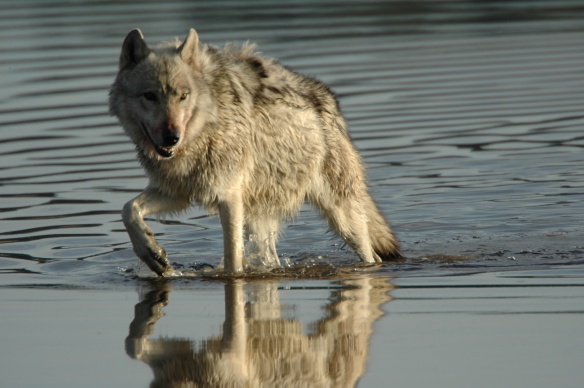
copyrighted wolf in water

After multiple livestock were killed in northeastern Washington’s Stevens County, state agency says it will eliminate the pack

  • By Josh Babcock, The Moscow-Pullman Daily News. Daily News
  • 8-30-2016

There were about 90 endangered gray wolves in Washington state earlier this summer, but that number is set to decline by 11 after cattle belonging to a rancher in northeastern Washington were recently killed near the den of the Profanity Peak wolf pack in the Colville National Forest.

To resolve the issue the Washington State Department of Fish and Wildlife is taking to the air to kill the pack of 11. As of last week at least six wolves in the pack had been shot and killed from a helicopter, according to advisories from the WDFW.


The incident is the second involving the Stevens County rancher, Len McIrvin, who several years ago also suffered livestock losses from the Wedge wolf pack, which was eventually killed by the state as well. “The facts are this is the second wolf pack he is having eradicated,” said Robert Wielgus, director of the Large Carnivore Conservation Lab at Washington State University. Wielgus said the livestock losses and the killing of one of the state’s 19 recognized wolf packs could have been avoided. He said while many ranchers opt to sign a cooperative damage prevention agreement to work with state wolf researchers, McIrvin chose not to, despite being approached by Wielgus to do so on multiple occasions. Wielgus said those agreements help provide ranchers with information on the location on wolves and their dens so they can better protect their cattle from predation. He said ranchers who have decided to work with him haven’t lost livestock to wolves. Wielgus said when cattle began to graze near the den the wolves’ native prey of deer were pushed away, and the wolves began to prey on the most populous food source around – McIrvin’s cattle.


Some say the rancher relocated his cattle near the den on purpose, as a way to have the endangered species wiped out from his family’s longtime grazing ranges. As per state law, ranchers who lose livestock to wolves also receive financial reimbursement. “It’s literally a war on wildlife and it’s a situation that could have been easily avoided,” said Brooks Fahy, executive director for the national wildlife advocacy organization Predator Defense. “The rancher was looking for a showdown – he got what he wanted. These animals were dumped knowingly right on top of the core of (wolf) territory. It’d be like someone coming into your home and dropping a bunch of aliens off in your home.”


Others disagree. “There could be a wolf den in the pasture, but the idea the producer willingly drove their cattle on it, I don’t know anyone that would drive their cattle into harms way,” said Jack Field, Washington Cattlemen’s Association executive vice president. “It’s very frustrating to think that that is getting a lot of play.” Field said it’s important to realize the pastures are very large and feature steep terrain, both of which can make it difficult to identify a wolf den. “It’s almost a crime,” he said. “It takes all the context out. I can tell you it’s tough country, steep terrain, a lot of brush. My only concern is we’re not giving a fair shake to what that landscape really looks like.”


While Field noted the family has been having the animals graze in the same ranges on national forest land for many decades, Fahy said it’s the wolves that are in their natural habitat. “Nonnative cows are displacing elk, deer, ruining streams – they are wreaking havoc. They are large non-native exotic herbivores,” Fahy said. “He doesn’t own this land – the American public owns this land.”

Fahy said he doesn’t know what the rancher pays to graze in the national forest, but he estimated it’s far lower than the roughly $80,000 it cost taxpayers to kill the Wedge wolf pack a few years back.


Donny Martorello, the Washington State Department of Fish and Wildlife wolf-policy lead, could not be reached Monday despite multiple phone calls from the Daily News. McIrvin also could not be reached.

Horse Killed For Wolf Bait in Denali

Old news, but still “legal”:

https://www.psychologytoday.com/blog/animal-emotions/201205/horse-killed-and-legally-used-bait-and-kill-wolves

Following up on the good news about the release of two dolphins into the wild, I learned this morning about a most heinous and perverse situation in Alaska. Healy, Alaska trapper Coke Wallace “apparently walked a horse out to an area off the Stampede Trail near the boundary of Denali National Park – an area made famous by the 1996 book Into the Wild – shot the horse, and set snares all around the area hoping to catch wolves attracted to the carcass. Wolves from Denali National Park were drawn to the dead horse, resulting in the killing of a primary reproductive female wolf from the Grant Creek (also called Toklat West) pack from the park, along with at least one other wolf. It is unknown how long the two wolves were alive in the snares before being killed and collected by the trapper. The Grant Creek wolf pack has been one of the three packs most often viewed in Denali National Park.”

All of this happened in a former buffer area where wolves were protected from 2002-2010 when the Alaska Board of Game eliminated the protected area. The loss of these wolves puts the fate of this long-lived and long-studied pack in jeopardy. Observations began on this pack back in the 1930s. Of course, the loss of any wolves due to killing another animal to use as bait is reprehensible, legal or not.

This kind of hearltess slaughter must not be tolerated and it’s important to call attention to it and to protest it loudly and clearly. While “the incident does not violate state law, the Alaska Department of Environmental Conservation (ADEC) is looking at potential violations of state water quality regulations, which prohibit discarding carcasses in surface waters of the state.”


copyrighted-wolf-argument-settled

Hunters protesting protections for Denali wolves

http://www.bendbulletin.com/outdoors/4583092-151/hunters-protesting-protections-for-denali-wolves

By Sam Friedman / Fairbanks Daily News-Miner /

Published Aug 17, 2016 at 12:02AM

Tired of having their concerns not addressed by Alaska’s Board of Game, opponents of wolf hunting near Denali National Park sought the attention of Gov. Bill Walker recently with a protest in downtown Fairbanks.

About two dozen people assembled at noon outside the 7th Avenue state offices building. They held signs and periodically howled likes wolves, drawing puzzled looks from people headed into the building.

Their signs addressed Walker directly with words like “Gov. step up” and “Bill, it’s time to act.” One used Walker’s Tlingit name of Gooch Waak, which means “wolf eyes.”

The protesters want Walker to order an emergency closure for the wolf hunting season near Denali National Park. The season opened last week.

A Walker spokeswoman said that she hadn’t had a chance to ask the governor for a response to the protest, but that Walker planned to meet with one of the protesters during his visit to Fairbanks and the Tanana Valley State Fair.

Gray wolves roam abundantly through much of Alaska but in recent years have become much less common inside Denali National Park — one of the main places visitors come to Alaska to see them.

The protesters argue that to protect Denali’s natural ecosystem and reputation as a place to spot wolves, wolf hunting should be stopped along the Stampede Trail corridor, a peninsula of state-managed land that juts into the park northwest of Healy.

The state instituted a buffer zone in 2000 to prevent wolf hunting close to the park boundary, but the Alaska Board of Game repealed it in 2010.

Fairbanks-based organization Alaskans For Wildlife organized last week’s demonstration. The group has about 40 members around Alaska, according to its president, Jim Kowalsky, who has a long history in environmental advocacy as a founder of the Northern Alaska Environmental Center.

The group held the protest because the seven-member Board of Game has repeatedly voted down their requests for an emergency reintroduction of the wolf buffer zone. Department of Fish and Game Commissioner Sam Cotten has also rejected their demands for emergency wolf-hunting closures, with the exception of the spring 2015 season, which Cotten closed two weeks early.

Despite limited movement so far from the Walker administration, Kowalsky was somewhat optimistic that the demonstration would change policy.

The killing of wolves in a particularly famous wolf pack has given the buffer zone campaign fresh attention.

The East Fork Pack, also known as the Toklat Pack, has been the subject of National Park Service studies since the 1930s. The pack dropped from 14 wolves in March 2015 to perhaps zero in July 2016, according to the Park Service’s official narrative of the pack history. The agency attributes the loss of wolves to factors such as trapping, hunting, an animal attack — possibly from a golden eagle — and wolf dispersal to other areas. The Park Service study observed that the loss of the long-researched pack is “unfortunate” but that it doesn’t mean the loss of the pack’s lineage, which lives on in the descendants of East Fork pack that formed or joined other packs.

copyrighted wolf in water

Park Service ended a study of Alaska wolves, since so many have been killed

Wildlife Photography ©Jim Robertson

Wildlife Photography ©Jim Robertson

https://www.hcn.org/articles/national-park-service-ends-study-on-alaska-wolves-because-adfg-killed-too-many

The state culled wolves that had been collared, and it’s no longer feasible to continue research.

For more than two decades, the National Park Service monitored the wolf packs in Alaska’s Yukon-Charley Rivers National Preserve. Now, so many of the predators have been killed by the state’s Department of Fish and Game that the feds have had to drop the program. It’s no longer feasible to conduct research, according to information recently published by the watchdog nonprofit, Public Employees for Environmental Responsibility (PEER).

The state has been shooting the wolves when they wander outside the boundaries of the federal preserve, to try to increase populations of moose and caribou for human hunters. According to Greg Dudgeon, superintendent of the preserve, since 2005, 90 wolves with ranges in Yukon-Charley have been killed, including 13 radio-collared animals that were essential to the park’s study. Each of the preserve’s nine wolf packs has lost members, and three packs have been entirely eliminated, while another five have been reduced to a single wolf each. The last population count by the National Park Service in 2011 came up with 77 wolves. Since that count, the Park Service wound down its study, officially ending it in 2014.

Jeff Rasic, chief of resources for Yukon-Charley Rivers and Gates of the Arctic National Park, says that federal budget constrictions played a factor in ending the study, but so did the number of collared wolves killed by ADFG and the fact that the state stopped giving the Park Service permits for collaring wolves on state land. “The state was pretty successful in killing wolves,” Rasic adds.

Public Employees for Environmental Responsibility published a letter on August 8, 2016 about the impacts the state’s predator killings had on the feds’ wolf study, bringing these issues back into the public eye.

“The expense of collaring and monitoring wolves for research is not sustainable when ADFG culls the same animals when located outside of the Preserve,” Dudgeon wrote in the letter to Richard Steiner of PEER, who had asked him what impacts ADFG has on wolf packs.

In additional correspondence that has been made public by PEER, Bruce Dale of ADFG confirmed that from 2011 to 2015, the department killed 179 wolves through its wolf control program. Dale also confirmed that his department uses 28 radio-collared “Judas” wolves to help them locate and kill other wolves.

Last fall, the National Park Service banned several sports hunting practices within federal preserves in an attempt to protect Alaskan predators like wolves and bears. But recent news of how many wolf packs have been eliminated or severely reduced by Alaska Department of Fish and Game across the state call into question if the federal ban went far enough to protect predators.

The 1916 Organic Act requires the National Park Service to manage wildlife for healthy populations of all animals, not just the ones that humans hunt for food. In October 2015, the Park Service made a breakthrough with something they had been asking Alaska Board of Game to do for years — exclude harmful practices within preserves like hunting wolves and coyotes with pups, baiting black and brown bears and using artificial lights to rouse hibernating bears out of their dens. The ban took effect this January.

Alaska’s Board of Game says that it’s required to curb predators by a 1994 food security law that required managing for abundant ungulate populations. By reducing wolves and bears, the board said, those populations would do better, benefiting Alaskans that rely on the herds for sustenance. The ban was eventually approved within the preserves, but the practices are still allowed outside their borders. This includes directly outside Denali National Park, where in 2010 the Board of Game eliminated a 122-square-mile buffer that protected wolves from hunting and trapping.

The park’s famed East Fork wolf pack, which had 17 members in 2014, disappeared in July 2016, according to state biologists. A number of wolves were known to have been hunted and killed, but it’s not clear what happened to the rest. Three days before Dudgeon wrote about the loss of wolves in Yukon-Charley Rivers National Preserve, biologists visited the den. Vegetation had begun to creep back over the entrance, and there were signs that porcupines had taken up residence. No wolves had been there for some time.

Anna V. Smith is an editorial intern at High Country News. She tweets

Shooters reduce Profanity Peak Pack by two wolves, so far

http://www.spokesman.com/blogs/outdoors/2016/aug/11/shooters-reduc-profanity-peak-pack-two-wolves-so-far/

ENDANGERED SPECIES — Two gray wolves in Ferry County have been killed by helicopter gunners after the Profanity Peak Pack was linked to killing livestock, the Washington Department of Fish and Wildlife reports.

Staff has been in the field every day since Aug. 4 after agency Director Jim Unsworth authorized killing a portion of the pack as a last resort after failed attempts to deter the attacks.  More wolves in the pack of about 11 animals are being targeted.

Gray wolves are protected by Washington state endangered species rules but allowances are made for removing wolves that can’t be thwarted from attacking livestock.

Two adult female wolves were shot on Friday, Aug. 5, said Donny Martorello, department wolf program manager.

“One of the wolves was this year’s breeding female,” he said.  “We were not targeting the breeding pair in this pack, but there is no way to identify the breeding animals during a removal operation, so there is always a chance a breeding animal may be killed.

“Given the age of the pups, we know that they are weaned, so the removal of the breeding female is not likely to impact their survival.  Typically, at this time of year, all of the remaining adults will provide food for the pups.”

The agency has not disclosed how many wolves will be killed.

As lethal removal efforts continue, the Diamond M Ranch livestock producers are continuing efforts to prevent wolf attacks on their cattle by using range riders to monitor activity around the herds, Martorello said.

No wolf depredation reports have been received since the lethal removal operation began, he said.

The Fish and Wildlife Department is posting updates on the effort on its Profanity Peak Pack webpage.

This is the third time the state agency has approved lethal removal operations since wolves were confirmed making a comeback in the state more than a decade ago.


Storied Alaska wolf pack beloved for decades has vanished, thanks to hunting

http://www.msn.com/en-us/news/us/storied-alaska-wolf-pack-beloved-for-decades-has-vanished-thanks-to-hunting/ar-BBvqgBq?li=BBmkt5R&ocid=spartandhp

A wolf photographed near the park road in Denali National Park, Alaska. Photo: Tim Rains of the National Park Service.© Provided by WP Company LLC d/b/a The Washington Post A wolf photographed near the park road in Denali National Park, Alaska. Photo: Tim Rains of the National Park Service.

For decades, the wolves of the storied East Fork pack were beloved by researchers and tourists alike at Alaska’s Denali National Park. They frequented the park’s entrance and roads and became the stars of hundreds of thousands of family vacation photos.

Since the 1930s, scientists have documented every detail of the pack’s lives: their hunting ranges, mating rituals, even the content of their droppings. They traced family lineage through dozens of generations, giving individual wolves names like “The Dandy,” “Grandpa” and “Robber Mask.”

Now the researchers must record one final detail in the wolves’ long history: They may all be dead.

The last radio-collared male was found shot dead near a hunting camp in May. Now, park officials can’t find the last three pack members: a uncollared female and her two pups. It’s impossible to know for sure what happened to them, officials said, but it’s unlikely that the mother and her pups will survive without the support and protection of a pack. The family’s den is empty and overgrown with weeds. Porcupines have taken it over since June 28, when the group was last seen.

The wolf pack is the most recent fatality of a controversial Alaska policy that allows hunters to kill wolves and other large predators in the state’s national wildlife refuges, wildlife advocates say. Park officials estimated 49 wolves lived in Denali National Park this spring, only three more than the park’s all-time low of 46 in 1986 and a significant decline from the early 2000s when it was common to count more than 100. In 2015, only 5 percent of Denali visitors reported seeing a wolf — down from 45 percent in 2010.

The East Fork pack’s decline was fast and drastic. In 2013, the nine-member East Fork pack was one of the largest of the nine monitored groups. By the fall of 2014 the pack’s numbers had grown to 17, according to park service data. Then, the numbers steadily drop.

The causes of their deaths vary. Many are shot and killed (legally and illegally) by hunters. One died of blood loss after becoming trapped in a snare. Some become untraceable and others die of natural causes. But one pattern emerges: About 75 percent of deaths in the East Fork pack in the past year were caused by human trapping and hunting, park biologist Bridget Borg told Alaska Public Media.

By May, only the mother wolf and her two cubs remained. Now, they are gone as well.

In a July report that details pack numbers, park officials wrote “it is unfortunate to lose track of this long-tenured and well-followed pack,” though they do note that the pack’s lineage would continue in the members of other packs who have bred with the East Fork wolves. Two other park packs, the Savage Pack and the Headquarters Pack, were previously destroyed by hunting and trapping, according to Wolf Song of Alaska, a non profit dedicated to preserving wolves.

The more than 70 years of continuous study make the East Fork pack one of the longest-observed large mammal families, perhaps only rivaled only by Jane Goodall’s chimpanzees.

Observation of the pack began in 1939 when National Park Service biologist Adolph Murie began tracking the wolves, following them on foot for more than two years — through buggy summers and hair-freezing winters — as they traversed the park’s 3,000 square miles. In 1944, he published a book, “The Wolves of Mount McKinley,” detailing his observations.

Things were better for the wolves then, it seems. Murie wrote “but as yet man’s activities have probably not altered conditions sufficiently to seriously change the (wolves’) natural relationships.”

Original drawings by biologist Adolph Murie of some of the first East Fork wolves from his 1944 book.© Images courtesy of the National Park Service. Original drawings by biologist Adolph Murie of some of the first East Fork wolves from his 1944 book.

But there might be hope for the remaining Denali wolves.

Last week, the U.S. Fish and Wildlife Service banned the hunting of predators in Alaska’s 16 wildlife refuges unless needed “in response to a conservation concern.” The change was a challenge to a continuous push by the Alaska Board of Game to loosen the regulation of predator hunting, which the board calls “intensive predator management.”

Over the past few years, the board has approved a variety of controversial hunting methods, including targeting bears and wolves from planes and shooting wolves and their pups in their dens. In 2010, it eliminated a “buffer zone” that banned wolf hunting just outside of Denali’s borders, near the East Fork’s historic range. The zone was an effort to protect park wolves who wander outside of its boundaries. The last East Fork male was found dead in an area that would have been protected by the buffer.

“There comes a time when the U.S. Fish & Wildlife Service must stand up for the authorities and principles that underpin our work and say ‘no,’” the wildlife service’s director, Dan Ashe, said about the new restrictions in a blog post published by The Huffington Post.

The state government “strongly opposes” the new rules, arguing that it is federal overreach into one of the state’s most lucrative industries and shrinks the moose and caribou populations that Native American groups rely on for food, The Guardian reports. Guided hunting generated a total of $78 million in economic activity and more than 2,210 jobs in 2012, according to a study commissioned by the Alaska Professional Hunters Association.

“These lands are your lands,” he wrote. “They are not game farms managed for a slice of their diversity for the benefit of a few people who would call themselves hunters.”