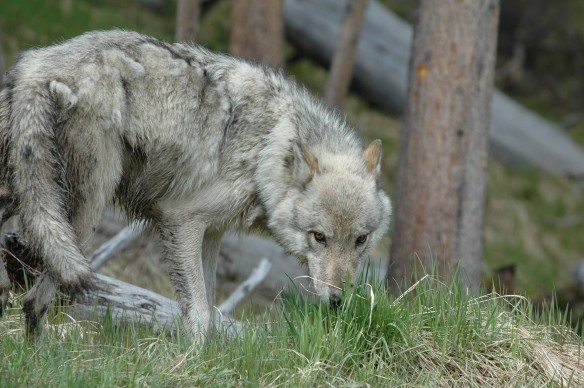
What Motivates a Wolf Killer?

Text and Wildlife Photography ©Jim Robertson, 2014. All Rights Reserved

Text and Wildlife Photography ©Jim Robertson, 2014. All Rights Reserved

Killing a wolf is a crime against nature—and the motive depends on the kind of perpetrator. To a trophy hunter, a dead wolf is something to mount on a wall and brag about. By literally possessing the animal, they can relive their kill over and over, remorselessly boosting their flagging self-esteem every time they vacuously gaze at their victim’s lifeless body. For a fur trapper, a dead wolf is just a hide and a chance to play modern-day frontiersman. Although there’s no real frontier left, they consciously choose to revive a bloody, destructive lifestyle—partly for money, but mostly for a sense of identity.

But to a “wolfer,” the kind of person whose central preoccupation is hiring on to rid an area of each and every last wolf he can, a prime sense of greed is the motivating factor.

Sure, a guy like that, such as the wolfer contracted by the Idaho Department of Fish and Game to snuff out the Golden Creek and Monumental Creek packs in Idaho’s Frank Church Wilderness Area, must get an ego boost from being known as a “professional” wolf killer. He no doubt experiences some kind of perverse thrill every time he finds an animal desperately trying to free him-or-herself from one of his leg crushing traps. And he probably even gets off on hearing that his actions are upsetting a lot of empathetic wolf advocates who desperately want him to stop his atrocities. But the main reason the wolfer does the job he does is greed, pure and simple: a selfish lust for power, control and of course, money.

That may not seem like a lot to accuse him of in a country built on the spoils of selfishness and greed. Yes, he is surely evil incarnate, soulless and sick to the core, but as long as someone is paying him to “get the job done”… And who the hell pressed the state into hiring a hit man to eliminate established packs, tormenting individual wolves and disrupting nature’s time-tested order? Ask the Idaho trophy elk hunting syndicate.*

The wolves in the Frank Church Wilderness area weren’t after anyone’s cows or frightening school kids at bus stops, they were just doing what comes naturally to wolves. Killing off apex predators to make it easier for sport hunters has got to be the height of human arrogance.
________________________________
*syn-di-cate (noun) 5) an association of gangsters that controls an area of organized crime

Seven Wolves Killed In Idaho’s Frank Church Wilderness by Government Hired Trapper

If wolves can’t live in a such a large and inaccessible wilderness area, then where?

http://networkedblogs.com/SEGKp

By Ken Cole On January 8, 2014

Plaintiffs in the case against the wolf killing plan for the Frank Church-River of No Return Wilderness in Idaho have learned that at least 7 wolves have been killed by the Idaho Department of Fish and Game hired trapper as of January 2nd. It is possible that more have been killed but communication with the trapper is conducted only when the trapper calls out using a satellite phone which is kept turned off most of the time.

From the court filing:

Plaintiffs learned from counsel for defendant Virgil Moore that, as of January 2, 2014, IDFG’s hired hunter-trapper had killed seven wolves within the targeted wolf packs, six by trapping and one by hunting, and that more wolves may have been killed as of today. Defendant Moore’s counsel further advised that IDFG’s only means of communication with the hunter-trapper is a satellite telephone in the hunter-trapper’s possession, and that, to preserve the phone’s batteries, the hunter-trapper turns on the phone only when he places a call.

In response, the plaintiffs have filed a second motion for a Temporary Restraining Order (TRO) with an expedited briefing schedule.

acrobat pdfRead Second Motion for TRO

Plaintiffs, represented by Tim Preso of Earthjustice, include Ralph Maughan and three conservation groups—Defenders of Wildlife, Western Watersheds Project, Wilderness Watch, and Center for Biological Diversity. The case, which was filed yesterday, challenges US Forest Service’s approval of the Idaho Department of Fish and Game’s plan to exterminate two wolf packs in the Frank Church-River of No Return Wilderness on the grounds that it violates several laws, management plans, and policies which are meant to protect wilderness characteristics, wildlife, and natural processes within wilderness.

528624c939a88_preview-620

What’s the Meaning?

It’s sometimes hard to convey just what we mean to say using only the written word, particularly if the reader has no visual cues to go by to see if you’re joking or serious—whether you’re being factual or facetious (aside from a semi-colon and parenthesis, which I’ll try to use more often;)

And there’s the problem that so many words sound the same, but are spelled differently and have vastly different meanings, like pray and prey, sleigh and slay, flee and flea, see and sea, might and mite, dye and die, right and rite, seed and cede, fir and fur, sell and cell, spade and spayed, knotty and naughty or gorilla and guerilla.

Also, some words like tense, bill or colon that can denote two or three drastically dissimilar things which are spelled exactly the same.

Then there are words that look similar, but should never be mistaken for one another. Here are ten examples of that phenomenon—the first of the two has good connotations, the second…not so much;)

Photos Jim Robertson

1) Obvious — Oblivious

2) Likeable — Liable

3) Inhabitable — Inhospitable

4) Straitlaced — Straitjacketed

5) Riffle — Rifle

6) Crab — Crabber

7) Seal — Sealer

8) Whale — Whaler

9) Wolf — Wolfer

10) Humane — Human