Wolverines spotted at Mount Rainier National Park for the first time in over 100 years

https://www.usatoday.com/story/news/nation/2020/08/20/wolverines-return-mount-rainier-first-time-over-100-years/5621423002/?fbclid=IwAR1_EJzYa3IQdse2paktPRNBPbWlv0ORAB8ayB589Onx9bay5FipD_xEv_o

Jessica FloresUSA TODAY1:021:23https://imasdk.googleapis.com/js/core/bridge3.426.0_en.html#goog_1507986022

For the first time in more than 100 years, wolverines have returned to Mount Rainier National Park in Washington state, the National Park Service announced Thursday.

The National Park Service and scientists with the conservation organization Cascades Carnivore Project spotted the female wolverine and her two offspring, also called kits.

“It’s really, really exciting,” Mount Rainier National Park Superintendent Chip Jenkins said.

“It tells us something about the condition of the park — that when we have such large-ranging carnivores present on the landscape that we’re doing a good job of managing our wilderness,” Jenkins said.https://platform.twitter.com/embed/index.html?creatorScreenName=usatoday&dnt=false&embedId=twitter-widget-0&frame=false&hideCard=false&hideThread=false&id=1296507311800942593&lang=en&origin=https%3A%2F%2Fwww.usatoday.com%2Fstory%2Fnews%2Fnation%2F2020%2F08%2F20%2Fwolverines-return-mount-rainier-first-time-over-100-years%2F5621423002%2F&siteScreenName=usatoday&theme=light&widgetsVersion=ed20a2b%3A1601588405575&width=550px

Wolverines are rare in the U.S. with less than 1,000 living in the lower 48 states, officials said. In Washington state, there are only about 20, according to the Washington Department of Fish and Wildlife. Scientists say climate change is presumably a threat to the species.

Wolverines are the largest members of the weasel family and weigh about 44 pounds. And they tend to live in mountainous areas.https://bc32a984cfdd20c4752c3f7dc3594512.safeframe.googlesyndication.com/safeframe/1-0-37/html/container.html

But a recent sighting in the state caught scientists off guard. During Memorial Day weekend, a wolverine was spotted at a Pacific County beach, Q13 FOX reported.

“This is way outside the beaten path for the wolverines,” Jeff Lewis, a biologist with the Washington Department of Fish and Wildlife, told CNN. “It’s not near the habitats they are usually at.”https://www.instagram.com/p/CEH0jI0gYDa/embed/captioned/?cr=1&v=12&wp=1116&rd=https%3A%2F%2Fwww.usatoday.com#%7B%22ci%22%3A0%2C%22os%22%3A15502.115000039339%7D

The National Park Service says they have set up cameras throughout the park as more sightings have been reported throughout the state.

Officials are asking the public to report any wildlife observations or wolverine photos to the park’s database or to the Cascade Wolverine Project’s website to help scientists study wolverines’ return to the Cascade ecosystem.

“Wolverines are solitary animals and despite their reputation for aggressiveness in popular media, they pose no risk to park visitors,” National Park Service ecologist Dr. Tara Chestnut said.

When a woman said she saw a wolverine on a Washington state beach, a wildlife official didn’t believe her

A wolverine was spotted on May 23 by Jennifer Henry in Long Beach Peninsula.

(CNN)When a woman told a wildlife official she thought she’d seen a wolverine on the beach of Washington state’s Long Beach Peninsula they didn’t believe her.

The elusive creatures live in remote mountainous areas and any sightings — let alone on a beach — are rare, according to the Washington Department of Fish and Wildlife (WDFW).
Then she showed them a picture. In the May 23 snap, a furry animal with distinctive markings appears to be eating the carcass of a marine animal that washed ashore.
Jeff Lewis, a mesocarnivore conservation biologist with the WDFW, told CNN about the encounter and that he confirmed the animal was indeed a wolverine. There are only around 20 of the mammals in the entire state, according to WDFW. They are usually roaming in the remote mountainous areas of the North Cascades not on the sandy beach.
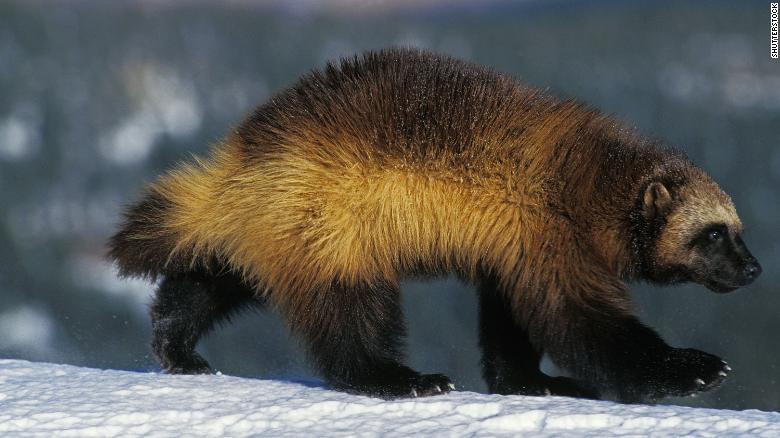
A stock photo of a wolverine.

The mysterious wolverine is the largest terrestrial member of the weasel family and it can resemble a small bear with a bushy tail. The animal is stocky with short, rounded ears, small eyes, and large feet that are useful for traveling through snow, according to WDFW.
Scientists believe there are only 300 of the species left in the contiguous US, according to the Center for Biological Diversity, a non-profit animal conservation organization. Due to trapping and habitat loss the wolverine population has been dramatically shrinking, according to the center.
“It’s special and noteworthy,” Lewis said about the sighting. “Before we had to take people for their word. It’s easier to document this now since everyone has a phone and a camera.”
A wolverine was spotted on May 20 by Jacob Eaton in Naselle.

A wolverine was also seen on May 20, walking down a road in Naselle, a town east of Long Beach Peninsula, Lewis said. An observer captured two pictures of it and submitted them to Lewis for confirmation.
“Given the oddball nature of these observations,” Lewis said. “It seems likely this is the same animal.”
While the animal does look like it is on the smaller side, Lewis said, it is normal for wolverines to strike out on their own. The age and gender of the animal are unknown. He added that juveniles disperse to find new homes away from relatives.
“I worry about this one because it is in an area way more densely populated then where it is used to,” he said. “My concern about it most is it can get hit in the road or someone might shoot it.”
Lewis said he hopes more people are able to document the animal’s travels which will give researches more insight into its unusual movement. Also if hair is left behind by the furry animal that will help researches collect DNA on it. Residents can submit photos by calling their regional wildlife office. Lewis said the animal isn’t a threat to humans.
People do not need to worry about it,” he said. “Just enjoy seeing it go by.”

‘I can’t believe I killed a wolverine with an ax’: North Idaho native wins reality wilderness survival show, $500,000

UPDATED: Thu., Sept. 5, 2019, 11:05 a.m.

Janahlee Jonas sneaks up on her husband, Jordan Jonas, on the final day of the reality TV show, “Alone.” Jordan Jonas, originally from Athol, Idaho, won the sixth season of the show. (Janahlee Jonas / COURTESY)

When Janahlee Jonas stepped off the helicopter in Canada’s northern backcountry, she didn’t know what to expect.

She hadn’t seen her husband, Jordan Jonas, in 77 days. She wondered if Jordan, who is naturally lean, would be emaciated. Or sick. Or injured. Or all three. After all, he’d been living in the subarctic wilderness for nearly three months, eating only what he could hunt or scavenge.

But when the helicopters’ engines cut out, her worries dissipated in the frigid Canadian air.

“The first thing I heard was his laugh, and I was like ‘Oh, he’s fine. He’s totally fine,’ ” she said in an interview Wednesday. “He didn’t suffer at all out here.”

While others struggled in the harsh Canadian subarctic, Jordan Jonas, a native of Athol, Idaho, thrived.

For that, he won $500,000.

Jonas, 36, spent 77 days living near Canada’s Great Slave Lake for the sixth season of the History Channel’s reality television show “Alone.” Unlike other reality shows, camera crews didn’t follow his every movement. Instead, Jonas was given three cameras and tasked with filming himself.

His goal? Outlast nine other contestants.

1 / 4

Janahlee Jonas sneaks up on her husband, Jordan Jonas on the final day of the reality TV show, Alone. Jordan Jonas, originally from Athol, Idaho, won the sixth season of the show. (Janahlee Jonas / COURTESY)

Each contestant was allowed to bring 10 items. Jonas brought paracord, a saw, an ax, a sleeping bag, a frying pan, a ferro rod, fishing line and hooks, bow and arrows, trapping wire and a multitool. With those tools, he built a shelter and thrived in the punishing conditions.

When he shot a moose, he became the first person in the show’s history to kill a large animal. He also made a fishing net out of the paracord and caught a 25-pound pike on his final day.

Contestants don’t know when others have dropped out, making it both a physical and psychological challenge. Contestants’ health is checked regularly, though. If they lose too much weight, they can be pulled by the show’s doctors. Or they can choose to tap out at any time.

And so, on the 77th day, in late November 2018, when the crew came to check on Jonas, he had no idea he was the last person standing. Instead, he thought it was just another health check.

“I wasn’t ready for it to end,” he said. “At 77 days, I had zero hope of winning yet. I was completely surprised.”

Instead, he’d mentally prepared to be out there at least 90 days. When his wife stepped off the helicopter, he estimated he still had 200 pounds of moose meat, 60 pounds of fish, an entire wolverine (which he killed with an ax), hares and a squirrel.

Just days prior, other contestants were choking down boiled hare feet and reindeer moss.

“I actually had a lot of fun,” Jonas said.

The sixth season aired this past summer, with the season finale shown in late August. That’s when Jonas was announced as the winner.

His success is a testament to an adventurous life. Jonas grew up on a farm near Athol. After graduating from Sandpoint High School, he attended North Idaho College and worked at Lighthouse Foods in Sandpoint. Then he spent the “better part of a year” riding freight trains around the country with his brother.

“It felt like a good coming-of-age type thing to do,” he said. “You get exposed to a mode of life that is not scheduled, and it feels a lot more free.”

After hopping trains, he headed to Russia to help build orphanages. There he met, and eventually lived with, nomadic Evenki reindeer herders. They taught him how to live with, and off, the land.

“To be honest with you, when I went to Russia I didn’t know people still lived like that,” he said.

The rhythm of nomadic hunter-gatherers reminded Jonas of his time on the trains. Free and unstructured. A day determined only by the most immediate of needs.

“When you’re in the forest, you wake up in the morning and there are things that need to be done. You might need to fish or get food,” he said. “But you do it on your own time, according to your own wisdom.”

Jonas traveled to Russia and Siberia a half-dozen times over the next few years. Eventually, he met Janahlee. The two married and had two children, Ilana, 3, and Altai, 2. A third child is on the way.

Now, the family lives in Lynchburg, Virginia.

And then they called in the spring of 2018.

“I definitively knew it is what I’m good at,” he said. “It would be crazy to say no.”

He didn’t prepare much, although he said he practiced shooting with his recurve bow and tried to gain weight.

“In the history of the show, most people that have won have been pretty chubby,” said the 6-foot-2, , 175-pound Jonas. “And part of me was thinking I might be too thin for this sport.”

In August, he found out he’d be heading to northern Canada, a climate perfect for his Siberian experience. A month later, he watched a helicopter fly off. He was alone.

“It’s really surreal,” he said. “The helicopter flies away and you have your 10 items and you don’t know anything about your area.”

He didn’t waste time. Within an hour of being dropped off, he’d shot a rabbit. The pursuit of food dominated his mind – and his time.

“It was all about food,” he said. “I threw up a shelter in less than a day. Then 100% of my energy was get food. Get food.”

He set snares for rabbits, fished and hunted moose. A steady supply of rabbit meat and fish kept him moving, but he knew he’d need more if he was going to go the duration.

He’d built a series of fences to funnel any passing moose into a particular area, and he had hung a number of cans to warn him when they were there. On day 20, it all came together. A bull moose wandered in, possibly responding to Jonas’ call from the night before. Jonas shot, then tracked the animal, eventually finding it dead near the lake shore. He skinned and gutted it with his Leatherman.

“It was like this whole burden off your back,” he said. “You’re gonna starve, you’re gonna starve. Finally, I’d gotten that off my back for a while.”

But his success brought new challenges, including the question of how to store the meat. At first, he stored it in trees and on a shelf he’d made in his shelter. But he forgot about the resident wolverines. One morning he woke up and found a store of moose fat gone.

So he set out more tin cans, and a few days later he heard – then saw – a wolverine return. The animal was behind a bush, but Jonas decided to risk a shot anyway.

The arrow ricocheted through the bush and pierced the animal through its back leg, pinning it to the ground. Jonas charged the snarling creature and killed it with his ax.

“That was super intense,” he said. “I can’t believe I killed a wolverine with an ax.”

No other major obstacles appeared for Jonas. In fact, he enjoyed nearly his whole experience. The worst part, he said, was worrying about things that might happen. Like missing Christmas with his family. Or running out of food.

“I had stressors,” he said. “But they were all things that were far off in the future. Had I been completely focused on the present, I don’t think I would have had any issues at all.”

Day-to-day, he enjoyed being alone, in the woods hunting and fishing for a living. Worrying about simple things. Food. Dry clothes. Warmth.

In fact, in many ways the whole experience was more difficult for his wife. She had support from her extended family through the 77 days, but it was hard for her and the two children.

“Both kids were pretty much on me the whole time,” she said. “I think what ended up happening was they didn’t want me to leave. So they ended up circling around me and making sure I didn’t leave, too.”

Plus, she had no idea how her husband was doing. All the show producers would tell her was that he was still out there. Nothing about his condition.

“I felt like I ended up worrying and losing weight,” she said, “And he was totally fine.”

That made the reunion all the more sweet. And the $500,000 prize gives the family some breathing room and a chance to reconnect.

They plan to move back to North Idaho, at least part time, and Janahlee will likely study nursing at North Idaho College.

“I’m glad it went as well it as did,” she said. “Obviously, I was worried about him. I didn’t realize how well he’d done until I saw everything and heard everything.”

Leaked Document: Scientists Ordered to Scrap Plan to Protect Wolverines

http://www.biologicaldiversity.org/news/press_releases/2014/wolverine-07-07-2014.html

Despite Extinction Threat From Global Warming, Obama Administration Caves to
Pressure From States, Overrules Federal Scientists

WASHINGTON— According to a leaked memo obtained by the Center for Biological Diversity, scientists with the U.S. Fish and Wildlife Service have been ordered to reverse their own conclusions and withdraw last year’s proposal to protect American wolverines under the Endangered Species Act.

Wolverine
Photo by Steve Kroschel, USFWS. Photos are available for media use.

Fewer than 300 wolverines remain in the lower 48 states, and global warming over the next 75 years is predicted to wipe out 63 percent of the snowy habitat they need to survive, government scientists have said. In fact changes due to climate warming are “threatening the species with extinction,” the Fish and Wildlife Service said in last year’s announcement of its protection proposal.

Now the memo — signed by Noreen Walsh, director of the Rocky Mountain Region of the Fish and Wildlife Service — tells federal scientists to set aside those conclusions, even though there has been no new science casting doubt on those findings.

“The Obama administration’s own scientists have said for years that global warming is pushing wolverines toward extinction, and now those conclusions are being cast aside for political convenience,” said Noah Greenwald, endangered species director at the Center. “This is a bizarre and disturbing turn, especially for an administration that’s vowed to let science rule the day when it comes to decisions about the survival of our most endangered wildlife.”

Fish and Wildlife Service scientists proposed Endangered Species Act protection for the wolverine in February 2013. Subsequently state officials in Montana, Idaho and Wyoming raised questions about the degree to which wolverines are dependent on persistent snow and about the degree to which warming will impact their habitat. In response Fish and Wildlife convened a panel of scientists to review the science behind the proposal, resulting in a report in which “nine out of nine panelists expressed pessimism for the long-term (roughly end-of-century) future of wolverines in the contiguous U.S. because of the effects of climate change on habitat.”

Based on the conclusions of the panel, scientists from the Montana field office of the Fish and Wildlife Service recommended that protection be finalized, but, as shown in the leaked memo, were overruled by agency bureaucrats.

“The decision to overrule agency scientists and deny protection to the wolverine is deeply disappointing and shows that political interference in what should be a scientific decision continues to be a problem under the Obama administration, just as it was under George W. Bush,” said Greenwald. “Wolverines and the winter habitats they depend on are severely threatened by our warming world. Only serious action to reduce fossil fuels can save the wolverine, tens of thousands of other species, and our very way of life.”

Background
On Feb. 4, 2013, the Fish and Wildlife Service found that wolverines warrant protection as a threatened species, concluding based on the “best scientific and commercial information available” that “the contiguous United States wolverine DPS presently meets the definition of a threatened species due to the likelihood of habitat loss caused by climate change resulting in population decline leading to breakdown of metapopulation dynamics.” This conclusion was based on the fact that “(w)olverines require habitats with near-arctic conditions wherever they occur,” that they “exist as small and semi-isolated subpopulations in a larger metapopulation that requires regular dispersal of wolverines between habitat patches to maintain itself” and that “(c)limate changes are predicted to reduce wolverine habitat and range by 31 percent over the next 30 years and 63 percent over the next 75 years, rendering remaining wolverine habitat significantly smaller and more fragmented.”

In response to the proposed rule, the states of Montana, Idaho and Wyoming all submitted comments opposing protection of wolverines, questioning the science behind the conclusion that they were threatened by climate change. To address these concerns, the Fish and Wildlife Service delayed final protection for six months and convened an expert scientific panel to evaluate the science. The panel issued a report in April 2014 concluding that “there are three primary climate related factors that are correlated with wolverines: persistent deep snow, contiguous snow, and temperature,” a finding that led to the panel’s unanimous statement of concern for the long-term survival  of wolverines in the contiguous United States. These conclusions support the conclusion of the proposed rule that the wolverine is threatened with extinction.

On May 17, 2014, the assistant regional director of ecological services at the Fish and Wildlife Service sent a memo to the regional director in Denver transmitting the recommendation of the Montana field office that “the wolverine listing be finalized as threatened.” The memo further concludes that, “In our review we have been unable to obtain or evaluate any other peer reviewed literature or other bodies of evidence that would lead us to a different conclusion.”

In contrast, the recently leaked memo overrules and ignores the substantial evidence and conclusions of the proposed rule, the independent science panel report, and the strong conclusions of the Montana field office, which is staffed with the agency scientists who have the greatest knowledge of wolverines.

The Center for Biological Diversity is a national, nonprofit conservation organization with more than 775,000 members and online activists dedicated to the protection of endangered species and wild places.

Otters—a Pinnacle of Evolution

As is often the case, I awoke this morning to the sensation of our cat walking gingerly across my head. Sleek and silky, with luxuriant dark fur, Winnie reminds me of the river otter I saw yesterday afternoon crossing the road and heading upstream into our backyard beaver pond system.

I’d been hoping the otter I have been seeing in the waterways nearby would find our ponds, which are fed by several small streams flowing out of the surrounding hills. Though the ponds turn a light brown this time of year from the clay-rich soil leaching from their banks, they support a healthy variety of life, from frogs, fish and crawdads; to ducks, herons, kingfishers and osprey; to beaver, muskrat, raccoon, mink…and now otter.

A descendant of the diverse weasel family, the river otter is a pinnacle of evolution if ever there were one. While their kin adapted to every other habitat in North America—the ermine and pine marten, to the snowy north woods; fisher, the ancient forests; mink, the riparian zones; badger, the arid plains; and wolverine, the mountainous high country—river otters are masters of inland waterways and freshwater lakes. To those who know them, “otter” is synonymous with the word “play.” Among the most spirited of species, they clearly enjoy themselves in the water, delighting in games with each other like tag and hide-and-go-seek. They also enjoy snow sports: otter “slides” are a familiar sight on snowy slopes along frozen rivers in winter.

Like every other fur-bearer on the continent, otters were nearly decimated during the mindless fur trade era. Unbelievably, otters are still killed in traps set by nineteenth century throw-backs even today. Others are shot by selfish humans unwilling to share aquatic resources that otters had adapted to hundreds of thousands of years before Homo sapiens reached the Western Hemisphere.

The threat of human greed is even more pervasive for sea otters, who have all but lost their ability to move about on land, giving themselves and their terrestrial origins up to their oceanic habitat. Unlike commercial fishermen, they don’t sit out the storms in a cozy home or a dry shack heated by an oil furnace; they spend day and night floating among the coastal kelp beds.

River otter are more than welcome to stay as long as they like here in our beaver ponds. Hopefully we’ll get an occasional glimpse of them swimming fluidly by, or moving on land with their trademark weasel-esque, undulating lope. I’m just glad Winnie is lighter afoot when she tip-toes across my head in the morning.

DSC_0068

Bloodthirsty ‘factual’ TV shows demonise wildlife

From: http://www.guardian.co.uk/environment/nature-up/2013/may/17/bloodthirtsty-wildlife-documentaries-reality-ethics

Major US TV channels are promoting hysterical and outdated ideas about wildlife in popular, blood-soaked shows

Most people’s wild beasts live in the TV.

What I mean is that, in my experience, most people are highly unlikely to come eyeball-to-eyeball with a large wild animal in their everyday lives, and much of their knowledge of wildlife comes from a screen.

If you’re North American or get US-produced satellite TV, you’ve probably learned a lot about wildlife from outlets like the Discovery Channel, Animal Planet and History. You might trust these channels because you’ve seen educational, factually accurate shows on them, unlike the ‘trashy’ material that dominates free-to-air network TV.

But not everything on on these ‘factual’ channels might be as ethical or even as accurate as you might think, and the implications for conservation could be profound.

I recently spent a few entertaining hours watching episodes of Discovery’s Yukon Men, a hit ‘reality’ series about the residents of the small town of Tanana in central Alaska. Launched in August last year, it’s consistently gained over two million US viewers in its Friday night slot, been syndicated overseas, and helped the channel win some of its biggest audiences ever.

The first episode brings us to midwinter Tanana, which a theatrical, husky male voiceover tells us is “one of America’s most remote outposts” where “every day is a struggle to survive”. A dramatic, orchestral score pounds as we see a lynx struggling in a leghold trap, guns firing, a man attacking a squealing wolverine with a tree trunk, a wolf which a voice tells us “might eat one of those kids”, a hand lifting up the head of a bloodied, dead wolf to show us its teeth, and then a gloved hand dripping blood while the voiceover rumbles that in Alaska, it’s “hunt or starve, kill or be killed”.

That’s all in the first minute.

In the second minute the voiceover tells us that “the town is under siege by hungry predators”. We see wolves eating a bloody carcass, a growling bear, men with guns shouting bleeped-out words, then a coffin. Another voice says that “there’s always somebody that’s not going to make it home”.

We’re soon told that Tanana’s water pipes are freezing up “but that’s not the only crisis. Wolves have been spotted on the edge of town.” Charlie, a hunter, shows us the tracks of “a lone wolf”. “Wolves are mean, ferocious animals and they can tear a man apart real easy” he says, so “we have to get this wolf, it’s not an if, its a must, because he’ll go to any measure to eat. They’re the worst kind.”

We then meet Courtney, a local mother, who’s scared that the wolf could eat her young daughter. Charlie agrees, “if we turned our backs for a couple of minutes, that baby would be gone.”

“There have been twenty fatal wolf attacks in the last ten years”, the voiceover intones.

Charlie kills the wolf in the next episode, pursuing it on a snowmobile and shooting it outside town with an AR-15, the same semi-automatic assault rifle used by the Sandy Hook school shooter. “The only good thing about a wolf is the quality of their nice fur”, says Charlie, holding up the blood-smeared pelt. Courtney agrees: “Dirty little rotten bastard.”

Another scene shows Stan, a fur trapper, dealing with a wolverine. Wolverines, about as big as a medium-sized dog, are the largest members of the weasel family. One has been caught by its front paw in one of Stan’s steel leghold traps and is trying to get away, squealing and snarling as he approaches. “He’s really dangerous”, says Stan, “I don’t think any human being could keep an attacking wolverine from killing them.”

Stan chops down a small tree, which he bashes the struggling wolverine with — to “stun” it, he says. Once the wolverine’s strength is somewhat depleted, he approaches it with a small handgun. The animal’s head turns, tracking the gun, and he shoots it. The camera zooms in to show steam rising from the carcass.

Charlie, too, sets a leghold trap for a wolverine, and catches it. As it squeals in the trap, trying to run away, the voiceover tells us dramatically that “wolverines are capable of tearing human beings apart.”

“He could gut me”, says Charlie, before raising his AR-15 and opening fire on the hapless animal. Many of his shots miss, but he eventually kills it.

All through Yukon Men we see predatory animals being killed: a leghold-trapped lynx is strangled to death with a wire noose by Stan’s son, a grizzly bear is shot in the head, etcetera, and every time the producers use the techniques of the reality TV genre to convince us that the animals are man-woman-and-child killers which are best turned into fur coats.

Joey Zuray kills a lynx – Yukon Men promo video

(Click here to view this video on YouTube.)

Frenetic edits and manic music are used to build drama, authoritative-sounding voiceovers combine with the tightly edited words of the on-screen characters tell how dangerous, vicious or deadly the creatures we’re seeing on screen are. I spot occasions where animal noises seem to have been overdubbed to make them sound scarier. It makes for gripping viewing, but I wondered if Discovery wasn’t betraying its viewers who trust it to deliver reliable, factual TV. As a trained zoologist and filmmaker, much of what I was seeing didn’t make sense to me.

Take wolverines for example: I lived in Alaska for almost a year and never saw one. They’re extremely shy and avoid humans. Although they’re capable predators of small animals and found in many cold, high-latitude regions of the northern hemisphere, I’d never heard of a wolverine killing a person.

I searched the web and could not find a single documented case of a wolverine even attacking a person anywhere in the world, ever.

To double-check, I emailed Jeff Copeland of the Wolverine Foundation, who told me that “we are not aware of any instance in which a wolverine has killed a human, or even attempted to do so”, which perhaps explains why the wolverines in Yukon Men are doing their desperate best to get away from their human assailants.

Wolves are a lot larger than wolverines, of course. But even though the US and Canada hold over 60,000 wolves, I found only two records of fatal attacks by wild wolves in these countries in last ten years; one controversial case in Saskatchewan, Canada, in 2005, which some experts think was actually a bear attack, and another in Alaska in 2010.

Why did the producers of Yukon Men tell their viewers that there had been twenty fatal wolf attacks in the last ten years, implying that these had taken place around Tanana? Why does a ‘factual’ show portray Alaskan wolves as man-eating monsters straight out of Victorian fairytales, a serious threat to life and limb, when the data show that wolf attacks are extremely rare in North America?

Idaho-based wolf expert Suzanne Stone told me that she’d once been surrounded by a howling pack of gray wolves while sitting by a campfire in the twilight, armed only with a marshmallow on a stick. The animals were only twenty or thirty yards away. Was she scared, I asked? “No, not at all. It was an incredible experience. I howled back and forth with them”, adding that people and domestic livestock were the most dangerous creatures she’d encountered in many years of walking in wolf-inhabited backcountry.

Yukon Men isn’t the only ‘factual’ show about people who kill wild animals that seems to hysterically hype up the danger the animals pose to humans while minimising (or completely failing to address) their important ecological roles.

The Louisiana alligator hunter stars of the History Channel’s blockbuster show Swamp People use huge baited hooks to snare alligators and various guns to blow their brains out, all the while telling us how desperately dangerous they are. Despite Louisiana having almost two million alligators, I could not find a single record of a fatal alligator attack there in the last century, although Florida ‘gators do occasionally eat people. (Swamp People gets record ratings for the channel, despite the contemporary alligator hunt’s tenuous connection to history.)

“It’s a Texas thing” – Rattlesnake Republic promo video

(click here to watch this video on YouTube.)

Animal Planet’s Rattlesnake Republic shows Texan snake wranglers capturing dozens of rattlesnakes at a time while repeatedly playing up their lethality. In the episodes I watched I never saw anything about how snake hunters have helped make the Eastern Diamondback Rattlesnake so rare that it’s now a candidate endangered species. Rattlesnake Republic sends a clear meta-message that the only good rattlesnakes are dead ones, sewn into boots.

Discovery and the BBC Natural History Unit have arguably similar status in the wildlife filmmaking industries on their respective sides of the Atlantic, and have co-produced high-profile series like Planet Earth and Africa. The BBC displays its editorial guidelines for natural history shows on a public website which, on the face of it, Discovery’s Yukon Men seems to fall afoul of. The BBC guidelines say that “audiences should never be deceived or misled by what they see or hear”, that “we [the BBC] should never be involved in any activity with animals which could reasonably be considered cruel”, for example.

This begs the question: What are Discovery’s editorial guidelines?

After numerous calls and emails to the Discovery Channel and Animal Planet, I’ve yet to find out. I’ve not received any indication that either of these channels (which are owned by the same company) even have editorial guidelines or an ethics policy. The Discovery Channel gave me only one line in response to my questions: “We are committed to the highest standards of natural history filmmaking.”

Despite partnering with them on multimillion-dollar shows, the BBC’s Natural History Unit also seems to have no idea what Discovery’s policies are; when I asked, the BBC would only say that they expected any versions of their programs aired by co-producers to adhere to BBC standards.

The History Channel told me that their standards and practices department ensures that all their shows meet “the standards of good taste and community acceptability while also allowing our creative departments the freedom to explore new and innovative ideas.” Each programme is individually evaluated, but “given the subjective judgments that are required, it is difficult to come up with a detailed list of guidelines.” History’s statement said nothing about factual accuracy or animal cruelty.

I contacted National Geographic TV, assuming that this flagship brand would have a policy something like that of the BBC’s. Christopher Alberts, the Senior Vice President of Communications for the National Geographic Channels, told me that they have “one of the best policies there is”, but refused to send it to me or tell me anything about it.

Why are these factual networks, whose survival depends on building trust with their audiences, so reluctant to clarify their ethics policies with respect to wildlife?

What does it mean for conservation if high-rating shows on leading channels are portraying wildlife in a negative, seemingly misleading way to millions of viewers worldwide? And why are so few people saying anything about it?

copyrighted-wolf-argument-settled

WTF’s Up w/MFWP?

What the Fuck (WTF) is up with the Montana state wildlife officials these days? Now they want to make it even easier to hunt and trap wolves in their state.

Last year, just after wolves were removed from federal endangered species protection, the Montana Fish, Wildlife and Parks department (MFWP) seemed comparably tame (well, compared to Idaho anyway). Though they wasted no time in implementing the state’s first season on wolves in seventy-some years, at least they spared wolves the torment of trapping.

Ignoring 7,000 letters in support of wolves, this year they added trapping to their wolf assault and upped the original “bag limit” from one to three per trapper—before the season even started. Instead, they’re bowing to the whims and whinings of ranchers, hunters and trappers who have called for an expansion of wolf killing and more liberal rules than the state had last year, when “only” 166 wolves were ruthlessly murdered. MFWP officials responded to anti-wolf, anti-nature, anti-environmental pressure by making the 2012 season longer, eliminating most quotas and allowing wolf trapping for the first time.

The agency is now mercilessly asking for additional measures in the form of a state House Bill, HB 73. Their proposal would let hunters and trappers buy multiple tags; use electronic wolf calls; reduce the price of a non-resident tag from $350 to $50 and eliminate the potentially life-saving requirement that hunters wear fluorescent orange outside of elk and deer season. (Okay, I’ll go along with that last one—who cares if wolf hunters shoot each other?)

“We want to get a wolf bill out of the Legislature so we can implement those things that can potentially make a difference,” said FWP spokesman Ron Aasheim, adding selfishly, “More management flexibility. That’s what we want now.”

The House committee will also take up a second bill by Republican Rep. Ted (oh shit, not another Ted!) Washburn, of Bozeman, which would also limit the total number of wolves allowed to live in the entire state (we’re talking 147,046 square miles) to no more than 250. Washburn’s plan also asks for an Oct. 1-Feb. 28 wolf hunting season and an even longer season for special districts next to Yellowstone and Glacier National Parks!!

No doubt you all remember that fateful day in 2011 when congress lifted federal protections for wolves in Montana and Idaho, handing management over to those openly hostile states.

Meanwhile, the nefarious Montana state wildlife officials are currently opposing federal Threatened Species protection for the depressingly rare wolverine, down to only 35 breeding individuals in the lower 48.

Not many hunters can honestly say that they don’t mind sharing “their” elk, moose or deer with the likes of wolves, cougars or coyotes. But those few who claim to support a diversity of life need to realize that every time they purchase a hunting license and a deer or elk tag, they validate wolf hunting and trapping. To game managers, every action, right down to the purchase of ammo and camo at Outdoor World, is a show of support for their policies—including killing wolves to ensure more deer, elk, moose or caribou for hunters to “harvest.”

A far cry from living up to their laughably undeserved reputation as the “best environmentalists,” hunters are just foot-soldiers carrying out a hackneyed game department program of “harvesting” ungulates and “controlling” predators. It’s an agenda based not on science or the time-tested mechanisms of nature, but on the self-serving wants of a single species—Homo fucking sapiens (HFS). Modern hunting is about as anti-environmental as mining, clear-cut logging, commercial fishing or factory farming.

Text and Wildlife Photography ©Jim Robertson, 2012. All Rights Reserved

Text and Wildlife Photography ©Jim Robertson, 2012. All Rights Reserved

Ban Wolverine Trapping—as a Matter of Principle

In an uncharacteristically uplifting post last week (semi-satirically entitled “Be of Good Cheer”), I shared the news that wolverines—critically endangered from decades of falling prey to the “tradition” of fur trapping—are for now off the hit list of species allowable to trap in Montana, thanks to an injunction filed by animal advocacy groups that resulted in a Temporary Restraining Order (TRO). While about every other “furbearer” in that state remains at risk, to the wolverine now spared the prospect of being caught by the leg in a steel-jawed trap for days and nights on end until some trapper arrives and clubs them to death this is nothing short of a Christmas miracle!

But that miracle may be short-lived if trappers and the Montana Fish Wildlife and Parks department—who are trying desperately to reverse the TRO against wolverine trapping—have their way.

In addition to being inherently cruel and demented, trapping is a lazy-man’s blood sport. Even some hunters resent the ease at which trappers can score a kill. A trapper can be likened to a fisherman who casts several baited hooks out into a lake and leaves them there, not bothering to come back for a week or so to see what he’s caught. All the while, the animal struggles and suffers—out of sight, out of mind…

Throughout recorded history, trapping has been the greatest threat to the existence of wolverine and their kin. Entire populations have been wiped out across the country, from the Sierra Nevada to the southern Rockies and from Washington’s Cascade mountains to the Minnesota woodlands.

In their 1927 book entitled Mammals and Birds of Mount Rainier National Park, authors Walter Taylor and William Shaw give accounts of Washington wolverines trapped and poisoned around the turn of the Twentieth Century. They write, “The wolverine, if ever common, has undergone a marked decrease throughout the Cascade Range, probably due to the increasing price put on his pelt by the fur trade.” Even a hundred years ago these two had the foresight to observe, “Where possible, the balance of nature should be left to establish itself.”

Text and Wildlife Photography© Jim Robertson

Text and Wildlife Photography© Jim Robertson

I couldn’t agree more.

The shadowy wolverine is one savage scavenger who is very dear to my heart. Despite their scarcity, I’ve been extremely fortunate to see them on four separate occasions, each one a high point in my memory. If my life were to flash in front of me, it would appear as a wildlife slide-show set to music—a Bolero, building in intensity—featuring images of black bears and cougars; bison, bighorns and bugling elk; snowshoe hare and ermine in a frosty meadow; pine marten in the boreal forest; mink and otters in the wetlands and badgers in the sagebrush. Moose, wolves, lynx and grizzlies in the wilds of Alaska would appear as the music reaches a crescendo, followed by a wolverine effortlessly scaling an alpine slope as the grand finale.

The first timeI saw a wolverine was in 1978, on a steep, snowy mountainside in Washington’s rugged North Cascades range. I was on a solo climb, my ice ax at the ready to avoid an uncontrolled, high-speed slide to the valley bottom. Suddenly, a fast-moving, dark-colored animal raced across an even steeper pitch about 50 yards above. Judging by the size and shape, my initial impression was coyote or wolf; then as I watched it move and got a better view of its stature, I recognized it for what it was—a wolverine! After he streaked out of sight, I continued my slow ascent, kicking steps into the snow and sinking my ice ax in for safety’s sake, up to where his trail—the only remaining sign of the incredible spectacle I’d just witnessed—crossed the steepest pitch of the slope. When I reached the wolverine’s distinctive, five-toed tracks, I could see that though his rapid traverse appeared effortless, he had dug his sharp claws deep into the snow with each step—confirming that a wolverine is as well adapted to its mountain habitat as an otter is to water, or a raven to air.

Since I considered it my back yard, I was thrilled to know that the North Cascades National Park and adjoining wilderness areas comprised a habitat extensive and secluded enough for such a secretive animal—and we’re talking sasquatch secretive—to feel at home.

I knew it had probably been a once in a lifetime sighting, but when some of the snow melted, I decided to return and planned to stay a while this time. I crossed the slope where I’d last seen the wolverine and headed over a pass into a trail-less, glacier-carved valley in search of a likely den site. Thinking like a wolverine, I chose a spot that had rarely, if ever, been visited by human beings, setting up camp by a small alpine tarn. As luck would have it, I came across a set of the familiar five-toed tracks that led up toward a small cave under a rocky cliff. Not wanting to disturb the cave’s occupants, I watched the opening from a respectful distance. Within minutes, I heard the sound of falling rocks and looked up to see a wolverine, probably a mother, eying me suspiciously from the ledge above her den.

Appreciating how unwelcome I was, I quickly determined that I had accomplished all I could hope to achieve without annoying the animal to the point that she might leave the area for good. Though I was tempted to stay around in hopes of a photo op, I instead did the right thing and moved on, leaving that wild place to the wildlife who depend on it.

Not being a fan of intrusive hardware, like the ear tags or radio collars used in the study of wild animals, I never reported the sighting or the location of the den to wildlife “authorities.” I object, on behalf of animals everywhere, to the ham-fisted treatment of wildlife for “research” purposes, and I knew that rather than taking my word for it, some overeager biologists, wildlife “managers” or other self-appointed “experts” would march out there and trap, collar or otherwise traumatize the animal.

My misgivings proved justified. Years later, I learned that at least two young wolverines were trapped, jabbed with needles, immobilized and manhandled; their ears were tagged and they were fitted with awkward, bulky radio-collars. It seems the biologists at the scene badgered their captives in every way imaginable, short of sending them to Abu Ghraib or on a hunting trip with Dick Cheney.

Worse yet, by meddling with such rare and reclusive animals—keeping one of them confined for days until “game experts” from Missoula, Montana could make the trip across two states to get some hands-on of their own—they may have separated one yearling from her mother. (Judging by the tracks around the box-trap, mama wolverine must have stayed around until people roared into the area on snowmobiles, forcing her to reluctantly abandon her trapped youngster and retreat further into the wilderness.)

After an Interminable imprisonment in a claustrophobic box trap, and then awaking from an unsettling tranquilization surrounded by gawking people—now with tags in her ears and a burdensome collar around her neck—another young female wolverine trapped by biologists in Washington fled through the Pasayten Wilderness and across the border into Canada.

When a Forest Service biologist told the Seattle Times, “…the best way to ensure wolverines continue in Washington is to learn as much about this population as we can,” I had to wonder if tormenting an animal so much that she hurriedly left the relative safety of Washington State (where a voter-approved initiative has banned recreational fur trapping) was really the best way to ensure the species continues. Canada and Alaska persist in allowing that archaic tradition. Putting animals through unnecessary suffering is just part of doing business up there—not a safe place for a “fur-bearer” of any kind.

Further knowledge is always helpful, but surely new information can be acquired through the use of remote cameras and other less disruptive methods. And really, how much more do we need to know before we reach information overkill?

We already know a lot about wolverines, such as the fact that they are the largest terrestrial mustelid—the brontosaurus of the weasel family. Among their relatives, the only species any larger are the sea otter and the Amazonian of all otters, the giant otter of the Amazon River basin. A wolverine looks like an oversized, striped mink or a small, elongated, agile bear. (Sorry I don’t have a photo of one to include here; all the sightings I’ve had have been brief, and all of the wolverine moved too quickly to get a clear photograph—just a couple of the challenges of using only ethically-acquired images.)

Putting their trademark pungent anal scent glands to good use, they seem to take special pleasure in fouling trapper’s cabins (whether for recreation or revenge, only the wolverine really knows…and they’re not telling). Possibly their best known attribute is their ferocity—wolverines could easily be considered the Tasmanian devils of the Northern Hemisphere. But a real-world Bugs Bunny would no doubt meet his match with these part-time predators.

The main thing we need to know about wolverines, we already well know: as a species, their numbers are perilously low.

I had my third wolverine sighting in the mid-1980s, on the volcanic flanks of Alaska’s remote Mount Katmai. I was backpacking with a couple of friends when we surprised a wolverine who crossed barely 20 yards in front of our path. He reacted not by baring his teeth and snarling, but by getting the hell out of there to the relative safety of a rocky cliff formed by a geologically recent lava flow. The naturally acrobatic animal leapt up from ledge to ledge with the fluid grace of a furry brown waterfall flowing in reverse. Within a few seconds the wolverine scaled a pitch that would have taken an hour and a half of effort for a skilled rock climber.

The encounter made me realize that, contrary to their notorious reputation for fierceness, wolverines will go to great lengths to avoid people. Clearly, in order to thrive, sensitive species like wolverine require vast expanses of wild land—and a minimum of human activity.

The most recent sighting I had was just a few years back, during one of my many trips into Yellowstone while living near the park in southwest Montana. That sighting was bittersweet as the wolverine was barely within the park boundary, and I knew all too well that trapping was legal at the time anywhere outside the protection of Yellowstone National Park. I couldn’t help but think just how easy it would be for a trapper to snag this far-ranging park animal in one of their horrible torture devices. All they’d need is a state permit, a few steel-jawed leg-hold traps, a snowmobile and a complete and utter lack of conscience, remorse or compassion.

There are only around 250 to 300 wolverines in the continental United States, but for reasons that have nothing to do with science and everything to do with “higher priorities” and political pressure from trappers, they are still currently considered only a “candidate” for federal Endangered Species Act protection.

Even the Montana state game department must understand that a population as pitifully low as the wolverine’s suffers immensely when a trapper kills even one individual. Prior to the TRO, “game managers” were set to allow five wolverines to be sacrificed to the gluttonous trappers. What’s the point of having a season on five wolverines? Clearly it’s symbolic—just a matter of principle for them. But a principle is supposed to be a moral or ethical standard based on something upright and upstanding, not an immoral standard based on something lowly and loathsome like trapping.

It’s high time to ban wolverine trapping entirely—as a matter of principle!

Text and Photography© Jim Robertson

Text and Photography© Jim Robertson

Montana Wolverine hearing set for January 10th

In the middle of writing a post on wolverines celebrating the end of trapping in Montana, I was informed that trappers and the Montana Fish Wildlife Parks Department are frantically trying to reverse the Temporary Restraining Order (TRO) and commence with the wolverine trapping season.  The agency is even getting other states wildlife agencies involved to act as witnesses. Stay tuned for my lengthy, updated wolverine post; in the meantime, Here’s the latest article on the situation–note that the follow up hearing is set for January 10th…….

A Helena judge issued a temporary restraining order that will delay Montana’s wolverine trapping season.

Written by Tribune staff
A Helena judge issued a temporary restraining order that will delay Montana's wolverine trapping season. The season was set to begin Saturday.
AP File Photo/Glacier National Park, Jeff Copeland

A district court judge in Helena granted a temporary restraining order against the state’s wildlife agency that blocks the opening of Montana’s wolverine trapping season until at least early next year.

The season was set to open Saturday.

The restraining order was sought by a coalition of groups trying to halt wolverine trapping in Montana. Helena District Judge Jeffery Sherlock granted the order. A follow-up hearing is set for Jan. 10.

The eight-group coalition, led by the Western Environmental Law Center, wants to ban wolverine trapping until the U.S. Fish and Wildlife Service determines if the wolverine will be placed on the federal list of threatened and endangered species.

Ken McDonald, wildlife bureau chief for Montana Fish, Wildlife & Parks in Helena, said Montana’s quota of five wolverines is based on sound wildlife management science that doesn’t put the state’s wolverine population at risk.

In 2010, USFWS determined that threats to the wolverine included climate change but declined to list it as an endangered or threatened species due to higher priorities. At the time, USFWS suggested that the wolverine population is stable or expanding and that between 250 and 300 wolverines inhabit the northern Rocky Mountains.

McDonald said FWP will immediately begin to examine the restraining order and consider legal options but for now trappers are prohibited from pursuing wolverines in Montana.

Be of Good Cheer

I get the feeling some people won’t be satisfied until I’ve plumbed the deepest, darkest depths of hunter/trapper depravity. I’ve had people ask me to write blog posts on issues as nauseating to cover as Wyoming’s new bounty on coyotes, and the glib manner in which some Wyomingites brag about cutting off coyotes ears in the parking lot of the “Sportsmen’s” Warehouse to claim their $20.00 bounty (following the same ugly tradition of  their forbearers who claimed cash at the fort for Indian scalps); incidents as horrible as the black bear (pictured here) who got caught in a 217855_388677001217027_1495584697_ntrap that some sick, twisted asshole set for pine marten; or report on how poachers are killing off the last of the world’s big cats; or go into how vacuous bowhunters sound when they praise one another for impaling animals for sport, or the malevolent tone used by wolf hunters or trappers when they get away with murdering beings far superior to them in every way.

The problem is, whenever I go there I get so irate I could end up saying something like, “They should all be lined up and shot, their bodies stacked like cordwood and set ablaze to rid the world of every last speck of their psychopathic evil once and for all.”

Well I’m not going to do that…at least not during the holiday season…

December should be a time for being of good cheer and spreading hopeful news, such as the pleasantly surprising announcement that, thanks to a lawsuit filed by Footloose Montana, along with several other litigants, the state of Montana put on hold its annual trapping season on wolverine this year, just 24 hours before that particular brand of butchery was set to begin! Of course, nearly every other “fur-bearing” animal in the state—from beavers and muskrats, to marten, fisher and mink; from otters and bobcat, to wolves, foxes and coyotes—is fair game for any sick fuck who feels the sadistic urge to set out a trapline in the wilderness…or just out of town.

But at least the wolverines—critically endangered from years of falling prey to a “celebrated” historic tradition, now down to only 35 successfully breeding individuals in the western United States—are illegal to trap right now.

Hallelujah! Thank goodness there’s some happy news to share with you this time of year!

Text and Wildlife Photography© Jim Robertson

Text and Wildlife Photography© Jim Robertson