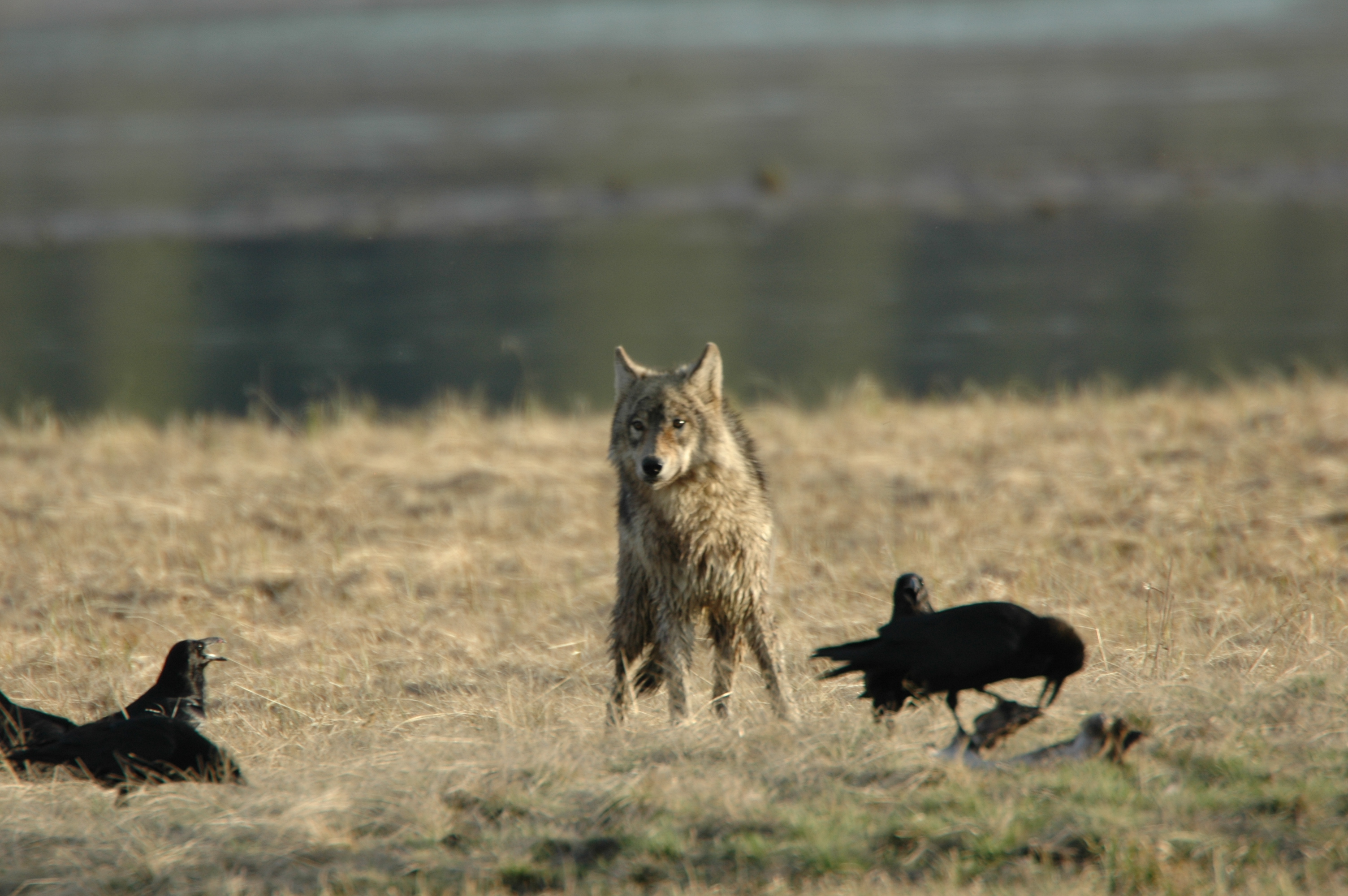
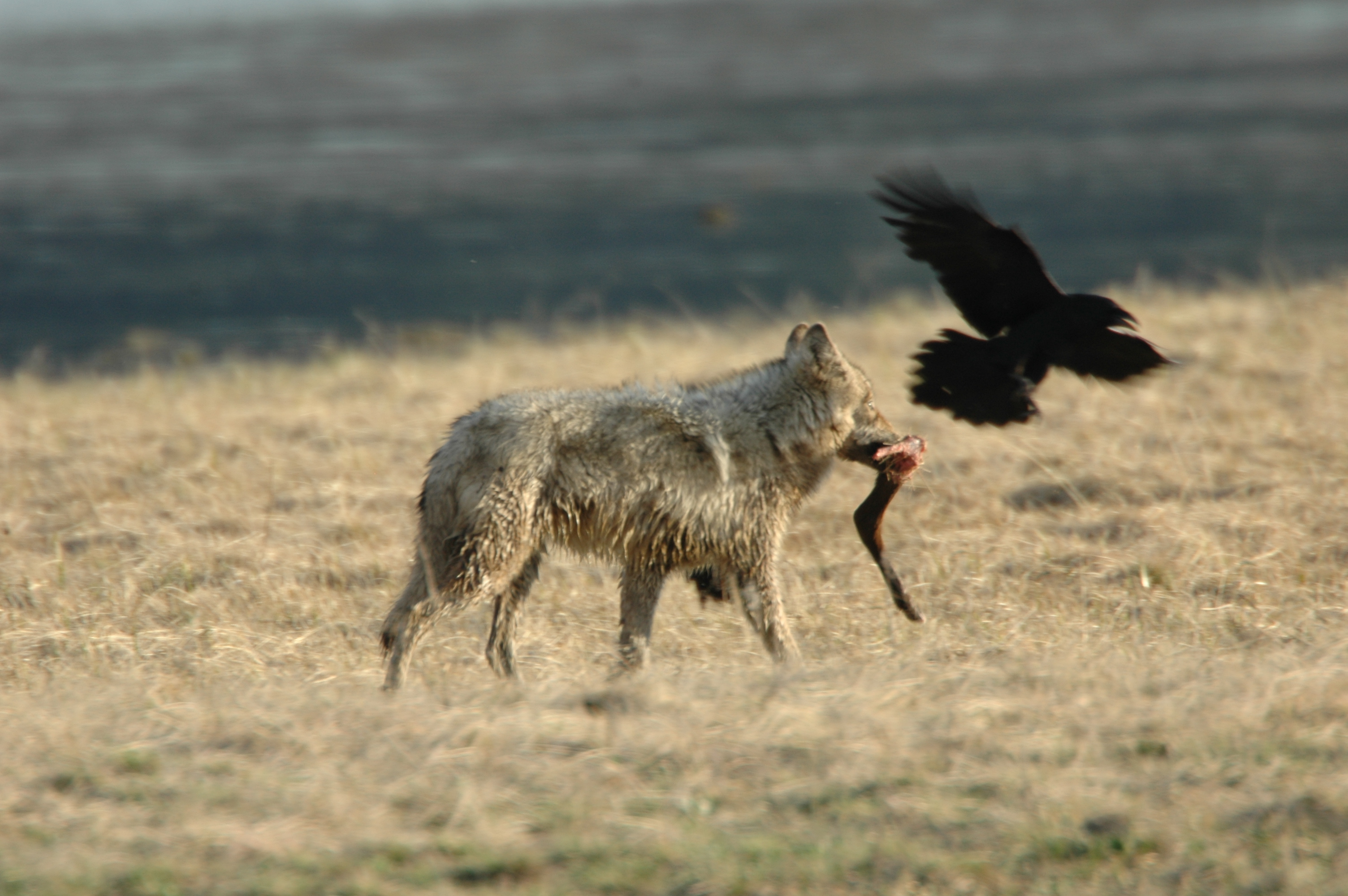
 They may not always be the best of friends, but they’re constant companions…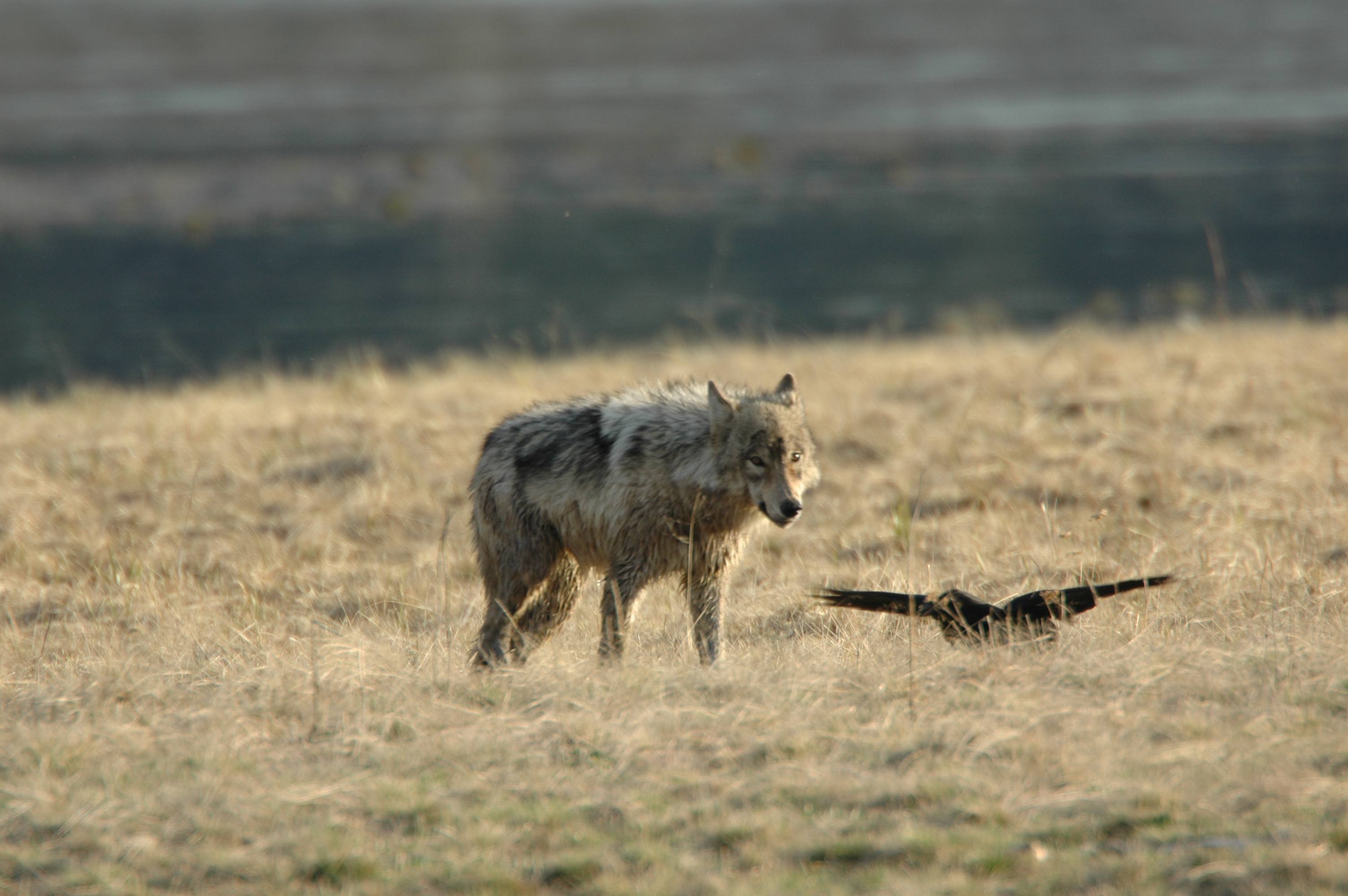
Wildlife Photography Copyright Jim Robertson

The relationship between ravens and wolves has been a topic of comments on a post about a Petition to Stop the Slaughter of Ravens in Idaho. Whenever I’ve seen wolves on a carcass in Yellowstone, ravens are right there with them to cash in and help clean up. The ravens lead in turn wolves to potential meals, letting them do the dirty work they aren’t equipped for.
Here’s a photo of the two together in Yellowstone’s Hayden Valley…

Wildlife Photography Copyright Jim Robertson
State and federal agencies said Friday there were a minimum of 1,691 wolves at the end of 2013.
That’s virtually unchanged from the prior year even as state wildlife agencies adopted aggressive tactics to drive down wolf numbers.
Under pressure from livestock and hunting groups, Idaho officials have used helicopters to shoot packs. Montana has eased hunting and trapping rules.
Federal wolf recovery coordinator Mike Jimenez says he expects the population to gradually decline over time in the face of the states’ efforts, but to remain healthy.
A pending proposal would lift protections for wolves across much of the remaining Lower 48 states.
http://abcnews.go.com/Technology/wireStory/rockies-gray-wolf-numbers-steady-hunting-23193709

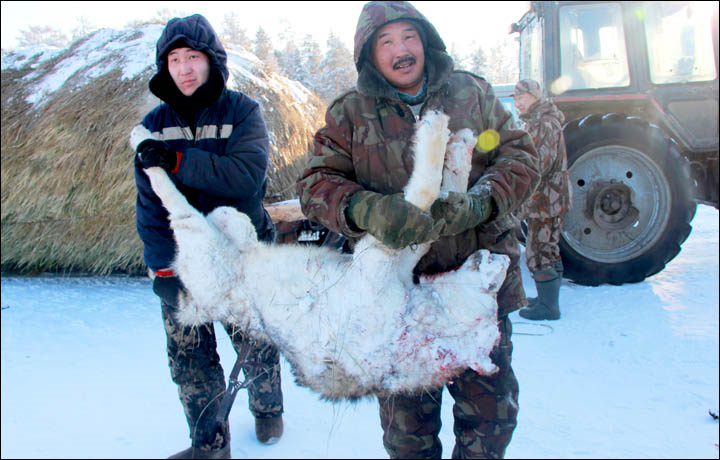 More drastic and controversial methods are to be imposed to counter the wolf plague in the next 12 months. Picture: Victor Everstov
………………………………..
If you’re interested in seeing more graphic images and reading an article bemoaning the potential threat to domestic reindeer herds numbering in the tens of thousands, be my guest. Personally, I can’t stomach any more wolf death or happy stories about any human’s way if life. Humans are the only plague on the planet:
April 2, 2014 4:30 am
The New West / By Todd Wilkinson
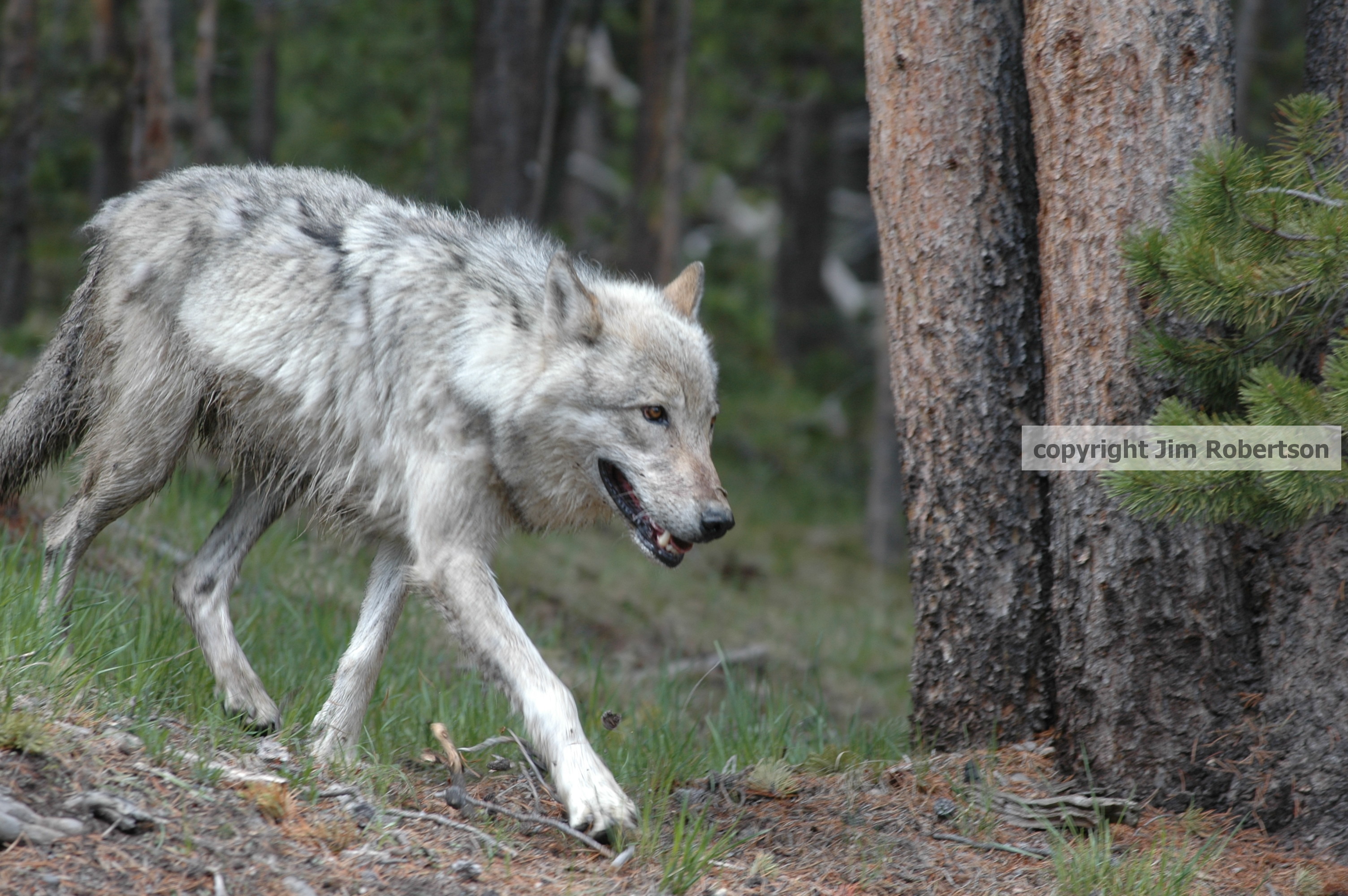
“Predators are bad for wildlife.” How often have Americans heard this refrain in public forums?
Pervasive as a belief in rural Western culture, it drives political discourse. It also is part of a nonstop feedback loop of social reinforcement, rife in barber shops, ammo stores, saloons, coffee klatches and outfitter camps.
But does it withstand scientific scrutiny? Do predators such as wolves and cougars “devastate” wildlife or do they help keep public game herds healthier?
Predator experts and others specializing in wildlife conservation medicine say it’s an important consideration when thinking about protocols for managing zoonotic diseases in the Greater Yellowstone Ecosystem.
I contacted biologist L. David Mech, one of the world’s foremost wolf authorities. He has written or contributed to hundreds of peer-reviewed scientific papers on wolves and prey.
“In the main, the preponderance of scientific evidence supports the view that wolves generally kill the old, the young, the sick and the weak,” Mech began. “There’s so much documented field data behind it.”
All the things humans treasure about every wild prey species — their physiology, agility and resilience — are reflections of the predators that made them adapt and evolve over eons.
Keeping domestic livestock healthy and fat often involves huge doses of antibiotics and, in some cases, growth hormones. Not so for free-ranging wildlife, especially wildlife not subjected to unnatural animal husbandry practices, such as artificially nourishing wild elk at crowded feedgrounds.
Wildlife professionals know such conditions elevate animal susceptibility to deadly pathogens like brucellosis, tuberculosis and chronic wasting disease, threatening ecological well-being.
Mech made a fascinating point: Wolves appear to target sick animals that, to the human eye, exhibit no overt symptoms of disease.
“There’s a lot more going on than we can detect,” Mech said. “They are killing animals that most people would say, ‘That animal looks pretty healthy to me,’ but in fact it isn’t.”
In 2003, Denver Post reporter Theo Stein interviewed scientists about CWD spreading though deer and elk in Colorado. Dr. Valerius Geist, who paradoxically has become a darling of anti-wolfers, made this assertion about the significance of wolves in containing CWD spread via proteins called prions.
“Wolves will certainly bring the disease to a halt,” he said. “They will remove infected individuals and clean up carcasses that could transmit the disease.”
Stein added that “Geist and Princeton University biologist Andrew Dobson theorize that killing off the wolf allowed CWD to take hold in the first place.”
Wolves aren’t alone. In a 2009 study titled “Mountain lions prey selectively on prion-infected mule deer,” researchers in Colorado discovered that “adult mule deer killed by mountain lions were more likely to be prion-infected than were deer killed more randomly … suggesting that mountain lions were selecting for infected individuals when they targeted adult deer.”
Researchers said, “Other studies indicate that predators like wolves and coyotes select prey disproportionately if they appear impaired by malnutrition, age or disease.”
In another study researcher N. Thompson Hobbs examined the potential impact of wolves on CWD-infected elk in Rocky Mountain National Park, where lobos are now absent.
Wolves, he found, could reduce average life spans of infected elk and therefore limit the amount of time infectious animals could spread disease to others.
“We suggest that as CWD distribution and wolf range overlap in the future, wolf predation may suppress disease emergence or limit prevalence,” Hobbs said.
Wyoming doesn’t accept this scientific reality. In Jackson Hole, where unnatural feeding of wapiti on the National Elk Refuge is contributing to persistent brucellosis infection and putting migrating elk at high CWD risk, wolves are killed under the ironic guise of “keeping elk herds healthy.”
In Wyoming’s “predator zone” which encompasses many of the state’s 22 elk feedgrounds, wolves can be killed at any time of day year round.
Are Wyoming, Idaho and Montana spending millions in tax dollars to eliminate the natural allies that help keep wildlife diseases such as brucellosis and CWD in check? Mech stays out of the political fray, though he says the value of predators is clear.
“Based upon everything I’ve seen over the course of my career, I generally stand behind the assertion that wolves make prey populations healthier,” he said. “The evidence to support it is overwhelming.”
Todd Wilkinson’s column appears every week in the News&Guide. He is author of “Last Stand: Ted Turner’s Quest to Save a Troubled Planet.”
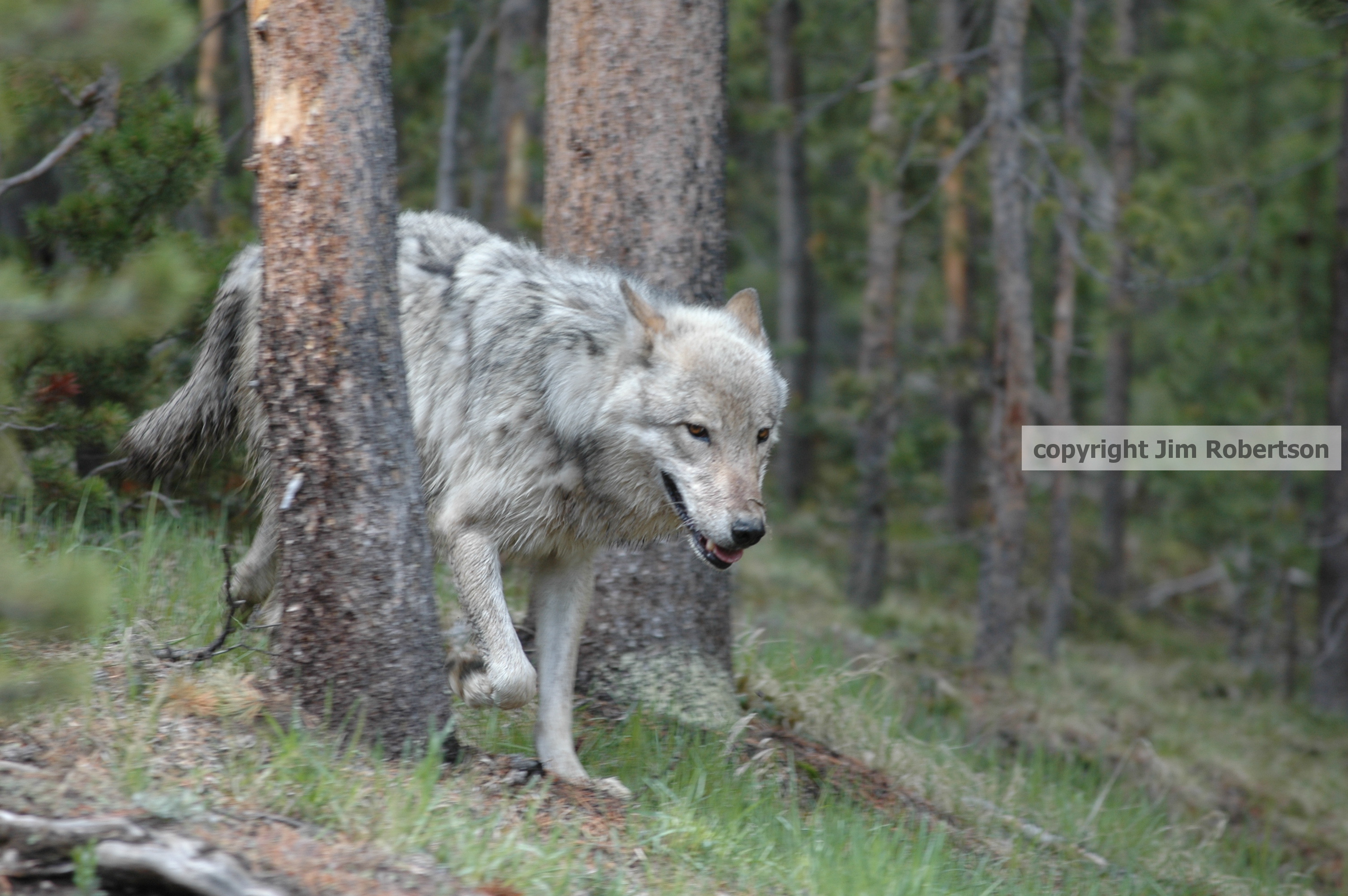
Year after year, Idaho demonstrates its intolerance for wolves. Idaho Department of Fish and Game, while tasked with preserving all of Idaho’s wildlife, continues to ratchet up hunting, trapping and snaring pressure on Idaho’s diminishing wolf population.
Around 600 wolves live in Idaho, which is also home to 83 times more coyotes, 33 times more bears, and four-to-five times more mountain lions than wolves. All of these species eat other animals to survive and all sometimes attack livestock. But Idaho reserves its special treatment for wolves alone.
Idaho’s wolf population has fallen consistently since 2009. Every year wolves have been under state management, Idaho has expanded, extended and loosened wolf hunting and trapping regulations. It’s an indefensible notion that “adequate regulatory mechanisms” are in place, as mandated by the Endangered Species Act for the oversight period under state management.
Idaho claimed it would manage wolves like any other species. No Idaho wildlife management authority can honestly defend this position.
Actions by Gov. Butch Otter and the state Legislature indicate they believe IDFG isn’t effective enough in killing wolves. The Wolf Control Board bill, “the wolf-kill bill,” was a priority the governor chose for his January State of the State address. Now, 400,000 taxpayer dollars for killing wolves is likely to be a recurring expense. Legislative sponsors and supporters repeatedly stated their intent to reduce Idaho’s wolf population to 150 wolves and 15 breeding pairs, the federal minimum.
As the state of Idaho and IDFG reach to further extremes to kill more and more wolves, these actions aren’t going unnoticed.
Far beyond the scope of wildlife management, these practices are quickly giving a black eye to Idaho’s reputation across the country. Idaho is not an island. It does not exist in a vacuum. If the state walks far enough out on a limb, the limb will break, bringing Idaho back to earth under an increasingly focused spotlight.
As fewer people take up hunting, those who enjoy Idaho’s nature in a nonconsumptive way steadily increase. IDFG’s one-dimensional revenue stream from hunting and fishing licenses and tag sales cannot keep pace with fiscal challenges. It’s time to realign economic realities with income-generating constituencies.
Recognizing the increasing difficulty of remaining solvent with growing bills, Director Virgil Moore commendably organized the 2012 IDFG Wildlife Summit to modernize the agency. Unfortunately, necessary innovations are still not forthcoming. Instead, the agency continues pursuing scientifically unsupportable programs, such as excessive and expensive lethal wolf removal and expanding trapping.
Recently, IDFG conducted its sixth costly wolf eradication action in the Lolo, killing 23 wolves from a helicopter, to artificially bolster a declining elk herd, even though IDFG has acknowledged the decline was precipitated by dramatic changes to habitat and vegetation that support elk.
This spring, IDFG hired a professional hunter/trapper to kill wolf packs in the same designated wilderness where wolves were originally reintroduced. IDFG has also declared another goal – reducing wolf populations by 60 percent in the same wilderness.
Remarkably, as this continues, Idaho’s statewide elk population of 107,000 has been growing since 2010. The presence of wolves equating to poor hunting opportunity is a fallacy. Wyoming, with the third largest wolf population in the West, reported their three largest elk harvests on record in the past four years, with 45 percent success in 2013. Hunters can coexist with wolves while maintaining a robust hunting tradition.
Efforts to kill wolves on Idaho’s wild landscapes, especially in designated wilderness – where wolves belong – will never yield the long-term results the agency desires. IDFG continues burning precious dollars on failing programs, while gaining increasingly widespread negative publicity as the black sheep of the nation. For the sake of our beautiful state and all of its wildlife, let’s hope that Idaho soon corrects course.
Garrick Dutcher is the program director for the Idaho-based national nonprofit organization Living With Wolves.
Read more here: http://www.idahostatesman.com/2014/04/01/3111241/back-off-wolf-crusade-and-dispel.html#storylink=cpy

http://www.care2.com/causes/if-wolves-are-protected-in-france-why-are-they-being-hunted.html
by Judy Molland
March 27, 2014
The Big Bad Wolf stock figure of so many children’s fairy tales, has surfaced again.
This time it’s in France, where there has been an outcry from animal rights groups since wolf hunts have resumed due to increased attacks by the animals after their “European comeback.”
Wolves were originally hunted to extinction by farmers in France back in the 1930s, but in 1992 a mating pair crossed the border from Italy. It is now estimated that there are around 300 individuals in 25 packs across France.
For many people, this is good news, but the Daily Telegraph reports that hunters, “wolf lieutenants,” and local farmers have grouped together to carry out a cull on the animals after sheep farmers complained of incessant attacks on their flocks.
This is in spite of the fact that the wolf is a protected species under the Berne convention and European law, meaning that it can no longer be hunted or poisoned.
So how can these hunts be legal?
It turns out that there are exceptions to this rule.
Culls can take place when all other attempts at protecting local livestock have failed. Under a government wolf plan, some 24 individuals can be “removed” in this way per year.
As it happens, the attacks have been happening just 25 miles inland from the top tourist spot of Nice on the French Riviera, and just 15 miles from Grasse, known as France’s perfume capital, which might explain the push for a cull. The hills in this region of the Var, called Caussols, have lost around 100 sheep to the grey wolf.
Conservation groups are understandably furious at the decision to re-intoduce wolf-hunting.
“To return to wolf hunts as if we were in the Middle Ages is scandalous. That the local authorities are organising them is even worse,” said Jean-François Darmstaedter, president of Ferus, who threatened to challenge their legality in the European courts.
“We call them ‘political killings’ as their only aim is to allow farmers to let off steam but they will solve nothing. Blindly shooting wolves will have no effect other than to exacerbate the problem. If you kill the alpha male, you can split up a pack, which will cause far more damage.”
And in fact, public opinion today is very much on the wolf’s side. A recent poll, commissioned by a pro-wolf group, found that 80 percent of French people wanted wolves to be protected from farmers, rather than sheep from wolves.
Neverthless, the wolf is once again under attack.
Of course, the track record in the U.S. is equally awful, especially in the state of Idaho, where state lawmakers just approved a bill that sets aside $400,000 to exterminate 500 wolves. Adding insult to injury, the bill takes management away from the state wildlife agency and places it in the hands of a “wolf depredation control board” that will consist solely of members appointed and overseen by Governor Butch Otter. This is the man who in 2007 said he wanted to be the first to kill an Idaho wolf after federal protections were taken away.
This is exactly the kind of ugly attitude that animal activists feared when Congress in 2011 stripped Endangered Species Act protections from wolves in the northern Rockies, where some 1,600 wolves have been killed since protections were lifted.
So what happened? The United States worked for 40 years to return wolves to the American landscape after they had been driven to the brink of extinction in the lower 48 states.
The Endangered Species Act allowed wolves to begin recovery, at least in a few places like the northern Rocky Mountains and Great Lakes states. After reintroductions in Yellowstone National Park and parts of Idaho, wolves came back.
Now this has all changed, as politicians in Congress have stripped federal protections from wolves and passed those protections over to the states.
Some states in the U.S. are pursuing wolves in much the same way that the French government in France is pursuing wolves in the oh-so-chic area near the French Riviera.
France and the U.S. have much in common after all, and that’s definitely not good news for wolves.
By Ken Cole On February 12, 2014
The Wildlife News
New plan aims to reduce population by 60% to please elk hunters
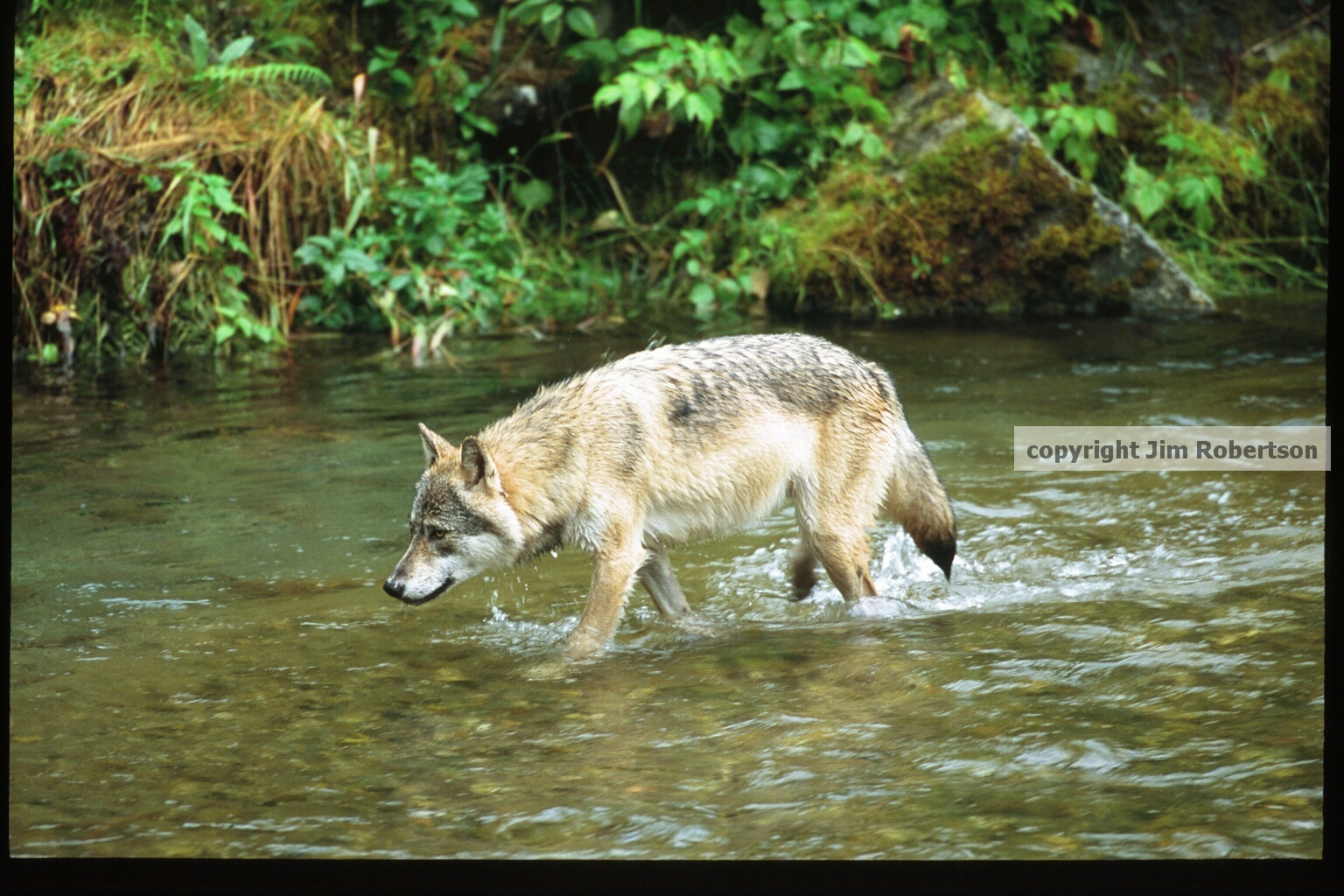
POCATELLO, Idaho – In an effort to inflate elk populations for commercial outfitters and hunters, the Idaho Department of Fish and Game (IDFG) hopes to kill 60 percent of the wolves in the Middle Fork area of central Idaho’s Frank Church River of No Return Wilderness, according to a predator management plan for the area released this week.
IDFG’s plan calls for an intensive program of wolf killing in the largest forested wilderness area in the lower-48 states through several successive years of professional hunting and trapping efforts designed to boost the local elk population beyond the level that can be sustained through natural predator-prey interactions. It comes just weeks after a hunter-trapper hired by the state wildlife agency killed nine wolves in an effort to exterminate two wolf packs in the Middle Fork area. State officials terminated the program in the midst of an emergency court proceeding to halt the program.
Earthjustice is in court to stop the professional extermination of wolves in central Idaho’s Frank Church-River of No Return Wilderness. Last month, Earthjustice filed an emergency motion asking the Ninth Circuit Court of Appeals to preserve the wolves and their vital contribution to the wilderness character of the . Rather than presenting its legal defense to Earthjustice’s argument, IDFG temporarily halted the program until the end of June 2014. Earthjustice will be filing its opening brief later this week in the Ninth Circuit proceeding. Earthjustice is representing long-time Idaho wilderness advocate Ralph Maughan, along with Defenders of Wildlife, Western Watersheds Project, Wilderness Watch, and Center for Biological Diversity in the case.
Statement from attorney Tim Preso of the Northern Rockies office of Earthjustice.
“The state of Idaho has made clear that it intends to double down on its plan to transform the Middle Fork area of the Frank Church River of No Return Wilderness from a naturally regulated wilderness to an elk farm benefiting commercial outfitters and recreational hunters. The only thing that is not clear is whether the U.S. Forest Service will step up to defend the wilderness character of this landscape on behalf of all the American people or instead will, as it has done to date, let Idaho effectively run the area to advance its own narrow interest in elk production. For our part, we intend to do everything we can to obtain a federal court ruling that will require the Forest Service to protect this special place and its wildlife.”
Statement from Idaho resident and long-time conservationist Ralph Maughan:
“By implication our lawsuit aims to protect the entire nationwide Wilderness Preservation System from similar efforts to transform the wild into a bland farm for a few kinds of common animals.”
Statement from Idaho resident and Defenders of Wildlife representative Suzanne Stone:
“It’s clear that IDFG isn’t interested in sustainable wolf recovery. Instead, they’re focused on doing anything they can to kill as many wolves as possible in the state. That’s not responsible state wildlife management any way you look at it. Idaho committed to responsibly managing wolves when federal protections were removed just a few short years ago. Actions like this just further demonstrate that they’re failing to uphold their end of the agreement.”
Statement from Ken Cole of Western Watersheds Project:
“For the idea of wilderness to have any meaning at all, wildlife must be allowed to self-regulate, to seek its own balance, to be wild. Instead, the Idaho Department of Fish and Game insists on heavy handed management of wolves in the Frank Church-River of No Return Wilderness to benefit a tiny minority of the people who use and enjoy the area. The nation’s premier wilderness is not just a recreation area of rocks and ice, it is a thriving ecosystem that should be treated as the treasure it is.”
Statement from George Nickas, executive director of Wilderness Watch:
“The State of Idaho has shown once again it is incapable of being a responsible partner in wilderness administration. It’s high time the Forest Service exert its authority and obligation to protect the public’s interest in Wilderness and wildlife protection.”
“This outrageous plan to slaughter wolves in the lower 48’s largest wilderness in an ill-conceived attempt to increase elk numbers is only the latest example of just how backwards wildlife management has become in Idaho. Already more than 900 wolves have been killed in Idaho during state-sanctioned hunting and trapping seasons. And this unnecessary slaughter will continue unless the courts step in and stop the senseless killing.”
http://www.wildernesswatch.org/newsroom/guardian/Targets_Wolves.html
http://www.huffingtonpost.com/noah-greenwald/idahos-wolf-hunting_b_5010249.html
by Noah Greenwald, 03/24/2014
When it comes to killing wolves, Idaho has an appetite that just can’t be sated.
State lawmakers just approved a bill that sets aside $400,000 to exterminate 500 wolves. Adding insult to injury, the bill takes management away from the state wildlife agency and places it in the hands of a “wolf depredation control board” that will consist solely of members appointed and overseen by Governor Butch Otter, who said in 2007 that he wanted to be the first to kill an Idaho wolf after federal protections were taken away.
Just a few months ago, Idaho sent a bounty hunter into the woods to wipe out two wolf packs and more recently announced plans to kill 60 percent of the wolves in another part of the state.
The slaughter continues and Idaho’s political leaders seem to bask in the carnage they’re leaving behind.
It’s exactly the kind of ugly behavior that we feared when Congress in 2011 stripped Endangered Species Act protections from wolves in the northern Rockies, where some 1,600 wolves have been killed since protections were lifted. And it’s clear, more mass killing is on the way.
This isn’t supposed to be happening. The United States worked for 40 years to return wolves to the American landscape. Canis lupus had been driven to the brink of extinction in the lower 48 states as settlement moved west, ranching moved in and government sponsored programs trapped, poisoned and shot wolves into oblivion.
The Endangered Species Act allowed wolves to begin recovery, at least in a few places like the northern Rocky Mountains and Great Lakes states. After reintroductions in Yellowstone National Park and parts of Idaho, wolves came back. New packs formed. Families were built. Ecosystems, now with a keystone predator back in the mix, began to function like they had historically.
Politicians in Congress, though, pulled the plug and unceremoniously stripped federal protections. We were told that wolves could be responsibly managed by state wildlife agencies in places like Idaho.
Truth is, wolves are being persecuted in Idaho with the same kind of repulsive attitude that nearly drove them to extinction 100 years ago. Only now it’s happening under the official state flag.
And here’s where it gets worse: the U.S. Fish and Wildlife Service now wants to take away federal protections for nearly all wolves in the lower 48 states. And, just like in 2011, we’re being told that wolves will be fine. They won’t be. Wolves today live in just five percent of their historic habitat.
Abandoning wolf protections across the country will not only ensure that wolves never get reestablished in places like the southern Rockies or the Northeast but that any wolves that remain will be subject to the same kind of treatment they’re getting in Idaho.
Idaho may have gone too far this time. The rule removing protections for wolves, which was made law by Congress, specified criteria under which wolves would again receive consideration for Endangered Species Act protection and this atrocious bill may just have crossed the line.
Conservation groups furious as government allows limited hunting of protected grey wolf amid rise in attacks on farm animals
Henry Samuel and Lewis Whyld 22 Mar 2014
As day broke, around 50 French hunters, wolf lieutenants and local farmers stood motionless, rifles in hand, gazing silently into the forest of Caussols in the Alpine foothills of Provence.
A few miles upwind, dozens of beaters in fluorescent orange and yellow tops began their arduous march though deep snow over steep, wooded terrain, making strident calls and firing shots into the air as they went.
Sandwiched between the two lines, the hunters hoped, were anything up to three packs of wolves that local sheep farmers say are ruining their age-old pastoral existence with incessant attacks on their flocks. Camera traps caught images of them only 48 hours previously. The clamour of the beaters was designed to flush them of the woods and into the line of the hunters’ fire.
But the danger was not just for the wolves. “The trackers will be behind the animals. Be sure to shoot downwards,” Louis Bernard, regional head of the hunting and wildlife commission, ONCFS, told the party beforehand.
“We’ve already had one fatal accident in the area this year, so please be careful. Only shoot when you have identified the animal.”
Related Articles
Wolf hunt returns to France: 360 degree view
22 Mar 2014
Scenes of ‘sublime heroism’ as Titanic sank revealed in letters
21 Mar 2014
Patriot buys only made-in-France products for 10 months
19 Mar 2014
‘Michelin revoked my star because of insect menu’
18 Mar 2014
Paris orders drivers with even number plates off the road
17 Mar 2014
Situated in the pre-Alps just 25 miles inland from Nice and 15 miles from Grasse, France’s perfume capital, the wild, rugged landscape of Caussols could not be further removed from the glitz of the Riviera.
In January alone, farmers in these hills lost around 100 sheep to the grey wolf, which is making a lightning comeback in France and other parts of Europe; in Spain, packs are breeding a mere 40 miles from Madrid.
For Ludovic Bruno, 20, whose 350 sheep graze here in the winter months before he takes six days to walk them to higher summer pastures, respecting the age-old practice of “transhumance”, the hunt was personal.
“Over there just behind that hill on January 5, four wolves attacked my flock and there was nothing I could do about it. I had no gun on me,” said the young farmer who suffered eight attacks last year killing scores of animals and has lost 18 in the past month.
“I saw one running off with one of my lambs in its jaws. Two more sheep lay dead. I felt only rage. The wolf is a threat to my way of life and my future.”
Miraculously, he managed to save his black billy goat, which the wolves had pinned to a rock by its throat. The wound was still raw.
“Look,” he suddenly said, pointing to tracks in the thick snow ahead. “Paw prints. This is a wolf. He must be quite big. A male of around 30 kilogrammes. But these are several days old, made in fresh snow that has frozen over now.”
With official encouragement, herders and farmers hunted wolves to extinction in France in the 1930s but in 1992, an alpha mating pair crossed the border from Italy.
Since then, Canis lupus has spread throughout the French Alps, across the Rhône valley into the Massif Central and up the eastern border of France to the Jura and Vosges mountains.
It recently reached the sparsely populated plains of eastern France, and last month the corpse of an illegally shot wolf was found in Coole in the Marne, just 100 miles east of Paris.
Today, there are at least 300 individuals in up to 25 packs across the country. As their number and reach increase, so do attacks, resulting in the death of more than 6,000 sheep last year – double the number five years ago. More than a third occurred in the Alpes-Maritimes département where the hunt took place.
The wolf is a protected species under the Berne convention and European law. It can no longer be hunted or poisoned. Yet culls can exceptionally take place when all other attempts at protecting local livestock have failed. Under a government wolf plan, some 24 individuals can be “removed” – the official term – in this way per year.
Initially this was a job only for state marksmen, but given their lack of success – only seven were killed last year – the government widened the remit to “wolf lieutenants”. Now, wolves can be shot in ordinary hunts in areas where they pose problems.
Conservation groups are furious. “To return to wolf hunts as if we were in the Middle Ages is scandalous. That the local authorities are organising them is even worse,” said Jean-François Darmstaedter, president of Ferus, who threatened to challenge their legality in the European courts.
“We call them ‘political killings’ as their only aim is to allow farmers to let off steam but they will solve nothing. Blindly shooting wolves will have no effect other than to exacerbate the problem. If you kill the alpha male, you can split up a pack, which will cause far more damage.”
The only solution, he said, was to protect flocks properly by using fierce Pyrenean “patou” mountain dogs, penning sheep inside high electrified fences at night and firing warning shots if wolves approach. “These measures can reduce predation to almost nil,” he insisted.
But Pierre and Deborah Courron, who own 900 sheep and goats near Caussols, have tried all this and despite their best efforts – including sleeping beside flocks in the summer months – lost 60 animals last year and have suffered eight attacks in 2014.
Mrs Courron scoffed at the suggestion they were not doing enough to protect their sheep.
“We already have four patous. If I had 15 of them, we would doubtless have no wolf attacks, but a pack that big would pose a threat to humans as they are semi-wild. They would make mincemeat of hikers.”
As for electrified enclosures, they help, but the wolves are deft at spooking the sheep so much they knock down fences in panic. The wolves are now so bold they sometimes attack yards from the farm. Techniques such as linking a sheep’s heart rate to an alarm have proved ineffective.
While farmers are compensated for the loss of animals they can prove were eaten by wolves and receive a “stress bonus” to cover potential miscarriages, the psychological strain is permanent.
“In 2013, we lost almost 2,500 sheep in 719 attacks,” said Jean-Philippe Frère, vice president of the chamber of agriculture for the Alpes-Maritimes.
“You can imagine the distress this causes farmers. To live 24 hours a day with the strain of thinking the wolf is going to eat my sheep is unbearable.”
Jean-Marc Moriceau, a historian who has studied the relationship between man and wolf over the ages, said that it was a “lie to simply say if you add more means, there will be no more problem”.
“As a historian I can tell you there has never been perfect cohabitation between man and wolf. It has always been imposed and under constraint,” he said.
In April, Mr Moriceau is launching a website documenting the 8,000 humans killed by wolves between the 17th and 20th centuries, many of them children between six and 15 sent to guard flocks.
“There is a kind of law of silence about this because it is seen as not politically correct to describe what is a historical reality. It was a tiny minority, but it is the reason for our ancestral fear of the wolf.”
Today public opinion is very much on the wolf’s side. A recent poll, commissioned by a pro-wolf group, found that 80 per cent of French people wanted wolves to be protected from farmers, rather than sheep from wolves. But Mr Moriceau said that could change as the wolf approaches built-up areas.
“The wolf is an indicator of all humanity’s weaknesses throughout the ages, including today. It will exploit any drop in the strength and domination of man on his environment,” he said. “The closer the wolf physically gets to people, the less they are in favour of its presence.”
With little to stop the wolf spreading all round France, some are calling for certain areas to be declared “wolf-free zones”.
“The wolf is gaining ground. If we left nature run its course, then certainly we will see them soon in the forests around Paris,” said Jean-Pierre Poly, national head of France’s wildlife and hunting commission, whose delicate mission is to protect the wolf, compensate farmers and organise culls.
“Some think that we should hem the wolf in to certain areas and organise a sort of defence zone to make sure it doesn’t get too close to built up areas. The jury is out,” he said.
Wolves undoubtedly prowl these woods, but they are remarkably elusive and can smell a man more than a mile off. At one stage, Mr Courron paused to point out fresh tracks in a clearing.
“Look at the pads, all in a line. When they follow each other, they step in each other’s paw prints. It looks like one, but could be several,” he said, pushing another cartridge into his rifle and firing into the blue sky.
“These are probably from yesterday.”
Despite what are, for the hunters, these encouraging signs, after an exhausting three-hour march the packs local farmers say are causing them such trouble were still nowhere in sight.
And help was at hand for the wolves: just as the trackers entered the final furlong, at last approaching the stationary marksmen’s line of fire, the hunt was abruptly cut short by furious ramblers demanding to know why their Sunday stroll had suddenly taken them into a war zone.
As tempers flared and the guns fell silent, the farmers railed against “tourists” whose right to roam had foiled their hunt. “All these people mobilised against the wolf, yet we get stopped by a bunch of walkers. It beggars belief,” said Mr Courron.
In truth, however, this is the third such hunt in the area in which the wolf has evaded his ancient foe. Last time, a marksman even missed one that dashed for cover right past his sights.
“Today is Sunday. If we had done the hunt on Friday we would probably have come across wolves,” said Mr Bernard. “But as they roam over a large territory of around 30,000 hectares (110 square miles) per pack, they constantly move around and today were not on the Caussols plain.”
Gripping his gun and clenching his jaw, Mr Courron stared dejectedly into the middle distance. “Better luck next time,” he murmured. “Even if we just get one or two, we will be a little less troubled.”
• Wolf hunt returns to France: 360 degree view
 Exposing the Big Game
