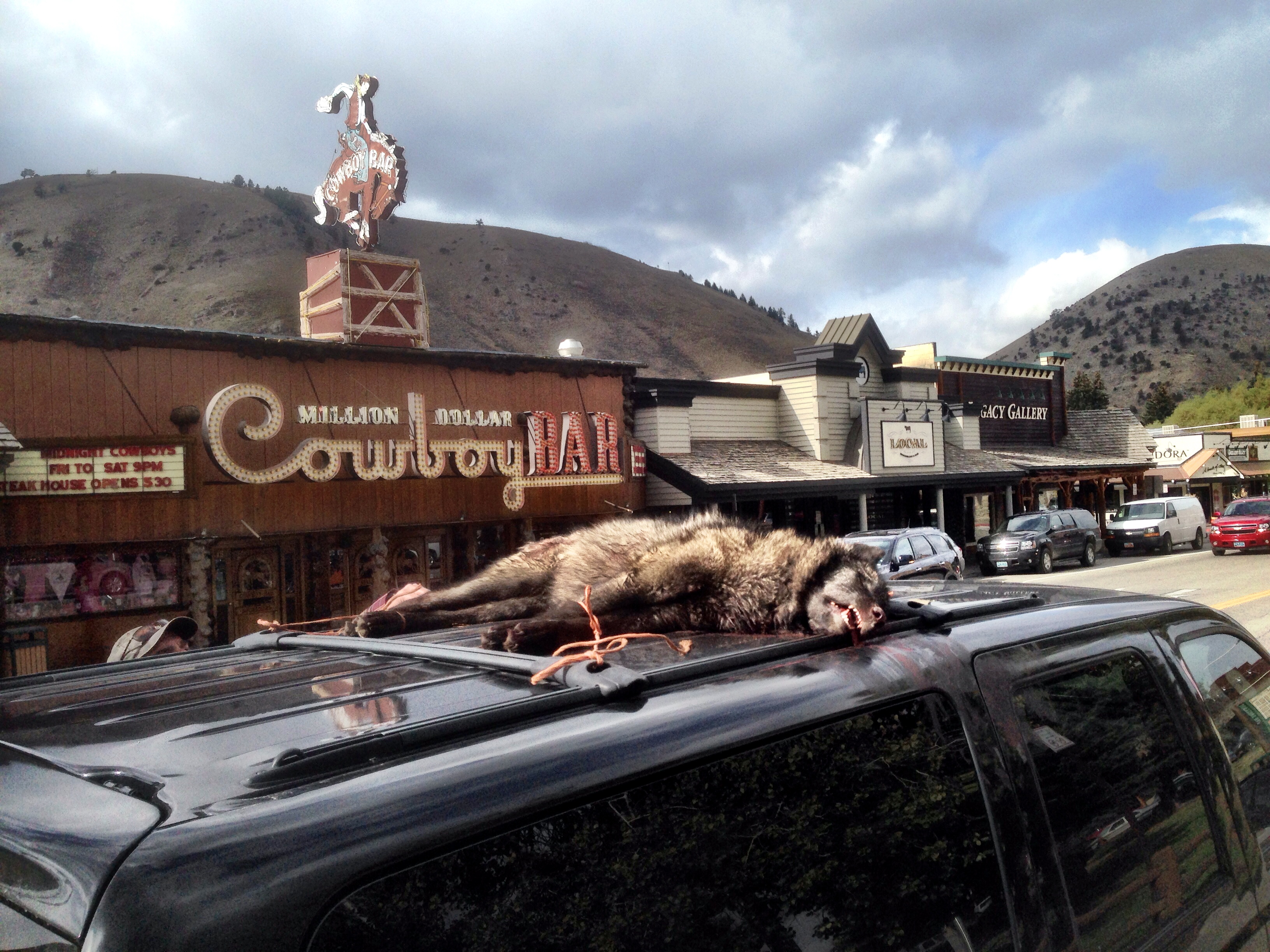
A-Hole Hunter Parks With Wolf on Roof in J-Hole

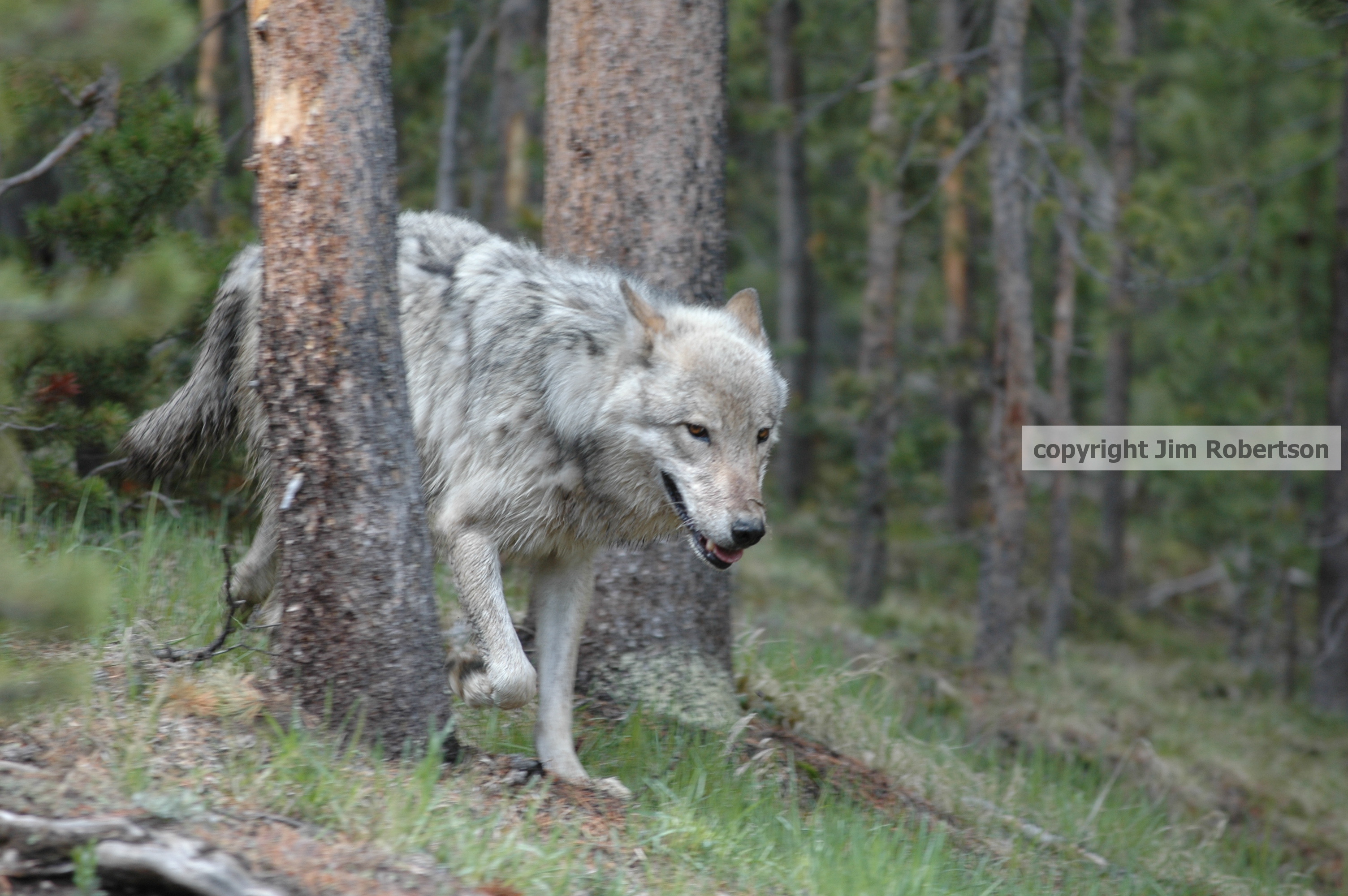
[One of the first wolves I ever saw in the lower 48 was in the Grant Tetons, near Jackson Hole, long before wolf hunting was allowed. Now, any ya-hoo a-hole who wants to can kill as many wolves as they want, any time they want—across 85% of Wyoming.

Note: Yellowstone and Grand Teton National Parks take up nearly 15% of the cowboy state.]
By Mike Koshmrl, Jackson Hole, Wyoming
Date: October 18, 2013

Bill Addeo swears he didn’t park an SUV with a dead wolf strapped to the roof on the Town Square just for the attention.

Addeo  sat on a bench next to his Ford Excursion across the street from the  Cowboy bar Thursday afternoon, eager to answer questions posed by folks  passing by.

“It’s a neck shot,” Addeo said. “The bottom of the  neck is blown apart and there’s blood everywhere, so I didn’t want to  put him in the back.”

The Hoback Junction resident killed the wolf, a black 85-pound female, that morning while elk hunting near Bondurant.

Addeo  said he toted the still-warm canine to Jackson to register it at the  Wyoming Game and Fish office on North Cache Street. He parked it on the  Town Square, he said, while his wife was shopping.

At the time Addeo shot the wolf, she and four packmates were sitting around “satiated” after having eaten an antelope, he said.

“We saw them from about one mile away,” Addeo said. “Then we crawled to 375 yards.”

His  guide, Sammy L. Coutts, had forgotten shooting sticks to rest a rifle  on for a shot, so the duo needed to improvise, Addeo said.

“He kneeled down and I put it right on his shoulder,” Addeo said. “It blew the hat right off his head.”

Coutts  called the Jackson Hole News&Guide on Thursday afternoon to alert  the newspaper to his client’s position on the Square.

The day before, Coutts had a shot at the wolves, Addeo said, but the hunting guide’s rifle didn’t prove steady enough.

“Yesterday, Sam saw the big one at about 250 yards,” Addeo said. “He gets on the hood of his truck and misses twice.”

Coutts stewed all night.

Back on the Square, almost everybody passing by stopped for a look. Most snapped photos.

Despite the interest, nobody gave Addeo flak for putting his wolf on display.

“There hasn’t been one person that’s said anything negative,” he said. “Everybody’s happy.”

Because  Addeo was hunting in Wyoming’s wolf predator zone, where there are  virtually no rules, a license was not necessary. The free-fire zone  encompasses about 85 percent of the state. The southern edge of the zone  starts in Wilson, just south of Highway 22, for about half the year.

Addeo could have shot all five wolves if he had the opportunity. The other four packmates, however, scampered off.

“After the shot went off,” Addeo said, “we ran the draw and never saw them again.”

Wolf_kill_on_vehicle_1

Wisconsin is Too Open to Hunting With Dogs

[First, I have a couple of pet peeves to air: 1) I’m getting real tired of all the articles these days that start out as a question when the author and readers clearly know the answer. Like this one: “Is the state too open to hunting with dogs?” This isn’t a question, it’s a statement! Why not just come right out and say, “The State is Too Open to Hunting With Dogs.” We all know it is, so I took the liberty in change the title to reflect the answer.

2) Another thing that gets extremely old are articles that start out something like, So and So, an expert on animal behavior, is not against hunting and even raises lamb for food…” as though So and So’s concessions to cruelty make them more credible. Okay, that’s all I have to say; enjoy the article.]

Bill Lueders: Is state too open to hunting with dogs? copyrighted Hayden wolf in lodgepoles

October 18, 2013 12:30 am  •  By Bill Lueders

Patricia McConnell, an expert on animal behavior, is not against hunting and even raises lamb for food. But the University of Wisconsin-Madison zoologist and author is appalled by what she regards as blatant cruelty to animals sanctioned and abetted by the state.

“I’m sure most people don’t know this goes on in Wisconsin,” McConnell says. “I think most people would be horrified.”

McConnell is referring to the use of dogs to hunt other animals, like bear, with often deadly consequences. Joe Bodewes, a Minocqua-based veterinarian, described the damage to dogs by bear in a recent letter to the Wisconsin State Journal.

“Broken and crushed legs, sliced-open abdomens and punctured lungs,” he wrote. “Dogs lying mangled and dying on the surgery table — all in the pursuit of sport.”

Bodewes, in an interview, says his small clinic treats about a dozen dogs a year mauled by bears while hunting. Usually two to four die. Recent cases include a dog whose jaw “was snapped off below the eyes” and one whose back muscles were “ripped loose from its spine.” Both survived.

Now Wisconsin is about to become the only state to let dogs be used in wolf hunts. A judge’s injunction blocking the use of dogs in last year’s inaugural hunt has been lifted; the case is now before a state appeals court. This year’s hunt, with a kill goal of 275 wolves, began Tuesday. Dogs can be used beginning Dec. 2.

McConnell and others warn of inevitable violent clashes. And with good reason.

According to the state Department of Natural Resources, wolves have killed 23 hounds so far this year, tying a 2006 record. All were being used to hunt or pursue bear, says DNR wildlife damage specialist Brad Koele.

Their owners can receive up to $2,500 per animal from the state. Many have already applied.

“People who choose to put their dogs at extreme risk of horrific injury are compensated,” McConnell says. “Some of these dogs die painful deaths, in a blood sport that it some cases is no better than organized dog fights.”

A recent study found that Wisconsin has a higher dog casualty rate than Michigan, which also allows their use in bear hunts. The lead author, a Michigan Tech wildlife ecologist, speculated that Wisconsin’s compensation program creates “an incentive for abuse” — that is, hunters who deliberately put their dogs at great risk.

Since 1985, a DNR tally shows, the state has spent $441,651 to reimburse hunters for hounds killed by wolves, usually while hunting or pursuing bear. Until last year these payments, and more than

$1 million paid for wolf depredations of other animals, came in part from the state’s Endangered Resources Fund.

Now these payments come from application and license fees paid by prospective wolf hunters. Last year, Koele confirms, none of these fees went for wolf population monitoring or hunt management costs.

McConnell and Bodewes trace the state’s policies back to small but politically powerful advocacy groups. These prominently include the Wisconsin Bear Hunters Association, the state chapter of Safari Club International and United Sportsmen of Wisconsin.

These three groups collectively spent nearly $400,000 since 2004 lobbying state officials, including their support for the wolf hunt law. Group officials did not respond to interview requests.

Former Republican state Rep. Scott Suder, the wolf hunt bill’s lead Assembly sponsor, helped United Sportsmen snare a $500,000 state grant, which Gov. Scott Walker yanked after concerns were raised about the group’s fitness and honesty. Suder ending up leaving a lucrative state appointment to become a lobbyist.

The owners of dogs killed by wolves while hunting wolves are not eligible for compensation. While McConnell is glad state funds won’t go to this purpose, she notes that hunters have “no motivation to report” dogs killed or injured.

A DNR official says the agency may try to gather information about dog casualties in its post-hunting-season questionnaire.

Bill Lueders is the Money and Politics Project director at the Wisconsin Center for Investigative Journalism.

Symposium on wolves draws opposing views to Duluth

copyrighted wolf in riverDULUTH, Minn. — Wolf experts from 19 nations will meet in Duluth for a major symposium this weekend focused on the future of the animal and its interactions with people.

The International Wolf Center global event, which is the first since 2005, will feature wolf advocates, researchers and wildlife managers who represent opposing viewpoints on how humans should treat wolves, the Wolf Center’s Nancy Gibson told the Duluth News Tribune (http://bit.ly/18RSwDa ). A debate on hunting, trapping and wolf protection is set for Saturday.

“Global interest in wolves, both wolf research and just a general public interest, just seems to be growing,” said Gibson, a wolf center co-founder and board member.

Wolves face many issues throughout the world. Their prey and habitat is under threat in places such as Russia. Farmers are pressing for more wolf killing in France. And closer to home, wolf hunts have been held in Minnesota and Wisconsin and soon will be Michigan.

Minnesota has an estimated 2,200 wolves, which is down from nearly 3,000 a decade ago. Wisconsin has about 800 wolves and Michigan about 500.

Gibson said wolves seem doomed to a constant state of conflict with people.

“With the human population ever increasing, and more people living where wolves live, wolves will usually come out on the short among these two species that historically haven’t gotten along very well,” she said.

Early snow–Not Wolves–kills thousands of cattle in S.D.

This sad story backs up what I wrote about the cruel treatment of cows in my recent post, Animal Industry = Animal Abuse.

It also highlights just one of the many ways that ranchers lose livestock which make the occasional wolf depredation pale in comparison. Because they can’t go out and trap or shoot a snowstorm, they shrug it off and accept their losses in stride. But if a wolf wanders through, it’s panic time. Scapegoating and killing a few wolves and coyotes must make them feel better about their powerlessness to stop a snowstorm.

Also, how many times do the deniers have to hear the word “record-breaking” before they take climate change seriously…

http://seattletimes.com/html/nationworld/2021983379_apusautumnstormsouthdakota.html

A record-breaking storm that dumped 4 feet of snow in parts of western South Dakota left ranchers dealing with heavy losses, in some cases perhaps up to half their herds, as they assess how many of their cattle died during the unseasonably early blizzard.

By CHET BROKAW Associated Press

Frozen cattle on Monday line Highway 34 east of Sturgis, S.D.

Enlarge this photoKRISTINA BARKER / AP

Frozen cattle on Monday line Highway 34 east of Sturgis, S.D.

PIERRE, S.D. —

A record-breaking storm that dumped 4 feet of snow in parts of western South Dakota left ranchers dealing with heavy losses, in some cases perhaps up to half their herds, as they assess how many of their cattle died during the unseasonably early blizzard.

Meanwhile, utility companies were working to restore power to tens of thousands of people still without electricity Monday after the weekend storm that was part of a powerful weather system that also buried parts of Wyoming and Colorado with snow and produced destructive tornadoes in Nebraska and Iowa. At least four deaths were attributed to the weather, including a South Dakota man who collapsed while cleaning snow off his roof.

Gary Cammack, who ranches on the prairie near Union Center about 40 miles northeast of the Black Hills, said he lost about 70 cows and some calves, about 15 percent of his herd. A calf would normally sell for $1,000, while a mature cow would bring $1,500 or more, he said.

“It’s bad. It’s really bad. I’m the eternal optimist and this is really bad,” Cammack said. “The livestock loss is just catastrophic. … It’s pretty unbelievable.”

Cammack said cattle were soaked by 12 hours of rain early in the storm, so many were unable to survive an additional 48 hours of snow and winds up to 60 mph.

“It’s the worst early season snowstorm I’ve seen in my lifetime,” said Cammack, 60.

Early estimates suggest western South Dakota lost at least 5 percent of its cattle, said Silvia Christen, executive director of the South Dakota Stockgrowers Association. Some individual ranchers reported losses of 20 percent to 50 percent of their livestock, Christen said. The storm killed calves that were due to be sold soon as well as cows that would produce next year’s calves in an area where livestock production is a big part of the economy, she said.

“This is, from an economic standpoint, something we’re going to feel for a couple of years,” Christen said.

Some ranchers still aren’t sure how many animals they lost, because they haven’t been able to track down all of their cattle. Snowdrifts covered fences, allowing cattle to leave their pastures and drift for miles.

“Some cattle might be flat buried in a snow bank someplace,” said Shane Kolb of Meadow, who lost only one cow.

State officials are tallying livestock losses, but the extent won’t be known for several days until ranchers locate their cattle, Jamie Crew of the state Agriculture Department said.

Ranchers and officials said the losses were aggravated by the fact that a government disaster program to help ranchers recover from livestock losses has expired. Ranchers won’t be able to get federal help until Congress passes a new farm bill, said Perry Plumart, a spokesman for Sen. Tim Johnson, D-S.D.

Meanwhile, more than 22,000 homes and businesses in western South Dakota remained without power Monday afternoon, according to utility companies. National Guard troops were helping utility crews pull equipment through the heavy, wet snow to install new electricity poles.

At least 1,600 poles were toppled in the northwest part of the state alone, and workers expect to find more, Grand River Electric Coop spokeswoman Tally Seim said.

“We’ve got guys flying over our territory, counting as they go. We’re finding more as we are able to access the roads. The roads have been pretty blocked on these rural country roads,” Seim said.

“One of our biggest challenges is getting access to areas that are still snowed in,” added Vance Crocker, vice president of operations for Black Hills Power, whose crews were being hampered by rugged terrain in the Black Hills region.

In Rapid City, where a record-breaking 23 inches of snow fell, travel was slowly getting back to normal.

The city’s airport and all major roadways in the region had reopened by Monday. The city’s streets also were being cleared, but residents were being asked to stay home so crews could clear downed power lines and tree branches, and snow from roadsides. Schools and many public offices were closed.

“It’s a pretty day outside. There’s a lot of debris, but we’re working to clear that debris,” said Calen Maningas, a Rapid City firefighter working in the Pennington County Emergency Operations Center.

Cleanup also continued after nine tornadoes hit northeast Nebraska and northwest Iowa on Friday, injuring at least 15 people and destroying several homes and businesses. Authorities also are blaming the weather for a car accident that killed three people along a slick, snow-covered road in Nebraska.

In South Dakota, the 19 inches of snow that fell in Rapid City on Friday broke the city’s 94-year-old one-day snowfall record for October by about 9 inches, according to the National Weather Service. The city also set a record for snowfall in October, with a total of 23.1 inches during the storm. The previous record was 15.1 inches in October 1919.

Would You Pay $19 to Kill a Wolf?

Gray wolf

 Alert from the Center for Biological Diversity
Breaking news: The anti-wolf zealots are losing ground.

After weeks of intense pressure from the Center for Biological Diversity and other groups, the U.S. Fish and Wildlife Service just admitted to excluding key wolf experts from the scientific analysis of its infamous, nationwide wolf-delisting plan. The Service has dissolved its hand-picked panel and turned over the entire review process to an independent research institute. Now the nation’s top wolf scientists –once improperly disqualified for questioning the Service’s proposal to delist wolves — will be reconsidered as candidates for the review panel.

This is a victory in our fight to keep federal protections for gray wolves — but another battle is raging in the northern Rockies and Great Lakes. The wolf-killing season is starting, and hunters and trappers are lining up by the thousands.

In case you missed my last email, the Center urgently needs 6,000 wolf heroes to counter 6,000 wolf killers in Montana. Will you help now by giving to our Wolf Defense Fund and become a hero for these beleaguered animals?

In Montana 6,000 people just paid $19 to kill a wolf. Selling cheap $19 wolf tags to 6,000 people is an atrocity, because  Montana only has 625 wolves left after last year’s killing season. Not satisfied with the massacre, the state has lined up 10 times as many rifles as there are wolves to finish the job.

I’m writing today because the Center for Biological Diversity needs help balancing the odds. We need 6,000 wolf heroes to donate to our Wolf Defense Fund to ensure that federal protections are not stripped from all wolves across the country.

By donating, you’ll help stop the killing and send Montana a powerful message that a wolf’s life is worth far more than $19.

We can’t let these extermination practices spread nationwide. Wolf haters are putting up money to wipe out wolves. Wolf supporters need to do the same if we’re going to stop the killing.

Hunter kills gray wolf in Pasayten Wilderness area

http://methowvalleynews.com/2013/10/02/hunter-kills-gray-wolf-in-pasayten-wilderness-area/

by admin on Oct 2, 2013

Photo courtesy of WDFW

Photo courtesy of WDFW

By Ann McCreary

A deer hunter shot and killed an endangered gray wolf north of Harts Pass last month, according to state and federal wildlife officials who are investigating the incident.

The hunter, who lives in the western part of the state, told state wildlife officials that he shot the wolf, an adult female, because he felt threatened.

“He felt he was in danger. He acted in self defense,” said Sgt. Dan Christensen of the Washington Department of Fish and Wildlife (WDFW).

The hunter called WDFW on Sept. 20 to report shooting the wolf, which is protected under federal law as an endangered species. Wolves in the western two-thirds of Washington state (west of Highway 97) are listed as a federally endangered, while wolves in the eastern one-third were removed from federal protection in 2011. Wolves throughout Washington are protected under state law as an endangered species.

Because the wolf was killed in an area of the Pasayten Wilderness where wolves are under federal protection, U.S. Fish and Wildlife Service  (FWS) officials are leading the investigation and collaborating with state officials, said spokesman Doug Zimmer.

Capt. Chris Anderson, of WDFW enforcement, said a group of four state and federal wildlife officials hiked on Sept. 22 to the site where the hunter reported shooting the wolf. He said the animal was a healthy adult female without a radio collar, and had been shot twice.

Christensen, who supervises wildlife enforcement for Okanogan and north Douglas counties, said he spoke with the hunter on the phone. The man said he was participating in the high buck hunt and was about five miles north of Slate Peak, not far from Silver Lake, when the wolf was shot on Sept. 19.

Christensen said the man was hunting with three companions from western Washington, but was alone when he encountered and shot the wolf. He called WDFW to “self-report” the next day, Christensen said.

Wildlife officials examined the dead wolf, took tissue samples and brought the hide back for examination and evidence, Christensen said. “There is no evidence” that the wolf is one of the wolves that has been monitored in the Lookout Pack territory, west of Twisp.

“We are assuming it was a lone female on a road trip,” Christensen said. “We have dispersing females just like we’ve had dispersing males. There were no signs of other members” of a pack, he said.

It will be up to federal investigators to determine if criminal charges related to killing an endangered species are warranted, said Christensen.

Also from the same paper:

State, feds consider changes in management of gray wolves

By Ann McCreary

Changes in the way endangered gray wolves are managed are being considered at both the state and federal levels.

The Washington Fish and Wildlife Commission will consider amending state wildlife interaction rules during a public meeting Friday (Oct. 4) in Olympia.

Those rules include conditions that allow ranchers and farmers to take lethal action to protect livestock from predators, including wolves, as well as for compensation for the loss of livestock killed by predators.

Amendments under consideration would:

• Make permanent an emergency rule that permits ranchers, farmers and other pet and livestock owners in the eastern third of the state to kill a wolf that is attacking their animals;

• Add sheep, goats, swine, donkeys, mules, llamas and alpacas to the list of animals livestock owners could be compensated for if those animals are killed by wolves. The current list only includes cattle, sheep and horses.

• Permit state compensation regardless of whether livestock owners were raising the animals for commercial purposes; and

• Compensate livestock owners for their losses at market value.

The commission, a citizen panel appointed by the governor to set policy for the Washington Department of Fish and Wildlife, will meet in Room 172 of the Natural Resources Building, 1111 Washington St. S.E. The meeting is scheduled to begin at 8:30 a.m.

On the federal level, the U.S. Fish and Wildlife Service (FWS) proposes removing Endangered Species Act (ESA) protections from wolves in most of the nation and has scheduled hearings around the country on the proposal.

The proposal affects wolves in Washington because, if enacted, it would remove federal protections for wolves in the western two-thirds of the state, where they are currently listed under the federal ESA. Wolves are currently protected as endangered under state law throughout Washington.

Several western conservation organizations have called on FWS to schedule more public hearings on the proposal, including hearings on the West Coast. Hearings were scheduled in Sacramento, Calif., Albuquerque, N.M, and Washington, D.C.

The Pacific Wolf Coalition, representing 34 conservation organizations, advocates scheduling additional public meetings in Washington, Oregon and California.

Wolf season starts this week; Three “harvests” made on first day of the hunt

http://county10.com/2013/10/02/wolf-season-starts-week-three-harvests-made-first-day-hunt/

by                                                                                                 October 2, 2013                                     

grey_wolf_1

(Jackson, Wyo.) –  Many fall hunting seasons have begun across the state of Wyoming, including wolf hunting seasons in the northwest part of the state. Hunting seasons in each wolf hunt area begin October 1 and end December 31, 2013, except for Hunt Area 12 south of Jackson, which opens October 15 and closes December 31.

As with other Trophy Game species, wolves in these areas are managed under a mortality quota system. The hunting season in each specific wolf area will remain open until the quota for the area is reached, or until December 31, whichever occurs first. All hunters must call the wolf hotline daily (1-800-264-1280) to ensure the quota for wolves in each specific area has not been reached. Wolf Hunt Area 10, southeast of Jackson, which has a quota of one wolf, has been filled.

The total quota for trophy hunt areas across this state is 26. As of Tuesday morning, three had been harvested.

Hunters harvesting wolves in areas where wolves are classified as Trophy Game Animals are required to report the kill within 24 hours by calling the hotline at 1-800-264-1280. Within five days, they are required to present the skull and pelt to a game warden, biologist, or other personnel at a WGFD regional office for registration.

In all other areas of the state where wolves are designated as Predatory Animals, no license is required to take a wolf, and there are no closed seasons or bag limits. Anyone who takes a wolf in areas of the state where wolves are designated as Predatory Animals is required to report the kill to a game warden, biologist, other personnel at a WGFD regional office, or by phone (1-800-264-1280 begin_of_the_skype_highlighting 1-800-264-1280 FREE  end_of_the_skype_highlighting) within 10 days. Anyone who takes a wolf in this area of the state is not required to present the skull or pelt, but the WGFD is encouraging them to do so to aid in department efforts to monitor wolf populations and genetic interchange throughout the state.

Hunters with questions about hunting seasons or regulations should pick up a copy of the current hunting regulations for the species they are interested in at any license selling vendor or call the Game and Fish office nearest the area they intend to hunt.

In other Wolf News:

Controversial Proposal for Wolf Conservation Gets a Reboot

Gray Wolf Killed in WA:http://www.therepublic.com/view/story/ecfdd3ddf08542cbb102934e8039533f/WA–Gray-Wolf-Killed


Feds Defend Plan to Drop Wolves

September 30, 2013 (AP)

By JOHN FLESHER AP Associated Press

Federal officials offered a staunch defense Monday of their proposal to drop legal protections for the gray wolf in most of the country, as opponents rallied in the nation’s capital before the first in a series of public hearings on the plan.

The U.S. Fish and Wildlife Service called for removing the wolf from the endangered species list for the lower 48 states in June, except for a subspecies called the Mexican wolf in the Southwest, which is struggling to survive. Ranching and hunting groups have praised the proposal, while environmentalists have said it is premature.

A final decision will be made within a year, following a scientific analysis of the agency’s proposal and three public hearings, the first of which was being held Monday in Washington. The others are scheduled for Wednesday in Sacramento, Calif., and Friday in Albuquerque, N.M., although officials said they will be postponed if the government partially shuts down because of the fight in Congress over the health care overhaul.

Fish and Wildlife Service Director Dan Ashe acknowledged the fierce opposition to the wolf plan from many advocacy groups, scientists and members of Congress. They say the predator remains in a tenuous position despite bouncing back from the last century, when trapping, shooting and poisoning encouraged by federal bounties left just a few hundred survivors in Minnesota by the time they were placed on the protected list in 1974.

“There’s certainly no more polarizing issue than wolves,” Ashe said.

But he said the agency’s mission is not to restore an endangered species in every place it once lived. Rather, it is to ensure that a species is established and thriving in enough places that it won’t die out.

“Recovery of the wolf is one of the greatest conservation success stories in the history of our nation … a poster child of what we can achieve through the protections of the Endangered Species Act even for our most imperiled species,” Ashe said.

More than 5,000 gray wolves roam the land, primarily in the western Great Lakes states of Michigan, Minnesota and Wisconsin and the northern Rockies states of Idaho, Montana and Wyoming. Minnesota officials said in July their population has dropped in the past five years by more than 700 animals — to about 2,200 — with the resumption of hunting and a decline in deer on which they prey.

Wolves also have spread to the Pacific Northwest. In Washington state, the population is estimated to be 50 to 100 wolves.

“We continue to believe that wolves are healthy, well distributed, genetically connected and continuing to prosper,” Ashe said.

Brett Hartl, of the Center for Biological Diversity, was among the proposal’s critics who planned to testify at the Washington hearing.

“The Fish and Wildlife Service is walking away from recovery even though wolves occupy just a fraction of their former range and face continued persecution,” Hartl said. “Large swaths of the American landscape would benefit from the presence of these top carnivores.”

In a study published this month, the Klamath Center for Conservation Research said the wolves’ chances in the West may depend on whether they can stake out new territory, instead of being bottled up in a few areas.

Ashe said the wolf still could return to states such as Colorado, Utah and Nevada, but that protecting them would be up to state governments.

More: http://abcnews.go.com/US/wireStory/feds-defend-plan-drop-gray-wolf-protection-20421604?page=2

copyrighted Hayden wolf walking

Jessica Lange to Governon: Halt wolf hunting in Minnesota

http://www.startribune.com/politics/statelocal/225371722.html

by Paul Walsh  September 26, 2013

The actress urges the governor to suspend the next wolf hunting season in the state; he said he can’t.

Jessica Lange

Hollywood actress and “Minnesota daughter” Jessica Lange is urging Gov. Mark Dayton to suspend the next wolf hunting season in Minnesota.

Lange cites the sharp drop in the state’s wolf population following the first of the newly reinstituted hunts last year and adds that hunters do this for no more than sport, fun or trophies.

“Nearly all Minnesotans believe the wolf is an asset that should be protected for future generations,” wrote Lange, who grew up in Cloquet, lived for a time in Stillwater and now counts a place in the woods near where she was raised as one of her homes.

In the letter released Wednesday by the Twin Cities-based advocacy group Howling for Wolves, Lange said the state’s reauthorization to resume the hunting of wolves was rushed by the Legislature and the Minnesota Department of Natural Resources (DNR) “to cater to particular groups, who for years had been clamoring for the chance to kill wolves.”

Dayton responded in a written statement, pointing out that he does not have the power to halt the hunt.

“Since Ms. Lange no longer lives in Minnesota, it is understandable that she is not familiar with all of the considerations in the Legislature’s decision to establish a wolf hunting season in Minnesota,” the statement began. “That decision was written into law; thus only the Legislature can change its terms.”

Maureen Hackett, founder and president of Howling for Wolves, said that Lange “contacted us and asked what she could do … to be of help to the wolf.”

Hackett said having Lange’s support for her group’s effort to halt the hunt is beneficial because “she’s a Minnesota daughter, so to speak … and lives in wolf country.”

The number of wolves that hunters can kill in Minnesota this fall will be slashed nearly in half, from 413 a year ago to 220. Also, only 3,300 hunters and trappers will be given permits this year to kill wolves, down from 6,000. The early season runs from Nov. 9 to Nov. 24.

The licensing reductions follow a survey last winter that estimated the state’s wolf population at 2,211 — a 24 percent decline from 2008, but a figure that didn’t include this year’s surviving pups.

In that first season since wolf hunting resumed in Minnesota, Lange contended that more than half of the wolves killed were less than 2 years old and almost a third were less than a year old.

“They were not problem wolves,” her letter said. “They were not in conflicts with people, livestock, or domestic animals. They were just wolves living wild and free in our North Woods.”

The state’s recent announcement of a nearly 25 percent drop in Minnesota’s wolf population “should compel action,” she said. “We haven’t had this few wolves in our state since 1988.”

Lange, whose Minnesota property is within one of the wolf hunting zones, also went after the “cruel methods” used to hunt and trap wolves, referring to “metal leg-hold traps that crush limbs, wire choke snares that cause painful brain bleeding, and bait like food and the calls of wolf pups in distress that lure adult protectors to their death.”

Near sellout: Licenses for Michigan’s first wolf hunt move briskly on first day of sale

Wolf photo.jpg
                    Once endangered, Michigan has an estimated 658 gray wolves. A Nov. 15 hunt in the Upper Peninsula will target 43 wolves total in three separate areas. Critics say it is unnecessary.
(photo Scott Flaherty/National Park Service)
By John Barnes on September 28, 2013 

Licenses for Michigan’s first managed wolf hunt sold briskly today, with 900 of the 1,200 available snatched up in 30 minutes.

As of 5 p.m. Saturday, only about 100 of the 1,200 licenses were still available, said Ed Golder, public information officer for the Michigan Department of Natural Resources. Licenses cost $100 for residents, $500 for non-residents.

“It went excellently,” said Golder of the first-come first-served sale that began at noon. The effort had been delayed to ensure proper procedures were in place to handle high demand online and at 1,400 retail outlets.

Even if there is a sellout, he urged hunters to check back as licenses may be returned if the buyer is ineligible, there are payment issues or cancellations.

While the Nov. 15 hunt will target just 43 wolves total in three Upper Peninsula locations, it has become highly controversial. Those on both sides of the issue accuse each other of spreading misinformation and half-truths.

Wolf photo trail.jpgGenerally there are about five wolves in a pack dominated by an alpha male, though packs can be larger. Douglas Smith/National Park Service

The state says the hunt is a necessary tool to reduce wolves in areas where they have entered communities and to manage wolf numbers in areas where cattle and dogs have been killed.

There have been 155 such predation reports from 2010 through this week, some involving more than one animal. That’s about the same number as for the previous 14 years.

Critics say those numbers are grossly exaggerated, particularly by one farmer’s actions and his failure to properly use state-provided deterrents. They say the effort is little more than a trophy hunt, and that lethal and non-lethal means already exist to manage wolves.

“The facts speak for themselves and it just shows this is all politically motivated and has nothing to do with science,” said Nancy Warren, a resident of the western Upper Peninsula town of Ewen and the Great Lakes regional director for the preservationist National Wolfwatcher Coalition.

DNR wildlife biologist Brian Roell, a wolf specialist in Marquette, says critics “cherry pick facts and leave out facts.”

“This is another control for minimizing wolf conflicts, a very conservative approach for taking away 43 animals,” Roell said.

Gray wolves essentially disappeared from Michigan by the time they received endangered species status in 1978.

It would be a decade before the state counted just three wolves in 1988-89. Their numbers grew exponentially, peaking at 687 in 2010-11. The current census puts their number at 658.

The resurgence here and in Minnesota and Wisconsin led the U.S. Fish and Wildlife Service to lift protections for the gray wolf in January 2012.

Minnesota and Wisconsin allowed hunts last year. This will be the first controlled hunt in Michigan.

Critics hope it will be the last.

The ballot group Keep Michigan Wolves Protected is gathering signatures to put a referendum on next year’s ballot. The effort seeks to throw out a law that allowed the Natural Resources Commission this summer to designate wolves as a game animal.

The Legislature shifted that authority to the commission, essentially to get around a successful petition drive by the group that would have stopped this year’s hunt.

The group hopes to have enough signatures by March to support the new ballot measure.

The upcoming hunt will be limited to three areas in the Upper Peninsula. The areas and the number of wolves that can be killed are:

Zone A: A portion of Gogebic County including the city of Ironwood, 16.

Zone B: Portions of Baraga, Houghton, Ontonagon and Gogebic counties, 19.

Zone C: Portions of Luce and Mackinac counties, 8.

The hunt will run from Nov. 15 until Dec. 31, or until the target harvest for each area is reached.

Hunters will be required to report any wolf kills by phone on the day it occurs. Once the target number of wolves are killed in a specific hunting area, that unit will be closed to hunting. License holders will be required to check daily by phone or online to determine whether any zones have been closed.