Exposing the Big Game

Forget Hunters' Feeble Rationalizations and Trust Your Gut Feelings: Making Sport of Killing Is Not Healthy Human Behavior

Exposing the Big Game

Animal rights in the Trump Era: protecting Alaskan wildlife

With so much news coming from Washington DC these days, it’s hard to keep up with everything. One story that caught my eye and disgusts me to no end is a bill Trump recently signed into law.

What happens now? Predators, mostly bears and wolves, living on federal lands in Alaska will be slaughtered.

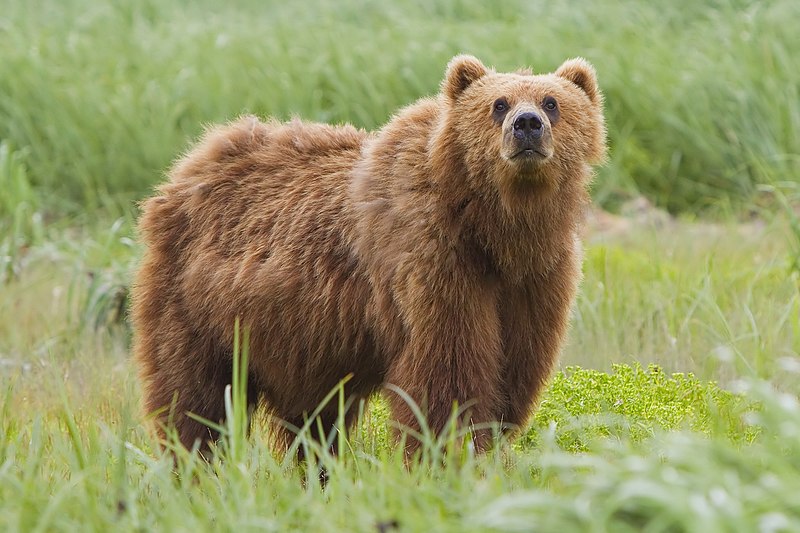
The law this bill repealed is an Obama-era regulation that prevented the hunting of bears and wolves on Alaskan federal lands unless it was deemed necessary to preserve the land’s refuge status. With the passage of this new law, bears and wolves can be shot from planes. They can be baited and shot. Cubs and pups can be killed in their dens, and mothers and their kids can be targeted and killed any time, any place.

As the former director of US Fish & Wildlife Services wrote in August of 2016, laws like this one are “purportedly aimed at increasing populations of caribou and moose but defies modern science of predator-prey relationships.” He was in favor of the Obama-era regulations that sought to protect predators on federal refuge lands. He stated that we should “ensure that predator and prey alike can thrive on our refuges.”

Why are bills like this, that so unfairly target predators–– going so far as to allow cubs and pups to be shot in their dens–– so popular among Republicans? The answer is the NRA, which backed this resolution. On the opposing side of the battle was the Humane Society, which urged Congress not to adopt the resolution.

One line in the NRA’s article about the law struck me as not only odd, but as an outright lie. They state that the ads the Humane Society aired in regards to the law are “falsely claiming that its repeal would allow for inhumane forms of taking bears and wolves.”

Is shooting hibernating bears in their dens not inhumane? Is chasing down bears from planes not inhumane? Is pulling the trigger on wolf puppies point-blank not inhumane?

The answer is obvious.

Now not only are the unethical and brutal murders of countless Alaskan bears and wolves legal, but the passage of this law suggests that we as a nation are okay with such inhumane actions. It also messes with the already fragile ecosystem, and will lead to the deaths of animals on refuge lands.

It is wrong, and I am deeply ashamed that it is now the law.

http://blog.timesunion.com/animalrights/animal-rights-in-the-trump-era-protecting-alaskan-wildlife/6512/

Trump Just Lifted A Ban On Shooting Bears And Wolves From Airplanes In Alaska

https://www.buzzfeed.com/salvadorhernandez/trump-just-lifted-a-ban-on-shooting-bears-and-wolves-from?utm_term=.dtVExXm7AZ#.hjE5KB39XE

An Obama-era rule prohibited the hunting of predator animals like bears and wolves in Alaska’s national wildlife refuges.

Posted on April 3, 2017, at 7:57 p.m.

Senate votes to lift limits on hunting Alaska grizzlies and wolves on federal land

 https://www.washingtonpost.com/news/energy-environment/wp/2017/03/21/senate-votes-to-lift-limits-on-hunting-alaska-grizzlies-and-wolves-on-federal-land/?utm_term=.6baf206d0e36
March 22

The Senate voted Tuesday to abolish a rule restricting specific hunting practices on national wildlife refuges in Alaska — including trapping, baiting and aerial shooting — on the grounds that state officials should be able to set the terms for wildlife conservation on public land within their own borders.

The 52-to-47 vote, which was almost entirely along party lines, represented the latest instance of Republicans using a powerful legislative tool — the Congressional Review Act — to eliminate regulations that President Barack Obama’s administration finalized before he left office in January. Independent Sen. Angus King (Maine) joined Republicans in backing the measure, and the measure needs only President Trump’s signature to become law.

With Trump’s support, congressional Republicans are working systematically to undo several environmental, labor and financial safeguards the previous administration put in place toward the end of Obama’s term. Under the 1996 law, any rule wiped off the books cannot be reinstated in a “substantially similar” form.

Although a disproportionate number of the regulations that have come under fire address energy and the environment, the larger debate has focused on whether the federal government has the right to establish sweeping rules Americans must live by or whether power should be devolved to the states.

During a sometimes-emotional debate Tuesday, Republicans and Democrats sparred over how best to define sportsmanship as well as state sovereignty.

Sen. Lisa Murkowski (R-Alaska) noted that the issue of managing wildlife “is something in Alaska that we take very, very seriously.” Recalling how she watched her grandparents and parents lobby for Alaska to become a state, she added, “It was all about fish, it was all about salmon. That’s one of the reasons we fought for statehood.”

But Sen. Martin Heinrich (D-N.M.), who spoke just before Murkowski, said the idea of allowing the killing of mother bears and cubs as well as denning wolves and pups would be putting “the federal stamp of approval on methods of take that the public views as unethical.”

“I don’t think that’s standing up for hunters,” he said. “I fear that it is endangering something that is critical to our culture and a way of life.”

Heinrich added that he had recently taken his 13-year-old son, Carter, on his first elk hunt, where “he soon learned that the hard work comes after you pull the trigger.” As his son painstakingly stripped the meat of the elk they had shot, the senator said, “Anything less would be unethical, and disrespectful to that magnificent wild animal.”

The National Rifle Association backed overturning the rule, as did the Alaska Department of Fish and Game and the Alaska chapter of Safari Club International. In mid-January the state of Alaska challenged the regulation, along with an earlier hunting rule issued by the National Park Service, in federal court.

Environmental and animal welfare groups, by contrast, lobbied against the measure.

For years the Alaska Department of Fish and Game and the U.S. Fish and Wildlife Service had negotiated on an annual basis how to establish hunting and fishing regulations for national wildlife refuges in the state, which encompass tens of millions of acres. But in 2013 the Alaska Board of Game, which is made up of political appointees, rejected the Fish and Wildlife Service’s proposed rules and instructed the state fish and game agency to write the regulations on their own.

In a statement after Tuesday’s vote, Sen. Dan Sullivan (R-Alaska) said that in his state, “many hunt for survival, both personal and cultural. Alaskans have been able to maintain these strong and life-sustaining traditions through a rigorous scientific process that allows for public participation and ensures we manage our fish and game for sustainability, as required by the Alaska Constitution.”

 But Ashe and other defenders of the rule said some of the changes envisioned by state officials, such as allowing people to fly into a place where grizzlies or caribou had gathered and begin hunting that day, could disrupt the natural predator-prey balance in the wild. Ashe warned that while some hunters may want to decrease the number of bears and wolves so that the numbers of other popular game species, such as moose and caribou, rise, there will be unintended ripple effects.

“There’s a natural tension between what the state wants to do, and what the federal law compels the Fish and Wildlife Service to do,” he said.

Outrageous Anti-Animal Acts Planned for Alaska

From: HSUS.org

Earlier this week, the U.S. Senate chose to turn nightmare into reality for animals living in our nation’s wildlife refuges — federal land in Alaska specifically set aside for them to thrive, not to become targets of inhumane and unsporting killing methods.

By a 52 to 47 party-line vote, Senators voted to repeal a 2016 U.S. Fish and Wildlife Service rule forbidding the most outrageous acts:

Black bears being caught in painful snare traps while foraging for food …

Wolf pups being shot point-blank in their dens …

Grizzly bears being chased by plane or helicopter before being shot down by trophy hunters …

All this cruelty and suffering for trophies.

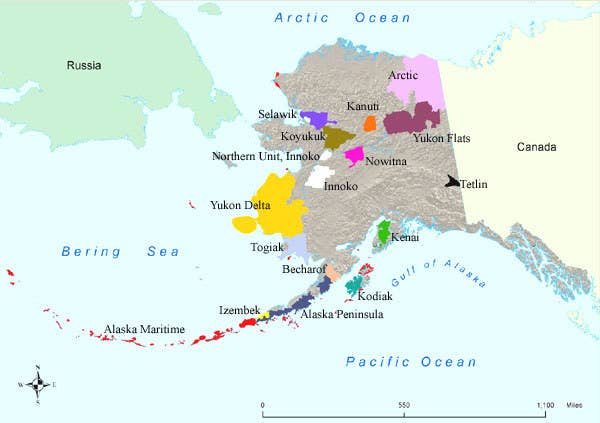
With this heartbreaking vote, Congress enabled 76 million acres of our national wildlife refuges to become killing fields for trappers, baiters and spring trophy hunters.

The politicians in Washington who voted to allow these cruel practices do not represent the views of regular Americans on animal welfare or wildlife conservation. They sided with the special interests who want to kill wolf pups and hibernating grizzly bears for pleasure.

And this is only one of the recent attacks on animals:

  • Congress is trying to cherry-pick wolves from the federal list of endangered species, exposing them to trophy hunting, commercial trapping and hounding.
  • The Department of the Interior will allow millions of birds and other animals to suffer from lead poisoning by reversing an order restricting the use of toxic lead ammunition on U.S. Fish and Wildlife Service lands.
  • Tennessee walking horses are still at risk of having chemicals burned into their skin until the anti-soring rule is unfrozen under the new administration.
  • And the U.S. Department of Agriculture has purged its website of government inspection reports on thousands of puppy mills, roadside zoos and other facilities.

Wildlife Services says it’s working to avoid future wolf harm

http://www.capitalpress.com/Oregon/20170315/wildlife-services-says-its-working-to-avoid-future-wolf-harm

Activists are harshly critical of the M-44 cyanide devices, which they say are extremely dangerous and kill indiscriminately.
by Eric MortensonCapital Press

Published on March 15, 2017 11:07AM

The state director for USDA Wildlife Services in Oregon said the agency has removed M-44 cyanide poison traps from “areas of immediate concern” following the unintended poisoning of a wolf in Wallowa County in February.

Director Dave Williams said Wildlife Services has reviewed what happened and shared that information with Oregon Department of Fish and Wildlife, which manages wolves in the state. The two agencies are in ongoing discussions about how to prevent another wolf death, Williams said.

“We don’t feel good about that,” he said.

Williams said Wildlife Services has removed M-44s from areas identified by ODFW as places wolves are present. ODFW officials confirmed that took place.

“We appreciate that Wildlife Services has voluntarily removed M-44s,” ODFW Wildlife Division Administrator Doug Cottam said in a prepared statement.

“We also recognize we want to increase our communication between our agencies,” he said. “We want to develop a more effective system to ensure that Wildlife Services’ staff working in areas with wolves know what ODFW knows about wolf activity.”

OR-48, a 100-pound male from the Shamrock Pack, died Feb. 26 after it bit an M-44 device, which fires cyanide powder into a predator’s mouth when it tugs on a baited or scented capsule holder. Wildlife Services set the trap on private land in an attempt to kill coyotes.

The federal agency kills predators or other wildlife that damage or pose a threat to property, livestock or humans. The agency describes M-44s as an “effective and environmentally sound wildlife damage management tool,” but the wildlife activist group Predator Defense calls them notoriously dangerous.

The devices are designed to kill canids such as coyotes and foxes. The cyanide powder reacts with saliva in an animal’s mouth, forming a poisonous gas that kills the animal within one to five minutes. Brooks Fahy, executive director of Predator Defense, said M-44s indiscriminately kill dogs attracted by the scent and are a hazard to children or others who might come across them in rural areas.

The Wallowa County incident is complicated by Oregon’s management and protection of gray wolves over the past decade as they entered the state from Idaho, formed packs, quickly grew in population and spread geographically.

Previously, Wildlife Services did not use M-44s in what the state designated as Areas of Known Wolf Activity. After wolves were taken off the state endangered species list in 2015, it was ODFW’s understanding that Wildlife Services would continue to avoid using M-44s in such areas.

“We discussed our concerns specifically regarding M-44s,” ODFW spokesman Rick Hargrave said last week. “We didn’t want those devices in those areas.

“We believed it was clear what our concerns were,” Hargrave said.

Williams, the Wildlife Services state director, said he wants to focus on preventing another wolf death rather than “who messed up here.”

He said the Wallowa County case was the first time the agency has killed a wolf in Oregon. Overall, the agency has recorded “lethal take” of “non-targeted” animals — ones it didn’t intend to kill — in 1.3 percent of cases, he said. He said the agency twice unintentionally caught Oregon wolves in foothold traps, which nonetheless allowed ODFW to put tracking collars on them before releasing them unharmed.

“Some of our tools are more forgiving than others,” Williams said.

He said Wildlife Services puts on workshops to help ranchers protect livestock with non-lethal methods. In one case two summers ago, agency personnel spent 260 hours over four weeks helping protect a sheep flock from Umatilla Pack wolves, he said. The work allowed ODFW to avoid having to kill wolves due to depredations, he said.

Meanwhile, the Oregon Cattlemen’s Association views the Wallowa County incident as a matter of agency to agency interaction and is “staying on the sidelines” in the investigation, said Todd Nash, a Wallowa County rancher who is the group’s wolf policy chair. Livestock producers, of course, have a keen interest in the state’s wolf management policies and outcomes.

“It’s never a good time politically to have a dead wolf,” Nash said.

Midwest, Wyoming lawmakers target wolf protections again

 https://www.washingtonpost.com/national/energy-environment/midwest-wyoming-lawmakers-target-wolf-protections-again/2017/02/26/5e4ce15c-fc50-11e6-9b78-824ccab94435_story.html?utm_term=.73e2d4001ac9
February 26
MINNEAPOLIS — Pressure is building in Congress to take gray wolves in the western Great Lakes region and Wyoming off the endangered list, which would allow farmers to kill the animals if they threaten livestock.

Representatives from Minnesota, Wisconsin, Michigan and Wyoming have asked House Speaker Paul Ryan of Wisconsin for a fast floor vote before the season during which most cows and sheep will give birth begins in earnest. That followed testimony before a Senate committee a week earlier from the president of the Wisconsin Farm Bureau Federation, who said producers need to be able to defend their livestock and livelihoods.

Meanwhile, both sides in the debate are waiting for a federal appeals court to decide whether to uphold lower court rulings that put wolves in the four states back on the list or to let the U.S. Fish and Wildlife Service return management of the species to the states, which it has wanted to do for years.

Here’s a look at some of the issues:

THE LETTER

 U.S. Rep. Collin Peterson of Minnesota, the ranking Democrat on the House Agriculture Committee, sent a letter co-signed by seven of his colleagues from the four states to House leaders urging a quick floor vote on a bill to return their wolves to state management. A key component of both is language that would prevent the courts from intervening.

The representatives said it’s urgent because calving season is when cows and calves are most vulnerable.

“As you know, cows and their calves can easily be worth several thousand dollars, so each instance of a wolf attack has devastating economic impacts on ranchers and their families. Currently, ranchers and farmers have no legal actions available to deal with gray wolf attacks because these predators are federally protected,” they wrote.

Peterson said in an interview that they very nearly passed a similar provision in the last Congress and that he thinks they have a decent shot at persuading Ryan to grant an early floor vote. Otherwise they’ll try to attach the language to a bigger appropriations bill later. The legislation is similar to what Congress used to delist wolves in Montana and Idaho in 2011 after courts blocked the federal government’s attempts to lift protections in those states.

“Wolves are not endangered,” Peterson said.

THE HEARING

The Senate’s Committee on Environment and Public Works held an informational hearing Feb. 15 billed as “Modernization of the Endangered Species Act.” Jim Holte, president of the Wisconsin Farm Bureau Federation, complained that it’s been illegal for farmers in the region to kill wolves that prey on their livestock since wolves went back on the list.

“As wolf populations continue to increase, interactions between farmers, their livestock, rural residents and wolves continue to escalate without a remedy in sight,” Holte testified.

THE COURTS

The U.S. Fish and Wildlife Service has long contended that wolves in Minnesota, Wisconsin, Michigan and Wyoming have recovered to the point where they’re no longer threatened, so hunting and trapping can be allowed under state control.

Gray wolves were once hunted to the brink of extinction in the lower 48 states, but they recovered under Endangered Species Act protections and reintroduction programs to the point where they now number around 5,500, according to the service. The combined gray wolf population of the three western Great Lakes states is now about 4,000, while Wyoming has roughly 400. The agency describes wolf numbers in those states as “robust, stable and self-sustaining.”

But federal courts have blocked multiple attempts to take them off the endangered list, most recently in 2014. The U.S. Court of Appeals for the District of Columbia Circuit last fall heard oral arguments in challenges to those rulings but hasn’t ruled on them yet.

THE OPPOSITION

Groups that support the federal protections say it’s premature to lift them because wolves are still missing from most of their historical range. They’ve been able to persuade the courts that the terms of the Endangered Species Act requires recovery in more than just a few states, even though the Fish and Wildlife Service disagreed.

Brett Hartl, government affairs director of the Center for Biological Diversity, said he’s skeptical that the latest congressional efforts will get much traction. He said Peterson and the other representatives who sent the letter are just sending a message to their constituents that they’re still trying.

Wisconsin Republicans Ask Congress To Remove Wolves From Endangered Species List– Lawmakers Are Hopeful President-Elect Donald Trump Will Help Effort

Wisconsin Republicans Ask Congress To Remove Wolves From Endangered Species List

Lawmakers Are Hopeful President-Elect Donald Trump Will Help Effort
Thursday, November 17, 2016

Republican state legislators Tom Tiffany and Adam Jarchow are again asking Congress to remove gray wolves from the endangered species list and they’re hopeful President-elect Donald Trump will help make it happen.

A letter from the lawmakers calls on Congress to overturn a federal judge’s decision and remove the gray wolf from the endangered species list in Wisconsin, Minnesota and Michigan. That way the states can manage their population through hunting. Sen. Tiffany said the election of Republican Donald Trump could add momentum to their cause.

“I can’t speak for the Trump Administration, but I would think that they are more amenable to delisting. So, I think it moves the needle in the right direction,” Tiffany said.

Republican legislators enacted a state wolf hunt in 2012 but that was blocked in 2014 when a federal judge places the great lakes gray wolf back on the federal endangered species list.

Rep. Adam Jarchow said he’s hopeful federal lawmakers will listen to rural citizens and again let Wisconsin and others use hunting to control the wolf population.

“The people of rural Wisconsin and rural America in general are crying out for legislators in both Madison and Washington to pay attention, and a very important issue to people in rural Wisconsin is being able to have an opportunity to manage the wolf,” Jarchow said.

Jarchow and Tiffany have also called on U.S. Sen. Tammy Baldwin to support delisting gray wolves. In 2011, Baldwin said she supported removing the wolf from the endangered species list.

Republican Fatwa

by Stephen Capra

We shall defend our island, whatever the cost may be, we shall fight on the beaches, we shall fight on the landing grounds, we shall fight in the fields and in the streets, we shall fight in the hills; we shall never surrender.Winston Churchill

The election that could not happen has occurred. Republicans were handed a miracle victory by the caliph known as Trump whose singular purpose appears to be the destruction of democracy. Like Jim Jones, the rogue minister who famously had his entire flock drink poisoned Kool-Aid, Trump has his sights on the destruction of America and the world as we know it. But it’s not Trump alone, it is the raging force of evil that defines the Republican Party and their hate and loathing for the freedom that is our natural world. With this unimaginable victory, they now will set their sights as Ronald Reagan, Bush one and two did, but with a zeal that we have likely never witnessed on the destruction of wildness. We must build the trenches and fortify our souls, for this is a fight to the death for all we love and understand. It is a fight for our planets survival.

In the days since the implosion of the Democratic Party, we are beginning to understand our new reality through the fog of war, Republican operatives are moving quickly to get a cabinet in place and move their radical and devastating agenda into the mainstream.

Trump is moving with haste to remove America from the global agreement to limit climate change, calling climate change a hoax. In quitting the Paris agreement that has been ratified by close to 200 nations, America risks setting a new precedent and unraveling the very accord, which while not perfect, is the linchpin for saving the planet.

Cabinet specific:

Secretary of Interior: Lucas oil founder, Forrest Lucas has had the inside track. Lucas has paid for films that support puppy mills, elephants in circuses and would likely set the tone as an Oil Executive on the agencies priorities on climate change. Sara Palin (drill, baby drill!) has been a name many are talking about; Trumps sons, the elephant killers and gun lovers, have also been mentioned. If this occurs, Democrats MUST Filibuster the nomination and try and avoid cloture, which would require 60 votes. No nomination is more vital to our National Parks, Wilderness Areas, and Wildlife Refuges and for protecting wildlife than this choice. Frankly, Democrats should simply fight any appointment for the duration of this administration, taking a page from Republicans.

Energy: Trump is looking at fracking billionaire Harold Hamm who Trump greatly admires. He has made clear he wants an energy secretary that will slash regulations on energy producers and open more lands for development.
Department of Agriculture, which controls our National Forests, could be run according to Politico by one of two men: bio-fuels Baron Bruce Ramstetter, a close friend of Chris Christie, or Texas Agriculture Secretary Sid Miller who earned his credibility with Mr. Trump by calling Hillary Clinton a “cunt” on his twitter account during the campaign. He also gave amnesty to a cupcake to protest healthy food for school children. Trump has also created an Agriculture advisory committee. It includes as my fried Melissa Smith has pointed out, members like MI Sen. Mike Green, who said in a committee meeting on wolf hunting that, “he knows several people that have been eaten by wolves.” He went on to say-“Let’s get those public lands opened up to grazing, get rid of those predators now.”
Republicans will try to end the Environmental Protection Agency, remove endless regulations for Power Plants and destroy funding for alternative energy development, while handing out even more subsidies for coal, nuclear and oil. Climate Change will likely be ignored, treaties ignored and more misinformation will fill the airwaves to a nation of people increasingly removed from the natural world.

Republicans in the west, primarily Utah, Idaho and Wyoming will push for the selling off of public lands and move aggressively to end, once and for all, the Presidents use of the Antiquities Act, which has been responsible for protecting so many important land and marine environments since the days of Teddy Roosevelt. The reality is, they control all three branches of government and only the filibuster and tremendous public outcry can stop their rampage.
Trump has been elected in a unique and powerful manner. He is not in truth beholden to either party, but he needs the support of one to move his agenda. In two years when the party that does not control the Presidency often makes big gains in congress, Democrats must defend a staggering 25 Senate seats, many in states Trump won, making taking control of the Senate in 2018 difficult.

Rarely have we faced such long odds and the prospect of such damage to our sacred trust. While historically we have been able to fight off many of these assaults, republicans have learned from the days of Jim Watt and will likely come with an immense war chest, courtesy of the Koch Brothers, Big Oil and their friends in the coal and nuclear industries.

The conservation community must move aggressively and Democrats, including those 25 up in 2018 must hold firm, this goes beyond one person’s reelection, this is a fight for our children, a fight for sanity! Democrats have been far too timid on conservation issues, voting correctly, but doing so without the emotion, drive and confidence that show on a host of other domestic issues.

Wolves, bears and so many species that define wildness will be ground zero in the rancher’s wish list, look for funding for Wildlife Services to jump, a push to further control or denude the Bureau of Land Management. More illegal actions like the Bundys and threats to government control of public lands will likely come from fringe groups emboldened by the recent acquittals and Republicans fanning the flames of their illegal actions.

More than anything this band of Republicans, led by speaker Ryan, encased with the dreadful ignorance of Rep. Steve Pearce and his band of yahoos from the west must be crushed and publicly shamed in such a forceful manner, that they retreat from their continue assault on the liberty and beauty we all enjoy with our public lands and wildlife.

To see this as anything short of a declaration of war is to be blissfully ignorant. The actions of this congress and our newly elected President are designed to break the power and spirit of conservation in America. To hasten the demise of our planet and the many species which depend on our decisions for life. To turn wildness into roads, oceans into acid, to drown the great bears of the north, to fill more lands and waters with the suffering of animals that ask why?
The answer is to enrich a few, to poison the many, to ignore the obvious. We have elected a man who does not respect people and walks through life devoid of morality. How can we anticipate any more for the environment and the diversity it defines in his coming Presidency?

For the planet to survive, we cannot regress every four or eight years. We need both parties, not just one to embrace the environment. That is going to require a revolution in the republican party of today. Without it we are destine to repeat ourselves in cycles of destruction, which is the definition of insanity.

Trump has fooled us before and may again: I hope so. But the lineup he is creating is perhaps the most life-threatening for the planet we have witnessed. We as a nation have hit the bottom, so now we can begin the steady climb back up. We begin with an understanding that we must fight. All of us together for the land, the great animals that define our lives, for the freedom that is wildness and the planet we all cherish. Evil cannot win. But we must be strong, loud and demand justice if we are to prevail.

That is our fatwa for the earth.

So what can be done?

  • It begins with a coordinated and aggressive push to educate the public and to make the environment a key issue with the new Administration. That will not be easy given the array of disturbing issues we face with this President and congress;
  • Protest, often and loudly;
  • The use of the filibuster will be essential;
  • President Obama must take the last days of his Presidency to make the Arctic National Wildlife Refuge a new National Monument. Ditto for the Bears Ears in Utah. If he does not, the refuge in particular will be lost to oil and gas development, destroying what many call America’s Serengeti. He would also be wise to look at another marine environment that could be threatened by drilling;
  • Fight on a local level;
  • Visits to all members of congress and send strong words to Democrat members will be essential to make sure they do not “trade off” environmental concerns for other legislative initiatives;
  • Accept no compromise. These Republicans are trying to destroy our public lands, this is treason;
  • Demand more from the Media. It is not enough to show both sides, you must do the hard work of telling the truth to viewers, readers and listeners;
  • Become a voice for wildness;
  • Give until it hurts: we need support.

What will Bold Visions Do?

  • We are going to be the strongest voice possible to fight this Administration;
  • We will continue to get out to the public to educate them about the reality of a Trump Administration;
  • We will push the media and have our voice be heard;
  • We will continue to write and produce films that are thought provoking and work to protect our lands, waters and wildlife;
  • We will meet with elected officials to press for environmental and wildlife sanity;
  • We will continue to come up with creative ways to voice our opposition to the undermining of our wildest public lands;
  • We will work with other conservation groups in a unified manner to fight this battle;
  • We will never surrender.

Hillary Clinton taps former Colorado Sen. Ken Salazar to lead White House transition team

WASHINGTON — Hillary Clinton on Tuesday named former U.S. Sen. Ken Salazar of Colorado as the chairman of her White House transition team — a job that puts him in prime position to join Clinton’s administration if she wins the election.

As head of a lineup that includes former Michigan Gov. Jennifer Granholm and former National Security Adviser Tom Donilon, Salazar will be in charge of vetting potential agency leaders and officials, as well as consulting with President Barack Obama’s administration on issues ranging from the economy to national security.

“Once Hillary Clinton makes history by being elected as the nation’s first woman president, we want to have a turnkey operation in place so she can hit the ground running right away,” Salazar, a Democrat, said in a statement released Tuesday by the Clinton campaign.

While transition teams are nothing new, their role has become increasingly official in recent years. Salazar’s team will meet regularly with the administration and use work space provided by the General Services Administration. New Jersey Gov. Chris Christie was tapped in May by Donald Trump for a similar assignment.

Clinton’s selection of Salazar is not a complete surprise, said Colorado Democrats who know both politicians. Salazar has been a longtime Clinton supporter — hosting a campaign event for her last fall — and he was mentioned as a possible running mate in the early months of the 2016 presidential campaign.

Clinton and Salazar have a history, too. Not only did they serve together in the U.S. Senate, the two politicians both were Cabinet officials under Obama: She with the State Department and he with the U.S. Department of the Interior.

“My perception is that Secretary Clinton and Secretary Salazar built a strong relationship when they both were serving in the Cabinet,” said Steve Bachar, a member of Clinton’s National Finance Committee. “They gained a lot of mutual respect and when Secretary Clinton announced her candidacy for president, Ken stepped in to be as helpful as he could in every way he could.”

Although Clinton ultimately selected U.S. Sen. Tim Kaine of Virginia as her pick for vice president — over Colorado Gov. John Hickenlooper — the transition team could provide Salazar a road back to Washington if he wants it.

More: http://www.denverpost.com/2016/08/16/ken-salazar-hillary-clinton-white-house-transition-team/

A Win for Alaska Wildlife

03 August 2016

New rule from U.S. Fish and Wildlife Service helps protect carnivores from aggressive hunting on national wildlife refuges in Alaska

Wolves, bears and other carnivores are too frequently threatened by government policies aimed at artificially increasing populations of moose, deer and other game species for hunting. In Alaska, even living on a national wildlife refuge could not prevent predators from being shot from a plane or killed in their dens in the name of boosting prey populations. Until today.

The U.S. Fish and Wildlife Service stood strong for iconic wildlife today with a new rule to conserve native carnivores on national wildlife refuges in Alaska. The rule forbids certain aggressive hunting practices like aerial gunning, trapping bears, killing mother bears and cubs, and killing denning wolves with pups. These tactics have no place on the 16 federally protected wildlife refuges in Alaska, which exist first and foremost to conserve species in their natural diversity. This is a huge win that will help protect the ecological integrity of these public lands, and ensure that our national wildlife refuges are managed for all wildlife.

Stand Strong with FWS

Special interests in Congress are already advancing measures to block this important new rule. Show your support by telling FWS you stand with their decision to protect iconic predators by preventing these inhumane killings.

Show your support »

Carnivores are critically important to wild lands, and help keep ecosystems in balance. Alaska’s national wildlife refuges span more than 76 million acres and encompass some of the largest and most remote wildlife habitats remaining in the United States. These vast areas are ideal for wide-ranging and large animals like wolves and bears.

Anti-wildlife representatives in Congress and Alaska’s state government have been fighting this rule since it was first proposed in January, and will surely continue to do so. We commend the Fish and Wildlife Service for finalizing this important rule, which upholds bedrock environmental laws like the National Wildlife Refuge System Improvement Act and the Wilderness Act. This action sends a clear message that science, not politics, governs our public lands.