From the Mouths of Psychos

What a strange era this age of social media is. Any idiot can start a Facebook page on just about any sick subject under the sun. There, as humane activists have found out time and again, they can get away with saying whatever they want about what they’d like to do to non-human animals. Things they could never say about humans are fair game to say about non-human animals.

Facebook does not monitor or police any of the horrid anti-animal sites out there; even the lowest gutter-dweller can receive encouragement in the form of “likes” for the perverse and abusive statements they come up with to voice their disdain for animals such as wolves.

This blog, on the other hand, is monitored to weed out comments like this one I just received from someone identifying himself only as “Bucksmasher” (typos are his):

“Wolves are no good. They serve no usefull purpose. They are not endangered as a species ,they never have been. The ESA listing in the US is a fraud. Wolf huggers are mentally sick. They cry when they hear about a wolf being shot but they have no sympathy for the the deer fawns and elk calves…”

Sure we do–we have a hell of a lot more sympathy for deer and elk than someone using the demented handle “Bucksmasher.”

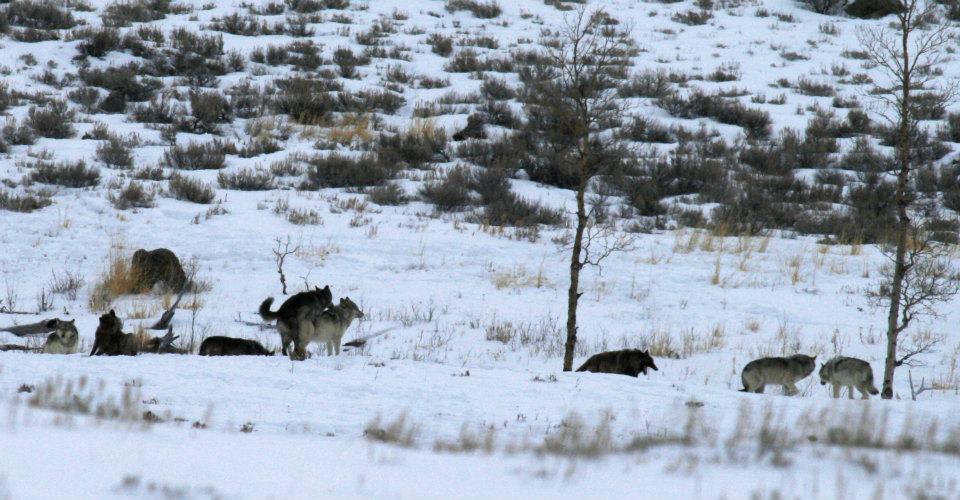
Here are some of the outrageous comments found on one of the many anti-wolf Facebook pages, in this case calling itself “Save Western Wildlife” (which to them obvious means, “Kill all the wolves so hunters have more ‘game’ for themselves.”)  Their comments are in reference to this photo of Yellowstone wolves, whom they threaten to shoot within the park…

Mating wolves

Save Western Wildlife

We are after breeding pair. Do you know where they are?

Like · · Share · March 11

77 others like this. 19 shares.

March 11 at 9:58pm

Why are they still alive

March 11 at 9:26pm via mobile · Like · 2..

Save Western Wildlife They are in Yellowstone!

March 11 at 9:30pm · Like · 3..

Shitty!

March 11 at 9:32pm via mobile

I want them both!

March 11 at 9:36pm via mobile

Are ya saying your gun doesn’t work in the park??

March 11 at 9:37pm · Like · 1..

Some one shoot quick!

March 11 at 9:41pm · Like · 1..

Well mabey the government will shut down do we can hunt wolf’s in the park

March 11 at 9:45pm via mobile · Like · 3..

Idaho come help kill all of them!

March 11 at 9:50pm via mobile · Like · 3..

I bet if you shot them all you would get the breeding pair.

March 11 at 9:58pm · Like · 2..

Well hell. Shoot them all anyway.

March 11 at 10:08pm

id drop the one on top. it always sucks when someone ruins your bust a nut groove

March 11 at 11:24pm

Need a machine gun instead of camera

March 11 at 11:35pm via mobile · Like · 4..

I see there’s one less bull elk as well going by the bone sticking up on he far right, which must leave 3 left! I seen on the news last night that the count showed good herd numbers. I guess those counters have better eye sight than the tourists and hunters that have a hard time finding them.

March 12 at 6:08am via mobile · Like · 2..

I don’t know were they r if did they be ded

March 12 at 6:31am via mobile

Why can wolf lovers get pics like these…..put me that close, and park or not there will be gunfire

March 12 at 7:51am via mobile · Like · 1..

there would be wall to wall carpet in my den if i was there with my ar 15 wack um an stack um…..

March 12 8:09am

Well when Obama run our country to the point of government shut down we will go to Yellowstone and get them. Until when you drive through Yellowstone just throw chunks of meet with lead in then. You know lead meatball.

March 12 at 12:20pm

X them all

March 12 at 1:10pm

they fck like rats ,need to kill um before all the deer and elk are gone… NO JOKE CHAZ MAN…. just look at the picture… 10 pups in a few months

March 12 at 3:57pm

They are/WERE IN MY SCOPE! Cant say where now..

March 12 at 6:30pm

Get those fckin things in my scope…fur will be a flying!!!….Click, Click, Click….BOOOOM!!!

March 12 at 6:55pm via mobile

If they were in my scope they’d be DEAD.

March 12 at 6:57pm · Like · 1..

Wolf introduction is totally criminal

March 13 at 6:46am via mobile · Like · 2..

Ask WDFW, they released them throughout WA State.

March 14 at 11:11pm · Like · 1..

Just blow away the smaller one….aim for the females.

March 17 at 2:27pm · Like · 1..

if you are taking pictures carry a gun and shoot some especially when you see this taking place..

March 18 at 7:54pm

Back in my car!

March 19 at 12:18pm

you should be packing a mini 14 with a 30 round clip not that camera..

High Time to Send the Cowboys Packing

The sad story of wolf “recovery,” since their unjust removal from the federal Endangered Species list in the Northern Rockies and Great Lakes states, reminds me of some Western b-movie wherein trigger-happy cowboys and corrupt cattle ranchers ride into a peaceful town, oust the sheriff and replace order with chaos, clear-headedness with insanity and serenity with violence.

So unprecedented is the ongoing slaughter of an endangered species immediately on the heels of their purported recovery that I can’t think of any situation to compare it to. The only hypothetical analogies I can think of is if the U.S. resumed full-scale whaling or sealing the day after those animals recovered or allowed people to shoot recently endangered eagles again, lest they prey on someone’s chickens.

After all, eagles are predators, aren’t they? Well, yes, sometimes, but they’re also the symbol of our country.

Wolves too are symbols. To those who revere wilderness, wolves represent nature unspoiled—a time before the merciless reign of humankind. But to wolf-haters, they are symbolic of something scary—the eventual evolution beyond their avaricious way of life.

Caught in the middle are the wolves themselves; all they want is the freedom to roam and their fair share of what has always been theirs—before human politics turned them into a bone of contention.

It’s high time some gunslinger-with-no-name drifted into town and sent those wolf-killing cowboys packing.

Text and Wildlife Photography ©Jim Robertson, 2013. All Rights Reserved

Text and Wildlife Photography ©Jim Robertson, 2013. All Rights Reserved

Wolves Getting Booted Back to the Brink

When an activist friend asked me to write an overview of the wolf situation, my first thought was: “What a daunting and extremely depressing task that would be.” But having followed the wolves’ story since long before their reintroduction to Yellowstone and the Idaho wilderness, I suppose it’s only natural that I take this on. After all, I’ve covered the issue many times in articles, on my blog, and I devoted two chapters of my book, Exposing the Big Game: Living Targets of a Dying Sport, to the plight of wolves.

At the time I wrote the book’s chapter, “From the Brink of Oblivion and Back Again,” wolves were still federally protected and their removal from the Endangered Species List was just someone’s bad idea that had yet to see its dark day—I never quite realized just how apt that title would soon be. Until recently I remained hopeful that any wolf hunting would be strictly monitored and regulated, and that abusers would be fully prosecuted. Frankly, I thought we would be a little more evolved as a species by now.

But time and again states have proven themselves unworthy by declaring open seasons on wolves, without regard for the species’ future or for the welfare of individual wolves. Indeed, the ongoing warlike attack on wolves is anything but sporting or humane, with kill methods ranging from traps and snares to aerial hunting, running them down with dogs or luring them in and sniping at entire packs with semi-automatic rifles—depending on a given state’s predilection. At the same time, many hunters and trappers go out of their way to express their hatred for wolves through horrific acts of overkill. They seem to take sick pleasure in further degrading their victims by glibly posing in morbid photos of trapped or bloodied wolves, then spreading their snuff shots across the internet, fishing for praise, while taunting wolf advocates.
Text and Wildlife Photography ©Jim Robertson, 2013. All Rights Reserved

Text and Wildlife Photography ©Jim Robertson, 2013. All Rights Reserved

For thousands of years, wolves played a central role as keepers of nature’s balance across the American landscape. Wolves are the personification of untamed wilderness; their presence is a sign of an ecosystem relatively intact.

But bigotry toward wolves has thrived across the country since colonial times and wolves have long been the object of unwarranted phobias. Today’s wolf-haters panic at the thought of natural predators competing for “their” trophy “game” animals and loath anything that might threaten their exploitive way of life. They view the federal government as the enemy in their ongoing combat against wilderness, and grasp for local control of species like wolves, who, until recently, were all but extinct in the continental U.S. Far from being their foe however, the federal government has actually been a fervent ally.

The contentious removal of wolves from the federal endangered species list—long before they were truly recovered—was a coldly calculated course set in motion by the Bush Administration, dutifully followed by the Obama Administration and rendered the law of the land through an underhanded act of Congress in 2011. This crooked covenant, conjured up for the sake of ranchers and trophy hunters, left the wolves’ fate in the custody of hostile western states…and fits right in with a centuries-old, historic norm.

In 1630, Puritans of the Massachusetts Bay Colony—known for holding the first Thanksgiving Day celebration…and Salem witch hunts—felt biblically impelled and duty-bound to “subdue the earth.” Hence, they were the first to establish a bounty on wolves. Soon the other colonies followed their example and set bounties of their own, and a systematic genocide of wolves in America spread west with the “settling” of the land.

In 1818, Ohio declared a “War of Extermination” against wolves and bears. Iowa began their wolf bounty in 1858; in 1865 and 1869 Wisconsin and Colorado followed suit. State by state wolves were shot, trapped and poisoned to extinction. As the demand for wolf pelts increased, “wolfers” began killing grazers like elk or bison and poisoning the meat as bait, decimating whole packs of unsuspecting canines in one fell swoop.

By 1872, the year President Grant created Yellowstone National Park, 100,000 wolves were being annihilated annually. 5,450 were killed in 1884 in Montana alone, after a wolf bounty was initiated there. By the end of 1886, a total of 10,261 wolves were offered up for bounty (sixteen times Montana’s 2011 population of 653 “recovered” wolves). Wyoming enacted their bounty in 1875 and in 1913 set a penalty of $300 for freeing a wolf from a trap.

Not to be outdone, the US government began a federal poisoning program in 1915 that would finish off the rest of the wolves in the region—including Yellowstone. By 1926 wolves had been completely extirpated from America’s premier national park.

Having no more regard for wolves than those who originally caused their extinctions, willfully-ignorant wolf-haters in the tri-state area of Idaho, Montana and Wyoming have not received their reintroduction with open arms but rather with loaded arms, hoping to turn the clock back to the dark ages of centuries past. The posture they assume on the subject of wolves is as warped and ill-informed as any Massachusetts witch hunter’s.

With the wolf population in the tri-state area at only a fraction of its historic sum, the federal government unceremoniously removed them from the endangered species list (and consequently from federal protection) in 2009, casting their “management” (read: eradication) into the clutches of eager states that wasted no time implementing wolf hunting seasons. Montana quickly sold 15,603 wolf permits, while their confederates in Idaho snatched up 14,000 permits to hunt the long-tormented canids.

For its part, Wyoming has stubbornly held to a policy mandating that wolves be shot on sight anytime they wander outside Yellowstone, allegedly to safeguard range cattle (who are actually 147 times more likely to fall prey to intestinal parasites). Wolves have killed a grand total of only 26 cows (out of 1.3 million head of cattle in the state). Still, the livestock industry is in control of their wolf management decisions. Though hunters there have killed 74 wolves this season, as of March 1st the state of Wyoming has expanded and extended its season indefinitely, declaring an open, year-round hunt on them. Winter, spring and summertime hunts are particularly harsh since this is when wolves are denning and raising their newborn pups.

On the other side of Yellowstone, the disingenuously but suitably named “Idaho Anti-Wolf Coalition,” backed by a well-funded trophy elk hunting industry, filed and circulated an initiative petition in 2008 calling for the removal of “all” wolves there “by whatever means necessary.” Fortunately, even in the state famous for potatoes, militias and neo-Nazi compounds, they failed to gain enough public support to move forward with their avaricious initiative. Even so, the Idaho government has been quietly carrying out the “whatever means” approach by adding aerial hunting, trapping, snaring and baiting to their wolf devastation arsenal. This last season, 169 wolves were killed by trophy hunters in Idaho, while trappers there claimed the lives of 76.

It should come as no great jolt that Idaho hunters felt they could get away with asking for the renewed obliteration of an entire species—their governor, “Butch” Otter, publicly proclaimed he hoped to be the first to shoot a wolf as soon as they lost federal ESA protection. Failing that, Otter used his gubernatorial powers to declare his state a “wolf disaster area,” granting local sheriffs’ departments the power to destroy packs whenever they please.

“Meanwhile,” according to Defenders of Wildlife’s president, Jamie Rappaport Clark, “the federal government is sitting idly by as Idaho almost singlehandedly unravels one of our nation’s greatest wildlife conservation success stories. This is totally unheard of—never before has a species climbed its way back from near extinction only to be quickly decimated once again.”

Montana started out seeming to be the sensible state, appearing almost tolerant of wolves. But between their state legislature and their wildlife policy makers, they’ve made an about face and quickly caught up with their neighbors, displaying a total disregard for the public trust doctrine which holds that wildlife, having no owners, are res communes, belonging “in common to all of the citizens.” They’ve recently passed bills barring any protected zones outside Yellowstone Park, while legalizing silencers for wolf hunting and the use of recorded calls to attract wolves, as well as allowing five wolf tags per hunter, 12 years and older. (And a new state bill is proposing lowering the legal age of hunters to nine years old.) Legislators also proposed a cap of 250 on their state wolf population. Last year’s wolf hunt kill totals for Montana were 128 wolves shot to death and 97 killed in traps.

Text and Wildlife Photography ©Jim Robertson, 2013. All Rights Reserved

Text and Wildlife Photography ©Jim Robertson, 2013. All Rights Reserved

Since Congress stripped wolves of their Endangered Species status, an estimated 1,084 wolves have been killed in the Northern Rockies. Again, that’s ONE THOUSAND AND EIGHTY-FOUR living, breathing, social, intelligent wolves killed by scornful, fearful, vengeful and boastful hunters and trappers, often in the most hideous ways imaginable.

Thanks to a federal judge’s 2010 decision, the wolf was granted a one-year stay of execution. But in 2011 our federal legislators on Capitol Hill attached a rider to a budget bill circumventing that judgment. This serpentine, backbiting end-run around science and public opinion played right into the hands of anti-wolf fanatics in Idaho and Montana and cleared the way for the bloodiest butchery of wolves in almost a century. Case in point: the opening week of Montana’s nascent hunting season on wolves saw sportsmen set up just outside the park boundary gun down every adult in Yellowstone’s well-known and much-loved Cottonwood pack, leaving their dependent pups to starve.

As if that weren’t enough, on December 6, 2012, the familiar, radio-collared alpha female of the park’s Lamar Canyon pack was shot and killed by a hunter. Suddenly the average American was aware of the atrocities of wolf hunting, yet in spite of widespread public outcry, wolf-killing states have stepped up their single-minded assault.

Wyoming’s expanded wolf-killing season is all the more tragic given that spring is the time of year that wolves are denning. As Defenders of Wildlife points out, “This expanded hunt puts the most vulnerable population of wolves – pups and pregnant or nursing mothers – in greater danger of being shot on sight. This kill-at-will approach is exactly the kind of flawed policy we knew would happen if wolves prematurely lost their Endangered Species Act protection – this is why Defenders is suing the U.S. Department of Interior to restore ESA protection for wolves in Wyoming.”

It’s not like the administration didn’t know what might happen when the fate of the wolves was turned over to states with extreme anti-wolf plans already in place. In just two years nearly 1,100 wolves have been ruthlessly murdered by hunters and trappers eager to relive the gory glory days of the 1800s.

All this is going on in spite of well-documented proof that wolves are beneficial to a given environment, and despite the fact that the majority of Americans, including most visitors to Yellowstone and the tri-state area, want to see wildlife unmolested. They are not there to hunt—the money they spend reflects their strong interest in the quiet enjoyment of nature. A 2011 National Park Service report shows that the 3,394,326 visitors to Yellowstone spent $332,975,000 in communities surrounding the park. But these figures could drop dramatically if Yellowstone wolves continue to be slaughtered.

Yellowstone is fertile ground for watching and learning about wolves. Biologists studying the Yellowstone ecosystem have found that since their reintroduction to the park, wolves have kept elk herds on the move, thus allowing over-browsed streamside riparian habitats to regenerate. Among the species that rely on a healthy riparian zone—and therefore benefit from the presence of wolves—are moose, trumpeter swans, warblers, wrens, thrushes, beavers, muskrats and the Yellowstone cutthroat trout. Everywhere they’re found, wolves play an important role in maintaining the health of ungulate herds by preying primarily on infirm or diseased animals, ensuring a healthy gene pool. And the remains of their kills provide a welcome relief for hungry scavengers, from bears to ermine to wolverines to bald eagles.

But the number of animals killed by wolves is grossly overplayed by their detractors. According to Yellowstone National Park data for 2011, project staff found that wolves barely took a bite out of Yellowstone’s rich and varied biota. And it’s long been established that wolf populations, left alone, are self-regulating; data from Yellowstone backs that up as well. Like humans, when they feel the pinch of too many of their own kind in a given area, they start to turn against one another. 2011 saw seven wolves killed in intra-pack quarrels. Yellowstone’s fluctuating wolf population has declined from 174 in 2003 to around 80 in 2012. Since then, hunters and trappers targeting wolves along the park’s borders have brought the current population down to the low 70s, as of this writing.

In addition, scientists studying the relationships between keystone predators, trophic cascades and biodiversity have found that ecosystems which include these predators have more diversity and are more resilient to climate change and stresses caused by a growing human population.

Sadly, state game departments are out of touch with these concepts. For example, according to a 2012 Montana Fish, Wildlife and Parks Department survey, there are 141,078 elk in the state, 55% over their management “objective” of 90,910; but rather than allowing wolves to solve their elk “problem,” they want to reduce the number of both elk and wolves. That policy is not scientific; it’s downright kill-happy. And an alleged threat to the cattle industry is certainly no excuse for the rampant killing of these important predators. Out of the approximately 2.6 million cattle in the state, only 74, or .0003%, were taken by wolves in 2011.

Biologist Bob Hayes, author of Wolves of the Yukon, wrote: “I spent 18 years studying the effects of lethal wolf control on prey populations. The science clearly shows killing wolves is biologically wrong. As I began to better understand the wolf, I developed a clear answer to my question about the effectiveness and moral validity of lethal wolf control programs. I can now say the benefits of broad scale killing of wolves are far from worth it…It should never happen again.”

And the late Canadian naturalist and author, R D Lawrence, stated in his book, In the Presence of Wolves: “Killing for sport, for fur, or to increase a hunter’s success by slaughtering predators is totally abhorrent to me. I deem such behavior to be barbaric, a symptom of the social sickness that causes our species to make war against itself at regular intervals with weapons whose killing capacities have increased horrendously since man first made use of the club—weapons that today are continuing to be ‘improved’.”

The 1996 reintroduction of wolves to the northern Rocky Mountains in Yellowstone and wilderness areas of Central Idaho as mandated by the Endangered Species Act–along with protections against hunting and trapping all too briefly afforded them under the ESA–gave the wolf a temporary reprieve and allowed Nature to reign again over some of her sovereign lands.

Yes, wolves are spreading out, but that doesn’t necessarily mean there are more of them; each time they find a given habitat hostile to them, they continue to branch out in search of someplace safer and more hospitable. The total wolf population of the tri-state area has fluctuated, reaching a high of around 2000 individuals. An impressive figure perhaps, unless you consider that 1,089 were killed this year (not including those killed by federal “Wildlife Services” agents); or that 10,261 wolves were destroyed between 1884 and 1886 in Montana alone; or even that 380,000 wolves once roamed the country.

While all this is going on, the Great Lakes states have been racking up a high wolf body count of their own. Wisconsin in particular seems to be bucking for a most merciless award—the cruelties they’ve unleashed on wolves are the stuff of nightmares. Though recent studies suggest wolf predation may suppress CWD (chronic wasting disease—the deer equivalent of mad cow disease), Wisconsin has spent 27 million de-populating its white-tail deer to curb CWD. To underscore the irony of this: no CWD has been detected in areas where wolves live in that state. In addition to CWD, wolves have been shown to reduce or eliminate brucellosis, ironically benefitting the very Montana ranchers who vilify them

Anti-wolf fanatics are an organized bunch of thugs. Lately a deceptively named hate-group calling itself “Big Game Forever” has been luring Utah state funds away from essentials such as schools and into their anti-wolf agenda. Just recently they leached $300,000 for their campaign against wolves in that currently wolf-less state.

States, such as South Dakota, that don’t even have wolf populations are hastily re-classifying wolves from the status of protected to “varmint,” in the event that any lost wolf happens by.  Even states as progressive as Washington are jumping on the bandwagon, allowing people to kill wolves without permit and changing the wolf’s status to “big game,” ahead of their anticipated complete removal from federal ESA protection. This can’t be allowed to happen—the minute federal protections are lifted, wolves will be fair game practically everywhere in the country!

As Aldo Leopold pointed out in 1949: “If the land mechanism as a whole is good, then every part of it is good, whether we understand it or not. If the biota, in the course of eons, has built something we like but do not understand, then who but a fool would discard seemingly useless parts? To keep every cog and wheel is the first precaution of intelligent tinkering.”

Who but a fool, indeed.

With the return of widespread wolf hunting, it will take today’s anti-wolf bigots only a few years to boot this misunderstood embodiment of wilderness back to the brink of oblivion.

________________________________________

This post includes excerpts from Exposing the Big Game: Living Targets of a Dying Sport.

Text and Wildlife Photography ©Jim Robertson, 2013. All Rights Reserved

Text and Wildlife Photography ©Jim Robertson, 2013. All Rights Reserved
Wolf-Murder by Numbers

Here are the totals of wolves murdered in the tri-state area, not including those who were victims of our taxpayer-funded assassins—the hit men from the federal “Wildlife Services” agency. (Note: all three of these states share a border with Yellowstone National Park)…

Latest Posted Idaho Wolf Hunt Kill total (current season): 169
Latest Posted Idaho Wolf Trapping Kill total (current season): 76
Final Posted Montana Wolf Hunt Kill Total (most recent season) 128
Final Posted Montana Wolf Trapping Kill total (most recent season): 97
Wyoming Wolf Kill Total (current season): 74 (Note: as of March 1st Wyoming’s season has been extended indefinitely)
Regional Total Reported Killed This Season: 544
Regional Total Reported Killed Since Delisting: 1,089

Meanwhile, a new National Park Service report for 2011 shows that the 3,394,326 visitors to Yellowstone spent $332,975,000 in communities surrounding the park. This spending supported 5,041 jobs in the local area.

(Michigan State University conducted this visitors’ spending analysis for the NPS. The report includes information for visitor spending at individual parks and by state. It can be downloaded at http://www.nature.nps.gov/socialscience/products.cfm#MGM click on Economic Benefits to Local Communities from National Park Visitation 2011.)

Needless to say, most people who visit national parks want to see the wildlife unmolested. They are not there to hunt; the money they spend reflects their strong interest in the quiet enjoyment of nature. Pro-hunting factions like to boast about the money their bloodsport brings to local communities. I don’t know if anyone has taken a survey on how much those kill-happy cowboys add to the communities around Yellowstone, but you can bet your boots it’s nowhere near $332,975,000.
One thing I know for sure is that the number of dollars spent by Yellowstone visitors is going to drop as the wildlife they went there to see continues to disappear.

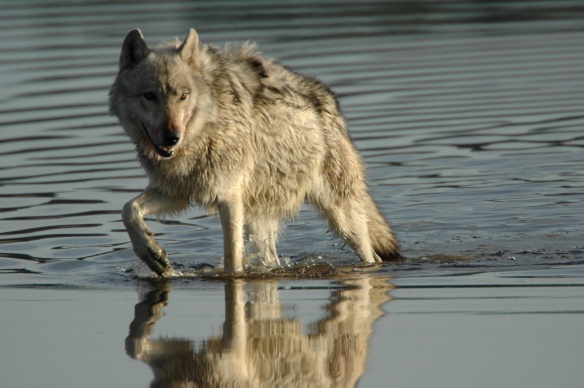
Yellowstone wolf photo ©Jim Robertson. All Rights Reserved

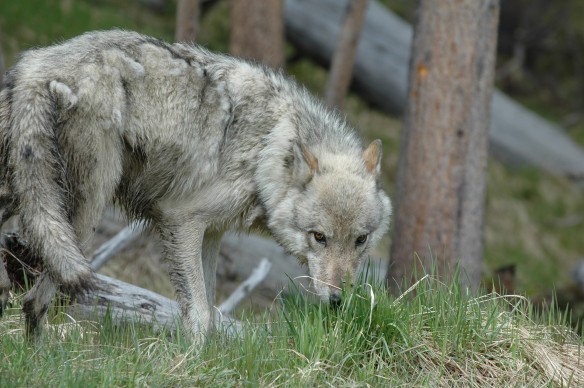
Yellowstone wolf photo ©Jim Robertson. All Rights Reserved

Witness to the Mourning

Yellowstone’s high plateaus are on average well over 5,000 feet in elevation; during the harsh winter months it can hardly be considered prime habitat for the wild grazers. Much of the park actually sits within the caldera of one the world’s largest active volcanoes.

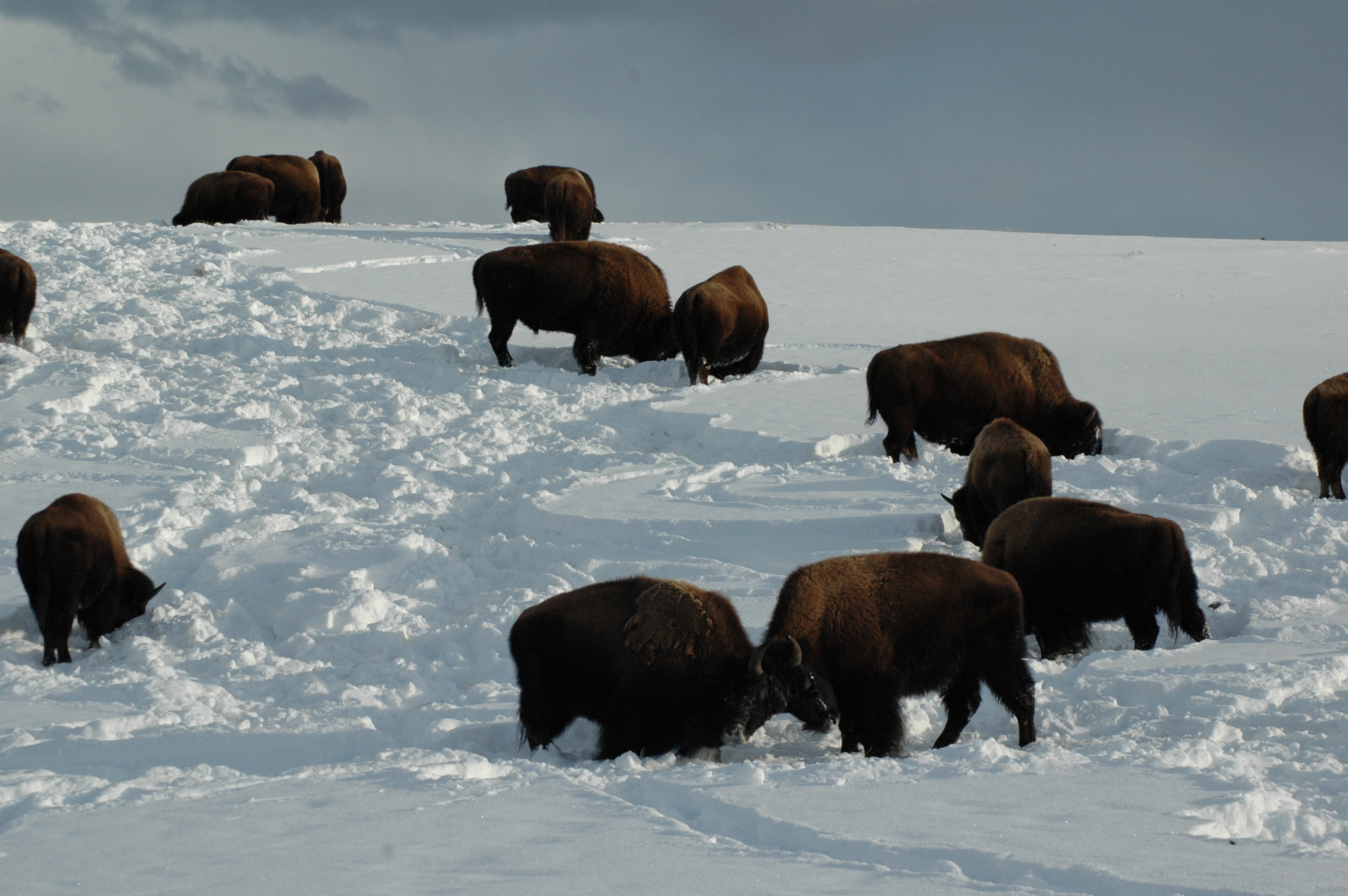
Though Yellowstone is synonymous with the shaggy bovines, bison would prefer to spend their winters further downriver, outside the park, on lands now usurped and fenced-in by cowboys to fatten-up their cattle before shipping them off to slaughter.

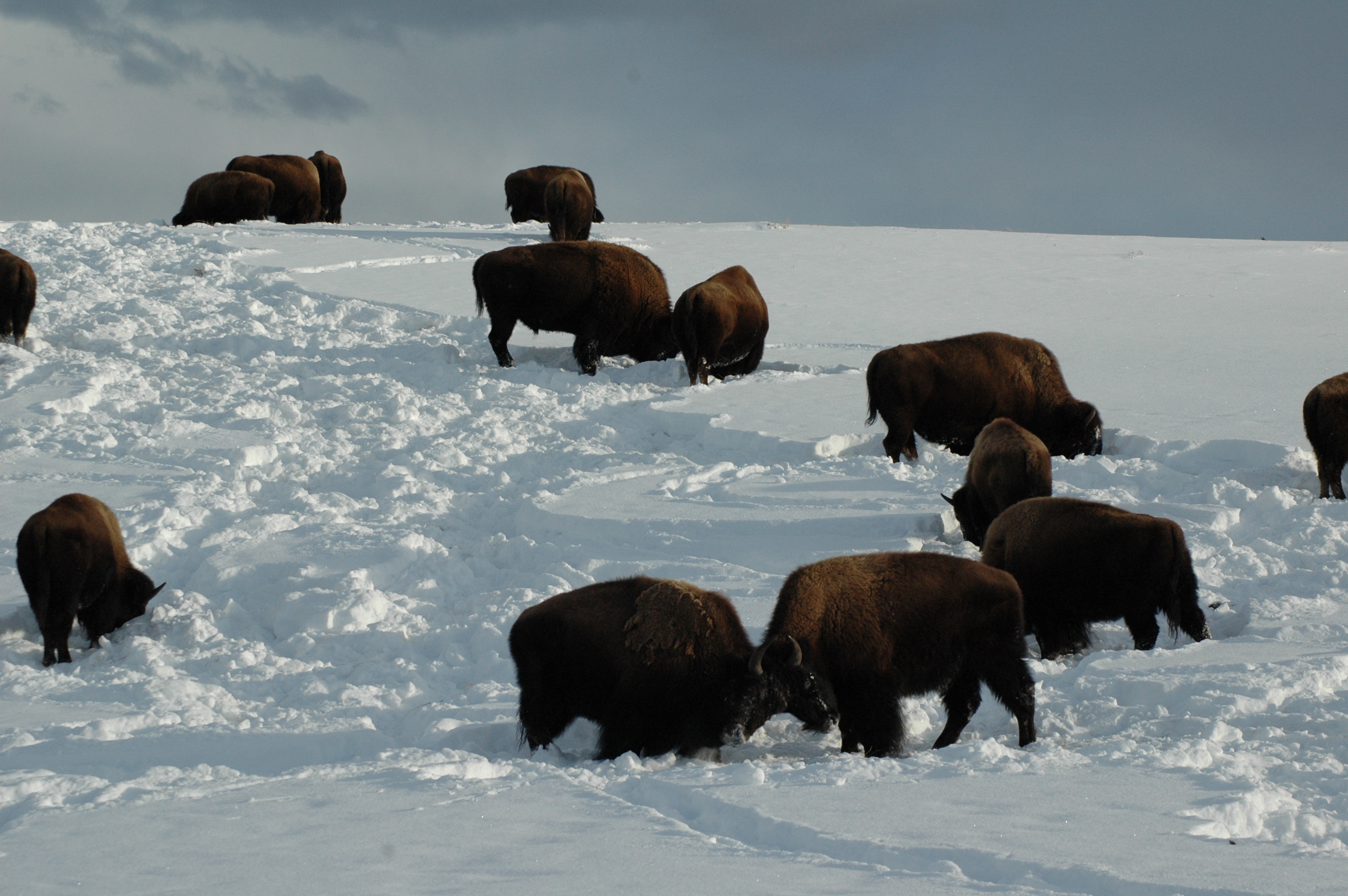
The following excerpt from my book, Exposing the Big Game: Living Targets of a Dying Sport, ties in with the report by Stephany of Buffalo Field Campaign, below the photo…

Selfless and protective, bison develop lasting bonds in and outside the family, not only between cows, calves and siblings but also between unrelated individuals who grew up, traveled and learned about life together. Juveniles help mothers look after the youngsters and will gladly lend a horn to keep potential predators away from the calves. I have witnessed cooperation among bison families often in the years I’ve spent observing and photographing them. I’ve also seen them put themselves in harm’s way to defend elk from hungry wolves, and even mourn over the bones of their dead.

Wildlife Photography ©Jim Robertson

Wildlife Photography ©Jim Robertson

Report from Buffalo Field Campaign:

Between Thursday and Sunday, forty-four of America’s last wild buffalo were killed in the Gardiner Basin by hunters with the Nez Perce and Umatilla tribes. Most of these buffalo were shot less than 300 yards from the north boundary of Yellowstone National Park, on a small area of Gallatin National Forest land called Beattie Gulch.

Three of the buffalo that were shot here did not immediately fall but walked into Yellowstone, where they were not allowed to be retrieved by the Nez Perce hunters who shot them; their bodies left to the ecosystem. According to state and tribal officials, the hunters who shot these buffalo are being allowed to keep their tags to kill other buffalo. In another incident, three other buffalo were illegally shot and killed by two non-tribal members.

Two days later we watched as more than a hundred buffalo
approached these killing fields. They found the remains of their relatives strewn across the land like fleshy boulders left behind by glaciers. We watched in sorrowful awe as the buffalo approached the gut piles. Their tails shot up in the air as they ran from remain to remain, discovering what was left. Enormous bulls bellowed like roaring dragons, mouths agape, bodies arched, and pawing the ground. The buffalo placed their faces close to the flesh left behind, nuzzling their muzzles into the earth where the buffalo had fallen.

They sniffed at fetuses still sheltered in their mother’s flesh whose lives were ended before they were born. The buffalo circled and scattered, ran to each other and away again.
Sparring, bumping, running, pawing and crying out in their deep emotion of their discovery.

Watching, we could only think of it as a wake, a mighty wailing of the buffalo. Back and forth they ran, frantic, between the gut piles that had been their friends, their family. Like chieftains in their own right, fathers of their clans, the mature bulls lingered the longest, as the mothers and grandmothers lead the young ones on in an ancient procession, their deliberate footsteps slower in their sorrow.

The depth of relationship the buffalo share is timeless,
intense, and far beyond most people’s willingness or ability to accept or understand. Indeed, it is easier, more convenient, to ignore or pretend that it doesn’t mean anything. In that blindness we deny not only to other creatures, but to ourselves, the honest power of love,
the gift of respect, and the aid of wisdom. The buffalo already encompass these things, and they are patiently waiting on the brink for us to catch up…

DSC_0110

It’s Official: Montana Hates Wildlife

To the casual observer, it would surely seem that Montana hates its wildlife.

Not only does the state continue to escalate its attack on wolves by prolonging its hunting and trapping season and increasing the per hunter quota even as the number of wolves there drops, but now their state legislature is proposing to eliminate free-roaming wild bison altogether, outside the confines of Yellowstone National Park.

The same Montana politicians who just rushed through a bill to expand the state’s ongoing wolf hunting and trapping are now considering new lethal bills to:

•prohibit reintroduction of wild bison into Montana;

•establish a year-round hunting season for bison, with virtually no limitations;

•authorize private landowners to shoot on sight any bison that wandered onto their property;

•order state officials to exterminate or move any wild bison that migrate into Montana.

The grizzly bear is soon to come off the federal Threatened Species list, and thereby lose federal protection. You can bet that states like Montana, Idaho and Wyoming—those few places fortunate enough to still support the bears in their wilderness areas—are planning to add trophy hunting of grizzlies to their long hit list of “big game” species as soon as (in)humanly possible.

But to hear them tell it, Montanans don’t hate all wildlife. They love having out of control populations of ungulates around to “harvest” between shopping trips to WalMart. As long as their Fish, Wildlife and Parks department provides them with huntable populations of “surplus” elk, deer and pronghorn, those token other species—the wolves, grizzly bears and bison—can stay in the national parks, “where they belong.”

Photos Copyright Jim Robertson

Photos Copyright Jim Robertson


Let Montana Governor Bullock know: “Our Voice Counts, Too!”

The following, from WolfWatcher.org, includes contact info for the MT governor.  More on this issue can be found in my previous blog post, Montana: Love the Place, Hate the Politicians …

Montana Governor Bullock: “Our Voice Counts, Too!”

Montana Governor Bullock: “Our Voice Counts, Too!”

Feb 10th, 2013

Posted in: All News, Front Page News, News, North American Wolves News, Northern Rockies News, Take Action, WolfWatcherYellowstone Wolf Project biologists are speaking out about a record number of wolves that were lost to this year’s hunting season in an article, “YNP biologists struggle to maintain wolf research,”  published in the Bozeman Daily Chronicle, Feb. 9, 2013.

“This is the first year that wolves were hunted on every side of the park. They’ve learned to tolerate people in the park, but that gets them in trouble if they leave. Some wandered outside the park, and within six hours, they were dead…The park has an international constituency and our mission is preservation. The kills are a big hit on our research, but another big concern for us is that too many kills affect visitor enjoyment,” said YNP wolf biologist Doug Smith.

More state bills have been introduced seeking to reduce the wolf populations with even more aggressive management ‘tools’ that make it easier to hunt and trap more wolves – even in areas near Yellowstone and Glacier National Parks. House Bill 73 has been fast-tracked to the Governor’s office, too.

Yellowstone National Park is posting record attendance numbers – a 2% increase to 3.4 million visitors in 2012.  With a projected 65 million international visitors to the USA in 2012 and more in 2013, Yellowstone National Park is the largest international draw in the Northern Rockies region.    With three of the five gateways accessed through Montana, the state serves to benefit from this increased traffic.

We heard that Montana’s Governor’s Office is disregarding calls and emails from tourists. Interestingly, the North Entrance at Gardiner, the area where zone closures were recently proposed and denied near Yellowstone , suffered a 5% loss in visitors in 2012.

We conclude that potential tourists are turned off when they learn about more aggressive hunting and trapping practices in the state.  So, is Montana killing the largest growing industry in the region – eco/wildlife tourism along with this apex predator?    We think so!

It’s time for us to remind Governor Bullock that our tourism dollars affect the economic future of his state and our voice counts!  We ask that you call the following officials to tell them you oppose the bill because it is anti-science, anti-eco-tourism, and anti-jobs!

1 – Montana Governor Bullock: tell him to VETO HB 73

Telephone: Toll Free Number: 855-318-1330;  Montana: 406-444-3111

governor@mt.gov and  http://governor.mt.gov/contact.aspx

2 – Gov. Bullock’s Natural Resources Adviser, Tim Baker: tbaker@mt.gov and 406-444-7857

3 – Montana Office of Tourismmt-webmaster@visitmt.com   Phone: 1-406-841-2870

4 – Montana’s Official Travel Sitehttp://www.visitmt.com/feedback/ or call 1-800-847-4868


REFERENCE:

House Bill 73 – introduced at the request of Montana Fish, Wildlife & Parks to increase the tools available to hunters to successfully kill more wolf populations (http://data.opi.mt.gov/bills/2013/billpdf/HB0073.pdf)

  • Reduces the price of nonresident licenses REDUCING THE PRICE OF A NONRESIDENT LICENSE;
  • Allows use of recorded or electronically amplified calls in wolf hunting; ALLOWING USE OF RECORDED OR ELECTRONICALLY AMPLIFIED CALLS;
  • Exempts hunters from wearing orange outside the general deer and elk hunting season
  • Prevents the creation of wolf harvest buffer zones and wolf harvest closures around national parks; In an area immediately adjacent to a national park, the commission may not: prohibit the hunting or trapping of wolves; or close the area to wolf hunting or trapping unless a wolf harvest quota established by the commission for that area has been met.”

Save the Animals—For Their Sake, Not Mine

Anthropocentricism is so deeply imbedded into the human psyche that these days it’s even hard to find a wildlife-related action alert which doesn’t focus on how some group of people might benefit from the continued existence of a given species. The well-being of the individual animal—let alone its species—so often takes a back seat to the ways humans benefit or profit from them.
Take wolves, for example. When Montana’s wildlife lawmakers were considering closing a few small areas around Yellowstone to wolf hunting and trapping, the primary reasons given by most wolf proponents for wanting the exclusion zones had to do with the value wolves have as tourist attractions and as part of a scientific study. To the majority of those who testified, the facts that the wolves themselves are sentient beings and/or are essential elements in nature’s design—who don’t deserve to be shot on sight as vermin—seemed secondary to the ways in which watchers and biologists were affected by the wrongful deaths of Yellowstone wolves.

Similarly, a petition to force Facebook to remove the page, Wolf Butchering, Cooking, and Recipes reads, “To protect the Wolves, and the Sensitivities of Native Americans. It is offensive, and a discrimination against the Religious Beliefs of Native Americans.” Of course I signed the petition, but I did so for the sake of the wolves, not because of anyone’s purported religious beliefs. I’m against cannibalism as well—for the sake of the victims of such barbarity, not because the culinary choice is considered a cultural taboo. At the same time, I don’t want migratory waterfowl habitat set aside just so I can go bird watching, or to save the whales so I can go whale watching. It’s about them, not about our perception or enjoyment of them.

As we’ve all heard, ad nauseam, “sportsmen” help wildlife by hunting—or so they would have us believe. As James McWilliams blogged in a timely post entitled Hunting, Land Conservation, and Blood Lust, “This land preservation defense of hunting is a common one. Get enough people who like to blow away animals on board and you can prevent undeveloped land from becoming a Walmart,” dispelling this myth with, “The vast majority of conservation-driven hunting policies are designed not to improve the quality of a particular ecosystem but to improve the quality of the hunt.”

Westerners didn’t know okapis or orangutans even existed until around a century ago. Were the lives of such unutilized and therefore unappreciated animals meaningless up until the day they were “discovered”? You or I may never get the chance to see a black rhino or a snow leopard, but that certainly doesn’t diminish their intrinsic value.

Text and Wildlife Photography ©Jim Robertson, 2013. All Rights Reserved
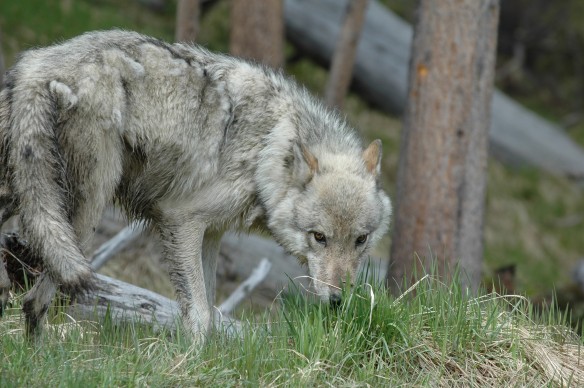
Text and Wildlife Photography ©Jim Robertson, 2013. All Rights Reserved

Who is the Creeping Cancer?

Amazingly enough, despite their wrongheaded policies toward wolves and wolverine (which I covered in the post, “WTF’s Up w/MFWP?”), the Montana WDFW actually came up with a good idea regarding bison. According to an article in the New York Times:

Montana’s Fish, Wildlife and Parks department is considering allowing bison year-round access to cattle-free pockets of public land on Yellowstone’s northwest side. Officials are also working on a statewide bison management plan that could allow the reintroduction of a few disease-free bison to some of the most remote parts of the state, possibly including the million-acre Charles M. Russell National Wildlife Refuge in northeastern Montana.

Public polls show that most Montanans support reintroducing wild bison that could be watched by wildlife enthusiasts and harvested by hunters. That approach would parallel established management plans that allowed elk, deer, antelope and bighorn sheep to return after they were hunted to near-extinction around the time bison vanished. …

Because of attitudes held by ranchers like John Youngberg, vice president for government affairs for the Montana Farm Bureau Federation, Montana has traditionally held to a policy of intolerence toward free-roaming bison.

Youngberg said that since wild bison were exterminated by the time Montana became a state in 1889, landowners should have the right to live without them.

“They got their property with the expectation that there were no buffalo,” he said. “And these are not white-tailed deer you’re talking about, they’re 2,000-pound animals”

Now, two new bills introduced in the Montana legislature would usher in a zero-tolerance policy for wild bison, potentially opening the way for a return to the shoot-on-sight practices of years past.

Under a bill proposed in the state Senate, Department of Livestock officials would have the leeway to exterminate all wild bison. And a different bill in the state House of Representatives would allow landowners to kill any bison that sets foot on private property.

“Why do you want to spread this creeping cancer, these woolly tanks, around the state of Montana? We’ve got zero tolerance left in our bones,” said John Brenden, a state senator  from Scobey, Mont., who is chairman of the Senate Fish and Game Committee and authored that chamber’s bill.

My response to Mr. Brenden: If you want to see a creeping cancer whose destructive behavior can be compared to a tank, look in the mirror.

Over the last three decades, around 7,000 bison from Yellowstone National Park, descendants of the less than two dozen free-range bison in America known to have survived the great slaughter of the Nineteenth Century, were killed for migrating from federal parkland into the states of Montana, Idaho and Wyoming.

Yet in Montana, where most Yellowstone bison have been shot or shipped to slaughterhouses, the state agreed last year for the first time to allow bison access to 75,000 acres of public land north of the park for a few months each year.

How generous.

For more on the plight of bison, past and present, read Chaper 1, “Hide Hunting Holocaust Survivors Still Under Fire,” in the book, Exposing the Big Game: Living Targets of a Dying Sport.

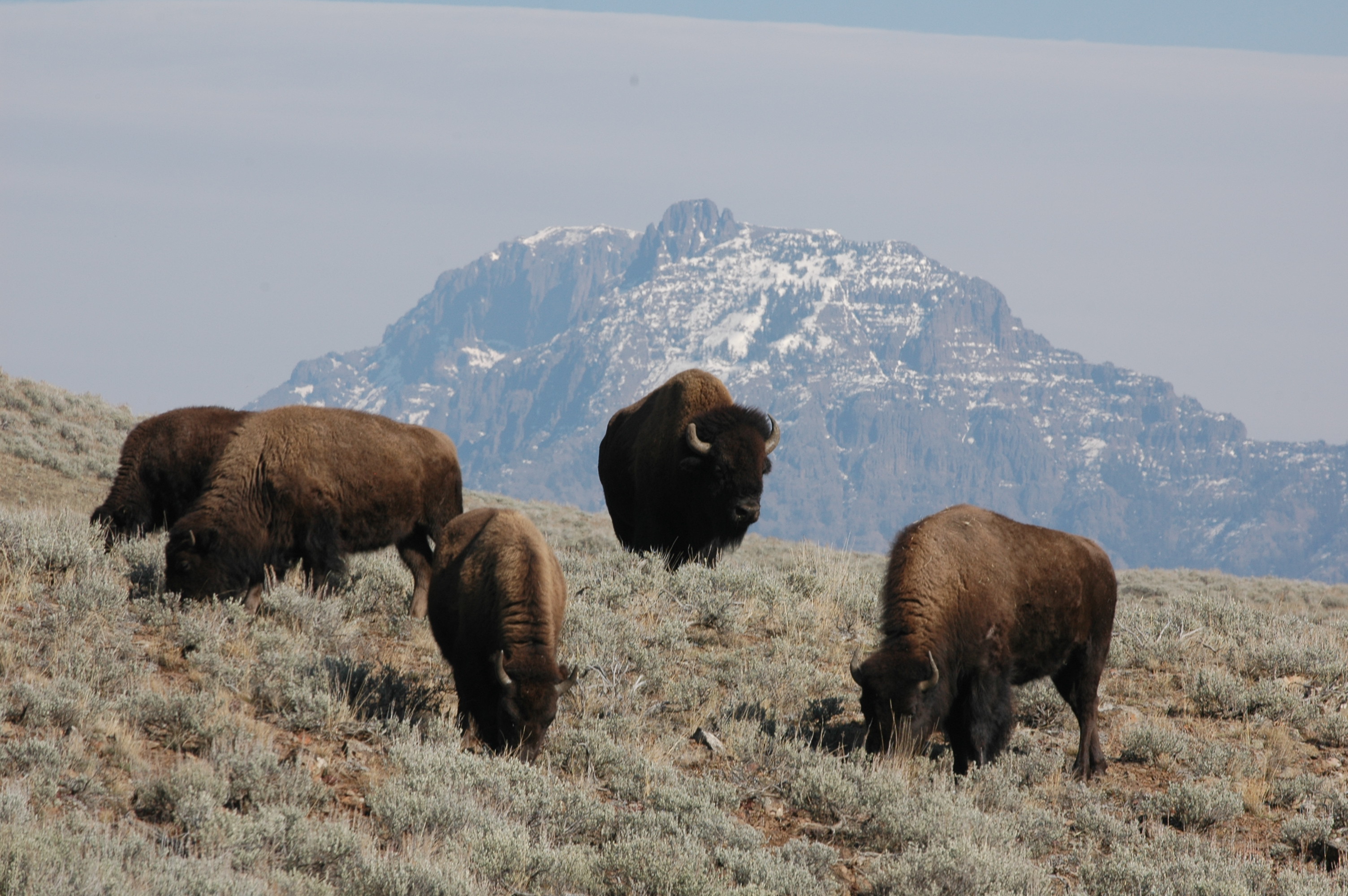
Photo Copyright Jim Robertson

Photo Copyright Jim Robertson

One Park Does Not a Recovered Species Make

Ignorance must be such sweet bliss for anyone who visits Yellowstone National Park and thinks the wildlife they see there represents fully recovered populations of some of North America’s most endangered species. Sorry to say, one park does not a recovered species make. For all its size, spectacularity and relative biodiversity, Yellowstone is little more than an island in an anthropogenic wasteland to much of its megafauna.

If ranchers and hunters had their way, wolves and grizzlies would be restricted to the confines of the park. Ranchers already have such a death-grip on Montana’s wildlife that bison are essentially marooned and forced to stay within park borders, battling snow drifts no matter how harsh the winter, despite an instinctual urge to migrate out of the high country during heavy snow winters.

Though Yellowstone is synonymous with the shaggy bovines, bison would prefer to spend their winters much further downriver, on lands now usurped and fenced-in by cowboys to fatten-up their cattle before shipping them off to slaughter.

Yellowstone’s high plateaus are on average well over 5,000 feet in elevation and can hardly be considered prime habitat for the wild grazers. Much of the park actually sits within the caldera of one the world’s largest active volcanoes. Any sizable eruption could release enough toxic gasses to kill off all of Yellowstone’s bison—the last genetically pure strain of the species now left on the continent.

People driving through cattle country on their way to Yellowstone often have no idea just how sterile the open plains they’re seeing really are. Gone are the vast bison herds that once blackened them for miles on end—killed off by hide-hunters, market meat-hunters or by “sportsmen” shooting them from trains just for a bit of fun. Gone are the wolves and plains grizzlies adapted to that arid habitat. And nearly gone are the prairie dogs as well as the ferrets, kit fox, plovers, burrowing owls and a host of others who depended on them for food or shelter.

Part of the reason I wrote Exposing the Big Game: Living Targets of a Dying Sport was to remind people about the wild species who once called so much of this continent home. No one’s going be able to claim ignorance on my watch; if I can’t go through life blissfully then neither can anyone else.

The following is an excerpt from one of the book’s two chapters on bison:

Selfless and protective, bison develop lasting bonds in and outside the family, not only between cows, calves and siblings but also between unrelated individuals who grew up, traveled and learned about life together. Juveniles help mothers look after the youngsters and will gladly lend a horn to keep potential predators away from the calves. I have witnessed cooperation among bison families often in the years I’ve spent observing and photographing them. I’ve also seen them put themselves in harm’s way to defend elk from hungry wolves, and even mourn over the bones of their dead.

But in a ruthless act of rabid backstabbing, 1600 bison—who had never known confinement or any reason to fear people—were slain to appease Montana ranchers during the winter of 2008. More than half of Yellowstone’s bison were killed in what was the highest body count since the nineteenth century. 1438 were needlessly and heartlessly shipped in cattle trucks to slaughterhouses (those nightmarish death camps where so many forcibly domesticated cattle meet their ends), while 166 were blasted, as they stood grazing, by sport and tribal hunters. Two winters prior, 947 bison were sent to slaughter and 50 were shot by hunters.

Instead of making amends for the historic mistreatment of these sociable, benevolent souls, twenty-first-century Montanans are still laying waste to them. Spurred on by industry-driven greed for grazing land (veiled under the guise of concern about brucellosis, a disease with a negligible risk of transmission that has never actually been passed from wild bison to cattle), the state of Montana sued to seize control of bison ranging outside Yellowstone. Now their department of livestock has implemented a lethal policy and the US National Park Service is facilitating it. Since the dawn of the new millennium, nearly 4000 Yellowstone bison have been put to death.

Text and Wildlife Photography ©Jim Robertson, 2012. All Rights Reserved

Text and Wildlife Photography ©Jim Robertson, 2012. All Rights Reserved