Contact info for MFWP

Here are two things you can do for wolves in the Yellowstone area…

1. Plan to attend the Montana FWP meeting Tuesday January 29, 2013 at 10 am to make a public comment: asking MTFWP to close the wolf hunt. You will have 2 minutes to speak.

2. Send a letter to MTFWP: Email Montana FWP Commissioners: fwpcomm@mt.gov, FWP Director Hagener: jhagener@mt.gov and Montana Governor Bullock: governor@mt.gov

Here are some things Bear Creek Council’s has written to FWP, which you might use as talking points:

YNP Wolf Project had lost 8 or more radio-collared and uncollared Yellowstone research wolves to hunting in Montana. Millions of tourists around the world were outraged to hear of the deaths of wolves they have observed. Montana’s economy depends on wolf and wildlife tourism, which brings in more dollars than ranching or hunting outfitting.

We want to see wolves protected in Yellowstone National Park and in the Gallatin National Forest/Absaroka-Beartooth Wilderness areas:

1. Our region depends economically on wolf tourism in Yellowstone Park and our National Forest. People come here to hike in wolf country or to visit the number one place in the world to observe wild wolves, Yellowstone National Park. Montana has begun hammering away at the wolves here, allowing hunters to take an inordinate number from our region and damaging an invaluable economic, educational, and research wildlife population.

2. We value and want to advance YNP Wolf Project research on predator-prey relationships and other science about wolves.

MTFWP claims its management polices are based on hard science, but aside from the YNP Wolf Project’s 18 years’ work, there are very few long-term studies of wolf predator-prey relations. Why isn’t Montana protecting the some of the best research on wolf-prey relationships? Why aren’t we protecting the study subjects—Yellowstone wolves?

One value of YNP Wolf Project is that it studies one of the largest unexploited wolf populations in the world. Until Montana’s hunts in opened the hunts in 2009 and 2012, there were practically no human-caused wolf mortalities in the park. Does Montana FWP want to be responsible for destroying one of the best research projects on wolves in the world?

3. We want to see wolves valued as native Montana and North American wildlife and for their role in our predator-prey ecosystem.

WTF’s Up w/MFWP?

What the Fuck (WTF) is up with the Montana state wildlife officials these days? Now they want to make it even easier to hunt and trap wolves in their state.

Last year, just after wolves were removed from federal endangered species protection, the Montana Fish, Wildlife and Parks department (MFWP) seemed comparably tame (well, compared to Idaho anyway). Though they wasted no time in implementing the state’s first season on wolves in seventy-some years, at least they spared wolves the torment of trapping.

Ignoring 7,000 letters in support of wolves, this year they added trapping to their wolf assault and upped the original “bag limit” from one to three per trapper—before the season even started. Instead, they’re bowing to the whims and whinings of ranchers, hunters and trappers who have called for an expansion of wolf killing and more liberal rules than the state had last year, when “only” 166 wolves were ruthlessly murdered. MFWP officials responded to anti-wolf, anti-nature, anti-environmental pressure by making the 2012 season longer, eliminating most quotas and allowing wolf trapping for the first time.

The agency is now mercilessly asking for additional measures in the form of a state House Bill, HB 73. Their proposal would let hunters and trappers buy multiple tags; use electronic wolf calls; reduce the price of a non-resident tag from $350 to $50 and eliminate the potentially life-saving requirement that hunters wear fluorescent orange outside of elk and deer season. (Okay, I’ll go along with that last one—who cares if wolf hunters shoot each other?)

“We want to get a wolf bill out of the Legislature so we can implement those things that can potentially make a difference,” said FWP spokesman Ron Aasheim, adding selfishly, “More management flexibility. That’s what we want now.”

The House committee will also take up a second bill by Republican Rep. Ted (oh shit, not another Ted!) Washburn, of Bozeman, which would also limit the total number of wolves allowed to live in the entire state (we’re talking 147,046 square miles) to no more than 250. Washburn’s plan also asks for an Oct. 1-Feb. 28 wolf hunting season and an even longer season for special districts next to Yellowstone and Glacier National Parks!!

No doubt you all remember that fateful day in 2011 when congress lifted federal protections for wolves in Montana and Idaho, handing management over to those openly hostile states.

Meanwhile, the nefarious Montana state wildlife officials are currently opposing federal Threatened Species protection for the depressingly rare wolverine, down to only 35 breeding individuals in the lower 48.

Not many hunters can honestly say that they don’t mind sharing “their” elk, moose or deer with the likes of wolves, cougars or coyotes. But those few who claim to support a diversity of life need to realize that every time they purchase a hunting license and a deer or elk tag, they validate wolf hunting and trapping. To game managers, every action, right down to the purchase of ammo and camo at Outdoor World, is a show of support for their policies—including killing wolves to ensure more deer, elk, moose or caribou for hunters to “harvest.”

A far cry from living up to their laughably undeserved reputation as the “best environmentalists,” hunters are just foot-soldiers carrying out a hackneyed game department program of “harvesting” ungulates and “controlling” predators. It’s an agenda based not on science or the time-tested mechanisms of nature, but on the self-serving wants of a single species—Homo fucking sapiens (HFS). Modern hunting is about as anti-environmental as mining, clear-cut logging, commercial fishing or factory farming.

Text and Wildlife Photography ©Jim Robertson, 2012. All Rights Reserved

Text and Wildlife Photography ©Jim Robertson, 2012. All Rights Reserved

A Day in the Sun for the Hayden Wolf Pack

The following is an excerpt from the book, Exposing the Big Game: Living Targets of a Dying Sport. The wolf in the photo is the alpha male of the Haden Pack…


Winters come early to the interior of Yellowstone, but the third week in October, 2007, was unseasonably warm, and the Hayden wolf pack lay stretched out in the bright afternoon light on a west-facing slope below the tree line, taking full advantage of what might be their last chance to sunbathe until spring. With a snow level creeping towards the valley bottom, the adult wolves knew that temperatures were soon to plummet and they may not get another restful nap like this for a long, long time.

The Hayden pack consisted of nine members, including a gray alpha male, a pure white alpha female, three gray pups born that spring, the sole black pack member (another half-grown pup sporting an extra thick coat) and three gray yearlings—one of whom was away on his own excursion.

As the waning sun sank behind the western hills enough to shroud their rendezvous site in shadows, the alpha male grew restless, slowly getting up to stretch. One by one, the rest of the pack rose and fell in line as their leader started in the direction of the Yellowstone River.

The wolves moved fluidly down a sagebrush slope that led to a bank above the river. The veteran male led the pack south along the bank to a point that provided an easy crossing. He was the first to take to the water, followed by the two yearlings. The stark white female was a harsh, blinding streak as she swam ahead of the pups on this, the safer part of their journey…

Text and Wildlife Photography ©Jim Robertson, 2012. All Rights Reserved

Text and Wildlife Photography ©Jim Robertson, 2012. All Rights Reserved

Silly Humans, Carrion is For Carnivores

Never before in the history of mammals have seven billion large, terrestrial, meat-eating members of one species ever single-handedly laid waste to so much of the Earth’s biodiversity. Human carnivorousness is killing the planet one species at a time, one ecosystem after another; one bison at a time, one wolf after another.

Every time you order a steak or grill a hamburger, you legitimize bison and wolf culling for the sake of livestock growers. If you really want to save the wolves and the bison, go vegan! And urge your friends and family and neighbors and co-workers to do the same.

Tell it to the world—it’s time to leave the predating to the predators!

Human beings can live much healthier on a plant-based diet, as their primate cousins always have. True carnivores, such as wolves, coyotes, cougars, marine mammals or members of the weasel family have to eat meat to survive. If you’re not willing to go vegan for your own health perhaps you could do it for the health of the planet; if not for the sake of the animals you eat, maybe for all the other species affected by your bill of fare.

Text and Wildlife Photography© Jim Robertson

Text and Wildlife Photography© Jim Robertson

Yellowstone Bison Back Under the Gun

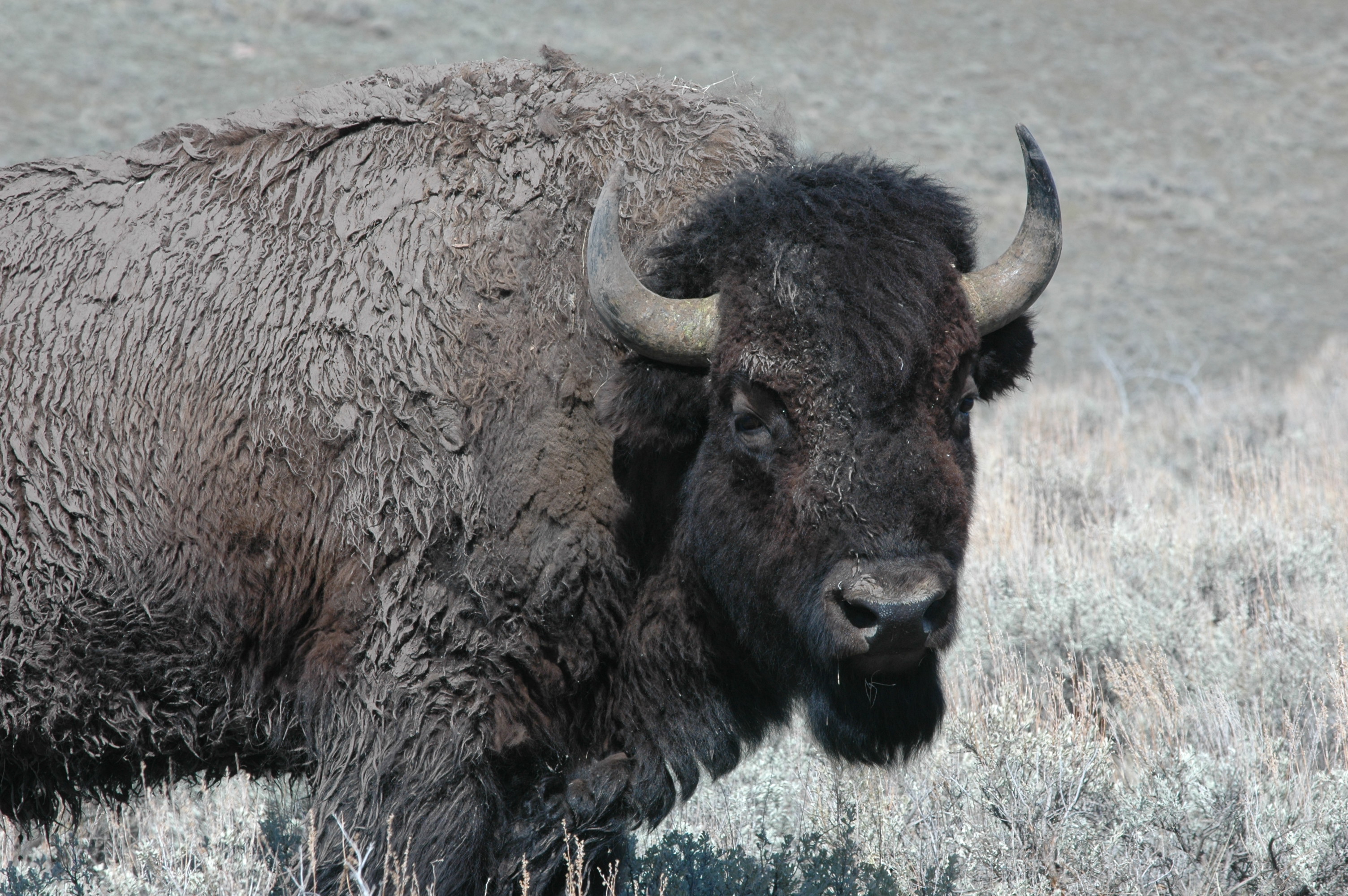
Wolves aren’t the only once endangered species being targeted right outside of Yellowstone National Park. Bison, the symbol of our National Park system, have been killed by the thousands in recently imposed state and tribal hunting seasons and by the Montana Department of Livestock, who, with the full blessing of the National Park Service, have rounded up over 5000 migratory park bison since 2008 and shipped them to slaughterhouses (those nightmarish death camps where so many forcibly domesticated bovines meet their ends).

In a ruthless act of rabid backstabbing, 1600 bison—who had never known confinement or any reason to fear people—were slain to appease Montana ranchers during the winter of ‘08. More than half of Yellowstone’s bison were killed in what was the highest body count since the nineteenth century.

Instead of making amends for the historic mistreatment of these sociable, benevolent souls, twenty-first-century Montanans are still laying waste to them. Spurred on by industry-driven greed for grazing land (veiled under the guise of concern about brucellosis, a disease with a negligible risk of transmission that has never actually been passed from wild bison to cattle), the state of Montana sued to seize control of bison ranging outside Yellowstone. Now their department of livestock has implemented a lethal policy and the US National Park Service is facilitating it. Since the dawn of the new millennium, over 5000 Yellowstone bison have been put to death.

The following action alert from the Buffalo Field Campaign includes contact info…

Before wild bison have even begun their annual migration to their winter habitat in Montana, State, federal, and tribal governments — including Yellowstone National Park –are aiming to kill hundreds of wild buffalo this winter through hunting, slaughter, or both. The agencies state that they want to “even the sex ratio” and have placed a heavy target on female buffalo, wanting to kill at least 400 female buffalo that migrate north of the Park into the Gardiner Basin. The herds that migrate north include buffalo from both the Northern and Central herds, which also means that the Central herds (which also migrate west) will be doubly impacted by hunting and slaughter.

Yellowstone National Park states that a “skewed sex ratio” has resulted from years of capture and slaughter operations, which have removed more bulls than cows from the population. In other words the government is saying they will slaughter more buffalo to mitigate the impact of slaughtering so many buffalo. Talk about playing God in Yellowstone.

With these plans aimed to placate Montana’s livestock interests, Yellowstone National Park threatens the buffalo’s immediate survival and evolutionary potential.  Yellowstone’s plans to capture and slaughter wild bison are absolutely contrary to their mission to preserve and protect plant and animal species unimpaired for present and future generations.  The wild bison of the Yellowstone ecosystem make up America’s last continuously wild population. Wild bison are ecologically extinct throughout their native, historic range, and currently number fewer than 4,300 individuals.  Wild bison once teemed across the North American continent in the tens of millions, but today the last remnant herds only exist in and around Yellowstone and are in dire need of protection.

TAKE ACTION!  Tell Yellowstone Superintendent Dan Wenk that you absolutely oppose any capture or slaughter of wild buffalo.  Yellowstone is mandated by law to protect wild bison, not cater to Montana’s cattle politics.  Tell Superintendent Wenk to stop being a puppet for Montana livestock interests, pull out of the draconian Interagency Bison Management Plan, and to stand up for the wildlife that the American people have placed in his care.  Wild bison are a natural, national treasure, the prehistoric and rightful roamers of North America, and we will not stand by and allow Yellowstone or Montana’s cattle industry to jeopardize their future for any reason.

Daniel Wenk, Superintendent

Yellowstone National Park

P.O. Box 168

Yellowstone National Park, WY 82190-0168

(307) 344-2002 phone

(307) 344-2014 fax

Dan_Wenk@nps.gov

DSC_0146


Situation Update: Judge lets wolf season resume near Yellowstone

Judge lets wolf season resume near Yellowstone

By MATTHEW BROWN, Associated Press
Updated 7:42 pm, Wednesday, January 2, 2013
BILLINGS, Mont. (AP) — Wolf hunting and trapping can resume near Yellowstone National Park after a Montana judge on Wednesday blocked the state from shutting down the practice over concerns that too many animals used in research were being killed.

The restraining order from Judge Nels Swandal allows hunting and trapping to resume in areas east and west of the town of Gardiner in Park County.

State officials closed the gray wolf season in those areas on Dec. 10. That came after several wolves collared for scientific research were killed, drawing complaints from wildlife advocates.

The move prompted a lawsuit from sporting groups and a state lawmaker from Park County, Rep. Alan Redfield, who said the public was not given enough chance to weigh in on the closures.

In his order, Swandal sided with the plaintiffs. He said the lack of public notice appeared to violate the Montana Constitution and threatened to deprive the public of the legal right to harvest wolves.

He ordered the state “to immediately reinstitute and allow hunting and trapping of wolves in all areas of Park County.”

A Jan. 14 hearing was scheduled in the case. The other plaintiffs are Citizens for Balanced Use, Big Game Forever, Montana Outfitters and Guides Association and Montana Sportsman for Fish and Wildlife.

A spokesman for the state, Ron Aasheim, said Montana wildlife commissioners followed proper public notice requirements before issuing the closures.

Wildlife advocate Marc Cooke said the lawsuit over the 60-square-mile closure area revealed the “irrational hatred” of some hunting and trapping supporters.

“You have 145,000 square miles in Montana, and they’re fighting over a measly 60 square miles of land that is critical habitat for these animals. To me, it’s very vindictive,” he said.

Montana had an estimated 650 wolves at the end of 2011. Through Wednesday hunters reported killing 103 of the animals and trappers had killed at least 30 more.

State officials lifted quotas on wolves across most of Montana this spring in hopes of decreasing a predator population blamed for livestock attacks and driving down elk numbers in some areas.

But park officials said at least seven Yellowstone wolves — including five wearing tracking collars — were shot by hunters in Montana, Idaho and Wyoming. Also shot were four collared wolves originally from the park but now living outside it. Three more shot in the vicinity of the park had unknown origins and were not wearing collars, park officials said.

The current season marks Montana’s first experience with wolf trapping since the animals lost their endangered species protections last year under an order from Congress.

Wolf hunting has also been contentious in Wyoming this season. The state took over wolf management from the U.S. Fish and Wildlife Service on Oct. 1, and hunters killed 43 wolves out of a 52-animal quota before Wyoming’s hunt ended Dec. 31.

Coalitions of environmental groups have filed federal lawsuits, now pending in Washington, D.C., and Denver, seeking to force the U.S. Fish and Wildlife Service to reclaim wolf management from Wyoming.

The groups say they’re concerned that Wyoming’s wolf management plan won’t ensure long term survival of the species, which the federal government reintroduced into Yellowstone in the mid-1990s.

Wolves in Wyoming are classified as unprotected predators that may be shot on sight in most of the state. They’re managed as trophy game animals in a flexible trophy hunting zone on the outskirts of Yellowstone.

Idaho also allows hunting and trapping of wolves, although it allows a maximum of 30 animals a year to be taken in a zone just outside Yellowstone. Through Wednesday, hunters and trappers in Idaho reported killing 154 wolves statewide, including 11 near Yellowstone.

_________________________________________

Well, there’s the facts and figures according to the Associated Press. I don’t know what to say. This time I’m in agreement with Marc Cooke; these hunting groups and some Montana state reps have an “irrational hatered” of wolves. As I said in an earlier post, wolf hunting should be considered a hate crime.

Time to put our full support behind the coalitions of environmental groups who’ve filed federal lawsuits seeking to force the U.S. Fish and Wildlife Service to take back wolf management from Wyoming. Come to think of it, Montana and Idaho need to be included in that lawsuit…

Text and Wildlife Photography ©Jim Robertson

Text and Wildlife Photography ©Jim Robertson

Wolves Are the Only Management “Tool” Necessary

I didn’t mean to set off a pissing match in my last blog post by quoting a group’s recent statement to the Missoulian, “We at Wolves of the Rockies understand and acknowledge the importance of hunting as a tool for managing wolves, and we stand beside the ethical hunter in doing so.” I’m sorry if I misinterpreted that statement, but I thought it made their position on wolf hunting pretty clear: they support it.

And I think it’s obvious what they’re saying with the lines, “We are not advocating the end of wolf hunting. We have only asked for a slight modification to the state wolf management plan to accommodate other legitimate values in this specific locale. Remember, Montana’s wildlife is owned by ALL the people, not just hunters.”

It sounds to me like they feel that wolf “management” through hunting and trapping is acceptable, as long as it doesn’t conflict with another “legitimate value” some other human being has placed on the canines. I would argue that wolves themselves have intrinsic value, as individuals and as a species.

While I whole-heartedly applaud this group’s part in getting a buffer zone closed to hunting and trapping implemented around Yellowstone National Park in Montana (“only for this year,” according to the Montana Wildlife Commission chair Bob Ream), I have to question whether anything is worth legitimizing wolf hunting and trapping as “management tools” like they did in their articles to the press. When the back-patting and back-pedaling are over, it’s time to bring the focus back on the real problem—the fact that wildlife are considered “property” of the states, to be “managed” as they see fit.

Commissioner Ream said they made the closure because of the “particular and unique situation” of collared Yellowstone wolves being shot. He assured hunters and ranchers that the closure will not affect the goals of the commission for the overall Montana wolf hunt and trapping season in any significant way because this is such a small area, and one with almost no winter livestock.

Still, it could have a big effect conserving Yellowstone’s small and shrinking wolf population, now down to only about 80 wolves. The park’s wolf population of 170 wolves three or four years ago began to drop when inter-pack rivalry and low surviving pup numbers took their toll. Clearly, wolves have self-regulating population control systems which kick into play before their numbers get too far out of hand (which is more than can be said for hunters and trappers).

Wolves play an important part in nature’s narrative, a role that has served both predator and prey for eons. Rightful kings returning from exile, wolves are far from new to the Yellowstone ecosystem. Their 71-year absence was the result of a heartless bounty set by the real newcomers to the fine-tuned system of checks and balances that has regulated itself since life began.

New to the scene are cowboys on four-wheelers with their monoculture crop of cows and ubiquitous barbed-wire fences. New are pack trains of hunters resentful of any competition from lowly canines, yet eager to take trophies of wolf pelts, leaving the unpalatable meat to rot. And new is the notion that humankind can replace nature’s time-tested order with so-called wildlife “management,” a regime that has never managed to prove itself worthy.

Unmatched manipulators, modern humans with their pharmacies, hospitals, churches, strip malls, sporting goods stores, burger joints and fried chicken franchises have moved so far beyond the natural order that population constraints, such as disease or starvation, are no longer a threat to the species’ survival (as long as society continues to function). Hunting is no longer motivated by hunger. Twenty-first century sport hunters are never without a full belly, even after investing tens of thousands of dollars on brand-new 4X4 pickups, motorboats, RVs and of course the latest high-tech weaponry.

But wolves can’t afford to be acquisitive; if they run low on resources, they must move on or perish. Theirs is a precarious struggle, without creature comforts or false hopes of life everlasting.

~ From the book, Exposing the Big Game: Living Targets of a Dying Sport

Text and Wildlife Photography ©Jim Robertson, 2012. All Rights Reserved

Text and Wildlife Photography ©Jim Robertson, 2012. All Rights Reserved

“I’d like to put an arrow in that.”

It’s bad enough to know that there are sadistic sociopaths by the thousands setting traps and snares for wolves out in Yellowstone’s tri-state area, or shooting arrows into deer throughout the Midwest and across the Mississippi; but some of these straightjacket escapees get an extra thrill, adding insult to injury, by taunting those of us who care.

Wolf advocates have been harassed, threatened and made to endure gut-wrenching photos of animals murdered in the most tweaked and twisted ways. Another favorite game the terrible-two-year-olds like to play is to post disparaging comments alongside photos of living animals they’d like to see stuffed and mounted on their trophy wall.

A recent example was a comment left under this bighorn ram photo on Exposing the Big Game’s Facebook page, “I’d like to put an arrow into that.”

Text and Wildlife Photography© Jim Robertson

Text and Wildlife Photography© Jim Robertson

Crazed killers such as these get off on knowing how much their glib comments upset the rest of us. But, as with any bully, cyber-bullies need someone to pick on. They feed on our reactions; take that away and it leaves them feeling as impotent as they obviously are.

The thing they fear the most is being ignored—a mouse hovering over the delete button is Godzilla to them. Therefore, whenever I get one of their comments, I send it straight to the trash can and banish the sender for good measure. In an instant their power is squashed. With that one quick click of the finger, we can get some small sense of satisfaction. They can’t get to us if we don’t let them in.

198333_531743856838438_1843100664_n

Wolf Hunters Are Guilty of Hate Crimes

It occurs to me that the killing of wolves by those who detest them qualifies as a hate crime. By definition, a hate crime is: a crime, usually violent, motivated by prejudice or intolerance toward a member of a social group.

Well, you don’t get a much more social group than a wolf pack—and you don’t find any greater prejudice or intolerance than among wolf-haters and hunters.

In an effort to defend his wolf hunting, wildlife snuff-filmmaker Randy Newberg presented the following shocking testimony to the court of public opinion (via NPR News), “Having these hunting seasons [on wolves] has provided a level of tolerance again.”

The U.S. Fish and Wildlife Service, Montana, Idaho and Wyoming state game departments and, most shocking of all, Yellowstone wolf biologists, are all going along with this line of thinking. But allowing wolf haters to have their fun by giving them a season on the object of their disdain is akin to letting the Clan get away with murder once in a while, believing it will “provide a level of tolerance again.”

Text and Wildlife Photography ©Jim Robertson, 2012. All Rights Reserved

Text and Wildlife Photography ©Jim Robertson, 2012. All Rights Reserved

Killing Wolves Provides “a Level of Tolerance”?

Yep, you read it right, according to Randy Newberg, who hunts wolves and makes hunting television programs, many people who live in Wyoming, Montana and Idaho don’t like wolves and hate that the federal government forced their recovery on them, “Having these hunting seasons has provided a level of tolerance again.” Newberg told NPR News that wolf hunts are easing the animosity many local people feel toward the predator. And Yellowstone biologist, Doug Smith, adds, “To get support for wolves, you can’t have people angry about them all the time, and so hunting is going to be part of the future of wolves in the West. We’ve got to have it if we’re going to have wolves.”

So, let me get this straight, in order to placate and appease good ol’ boys and get them to put up with the presence of one of North America’s most historically embattled endangered species, we have to let them kill some of them once in a while? Wolf hunting and trapping are just a salve—a bit of revenge-killing for them–why not let them have their fun? By this logic, they should also be entitled to shoot an Indian every so often (like their forefathers who tried to wipe them out), to help promote tolerance and cultural acceptance.

Excuse me, but why should we care what wolf hunters think they need to get them to go along with the program—those people are sick, end of story. Just look at their evil, gloating grins and smug, satanic smirks plastered on their faces whenever they pose with their “trophy” wolf carcasses. But don’t bother telling them that they’re vacuous, malicious little goblins, apparently they enjoy being hated by wolf-lovers—otherwise they wouldn’t pose for the camera and spread their gruesome images around the internet whenever they make a kill.

In the spirit of promoting tolerance, it only seems fair that wolf advocates be allowed a season on them in return for all the losses they’ve endured. I don’t know if it would really engender a feeling tolerance, but it can always be justified as a way of “managing” or “controlling” them, and thinning their numbers.

Text and Wildlife Photography ©Jim Robertson, 2012. All Rights Reserved

Text and Wildlife Photography ©Jim Robertson, 2012. All Rights Reserved