
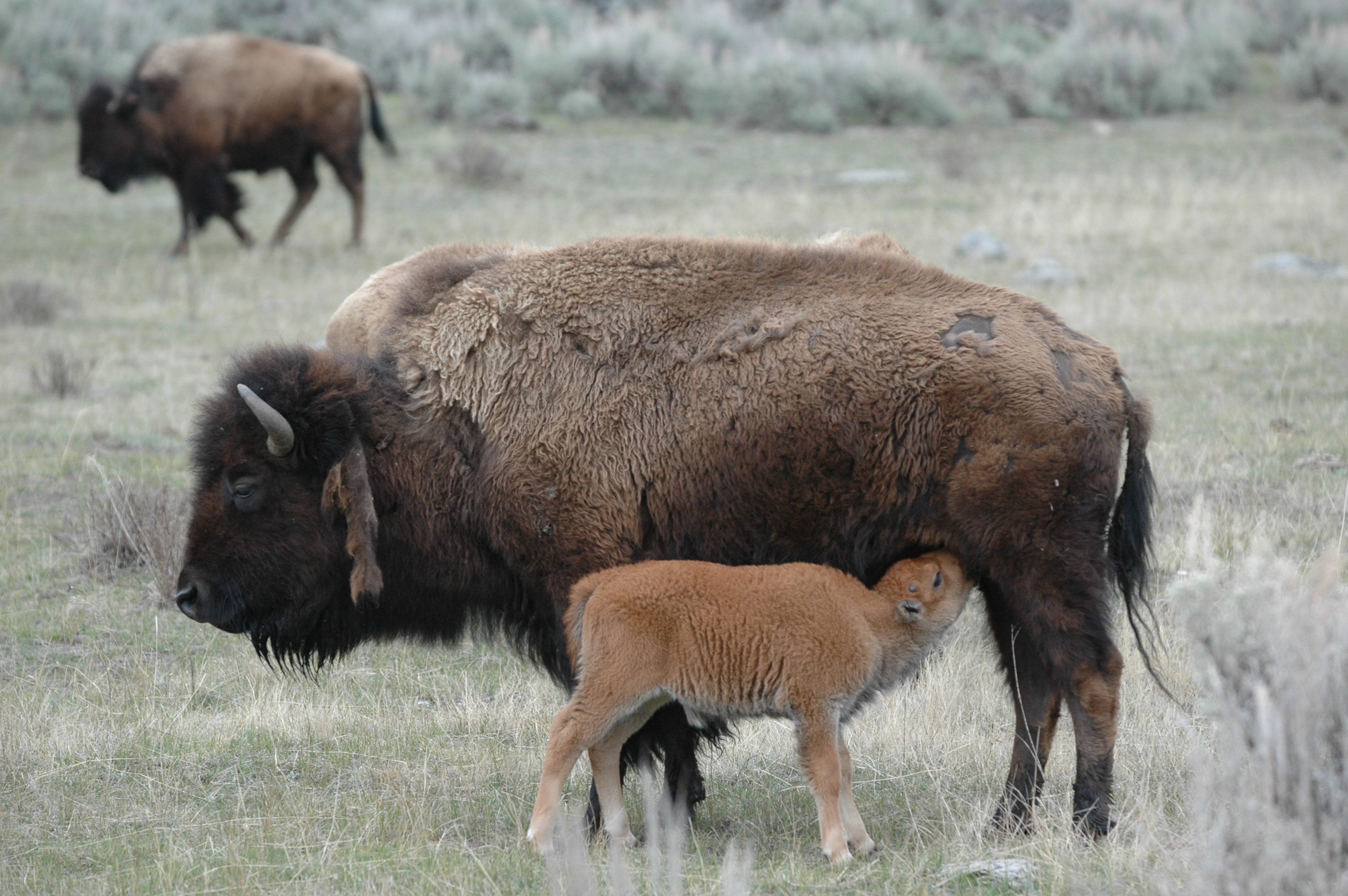
Bison calves are normally born in the spring or early summer. For the first few months of their lives they’re coat is an orange-ish color, turning progressively darker through the warm summertime, until by late August they are as dark as their parents and the other adult and sub-adult members of their herd.
So I was surprised to hear from my wolf-watching friend and former neighbor in southwest Montana that an orange bison calf was just seen in Yellowstone trailing an umbilical cord, a sure sign he was born within the past few days.
Not good timing, as nighttime temperatures hover in the teens now, and snow has already begun falling in the park. The snows will only get deeper and the temps colder for months to come. Life will be tough for the poor little calf this first winter; chances are good he won’t survive.
This is precisely the reason bison have evolved, as a rule, to being receptive to breeding exclusively in August. The ensuing gestation period assures that newborn calves are greeted with a full summer ahead of them. Nearly every animal species living above or below the equatorial belt has adapted to Earth’s changing seasons by only ovulating during a brief window of opportunity, thereby naturally limiting their populations.
Conversely, Homo sapiens can impregnate one another year-round. Our species has had it easy for so long—starting fires for warmth and skinning animals for clothes and shelter—that now human babies are brought forth continuously, 24-7. At last report, 490,000 new humans per day are born to add to the 7 billion mostly carnivorous hominids already here.
Meanwhile, whenever bison herds in Yellowstone thrive enough to reach the arbitrary number of 3,000 total “head,” the park service and the Montana Department of Livestock implement a longer “hunting” (read: walk up and blast the benign, grazing, half-tame bison) season on them, or truck them off to the slaughterhouse—those nightmarish death camps where so many of the bison’s forcibly domesticated bovine cousins meet their ghastly ends in the name of human hedonism.
And people think we need to control their population?
Text and Wildlife Photography © Jim Robertson

 Exposing the Big Game