Exposing the Big Game

Forget Hunters' Feeble Rationalizations and Trust Your Gut Feelings: Making Sport of Killing Is Not Healthy Human Behavior

Exposing the Big Game

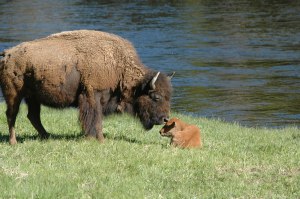
‘Stop the Yellowstone Massacre’: Group puts up billboards urging end to bison slaughter

The billboard is one of two that the Alliance for the Wild Rockies bought, the other being in Helena. Steve Kelly, a board member for Alliance for the Wild Rockies and the artist who painted the picture, said they hope people will see the signs and pressure Montana Gov. Steve Bullock into blocking the annual shipping of Yellowstone bison to slaughter for the year.

“It’s a horrendous thing,” Kelly said. “He’s the one who has the power to stop it.”

The signs went up this week, arriving after hundreds of bison have already been sent to slaughterhouses and while another few hundred wait their turn. Alliance for the Wild Rockies is one of several environmental groups that oppose shipping bison to slaughter, a practice government officials consider necessary to meet population reduction goals each year.

“The National Park Service needs to address bison overpopulation in Yellowstone National Park,” said Bullock spokeswoman Ronja Abel in an emailed statement.

The culling of Yellowstone’s bison herd happens because of a 17-year-old management plan rooted in fears of the disease brucellosis. Brucellosis can cause animals to abort their calves, and the livestock industry worries that if bison are allowed to roam farther outside of the park that the disease might be spread to cattle herds, though no case of bison transmitting the disease to cattle has been documented in the wild.

Reducing the population is one way they try to curtail the risk of brucellosis transmission. The management plan calls for a population of about 3,000 bison in Yellowstone. About 5,500 bison live there now, and officials want to kill about 1,300 from the herd through public hunting and ship to slaughter this year.

State wildlife officials believe hunters from five tribal nations and those licensed through the state have taken roughly 400 so far. The most recent update from Yellowstone National Park said that 179 bison had been sent to slaughter.

There is precedent for a governor blocking the shipment of bison to slaughter. In 2011, then-Gov. Brian Schweitzer issued an executive order blocking the shipment of any bison to slaughterhouses in Montana, a move that prevented the slaughter of roughly 500 bison.

Using the same powers, Bullock delayed shipments to slaughter earlier this year over a group of 40 bison originally meant for establishing a quarantine program at the Fort Peck Indian Reservation.

A quarantine program would take in bison from Yellowstone and keep them in isolation until they can be certified brucellosis free — a certification that would allow the animals to be taken elsewhere. Yellowstone National Park proposed setting up the quarantine operation at Fort Peck in 2016, a political stalemate over transporting bison through Montana stalled those plans. The park had decided to send those 40 bison to slaughter.

Bullock’s action resulted in a deal to send some of those bison to U.S. Department of Agriculture corrals near Corwin Springs and for the governor to lift the shipping ban.

Abel said in her statement that the state “recognizes culling efforts are not everyone’s preferred approach, and will continue to work directly with the U.S. Department of Interior and USDA’s Animal and Plant Health Inspection Service to look at future quarantine as an alternative to slaughter.”

Kelly said they want the governor to either revive the previous ban on shipments or write a new executive order. He said there is probably enough support for the action — aside from the state’s powerful agriculture lobby.

“Certainly there’s enough support,” Kelly said. “He’s just favoring the livestock lobby.”

Yellowstone bison death tally likely more than 570

Wildlife managers estimate more than 570 Yellowstone bison have been killed so far this winter between hunters and the annual ship to slaughter, according to state and federal bison management documents.

A Yellowstone National Park bison management report posted online Monday said 179 bison have been transferred to Native American tribes for slaughter and that 359 bison have been killed by hunters as of last Friday. A Montana Fish, Wildlife and Parks report on hunt numbers compiled two days earlier showed a lower number of confirmed bison harvests, but said that officials believe the total harvest has likely surpassed 400.

The numbers show that bison managers have already surpassed 2016’s confirmed death tally of 534 and are inching toward their goal of removing 1,300 from the Yellowstone herd.

According to the report, another 321 bison were in the park’s Stephens Creek Capture Facility as of last Friday. Those are likely to be sent to slaughter. The park will also continue capturing more bison as they migrate out in search of forage. The park report said 472 bison were seen between the North Entrance Station and the trap last Monday.

Government officials try to reduce the Yellowstone herd each year because of a 2000 bison management plan that calls for a population of 3,000 bison in the region. About 5,500 live there now.

They go about reducing the population through shipping some bison to slaughter and public hunting. Some hunters are licensed through Native American tribes with treaty hunting rights outside the park and some are licensed through the state of Montana.

The state’s hunting season ended Wednesday. FWP’s report was compiled that morning, and it said state hunters had taken 55 of the bison so far. Hunters from Confederated Salish and Kootenai Tribes have killed 180 bison, the most of any of the five tribes.

Bison that are sent to slaughter are consigned to Native American tribes or the Intertribal Buffalo Council before they leave the park’s capture facility. Tom McDonald, a wildlife manager with the CSKT, said the park was splitting shipments between the ITBC and CSKT as of last Friday, but he couldn’t give exact numbers for how many bison went to each.

The park is still holding 24 bull bison that are slated for a trip to U.S. Department of Agriculture corrals near Corwin Springs. The park originally wanted to send them to the Fort Peck Indian Reservation to establish a quarantine program there, but that plan was shelved because of state law requiring they be certified brucellosis free before leaving the Yellowstone region. After time in the corrals at Corwin Springs, those bison may still be sent to Fort Peck.

Yellowstone spokeswoman Linda Veress said Monday that the logistics of moving the bison to Corwin Springs hadn’t been worked out yet.

Slaughter of Yellowstone Park bison gets green light

Photo Copyright Jim Robertson

http://news.sky.com/story/slaughter-of-yellowstone-park-bison-gets-green-light-10754613

Campaigners argue the imposing animals should be left to roam, but officials warn there is a chance they could infect cattle.

15:46, UK,Friday 03 February 2017

Hundreds of bison migrating from America’s Yellowstone National Park are set to be killed because of fears they could spread disease.

Montana governor Steve Bullock had blocked the plan to cull up to 1,300 of the park’s 5,500 bison this winter.

But after two weeks of intensive negotiations a deal has been struck between Montana, Yellowstone and the Department of Agriculture.

Officials say it is necessary to stop them spreading brucellosis to cattle as they head out on their annual migration.

The disease can cause animals to abort their young and has been eradicated in the US, apart from in Yellowstone.

However, researchers and livestock officials say no transmissions of the disease from bison to cattle have been recorded.

That is partly because more than 5,000 have been killed of captured trying to leave the park since 1985.

Wildlife campaigners strongly oppose the periodic culls.

“Stop the slaughter, let them roam and manage them just like we do with elk, just like we do with deer, just like we do with other wildlife,” said Stephany Seay from the Buffalo Field Campaign.

Some 25 bison will be spared so that Native American tribes can start new herds elsewhere.

They will be kept for a year in quarantine just north of the park in Corwin Springs, before being moved to Fort Peck, home of the Assiniboine and Sioux tribes.

Wildlife officials say hunters have killed more than 300 bison so far this winter as they left the park to search for food.

About 400 have also been captured trying to migrate and will be slaughtered. Meat from the animals is given to Native American tribes in the region.

An agreement in 2000 set a population goal of 3,000 bison in the park.

Yellowstone is renowned for its wildlife and spurting geysers such as Old Faithful, and spans nearly 3,500 square miles across Montana, Wyoming and Idaho.

Yellowstone…., (before Trump)


Stephen Capra

There is a place where wolves and bears spend time together. It is a land that still holds in its heart wildness. It is a large protected landscape, where rivers flow strong and thermal features boil and bubble to the surface and geysers send their scalding fury skyward. This is a land of grizzlies, wolves, bighorn sheep and bison. It is a place overrun by tourism in the heat of summer and a vast wilderness surveyed in the stark cold of a December morning. It is managed by humans and its history, not surprisingly, is pockmarked by some very serious collective failings.

But in these days before we begin the Trump Administration, it is perhaps important to remember what good people, with character and foresight can give to a nation, to the world. Yellowstone was and remains that vision, that gift; and if you have ever had the privilege to spend a cold winter day in the heart of the Lamar Valley watching wolves race across the open landscape or skiing through the heart of the geyser basin, then you understand the majesty, the guttural joy that land, wildlife and wilderness can bring to the soul.

Yellowstone this time of year is marked by short days and often bitter cold nights. Snow can be deep in places, windswept in others. The heat of the geysers and thermal features creates an open air sauna for wildlife, and keeps the ice at bay along portions of rivers, streams and lakes. Bison sway their heads back and forth in the deep snow, digging down like a steam shovel to find precious grasses for survival. Trumpeter swans lend their grace to the silent lands of winter and radiate the beauty that is all things wild.

The New Year will bring a new President, one that has never tasted wildness. Likely never hiked or camped or skied in this place called Yellowstone. His ideas, his morals do not seem to seek out good or shared inheritance, rather they are pulled like gravity towards self-fulfillment, delusion and enrichment. He has none of the strength or confidence of the wolf, none of the wisdom of the bear. He has not learned the patience or mutual enrichment of the White bark or Lodge pole pines. He could never understand the courage of the men who decided that this land was not designed for profit, but rather preserved for the wealth its wildness would give to generations to come.

National Parks remain for many our greatest idea. They were created in an era when wealth meant privilege and a park like Yellowstone, while still very hard to access, was open to any and all. Like Yosemite, which was created a few years earlier, they indeed did all come. Men and woman, young and old, fewer of color, but they did come and today are coming in record numbers.

Today with this President and this congress, ideas like our National Parks are viewed with disdain; somehow to many of these men and sadly woman, the power and money of big oil, Koch Brothers, and pipeline kings are transforming our landscapes, our air and waters. The sanctity of our National Parks are being eroded as never before by the very greed, that the men who sat by a campfire more than 146 years ago tossed aside, because they knew it was wrong. They saw in America, a chance to get it right and break free from the very European model that so many had fled. Because of such moral bearings, we now have parks from coast to coast that are shared by all Americans and the peoples of the world.

Yet in the incoming Administration, such moral bearings appear lost with each new cabinet choice, by the fractured nature of our country and bombastic social and contrived media that bears no semblance to truth. Our National Parks in such a battlefield have no medics and we, citizens of America, are the only foot soldiers.

They will come for oil or gold or water. They will look to shoot our bears or desecrate the parks’ borders with mines, gun ranges, or refineries. These concepts are designed not just to break up the land, but more importantly- Our spirit.

In the raw morning that is winter in Yellowstone, we are witness to the magic that is our National Parks, to their strength for our nation and the wisdom they impart to those who care to listen. If you ask me we could double or triple the size of Yellowstone, that much more to share with future generations. That much more safe room for grizzlies, wolves and swans to live and thrive, that much more for people to learn and explore and share with animals that leave in us simply wonder.

But first we must confront the disease, the blight on the horizon. To do this, we must channel the energy that comes from the heart of 2.2 million acres of rare, protected lands, where the bones of bison mix with fiery waters and the primordial muds that define beauty and spirit in perfect balance. That energy source is the fuel for our souls in these times of uncertainty and danger for our lands and wildlife.

It can and will make us warriors!

When they come, for they will come for our lands, we will be ready to fight. In their retreat we will understand the power of land, of animals and wildness to prevail over of the iniquity of greed and the barren promise of money.

But it will take courage, the courage taught by time spent in the heart of wild nature and the spirit of those who came before us, who made sure these lands were to be protected for all generations, not to be exploited by one.

A Recipe for Killing: The “Trust Us” Argument of State Grizzly Bear Managers

http://www.grizzlytimes.org/single-post/2016/10/19/A-Recipe-for-Killing-The-Trust-Us-Argument-of-State-Grizzly-Bear-Managers


October 19, 2016

|

David Mattson

There is a peculiar argument favored by politicians, bank managers, airline representatives, and sales-people of various stripes that goes something like this: “Your interests are important. The customer/voter is my top priority. Trust me.” Such claims will sometimes be accompanied by presumably substantiating evidence as part of glossy promotional material. It helps, of course, if the person making the claim is either ruggedly handsome or a gaunt beauty, and groomed to a pitch of stereotypic trustworthiness.

Right. I would hope that the visceral impulse of half-way rational people is to run as fast as possible in the opposite direction. Even minimal scrutiny of the behaviors of those fielding the “trust me” argument often reveals the obvious: self-interest is a top priority along with serving the narrow special interests of those holding the reins of power and finances, typically the maximization of profits, prestige, and influence for these select few. Think shareholders, corporate bosses, political donors, and ideological allies. Certainly not the gullible client, customer, voter or larger abstract “public” so devotedly cultivated. The obvious.

“Trust us” with Grizzly Bears?

So when I hear wildlife managers in the states of Wyoming, Montana, and Idaho saying “trust us” to manage Yellowstone’s grizzly bear population, my initial response is skepticism and suspicion. And it doesn’t fill me with warm fuzzy feelings when I further hear and read that these state managers are categorically refusing to be held accountable in any authoritative way to the federal government or the national public if and when the reins of grizzly bear management are handed over by the US Fish & Wildlife Service (FWS). The letter submitted by the States as part of their comments on the FWS’s proposal to remove Endangered Species Act (ESA) protections for Yellowstone’s grizzlies makes interesting reading. The States are clearly in it for power gains and ideological gratifications.

Moreover, there is little ambiguity about the fact that, in practice, state wildlife managers see predators such as grizzly bears primarily as competitors, nuisances or even varmints—and this despite the palliatives and platitudes you can find in State plans. The reasons are pretty obvious. State management more closely resembles a for-profit venture organized around huntable surpluses of big game than it does an exercise in fulfillment of the public trust. Wildlife managers are slaved to the narrow special interests of hunters, fishers, and livestock producers by shared culture and political vulnerabilities, but more fundamentally by dependence on the marketing and sales of arms, ammunition, and licenses to kill elk and deer (for more on all of this read the first and second blogs in my series on state wildlife management). Unless you are a hunter, none of this is a prima facie basis for “trust.”

Based on What Plans?

And then read the details of State plans for managing Yellowstone’s grizzly bears; plans that the States have offered as evidence of trustworthiness; plans that the States insist are, at the same time, entirely discretionary. Which may actually be a good thing given how unconscionably and appallingly inadequate they are.

The centerpiece of State plans consists of a tristate Memorandum of Agreement (MOA) that details methods for managing grizzly bear mortality. These methods specify aspirational mortality rates linked to different estimated grizzly bear population sizes as well as the means by which permitted deaths are to be allotted to the three involved States. The MOA goes on to describe benchmarks that, if “violated,” would putatively trigger discretionary reviews of management. All fine and good.

But read further. The MOA assumes that male grizzlies can be killed at twice the rate as female grizzlies without jeopardizing population stability, and that bears living inside protected areas (i.e., National Parks) will be counted towards estimates of total population size, which will then be used as the basis for calculating total numbers of bears able to be killed during a given year. The MOA considers a certain percentage of this total to be “discretionary,” all of which is allotted to States (i.e., none to the National Park Service [NPS] or involved Tribes), and from which comes the bears available for state-administered trophy hunting. The States pointedly excluded the NPS and Tribes from development of the MOA and make no provision for either to be authoritatively involved in its implementation—this for two jurisdictions that collectively support over a third of Yellowstone’s grizzly bear population. Your eyebrows should be elevated at this point.

A Recipe for Killing

Without being exhaustive, even this minimal description of the MOA highlights some aspects that are a recipe for trouble. First, you can’t kill males at twice the rate you kill females and have a stable population. Males and females are replenished at an equal rate (i.e., the sex ratio of cubs is roughly 1:1), which means you can’t sustainably kill more males. Second, bears on NPS and Tribal jurisdictions are being used by the States to subsidize their killing of bears elsewhere without explicitly involving either sovereign entity in any deliberations or considering population-level consequences. Because grizzly bears protected by National Parks will be dying at a comparatively low rate, the de facto mortality rate of bears on non-Park jurisdictions will be higher than the population-wide target or guideline. As a consequence, there will be a net outflow of bears from Parks to non-park jurisdictions. The subpopulation in Parks will be a reproductive engine (i.e., “source”) subsidizing otherwise unsustainable killing in the State-administered subpopulation (i.e., “sinks”). And the brunt of this will be borne by male grizzly bears.

And then consider this. Estimates of total population size will be based almost exclusively on sightings of females with cubs made over three successive years. Given a three-year reproductive cycle, this yields an estimated total number of reproductive females. Other classes of bears are accounted for in calculations of total population size simply by applying various fixed multipliers, notably including the assumption that independent males are equal in number to independent females (i.e., a 1:1 sex ratio). The MOA makes explicit provision for adjusting these multipliers (including the ratio of males to females) only if estimated total population sizes fall below certain thresholds, thereby triggering discretionary reviews leading to discretionary revisions. In other words, state managers could be slaughtering males within their jurisdictions and, because this segment is not directly monitored, continue to generate increasingly phony and inflated population estimates driven almost solely by sightings of reproductive females—without dropping below any population triggers and thereby without triggering any corrective actions.

With Predictable Destructive Outcomes

This doesn’t need to be left as a verbal hypothetical. I found it easy enough to specify a model that embodied the essentials of the methods contained in the States’ MOA, including a source-sink structure, variable but lower death rates within Parks, procedures for estimating total population size based on sightings of females with cubs, the meting out of “discretionary” deaths according to population-level guidelines for mortality rates, the realization of resulting de facto death rates on non-Park lands, and changes in prescribed mortality rates in accord with changes in estimated population size driven by numbers of reproductive females. Once specified, I was then able to use this model to project what would likely happen with implementation of MOA protocols employing the notable (and probably untenable) assumption that Yellowstone’s grizzly bear habitat would remain static. Key results are in figure 1, immediately below.

Figure 1. Results of a stochastic model simulating implementation of methods for post-delisting management of Yellowstone’s grizzly bear population described in the tristate MOA. Figure 1A shows trends in numbers of independent males and females in source (i.e., Park) and sink (i.e., non-Park) populations. Figure 1B shows trends in “real” and estimated total population sizes relative to population thresholds linked to management triggers, along the magnitude of discrepancy—or error—between estimated and real population sizes.

Hopefully without belaboring the obvious, there are some more-or-less guaranteed outcomes from implementation of the MOA. First and foremost, numbers of independent males will tank outside of National Parks, primarily because they will be subject to grossly unsustainable mortality rates. Numbers of independent males inside Parks will decline slightly because of losses to net out-migration. Numbers of reproductive females will remain steady to slightly increasing, leading to increasingly inflated estimates of total population size, despite a collapse of the male segment on non-Park lands. Within eight or so years population estimates will have been inflated by roughly 200 bears over “reality,” but without detection and without triggering any corrective measures.

And this is probably an optimistic scenario. The model does not include the on-going and foreseeable effects of unraveling habitat conditions (see this blog for a synopsis). Nor are the effects of declining female reproductive success included, foreseeably attributable to lack of sufficient breeding males outside the Parks and, before that, an ephemeral pulse of elevated cub mortality caused by social turmoil.

What do I make of this? It’s pretty obvious. The methods contained in the States’ MOA are so egregiously flawed as to call into question the competence and motives of the wildlife managers who concocted them. The Plan certainly does not build a case for trust.

And Then There is History

And then there is the history of state management. Without being exhaustive, there are two observations of particular relevance to the rather dismal track record that the states of Wyoming, Idaho, and Montana have established managing our endangered large carnivores.

First, consider how the states of Idaho and Montana have managed wolves since ESA protections were removed in 2011. I don’t have the space here to elaborate on all of the relevant details (see the third point in this document), but a consistent pattern emerges. It is clear that both states unapologetically embarked upon a post-delisting wolf-killing program that was designed to reduce wolf populations in service of, first, controlling depredations on behalf of livestock operators disinclined to take the most basic of precautions; second, achieving inflated goals for elk and deer populations; and, third, offering essentially unlimited sport hunting opportunities. There is no evidence that either Idaho or Montana were attempting to serve other “values,” foster something as apparently inconsequential as wolf-derived ecological services, or, even, Heaven forbid, accommodate the inevitable toll of predation in goals for ungulate populations. Wyoming and Montana have both made clear that these are the outcomes planned for grizzly bears as well, barring, perhaps, a more circumscribed approach to sport-hunting.

Second, consider why grizzly bears in the Yellowstone ecosystem ended up on the Endangered Species list in the first place. Between 1959 and 1970 grizzly bear deaths in areas under state jurisdiction accounted for the majority of mortality in this region. Of these deaths, 84% were attributable to sport hunting. And, of these, 59% were adults—33% adult males and 26% adult females. In short, the states of Wyoming and Montana were administering a sport hunt that was unsustainable, manifest in the patently small size of the grizzly bear population at the time it was given ESA protections in 1975. The States were clearly not managing for recovery nor increases in Yellowstone’s grizzly bear population during the 1960s and early 1970s. More certainly yet, the States remained wedded to a regime of sport hunting on the basis of principle and custom, and with little apparent reference to or regard for information on population trend. Montana’s devotion to the ethos of hunting is evident in the fact that this state continued to administer a sport hunt of grizzly bears in the Northern Continental Divide Ecosystem until forced by litigation to stop in 1991, sixteen years after the population was listed by the FWS as Threatened.

“Trust us.” Are You Kidding?

The institution of state wildlife management in the tristate region of Wyoming, Idaho, and Montana is despotic, corrupt, and fundamentally anti-predator. By design, it disenfranchises the vast majority of Americans and, because of transactional financial dependencies, overtly caters to a small number of special interest groups. It is interesting to me that very few people are even aware of these structural problems, and of those who are cognizant there is an alarming tendency to concoct narratives (e.g., the North American Model of Wildlife Management) that justify the corruption. Moreover, the demographic profile of hunters (mostly white less-well-educated males) overlaps almost exactly with Trumps’ misogynist, racist, jingoistic, and otherwise bigoted core supporters; the very same people who seem to have little respect for or understanding of democratic institutions. We can pretty much count on state wildlife managers catering to this crowd in their management of Yellowstone’s grizzly bears, including the pathetic few who apparently need a stuffed grizzly bear in their den to prop up a frail ego.