The “Euphoria” of Killing?

When a friend sent me a link to an article about a popular new pro-hunting book that came out within a week of the release of my book, Exposing the Big Game: Living Targets of a Dying Sport, I knew I’d have to think of a way to respond. As it turns out, the author of The Call of the Mild: Learning to Hunt My Own Dinner, a young woman from New York City (who decides to emulate Sarah Palin and take up hunting), has made that an easy task.

She came right out and spilled the beans about her feelings (or lack thereof) when she opened fire on a pheasant (one of Dick Cheney’s favorite targets) and made her first kill:

“It felt incredible. It really felt pure. Like euphoria to me. It was just this amazing rush of excitement and pride and relief, and I know this word gets overused a lot, but it was empowering. I didn’t believe I had it in me to do that. It shocked me.”

There’s nothing like getting in touch with your inner psychopath, I guess.

In the article, the author of “The Mild” relates that she was also surprised that she didn’t feel much guilt afterwards. Though rarer than their male counterparts, female psychopaths share the same trademark characteristics: a lack of empathy, remorse or guilt.

It’s curious that she chose a pheasant as the first victim of her quest to live off the spoils of nature, since pheasants are non-native, farm-raised birds who are often kept in captivity like chickens or turkeys before being released into fields frequented by hunters.

I saw this unnatural process for myself back in my early college days. At the time I’d enrolled in a wildlife “management” course, during my brief flirtation with the notion that a true animal lover could find happiness working for the “Game” Department.

Thinking it might help me get ahead in the field, I stopped in to volunteer at a local wildlife “recreation” area. The “game” manager that ran the place was busy herding pheasants from a pen area into a cage. Though only a about foot wide, a foot high and six feet long, the cage was intended to contain a dozen of the big birds. To my delight, one of them got away before he could close the cage door. But the pheasant’s freedom was short-lived—within a minute a shotgun blast rang out and one of the bird hunters “recreating” there soon walked by carrying the carcass of the half-tame “game” bird. I decided on the spot not to pursue the field of “wildlife management” any further.

Presumably the purpose of The Call of the Mild is to inspire more people to take up arms against the wildlife. Let’s hope it’s not successful. However, it does give me an idea for tomorrow’s blog post: “The Day Seven Billion People Decided to Hunt Their Own Dinner.”

The Time They Feel Most Alive

While we’re exploring the similarities between serial killers and sport hunters, another thing they both have in common is, the time they feel most alive is when they’re out killing. A serial killer can’t be satisfied with a quiet walk in the night air any more than a hunter can take a hike on a trail without a weapon. 

That might explain why there’s no closed season on prairie dogs or coyotes in states that “manage” them for “recreational shooting opportunities.” “Game” managers must be able to relate to their hunter constituents well enough to know that killing just once a year isn’t enough for many of them. Like serial killers, sport hunters have a cooling off period between kills which doesn’t always last throughout the winter, spring and summer until the next hunting season. 

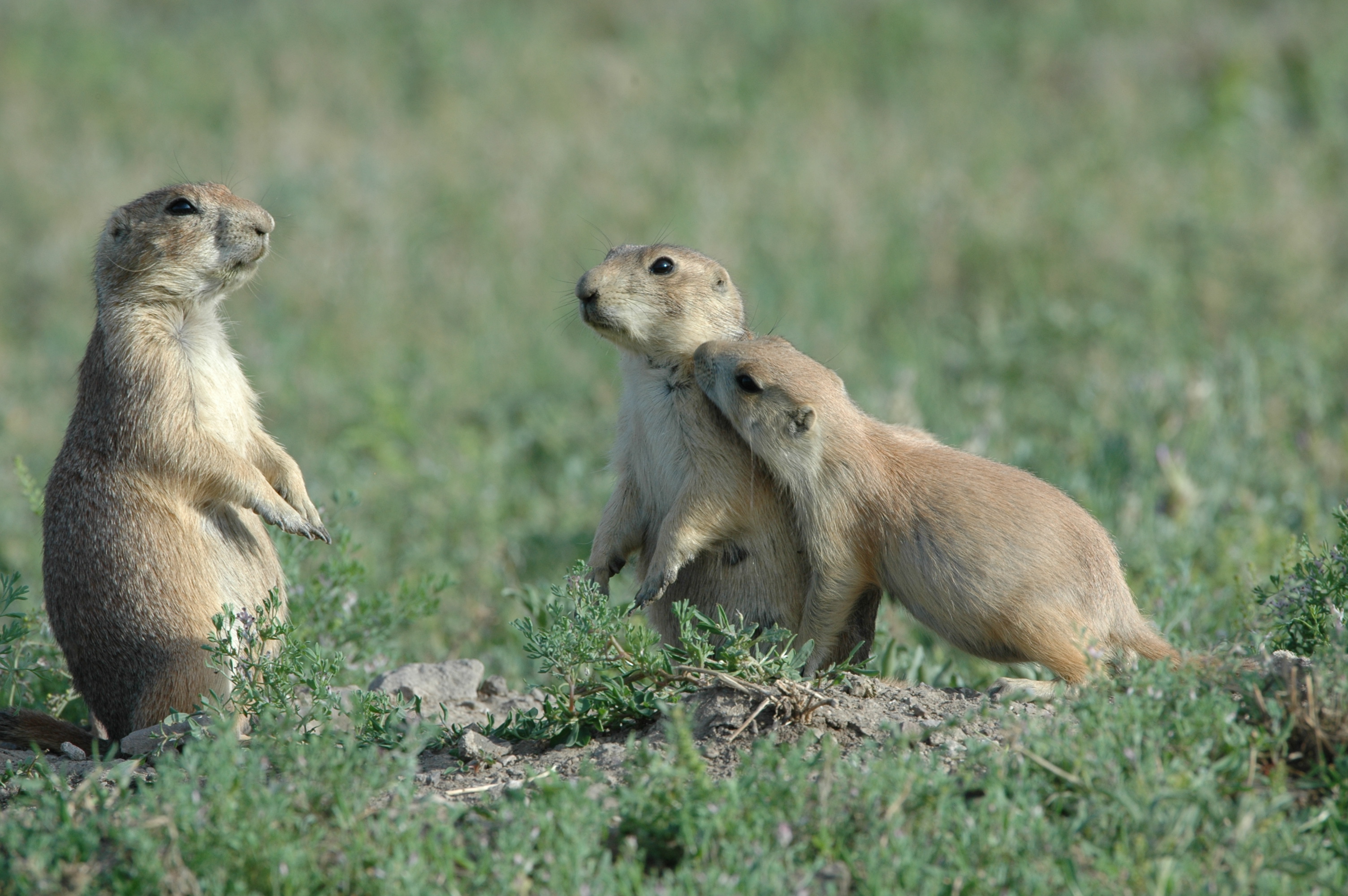
Prairie dogs and coyotes are two species that are heavily hunted, but never for food. Their killers can’t claim a need for sustenance; they’re just out for a bit of “fun.” One thrill-killer describes his sport this way: “Prairie dog hunting is a blast, on both private and public lands. I like to start by clearing everything within50 yardswith an AR-15, then switch to my .223 Remington for anything out to about 150 and finally trade up to the bull barrel .22-250 for the longer shots.” Clearly, it’s the act of killing that really gets their blood up.

Wildlife Photography Copyright Jim Robertson

The Serial Killers Named Buffalo Bill

It puts the lotion on its skin, or else it gets the hose again.”

That haunting line was made famous by the serial killer, Buffalo Bill. Not the historic character credited with the serial murder of tens of thousands of gregarious and benign bison, including 4,120 in one eighteen month period alone. No, it was uttered by the other famous (though in this case, make believe) multiple murderer of the same name: the nemesis in the story, The Silence of the Lambs.

Like his namesake, the old west bison slayer (forever immortalized with towns named after him and museums devoted to his memory), the fictional “Buffalo Bill” made a habit of objectifying his victims, using the pronoun “it” to depersonalize them in order to avoid any stirrings of conscience that might drift by. Both Buffalo Bills thought those they killed were beneath them and therefore unworthy of their concern.

The fictitious “Bill” was modeled in part after the real-life serial killer, Ed Gein, who, like most sport hunters, made trophies and souvenirs from his victims’ bones and skin.

It seems whether their victims are human or non-human animals, objectification and depersonalization play major roles in the psyches of hunters and/or serial killers.

Making Too Much of Hunting?

Some folks might be thinking that I’m making too much of this whole hunting issue. After all, it’s been a long time tradition practiced by some of our most famous presidents (and infamous vice presidents). How bad could it be?

Well, all you have to do is visit any grocery store magazine rack across America to find out how bad it is. If anything, you’ll see that sport hunting is worse than what I’ve been saying.

Like any other animal exploitation industry out there these days, the deeper you dig, the more shocking the details you’ll uncover. Despite my involvement (some might say obsession) with this issue (to the point of writing a book about it) I guess I really haven’t plumbed the darkest depths of hunting’s heartlessness yet. I found myself genuinely shocked when I saw the wording on the cover of an Alaskan “sportsmen’s” magazine in a grocery store check-out line on my way home from visiting relatives yesterday. Partially covering the photo of a grinning hunter posing with his dead “trophy” animal were the words, “Where to Kill the Biggest Critters”!

At least this publication was honest, it came right out and said “kill,” not “harvest” or “take” or any of those other soft-sell terms for animal murder. They know they’re evil, and they’re proud of it. Among the other articles featured was “Learning from Ted Nugent.” That should give you some idea of the intellect level of the magazines’ readership. 

But this rag is not just for sale in some backwoods enclave or at the rat-hole mini-mart where Bubba stops in for beer and beef jerky. I came upon it at an upscale grocery store by a ferry landing right across the Puget Sound from the supposedly progressive city of Seattle. This stuff is wide spread and insidious.

So what kind of awful, sick things were inside that magazine? I didn’t have the stomach to pick it up and look. Maybe next time…

Wildlife Photography Copyright Jim Robertson

The Smallest Particle in the Universe

Hooray, hooray. After sinking tens of billions of dollars into giant underground “atom-smashers,” scientists think they’ve discovered the smallest thing in the universe, the so-called “God particle” (a more appropriate name would be the “humans-playing-god-particle”). But for the most part, scientists haven’t yet discovered how seven billion human beings can live sustainably on (i.e., in lasting harmony with) this, our home planet. 

With triple-digit temperatures arriving earlier than ever across the United States, it appears the specter of global warming is stepping out of the shadows and thumbing its nose at anyone who still doubts its existence. Not to be deterred by a few heat-related deaths, out of control fires raging across the Rockies or apocalyptic thunderstorms knocking out power to those dependent upon air conditioning, the unrelenting, singe-minded machine known (paradoxically) as “progress” (intent on burning the last stores of carbon over the shortest possible time period) continues to tear open vast wounds in the Canadian arctic in search of tar sands and slurp up the last pools of crude from the most fragile of onshore and offshore environments. 

Meanwhile, more people than ever are eating more animals than ever. By clearing off the life-giving, naturally carbon-sequestering rain forests that slow the pace of climate change and replacing them with over-crowded cattle feedlots, human’s taste for flesh foods now surpasses even their thirst for oil in increasing the earth’s average overall annual temperature. 

Ironically, when the dust settles on humankind’s reign of terror, those costly underground atom-smashers may serve an important function after all. They can be put to use in the search for what must be the real smallest particle in the universe: the minute speck of human concern for anything beyond short-term gratification.

Exposing the Big Game goes Digital

FOR THOSE WHO HAVE ASKED, THE BOOK, EXPOSING THE BIG GAME, IS NOW AVAILABLE IN E-BOOK AND INCLUDES ALL 240 PHOTOS.

HERE’S A LINK TO ORDER ON KINDLE

As with any book that comes out both in print and in digital, there are pros and cons with either format.

Personally, I prefer the print version for two reasons:  First of all, I don’t own any kind of e-reader yet;-)  The other reason is that the photos were laid out to coincide with specific lines of text, often featuring complementary images facing each other on opposing pages.

For the most part the layout translates well on digital, unless a person were to change the text’s font size, in which case a photo can sometimes end up a paragraph or even a page away from it’s originally intended location. But, changing the font size is one of the pluses of the e-book version and I wouldn’t want to discourage anyone from taking full advantage of all the benefits of the latest technology.

Here’s the ultimate solution: why not get a copy of both versions of Exposing the Big Game😉 That way you can see the photos just the way they were meticulously laid out by my wife and I over many long (but not necessarily always tedious) hours, while you read the e-copy with extra large text and maybe even your choice of three background colors.

With the e-version you’ve got possibly the only digital anti-hunting book yet in exisitence, but then again, the print version doesn’t require electricity and (if you take good care of it and don’t dog-ear every other page) could well outlive this flash-in-the-pan age of the machine…

And with the print version, you could ask the author to sign it for you;-)…

That “Good Clean” Shot?

One September afternoon while I was hiking back down a trail I had been maintaining for the U.S. Forest Service, I ran into my former high school P.E. teacher and track coach, whom I hadn’t seen in years. He asked me, somewhat frantically, if I’d sighted a wounded deer in the area. He said he’d shot and hit a buck with his black powder rifle and (of course) didn’t have time to re-charge his muzzle-loader before the deer got away. 

One of the rationalizations hunters have for the “humaneness” of their legalized-cruelty-to-animals is that they always kill their quarry on the first shot. Funny, how they all say that when I’ve seen plenty of wounded deer over the years. Clearly, someone’s not ‘fessing up. Maybe it’s not as easy to kill an animal on the first shot as they’d like to have people believe… 

This rationale is similar to the logic used by Peggy Good, one of Ted Bundy’s many defense lawyers, during the sentencing phase of his trial in Florida, after he was found guilty of first degree murder in the clubbing deaths of two University of Tallahassee co-eds and the critical wounding of three others. 

She hoped to spare him the death penalty with the reasoning that, “One of the factors of the definition (of heinous crimes worthy of capital punishment) is whether the victim suffered, whether there was torture to the victims. I believe you recall the testimony of Dr. Wood where he states explicitly that both these women were rendered unconscious by a blow to the head…They didn’t even know what was happening to them. It was not heinous, atrocious, or cruel because of the fact that they were not aware of impending death, they did not suffer, and there was no element of torture involved whatsoever as to the victims who died.” (She didn’t happen to mention the other three victims who lived, only to suffer physically and emotionally for the rest of their lives from their injuries.) 

Good’s argument didn’t wash for the jury who had just sat through five weeks of testimony on the cruelties Bundy had inflicted. They sentenced Ted Bundy to death by electric chair. 

Whether or not hunters actually kill their prey with one “clean” shot, they are robbing an animal of its precious life. 

Do they deserve the same sentence Bundy got for his crimes? Well, the jury’s still out on that… 

The day after my chance meeting with my former coach, I saw him again in town. He was pleased to tell me he’d gone back in the morning, followed the blood trail and dispatched the wounded deer with a second shot. The “good” news was, at least that deer only had to suffer 12 hours or so for someone’s unnecessary pastime.

Wildlfe Photography by Jim Robertson

Answer to an Elmer “Enjoying a bear hunt in Alaska”

The following is a letter in response to an article in the “sports” section of the Albany, NY Times Union:

Dear Editor,

A friend of mine sent me the article, “Enjoying a bear hunt in Alaska,” by your Outdoors writer, Rob Streeter (June 15, 2012). With friends like that, who needs enemies? I don’t normally have acid reflux, but reading how casually Mr. Streeter prattled about his desire to impale a black bear with an arrow made me burp up enough burning bile to fill a golf cart battery.

Bears are not play toys put here for our sporting pleasure; they are intelligent, autonomous, highly evolved sentient beings. But each year, ursiphobic “Elmers,” as I un-lovingly refer to bear hunters in my book, Exposing the Big Game: Living Targets of a Dying Sport, are responsible for the deaths of 30,000 black bears in the US alone.

I’ll never understand how a New Yorker can feel justified in flying clear to Alaska to savagely snuff out an innocent bear peacefully grazing on spring grass.

Rachel Carson, author of Silent Spring, saw the brutality of hunting as a detriment to civilized society:

“Until we have the courage to recognize cruelty for what it is—whether its victim is human or animal—we cannot expect things to be much better in this world. We cannot have peace among men whose hearts delight in killing any living creature. By every act that glorifies or even tolerates such moronic delight in killing we set back the progress of humanity.”

On the rare instance that bears resort to violence, at least they don’t take moronic delight in it.

Wildlife Photography Copyright Jim Robertson