Crippling Animals Should Weigh on One’s Conscience

Other than a stopover at the Anchorage Airport on my family’s flight home from Japan in 1962 when I was two years old, my first trip to Alaska was in 1977. Back then I was still deceived by society’s prevailing norms and under the influence of its contradicting principles regarding fish (as they were aquatic, enigmatic and incapable of voicing their distress, surely they didn’t have the right to be left alone), so I’d taken a summer job in the salmon fishing industry at a dismal settlement on the windswept side of the breathtaking Alaska Peninsula.

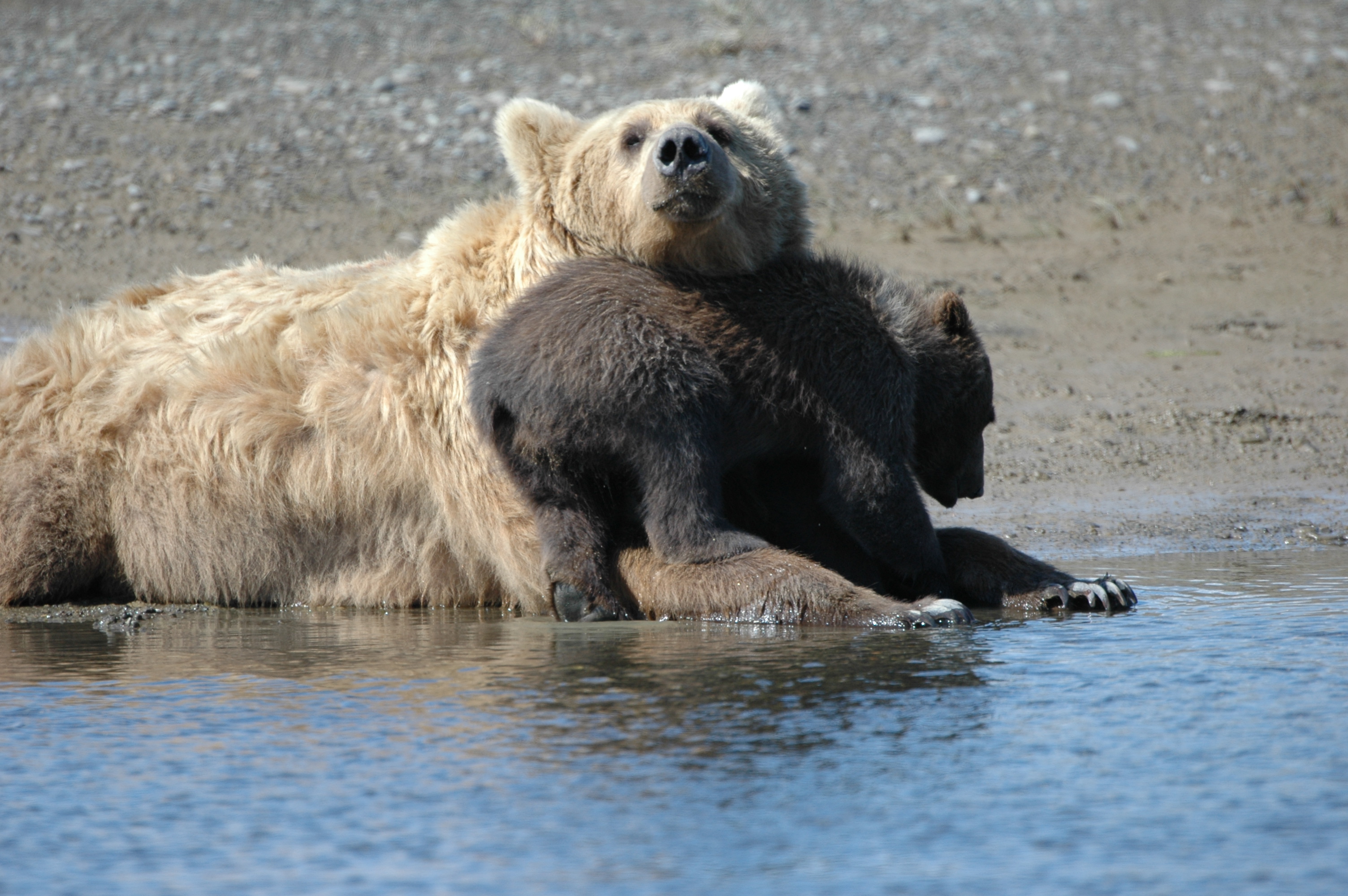
Nak Nek was a gloomy ghost town most of the year and a small but hyperactive boom town during the annual fish-kill frenzy, when the tides twice-daily ushered in barge after barge overflowing with mountains of bloody fish bodies. The only thing the village had going for it, to my mind, was its proximity to the spectacular emptiness of Katmai National Monument, which I vowed to visit once the term of my employment was over. Named after one of its many active volcanoes and supporting a hefty population of grizzly bears who congregate at the spawning streams (to which any salmon lucky enough to escape slow death stuck in a gill net feels a desperate yearn to return), Katmai’s best known feature is Brooks Falls.

At the time, grizzlies (or brown bears, as they’re locally known) outnumbered people, and there wasn’t so much as a footbridge across the clear, deep river that connects Nak Nek Lake to Brooks Lake. This was long before the construction of the now-popular tourist boardwalk and viewing platform, complete with bear-proof railings and gates. The only way through the dense black spruce forest and tall-grass marsh to the falls was on a crooked, narrow bear trail.

On the afternoon of my last day of my stay at Katmai, I decided to cast out a line and try to catch one of the many sockeye salmon converging along the edge of Nak Nek Lake, waiting for their turn to head upstream. Right away I hooked one, but before I could bring it ashore, the line broke and the fish swam off trailing a length of fishing line. I felt terrible, imagining it would end up tangled on something and die unable to get to a spawning bed.

But the next morning, while waiting for the float plane, I tied on a new fly and cast out my line once again. This time I was able to land a fish, which turned out to be sweet relief both for me and for the fish. Incredibly, it was the same fish as the day before—this time the hook was stuck in a branch that had the broken line from the day before tangled around it! I unhooked the fish and released it back into the lake to continue its journey, now unfettered by human garbage…

The experience was part of what led me to eventually turn my back on fishing altogether. The reason I bring all this up is, knowing how bad I felt when the fish got away with a hook stuck in it makes me wonder how some hunters can live with themselves when they wound animals with bullets or arrows and watch them run off to suffer and die a prolonged death because of their thoughtless acts.

Bowhunting is notorious for wounding deer, elk or others who can 473851-1234448543-mainlive for months with arrows stuck in them. A recent article about a town on the Oregon Coast deciding to allow bowhunting and hunting with shotguns loaded with slugs, in a forest reserve right outside city limits, quoted a city council member reporting on an all-too-common tragedy, “There are animals that are harvested during rifle season where broadheads are found” (in them). Though he admitted that there’s a higher chance that an elk or deer will be wounded but not killed if hit by an arrow rather than by a slug or a rifle bullet, the bureaucrat did not want to appear softhearted and callously went on to say, “Elk are amazingly tough animals.”

What I want to know is, given that bowhunting has a 50% crippling rate, why aren’t we hearing about more bowhunters turning their backs on the sport? Could it be they lack remorse, guilt, empathy or a normal human conscience?
_______________________

This post includes an excerpt from the book, Exposing the Big Game: Living Targets of a Dying Sport.

Text and Wildlife Photo ©Jim Robertson

Text and Wildlife Photo ©Jim Robertson

Meet the Wolves’ Enemies

From Earth Island Journal: 

Wolf Hatred is a Gateway to Bigotry

by Bob Ferris – January 17, 2013

Hate and intolerance are the underlying themes of the philosophies and motivations anti-wolf folks exhibit

This article originally appeared in Cascadia Wildlands

(This a PG-13 rated article. We purposely omitted profanity laced posts, death threats, and pictures of blood and gore because we feel that the evidence of bigotry is obvious and the need for action compelling.)

In late December an “event page” on facebook was attacked. The page was celebrating a prayer vigil for wolves that was to be held in Salem, Oregon. And the attackers swooped down electronically the day after the event and filled the page with bloody pictures of wolf kills and fetal deer purported to have been “aborted” by wolves. The action was disturbing and eerily like the protests held by the Westboro Baptist Church, where they show up where they are not wanted and act in the most offensive and inappropriate manner possible.

artwork depicting a Santa Claus figure shooting a wolf from his sleigh“Cartoon” from Save Western Wildlife’s Facebook page

The Westboro mob is classified as a hate group and rightfully so. They—like the anti-wolf folks—are generally overflowing with unbridled faith, strongly held opinions and self-righteousness and somewhat bereft of relevant education, understanding, or any form of tolerance or compassion. Both groups are classic bigots in that they hold unfounded and yet deep beliefs and will not let facts or reason dissuade them from dishing out broadsides of vitriol towards the object of their scorn whether it be homosexuals, people of color, members of other religions or wolves.

Is Wolf Hatred Gateway Bigotry?

Do I go too far in linking bigotry against wolves with the same attitudes against individuals and sectors of the human population? I don’t think so. Studies have conclusively linked animal abuse to child abuse, domestic violence and even serial killing. The experts assert that these acts are all parts of the same dangerous syndrome. I strongly suspect that bigotry is a related syndrome and behaves the same way. And I have seen enough human-directed bigotry—mainly racial, anti-Semitic and life-style directed—on the facebook pages of these anti-wolf actors and their compatriots to think that, once started, predator bigotry translates quite easily across the wildlife-to-human spectrum.

Article Continues here: 

http://www.earthisland.org/journal/index.php/elist/eListRead/wolf_hatred_is_a_gateway_to_bigotry/


Restoring the Imbalance–for Hunters

First, here’s an urgent message from Defenders of Wildlife:

…In the past year more than 400 wolves have been killed in Idaho, and last week the Idaho Fish and Game Commission approved a proposal to pay Wildlife Services $50,000 to launch a new round of wolf killing – which could include aerial gunning of wolves under the excuse of artificially inflating elk herds to make hunting them easier. This death-by-helicopter or airplane plan is misguided and wrong!

Last year, Idaho called in Wildlife Services to kill wolves in the central part of the state to artificially boost game populations in the region – and it appears that they’re planning on doing it again…

Clearly, hunters want their cake and eat it too. Out of one side of their mouth they declare there are too many elk and that they are doing the animals a favor by killing them to prevent overgrazing. Yet when wolves spread out and successfully reclaim some of their former territories, hunters resent the competition and call for every brutal tactic imaginable to drive wolves back into the shadows, thereby restoring the imbalance that hunters depend on to justify their exploits.

The point of recovering endangered species should be to bring back and/or protect enough biodiversity to allow nature to function apart from human intervention. The presence of predators like wolves can help to restore a sense of natural order and nullify the claims by hunters that their sport is necessary to keep ungulate populations in check.

Wolves in Yellowstone have been keeping elk on the move enough to allow willows to thrive once again in places like the Lamar Valley. Newly emerging willow thickets in turn provide food and shelter for an array of species, from beavers to songbirds. The loss of each thread of biodiversity brings us one step closer to a mass extinction spasm that would wreak more destruction and animal suffering than the Earth has seen in some 50 million years.

Now more than ever we need to counter the hunter agenda at every turn, for the sake of a functioning planet. It’s time to put an end to the notion that wildlife are “property” of the states, to be “managed” as their “managers” see fit. The animals of the Earth are autonomous, each having a necessary role in nature. Only human arrogance would suppose it any other way.

Text and Wildlife Photography ©Jim Robertson, 2012. All Rights Reserved

Text and Wildlife Photography ©Jim Robertson, 2012. All Rights Reserved

For Safety’s Sake, Some Gun Collectors Should Switch to Stamps

According the Associate Press,five people were wounded in accidental shootings at gun shows in North Carolina, Indiana and Ohio on Saturday. That’s five shooting victims—all in one day!

At the Dixie Gun and Knife Show in Raleigh, a 12-gauge shotgun discharged as its owner unzipped its case for a law enforcement officer to check at a security entrance, injuring three people, a state Agriculture Department spokesman said. Two bystanders and a retired deputy sheriff were hit by shotgun pellets and taken to a hospital.

Sheriff Donnie Harrison said that it was too early to know whether the shotgun’s owner might be charged, but that it appeared to be an accident. (But don’t be surprised if the victims are the ones who end of being charged—with failure to wear a bullet proof vest at a public gun show.)

The North Carolina show, which is held at the state fairgrounds (not annually, but four times a year), usually draws thousands of people (some of whom actually survive the event unscathed).

In Indianapolis, police said a 54-year-old man was injured when he accidentally shot himself while leaving a gun show. (He could have saved himself the entry fee if he would have just shot himself before leaving home.)

Emory L. Cozee, of Indianapolis, was loading his .45 caliber semi-automatic when he shot himself in the hand as he was leaving the Indy 1500 Gun and Knife show at the state fairgrounds. Police said that loaded personal weapons aren’t allowed inside the show, but (presumably since the shooting occurred outside the building in the fairgrounds parking lot) no charges will be filed. (After a trip to the emergency room, Cozee is comfy once again.)

And in Ohio, a gun dealer was checking out a semi-automatic handgun he’d just bought when he accidentally pulled the trigger. The gun’s magazine had been removed, but one round remained in the chamber, police said. The afore-mentioned (magic) bullet appears to have ricocheted off the floor and struck the gun owner’s friend in the arm and leg. The (erstwhile) friend was taken by helicopter to a hospital 30 miles north in Cleveland; his condition was not immediately known.

Now I’m not trying to trounce on anyone’s God-given American rights (except the self-allocated “right” to hunt and kill animals recreationally), but for safety’s sake, maybe some of these folks should take up crocheting, knitting or collecting stamps, rather than gun collecting. Once they’ve mastered benign hobbies such as these, if they still feel the puerile need to prove their machismo, they could work back into it slowly, starting with craft shows or canasta tournaments.

Hell, it sounds like playing Russian roulette is probably a safer pastime than attending some of those gun shows.

90823_Pred_ATACS

Hunting Is Not a Sport, It’s Sadism

I know I’ve said it many times before, but allow me to reiterate: hunting is not a sport, it’s sadism. Football, baseball, basketball and hockey are sports. Bicycle racing, marathon running, pole vaulting and shot putting are other examples.

I went skiing yesterday; skiing is both an outdoor activity and a sport. It tests one’s skill and promotes quick reactions and good balance. Skiers can challenge themselves by going faster, taking steeper runs or skiing heavier, untracked snow.

Boxing, karate, and tennis all qualify as sports; each one pits two people—perhaps not equally matched, but equally willing—in a friendly contest of skill or chance. Granted, the human hunter without weapons is not as equally suited for survival as any non-human animal. Every last squirrel, rabbit or mallard would laugh at the efforts of an un-armed human hunter.

To compensate for being the obvious underdog, sport hunters are the most ruthless, cunning, conniving and—especially in the case of bowhunters or trappers—the most barbaric and monstrous creatures to ever walk the earth. Today’s hunters who want a challenge can opt for lower-tech, less accurate equipment like bows and arrows or black powder rifles. But that just increases the chance that their living targets will get away only wounded, rather than killed outright. If they want to call it a sport, hunters should arm the animals to at least allow them a fighting chance.

The key element clearly lacking in the so-called “sport” of hunting is that both sides are certainly not equally willing. Serial killers may consider stalking and killing their victims a sport, but any sane member of society would have to disagree.

It’s high time we sane members of society take a firm stand for the non-human victims of hunting and demand an end to killing in the name of sport.

574922_10150775941916188_960382052_n

Meet Thy Enemy

Paul Ryan with 8 Point Buck

Safari Club International Recognizes Congressman Paul  Ryan as 2013 Federal Legislator of the Year

Safari Club International

Safari Club International

Washington, DC – -(Ammoland.com)- Safari Club International (SCI) is pleased to  recognize Representative Paul Ryan (Wisc.) as the 2013 SCI Federal Legislator of  the Year.

The award will be presented during the evening banquet on Jan. 25, 2013 at  the world’s greatest convention dedicated to North American and international  hunting, the 41st Annual Safari Club International Hunters’ Convention.

“No other legislator is more deserving of this award after the 2012 election  cycle than Congressman Paul Ryan,” said SCI President John Whipple.

“Being an avid hunter, Congressman Ryan was a champion to our cause, and put  the preservation of hunting heritage in the national spotlight during his 2012  vice-presidential campaign. Be it in a business suit or full field attire,  voters across the country saw the indelible image of him, with his bow at full  draw; showing indisputable evidence of his commitment to being the voice for  sportsmen and women both on the campaign trail and in the 112th Congress. SCI is  proud to honor Representative Ryan as the 2013 SCI Federal Legislator of the  Year.”

“It is an honor to be recognized by Safari Club International and its members  as the 2013 Federal Legislator of the Year. I’m grateful to win this award and  even more excited to be able to pass on to my children the hunting traditions  and values that SCI stands for,” Ryan said. “The values of sportsmen and women  have been a focus throughout my career and I will continue to support the  hunting traditions and rights we cherish.”

Aside from his legislative work in Congress and with Safari Club  International, Ryan is a member of the Congressional Sportsmen’s Caucus (CSC),  having previously served as co-chairman for CSC in the U.S. House of  Representatives from 2007 to 2011.

Becoming an SCI Member: Joining Safari Club International  is the best way to be an advocate for continuing our hunting heritage and  supporting worldwide sustainable use conservation, wildlife education and  humanitarian services. JOIN NOW: http://www.safariclub.org/Join.

Safari Club International First For Hunters is the leader  in protecting the freedom to hunt and in promoting wildlife conservation  worldwide. SCI’s approximately 200 Chapters represent all 50 of the United  States as well as 106 other countries. SCI’s proactive leadership in a host of  cooperative wildlife conservation, outdoor education and humanitarian programs,  with the SCI Foundation and other conservation groups, research institutions and  government agencies, empowers sportsmen to be contributing community members and  participants in sound wildlife management and conservation. Visit the home page  http://www.safariclub.org

Read more at Ammoland.com: http://www.ammoland.com/2013/01/paul-ryan-as-2013-federal-legislator-of-the-year/#ixzz2ISLTVbhV

“Game” Laws Are the Ultimate In Moral Schizophrenia

People like to think we live in a civilized society; after all, we no longer condone slavery, human sacrifice, cannibalism, lethal gladiator games or a host of other outdated cruelties. But in reality, we’re living in a time when the accepted treatment of non-human animals has never been more morally schizophrenic.

Take, for example, the following excerpt from a UK Mirror article about a criminal case of animal abuse that could easily be confused with a perfectly “legal” bird hunt…

Locked up: Yob shot dead 18 ducks and posted pictures of rampage on Facebook
The cruel 18-year-old went on the rampage up a canal bank and when caught told police he only killed the birds ‘for a bit of fun’
12 Jan 2013
A lout who shot dead 18 ducks and posted pictures of their corpses on Facebook was locked up for eight weeks yesterday.
Cruel 18-year-old Michael Prince went on the rampage up a canal bank and when caught told police he only killed the birds ‘for a bit of fun.’
The sick gunman caused armed police to be deployed to the scene to reel him in and his friend who was also armed with a gun at the waterside.
Animal welfare bosses described Prince’s actions as ‘senseless cruelty’ as he was sent to a young offenders’ institution for eight weeks.
Prince and his pal shot birds while others they had just targeted lay flapping their wings in agony and even took aim at horses in nearby fields in Stoke-on-Trent, Staffordshire.
Cops managed to catch the brainless teen when he stupidly posted photographs of his macabre exploits on the internet. …

A “bit of fun” eh? That sounds eerily reminiscent of a case of senseless animal cruelty I covered in an earlier blog post entitled, “Just Out For a Bit of Fun.”
It’s good to know that crimes like these are prosecuted (though the punishments for crimes against animals are seldom more than a slap on the wrist). The question is how does the shooting of ducks “for a bit of fun” differ from the legalized blasting of birds in the name of sport? Depending on the species, the shooting of 18 ducks can be well within the “bag limit” set by local “game” departments. And leaving ducks winged and wounded is standard practice for the average bird hunter.

DSC_0082

State Agency Game Farming Is Not Compatible with Ecosystem Integrity

The following pro-wildlife/anti-wolf hunting article puts today’s “game” department policies into perspective…

State Agency Game Farming Is Not Compatible with Ecosystem Integrity
by George Wuerthner

With the delisting of wolves from protection under the Endangered Species Act, management of wolves has been turned back to the individual states where wolves occur. In most of these states, we see state agencies adopting policies that treat wolves as persona no grata, rather than a valued member of their wildlife heritage. Nowhere do I see any attempt by these state agencies to educate hunters and the general public about the ecological benefits of predators. Nor is there any attempt to consider the social ecology of wolves and/or other predators in management policies. Wolves, like all predators, are seen as a “problem” rather than as a valuable asset to these states.

In recent years state agencies have increasingly adopted policies that are skewed towards preserving opportunities for recreational killing rather than preserving ecological integrity. State agencies charged with wildlife management are solidifying their perceived role as game farmers. Note the use of “harvest” as a euphemism for killing. Their primary management philosophy and policies are geared towards treating wildlife as a “resource” to kill. They tend to see their roles as facilitators that legalize the destruction of ecological integrity, rather than agencies dedicated to promoting a land ethic and a responsible wildlife ethic.

Want proof? Just look at the abusive and regressive policies states have adopted to “manage” (persecute) wolves and other predators.

Idaho Fish and Game, which already had an aggressive wolf killing program, has just announced that it will transfer money from coyote killing to pay trappers to kill more wolves in the state so it can presumably increase elk and deer numbers.

The Montana Department of Fish, Wildlife and Parks (MDFWP) which many had hoped might be a bit more progressive in its predator attitudes, supports new regulations that will expand the wolf killing season, number of tags (killing permits), and reduces the license fee (killing fee) charged to out of state hunters who want to shoot wolves.

Wyoming is even more regressive. Wolves are considered “predators” with no closed season in many parts of the state.

Alaska, perhaps displaying the ultimate in 19th Century attitudes that seem to guide state Game and Fish predator policies, already has extremely malicious policies towards wolves, and is now attempting to expand wolf killing even in national parks and wildlife refuges (it is already legal to hunt and trap in many national parks and refuges). For instance the Alaska Fish and Game is proposing [aerial?]-gunning of wolves in Kenai National Wildlife Refuge and wants to extend the hunting/trapping season on wolves in Lake Clark National Park, Katmai National Park, and Aniakchak National Preserve until June, long after pups have been born. Similar persecution of wolves to one degree or another is occurring in Minnesota, Wisconsin and Michigan, which have been given management authority for wolves in those states.

Although some states like Montana changed their name from “game” to wildlife, their attitudes and policies have not changed to reflect any greater enlightenment towards predators.

Montana recently increased the number of mountain lions that can be killed in some parts of the state to reduce predation on elk.

South Dakota Game, Fish and Parks is on a vendetta against a newly established mountain lion population in that state, and greatly increased mountain lion kill in a small and recently established population of these animals.

The Wyoming Game and Fish is almost salivating at the prospect of grizzly delisting so hunters can kill “trophy” grizzly bears.

I could give more examples of state game agencies that have declared war on predators in one fashion or another.

The point is that these agencies are still thinking about predators with a 19th Century mindset when the basic attitude was the “only good predator is a dead predator” and the goal of “wildlife management” was to increase hunter opportunities to shoot elk, deer, moose and caribou. These ungulates are seen as desirable “wildlife” and predators are generally viewed as a “problem.”

Many state game farming agencies suggest that they have to kill these carnivores to garner “social acceptance” of predators. Killing wolves, bears, coyotes and mountain lions is suggested as a way to relieve the anger that some members of the ranching/hunting/trapping community have towards predators. Is giving people who need counseling a license to kill so they can relieve their frustrations a good idea? Maybe we should allow frustrated men who are wife beaters to legally pound their spouses as well?

Despite the fact that many of these same agencies like to quote Aldo Leopold, author of Sand County Almanac, and venerate him as the “father” of wildlife management, they fail to adopt Leopold’s concept of a land ethic based upon the ecological health of the land.

Aldo Leopold understood that ALL wildlife have an important role to play in ecosystem integrity. Decades ago back in the 1940s he wrote: “The outstanding scientific discovery of the twentieth century is not television, or radio, but rather the complexity of the land organism. Only those who know the most about it can appreciate how little we know about it. The last word in ignorance is the man who says of an animal or plant: “What good is it?” If the land mechanism as a whole is good, then every part is good, whether we understand it or not. If the biota, in the course of aeons, has built something we like but do not understand, then who but a fool would discard seemingly useless parts? To keep every cog and wheel is the first precaution of intelligent tinkering.”

To keep every cog and wheel means keeping not only species from going extinct, but maintaining the ecological processes that maintain ecosystem function. What makes state game farming policies so unacceptable is that there is no excuse for not understanding the ecological role of predators in ecosystem integrity. Recent research has demonstrated the critical importance of predators for shaping ecosystems, influencing the evolution of prey species, and maintaining ecosystem integrity. We also know that predators have intricate social relationships or social ecology that is disrupted or destroyed by indiscriminate hunting.

Yet state game farming agencies continuously ignore these ecological findings. At best the policies of game farming agencies demonstrates a lack professionalism, or worse, maybe they are just as ignorant of recent scientific findings as the hunters/trappers they serve.

Ironically these same state game farming agencies see that the numbers of hunters and anglers are declining, along with their budgets. Agencies depend upon the killing fees (licenses and tags) charged to hunters and anglers for the privilege of killing and privatizing public wildlife to run their operations. Yet instead of broadening their base of support from other wildlife watchers to those interested in maintaining ecological integrity, these agencies are circling the wagons, and adopting policies that reflect the worse behaviors and attitudes of the most ignorant and regressive hunting/trapping constituency. In the process, they are alienating more moderate hunters and anglers, as well as the general public.

The problem is that state game farming agencies have a conflict of interest. Their budgets depend on selling killing permits which depends upon the availability of elk, deer, moose and caribou to kill, not more predators. Any decline in the population of these “game” animals is seen as a potential financial loss to the agency. Therefore, these agencies tend to adopt policies that maintain low predator numbers. Yet these same agencies are never up front about their conflict of interest. They pretend they are using the “best available science” and “managing” predators to achieve a “balance” between game and predators.

Because of this conflict, game farming agencies turn a blind eye to ethical considerations as well. Most of the public supports hunting if one avoids unnecessary suffering of the animals—in other words, makes a clean kill. They also want to know the animal did not die in vain and the animals is captured and/or killed by generally recognized codes of ethical behavior. In other words, the animal is consumed rather than killed merely for “recreation” or worse as a vendetta and the wildlife has a reasonable chance of evading the hunter/trapper. But when the goal is persecution, ideas about ethics and “fair chase” are abandoned.

Personally I would rather see state agencies reform themselves and adopt more inclusive, informed and progressive attitudes towards all wildlife, especially predators. But judging from what I have seen, it appears these state game farming agencies are headed in the opposite direction.

If they continue down this path, it’s clear that they will lose legitimacy with the public at large. Efforts to take away management authority will only strengthen. For instance, voters in a number of states have already banned the recreational trapping of wildlife, always over the objections of state game farming agencies. Efforts are now afoot to ban trapping in Oregon and I suspect other states will soon follow suit.

The next step will be to take away any discretion for hunting of predators and perhaps ultimately hunting of all wildlife. The trend towards greater restrictions is seen as the only way to rein in the abusive policies of state game farming agencies. In California, the state’s voters banned hunting of mountain lions in 1991. Oregon banned hunting of mountain lion with dogs. In other states, there are increasing conflicts between those who love and appreciate the role of predators in healthy ecosystems, and state game farming agencies.

Bans on all hunting has even occurred in some countries. Costa Rica just banned hunting and Chile has so limited hunting that it is effectively banned.

I suggest that the negative and maltreatment of predators displayed by game farming agencies in the US, will ultimately hasten the same fate in the U.S.

ABOUT THE AUTHOR
George Wuerthner is an ecologist and former hunting guide with a degree in wildlife biology

Nabeki's avatarHowling For Justice

howlingwolfkewlwallpaersdotcom-1

Thank god, we’ve all waited for this news! Salazar is leaving the Interior and heading home to Colorado in March! The wolves will be howling tonight.  Salazar has been the worst Interior Secretary EVER. James Watt couldn’t hold a candle to him and that’s saying something.

He and Obama together have delisted wolves twice in the NRM AND recently delisted wolves in the Great Lakes, causing untold wolf suffering  in both parts of the country.  Our rancher Interior Secretary announced last year he’d like to see grizzlies delisted by 2014. So all I have to say to Ken Salazar is GOOD RIDDANCE!!

Rep. Raul Grijalva, D-AZ,  is the right choice to be our next Interior Secretary. His record on the environmentstands for itself. Not only would his selection be right for all America’s wildlife and wild places but he actually cares about wolves.  When the Fox Mountain alpha female…

View original post 342 more words