Wash. woman allegedly starved horse to avoid euthanasia fee
Reply

Longtime wildlife advocate, animal activist and follower of this blog, Louise Kane, shared with me the following…

Dear Eddie Bauer Company,
Today when I needed to buy some footwear, I was dismayed to see your new sports line to promote hunting clothing for women and men. In light of today’s commercialization of wildlife and the threats wild animals face from habitat loss and encroachment in their living spaces, trophy hunting is even more despicable than it was when animals were more numerous. The new push to engage women in trophy hunting, or what some deem as serial killing, is very disturbing to me. Trophy hunting has always been touted as a “sport”. There is nothing remotely sporting about going into a wilderness area with high tech gear and killing animals for fun. I hope you’ll consider a line of clothing that is more in keeping with an ethical use of wilderness and wildlife. Photography, hiking, climbing, are all sports that teach endurance and appreciation and understanding of wilderness and wild animals instead of the exploitation of wild animals for the thrill of killing.
Until then I won’t be buying any more clothing from your company in boycott of your new women’s line of hunting clothing. Trophy hunting is a despicable “sport,” I hope you’ll consider the majority of Americans who care for wildlife and our thoughts about this terrible sport.
I really despise killing for fun and that’s what most hunting is all about these days.
Louise Kane, JD

**UPDATE** Please contact the DNR and express your outrage at this blatant pandering here: http://dnr.wi.gov/contact/
Today, the Wisconsin DNR has been putting out all kinds of press about how their “diverse” group of “stakeholders” on the Wolf Advisory Committee is meeting in Wausau to determine the kill numbers for this years wolf slaughter. Of course when you take a closer look at who is on this “committee” you will see why we have grave concerns about the future of the gray wolf in Wisconsin:
View original post 486 more words
From Environmental News Service
WASHINGTON, DC, May 22, 2013 (ENS) – The Obama Administration’s plan to remove the gray wolf from the protections of the Endangered Species Act, as detailed in a draft Federal Register notice released today by Public Employees for Environmental Responsibility, PEER, is temporarily on hold.
The reasons for the indefinite delay announced this week were not revealed nor were the records of closed-door meetings to craft this plan that began in August 2010.
Today a federal Freedom of Information Act lawsuit to obtain the records from those meetings was filed by PEER, a nonprofit national alliance of local, state and federal resource professionals.
The draft Federal Register notice would strike the gray wolf from the federal list of threatened or endangered species but would keep endangered status for the Mexican wolf. No protected habitat would be delineated for the Mexican wolf, of which fewer than 100 remain in the wild.
This step is the culmination of what officials call their National Wolf Strategy, developed in a series of federal-state meetings called Structured Decision Making, SDM. Tribal representatives declined to participate.
On April 30, 2012, PEER submitted a Freedom of Information Act request to the U.S. Fish and Wildlife Service for all SDM meeting notes, handouts and decision documents. More than a year later, the agency has not produced any of the requested records, despite a legal requirement that the records be produced within 20 working days.
Today, PEER filed suit in the U.S. District Court for the District of Columbia to obtain all of the SDM documents.
“By law, Endangered Species Act decisions are supposed to be governed by the best available science, not the best available deal,” said PEER Executive Director Jeff Ruch, pointing to a letter from the nation’s leading wolf researchers challenging the scientific basis for the de-listing plan.
“The politics surrounding this predator’s legal status have been as fearsome as the reputation of the gray wolf itself,” said Ruch.
To support its argument that politics trumps science in deciding how to handle the nation’s wolves, PEER also made public today a letter from 16 scientists to the new Interior Secretary Sally Jewell and U.S. Fish and Wildlife Service Director Dan Ashe expressing “serious concerns with a recent draft rule leaked to the press that proposes to remove Endangered Species Act protections for gray wolves across the Lower 48 States…”
“Collectively, we represent many of the scientists responsible for the research referenced in the draft rule,” wrote the scientists, who specialize in carnivores and conservation biology. “Based on a careful review of the rule, we do not believe that the rule reflects the conclusions of our work or the best available science concerning the recovery of wolves, or is in accordance with the fundamental purpose of the Endangered Species Act to conserve endangered species and the ecosystems upon which they depend.”
Among other problems with the delisting proposal, the scientists say it ignores the positive influence of large carnivores such as wolves on the ecosystems they inhabit.
“The gray wolf has barely begun to recover or is absent from significant portions of its former range where substantial suitable habitat remains. The Service’s draft rule fails to consider science identifying extensive suitable habitat in the Pacific Northwest, California, the southern Rocky Mountains and the Northeast. It also fails to consider the importance of these areas to the long-term survival and recovery of wolves, or the importance of wolves to the ecosystems of these regions,” the scientists wrote.
“The extirpation of wolves and large carnivores from large portions of the landscape is a global phenomenon with broad ecological consequences,” the scientists wrote. “There is a growing body of scientific literature demonstrating that top predators play critical roles in maintaining a diversity of other wildlife species and as such the composition and function of ecosystems. Research in Yellowstone National Park, for example, found that reintroduction of wolves caused changes in elk numbers and behavior which then facilitated recovery of streamside vegetation, benefitting beavers, fish and songbirds. In this and other ways, wolves shape North American landscapes.”
“Given the importance of wolves and the fact that they have only just begun to recover in some regions and not at all in others,” the scientists wrote, “we hope you will reconsider the Service’s proposal to remove protections across most of the United States.”
PEER charges that the resulting National Wolf Strategy used political and economic factors to predetermine the answer to scientific questions, such as the biological recovery requirements for wolves and ruling out areas in states within the species’ historical range which lack sufficient suitable habitat.
“This closed-door process lacked not only transparency but also integrity. It involved no independent scientists, let alone peer reviewed findings,” Ruch said. “It is not surprising that the Fish and Wildlife Service does not want to see this laundry airing in the public domain.”
Jamie Rappaport Clark, president of the nonprofit Defenders of Wildlife, is a former director of the Fish and Wildlife Service who served during the Clinton Administration.
“The gray wolf delisting proposal represents a major retreat from the optimism and values which have been the hallmark of endangered species recovery in this country for the past 40 years,” says Clark. “Instead, the proposal reflects a short-sighted, shrunken and much weaker vision of what our conservation goals should be. The Service has clearly decided to prematurely get out of the wolf conservation business rather than working to achieve full recovery of the species.”
Clark and five other heads of environmental organizations – Center for Biological Diversity, Earthjustice, Endangered Species Coalition, Natural Resources Defense Council and Sierra Club – last week sent a letter to Secretary Jewell asking that she reconsider the nationwide wolf delisting plan.
“Maintaining federal protections for wolves is essential for continued species recovery,” the letter says, adding that the unwarranted assault on wolves in the northern Rocky Mountains after wolves in those states lost federal protections highlights the “increasingly hostile anti-wolf policies of states now charged with ensuring the survival of gray wolf populations.”
Since wolves in Montana, Idaho and Wyoming were delisted in 2011, more than 1,100 wolves have been killed in these Northern Rockies states.
Gray wolf populations were extirpated from the western United Stated by the 1930s, explains the Fish and Wildlife Service. Public attitudes towards predators changed and wolves received legal protection with the passage of the Endangered Species Act in 1973.
Subsequently, wolves from Canada occasionally dispersed south and successfully began recolonizing northwest Montana in 1986. In 1995 and 1996, 66 wolves from southwestern Canada were reintroduced into Yellowstone National Park and central Idaho.
Recovery goals of an equitably distributed wolf population containing at least 300 wolves and 30 breeding pairs in three recovery areas within Montana, Idaho, and Wyoming for at least three consecutive years were reached in 2002, according to the Service.
Copyright Environment News Service (ENS) 2013. All rights reserved.

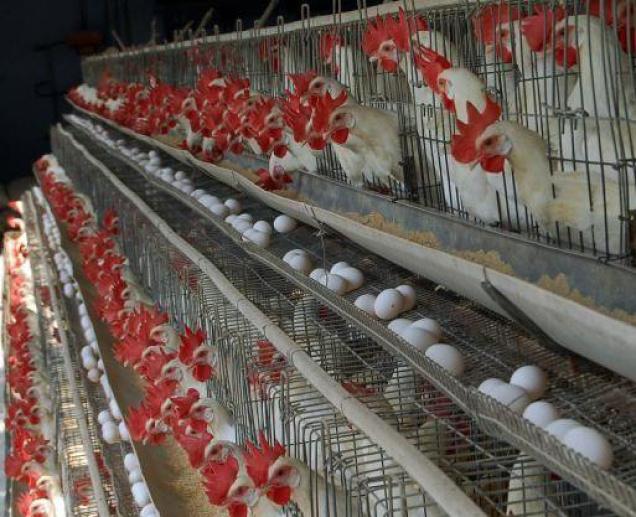
While an article in the Hindu Business Line tells us that China’s poultry industry has lost 65 BILLION Yuan since the end of March, what I found shocking is that the industry has been losing an average of one billion Yuan a day for the past two months! What I want to know is, how many millions of birds does it take to raise one billion Yuan and what kind of horrendous living conditions must that many birds be forced to endure? How miserably confined, overcrowded and devoid of any semblance to natural bird life must it be like (for the short time their allowed to live).
The article (inadvertently) points out some shocking facts, which I’ve highlighted in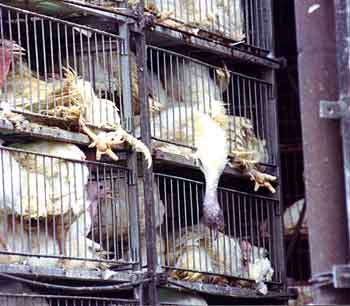 bold…
bold…
Bird flu costs China’s poultry industry $65 bn: State media
Beijing, May 21:
China’s human H7N9 bird flu outbreak has cost the country’s poultry industry more than $65 billion as consumers shun chicken, government officials said according to state media yesterday.
The sector has been losing an average of one billion yuan a day since the end of March, the Beijing Times said, citing Li Xirong, head of the National Animal Husbandry Service.
H7N9 avian influenza has infected 130 people in China, killing 35, since it was found in humans for the first time, according to latest official data.
Poultry sales have tumbled and prices plunged, Li said, causing major financial problems and job losses as a result.
Another agriculture ministry official, Wang Zongli, said government agencies should set a good example for the public by treating “poultry products in a correct way”, the report added.
In a stunt to boost confidence, officials and poultry business leaders in the eastern province of Shandong held a widely reported all-chicken lunch last week, according to Chinese media.
China has seen several food safety scares in recent years, including one in which the industrial chemical melamine was added to dairy products in 2008, killing at least six babies and making 300,000 ill.
Decision on wolf protections in Lower 48 delayed
May 20, 2013 22:00 GMT
http://ktvl.com/template/inews_wire/wires.national/20f04fe9-www.ktvl.com.shtml
Wildlife advocates and some members of Congress argue that the wolf’s recovery is incomplete because the animal occupies just a fraction of its historical range….
BILLINGS, Mont. (AP) — Federal wildlife officials are postponing a much-anticipated decision on whether to lift protections for gray wolves across the Lower 48 states.
In a court filing Monday, government attorneys say “a recent unexpected delay” is indefinitely holding up action on the predators. No further explanation was offered.
Gray wolves are under protection as an endangered species and have recovered dramatically from widespread extermination in recent decades.
More than 6,000 of the animals now roam the continental U.S. Most live in the Northern Rockies and western Great Lakes, where protections already have been lifted.
A draft proposal to lift protections elsewhere drew strong objections when it was revealed last month.
Wildlife advocates and some members of Congress argue that the wolf’s recovery is incomplete because the animal occupies just a fraction of its historical range.

 Exposing the Big Game