12 States’ Attorneys General Join Unjust Side of Lobo-Trapping Litigation
2

Apparently, the average law-abiding citizen officially has no say any more in the state of Michigan. Anyone with a modicum of compassion for non-human animals is being ignored, written off and treated like a child in a power coup led by anti-wolf fanatics in their game department, state legislature and governor’s office.
After all the information that’s come out about the benefits of wolves to an ecosystem, or the intrinsic rights of animals, wolves are still being treated as vermin, trapped, snared and bounty-hunted as blindly as they were in the ignorant 1800’s. Indeed, all hell is breaking loose across the West.
Here’s what the mainstream media wants us to know about the situation there [my comments in brackets]:
Governor signs bill that may open door for wolf hunt
by Anne Cook
LANSING — Gov. Rick Snyder signed legislation today that may open the door for a wolf hunt in Michigan.
Senate Bill 288 gives the Natural Resources Commission the responsibility to establish managed open season hunts for wild game. It exempts the taking of mourning doves, pets and livestock.
The Legislature will maintain its ability to both add and remove species on the list.
“This action helps ensure sound scientific and biological principles guide decisions about management of game in Michigan.” Snyder said. “Scientifically managed hunts are essential to successful wildlife management and bolstering abundant, healthy and thriving populations.”
[Explain how killing healthy wolves is supposed to bolster thriving animal populations.]
The legislation met plenty of opposition, however, from groups like the Keep Michigan Wolves Protected coalition. The KMWP said the legislation was an attempt to run around a proposed referendum on wolf hunting.
“The legislature wants to silence the voice of Michigan voters, circumvent the democratic process and nullify the more than 255,000 signatures submitted to the Secretary of State’s Office,” said Jill Fritz, director of the KMWP coalition.
Michigan Farm Bureau, the state’s largest farm group, however, applauded the signing of the legislation [no surprise there] calling it a “triumph of science and reason over emotion stirred by out-of-state interests.”
“Michigan voters’ strong support for Proposal G in 1996 made it clear residents want oversight of wildlife management in the hands of experts,” said Rebecca Park, legislative counsel for Michigan Farm Bureau. “Despite what opponents to this legislation would have you believe, these bills are very much about respecting and reinforcing the people’s will, not denying it.”
[No doubt Michigan residents never knowingly intended to give up their right to the voter initiative process in regards to wildlife.]
“We welcome visitors from out-of-state to come enjoy the bounty of our woods and waters, but have to remain vigilant and draw a line when deep-pocketed activist groups try to tell us how to manage those resources,” Park said.
[Deep pocketed? Surely “out of state” wolf proponents’ pockets are not as deep as the ones on the OshKosh B’Gosh coveralls worn by members of the Michigan Farm Bureau or the suits of their lobbyists.]
Meanwhile, here’s the press release from Keep Wolves Protected:
Governor signs bill allowing NRC to designate animals as game species without legislative or voter oversight
LANSING, Mich. – The Keep Michigan Wolves Protected (KMWP) coalition expressed its deep disappointment in Gov. Rick Snyder, who today signed legislation (SB 288) that circumvents voter rights by allowing the Natural Resources Commission (NRC) to establish a wolf hunting and trapping season before Michigan voters can decide the issue in the November 2014 election.
“Governor Snyder has betrayed the trust of Michigan voters by signing legislation that takes away their referendum right to challenge laws on animal issues. And Governor Snyder failed to defend Michigan’s Constitution by allowing the democratic process and referendum vote in Nov. 2014 to be circumvented. The governor’s action validates the perception that state government is broken and does not reflect the best interests of the people it is supposed to serve. This is a dark day in the history of Michigan and for people who believe in fundamental democratic principles and the humane treatment of animals. We will not give up the fight to stop wolf hunting and trapping in Michigan,” said Jill Fritz, director of KMWP.
SB 288 has resulted in Michigan’s 7.4 million registered voters losing their right to decide whether to protect Michigan’s declining population of 658 wolves in the November 2014 election. KMWP submitted more than 255,000 petition signatures on March 27 to suspend Public Act 520 – a law that was rushed through last December’s lame duck legislative session and classifies wolves as a game species, until a referendum vote in November 2014.
SB 288 was fast-tracked through the legislative process before the Board of State Canvassers has certified signatures from registered voters from every corner of the state. SB 288, which empowers the NRC, a politically-appointed panel of seven persons, to designate animals as game species without legislative or voter oversight, is an an end run around the referendum and an attempt to silence the voice of over quarter of a million Michiganders who signed petitions to stop wolf hunting and trapping . Michigan voters would be unable to reverse decisions of the NRC because it is a regulatory body and not the Legislature.
Facts
• Michigan’s wolf population has decreased from 687 to 658 according the latest census by the Department of Natural Resources.
• More than 2,000 Michigan residents from the Upper and Lower Peninsulas volunteered for Keep Michigan Wolves Protected, a coalition of animal welfare groups, conservationists, veterinarians, Native American tribes and faith leaders, to gather signatures during sub-freezing temperatures in just 67 days.
• Despite the wolf population’s fragile status and over the objections of renowned Michigan-based wolf scientists, the Michigan legislature rushed a bill through in December 2012, opening the door to the same practices that virtually eradicated the wolf population in the first place.
• Wolves are extremely shy and have a natural fear of humans. In the past 100 years, there has never been a verified attack by a wolf on a human in the lower 48 states.
• Current state law already allows farmers and dog owners to remove or shoot wolves that are attacking their animals, and farmers may obtain a permit from the DNR to remove additional wolves following a depredation incident. Fewer than 8 percent of the Upper Peninsula’s farms have reported any wolf depredations in the past 17 years.

Wildlife Photography ©Jim Robertson
Montana governor vetoes the last of the anti-bison bills sent to him by 2013 legislature
By Ralph Maughan On May 9, 2013 The Wildlife News
… .
Anti-bison mania seizes legislature, Governor Bullock helps beat off the attack on a national symbol-
Helena, MT. Montana’s new legislature, elected in 2012, was a hotbed of anti-bison activity. Ten or so bills to hurt the bison in one way or another were introduced and a number passed and were sent to Montana’s new governor Steve Bullock.
Governor Bullock has saved the limited number of free roaming bison, and maybe bison as something other than livestock, with his veto pen. This week he vetoed the last two bills that would harm the bison, SB 256 and SB 305.
It is difficult to understand why the majority party of legislature is so hostile to the bison except it seems to have become a partisan issue as over the years all the standard anti-bison arguments have been knocked down by management and regulatory changes made by the U.S. agency APHIS (Animal and Plant Health Inspection Service) and Montana Department of Livestock and by scientific studies.
The Wildlife News has, over the years generally argued that anti-bison sentiment is basically a cultural response from the state’s cattle ranchers now angry that anyone would dare challenge their cultural hegemony — it has little to do with a threat of brucellosis spreading, bison knocking down fences, chasing people, etc. The trouble with cultural animosity is that science, economics, compromise cannot calm “a party with a chip on their shoulder.”
Those who want rational bison management and a degree of free roaming bison in the state outside of the limited boundary of Yellowstone National Park should contact the governor and thank him. governor@mt.gov
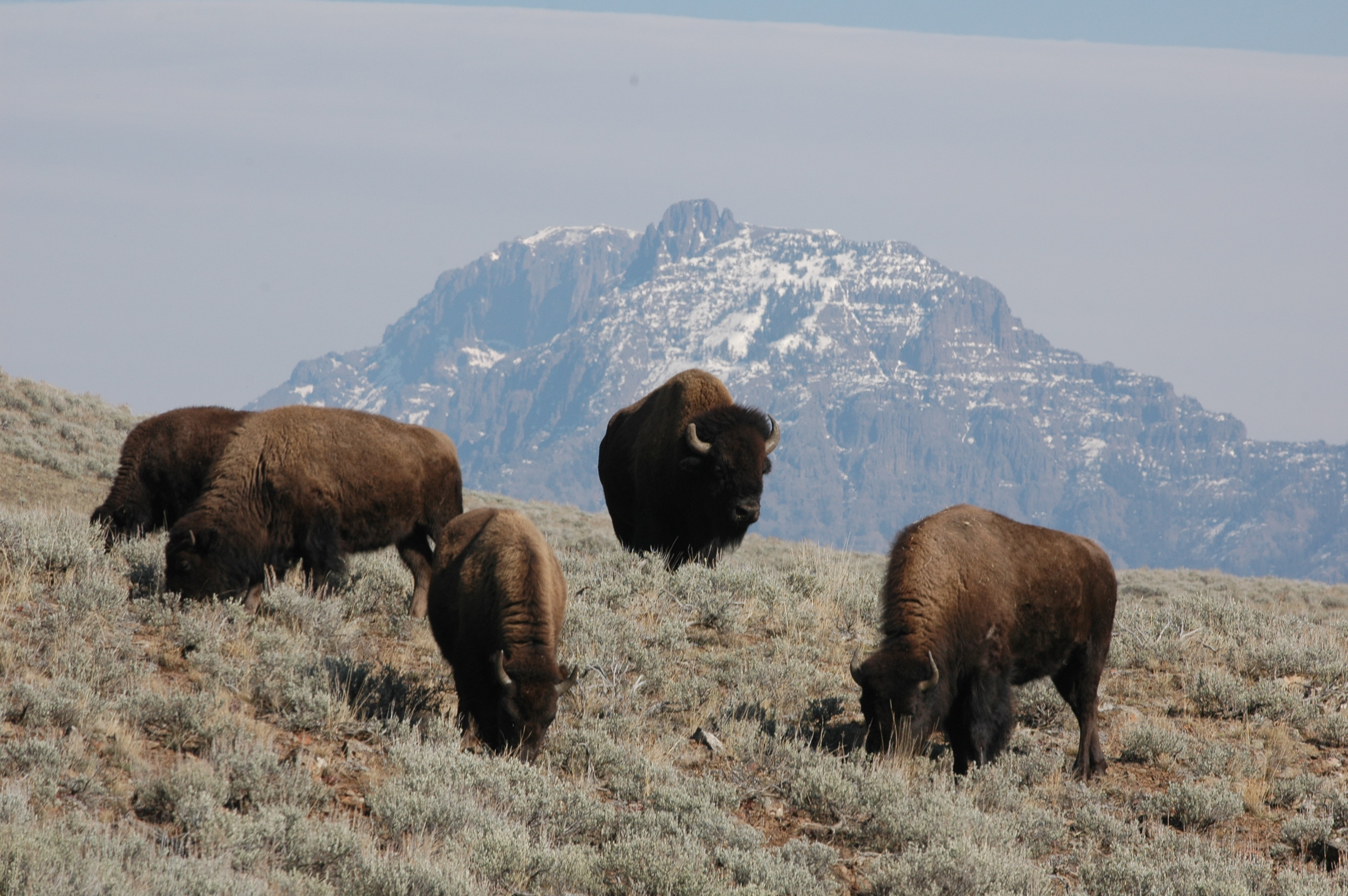
Photo Copyright Jim Robertson


Imagine the following scenario from the perspective of a “conservative,” “pro-life,” hunter, trapper, and wolf hating Wisconsinite.
Wisconsin has elected a progressive and pro-living wildlife governor and legislature. The governor has decided to appoint an outspoken living wildlife advocate as the Secretary of the Wisconsin Department of Natural Resources. Upon assumption of the position the Secretary of the DNR decided to “reassign” most of the pro-hunting and trapping biologists and wardens along with filling her assistant positions with outspoken living wildlife advocates, former lobbyists from groups such as the Humane Society of the United States, and other outspoken animal welfare advocates. One of these assistants was a former state legislator responsible for an amendment to the state constitution that allowed for a guaranteed right for wildlife watchers to enjoy and protect wildlife and not be subjected to hunter harassment and intimidation. The agency is also now funded solely by wildlife…
View original post 1,718 more words
One of the hunter trolls who reads this blog (to see how the enlightened, humane people think) just reared his ugly head in comment to the post “Top 10 Retorts to Hunter Fallacies” (soon to be 20…). He unimaginatively cited yet another one of the most common excuses hunters use to justify killing innocent, inoffensive animals for sport:
11) “You do realize that even if you are a vegitarian [sic] you killed the plants you eat. So plants can’t feel pain but all other animals can?”
Well, yes, that’s right, in fact. Apparently the guy hasn’t heard that animals (presumably including him) have a central nervous system and a brain—two things lacking in plants which spare them the experience of feeling pain when stepped on or fear when they’re about to be eaten. There must be something about being consciously aware that he can’t relate to.
His comment went on, “You stand up for the rights of helpless animals but then kill some plants probably eating them while they are still alive you sick sick people.” (Ahem…look who’s talking. Does that mean he doesn’t eat potatoes with his meat?) According to his (il)logic, those who ascribe to a raw food diet are eviler than any hunter or trapper. But of course, his reasoning runs counter to both science and common sense.
For a grand finale, he ends with, “Or how about the irony of wasteing [sic] valuable resouces [sic] so that you could put this on the internet, think of all the distructive [sic] mining that was done to generate electricty [sic] so you could put this on the internet. Have a nice day.”
A good point—I promise not to waste any precious resources answering to his comments in the future. Of course any hunter who makes a statement such as his must surely see the irony in the fact that they just wasted time and resources trolling and commenting to a blog with a policy of not approving hunters’ comments without making a mockery of them.

Text and Wildlife Photography ©Jim Robertson, 2013. All Rights Reserved
Here’s a glimpse at things from the point of view of the dark side–an article in the “Daily Caller” in the “Guns and Gear” section from the Safari Club International (the self-proclaimed keepers of “common sense”) touting pro-hunting bills (which need to be stopped)…
Essential legislation to protect hunting introduced in U.S. Congress
Washington, D.C. – Safari Club International (SCI) supports the Recreational Fishing and Hunting Heritage and Opportunities Act introduced by Congressman Dan Benishek (MI) and Senator Lisa Murkowski (AK). H.R. 1825 and S. 170 will require the U.S. Forest Service (FS) and the Bureau of Land Management (BLM) to manage their lands for hunting, angling, and target- shooting based recreation. Members of Safari Club International will be traveling to Washington, D.C. on May 9th to advocate for H.R. 1825 and S. 170.
“For hunters, it is critical that legislation be passed that will ensure future generations of sportsmen and women have every opportunity to enjoy the great outdoors,” said SCI President John Whipple. “We are extremely thankful for the leadership that Congressman Dan Benishek of Michigan and Senator Lisa Murkowski of Alaska have shown with the introduction of this needed legislation.”
The U.S. House of Representatives passed this language with bi-partisan support as part of the Sportsmen’s Act of 2012, whereas the Senate never took final action during the 112th Congress.
“We hope to have this common sense legislation move quickly through both the House and Senate,” concluded Whipple.
Other legislation that is critical to sportsmen includes: H.R. 1818 (Young-AK) and S. 847 (Crapo-ID) allowing the importation of a small number of already harvested polar bears; H.R. 1819 (Young-AK) reinstating sustainable use importation of polar bears by U.S. citizens; and H.R. 322 (Miller-FL) protecting traditional hunting and fishing equipment and other policy issues important to all hunters.
More than 200 meetings will take place on May 9, 2013, as part of Safari Club International’s overall advocacy efforts to protect the future of hunting. The grassroots involvement from SCI members enhances the year-round efforts of SCI’s D.C. office. While SCI is headquartered in Tucson, Ariz., a team of attorneys, policy experts, and dedicated hunters lead SCI’s advocacy efforts in Washington.
Contact: Nelson Freeman; media@safariclub.org
“Can they demonstrate that the bounty hunt actually helped boost mule deer populations? I think they’d be hard pressed to show this.” –- Camilla Fox, executive director, Project Coyote
Take the poll: http://www.ksl.com/?sid=25052737&nid=148&fm=most_popular&s_cid=popular-4
Are coyote bounties a good thing for Utah?
Results so far:
1. Yes 67% (3218)
2. No 33% (1573)
Total Votes: 4791
6,000 coyotes killed in Utah’s bounty program
By Grant Olsen, ksl.com Contributor May 6th, 2013
SALT LAKE CITY — More than 6,000 dead coyotes have been redeemed by hunters since Utah’s Division of Wildlife Resources launched its coyote bounty program last September.
The DWR hopes its ambitious plan will eliminate a significant portion of the state’s coyote population, which in turn will benefit the deer herds on which they prey. Officially known as the Predator Control Program, the incentive-based program pays hunters $50 for every coyote they kill.
Other states have implemented bounty programs over the years, but rarely on this scale. Even the New York Times has taken note of Utah’s Predator Control Program, calling it “one of the nation’s largest hunter-based efforts to manage predatory wildlife.”
John Shivik, mammals coordinator for the Division of Wildlife Resources, is proud of how his team worked together to start the Predator Control Program from scratch and get it “up and running so quickly.”
While few can argue that the Predator Control Program enjoyed a smooth launch, the effect it has had on wildlife is debatable. Camilla Fox, executive director of Project Coyote, says that the Predator Control Program is “ecologically reckless, economically unjustifiable and ethically reprehensible.”
According to Fox, most government agencies acknowledge that coyote bounties are not only ineffective at reducing coyote populations, but are often counterproductive. She asserts that decades of research suggests that the systematic killing of coyotes increases reproduction, immigration and survival.
Dr. Robert Crabtree, founder of the Yellowstone Ecological Research Center, agrees with this perspective. “It cannot be over-emphasized how powerfully coyote populations compensate for population reductions,” he says.
Fox maintains that there is “no science that demonstrates that bounty programs are effective at reducing coyote populations over the long-term.” She questions the DWR’s methods and how it will measure the program’s success. “Can they demonstrate that the bounty hunt actually helped boost mule deer populations? I think they’d be hard pressed to show this.”
According to Shivik, the DWR has been “collecting what looks like it will be excellent data to help us evaluate how effective our efforts are.” He says it’s too early to assess the program’s impact and that the biggest challenge his team faces is identifying the deer populations that are most affected by coyotes, because the DWR is “trying to be as efficient and effective as possible with our resources.”
The topic of resources brings up another criticism that bounty programs often face — that they are susceptible to fraud. When all that is required for a payout is portions of a carcass (such as paws, jaws or ears), it’s difficult for authorities to be sure the coyotes weren’t killed in other parts of the country. The DWR attempts to address this by requiring hunters to document the date and location of each kill before paying a bounty, but critics point out that the information could easily be fabricated.
An example of this kind of fraud reportedly occurred in Canada when Saskatchewan offered a coyote bounty. To collect the $20 bounty, hunters were required to remove the paws from every coyote killed and give them to authorities. As a result, piles of dead coyotes were found in other parts of the country with their paws cut off. More than 70,000 coyotes were killed as part of Saskatchewan’s bounty program and it’s impossible to know how many were killed elsewhere and then illegally redeemed in the province.
Fox points to these past problems as proof that bounty programs are a waste of money. “These programs are very often fraught with illicit activity,” she says. “I would ask: How many of the coyote body parts turned in for the $50 bounty were actually killed in other states?”
Despite these lingering questions, Utah’s Predator Control Program has received enthusiastic support from many local hunters. You can learn more about the program and register for the bounty by visiting the official website at http://www.wildlife.utah.gov/predators.

Wildlife Photography ©Jim Robertson, 2013.
**Update** Apparently there are some that cannot understand sarcasm, so I will further elaborate about the “missing calves” issue. Last year after contacts with the DNR we were told that the DNR automatically attributes any livestock losses over 2.3% to “wolf depredation.” When contacted the DNR had no answer or evidence as to why so much money is being paid out for “missing calves.” Even more disturbing is that there was ZERO evidence that wolves were involved, only that there may have been wolf “activity” in the area. This is why I said that wolves in Wisconsin must have “magic” powers that allow them to just make these calves “disappear” considering that there is nothing left behind, not even bones to show that these calves even existed. For more on this please read this article.
All over the local news today were stories from the Wisconsin Department of Natural…
View original post 947 more words

Update: May 5, 2013
While we’re mourning the death of OR-5, remember Oregon’s Walla Walla Pack yearling wolf OR-16, was also slaughtered in Idaho’s wolf hunt in January of this year. That makes three Oregon collared wolves wiped out in Idaho. Anyone think collaring wolves is a good thing? Interesting how collared wolves are targeted so easily. As Bob Dylan famously wrote, “You don’t need a weatherman to know which way the wind blows”!
===
January 25, 2013
Here’s the convo from an anti-wolf Facebook page laughing about OR-16’s death. This is what these freaks find funny, the death of a yearling wolf.
Too bad it didn’t get shot. So much for the whole family thing the wolf humpers claim.
Larry O.
Hopefully he will stay…
View original post 502 more words

 Exposing the Big Game