Jolly old Santa Claus used his in with the Man upstairs when he granted a terminally ill boy’s one Christmas wish. When the child told Santa all he wanted for Christmas was peace on earth, the kindly do-gooder intuitively knew where to begin to achieve this objective and asked, “How about if I get rid of all the sport hunters?” This pleased the boy, so Santa (who has a soft spot for the innocents, like children and animals) put a finger to the side of his nose and sent the hunters straight to Hell.
So if the days seem quieter and the nights more peaceful now, be sure to thanks Santa Claus by setting out an extra glass of hemp milk and plenty of vegan cookies.
And any of you budding young “sportsmen” who got a new hunting rifle, Duck Dynasty tee shirt or entry into the Salmon, ID Youth Wolf and Coyote Derby for Christmas can thank your fathers when you catch up with them in Hell.
Fortunately the mental disease the Salmon Idaho derby hunters have, psychopathy, is not communicable, but it seems to be spreading, due to the contagious intolerant attitudes of hunters and wolf haters across the country.
(NOTE: See my updates scattered throughout the text & comment section)
Cry “Havoc!” There will be blood…and it will be wolf blood.
Idaho Fish and Game (IDFG) has hired a killer to slaughter two wolf packs within the federally-protected Frank Church-River of No Return Wilderness. This is congressionally-designated,captital-Wwilderness, certainly the one place nature should be allowed to express itself without manipulation by and for humans. Said wolf biologist and PBS filmmaker (“River of No Return”) Isaac Babcock,
…when Fish and Game hires a bounty hunter to go live in designated wilderness in a Forest Service cabin with the goal of eliminating entire wolf packs — something seems terribly wrong with that.” ~ Idaho Statesman: “Idaho Fish and Game turns to hired hunter“
In central Idaho, local hostility to wolves expresses itself on signs along the highway. Many residents don’t like the wolves because the animals kill elk, livestock and pets. (NPR)
Conservation groups howled when Congress removed the Rocky Mountain gray wolf from the federal endangered species list. The “delisting” in most of the Northwest was attached to the budget deal in April between the White House and Congress.
The head of one environmental organization likened it to Congress throwing the wolf off Noah’s Ark. But now that states like Idaho have full authority over the wolf’s fate, they’re eager to use it.
Idaho Fish and Game Regional Supervisor Dave Cadwallader welcomes the delisting because it allows the state to treat the wolf like any other animal.
“Wolves are classified as a big-game animal in Idaho, and we fully intend to manage them like we do our other big-game animals that we’ve done successfully, bears and lions, for example,” he says. “And we want to be able to do the same with wolves.”
That most likely means annual wolf hunts. The state hasn’t yet settled the details of its wolf management plan, but it’s already started shooting them. Idaho Fish and Game recently sent helicopters to a part of the state where wolves are thought to be killing too many elk; the “aerial gunning,” as it’s called, killed five wolves.
Wolves A Menace To Some Locals
Residents of Elk City, a tiny town in Idaho’s Clearwater Mountains, say they’ve been especially plagued by wolves. They say the wolves are killing huge numbers of elk and driving the frightened survivors right into town. And other animals have been killed. Stan Denham lost one of the hunting dogs he keeps on his land just outside town.
“They attacked her right over here and then dragged her down over to the timber,” Denham says. “The whole hillside here seemed like it was covered with blood.”
Denham also happens to be one of the sheriff’s deputies in Elk City. In May, the state gave the deputies special authorization to shoot wolves in town.
“This is actually a request to hunt them and put some effort into shooting them, whether they’re causing problems or not,” he says.
Anti-Wolf Feelings Have Deep Roots
The science isn’t clear on whether killing wolves will bring back the elk. But when it comes to wolves, science is sometimes beside the point.
John Freemuth, a political science professor at Boise State University, tracked the politics of this issue. He says anti-wolf feelings have deep historical roots. “The wolf was viewed as a sort of a bad species, a predator that needed to be removed so the West could be settled and developed,” Freemuth says.
People worked hard to eradicate the wolf. And then, a few generations later, the federal government said those methods were wrong. In the 1990s, it brought in fresh wolves from Canada.
“Suddenly it’s being brought back and it’s a good species to have on the land,” he says. “The history there just suggests that some Befuddled — or just plain angry. And in the West, it’s not unusual for the wolf to become a symbol for other contentious issues.
Anger An Undercurrent On Both Sides
Sitting in the general store in Elk City, Carmen Williams considers the feds’ insistence on bringing back the wolves and sees a deeper motivation.
“Gun control in disguise,” he says. “If we don’t have any game left to shoot, what’s the sense to carrying a rifle?”
These aren’t majority opinions in Idaho, but they represent powerful political undercurrents, which have been intensified over the past few years by the prolonged court battles over when and how to take the growing wolf population off the endangered species list.
Randy Stewart has seen some of that anger over the years at the Wolf Education and Research Center, in the small town of Winchester, Idaho.
Behind a chain-link fence, a gray wolf silently touches its nose to Stewart’s hand in greeting. Stewart, who guides tours at this wolf center, says he has seen attitudes sharpen in recent years, on both sides.
“There are probably still people that don’t want wolves here, that want to see them all removed, and there’s still people who say don’t hunt a wolf,” Stewart says. “But we’re not in a society in my opinion that we can have one or the other extreme.”
Some Western conservationists are hoping the delisting of the wolf also has a silver lining. They say now that the wolf is no longer federally protected, maybe it can also shed its reputation as the federal government’s pet.
You may recall that, last April, Congress removed the Rocky Mountain gray wolf from the federal endangered species list. And conservation groups howled. As part of a budget deal also approved by the White House, states like Idaho now have full authority over the wolf’s fate. And they are eager to use that authority, as NPR’s Martin Kaste reports.
MARTIN KASTE: Environmentalists see the wolf de-listing as a calamity. But in Idaho, there’s a different take.
Mr. DAVE CADWALLADER (Idaho Fish and Game): We’re not going to annihilate wolves or remove wolves from the landscape.
KASTE: Dave Cadwallader is regional supervisor with Idaho Fish and Game. The way he sees things, the wolf is finally just another animal.
Mr. CADWALLADER: You know, wolves are classified as a big game animal in Idaho, and we fully intend to manage them like we do our other big game animals that we’ve done successfully, bears and lions, for example. And we want to be able to do the same with wolves.
KASTE: That means regular wolf hunts, probably starting this fall. The state is already shooting. Fish and Game recently sent helicopters to a part of the state where wolves are thought to be killing too many elk. The aerial gunning, as it’s called, killed five wolves.
(Soundbite of dog barking)
KASTE: Stan Denham keeps hunting dogs on his land just outside Elk City, a tiny town at the end of the highway in Idaho’s Clearwater Mountains.
Mr. STAN DENHAM (Deputy, Sheriffs Department, Idaho County): That’s Penny, it’s a little female. That’s Digger down there. My kids named them all.
KASTE: Residents of Elk City say they’ve been especially plagued by wolves. They say the wolves are killing huge numbers of elk, and driving the frightened survivors right into town. Other animals have also been killed. Denham recently lost one of his dogs.
Mr. DENHAM: They attacked her right over here and then drug her down the hill into the timber. The whole hillside here seemed like it was covered with blood.
KASTE: Denham also happens to be one the two sheriffs’ deputies here. And in May, the state gave them special authorization to shoot wolves in Elk City Township – any wolves.
Mr. DENHAM: This is actually a request to hunt them and put some effort into shooting them, whether they’re causing problems or not.
(Soundbite of barking dogs)
KASTE: It’s debatable whether killing wolves will bring back the elk – the science just isn’t clear. But when it comes to wolves, science is sometimes beside the point.
John Freemuth is a professor at Boise State, who’s tracked the politics of this issue. And he says anti-wolf feelings have deep historical roots.
Professor JOHN FREEMUTH (Political Science, Boise State University): The wolf was viewed as a sort of a bad species, a predator that needed to be removed so the West could be settled and developed.
KASTE: People worked hard to eradicate the wolf. Then, a few generations later, the federal government came along and said that was all wrong. In the 1990s, it brought in fresh wolves from Canada.
Prof. FREEMUTH: Suddenly it’s being brought back and it’s a good species to have on the land. The history there just suggests that some people are going to be a little befuddled by that.
KASTE: Befuddled or just plain angry. And in the West, it’s not unusual for the wolf to become a symbol for other contentious issues.
Sitting in the general store in Elk City, Carmen Williams considers the fed’s insistence on bringing back the wolves and sees a deeper motivation.
Mr. CARMEN WILLIAMS: Gun control in disguise.
KASTE: How do wolves lead to gun control?
Mr. WILLIAMS: Well, if we don’t have any game left to shoot, why what’s the sense of carrying a rifle?
KASTE: These aren’t majority opinions in Idaho, not by a long shot. But these are powerful political undercurrents. And over the last few years, they’ve been intensified by the prolonged court battles over when and how to take the growing wolf population off the Endangered Species List.
Randy Stewart has seen some of that anger over the years at the Wolf Education Research Center, in the small Idaho town of Winchester.
Mr. RANDY STEWART (Education Coordinator, Wolf Education Research Center): Here comes the alpha male. He is beginning to shed his undercoat
KASTE: Behind a chain-link fence, a gray wolf silently touches its nose to Stewart’s hand in greeting. Stewart, who guides tours at this wolf center, says he’s seen attitudes sharpen in recent years, on both sides.
Mr. STEWART: There are probably still people that don’t want wolves here and would like to see them all removed. And there are still people that say don’t hunt a wolf. But we’re not in a society, in my opinion, that we can have one or the other extreme.
KASTE: Some Western conservationists are hoping the delisting of the wolf also has a silver lining. They say, now that the wolf is no longer federally protected, maybe it can also shed its reputation as the federal government’s pet.
Martin Kaste, NPR news.
INSKEEP: It’s MORNING EDITION from NPR News. Transcript provided by NPR, Copyright NPR.
December 19, 2013 A Chinese antique dealer, described as one of the most prolific wildlife traffickers in the world, pleaded guilty Thursday as the director of conspiracy to smuggle $4.5 million in rhinoceros horn and elephant ivory from the U.S. to China.
Zhifei Li, 29, faces a maximum punishment of 10 years in prison on each of 11 criminal counts when he is sentenced April 1.
New Jersey U.S. Attorney Paul Fishman, whose office prosecuted the case, said the trafficking of such things as rhino horn, which can fetch up to $17,500 per pound on the illegal market, has swelled to “unprecedented levels.”
“The brutality of animal poaching, wherever it occurs, feeds the demand of a multibillion-dollar illegal international market,” Fishman said.
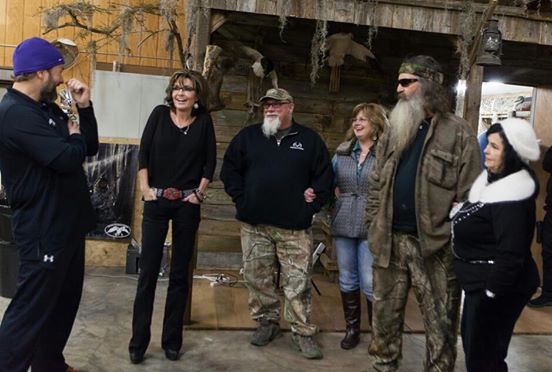
The shaggy Texas Rock Band successfully sued the “cast” members of Duck Dynasty for ID theft today, claiming the faux “reality” cable TV show was cashing-in on a look the furry guitarist made famous in the 1970s.
Top donated their $100 million settlement to an anti-duck hunting group which plans to put Ducks Unlimited out of business and purchase land where ducks and geese are actually protected—from hunters.
[True to form, the Huffington Post failed to even mention what Palin and the DD quacks have most in common–they’re all serial killers of animals.]
Sarah Palin believes the backlash over “Duck Dynasty” star Phil Robertson’s anti-gay comments is a threat to freedom of speech.
The 67-year-old duck hunter made headlines when GQ published an interview in which he discussed morality and sin, and juxtaposed homosexuality with bestiality.
“It seems like, to me, a vagina — as a man — would be more desirable than a man’s anus,” he told the magazine. “That’s just me. I’m just thinking: There’s more there! She’s got more to offer. I mean, come on, dudes! You know what I’m saying? But hey, sin: It’s not logical, my man. It’s just not logical.”
After the quotes were published, GLAAD spoke out against Robertson’s comments, calling them vile and misinformed. A&E ultimately suspended him from “Duck Dynasty” with an indefinite hiatus, saying his views do not align with those of the network.
Some are coming out in defense of Robertson, like Palin, who believes he is being persecuted for merely practicing his First Amendment right.
She took to Facebook to voice her opinion Wednesday, Dec. 18.
“To our GOP leaders in Washington, especially – this is what Americans desire and deserve; we’re not rooting for your social truces,” she wrote on Facebook at the time. “Kudos to these Duck dudes for speaking their minds, and for their boldness in living the American dream of LIFE, liberty, and the pursuit of happiness – reminding us all that it’s only with freedom that anything is possible.”
In a statement obtained by The Huffington Post, Robertson defended himself against the controversy, saying he is only sharing God’s word.
“My mission today is to go forth and tell people about why I follow Christ and also what the bible teaches, and part of that teaching is that women and men are meant to be together,” he said, in part. “However, I would never treat anyone with disrespect just because they are different from me.”
Clarification: The headline of this article has been amended to specify that Sarah Palin defended Phil Robertson’s freedom of speech.
Like me, you’re probably getting fed up with mainstream media’s coverage of wildlife issues lately. Although hunters make up a paltry 6% of the country’s overall population, every source, from the nightly news to Timemagazine has been reporting on hunters’ atrocities against animals like a bunch of star-struck, goo-goo eyed fans, rather than impartial journalists.
Why else would news of a “contest” hunt for coyotes and wolves planned for December 28th in Salmon, ID, go unnoticed on the media’s radar screen?
You can bet if Justin Bieber (whoever the hell that is) stepped in dog crap, they’d be all over that shit.
But when an endangered species makes a bit of a comeback only to provide “recreational hunting opportunities” for psychopaths bent on their renewed extermination, they give it the coverage they would a company picnic.
That’s why Exposing the Big Game(ETBG) is starting a new series: “Headlines We’d Like to See” (based on Mad Magazine’s “Scenes We’d Like to See.”) Watch for installments over the coming weeks…
Anyway, getting back to my original point, adding wolves to the cast of potential derby victims should indeed shoot Idaho hunters in the collective foot—figuratively, if not literally.
A sportsmen’s group in Salmon, Idaho, is sponsoring a two-day coyote and wolf hunting “derby” geared toward kids, with two separate $1,000 prizes and trophies going to those who kill the largest wolf and the most coyotes. There will also be special awards for youth ages 10-11 and 12-14.
The rules for the Salmon Youth Predator Derby, which is sponsored by the Salmon chapter of Idaho for Wildlife, state that no trapping or spotlights are allowed in the contest and all Idaho Fish and Game rules apply. The derby will be held Dec. 28-29.
“It’s not a murder killing spree,” said Steve Alder, [Oh?] executive director of Idaho for Wildlife. “Hunting is a tool for us to go out and manage wildlife. [Is it a derby or a “tool,” make up your mind.] And what people don’t realize is if you don’t manage wolves, you won’t have any of them. What people don’t understand is they will take the prey base down so low that they’ll wink out. You have to manage them. And this is an opportunity for these kids who don’t get out a lot to learn how to hunt.” [That’s a bit unscientific, wouldn’t you say? Who managed wolves back before you people became the self-appointed rulers of the wildlife?]
The contest, which costs $20 to register as a two-person team, will also give out awards for largest male coyote, largest female coyote and most female coyotes killed. There will be fur buyers available after the hunt. [Fur buyers for a hunt?]
Alder said he doesn’t actually expect any wolves to be killed during the hunt. [Wait a minute, I thought you just said you thought there were too many wolves?]
“One of our outfitters had 40 hunters this year and only saw one wolf,” he said. “And he missed. So the chances of getting a wolf are very low. We basically have these events occasionally and it’s going to be a youth hunting opportunity. We’ll have youth mentors on hand showing them how to hunt. It’s a good opportunity in the winter, instead of big game animals, you have a coyote. It’s a good way to learn how to hunt. It’s also a disease awareness campaign, and we want to educate the public about safety measures in high wolf density areas and how to take precautions.”
The disease Alder was referring to is a tapeworm, echinococcus granulosus, which showed up in Idaho game in 2006. The adult is carried by dogs, wolves, foxes and coyotes. The larval form is usually found in the lungs or liver of a herbivore.
The tapeworm requires two different animal species, a canid and an ungulate like deer, sheep, cattle or elk, to complete its lifecycle, according to the Idaho Fish and Game website. During intensive surveillance between 2006 and 2010, 62 percent of wolves tested were determined to be infected in central Idaho.
Idaho for Wildlife’s website states that the group is “dedicated to the preservation of Idaho’s wildlife.” Their motto is: “To protect Idaho’s hunting and fishing heritage. To fight against all legal and legislative attempts by the animal rights and anti-gun organizations who are attempting to take away our rights and freedoms under the constitution of the United States of America. To hold all government and state agencies who are stewards of our wildlife accountable and ensure that science is used as the primary role for our wildlife management.” [?]
————-
Go here to stop this atrocity and attempt to take away their hunting “rights”:
Montana’s gray wolf season around the town of Gardiner ends 30 minutes after sunset Thursday after hunters filled a four-wolf quota in the area near Yellowstone National Park.
Montana Fish, Wildlife and Parks spokesman Ron Aasheim says the closure applies to both hunting and trapping in Wolf Management Area 313. That’s one of two areas near Yellowstone where hunting has been restricted following requests from federal park officials.
The only other place in Montana with restrictions on how many wolves can be shot is west of Glacier National Park, where there’s a two-wolf quota.
Hunters statewide have reported shooting 106 wolves since the season began Sept. 7. Wolf hunting ends March 15.
Trappers have taken three wolves so far, in a season that began Sunday and runs through February 28…..

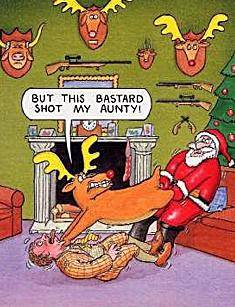 boy, so Santa (who has a soft spot for the innocents, like children and animals) put a finger to the side of his nose and sent the hunters straight to Hell.



 Exposing the Big Game