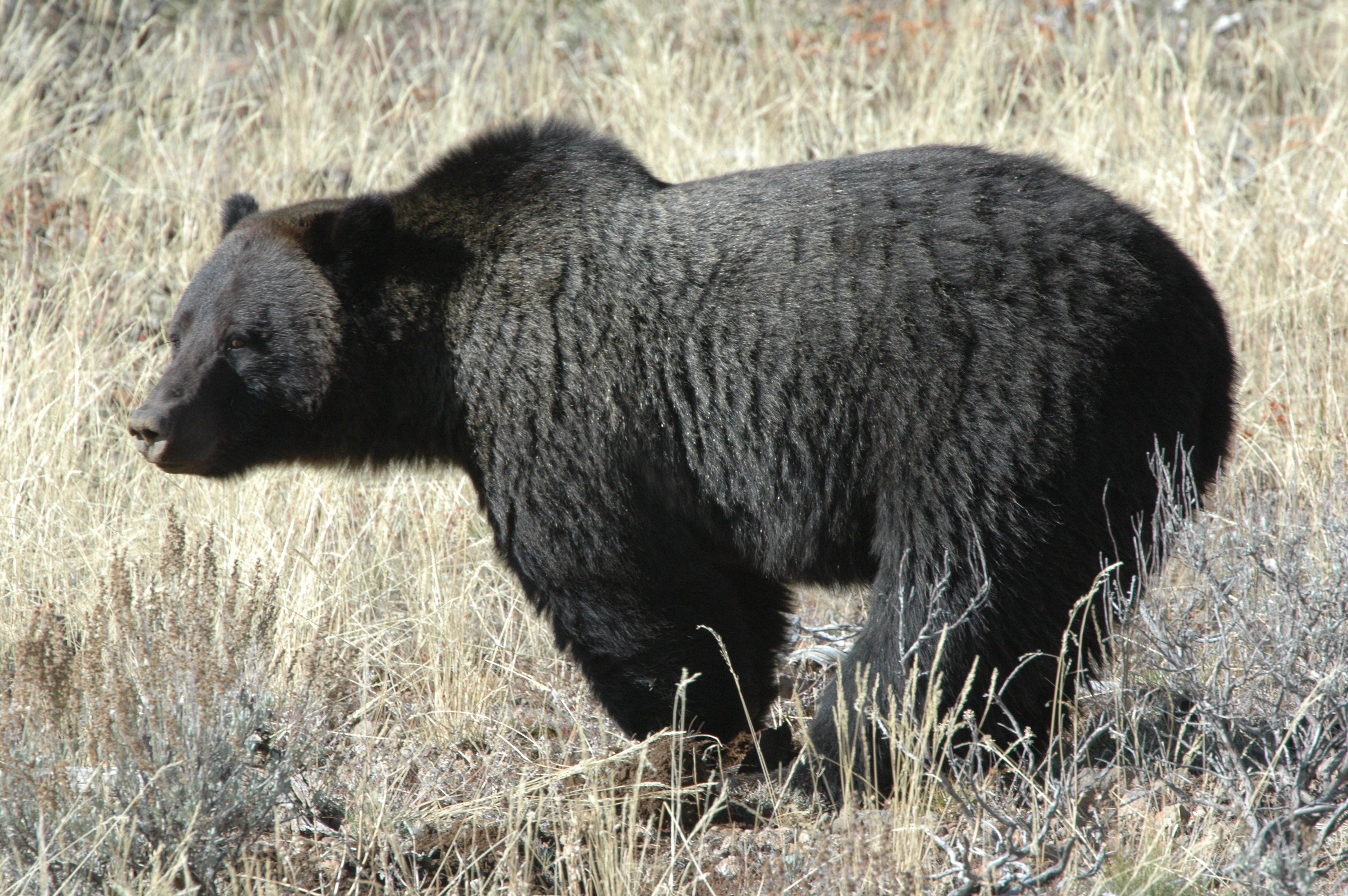
Grizzly bear caught in wolf trap

GREAT FALLS — A 4-year-old male grizzly bear was briefly

Photo Copyright Jim Robertson

Photo Copyright Jim Robertson

caught in a steel leg-hold wolf trap near the Rocky Mountain Front west of Dupuyer.

Fish, Wildlife and Parks grizzly bear management specialist Mike Madel says two men were checking wolf traps Tuesday afternoon when they discovered the bear with its foot in the trap. The bear had pulled the trap out of the ground, but the trap became entangled in a tree and some brush.

The trapper reported the accidental capture to state wildlife officials, who immobilized the 473-bear with a dart gun and removed the trap. Madel planned to relocate the bear, which was not seriously injured other than swelling of the toe joints.

Read more: http://billingsgazette.com/news/state-and-regional/montana/grizzly-bear-caught-in-wolf-trap/article_872d0ba0-21c2-5d5f-8b92-48166edfa702.html#ixzz2nsSxTl3v

One Million Protest Stripping Wolves of Endangered Listing

http://ens-newswire.com/2013/12/17/one-million-protest-stripping-wolves-of-endangered-listing/

WASHINGTON, DC, December 17, 2013 (ENS) – The public comment period closed today on a proposal by the U.S. Fish and Wildlife Service to remove federal protections for all gray wolves across the country. Close to one million Americans stated their opposition to the plan – the largest number of comments ever submitted on a federal decision involving endangered species.

Also today, conservation groups challenged as “premature” the Service’s removal of federal Endangered Species Act protections for gray wolves in Wyoming. Arguments were heard at the U.S. District Court in Washington this morning.
wolves
The court’s decision will determine whether Endangered Species Act protections will be restored to gray wolves in Wyoming unless and until state officials develop a stronger wolf conservation plan.

The delisting of wolves in Wyoming turned wolf management over to the state, which the plaintiff groups say is “promoting unlimited wolf killing across more than 80 percent of Wyoming and providing inadequate protections for wolves in the remainder.” Since the delisting last year, 119 wolves have been killed in Wyoming.

Twelve small areas of Wyoming are designated as wolf hunt areas where wolves are classified as trophy game animals, quotas are set, and hunters who kill wolves must present the skulls and skins to state wildlife officials.

In all other areas of the state wolves are designated as predatory animals. There, no license is required to kill a wolf, and there are no closed seasons or bag limits. Anyone who takes a wolf in these areas must report the kill to a state wildlife official within 10 days. Presenting the skull and pelt is not required.

The conservationists claim that Wyoming “has a history of hostile and extreme anti-wolf laws and policies, which in the past caused the Fish and Wildlife Service to deny Wyoming the authority to manage wolves in the state.” But the Service reversed that position in 2012 and delisted wolves in Wyoming after state officials made what conservationists describe as “cosmetic” changes to the Wyoming wolf management laws.

“The extreme hostility toward wolves demonstrated by some who participated in this fall’s Wyoming wolf hunt shows why adequate legal protections are especially important for wolves in Wyoming,” said Earthjustice attorney Tim Preso, who argued the case on behalf of Defenders of Wildlife, Natural Resources Defense Council, the Sierra Club and the Center for Biological Diversity.

“The questions asked by Judge Jackson at today’s hearing got to the heart of the issue,” said Jason Rylander, senior staff attorney with Defenders of Wildlife. “The U.S. Fish and Wildlife Service cannot ensure sustainable populations of wolves in Wyoming when the state’s laws allow so much unregulated wolf killing.”

“If allowed to stand, Wyoming’s current wolf management plan will set wolf recovery back decades, and potentially take wolves back to the brink of extinction,” said Bonnie Rice of Sierra Club’s Our Wild America campaign.

“Wolves in Wyoming must have federal protection until the state develops a management plan that treats wolves as valued native wildlife, not vermin that can be killed by any means without a license in over 80 percent of the state,” said Rice.

But the Wyoming delisting is just one state’s experience. The Fish and Wildlife Service is proposing to remove federal Endangered Species Act protections for gray wolves across the country.

“Americans overwhelmingly oppose removing protections for wolves, and for good reason. Wolves have recovered to just a fraction of their range and are severely threatened by state-sanctioned hunts intended to decimate them,” said Kieran Suckling, executive director of the Center for Biological Diversity. “We hope the Obama administration will hear the pleas of hundreds of thousands of citizens and maintain these critically needed protections for wolves.”

The 750,000-plus comments delivered today to the Fish and Wildlife Service by many conservation groups will bring the total number of opposing comments to well over one million.

The wolf conservationists followed delivery of the comments with a candlelight vigil with music and costumes in Triangle Park across from the C Street entrance of the Department of the Interior headquarters.

Fish and Wildlife Service Director Dan Ashe defends the agency’s decision to remove federal protections for wolves.

“From the moment a species requires the protection of the Endangered Species Act, our goal is to work with our partners to address the threats it faces and ensure its recovery,” said Ashe, announcing the proposal in June.

“An exhaustive review of the latest scientific and taxonomic information shows that we have accomplished that goal with the gray wolf, allowing us to focus our work under the Endangered Species Act on recovery of the Mexican wolf subspecies in the Southwest,” Ashe said.

The Service’s proposes to remove existing protections for wolves everywhere except Arizona and New Mexico, where the Mexican wolf is clinging to survival with an estimated population of 75 wolves.

There were once up to two million gray wolves living in North America, but the animals were driven to near-extinction in the lower 48 states by the early 1900s.

After passage of the federal Endangered Species Act in 1973 and protection of the wolf as endangered, federal recovery programs resulted in the rebound of wolf populations in some parts of the country.

Roughly 5,500 wolves now live in the continental United States.

After its most recent population assessment, the Service said, “In the Western Great Lakes and Northern Rocky Mountains, the gray wolf has rebounded from the brink of extinction to exceed population targets by as much as 300 percent. Gray wolf populations in the Northern Rocky Mountain Distinct and Western Great Lakes Population Segments were removed from the Federal List of Endangered and Threatened Wildlife in 2011 and 2012.”

Conservationists argue that the delisting would remove protections for wolves in places where wolf recovery is just beginning, such as Oregon and Washington, and would prevent wolves from recovering in other places where good wolf habitat has been identified, such as northern California, the southern Rocky Mountains and the Northeast.

“Oregon wolves have taken the first tentative steps toward recovery in the last few years,” said Sean Stevens, executive director of Oregon Wild. “If the Obama administration takes away the strong protections of the Endangered Species Act, we pull the rug out from the fragile success story here on the West Coast and leave the fate of wolves in the hands of state agencies in Idaho, Montana and Wyoming who have proven incapable of balanced management.”

But Roy Elicker, director of the Oregon Department of Fish and Wildlife, said when the proposal surfaced in June, “With a solid state conservation and management plan in place for the Northern gray wolf, an experienced wildlife management agency that is committed to wolf recovery, and established populations recovering at an increasing rate, Oregon is ready to take on further responsibility for wolf management in this state.”

“The Washington Department of Fish and Wildlife is firmly committed to the long-term persistence of wolves in Washington,” said Miranda Wecker, who chairs the Washington Fish and Wildlife Commission. She says the state should be responsible for wolf management and supports the delisting proposal.

But Defenders of Wildlife President Jamie Rappaport Clark, a former director of the U.S. Fish and Wildlife Service, said today, “The incredible volume of comments give voice to a sad fact – the delisting proposal is a radical departure from the optimism and courage we need to promote endangered species recovery in this country. The comments show that Americans believe the Fish and Wildlife Service’s proposal falls well short of the conservation ideals this country stood for 40 years ago when the Endangered Species Act was signed.”

Copyright Environment News Service (ENS) 2013.

528624c939a88_preview-620

Last Chance To Comment to the USFWS on Wolves

To those who want to send the USFWS a quick note on their plan to delist wolves, here’s the email address to their comment form: http://www.regulations.gov/#!submitComment;D=FWS-HQ-ES-2013-0073-30560

TODAY IS THE LAST DAY THEY WILL BE ACCEPTING COMMNTS!

In addition to written comments earlier this year, I just sent them the following comment:

In light of the fact that Western and Great Lakes states have proven time and again that they can’t be counted on to manage an endangered species such as wolves fairly–Wisconsin uses hounds to run wolves to exhaustion; Montana changes their wolf hunting rules, to the benefit of hunters, on a regular basis; Wyoming treats wolves like vermin outside the park; Idaho has hired a professional hunter/trapper to kill off two packs within a Wilderness Area at the behest of trophy elk hunters and now has added wolves to a coyote contest hunt–I respectfully urge you not to delist gray wolves from the Endangered Species List.

States with small populations of wolves adjoining the tri-state area are poised to start in with the same misguided policies of Montana, Wyoming and Idaho. Utah has taken steps to disallow wolves to expand their territory, South Dakota has listed wolves as vermin–ahead of their possible expansion–and Washington has implemented the same loopholes for ranchers to kill wolves that their neighbors came up with a few years ago.

The job of wolf recovery is unfinished. Please don’t remove them from ESA protections only to see them subjected to irresponsible contest hunts and eradicated once again.

copyrighted Hayden wolf walking

French teen accidentally kills father while hunting — and, distraught, turns gun on himself

[Enough said?]

http://www.nydailynews.com/news/world/french-teen-accidentally-kills-father-hunting-article-1.1549450#ixzz2nl7vKboH

Sadly, this hunting-related tragedy is far from the first to occur in French hunting circles.

In October, a 61-year old hunter mistook his son for a wild boar and opened fire, the Ouest France news site reported. Around that time, a 6-year-old was shot and killed in another traffic hunting accident.

A month earlier, a deaf 82-year-old hunter mistook two mushroom pickers for pheasants and shot them…

RELATED: GEORGIA MAN ACCIDENTALLY SHOOTS GIRLFRIEND WHILE HUNTING

Also see: Officials Warn Duck Hunters of the Dangers of Duck Hunting

imagesQB1DEJIT

Montana is a backward wolf massacre state

http://billingsgazette.com/news/opinion/montana-is-a-backward-wolf-massacre-state/article_4125d0d7-2f81-53b8-be26-a95b9c59af7f.html

Regarding allowing ranchers to kill perceived “threatening wolves” (Senate Bill 200): Montana policy wolf qualifies it, from wolf conservationists’ perspectives, as a backward wolf massacre state.

This attitude is evidenced by $19 tags for five wolves; not having a real quota; by having a trapping season beyond and through the hunting season; an attitude of “we need to drive down the population” without any science behind such thinking; an attitude of not holding the rancher responsible in any way for taking preventive, good husbandry, measures.

It is political management, not scientific management. Now it will be in evidence with a policy of allowing a rancher to kill a wolf “perceived” as a threat, which to a rancher and guests will likely mean any wolf seen, which will all equate to open season on wolves, with much of it on leased public land.

Wolves kill around 65 cattle annually in a state that has 5.5 million which is 0.001 percent. There are 3,776 leases on BLM land and 772 on national forest lands. Ranchers are reimbursed for losses. Oregon has a model for Montana, although Montana rule makers are too backward and obstinate to listen and learn. The Oregon wolf management model requires ranchers to have nonlethal deterrents in place and to have used them, and then only kill chronic offenders.

Wolves are not vermin. Wolves are apex predators that are good for wildlife ecology, having a positive cascading effect throughout the food chain versus ecological unhealthy man wildlife killing.

References: The Hidden Life of Wolves, Jamie and Jim Dutcher; The Wolf Almanac, Robert Busch

Roger Hewitt

Great Falls
Read more: http://billingsgazette.com/news/opinion/montana-is-a-backward-wolf-massacre-state/article_4125d0d7-2f81-53b8-be26-a95b9c59af7f.html#ixzz2nl6OgwYZ

Lawsuit: Ban coyote hunting to stop red wolf shootings

[On a related note, we need to ban contest hunts on coyotes if we want to keep wolves safe from being targeted by that backwards, barbaric pastime…]


http://www.charlotteobserver.com/2013/12/16/4549879/lawsuit-ban-coyote-hunting-to.html#.UrCQSbCA1y0

Story by Bruce Henderson
bhenderson@charlotteobserver.comRed-wolf-and-pups-240x300

Monday, Dec. 16, 2013

Three conservation groups asked a federal court Monday to stop coyote hunting in five coastal N.C. counties, saying the practice is killing lookalike red wolves.

Five of the endangered wolves have been shot since mid-October, and only the cut-off radio collar of a sixth animal has been found. Rewards totaling $26,000 have been offered for information on the shootings.

The N.C. Wildlife Resources Commission allows an open hunting season on coyotes, which have spread across the state in recent decades. Young red wolves look very much like coyotes.

The motion filed Monday asks that a U.S. District Court judge stop coyote hunting in Dare, Tyrrell, Hyde, Washington and Beaufort counties. Those counties include the 1.7 million acres where about 100 red wolves run wild on the Albemarle Peninsula.

Filed on behalf of the Red Wolf Coalition, Defenders of Wildlife and the Animal Welfare Institute, it says the practice allows the illegal taking of endangered wolves that are protected by federal law.

The Wildlife Resources Commission had no immediate response, spokesman Geoff Cantrell said.

The commission said in a statement last month that its coyote hunting rules are “in the best interest of the public, the environment and the agricultural community.” It denied breaking federal law.

So far this year, 14 red wolves are known to have died. Eight gunshot deaths were confirmed and two more suspected. Killing red wolves is punishable by up to a year in prison and a $100,000 fine.

The Southern Environmental Law Center, which represents the conservation groups, argues that wolves mistakenly shot as coyotes are hurting the breeding success of the recovery program. Eleven breeding pairs of wolves are now down to eight, the U.S. Fish and Wildlife Service has said.

Five shooters in the past two years have said they mistakenly killed wolves they thought were coyotes, the law center said.

Research shows that breaking up established pairs increases the odds that succeeding litters will be wolf-coyote hybrids, pairings that federal biologists go to great lengths to prevent.

In 2012 the Wildlife Resources Commission expanded coyote hunting by allowing shooters to spotlight coyotes, blinding them, and shooting them at night.

With that, said the injunction motion, the problem of telling young wolves and coyotes apart “becomes virtually impossible at night.”

Read more here: http://www.charlotteobserver.com/2013/12/16/4549879/lawsuit-ban-coyote-hunting-to.html#storylink=cpy

Idaho Wildlife Officials Hire Hunter to Kill Wolves

528624c939a88_preview-620

BOISE, Idaho (AP) — State wildlife officials have hired a hunter to eliminate two wolf packs in a federal wilderness area in central Idaho because officials say they are eating too many elk calves.

Fish and Game Bureau Chief Jeff Gould tells the Idaho Statesman that hunters are having a difficult time getting into the Frank Church-River of No Return wilderness, so the agency hired hunter-trapper Gus Thoreson of Salmon to kill the wolves in the Golden and Monumental packs.

The U.S. Forest Service allowed the state agency to use an airstrip and cabin in the Payette National Forest as a base.

Fish and Game paid $22,500 for aerial killing of 14 wolves in the Lolo area in 2012. Gould said Monday he didn’t know how much the agency would end up paying for Thoreson’s salary and expenses.

_______________________

Make no mistake, Idaho officials and their constituents aren’t concerned about elk for the elk’s sake. They want ’em all for themselves–especially the big-antlered, trophy ones. Here are headlines for a couple more articles on the subject, linked from the same page:

Hunters Bemoan Idaho Elk Numbers, Blame Wolves

Elk Hunters Face Tougher Test with Wolves in Woods

ST. MARIES, Idaho (AP) — Calob Wilson sat on the tailgate of his dad’s pickup, dangling a rack of antlers on his knees. Read more: http://magicvalley.com/news/local/idaho-wildlife-officials-hire-hunter-to-kill-wolves/article_c6d2a9c4-6733-11e3-8002-0019bb2963f4.html


Coyote Photo by Jim Robertson

Coyote Photo by Jim Robertson

“In my opinion, a society that condones unlimited killing of any species of wildlife for fun and prizes is morally bankrupt.”
~ Dave Parsons, Project Coyote Science Advisory Board

Please join Project Coyote in protest of an indefensible coyote and wolf killing “derby” ironically scheduled on the 40th anniversary of the passage of the Endangered Species Act, our nation’s safety-net for wildlife, that brought wolves back from the brink of extinction. It is imperative that everyone speak out against this atrocity scheduled in just two weeks. Time is ctitical.

This is not hunting but a gratuitous massacre that is legal in Idaho and across the country. Prizes will be offered to contestants who kill the largest wolf and the most female coyotes. Children as young as 10 are encouraged to compete, with prizes being offered to youth from the ages of 10-14.

These competitions are ethically indefensible and ecologically reckless, as well as a public safety risk, as shooters fan out across the landscape, trying to shoot large numbers of coyotes and wolves.

Specific details about the contest hunt:

What: “1st Annual 2 Day Coyote & Wolf Derby” brough to you by Idaho for Wildlife, Salmon Chapter, Sportsman Group
Where: Salmon, Idaho
When: Dec. 28th & 29th, 2013

Wolf Coyote Derby Salmon Idaho Dec.2013

A wolf tag can be purchased for as little as $11.75, permitting each hunter to shoot 4 to 10 wolves (depending on region). 154 wolves have been killed in Idaho since hunting season opened on August 30th. Idaho is showing the nation what happens to wolves following the removal of federal protections under the Endangered Species Act.

Please contact the following individuals to voice your opposition:

Idaho Department of Fish & Game
Virgil Moore, Director
600 S. Walnut
Boise, ID 83720
(208) 334-2920
Email: virgil,moore@idfg.idaho.gov
http://gov.idaho.gov/ourgov/contact.html

Idaho Department of Fish & Game
Will Naillon, Salmon Region IDFG Commissioner
Email: willnaillon@gmail.com

Idaho Fish and Game Commission
Bob Barowsky, Chairman
Email: bbarowsky@fmtc.com

Idaho Governor C.L. “Butch” Otter
P.O. Box 83720, Boise, ID 83720
(208) 334-2100
Email: governor@gov.idaho.gov

Salmon Valley Chamber of Commerce
Charleane Hermosillo, Executive Director
Phone: (800) 727-2540 , (208) 756-2100
Email: svcc1@centurytel.net

Idaho Outfitters & Guides Association, Boise
John May, Executive Director
Phone: (208) 342-1438
Email: john@koga.org
IOGA represents all outfitters in the state of Idaho. If you use Idaho outfitters for white water rafting, camping, backcountry skiing – please mention this and urge IOGA to speak out against having their members participate in a predator killing contest.

2010-10-15-CoyotesonAlbertaBarn2006fromJamesKerryFinley

“The non-specific, indiscriminate killing methods used in this commercial and unrestricted coyote killing contest are not about hunting or sound land mamangement. These contests are about personal profit, animal cruelty…It is time to outlaw this highly destructive activity.”
~ Ray Powell, New Mexico Land Commissioner

Talking Points (please personalize your letter and if you recreate in Idaho please mention this):

1. Killing contests have nothing in common with fair chase, ethical hunting. Technology, baiting, and “calling” place wildlife at an even greater and unfair disadvantage. Killing predators, or any wild animal, as part of a ‘contest’ or ‘derby’ is ethically indefensible and ecologically reckless.

2. Bloodsport contests are conducted for profit, entertainment, prizes and, simply, for the “fun” of killing. No evidence exists showing that predator killing contests control problem animals or serve any beneficial management function. Coyote populations that are not exploited (that is hunted, trapped, or controlled by other means), form stable “extended family” social structures that naturally limit overall coyote populations through defense of territory and the suppression of breeding by subordinate female members of the family group.

3. The importance of wolves, coyotes and other predators in maintaining order, stability, and productivity in ecosystems has been well documented in peer-reviewed scientific literature. Coyotes provide myriad ecosystem services that benefit humans including their control of smaller predators, rodents, and jackrabbits, which compete with domestic livestock for available forage. As apex predators wolves increase biodiversity and ecological integrity.

4. With fewer than 700 wolves in Idaho and poaching a common problem, allowing a killing contest of a species just off the endangered species list is reckless, indefensible and counter to sound science.

5. Economically, a live wolf is worth far more than a dead one. Wolf watching has brought in millions of dollars into Idaho and tourism is a major economic revenue source.

6. Wildlife killing contests perpetuate a culture of violence and send the message to children that life has little value and that an entire species of animals is disposable.

7. Wildlife killing contests put non-target animals, companion animals, and people at risk. Domestic dogs are sometimes mistaken for coyotes and wolves (see article on sidebar).

**********
Thank you always for your support & action on behalf of wildlife!

 Camilla H. Fox
Executive Director

*************

PLEASE SHARE THIS ALERT WITH OTHERS!

VR_golden eyes (from Geri).jpg

Our Mission:

Promoting coexistence between people and wildlife through education, science and advocacy.

Join Our Pack!

green-donate-now-button 2

pup

facebook.jpg Find us on facebook

twitter.jpg Follow us on Twitter

You Tube symbol Find us on YouTube

Receive this from a friend?

Join Project Coyote’s E-Team to receive our e-newsletters and e-alerts.

**********

Related News:

Competitive Hunting of Wolves, Coyotes in Idaho Sparks Outcry
Reuters
by Laura Zuckerman

Kill for Cash ~ Coyotes Targeted in Nova Scotia’s “Pelt Incentive” Program
Huff Post Green
by Camilla Fox and Chris Genovali

Pet Malamute Shot, Killed by Wolf Hunter
USA Today
by John S. Adams
“Layne Spence’s beloved dog was mistaken for a wolf.”

Last week Arizona Rep. Raul Grijalva released a letter co-signed by 85 House Democratic and Republican colleagues urging Secretrary of the Interior Sally Jewell to continue offering Endangered Species Act (ESA) protection to gray wolves across the United States.

Unknown 3
Basin Butte wolf pack near Stanley, Idaho (100 miles North of Salmon, Idaho). All the wolves in this photo have been killed since this photo was taken in 2008. Copyright photo: Lynne K. Stone