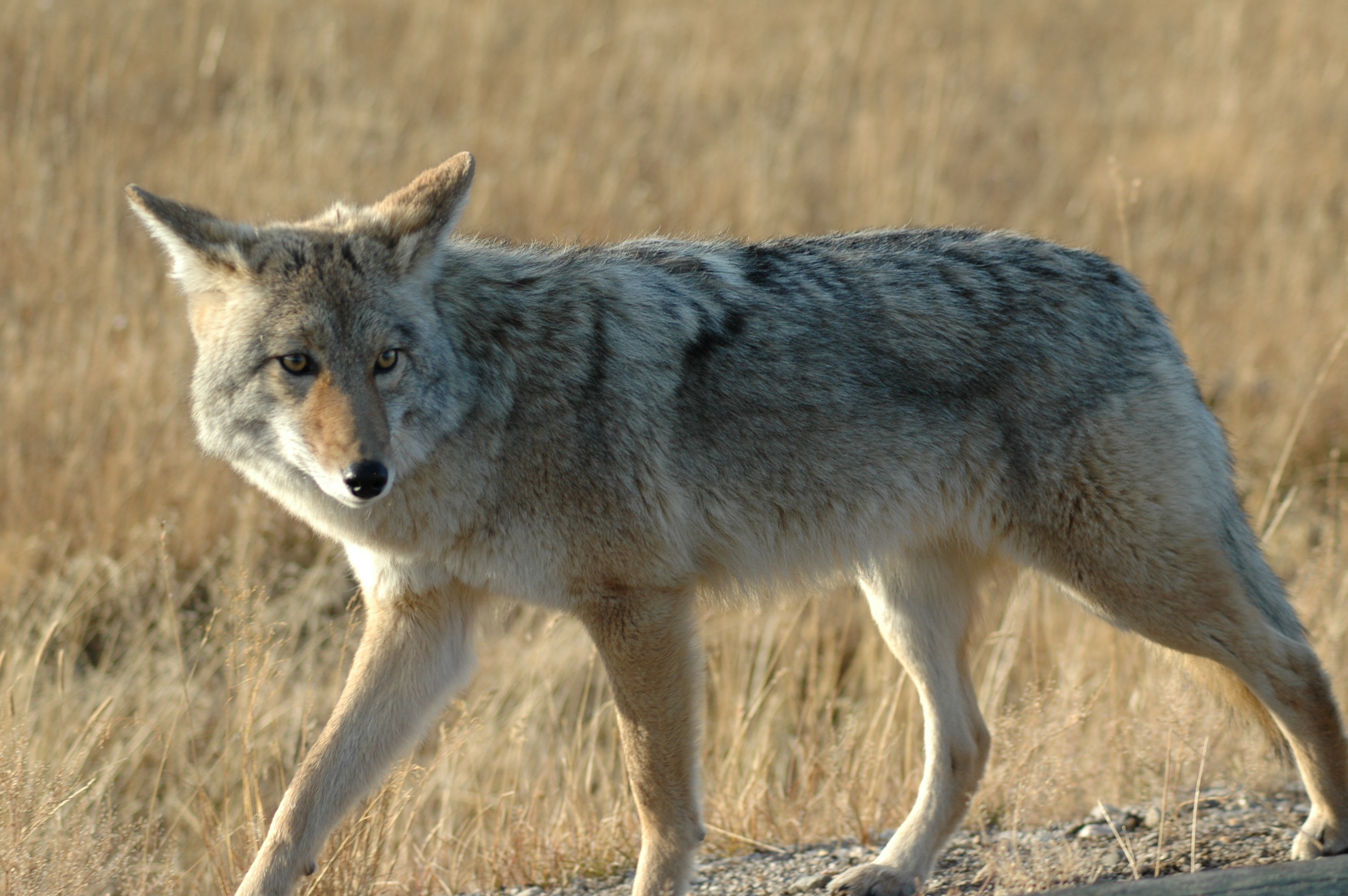
ACTION ALERT: Oregon Coyote Killing Contest

Photo Copyright Jim Robertson

Photo Copyright Jim Robertson

We have learned of a Coyote Killing Contest in Central Oregon over a three day period from Friday, January 17 through Sunday, January 19, 2013.

The contest offers a special one-day free entry for children under 16. Cash, belt buckles and other prizes will be awarded to the two-man team killing the most coyotes by weight, the largest individual coyote, and more.

Please contact [see below*] the Bureau of Land Management (BLM) and the US Forest Service (USFS) to express your concerns, which may include the following:

• Commercial activities on public federal lands require special use permits and an environmental review to determine their impact on the ecosystem and the quality of the human environment.
• Are these agencies aware of this event?
• Participants are paying a one hundred dollar fee to join the event, making it a commercial endeavor.
• Have the promoters of this event applied for and received a permit?
• An undetermined number of hunters will be involved in the organized event, likely putting the public at risk over the weekend when many families recreate on public land.
• Like other top predators, coyotes play a critical role in keeping natural areas healthy. In fact, coyotes are a keystone species, meaning that their presence or absence has a significant impact on the surrounding biological community.
• Field research demonstrates that the indiscriminate killing of coyotes actually increases conflicts and predation on livestock by causing coyote populations to dramatically increase. In order to feed more robust litters, coyotes may change their hunting habits to include unnatural and larger prey, such as livestock. Thus, increased persecution leads to larger populations and increased predation.

See http://www.predatordefense.org/coyotes.htm

*Bureau of Land Management contact information:

http://www.blm.gov/or/districts/burns/notesdirectory.php

Brendan Cain
District Manager
28910 Hwy 20 W
Hines OR 97738-9424
541-573-4422
bcain@blm.gov

*US Forest Service contact information:

Emigrant Creek Ranger District
265 Hwy 20 S
Hines OR 97738-9428
541-573-4300

Blue Mountain Ranger District
PO Box 909
John Day OR 97845-0909
541-575-3000

Prairie City Ranger District
PO Box 337
Prairie City OR 97869-0337
541-820-3800

http://www.fs.usda.gov/main/malheur/about-forest/districts

Check out this link for contest details:

Shooters Services Unlimited – JMK Coyote Hunt

http://www.shootersservicesunlimited.com

Connections of animal and human suffering

http://www.stltoday.com/lifestyles/pets/dr-fox/connections-of-animal-and-human-suffering/article_0d7de883-b56e-587a-bc67-516db2cddce1.html

by Dr. Michael Fox

Dear Readers • Humans, like other animals, have so-called mirror neurons in their brains that instantly process the emotional state of another deciphered through their facial expressions, vocalizations and body language. This happens to facilitate communication and appropriate action/reaction.

When signals of distress and suffering are processed, empathetic concern is evoked, as is fear. Sociopaths and psychopaths may respectively feel nothing or some perverse pleasure. Empathetic concern, which can include sympathy, outrage, remorse, anger, guilt and disbelief, can lead to denial or appropriate action to help, save, protect and defend by direct action.

While the print and TV media increasingly limit public exposure to extreme human suffering, there are even greater limits imposed, at least in America, on showing documented cruelties and suffering of animals. Ironically, some newspapers —1474693_10202436592133870_578596781_n including my local edition — have no qualms publishing photographs of a 12-year-old girl with a deer she had shot and a wildlife biology student grinning with a wolf he had shot draped around his shoulders. This establishes a culturally accepted norm, but images of animal suffering and cruelty — of animals in traps, in factory livestock and fur farms, puppy mills and slaughterhouses — are rarely shown by the mass media. We should ask why, and who is protecting whom.

Censorship of animal cruelty and suffering by the mass media parallels the atrocious record of state and federal law enforcement agencies of anti-cruelty laws. Janelle Dixon, president and CEO of the Minneapolis Animal Humane Society, recently reported how her organization spent $225,000 caring for dogs from a puppy mill, while the operator of this commercial dog breeding operation received a charge of a year’s probation, a 90-day suspended jail sentence and a $50 fine.

Clearly, America must wipe its mirror clean when it comes to animal and human suffering caused by how, as a culture, we choose to do our business. And the media must begin to act responsibly rather than entertain, distract and continue to promote consumerism and biased information.

Sick Second-Grader Wants to Make Others Suffer

Hopefully he–and his victims–won’t have to suffer much longer.

-92da6b8afe8bf7da

Aiming for a bear: 7-year-old Alto boy goes on hunt of a lifetime

By Sue Thoms January 06, 2014

ALTO, MI – Seven-year-old Wyatt Fuss has already enjoyed a Hunt of Lifetime – a bear hunt in the woods of North Carolina.

With help from an organization that arranges hunting and fishing trips for children and teens facing life-threatening illness, Wyatt recently spent a week at a hunting lodge with his brother and grandfather.

Alas, they saw no sign of bears. The animals were scarce because the weather was unseasonably warm for the area — near 80 degrees.

“All I got were three pigs and a deer,” Wyatt said. Still, he says he had a lot of fun: “I had the best time, even though I didn’t get a bear.”

“It was quite an experience,” said his mother, Jennifer Fuss.

Wyatt, a second-grader at Alto Elementary School, has battled a spinal cord tumor since he was 1 year old. He has undergone two surgeries to remove as much of the benign ganglioma tumor as possible and has received dozens of MRIs. The tumor causes, among other things, numbness in parts of his hands and arms.

But it doesn’t affect his aim.

“He’s quite a good shot – that’s what they tell me,” his mother said.

Wyatt lives on his family’s beef cattle farm in Alto with his parents, Jennifer and Gerald Fuss, his sister, Sophie, 11, and his brother, Dalton, 15. He began hunting at an early age, and it’s one of his favorite things to do, his mother said. He dreamed of going on a big-game hunting trip.

The family learned about Hunt of a Lifetime through a social worker with Hospice of Michigan’s Early Care program, which helps children with serious, chronic illness.

Hunt of a Lifetime Foundation was started by Tina Pattison, a Pennsylvania mom who was unable to get her son’s wish for a moose hunt arranged through another wish-granting organization. Hunting outfitters and the tiny town of Nordegg in Alberta, Canada, came forward and provided a hunt of a lifetime for her son, Matt, six months before he died of cancer.

The organization went all-out for Wyatt’s trip, Jennifer Fuss said. Wyatt, Dalton, and their grandfather, Doug Klahn, spent a week at Buffalo Creek Lodge near Clinton, N.C. Before the trip, Wyatt enjoyed a $400 shopping spree for hunting gear at Cabela’s. (Photos here: http://www.mlive.com/news/grand-rapids/index.ssf/2014/01/hoping_for_bear_7-year-old_goe.html )

The hunters stayed in a lodge at a couple’s farm from Dec. 16-21, were served hearty meals and were brought to a hunting blind each day. Also staying at the lodge was another boy on a Hunt of a Lifetime trip.

Neither boy saw a bear. Jennifer Fuss wonders if her son would have been scared if he did. After he shot a boar in the hind quarters, his grandfather told him, “If you shoot a bear in the butt, we need to run.”

“I think that scared him a little bit,” she said.

But Wyatt said if he saw a bear, “I would have shot it.”

The three boars he shot weighed 45, 80 and 92 pounds. A taxidermist has volunteered to stuff the boars at the Ultimate Sport Show at DeVos Place in March.

Overall, Wyatt’s health is good, his mom said. His biggest issue now is dealing with sleep apnea, caused in part by the tumor. But his latest MRI in October showed no sign of growth, and the doctor said he can wait a year for the next scan.

“That was really good news,” she said.

Sue Thoms covers health care for MLive/The Grand Rapids Press.

Documentary Spotlights Wildlife Services’ Lethal Mass Killings

Activist discovered an “agency running amok and totally out of control” with no authority to answer to.
By   |      January 6, 2014

(Photo/Tom Ryburn via Flickr)

(Photo/Tom Ryburn via Flickr)


 Since its inception in 1931, the U.S. Department of Agriculture’s Wildlife Services has taken its mission “to improve the coexistence of people and wildlife” to heart, killing an estimated 3 million animals per year, which often includes endangered species such as eagles and household pets.

Though the agency does kill some species that are overpopulated and prey on livestock such as wolves, coyotes, mountain lions, and other wild carnivores, a new documentary from the Oregon-based nonprofit Predator Defense spotlights a darker side of the agency, hoping to spark public-demanded reform.

Brooks Fahy is the executive director of Predator Defense, the group behind Exposed: USDA’s Secret War on Wildlife. He says he heard stories about Wildlife Services officials brutally killing thousands of animals each year with poisons and aerial guttings for years, but never thought the agency actually was capable of such behavior until he launched his own investigation.

Fahy says what he discovered was an “agency running amok and totally out of control” with no authority to answer to. He believes the American public needs to know how their tax dollars are being inhumanely spent.

Lethal killings

Dubbed “criter assassins” by those opposed to the agency’s work, makers of the expose hope the documentary brings animal rights activists, environmentalists, politicians and the public together in order to stop the agency from continuing to use steel traps, wire snares, poisons, and snipers to kill wild animals in mass, unnecessarily.

Although calls for the agency’s reform may have started out as a concern about changes in the ecosystem, Democratic Rep. Peter DeFazio of Oregon says “Wildlife Services is one of the most opaque and obstinate departments” he has ever dealt with, including the Pentagon, which is why he is pushing for the agency’s reform.

“We’re really not sure what they’re doing,” DeFazio said. “I’ve asked the agency to give me breakdowns on what lethal methods they’re using. They can’t or won’t do that. We’ve asked them to tell us what goes into their poisons. They won’t say.”

DeFazio and John Campbell, a Republican from California, have teamed up and have tried to press for Congressional hearings regarding the agency’s work, as well as for the Agriculture Department’s inspector general to investigate Wildlife Services, but so far their efforts have been largely unsuccessful thanks to Wildlife Services corporate agriculture allies.

In response to the video, Carol Bannerman, public affairs specialist for Wildlife Services, told MintPress that some of the information provided is outdated, as the agency has changed in the last 20 to 40 years. And while Bannerman acknowledges that the agency largely uses lethal means to remove predator species, she says that the agency also does a lot of good work that is being overlooked.

Talking to the Sacramento Bee, William Clay, deputy administrator of Wildlife Services, said the agency attempts to use non-lethal control methods first, but “The problem is, generally when we get a call, it’s because farmers and ranchers are having livestock killed immediately. They are being killed daily. Our first response is to try to stop the killing and then implement non-lethal methods.”

However, Carter Niemeyer, a former Wildlife Services district manager who worked for the agency for 26 years, told the Sacramento Bee much of the agency’s work is excessive, scientifically unsound, and a waste of tax dollars.

“If you read the brochures, go on their website, they play down the lethal control, which they are heavily involved in, and show you this benign side,” Niemeyer said. “It’s smoke and mirrors. It’s a killing business. And it ain’t pretty.

“If the public knows this and they don’t care, I’m not going to lose any sleep over it. But they are entitled to know.”

Nuclear wildlife management

Though many lawmakers and activists including Andrew Wetzler, director of the land and wildlife program at the Natural Resources Defense Council, recognizes the agency does good work as well, Wetzler says the agency needs to be held responsible for its inhumane actions.

“We asked them about data,” he said, “How much do they use poison, where. How much do they spend renting helicopters to gun down coyotes and wolves,” but “The consistent answer we’ve gotten back … is: ‘We don’t know.’ There’s a severe lack of transparency.”

In the Predator Defense documentary, Rex Shaddox, a former special investigator for the Wyoming Sting Operation and a former Wildlife Services Trapper, explained that the USDA sells illegal pesticides to state Agriculture Department’s, who in turn sell the poisons to farmers and ranchers to kill coyotes.

Shaddox said poisons he worked with were all banned in the 1970s, such as Compound 1080 and DDT, and were not supposed to be in existence any longer, but the government was selling the pesticides “like a big huge drug operation.”

Although Bannerman says Compound 1080 has been largely replaced by sodium cyanide M-44 containers, Fahy says it is absurd to use a device that kills anything that investigates it, including people, and called Wildlife Services’ killing techniques a “nuclear approach to wildlife management.”

News of Wildlife Services lethal work may be shocking to the public, and largely absent from the mainstream media, but calls for the agency’s reform date back to the early 1960s, when scientists reported that eradicating certain species of animals was not leading to a balanced ecosystem.

In 1971 President Richard Nixon signed an executive order banning the use of poison for federal predator control, saying the public needed to learn to coexist with wildlife, but President Gerald Ford later amended the order to allow for the use of sodium cyanide.

As Fahy and others in the documentary pointed out, it’s not that the agency needs to incorporate more rules and legislation that dictates what trappers can and can’t do, they have to actually follow those laws.

Failure to follow federal law

Gary Strader is a former wildlife services trapper who currently works as a private trapper. He shared that on one occasion two mountain lions were shot from the air, which is a felony. A retired law enforcement officer, Strader said that government employees are not supposed to be committing any sort of crime, especially on taxpayer dollars, so he went to his supervisor.

Strader says he didn’t want to get anyone in trouble, but he wanted abuse of the law to stop. But after talking to his supervisor, Strader says he was treated poorly and within a few months, his job was eliminated.

“I’m not an animal rights activist,” Strader said, but Wildlife Services should have to abide by state laws, including checking traps every 24-hours so animals don’t languish in pain. “If the American public saw this and understood the brutality of this,” Strader says the practice would be ended almost immediately.

“I learned the hard way they lie from the top to the bottom,” Strader said. Shaddox agreed and added that while there are about 26 restrictions regarding the use of M-44, including a complete ban on using the poison on domestic animals, he said his supervisor often tested the poisons on dogs at city dumps.

“Most of top supervisors have total disregard for their own policy,” he said, adding that the goal is to keep the customer — the farmers and ranchers — happy above anything else.

Though Bannerman says the agency has improved in recent years, Fahy says the documentary was made not because there is just one individual who has an axe to grind. He said these employees have done things and witnessed things that are hard for them to live with.

“It isn’t he said, she said,” Fahy said. “There’s a tremendous amount of information out there. We have evidence … Wildlife Services doesn’t dispute our cases.”

Sheep in Wolves’ Clothing

http://foranimals.org/

wildlife management

by Marc

The December 18, 2013, Santa Fe Reporter, featured a profile of

Photo Copyright Jim Robertson

Photo Copyright Jim Robertson

James Lane recently fired as director of the New Mexico Department of Game and Fish. While no public reason was given for Lane’s firing, it seems likely that it was due, at least in part, to his public derision of the nonhunters as “tree-huggin’ hippies.” The department, sometimes known as “Maim and Squish,” manages wildlife on behalf of hunters and ranchers. Even after Lane’s ignominious departure, Scott Bidegain, a board member of NM Cattlegrowers Association, continues as chairman of the Game Commission, which supervises the department’s so-called professional wildlife managers.

What has been the reaction of New Mexico’s environmental and animal protection lobbyists? The supposed protectors of wildlife sheepishly sent a letter to the hunter-rancher-in-chief, begging Bidegain to replace Lane with a professional wildlife manager dedicated to the principles of the North American Model of Wildlife Conservation.

This model is aptly summed up by the Rocky Mountain Elk Foundation:

Man has hunted since he walked the Earth. Every early culture relied on hunting for survival. Through hunting, man forged a connection with the land and learned quickly that stewardship of the land went hand-in-hand with maintaining wildlife – and their own way of life.

In the first half of the 20th century, leaders like Theodore Roosevelt and Aldo Leopold shaped a set of ideals that came to be known as the North American Model of Wildlife Conservation. They articulated the philosophy that all wildlife belong to all of us. . . .

The Pittman-Robertson act was passed in 1937, through which hunters voluntarily imposed a tax on themselves, ensuring that a portion of the sale of all firearms and ammunition would be expressly dedicated to managing the wildlife entrusted to the public. The Pittman-Robertson Act generates $700 million annually, which is distributed by the U.S. Fish and Wildlife Service to state fish and game agencies across America.

The federal tax on firearms and ammunition is collected by the Alcohol and Tobacco Tax and Trade Bureau (TTB). As its name suggests, TTB also administers federal taxes on alcohol and tobacco. No one expects these tax revenues to be used to promote smoking and drinking, yet hunters expect firearms taxes to be used to promote hunting.

RMEF is, however, correct to point out that hominids have been killing wildlife since they first learned to walk upright. In North America, hunting dates back to mass extinctions of the Pleistocene, which corresponded with the arrival of humans on this continent. Well before the establishment of “Native” American cultures species such as saber-toothed cats disappeared from the North American landscape. Species which were able to survive centuries of hunting with spears, bows and arrows, proved little match for European firearms technology.

Only when hunters began to fear an end to their gruesome blood sport did wildlife managers like Aldo Leopold begin to rethink the idea of hunting without limit. Along with the establishment of the US Forest Service and the Bureau of Land Management, the Pittman-Robertson Act attempted to protect ranchers and hunters from destroying both their own livelihoods and their ability to indulge in sadistic blood sports. Thus was born the myth that ranchers and hunters, who had come close to totally destroying the land and the wildlife who live on it, were the “true conservationists,” codified by the North American Model of Conservation.

In spite of the best efforts of the “hunter-conservationists,” hunting continues to decline in the United States. According to the latest [2011] National Hunting Survey, only 6% of the U.S. population hunts. When broken down by region, there has been a 45% drop over the last decade in the Mountain States from 11% to 6%. Correspondingly, the New Mexico report shows a 47% drop in expenditures by hunters.

The drop in hunting is a threat not only to hunters and ranchers, but also to conservation and animal protection lobbyists who have been collaborating with them. In their letter to the Game Deparment, Animal Protection of New Mexico, the Rio Grande chapter of the Sierra Club, the New Mexico chapter of the League of Conservation Voters and Wild Earth Guardians expressed their support for the hunters’ North American Model of Conservation.

Many of the organizations which signed this letter have had a long history of collaboration with hunters. Hunter Jon Schwedler headed APNM’s wildlife program before leaving to form the short-lived Sierra Sportsmen, the Sierra Club’s failed attempt to organize hunters in support of conservation.

Now it is the turn of Wild Earth Guardians to join the ranks of hunters masquerading as environmentalists, with the hiring of Erik Molvar. According to his WildEarth Guardians profile, Molvar has a degree in “wildlife management” and “enjoys antelope hunting.”

This profile reveals not only the sadistic pleasure Molvar takes in killing animals and watching them die, but also the difference between a wildlife manager and a biologist. State game departments and other wildlife managers use the cowboy term “antelope” to describe pronghorns. The last of their family to survive the Pleistocene extinctions in North America, pronghorns are not related to antelope, which are native to Africa. “Wildlife management” might be considered a “science” similar to economics and political science, but it is not a natural science like biology and geology.

In any case, contrary to the propaganda of the conservation lobbyists, there is no “pure science” which can guide the protection of wolves, prairie dogs, pronghorn, and other wild species, whether or not they are legally endangered. As the career of Jon Tester, Rancher-Democrat of Montana, demonstrates, the U.S. Congress retains the right to determine what animals can be legally killed without limit. Tester, after using funds from the League of Conservation Voters to defend his seat against the notorious “evil Koch brothers,” authored the law which removed endangered species protection for the grey wolf. A belated attempt by conservation lobbies to petition the Department of the Interior to restore wolf protection in violation of Tester’s law may succeed in raising funds, but it will not succeed in protecting wolves.

Rancher-Democrat Tester has now been joined in the Senate by New Mexico Hunter-Democrat Martin Heinrich. Heinrich & Tester’s Sportsmen’s and Public Outdoor Recreation Traditions Act (SPORT) Act (S. 1660) would open all federal lands, including National Park Service land, to hunters.

Congressmen question costs, mission of Wildlife Services agency

http://www.latimes.com/nation/la-me-wildlife-killing-20140105,0,2146578.story#axzz2pXmR2tyM

By Julie Cart
January 4, 2014, 7:41 p.m.la-me-wildlife-killing-g

The U.S. Department of Agriculture’s inspector general will investigate a federal agency whose mission is to exterminate birds, coyotes, mountain lions and other animals that threaten the livelihoods of farmers and ranchers.

The investigation of U.S. Wildlife Services is to determine, among other things, “whether wildlife damage management activities were justified and effective.” Biologists have questioned the agency’s effectiveness, arguing that indiscriminately killing more than 3 million birds and other wild animals every year is often counterproductive.

Reps. Peter A. DeFazio (D-Ore.) and John Campbell (R-Irvine) requested the review, calling for a complete audit of the culture within Wildlife Services. The agency has been accused of abuses, including animal cruelty and occasional accidental killing of endangered species, family pets and other animals that weren’t targeted.

DeFazio says the time has come to revisit the agency’s mission and determine whether it makes economic and biological sense for taxpayers to underwrite a service, however necessary, that he argues should be paid for by private businesses.

“Why should taxpayers, particularly in tough times, pay to subsidize private interests?” said DeFazio, ranking Democrat on the House Committee on Natural Resources. “I have come to the conclusion that this is an agency whose time has passed.”

Wildlife Services was created in 1931 as part of the USDA’s Animal and Plant Health Inspection Service. It has wide-ranging responsibilities, including rabies testing and bird control at airport runways. But the bulk of its work is exterminating nuisance wildlife by methods that include poisoning, gassing, trapping and aerial gunning.

The agency acts as a pest management service not only for agribusiness and ranches, but also for other federal agencies, counties and homeowners who might have such problems as raccoons in an attic. Other services include protecting endangered species and maintaining game herds for hunters.

The services are free or substantially subsidized, which many private predator- and pest-control companies say unfairly undercuts their business. States and counties complain that they are responsible for an increasing share of the costs.

DeFazio and Campbell are also calling for congressional oversight hearings. DeFazio says he has spent years asking for but not receiving information from Wildlife Services, which he calls “the least accountable federal agency” he has ever seen.

He said he had to learn from the Los Angeles Times about an internal audit the agency conducted last year. The audit found the agency’s accounting practices were “unreconcilable,” lacked transparency and violated state and federal laws. Further, the audit revealed that $12 million in a special account could not be found.

“The last time I tried to get more specific financial information, they just blew me off and said they couldn’t provide that,” DeFazio said in an interview. “Yet, at the same time, they were undertaking this audit. So, the managers were, at best, disingenuous, and at worst, undertaking a coverup.”

A Wildlife Services spokeswoman said the agency had already begun to carry out changes recommended in the audit.

In response to allegations of improper behavior by agents, the spokeswoman said the department does not condone animal cruelty and that employees are trained to strictly follow state and federal wildlife laws.

Information that DeFazio’s office says Wildlife Services has refused to disclose includes the identities of its clients. DeFazio’s office has determined that the agency acts as an exterminator for golf clubs and resorts, hunting clubs, homeowners associations, paving companies and timber giants International Paper and Weyerhaeuser.

The agency’s supporters argue that the cost is appropriately borne by consumers, who value local food production. In California, many ranchers and farmers would go broke if they had to pay private companies to do the work provided free of charge by Wildlife Service agents, said Noelle G. Cremers, a lobbyist for the California Farm Bureau.

Members of Congress have heard allegations for years of improper — and in some cases, illegal — practices within Wildlife Services. Attempts at congressional investigations have been stalled by what DeFazio calls the agency’s “powerful friends” in agriculture and ranching lobbies.

Among the allegations legislators want to review are those by Gary Strader, a Wildlife Services hunter in Nevada until 2009. He alleges he was fired for reporting to superiors that colleagues had killed five mountain lions from airplanes, which is a felony. He said his supervisor told him to “mind his own business.”

Strader said the same supervisor gave similar advice when the hunter discovered that a snare he set had unintentionally killed a golden eagle. Knowing that the bird was protected under federal law, Strader called his supervisor for guidance. “He said, ‘If you think no one saw it, take a shovel and bury it,'” Strader said.

Agents are required to maintain records of their kills, but critics say those records are opaque and probably inaccurate. The official count, for instance, does not include offspring that will die after adult mountain lions or bears are killed, or coyote pups inside a den that has been gassed.

“The numbers are absolutely manipulated — gravely underestimated,” said Brooks Fahy, executive director of Predator Defense, a wildlife conservation group.

Part of the difficulty of wildlife control work is making sure the lethal methods reach only the intended targets. Cyanide traps set for coyotes can kill other animals. Many domestic dogs — thousands, by the accounting of watchdog groups — have been inadvertently poisoned by capsules meant for coyotes.

Rex Shaddox, a former Wildlife Services agent in Wyoming, said agents “were told to doctor our reports — we were not allowed to show we killed household pets.” Shaddox said he knew a rancher who kept a grisly souvenir of the agency’s collateral damage: a 10-foot chain of interconnected dog collars.

Shaddox says the agency rarely handles federally controlled poisons legally. Agents are required to post signs where pesticides and poisons are placed and maintain detailed logs. But supervisors tell them not to, Shaddox and other former agents said.

Wildlife Services agents have also been accused of animal cruelty, particularly in the use of dogs to control and kill coyotes. Last year, a Wyoming-based trapper posted photographs to his Facebook page showing his dogs savaging a coyote caught in a leg-hold trap. Other pictures showed the agent’s animals mauling bobcats and raccoons.

The agency said it was investigating.

Wildlife biologists also criticize the agency’s work, which they say ignores science. Bradley J. Bergstrom, a conservation biologist at Valdosta State University in Georgia, and other biologists at the American Society of Mammalogists say they have been frustrated by the agency’s unwillingness to share scientific data tracking the effectiveness of its approach.

For instance, Bergstrom said, eradicating coyotes from a landscape creates unintended consequences. He said a Texas study found that killing coyotes that preyed on cattle led to an increase in rodents, which prey on crops. The pest problem shifted from those who raise cattle to farmers who grow crops.

“Preemptive lethal control … makes no sense,” Bergstrom said. “It’s known as the ‘mowing the lawn’ model — you just have to keep mowing them down.” .

http://www.latimes.com/nation/la-me-wildlife-killing-20140105,0,2146578.story#ixzz2pZziBW5a

Man Killed In Hunting Accident…make that, 2 men killed in hunting accidents

http://www.kktv.com/home/headlines/Man-Killed-In-Hunting-Accident-238774501.html

January 5, 2014

TELLURIDE, Colo. (AP) — Authorities say a 28-year-old man was accidentally shot to death by a fellow hunter during an outing near the tiny community of Egnar in southwestern Colorado.

The Telluride Daily Planet reports Trenten Tyler Sutherland was shot in the head while hunting coyotes with two companions the night of Dec. 27. The accident happened on Sutherland’s parents’ property, and investigators say the group was using an optical device known as an illuminator, which highlights animals’ eyes in darkness.

San Miguel County Sheriff Bill Masters says the group became separated and one of the hunters was using the device with a rifle when he apparently mistook Sutherland’s eyes for those of a coyote.

Egnar is an unincorporated community about 50 miles west of Telluride near the Utah-Colorado border.

______________________

http://blog.al.com/tuscaloosa/2014/01/birmingham_area_man_dies_in_su.html

By Kelsey Stein January 04, 2014

SUMTER COUNTY, Alabama – A man from the Birmingham area was fatally shot in a hunting accident early Saturday, a Mississippi news station has reported.

Sumter County Sheriff Tyrone Clark told WTOK that one man was shot on County Road 74 near Livingston.

The victim’s name is not being released pending notification of family, but officials said the man was from the Birmingham area. Sumter County authorities are investigating the shooting.

imagesD5ZT7PC1

New Rules Would Allow Montana Landowners to Shoot, Trap More Wolves

http://switchboard.nrdc.org/blogs/zstrong/new_rules_would_allow_montana.html

This originally appeared on The Wildlife News.

copyrighted wolf in riverLast week, more than a million Americans registered their opposition to the U.S. Fish and Wildlife Service’s (FWS) proposed plan to remove Endangered Species Act protections from gray wolves in most of the lower-48 states. This was the largest number of comments ever submitted on a federal action involving endangered species.

One of the reasons so many of us oppose the plan is because removing federal protections from wolves means handing their management over to state governments and wildlife agencies. Unfortunately, many states have demonstrated hostility toward wolf conservation, such as with overly aggressive hunting and trapping seasons, the designation of “predator zones” where wolves may be killed year-round without a permit, and large appropriations of taxpayer dollars doled out to anti-wolf lobbyists. If states are allowed to take the reins now, before wolves have had a chance to recover in places like the Pacific West, southern Rockies, and northern New England, wolves may never get the chance.

Continuing the disturbing pattern of state aggression toward wolves, Montana’s Fish, Wildlife and Parks (“FWP”) Commission recently proposed several amendments to the state’s wolf management rules that would greatly expand the circumstances under which landowners could legally kill wolves on their property. NRDC testified against, and submitted a letter opposing, many of the proposed changes, because they are unnecessary, impossibly vague, and would result in the trapping and killing of many non-threatening, non-offending wolves and other animals.

For example, one of the proposed amendments would allow landowners to kill any wolf, anytime, anywhere on their property, without a permit, whenever the wolf constitutes a “potential threat” to humans or domestic animals. Yet the amendment does not define “potential threat” or provide any clear examples of when a wolf is or is not acting “potentially threatening.” This is a big problem because some landowners (as one sitting next to me loudly announced during a recent public hearing) consider all wolves on their property “potential threats”—despite, for example, the fact that wolves commonly travel near and among livestock while completely ignoring them.

And even if “potential threat” was clearly defined, such a rule would be unnecessary. Montana law already allows a person to kill a wolf if it is “attacking, killing, or threatening to kill” a person, dog, or livestock, or to receive a 45-day kill permit for a wolf that has already done so. Further, the state pays ranchers the full market value of livestock losses when government investigators confirm, or even think it was probable, that the animal was killed by a wolf. These measures already safeguard ranchers and their property; allowing “potentially threatening” wolves to also be killed seems more a guise for further reducing the state’s wolf population than providing needed assistance to landowners.

Another amendment would allow landowners with a kill permit to use foothold traps to kill wolves that have attacked livestock. Such an amendment is unnecessary, because kill permits already allow landowners to shoot these wolves. Further, foothold traps are non-selective, and would be more likely to capture a non-threatening, non-offending animal than a specific wolf. In fact, foothold traps are so indiscriminate, and cause such prolonged pain and suffering, that they have been banned in more than 80 countries, and banned or severely restricted in several U.S. states.

Allowing the use of foothold traps could also result in the capture and killing of threatened and endangered species such as wolverines, lynx and grizzly bears, as well as black bears, deer, elk, moose, mountain lions, eagles, and, yes, landowners’ own dogs and livestock—the very animals these traps would supposedly be protecting. The odds of incidental captures would be particularly high, given that landowners would be allowed to leave these traps out a full month and a half after the livestock attack had occurred.

A third amendment would remove the requirement that FWP set quotas during the wolf hunting and trapping seasons. Quotas, when used properly, help ensure against hunters and trappers killing unsustainable numbers of wolves, entire packs, wolves that primarily inhabit protected areas, and wolves that pose little or no threat to domestic animals (such as wolves that reside in wilderness areas or in places where little or no grazing occurs). Given that this year FWP extended the season by two months, increased the number of wolves one could kill from one to five, and authorized the use of electronic calls (some of which mimic the cries of pups), it should be proposing to institute more quotas, not fewer.

Like FWS’ proposed “delisting,” the FWP Commission’s proposed amendments are simply not rooted in science or conservation. Instead, ironically, two agencies tasked with recovering and sustaining healthy wolf populations have manufactured the species’ newest threats. Both proposals should be dropped, and conversations begun anew about new ways to conserve and manage, not kill, these animals. Let’s discuss how to treat them as they deserve to be treated—not as saints, not as demons, but, very simply, as the wild, intelligent, ecologically critical creatures that they are.

Duck Dynasty guns? Yep, but will new product line actually revive hunting?

By Patrik Jonsson, Staff writer / January 3, 2014

Photo Copyright Jim Robertson

Photo Copyright Jim Robertson

Just about everyone in America now knows that Phil Robertson and the “Duck Dynasty” clan are a rare breed, indeed. But even as the bayou-based reality TV family has morphed into a marketing and cultural commodity – note its new line of Mossberg shotguns and rifles – there’s another angle to ponder: Until now, hunters like Phil Robertson had actually been disappearing from America’s duck-dotted wetlands.

“Duck Dyasty,” a show about a band of self-described rednecks and their kin straddling the gulf between rural values and fabulous wealth – built to a TV viewership crescendo this past summer, during its fourth season. It captured even broader attention more recently when Mr. Robertson, the clan patriarch, became embroiled in a corporate spat with A&E executives over his views, expressed to a GQ reporter, that homosexuality is a sin like bestiality, and that homosexuals are akin to drunkards and terrorists.

The Robertsons’ subsequent decision to break away from their TV licensing to sign the Mossberg shotgun deal independently – not to mention the multitude of TV and newspaper stories about the “Dynasty” clan’s red-state attitudes and values – speaks to what some call redneck commoditization. That’s an appeal to primarily white Southern fundamentalist Christians that has translated into financial (some $450 million in merchandise sold in less than two years), as well as cultural and political, payoff.

More: http://www.csmonitor.com/USA/Society/2014/0103/Duck-Dynasty-guns-Yep-but-will-new-product-line-actually-revive-hunting

Also see: https://exposingthebiggame.wordpress.com/2014/01/05/duck-dynastys-evil-is-spreading/

And: https://exposingthebiggame.wordpress.com/2013/09/10/im-not-one-of-those-duck-dynasty-douchebags/?relatedposts_exclude=4210

Reducing Gas Emissions from Livestock Key to Curbing Climate Change: Study

By James A. Foley

Jan 03, 2014

A study published recently in the journal Nature Climate Change highlights both the need for policy changes and greater emphasis on livestock management in order to curb climate change.

Although it’s well known that significant quantities of methane are produced by the burps and excrement of the world’s livestock, the study authors contend that inadequate attention is being paid to to the greenhouse gasses associated with ruminant animals such as cows, sheep, goats and buffalo.

“Because the Earth’s climate may be near a tipping point to major climate change, multiple approaches are needed for mitigation,” study leader William Ripple, a professor in the College of Forestry at Oregon State University. said in a statement. “We clearly need to reduce the burning of fossil fuels to cut CO2 emissions. But that addresses only part of the problem. We also need to reduce non-CO2 greenhouse gases to lessen the likelihood of us crossing this climatic threshold.”

Ripple and his colleagues suggest that an effective way to mitigate the effects these greenhouse gasses have on the environment is to reduce global populations of ruminant livestock.

At approximately 3.6 billion heads, the world population of ruminant livestock is about half the global human population. Moreover, about 25 percent of the Earth’s land area is dedicated to livestock grazing, and a third of all arable land is used to grow feed crops for livestock, the researchers write.

On the basis of pounds of food produced, cattle and sheep generate between 19 and 48 times more greenhouse gasses than protein-rich plant foods such as beans, grains, or soy products, the researchers found.

More: http://www.natureworldnews.com/articles/5514/20140103/reducing-gas-emissions-livestock-key-curbing-climate-change-study.htm#

15242-333e1363ed3eb6b53508d726e22a5fecb3cbcb4a168d4cea6cce61d8_w_240_px