Earthrace Conservation, applauds International court verdict on Japanese whaling

Pete Bethune, Earthrace Conservation, applauds International court verdict on Japanese whaling.

The International Court of Justice in The Hague today (Monday, 31 March 2014) found in favor of Australia and New Zealand in the court case against Japan’s so-called Research Whaling in Antarctica.

Earthrace Conservation founder Pete Bethune, who was at the court for the original case in June 2013 and today to hear the verdict, said, “I am absolutely thrilled. Today will go down in history as a great day for whales, for conservation and for justice.”
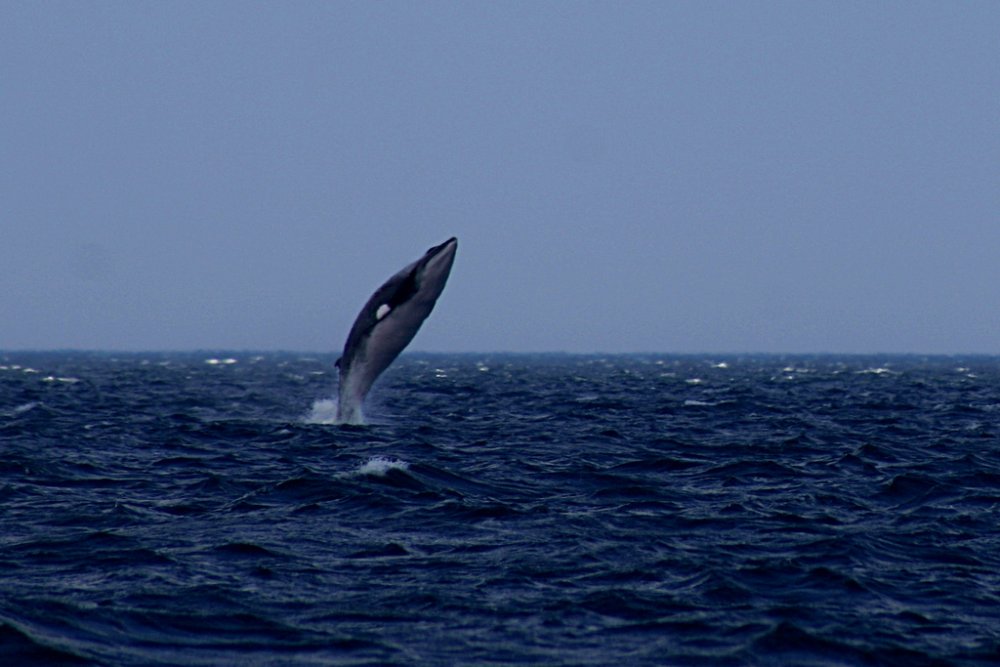
Minke%20whale%20creative%20commons%20Smudge9000%20on%20flickrHe said, “The verdict makes Japan’s Research Whaling program, which has killed many thousands of whales in the name of science, illegal. It also halts any likely copycat programs from the likes of Russia and Korea which had the decision favored Japan had been expected to introduce research whaling programs of their own”.

Bethune had his boat, the Ady Gil, destroyed when it was run over by a Japanese security vessel in Antarctica in January 2010. He then spent five months in a maximum-security prison in Japan after he illegally boarded the vessel that had nearly taken the lives of himself and his crew.

This period saw such intense public outcry over research whaling, that the Australian government announced it was taking Japan to the International Court of Justice. Bethune remembers the day when he heard the news in prison. “I went down to meet my lawyer, and the first thing she said to me was Australia had taken the court action against Japan over whaling. I burst into tears. I was optimistic that any decent judicial system would find against Japan, and to finally see it become a realityis amazing.”

Bethune always felt that Japan’s case was weak. “They used a loophole in the original IWC regulations that allowed for nations to conduct their own research-whaling program”, he said.

“Japan argued the court had no jurisdiction to decide what legitimate research was, and that Japan could choose its research programs as it liked. They also presented some of their research findings, although none but the most one-eyed would accept them as being valued by the Scientific-community”.

The verdict is binding for all three countries and cannot be appealed. Japan has little choice now but to cease their whaling program in the Southern Ocean Whale Sanctuary.

Bethune spoke to several senior Japanese delegates after the verdict was announced and says they indicated that while they were very disappointed with the outcome, they would abide by the ruling and not go back to Antarctica.

According to Bethune, the one drawback with the court case is it only addressed Japan’s scientific whaling program in Antarctica. The verdict has now made this illegal, but it still leaves Japan free to continue with research whaling in the Northern Pacific.

Bethune said, “I have no idea why Australia and New Zealand left the Northern Pacific out of their case. If the research program in Antarctica is illegal, then by definition so is the program in the Northern Pacific but it will require another court action to make this illegal also.”

Bethune now feels that his actions back in 2010 were not in vain and hopes that in some small way what happened to him contributed to today’s verdict.
“I lost my boat, spent five months in prison for peacefully protesting against what has now been confirmed as illegal activities, and was paraded around in Japan as a dangerous criminal which was difficult to take at the time. If all that was even a small part of the means to this happy ending, then I’m bloody happy to have gone through it all.”
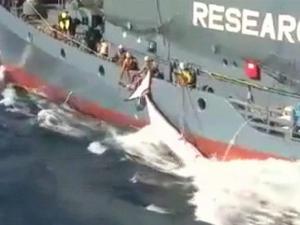
World Court rules Japan’s whaling not for scientific purposes

Monday March 31, 2014

The International Court of Justice has ruled that Japan’s whaling programme is not for scientific purposes, in a landmark decision tonight.

After years of protest and diplomatic wrangling, the court in The Hague ruled by 12 votes to 4 that Japan does not have the right to hunt whales in the Antarctic. The decision is binding so Japan can not appeal.

“The court concludes that the special permits granted by Japan for the killing, taking and treating of whales in connection with JARPA II are not for purposes of scientific research,” President Peter Tomka told the International Court of Justice tonight.

The court ruled Tokyo should cease its whaling programme “with immediate effect”.

New Zealand helped Australia to haul Japan before the courts accusing Japan of exploiting a loophole in the rules by saying they are hunting whales for scientific purposes.

Japan says it’s necessary to kill a small number of whales to find out more about them. In the last 20 years, 10,000 whales have been slaughtered in the name of science.

The case started in 2010 but during a three-week hearing last year, New Zealand and Australia argued Tokyo’s programme was just a commercial operation in disguise.

However, Japan argued the court didn’t have the right to decide what is and isn’t science.

Foreign Minister Murray McCully said it was a complex case.

“The big issue for us is whether we do see a pathway out of whaling in the Southern Ocean from Japan’s perspective and that’s what we’ll be looking for in the small print of the court’s decision.”

In 1986 commercial whaling was banned but several countries like Norway and Iceland continue to practise it and remain members of the commission. Japan reverted to the 1940s regulations that allow hunting for scientific purposes but there are no rules on how many whales can be killed.

The Sea Shepherd protest ship has been working to stop whaling in the Southern Ocean. The ship has collided with whaling boats, dragged ropes in the water to damage propellers and used smoke bombs.

Sea Shepherd campaigner Pete Bethune says it’s “judgment day for Japan… the stakes couldn’t be higher”.

http://tvnz.co.nz/world-news/court-rules-japan-s-whaling-not-scientific-purposes-5880814

whaling_stand_off_causes_diplomatic_waves_1721713978

Boone and Crockett Club: Drone hunts ineligible for records

http://missoulian.com/news/local/boone-and-crockett-club-drone-hunts-ineligible-for-records/article_a263a49c-b86b-11e3-b4f4-0019bb2963f4.html

Heading out for the big hunt? Leave your drone at home.

The Missoula-based Boone and Crockett Club, North America’s oldest hunting and conservation organization, has announced that any game scouted or taken with the help of drones or other unmanned aerial vehicles is ineligible for entry into its records program.

“Boone and Crockett likes to, as much as possible, set the standard for fair chase,” said Richard Hale, the chairman of the club’s big game records committee.

The club defines fair chase as the ethical, sportsmanlike and lawful pursuit and taking of any free-ranging wild, native North American big game animal in a manner that does not give the hunter an improper advantage over such animals.

“These drones, like all technology, have advanced rapidly. We need to be responsive to the way technology is changing things,” Hale said Sunday, adding that several states, including Colorado and Alaska, have already moved to ban the use of drone-aided hunting.

Curbing the use of technology is not new for the Boone and Crockett Club.

In the 1960s, the group declared that trophies taken with the use or assistance of aircraft, including spotting or herding game, would be ineligible for its prestigious records.

“We already don’t allow things like trail cameras that could send an image to, say, your phone, or pursuing game in a vehicle,” Hale said.

He said if Boone and Crockett or even state wildlife agencies take a wait-and-see approach on new technology, companies and other groups can develop an entrenched interest in seeing such technology stay legal, and lobby against any moves to limit them later on.

The Boone and Crockett Club was founded by Theodore Roosevelt in 1887 to promote the proper management of wildlife and encourage hunting sportsmanship. Its international headquarters is in Missoula.

Colorado-man-offering-drone-hunting-lessons-in-Deer-Trail

Beloved pets also lost, displaced by mudslide

[Only now, after the human death toll has been tallied up, do we hear about the no-human casualties of the Oso slide.]

imagesCALYDLG2

http://www.komonews.com/news/local/Beloved-pets-also-lost-displaced-by-mudslide-253195501.html

By MANUEL VALDES, Associated Press Published: Mar 31, 2014
DARRINGTON, Wash. (AP) – After a rescue worker called her animal clinic saying dogs had been extracted from the destruction left behind by a massive mudslide, veterinary assistant Cassna Wemple and her colleagues raced to this small Washington town near the debris field.

They found one of the dogs at the fire station among a flurry of rescue workers and townspeople. Bonnie, an Australian shepherd, was wrapped in a comforter. She was muddy and had a broken leg in a splint. One of Bonnie’s owners had just died in the slide. The other had been pulled out.

“She was just very much in shock,” Wemple said.

In this rural community north of Seattle, Wemple said it’s common for residents to have plenty of animals, including pigs, horses, rabbits, chickens, dogs and cats. When the deadly slide struck March 22, beloved pets and livestock also perished.

The full number of pets and livestock killed may never be known. Authorities also don’t have a clear number of how many pets are missing or displaced by the slide, incident spokespeople have said. There are at least 37 horses displaced and at least 10 dogs that were missing, according to different animal services helping the recovery efforts.

“To know that their animals are lost and may or may not be found. It’s heartbreaking. It’s heartbreaking for the people and the animals,” said Dee Cordell of the Everett Animal Services.

Wemple said rescue workers could hear horses crying from the debris hours after the slide, but because of the unsafe conditions, rescuers couldn’t go in.

For those animals that survived, the community and outsiders have rallied in support with donations. Bag after bag of food for dogs, cats and chickens have filled up the rodeo grounds outside Darrington, which are serving as a makeshift shelter. At last count, it totaled nearly 45,000 pounds. On Saturday alone, 27 tons of donated food from Purina arrived.

Lilianna Andrews’s seven horses are now at the rodeo grounds. Their house wasn’t buried in the mud, but the displaced earth formed a dam, backing up the Stillaguamish River into a lake that rose waist-high in the house and as high as 10 feet in the barn.

“We got them out before they got any water on them,” the 13-year-old said after helping unload hay at the rodeo grounds on Saturday. “But they would have drowned. So we just had to evacuate them from the water, and they’ve been staying here ever since.”

The Andrews were in Seattle when a friend called to check on their whereabouts. When they realized it wasn’t just a small mudslide blocking the road, they hurried home. Their dog, cats and chickens are fine too, Andrews said, although they haven’t been able to get in to feed the chickens.

Volunteers are also tending to 20 horses that belonged to Summer Raffo, a farrier who died in the slide.

Wemple’s clinic, Chuckanut Valley Veterinary, treated three dogs hurt from the slide. One of those dogs, named Blue, had to have one of his legs amputated last week. His owner is still hospitalized. The owner’s daughter has visited the dog daily.

“He’ll be happier in the long run. No more pain in that leg,” Wemple said.

Bonnie’s owner was Linda McPherson, a retired librarian. She was in her living room reading newspapers with her husband, Gary “Mac” McPherson, when the slide hit. She died. He lived. Bonnie has been kept at the clinic for rehabilitation. At night, one of the staffers takes her home.

A memorial is planned for next week for Linda McPherson. Wemple said the staffer will bring the Australian shepherd to the memorial for a reunion with her surviving owner.

___

Associated Press writer Jonathan J. Cooper contributed to this report.

Bill Maher to Hunters: ‘There’s Something Wrong With You’

MONSTER HOG SHOT DEAD IN NORTH CAROLINA

http://www.real-time-with-bill-maher-blog.com/index/2014/3/27/bloody-funday

March 27, 2014/

By Bill Maher

[By the way, the wild boars are escapees from canned hunting compounds, like the kind that raises deer and elk for fenced-in hunting that I posed on earlier.]

New Rule: If you’re delighted to take a life, there’s something wrong with you. This photo has gone viral on the Internet because, well, just look at the size of the wild boar Jett Webb bagged in the woods of North Carolina. That’s some specimen of a pig. And the boar’s pretty big too.

It’s an 8-foot, 500-pound beauty that just moments ago was roaming proudly in the wild, and now it’s dead and I’m holding up my gun and pressing my cock against it! “This might be the best day ever!”

Now, I don’t want to blame this guy too much, because I think, if you’re from rural North Carolina and you have a name like “Jett Webb,” you’d be hard pressed not to end up in a photo like this. Plus, it’s pointed out in the article that wild pigs are an invasive species and that North Carolina is being overrun by boars – just like “Fox and Friends.”

And I get the argument that “a man’s gotta eat” and that sometimes you have to take a life to feed yourself and your family – but shouldn’t it be more of a solemn occasion?

We kill people too, when we carry out executions, but afterwards the warden and guards don’t high-five and pose with the corpse. That’s what bothers me: the trophy aspect, the absolute glee, the beaming with pride. Get over yourself. You pointed at something, pushed a button, and it died.

_______________________________________________________________

The first comment to his blog, from Dominique Osh, is also worth reading:

You know, Hunters are sociopathic killers, simple as that..you match criminal profilers analyze of sociopathic murders of life. There is no need to kill anything to survive these days. There is education available to even the most rural residents that humans do not need meat to survive, not only do they not need to eat meat, we are designed not to. There are many, many alternatives, most vegetables have more calcium and protein than fat laddened flesh, that science has proven to be harmful to human health, if that’s all you care about. And if you think that organic meat from your kills is better, there are many prions in meat that are eating your brains..haha, go figure, huh..no, really, CDC keeps quiet, because the Industrial Meat market does not want you to know these things, when some old man in AK has worms in his brains from eating pigs, or “Mad Cow” & Bird Flu disease isn’t transferable to humans..right..wink, wink..It is gross abomination to eat the flesh of any animal, humans are animals too, It’s cannibalism, a serious crime against nature that we will suffer from. EVOLVE!


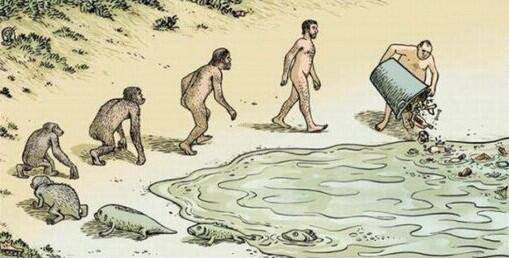
Human “Progress”

Rosemary commented: “We are seeing a longing for so-called ‘traditional’ ways of life, a manic nostalgia for something that really never was–except it was a less crowded world.”

To which I replied: I’ve thought that same thing many times. The only reason human life ever seemed to be in any kind of harmony with the rest of nature is that there were a LOT fewer of us. Sorry, but there’s no way an ever-growing population of humans can hope to be sustainable.

Here is a simple yet accurate depiction of human evolutionary “progress.”

1527138_271312873037188_1829199472_n

Buck Fever

Robert Scheer/The Star

This is X-Factor, an Indiana deer that in his prime was worth an estimated $1 million.

His value as a stud comes not from research and not from the quality of his venison. Instead, his value is in those freakish antlers, the product of more than three decades of selective breeding.

In less than 40 years, a relatively small group of farmers has created something the world has never seen before — a billion-dollar industry primarily devoted to breeding deer that are trucked to fenced hunting preserves to be shot by patrons willing to pay thousands for the trophies.

An Indianapolis Star investigation has discovered the industry costs taxpayers millions of dollars, compromises long-standing wildlife laws, endangers wild deer and undermines the government’s multibillion-dollar effort to protect livestock and the food supply.

To feed the burgeoning captive-deer industry, breeders are shipping an unprecedented number of deer and elk across state lines. With them go the diseases they carry. Captive-deer facilities have spread tuberculosis to cattle and are suspected in the spread of deadly foreign deer lice in the West. More important, The Star’s investigation uncovered compelling circumstantial evidence that the industry also has helped accelerate the spread of chronic wasting disease, an always-fatal deer disease similar to mad cow. CWD now has been found in 22 states.

CWD’s spread roughly coincides with the captive-deer industry’s growth. In half of the states where CWD was found, it first appeared in a commercial deer operation. Officials in Missouri, Nebraska, New York and Canada think captive deer or elk introduced the disease to the wild.

So far, government programs have failed to halt CWD’s spread, largely because there is no reliable way to test live animals for the disease. So infected deer may be shipped into disease-free states, where they can infect other animals, captive or wild. The Star’s investigation uncovered examples of deer escaping from farms, shoddy record keeping and meager penalties for those caught breaking the rules, which further undermine state and federal efforts to contain the disease. Plus, in less than a decade, more than a dozen people have been charged with smuggling live deer across state lines.

More: http://www.indystar.com/longform/news/investigations/2014/03/27/buck-fever-intro/6865031/


Call to Action!

dvoight09's avatarWisconsin Wildlife Ethic-Vote Our Wildlife

POSTERS THAT CAN BE DOWNLOADED TO HIGHLIGHT DIFFERENT HUNTER POWER GRABS ON THE APRIL 14 ELECTION AND VOTE

trapping pic (raccoon) Allowing trapping all night

Tundra Swan Annual Tundra Swan Hunt

hounding Private land access w/o restrictions

Trapping Teaching trapping to kids too young for classes

Madravenspeak Column # 86 Albino deer-1 Rare white deer kill

Trapping pic (coyote) Trapping expansion with dogs

Adapt them to your county location by copying and pasting the location from the DNR web site locations for every county:
Second link here: http://dnr.wi.gov/About/WCC/springhearing.html

View original post

3 elk shot and left to die near Fernie, B.C.

Photo  Jim Robertson

Photo Jim Robertson

Conservation officer Frank DeBoon says someone went for a drive recently in
the Baynes Lake area south of Fernie, spotted a herd of elk and shot into
it, dropping three cows where they stood.

Deboon says the three females, who were likely pregnant, were then left
there to die. In 26 years as a conservation officer, DeBoon says he’s never
seen anything like it.

“It’s pretty upsetting to see somebody who would just go and shoot animals
and leave them to waste,” he told CBC News.

Deboon estimates it happened about a week ago. He says the shooter or
shooters didn’t take anything.

“The elk were all in good health, probably pregnant with this year’s calves.
There’s no reason for it other than somebody deciding to shoot them.”

DeBoon says they’ll likely get away with it too. The site of the shooting is
off a fairly remote logging road and unless there was more than one person
in the vehicle, there are likely no witnesses.

Still DeBoon wants the story out there. He’s hoping someone either heard the
shots, or or perhaps stories from someone bragging about their hunting
prowess.

The shooting comes after nearly a dozen elk were shot and butchered by
poachers on Vancouver Island last year.

https://ca.news.yahoo.com/3-elk-shot-left-die-near-fernie-b-140233256.html