Idaho Passes Bill to Kill Hundreds of Wolves

http://ecowatch.com/2014/03/21/idaho-bill-to-kill-hundreds-of-wolves/

The Idaho Legislature yesterday passed House Bill 470, a bill to create a new lethal “Wolf Depredation Control Board” to administer a fund for widespread killing of wolves in the state. The bill, expected to be signed into law by Gov. Otter (R-ID), sets aside $400,000 in state funds to kill roughly 500 wolves, leaving just 150 in the entire state.

wolfFI
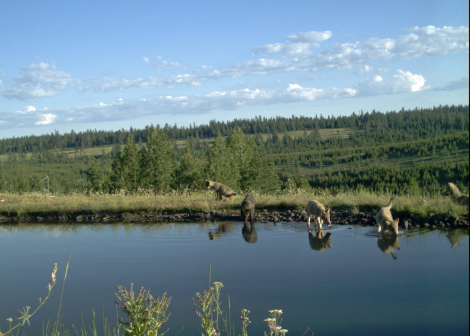
The wolf population in Idaho is under serious threat of dropping near—or even below—minimal recovery levels that Idaho promised to maintain in 2011. Photo courtesy of Shutterstock

The new board will consist of members appointed and overseen by Gov. Otter, who said in 2007 that he wanted to be the first to kill an Idaho wolf after federal protections were taken away. The board will be made up of representatives of the agricultural, livestock and hunting communities. The bill does not require any members of the board to represent the wolf conservation community.

“Political leaders in Idaho would love nothing more than to eradicate Idaho’s wolves and return to a century-old mindset where big predators are viewed as evil and expendable,” said Amaroq Weiss, West Coast wolf organizer at the Center for Biological Diversity. “The new state wolf board, sadly, reflects that attitude. The legislature couldn’t even bring itself to put a single conservationist on the board, so the outcome is predictable: many more wolves will die.”

Congress in 2011 stripped Endangered Species Act protection from wolves in Idaho and Montana. Since then, 1,592 wolves have been killed in those states.

The bill is the latest in a series of anti-wolf actions in Idaho that could ultimately backfire and force the return Endangered Species Act protections for gray wolves in the northern Rocky Mountains. Other commitments made by Idaho, including promises to maintain refugia for wolves in remote areas and wilderness, have been rolled back. The Idaho Department of Fish and Game sent a hunter-trapper into the Frank Church-River of No Return Wilderness this winter to eliminate two wolf packs. It recently announced a new predator-management plan designed to kill 60 percent of the wolf population in the Middle Fork area over the next several years, and contracted with USDA’s Wildlife Services to gun down 23 wolves in the Lolo management zone in February.

“Yet again, Idaho has put a black eye on decades of tireless work to return wolves to the American landscape,” said Weiss. “This bill sets aside $400,000 in state funds to wipe out as many wolves as legally possible in Idaho. Reducing these wolf populations to below even the absolute bare minimum sets a dangerous precedent and ensures that true wolf recovery will be little more than a pipedream in Idaho.”

In combination with mortality from annual hunting and trapping seasons, the wolf population in Idaho is under serious threat of dropping near—or even below—minimal recovery levels that Idaho promised to maintain when wolves in the northern Rockies lost federal protections in 2011. The sponsor of H.B. 470, Rep. Marc Gibbs (R-Dist. 32), says the intent of the bill is to reduce Idaho’s wolf population to as few as 10 packs.

The U.S. Fish and Wildlife Service is required by its own delisting criteria to review the population if changes in Idaho law or management objectives significantly increase the threat to the population. It must then decide whether to reinstate federal Endangered Species Act protections or extend the post-delisting period for federal oversight.

What’s Not to Like about Guns

Guns. Sure, I own a few. What good god-fearin’ American doesn’t? I figure it’s my duty to keep the arms manufacturers afloat. Of course, mine are just to keep those other gun nuts at bay. I hope I never have to use them, but if someone’s spoilin’ for a gunfight, well that’s ok too.

So, what’s not to like about guns? Well, for starters, they’re noisy, and they’re made for killing. And since it’s illegal to shoot each other, most people use them against non-human animals.

Some folks out here in rural America are so proud of their guns they wear it like a badge. They advertise it all over their loud pickup trucks so no one seeing the cute little Pomeranians in their cab mistakes them for some kind of anti-gun pinko.

Mostly, I don’t like the noise they make. And I guess I empathize with the animals too much. Whenever you hear gunfire, ya have to wonder who the hell’s out there shooting now and what, or who, are they shooting at this time.

Text and Wildlife Photography ©Jim Robertson, 2014.

Text and Wildlife Photography ©Jim Robertson, 2014.

Bill to prohibit mountain lion hunting hits a snag

http://rapidcityjournal.com/news/local/communities/chadron/bill-to-prohibit-mountain-lion-hunting-hits-a-snag/article_7d2aad20-b10d-11e3-bb3c-001a4bcf887a.html

             
2014-03-21 By JoANNE YOUNG Lincoln Journal Starcougar cub                         Rapid City Journal                    

The bill that would halt mountain lion hunting in Nebraska was expected to get final approval Thursday morning from the Legislature.

It didn’t happen.

As the Legislature reached the lunch hour, the bill was pulled for the day by Speaker Greg Adams.

What took place between 9:53 a.m., when final reading on the bill (LB671) began, and 11:58 a.m. when debate stopped, was a not-so-well defined filibuster led by Omaha Sen. Scott Lautenbaugh and several other senators. Near the end of the morning, a motion by Ernie Chambers of Omaha, who introduced the bill, to delay it until the last day of the session, which would kill the bill, was made and then withdrawn by Chambers.

Chambers said Lautenbaugh’s plan was a political maneuver to determine the length of a filibuster on final reading. That kind of extended debate on final reading is exceedingly rare.

But that’s the kind of session this has been.

The morning debate went on for 2 hours and 5 minutes. There is no official time for how long a filibuster can go on final reading before a motion to force a vote on the bill, a cloture motion, can be made.

Lautenbaugh’s constitutional amendment on historical horseracing (LR41CA) is expected to be debated on final reading Tuesday, and amendments and a possible filibuster are pending on that resolution.

Speaker Greg Adams said the filibuster on the mountain lion bill was unanticipated when he put the agenda together.

The Legislature recessed for lunch and Adams said senators would not continue with the bill when they reconvened.

The bill is not on Friday’s agenda. Chambers said Thursday night he expects the bill could come back on final reading next week.

During the filibuster, opponents brought up arguments that the protection of the constitutional right to hunt could be violated by the bill.

Chambers has said through debates on the bill that the small number of mountain lions the Game and Parks Commission has verified in the state shows there is no need at this time to manage the game animal. There also have been no reports of attacks by lions on livestock or people in the state.

The Game and Parks Commission scheduled two hunting seasons this year, both of which have ended.

Two male lions were killed in January in the Pine Ridge and a female was killed in February in Sheridan County as part of two hunting seasons.

Chambers especially objected to the commission allowing hunters in the Pine Ridge to use dogs to chase the lions into trees, making them easier to shoot.

In addition to those killed in hunting seasons this year, two mountain lions were killed in traps, one of those a female, and one was run over by a car.

Living in wolf country

March 21, 2014 By BJORN DIHLE

  FOR THE JUNEAU EMPIRE

This Monday, during a hike with my brothers, we came across fresh tracks of wolves. Three or four had milled around the trail before heading off into the dark woods. There was something electric knowing they were nearby, perhaps watching and listening. When we returned an hour later the tracks had nearly been erased by the falling snow.

The Alaska Department of Fish and Game estimates there’s between 7,000 and 11,000 wolves in the state. The densest populations are in Southeast where deer, by and large, make up their main food source. The U.S. Fish and Wildlife Service estimates there’s around 5,400 gray wolves in the lower 48. According to the International Wolf Center there are between 53,600 and 57,600 wolves in Canada.

One of many reasons I love living in Juneau is because all I have to do is go outside and I’m in wolf country. Their range stretches from the edge of suburbia to the Juneau Icefield — I’ve seen tracks on the upper stretches of the Mendenhall Glacier, in Death Valley and on the Meade Glacier. Many of us have encountered tracks, kills and if, we’re lucky, wolves in the woods and mountains surrounding town. Watching a pack moving along an alpine ridge, or listening to howling in deep forest is something you don’t easily forget. While healthy wolves almost always avoid people, sometimes if they’re sick, old, starving or if there’s a lot of deer near a residential area, they may come to the edge of a town. Out of desperation or irritation, they’ll occasionally turn to attacking dogs.

In North America attacks on humans are very rare. You’re more likely to be trampled by pigs while vacationing in Iowa. The few attacks that have occurred usually involved habituated, injured, starving or sick animals. There’s been one verified fatal attack in Alaska since statehood. Most people living in wolf country know this, but due to movies like The Grey, the misperception of North American wolves having a penchant for hunting humans is still being perpetuated.

According to ADF&G each year in Alaska around 1,300 wolves are killed by hunters and a trappers, and up to an additional 200 or so are taken in state sponsored control programs. Populations remain stable and in some areas, according to many locals who compete with wolves for moose and caribou, they’re too abundant. With the ability to breed at two years of age and having several pups in a litter, wolf numbers rebound quickly if prey populations are healthy.

In the last month there’s been reports of two wolf attacks on dogs in northern Southeast Alaska. One dog, as reported in the Chilkat Valley News, north of Haines was killed and eaten. The dog’s owner, Hannah Bochart, when interviewed, despite having what for most would be a very traumatizing experience, spoke of the attacking wolf with compassion. She described it approaching her while she was walking four dogs, and looking “weak and wobbly” and “scared and exhausted”. Though it killed one of her dogs, Bochart stated she “wouldn’t want this to end with the wolf being shot”.

Living in wolf country is a gift to some, a curse to others and for some it’s just normal. Many people have strong and sometimes irrational opinions of wolves that frequently tell more about human nature than the actual wolves. No other creature has been as villianized and, in contemporary times, as romanticized.

A while back I had conversation with an older man, a lifelong hunter and fisherman, who offered one of the best opinions on wolves I’ve heard.

“Wolves are perfect,” he said with a twinkle In his eyes, “at being wolves.”

I can’t imagine living anywhere without wolves. A hike would be a lot less interesting. The woods would feel empty. The mountains would seem lonesome.

Thankfully, living in Juneau, wolves are never too far away.

Support Rep. DeFazio’s Efforts To Stop The National Wolf Delisting Rule

Nabeki's avatarHowling For Justice

Imnaha Pack 5 wolf pups 2013 Oregon

“Five wolf pups from the Imnaha pack were photographed by a remote camera on July 7, 2013. The pups were approximately 2.5 months old in this photo. Photo courtesy of ODFW.”

Every day there is bad, very bad or really bad news about wolves. But “Ranking Member of the House Natural Resources Committee Peter DeFazio” is speaking out for wolves. He wants the national wolf delisting rule revoked.

Rep. DeFazio D -Oregon and 73 other House members, who oppose the national wolf delisting rule, are urging Secretary of the Interior, Sally Jewell, to keep wolves protected under the ESA and to “rescind the proposed rule immediately”.

Thanks to Rep. DeFazio and the 73 House members who joined him. We must stop this rule.

Please comment by March 27, 2014 on the proposed national wolf delisting by clicking HERE!

===

Natural Resources

Committee – Democrats
Ranking Member – Peter DeFazio

Press Release

Mar 19, 2014

DeFazio Leads 73…

View original post 1,197 more words

Majority of California’s House Democrats Want Wolves Protected

by

March 20, 2014

Unlikely to be able to register to vote any time soon | Photo: USFWS/Flickr/Creative Commons License

Political wonks have long talked about “blue dog” and “yellow dog” Democrats, but now California has a new Democratic dog political tendency: the Gray Wolf Democrat. A majority of California’s Congressional House Democrats have signed on to a strongly worded letter urging the U.S. Fish and Wildlife Service to abandon attempts to strip the gray wolf of protection under the Endangered Species Act (ESA).

The letter to Interior Secretary Sally Jewell, written by Oregon Democrat Peter De Fazio, slams USFWS for its ongoing proposal to remove the gray wolf from ESA protection, charging that the proposed delisting is “not based on the best available science.” DeFazio, the ranking Democrat on the House Committee on Natural Resources, writes that USFWS “should rescind the proposed rule immediately,” charging that the agency tried to stack the scientific deck against the wolves in its rulemaking.

And of the 73 Representatives that co-signed DeFazio’s letter to Jewell, 19 were California Democrats. That’s just over half the Democratic delegation and more than a third of the state’s total representation in the House, and yet another sign that there’s significant pro-wolf sentiment in California.

The California Representatives signing the DeFazio letter were Julia Brownley, Lois Capps, Tony Cárdenas, Judy Chu, Anna Eshoo, Sam Farr, Mike Honda, Jared Huffman, Barbara Lee, Zoe Lofgren, Alan Lowenthal, Jerry McNerney, George Miller, Grace Napolitano, Raul Ruiz, Adam Schiff, Jackie Speier, Mark Takano, and Henry Waxman.

With the exception of Huffman, Ruiz and McNerney, the California signers hail from relatively liberal coastal urban districts. Ruiz represents the Coachella Valley and Riverside County desert; McNerney took over arch-conservative Richard Pombo’s district in San Joaquin County in 2007. Huffman represents the north coast’s expansive Second District, which runs along the coast from the Golden Gate to the Oregon state line. (Alone among the letter’s California signers, Huffman actually stands a chance of seeing wolves move into his district in the next decade or two.)

None of California’s Republican Representatives signed on to the DeFazio letter.

In the letter, DeFazio pretty much rakes USFWS over the coals for its conduct during the wolf delisting proposal. “The ESA does not charge [USFWS] with restoring only as much of the endangered species as it deems politically convenient,” writes DeFazio, charging that he and his co-signers “have serious concerns regarding the initial attempts to exclude top wolf experts from this process, and the resurrection of a long-dormant government journal to ‘publish’ the study… used to justify the rule.”

The letter charges that delisting would interfere with the gray wolf’s recovery, saying that “recovery has yet to begin in California, Colorado, Utah, and the Northeast, where scientists have identified a significant amount of suitable habitat that would support wolf populations.”

Neither Interior nor USFWS have responded publicly to the letter, but the presence of so many California Representatives on the roster of co-signers should provide a bit of moral support for the state’s wolf advocates, not to mention political cover as the state’s Fish and Game Commission determines whether to protect gray wolves under the California Endangered Species Act.

Who Should Read Exposing the Big Game?

Imagine you’re a hunter and you just bought a copy of Exposing the Big Game to add to your collection of books and magazines featuring photos of prize bull elk, beefy bison and scary bears (the kind of animals you objectify and fantasize about one day hanging in your trophy room full of severed heads). This one also includes pictures of “lesser” creatures like prairie dogs and coyotes you find plain ol’ fun to trap or shoot at.

You don’t normally read these books (you’re too busy drooling over the four-legged eye candy to be bothered), but for some reason this one’s burning a hole in your coffee table. So you take a deep breath and summon up the courage to contemplate the text and its meaning. Several of the words are big and beyond you, and you wish you had a dictionary, but eventually you begin to figure out that Exposing the Big Game is more than just a bunch of exposed film featuring the wild animals you think of as “game.”

This book actually has a message and the message is: hunting sucks!

You don’t want to believe it—the notion that animals are individuals rather than resources goes against everything you’ve ever accepted as truth. But reading on, you learn about the lives of those you’ve always conveniently depersonalized. Finally it starts to dawn on you that animals, such as those gazing up at you from these pages, are fellow earthlings with thoughts and feelings of their own. By the time you’ve finished the third chapter your mind is made up to value them for who they are, not what they are. Now your life is changed forever!

Suddenly you’re enlightened and, like the Grinch, your tiny heart grows three sizes that day. The war is over and you realize that the animals were never the enemy after all. You spring up from the sofa, march over to the gun cabinet and grab your rifles, shotguns, traps, bows and arrows. Hauling the whole cache out to the chopping block, you smash the armaments to bits with your splitting maul. Next, you gather up your ammo, orange vest and camouflage outfits and dump ‘em down the outhouse hole.

Returning to the book, you now face the animals with a clearer conscience, vowing never to harm them again. You’re determined to educate your hunter friends with your newfound revelations and rush out to buy them all copies of Exposing the Big Game for Christmas…

Or suppose you are a non-hunter, which, considering the national average and the fact that the percentage of hunters is dropping daily, is more than likely. Avid hunters comprise less than 5 percent of Americans, while you non-hunters make up approximately 90 percent, and altruistically avid anti-hunters represent an additional 5 percent of the population. For you, this book will shed new light on the evils of sport hunting, incite outrage and spark a firm resolve to help counter these atrocities.

And if you’re one of the magnanimous 5 percent—to whom this book is dedicated—who have devoted your very existence to advocating for justice by challenging society’s pervasive double standard regarding the value of human versus nonhuman life, the photos of animals at peace in the wild will provide a much needed break from the stress and sadness that living with your eyes open can sometimes bring on. As a special treat cooked up just for your enjoyment, a steaming cauldron of scalding satire ladled lavishly about will serve as chik’n soup for your anti-hunter’s soul.

So, who should read Exposing the Big Game? Any hunter who hasn’t smashed his weapons with a splitting maul…or any non-hunter who isn’t yet comfortable taking a stand as an anti-hunter. The rest of you can sit back and enjoy the pretty pictures.

______________________________________________________________

The preceding was an excerpt from the book, Exposing the Big Game: Living Targets of a Dying Sport.

front-cover-low-res6

Over 7 Billion Served

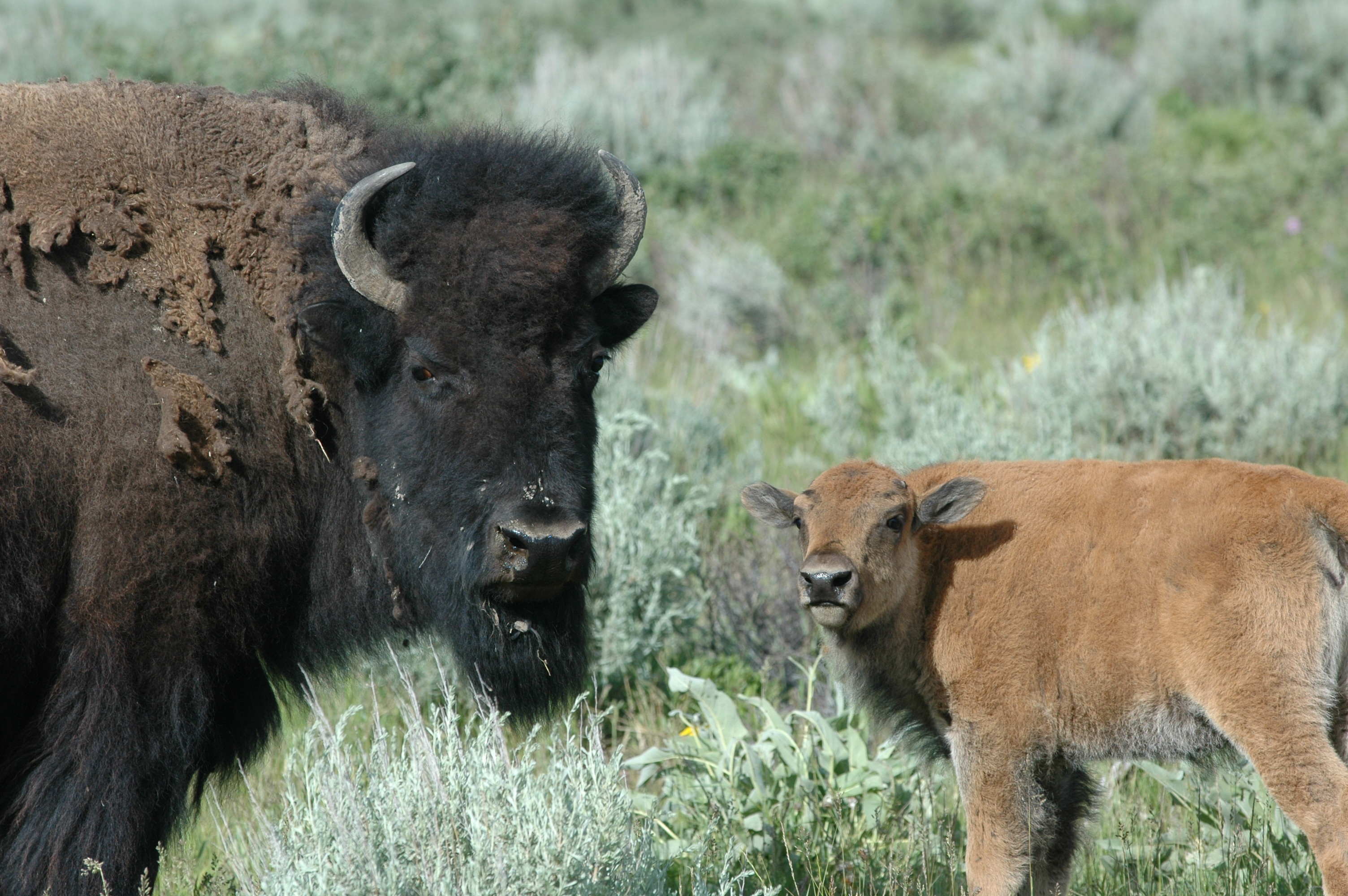
Bison calves are normally born in the spring or early summer. For the first few months of their lives they’re coat is an orange color, turning progressively darker through the warm DSC_0060summertime, until by late August they are as dark as their parents and the other adult and sub-adult members of their herd.

Winters can be harsh for a young calf in Yellowstone, which is precisely the reason bison have evolved, as a rule, to being receptive to breeding exclusively in August. The ensuing gestation period assures that newborn calves are greeted with a full summer ahead of them.

Nearly every animal species living above or below the equatorial belt has adapted to Earth’s changing seasons by only ovulating during a brief window of opportunity, thereby naturally limiting their populations.

The exception to that rule is Homo sapiens, who can impregnate one another year-round.

Our species has had it easy for so long—starting fires for warmth and skinning animals for clothes and shelter—that now human babies are brought forth continuously, 24-7. At last report, 490,000 new humans per day are born to add to the 7 billion mostly carnivorous hominids already here.

Meanwhile, whenever bison herds in Yellowstone thrive enough to reach the arbitrary number of 3,000 total “head,” the park service and the Montana Department of Livestock implement a longer “hunting” (read: walk up and blast the benign, grazing, half-tame bison) season on them, or truck them off to the slaughterhouse—those nightmarish death camps where so many of the bison’s bovine cousins meet their ghastly ends in the name of human hedonism.

And people think we need to control their population?

Text and Wildlife Photography © Jim Robertson

Text and Wildlife Photography © Jim Robertson