Killing Echo/Killing Wolves: – “Mistaken Identity and Other Excuses: Part Two

Nabeki's avatarHowling For Justice

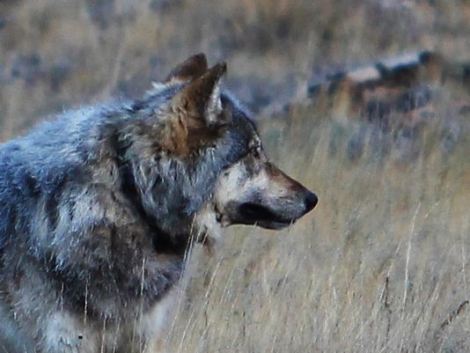
Echo Arizona Game and Fish

Echo

March 4, 2015

Wolves are one of the most social animals on earth, they’re right up there with us, the Great Apes, dolphins, lions, elephants, etc. Their lives are about family. Wolves may disperse from their natal packs between 1-3 years of age but it’s an individual choice. When they do decide to leave they’re prepared to do whatever it takes to find a mate and claim new territory. And that’s when the trouble begins for them.

There’s a reason wolves have been unable to reclaim lost habitat in most of their former range, they’re killed before they have a chance. The Pacific Northwest, Northern Rockies, Great Lakes and Southwest, where critically endangered Mexican gray wolves  struggle to increase their numbers, are the only areas of the country where gray wolves are successfully breeding and raising pups. BUT in 2009, when wolves in the Northern Rockies were delisted by the Obama administration…

View original post 3,444 more words

Could Fewer Wolf Kills Mean Fewer Wolves?

Trappers in Montana have killed 77 gray wolves and hunters have shot 127 so far this winter — a total of 204 animals — as the season for the animals nears its end.copyrighted wolf in river

Montana Fish, Wildlife and Parks spokesman Ron Aasheim said the final tally for this winter’s wolf harvest is expected to fall short of the 230 wolves killed in the 2013-2014 season.

The trapping season closed Feb. 28, and Montana’s rifle hunting season for gray wolves ends March 15.

Six of the predators have been killed by landowners, under a new state law that allows wolves to be killed if they are considered a potential threat to livestock or human safety.

In neighboring, Idaho hunters have shot 113 of the animals so far this winter and trappers have killed 92.

The state’s total harvest of 205 wolves is well short of the prior year’s total of 302 animals killed.

Idaho’s wolf season ends March 31 for most of the state but continues year-round in some areas.

Wyoming did not have a wolf hunting season this winter. After losing their federal protections across the Northern Rockies in 2011 and 2012, wolves were put back on the endangered species list in Wyoming in September under a court order.

U.S. District Judge Amy Berman Jackson sided with wildlife advocates who said Wyoming’s declaration of wolves as unprotected predators that could be shot on sight in most of the state afforded insufficient protection.

Legislation pending before Congress would nullify the judge’s decision.

There were 1,691 wolves in the Northern Rockies at the end of 2013, the most recent data available.

http://trib.com/news/state-and-regional/winter-wolf-harvests-trailing-in-northern-rockies-most-hunting-trapping/article_d585057d-f9b6-50f1-b661-e5e4f6be8006.html

Ask Ducks Unlimited to Cancel Cruel Live Pigeon Shoot

imagesQB1DEJIT

http://www.sharkonline.org/index.php/donate-to-shark/support-shark
March 3, 2015
Ask Ducks Unlimited to Cancel Cruel Live Pigeon Shoot
DEAR FRIENDS,

Last year, SHARK exposed a horrifically cruel live pigeon shoot that was to be held as a fundraiser for the Prior Lakes, Minnesota chapter of Ducks Unlimited. We made THIS (https://www.youtube.com/watch?v=CnllHXc17BI) video calling out Ducks Unlimited. To its credit, Ducks Unlimited quickly shut the shoot down and replaced it with a clay target shoot.

Ducks Unlimited Senior Communications Specialist Matt Coffey explained the shutdown this way:

“We have policies in place holding our staff and local volunteers to high ethical and moral standards, and do not condone wanton waste of wildlife or other animals. To avoid the potential for wanton waste, the event committee has decided to change the live pigeon event to a sporting clays shoot.”

Sadly, the Prior Lakes chapter of Ducks Unlimited is planning another pigeon shoot for March 19th. SHARK is again asking Ducks Unlimited’s national leaders to shut this down before 2,000 innocent birds are shot, wounded, crippled and viciously killed.

Here is the flyer for the shoot. Note how event organizers are calling it a “driven hunt.” They claim they are “harvesting” the pigeons and that they will be given to people to eat. US Senator James Inhofe tried to spin his cruel pigeon shoot the same way last year, but we exposed that as a lie in THIS (https://www.youtube.com/watch?v=eDbN36abT0k) video.

Let’s hope that the national leaders of Ducks Unlimited have more integrity than those in the Prior Lakes chapter.

Please call and write to Ducks Unlimited and politely ask that they follow their own standards and stop this horror before it happens. Let them know that if this slaughter takes place, then Ducks Unlimited reputation will be forever stained. Please let us know of any response you receive.

Dale Hall
CEO
(901) 758-3825
dhall@ducks.org

Matt Coffey
Senior Communications Specialist
(901) 758-3764
mcoffey@ducks.org

Man’s Fleeting Supremacy

10805570_795331970508849_1663368468143849002_n

I recently learned about author John A. Livingston, whose pioneering 1970s era environmental works are steeped in a misanthropy that reflects my own feelings on the scourge of humanity. I just acquired a used hard-back copy of his book, One Cosmic Instant: Man’s Fleeting Supremacy, and found myself in agreement with his attitude from the get-go, starting with Chapter One:

“The non-human world is important to the bird watcher. Its relative importance grows, in inverse relationship with an inevitable misanthropy. One’s disillusionment with society’s treatment of non-human nature is built on a body of evidence which is conspicuous on every hand…

“…if for no other reason than his own survival, man must soon adopt an ethic toward the environment. ‘The environment’ encompasses all non-human elements in the one and only home we have on Earth. However, it will be some time before we are able to enunciate, much less promulgate, an environmental ethic because, fundamentally, the ethic runs contrary to our cultural tradition.

“Ethics have been associated with man-to-man or man-to-society. They have not been concerned with man’s relationships to the non-human. Most moral philosophers have not acknowledged that man might have at least some ethical responsibility to the non-human. Perhaps this is because we cannot conceive of having any ethical responsibility to that which is not capable of reciprocating. Ethics, morals, fitness and propriety of behavior—these are human attributes. They do not exist, so far as we’ve been able to determine, in the non-human world. (That this may be a mere problem in communication does not seem to have occurred to us.) Since ethics do not exist in the non-human world, there is no need to apply them to that world. Our attitude toward the non-human world is not immoral: it is amoral.”

Celebrities Get Naked for Fish

Finally, these celebrities get naked for fish

Do you love fish as Helena Bonham Carter does?

Helena Bonham Carter

That’s not Photoshop. That is HBC in the buff, cradling a bigeye tuna.

And she wants you to know how serious she is about this love:

Helena Bonham Carter

The photo is part of a British campaign called Fishlove, behold Dumbledore coyly peeking out from behind a pufferfish!

Fishlove is produced by Nicholas Röhl, co-owner of Japanese restaurant MOSHIMO, based in Brighton, UK
©Alan Gelati/Fishlove

Fishlove is produced by Nicholas Röhl, co-owner of Japanese restaurant MOSHIMO, based in Brighton, UK

British-Indian movie star Ayesha Dharker loves moray eels as much as she loves that fat baby. 
©Alan Gelati/Fishlove
Fishlove is produced by Nicholas Röhl, co-owner of Japanese restaurant MOSHIMO, based in Brighton, UK
Sir Ben Kingsley is alarmed by — and concerned about — the deflated cephalopod he finds in his hands. 
©Rankin/Fishlove
Fishlove is produced by Nicholas Röhl, co-owner of Japanese restaurant MOSHIMO, based in Brighton, UK
Emmy-award winner Greta Scacchi hopes to cod someone will save the oceans. 
©Rankin/Fishlove
Fishlove is produced by Nicholas Röhl, co-owner of Japanese restaurant MOSHIMO, based in Brighton, UK
Actor Trevor Laird has appeared on Doctor Who, but may go down in history for appearing underneath this sailfish. 
©Alan Gelati/Fishlove
Fishlove is produced by Nicholas Röhl, co-owner of Japanese restaurant MOSHIMO, based in Brighton, UK
Lily Loveless made her debut in British TV show Skins, now makes serious dermal contact with an octopus. 
©Rankin/Fishlove

For the rest of these sea stars, check out the galleries (and the campaign) here.

Global warming helped trigger Syria’s bloody civil war

[Watch for more of this kind of news in the coming years as anthropogenic climate change leads to more drought, weather disruption and food scarcity…]

http://mashable.com/2015/03/02/global-warming-syria-civil-war/

by Andrew Freedman

Manmade global warming helped spark the brutal civil war in Syria by doubling to tripling the odds that a crippling drought in the Fertile Crescent would occur shortly before the fighting broke out, according to a groundbreaking new study published on March 2.

The study, published in the journal Proceedings of the National Academy of Sciences, is the first to attribute the drought in Syria in large part to global warming.

In doing so, it provides powerful evidence backing up the Pentagon and intelligence community’s assessments that climate change is likely to play the role of a “threat multiplier” in coming decades, pushing countries that are already vulnerable to upheaval over the edge and into open conflict.

Previous studies had shown that the drought, along with other factors such as an influx of refugees from the Iraq War next door, helped prime Syria for conflict by 2011, when the uprising began, before transitioning into an all-out civil war. Today, once-cosmopolitan Syria has been reduced to rubble, with the terrorist group known as ISIS taking over large swaths of territory.

At least 200,000 people are estimated to have died in this conflict so far.

A Syrian refugee woman is seen between a line of tents in a refugee camp near Azaz, north of Aleppo province, Syria, Sunday, Feb 17, 2013.

AP Photo / Manu Brabo

Turkey, Lebanon, Israel and Jordan may face an even more tenuous security situation in the coming decades.

The drought, which gripped the country between 2007 and 2010, forced 1.5 million farmers and herders in northeastern Syria to flee their lands and travel to urban areas in search of food and work.

This profound demographic shift helped further destabilize the country, the study says.

The study also found that much of the eastern Mediterranean, including Syria, parts of Turkey, Lebanon, Israel and Jordan — no bastions of stability today — may face an even more tenuous security situation in the coming decades as global warming increases temperatures and reduces rainfall throughout much of the region.

According to this study and others, global warming along with unsustainable water use is causing the Fertile Crescent, where agriculture and animal herding first began 12,000 years ago, to lose its fertility.

“This region is going to continue to get drier and continue to get hotter, so this is only a problem that is going to continue to get worse in that region,” says Colin Kelley, the study’s lead author and a postdoctoral researcher at the University of California at Santa Barbara.

Although the drought did not directly cause the war and subsequent rise of ISIS, which the U.S. and its allies are combating using military force, it formed a significant part in the cascading series of events that led to the deadly Syrian conflict.

Government policies that encouraged the unsustainable use of water resources and provided inadequate aid to displaced persons, among other factors, also ratcheted up Syria’s vulnerability to conflict around the time of the drought.

“We would not say and did not even attempt to say that the uprising was caused by climate change,” Kelley says. Rather, the drought was one in a chain of events that led to the breakout of hostilities.

“[Syria’s] vulnerability was so acute that all it took was something to push them over the edge,” he said in an interview.

Kelley says the drought set in motion a series of events that wound up sparking one of the deadliest conflicts of the 21st century to date. “A lot of these farming communities abandoned their villages and went to the cities at the same time that Iraqi refugees were coming in,” Kelley says.

“There was a very big population shock to these urban areas.”

Urban areas in Syria saw a population jump of 50% between 2002 to 2010, from 8.9 million to 13.8 million, as a result of refugees fleeing fighting in Iraq as well as those who were abandoning their land in northeastern Syria.

“That’s a tremendous increase in people to these urban areas over this period,” Kelley told Mashable. “It’s not at all surprising that the uprising happened shortly after this.”

Richard Seager, a climate scientist at Columbia University’s Lamont-Doherty Laboratory in New York and a co-author of the study, told Mashable that farmers were prepared to cope with a one-to-two-year dry spell, but three years exceeded their ability to cope.

“The length and severity of this drought [that was] made more likely by human climate change was absolutely key in driving the agricultural community toward a threshold where they had no other opportunity but to pick up and leave,” Seager says.

Arctic Methane Release and Global Warming: Is anybody listening?

Excerpts from Methane Release and Global Warming

http://www.globalresearch.ca/arctic-methane-release-and-global-warming/5344315

Global Research, July 30, 2013
… the “release of methane from thawing permafrost beneath the East Siberian Sea” would come with an “average global price tag of $60 trillion.” The news should have sent a shock wave through the media. But instead, predictably, the public were encouraged to celebrate—again and again, and again—the birth of the royal son.
…

Shakhova–Semiletov and Whiteman–Hope–Wadhams Studies

During the 1990s Russian scientist Dr. Natalia Shakhova had done studies of methane release from terrestrial permafrost in Eastern Siberia. In the fall of 2003, Shakhova and her colleague Dr. Igor Semiletov took the study offshore—to the East Siberian Arctic Shelf. Every year since then, they conducted annual research trips, mostly on ships during summer, but also one aerial survey in 2006, and one winter expedition on sea ice in April 2007. They published their findings in the 5 March 2010 issue of the journal Science.

Title
Methane release from the East Siberian Arctic Shelf. Credit: Zina Deretsky, National Science Foundation.

Their research, for the first time, brought attention to the East Siberian Arctic Shelf as a key reservoir of Arctic methane that “encompasses more than 2 million square kilometers of seafloor in the Arctic Ocean,” and is “more than three times as large as the nearby Siberian wetlands” that was previously “considered the primary Northern Hemisphere source of atmospheric methane.” Their findings showed that the “permafrost under the East Siberian Arctic Shelf, long thought to be an impermeable barrier sealing in methane, is perforated and is starting to leak large amounts of methane into the atmosphere.” Shakhova pointed out that the current average methane concentrations in the Arctic is “about 1.85 parts per million, the highest in 400,000 years.”

The East Siberian Arctic Shelf is shallow, only about 164 feet in depth, which means that the methane that is getting released there, most of it is escaping into the atmosphere rather than getting absorbed into the water, which would have been the case if it was a deep seabed. Shakhova had warned at the time that the release of “even a fraction of the methane stored in the shelf could trigger abrupt climate warming.”

Shakhova and Semiletov now hold joint appointments with the International Arctic Research Center at the University of Alaska Fairbanks and the Pacific Oceanological Institute of the Russian Academy of Sciences. Their research is ongoing, and Shakhova is the lead scientist for the Russia–US Methane Study.

I pointed out earlier that the rapid loss of summer sea ice in the Arctic Ocean is a key contributor to—thawing of terrestrial permafrost. It is also a key contributor to—thawing of the subsea permafrost in the East Siberian Arctic Shelf.

With all these background information, I’m finally ready to discuss the Whiteman–Hope–Wadhams study.

Arctic nations, including US, Russia, Canada, Norway, Denmark, as well as some non–Arctic nations, including China and India—are eyeing on the Arctic Economic Prize: “oil and gas” underneath the Arctic seabed. It is estimated that the Arctic Ocean contains 13 percent of undiscovered oil and 30 percent of undiscovered gas. These nations are also working to open up the Arctic sea route for moving all that crude around. It’s a great irony that the rapid melting of the summer sea ice is making the Arctic Ocean accessible for extraction and shipping.

Whiteman, Hope, and Wadhams point out that this frenzy for short–term profit is ignoring the long–term huge “economic impacts of a warming Arctic.” By using modeling they tried to understand the global economic impact of methane release from the East Siberian Arctic Shelf.

Referring to the Shakhova–Semiletov study, Whiteman, Hope, and Wadhams write: “A 50–gigatonne (Gt) reservoir of methane, stored in the form of hydrates, exists on the East Siberian Arctic Shelf. It is likely to be emitted as the seabed warms, either steadily over 50 years or suddenly.” They use “a decade–long pulse of 50 Gt of methane, released into the atmosphere between 2015 and 2025” as input to the PAGE09 economic model. They took into account “sea–level changes, economic and non–economic sectors and discontinuities such as the melting of the Greenland and West Antarctic ice sheets.” They ran the model 10,000 times under two emissions scenarios: low–emissions and business–as–usual emissions. The result is a shocker: a $60 trillion price tag for the global economy.

That’s just the beginning, because there is much more methane in the Arctic than what is in the East Siberian Arctic Shelf. Furthermore, Whiteman, Hope, and Wadhams write, “The full impacts of a warming Arctic, including, for example, ocean acidification and altered ocean and atmospheric circulation, will be much greater than our cost estimate for methane release alone.”

“The economic consequences will be distributed around the globe, but the modeling shows that about 80 percent of them will occur in the poorer economies of Africa, Asia and South America,” Whiteman, Hope, and Wadhams write. The $60 trillion number is astounding, beyond the comprehension of most human minds. It has the capacity to cripple the economy of many small nations, that are already stressed from global economic crises. This is what I’d call—economic dystopia. …