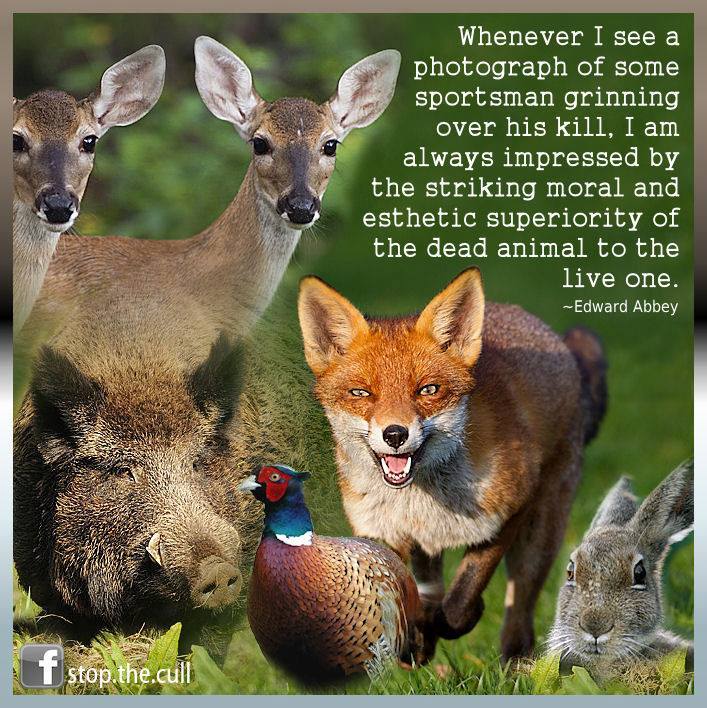
A letter from a hunter published in recent issue of Field & Stream.
Isn’t hunting a great “sport?”


A letter from a hunter published in recent issue of Field & Stream.
Isn’t hunting a great “sport?”

Capital Press March 6, 2015
Wildlife biologist Russ Morgan said Oregon’s wolves are increasing at a pace identical to their recovery in the northern Rocky Mountains.
“From a conservation perspective this is very much a measure of success,” Morgan said.
The 2014 shows Oregon has a minimum of 77 wolves, including 26 known pups, in nine packs. More importantly, eight of those packs contained breeding pairs, meaning they had at least two pups that survived to the end of the year.
The numbers mean ODFW now moves into what’s known as Phase 2 of the Oregon Wolf Plan, the hard-fought compromise that governs wolf conservation and management in the state. It also means the agency can propose removing wolves from the state’s endangered species list. That’s likely to be a lengthy public process. More immediately, Phase 2 gives ranchers the right to shoot wolves caught in the act of biting, killing or chasing livestock.
State delisting would eliminate endangered species status for wolves in the eastern third of the state. Wolves in the rest of Oregon — all areas west of state Highways 395, 78 and 95 — remain covered under the federal Endangered Species Act, administered by the U.S. Fish and Wildlife Service. The federal jurisdiction includes the Southwest Oregon Cascades now inhabited by the well-traveled OR-7 and his mate and pups.
Oregon’s true wolf population is unknown but is certainly higher than 77, Morgan said. The state tracks wolves from signals emitted by radio collars, but only 33 wolves have been collared in a decade of work. Many of those collars have failed, or the wolves have died or been killed, leaving researchers with only 13 collared wolves at year’s end. Three radio-collared wolves dispersed out of state in 2014, Morgan said. One was killed in Idaho, one was killed in Montana, and the third is living in Washington, Morgan said.
In his remarks to the wildlife commission and in an interview, Morgan said five of the six pairs living outside designated packs are known to be male-female pairs, which could produce pups and expand to pack status.
“These pairs are very important, they really represent an increasing population,” Morgan said.
In comments to the commission, representatives of three hunting organizations said the state should continue following the wolf plan guidelines.
“Certainly the population growth has caused some issues, but we strongly support staying the course with your plan,” said Dave Wiley, representing the Rocky Mountain Elk Foundation.
Stephanie Taylor of Portland, who said she has an environmental science degree and hopes to become a wolf biologist, said it is “premature” to allow ranchers to take lethal measures against wolves.
Jerome Rosa, executive director of the Oregon Cattlemen’s Association, said the population increase means it is time to “think about the maximum number of wolves that will be acceptable.”
Rosa said the OCA is working on a idea to help fund endangered species programs with a self-imposed fee assessed to ranchers. “It would be unprecedented for our organization,” he said.
The OCA has previously said it expects more attacks on livestock this year if wolves remain on the endangered species list.
Conservation groups oppose delisting Oregon wolves too soon. Oregon Wild, a key player in formulating the wolf plan, said the wolf count represents “great progress” but does not represent biological recovery. Conservation director Doug Heiken has said the state needs to see better geographical distribution of wolves as well. He said that will happen over time if wolves are not prematurely delisted and “persecuted.”

BySeth Augenstein | NJ Advance Media for
March 04, 2015
Opponents of a bigger, longer bear hunt charged today that the state is
artificially inflating the number of bruins in New Jersey to placate
hunters, and have vowed to fight a plan to kill more bears each year.
The state’s Fish and Game Council unanimously approved a bear
“management” plan Tuesday that would open the majority of North Jersey
to the hunt adding a total of 633 square miles of new hunting grounds.
The plan would also lengthen the hunt to as much as 16 days each year,
including a week in October, instead of just the current 6-day December
season. The use of bows and arrows would also be allowed.
The bear population is the big contention point, as it has been for more
than a decade of courtroom battles and public protests.
“We’ll be considering all our options — including legal options,” added
Doris Lin, director of legal affairs for the Animal Protection League of
New Jersey.
Before the annual hunt started in 2010, the bear population was
estimated by the state at 3,400. About 1,900 were killed over the course
of the five yearly hunts, held each December.The state said there were
2,500 bears prior to the December 2014 hunt, officials
said at the time.
But when the plan for future hunts was unveiled Tuesday, the population
estimate was revised to its highest total yet: anywhere from 3,500 to
4,000. State biologists said it was data collected during the December
hunt that showed an unexpected surge in the population.
“They have high reproductive rates,” said Tony McBride, a supervising
wildlife biologist with the Division. “It’s all habitat quality.”
Black bear litters are larger here than the average in other parts of
North America, the state scientists say. Females bears in New Jersey
produce three bears per litter — compared to one or two per litter in
the western United States, said McBride.
But five or six cubs have been counted in some New Jersey litters,
according to the new bear management plan. The Garden State has the
perfect mix of southern and northern forests that provide a variety of
acorns and other natural foods which lead to much higher reproductive
rates, said McBride.
But skepticism from the critics abounds. Animal-rights groups allege the
Division of Fish and Wildlife changes its estimates to suit its
hunter-first plans.
The latest population estimates are a way to drum up public support for
the hunt, they contend.
“Whenever it’s convenient for them, they say the bear population is
going up or going down,” said Lin. “Now that they want to expand the
hunt, they say they’re up.”
“It’s hard to know what to say,” added Susan Russell, the wildlife
policy director of the Animal Protection League. “The hunters wanted to
get bowhunting, and they got bowhunting. This is what they wanted — and
they’re going to get it.”
The public will have its say on the new hunt and management plan. The
DEP commissioner must approve the plan, it must be published in the New
Jersey Register, and the public will have 60 days to comment – including
a hearing. Bothwill be announced by the DEP
An NJ Advance Media analysis of statewide bear complaints conducted in
December showed that Category I incidents — the most-serious and aggressive incidents
— increased significantly after the 2013 hunt, as the population
approached pre-hunt levels, according to Department of Environmental
Protection statistics.Aggressive-bear complaints were initially pushed
down by the first hunts, but later made a resurgence.
Dave Chanda, the director of the Division of Fish and Wildlife, told NJ
Advance Media that the approval of the new plan would be too late to
open for the October season this year.

===
From the Endangered Species Coalition

A little known and decades old Department of Justice policy is protecting the killers of endangered grizzly bears, whooping cranes, California condors and wolves.
The so-called “McKittrick Policy” was enacted after a Montana man gunned down a wolf and later claimed he had thought he was firing on a dog. He was prosecuted, though the Department of Justice (DOJ) later decided to accept his self-exoneration by claimed ignorance and has clung to that policy of inaction for years.
Endangered species need to be protected from hunters that can simply claim they did not know what they were shooting at.
Tell President Obama and Attorney General Eric Holder to drop the McKittrick Policy and…
View original post 64 more words
ALERT
March 5, 2015
PLEASE BROADCAST NOW
NOTE: I think it important that form letters and emails be avoided and that the calls not be identified with an organization to help prevent reactions from legislators who will vote against anything “animal”.
Immediate Help Needed: Keep Whales and Dolphins Out of Captivity
Who: All Washington State residents, any age. Young people who do not want to see whales and dolphins in captivity are encouraged to call when their parents do.
What: Contact your legislators. Washington State Legislature House Bill 2115 would prohibit captivity of whales, dolphins and porpoise for entertainment and exploitation. It is under attack and being blocked from leaving the Rules Committee which decides if a bill will proceed to debate and vote by the full Washington State House of Representatives.
When: Now. All bills must be voted out of the House by Wednesday or they die.
How:
a) If your Representative is on the Rules Committee, call their office or email them.
b) Call your Representatives who are not on the Rules Committee. If many people call their Representatives, your voice will flow to the Rules Committee.
c) If you need to find who your Representatives are in Washington State, go here.
Please act now!
According to an MSN news article entitled, Golden Gate Bridge jumper says sea lion saved him, “A man who jumped off San Francisco’s Golden Gate Bridge to try to take his own life and was kept afloat by a sea lion said Wednesday suicide prevention was now his life’s work.”
Witnesses who saw the incident said a sea lion kept him afloat until the Coast Guard sent a rescue boat. Kevin Hines told MSN news, “I really thought it was a shark and I thought it was going to take off a leg and I was panicking. And then it just didn’t, it just kept circling beneath me. I remember floating atop the water and this thing just bumping me, bumping me up.”
One of the witnesses told Hines, “I was less than two feet away from you when you jumped. It haunted me until this day; it was no shark, it was a sea lion and people above looking down believed it to be keeping you afloat until the Coast Guard brought a ride behind you.”
Hines stated, “[Witnesses] saw me laying atop the water and being bumped.” He added, “This thing beneath me didn’t stop or didn’t go away until I heard the boat behind me.”
After all our species has done and continues to do to sea lions—hunted them by the thousands for their fur and oil while feeding their flesh to dogs or captive minks; vilifying and putting a bounty on their heads for competing with commercial fishermen; and forcing them to perform as trained “seals” in the circus, etc.—it’s incredible that one of these “lesser” mammals would go out of his or her way to save a human.
If not for the sea lion keeping him afloat, Hines would very likely have gone under and drowned before the rescue boat arrived. While it’s noble that he is now devoting his life to suicide prevention, if he really wants to be altruistic, why not advocate for the one who went out of their way to prevent his suicide. It seems to me that if anyone has a good reason to become a marine mammal advocate, he does—he owes them his life.
While the human population grows by 350,000 per day, Steller sea lions, 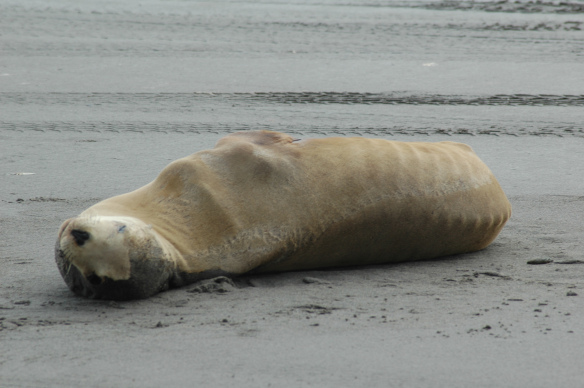 whose total pre-persecution numbers were never more than 300,000, have been driven below 100,000 and are still in decline. In Alaska, the Western segment of Stellars is down to a mere 18% of their historic numbers. Meanwhile, starved California sea lion pups are washing up dead on the beaches.
Sea lions are still being scapegoated, branded and shot, all for eating fish—the only food they have.

Text and Wildlife Photography ©Jim Robertson

Wildlife Photography ©Jim Robertson
Two new bills seek to underhandedly undermine voter-approved advancements for wildlife that set Washington apart from its anti-wildlife neighbors. Both the hound hunting of cougars and the baiting of black bears were banned by the citizenry of in Washington, but could once again threaten wildlife if these bills are passed. Please take action on these two Human Alerts:
A terrible bill has been introduced that will allow for the expanded hound hunting of cougars. This cruel and unsporting practice was rightfully outlawed by voters in 1996.
Under this proposal, counties can authorize a hound hunt based on public safety complaints of cougar sightings. The existing law already allows for citizens to protect themselves if they feel threatened by a cougar. Despite the fact that seeing a cougar does not constitute a threat and cougar kittens are extremely vulnerable to attacks by packs of dogs, proponents of the bill want to bring back the trophy hunting of cougars with hounds. This program was in place from 2004 until 2011, and resulted in widespread, guided recreational hound hunts offered by hunting clubs throughout eastern Washington.
TAKE ACTION
Please call your state senator today to stop this dangerous proposal. Look up your legislator’s phone number. You can say: “I am a constituent, and I am calling to ask you to please oppose SB 5940.”
After making your call (please do not skip that crucial step!), fill in and submit the form below to send a follow-up message. Legislators receive a lot of email; be sure to edit your message so it stands out.
Washington’s bears need your help from being shot over bait stations packed with greasy, sugary junk foods. Bear baiting is cruel and unsporting, and Washingtonians rightfully outlawed it in 1996.
A bill has been introduced that would allow any land owner or tenant to place a bait station on their property. Baiting stations, full of high-calorie junk food, lure bears in for an easy kill. While the bill sponsor wants landowners to kill bears who have caused damage to timber plantations and livestock, the truth is baiting attracts all bears. The result will be killing random bears, orphaning new born cubs, and unnecessarily putting people in dangerous proximity to human-food habituated bears.
After hibernation, bears are in a state of starvation because they have not fed for many months. Sadly, mother bears, who wake up with newborn cubs, are drawn to bait stations because they must urgently obtain thousands of calories for the whole family’s survival.
Mother bears may strip bark from trees to obtain sugary sap. While girdling trees has some negative economic consequences for the owners of industrial timber lands, the harm is small and can be mitigated. Likewise, livestock growers can employ many non-lethal solutions to prevent the minuscule threat of predation by bears on their domestic animals
Landowners who bait bears will create unwanted human-bear conflicts. That is because baits are covered in human scents, and bears will learn to associate baits with humans. When that happens, the neighbors of bear baiters may be exposed to human-habituated bears, and they can be dangerous. There is a reason why voters prohibited bear baiting almost 20 years ago.
TAKE ACTION
Please call your state representatives’ offices today, and urge opposition for SHB 1838.. Look up your legislators’ phone numbers. You can say: “I am a constituent, and I am calling to ask you to please oppose SHB 1838.”
After making your call (please do not skip that crucial step!), fill in and submit the form below to send a follow-up message. Legislators receive a lot of email; be sure to edit your message so it stands out.
See sample letters here: https://secure.humanesociety.org/site/Advocacy?cmd=display&page=UserAction&id=6771&autologin=true&s_src=sh_aa6771
Please contact your U.S. senators and ask them to oppose the Bipartisan Sportsmen’s Act of 2015, which seeks to open federal lands to killing, creating shooting ranges and more.


Human aggression “threatens to destroy us all.” — Stephen Hawking
During a tour of London’s Science Museum, professor Stephen Hawking said, “The human failing I would most like to correct is aggression. It may have had survival advantage in caveman days, to get more food, territory or partner with whom to reproduce, but now it threatens to destroy us all.”
He elaborated, “The quality I would most like to magnify is empathy. It brings us together in a peaceful, loving state.”
The suffering caused and reaped by those who inflict violence is obvious in the suicides of men returning from war. It spills over into alcoholism, drug addiction, domestic violence, and perpetual violence to innocent wild beings.
It seems obvious that none will kill their way to a sense of fulfillment or happiness.
As the power and resources of the state Department of Natural Resources are focused on expanding killing…
View original post 751 more words


