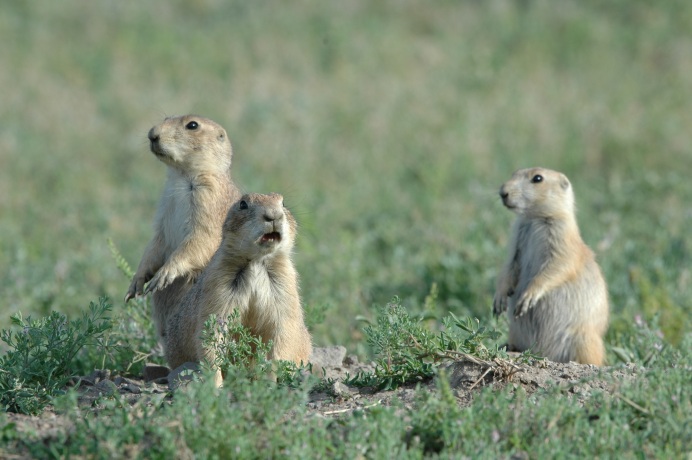
“Recreational Shooting Opportunities” Have Taken Their Toll

I combed hundreds of miles of what should be prime prairie dog habitat, scouring gravel back roads amid over-grazed cattle allotments and between functioning and defunct oil rigs, but found almost no sign of them. What I did find were prairie dog ghost towns and a lot of lonely, parched and denuded ground desperately in need of the vital cornerstone of the treeless grasslands.

Exposing the Big Game's avatarExposing the Big Game

Every place I have lived in the West, I’ve been fortunate enough to locate or stumble upon the rare or secretive creatures native to the locality, be they cougars, wolves, grizzly bears, lynx, otters, fisher, mink, pine marten, or badgers, even crossing paths with the shadowy wolverine on four separate occasions. So it was with confidence that I set out across eastern Montana and Wyoming in search of the amicable, diurnal rodents that call the prairie their home. Surely they must be thick out there. How hard could they be to ferret out? It’s not like I was searching for Bigfoot this time. 

I combed hundreds of miles of what should be prime prairie dog habitat, scouring gravel back roads amid over-grazed cattle allotments and between functioning and defunct oil rigs, but found almost no sign of them. What I did find were prairie dog ghost towns and a lot…

View original post 274 more words

Serial Killing for Shopping Malls

The Earth is being raped, strangled and left for dead by people who care only about themselves and what they can get in the short term. The suffering of others is inconsequential. Indeed, they pride themselves in their ability to disregard the cries and struggles of their targets, whom they objectify while denying their very sentience. Like psychopathic serial killers, they ignore the rights and welfare of their victims, intentional or incidental.

Text and Wildlife Photography ©Jim Robertson

Text and Wildlife Photography ©Jim Robertson

Killing Coyotes, Bobcats and Foxes for Fun and Profit

Killing Coyotes, Bobcats and Foxes for Fun and Profit


Dead coyotes in a cage on top of a truck at the West Texas Big Bobcat Contest

Standing in a West Texas sporting goods store parking lot on a recent Sunday morning, Margaret Lloyd felt like she’d wandered onto the set of a gory movie. The lot was packed with trucks full of dead coyotes, foxes and the occasional bobcat; one pickup had a cage welded to its bed, and it was crammed with carcasses. “It was one wave of fur, tails on top of ears and ears on top of tails,” she said. “It was just horrifying.”

Around back, participants in the West Texas Big Bobcat Contest were weighing their kill in a competition to see who had shot the biggest bobcat and the most coyotes, gray foxes and bobcats in a 23-hour period. Some $76,000 in prize money was at stake — more than $31,000 went to the team that bagged a 32 pound bobcat. Other jackpot winners were a four-man team that killed 63 foxes, a team that killed 8 bobcats, and another that killed 32 coyotes.

Photo of Geoff Nemnich of Coyote Craze with his sons

Lloyd, a retired lawyer who lives in Galveston, grew up in the South among hunters and says she’s not opposed to killing animals for food or to protect a herd.

“This is not hunting,” she said. “This is a blood sport, plain and simple.”

Contests like these — often called coyote calling contests, varmint hunts or predator hunts — have become popular events, especially in the Midwest and West. The website CoyoteContest.com lists 21 states with upcoming or recent killing contests, including Arizona, Idaho, Illinois, Indiana, Iowa, Michigan, Minnesota, New York, South Dakota and Utah.

The Big Bobcat competition in San Angelo, Texas started in 2008 with just 21 teams, but drew 380 teams to the contest last month. “They’re growing exponentially,” said Geoff Nemnich, a champion coyote hunter who is cashing in on the phenomenon. His website, Coyote Craze, exhorts visitors to “Feed Your Addiction” and offers videos of coyotes being dispatched by high-powered weapons, along with t-shirts that read “Coyotes Fear Me,” and depict dead coyotes hanging by their feet. “Almost every weekend you can find [a contest] somewhere within driving distance,” he said.

Dead coyotes at the West Texas Big Bobcat Contest

But as these contests proliferate, efforts to stop them are, too. In December, California Fish and Game Commission outlawed contests that award prizes for killing wildlife (the ban takes effect in April). Legislation to bar such contests passed the New Mexico state senate but died in the house. In Nevada, a petition to prohibit predator-killing contests is pending before the state Board of Wildlife Commissioners. And protesters blasting the events as indiscriminate slaughter have been demonstrating outside of contests and related events, like the Predator Masters convention in Arizona in January.

Wildlife defenders cite research that suggests killing adult coyotes may actually increase the population, since it allows more pups to survive. Predators like coyotes also fill an important role in the ecosystem by helping keep the population of rodents in check.

Jeremy Harrison, a fifth-generation rancher, organized the Big Bobcat contest in Texas. He said coyote contests do a public service by reducing the number of livestock predators and protecting the public from rabies. “This is not bashing baby seals in the head,” he said.

To those who are offended, he has simple advice: Butt out. “It’s none of their business. It has nothing to do with them,” he said. “It’s one of the best things about this beautiful state of Texas. We have 100 percent support from Texas and from the local people. If they don’t like it, they can just stay away from it.”

Opponents of these events call people like Harrison “thrill killers.” And there is a jarring sort of gleefulness that surrounds the slaughter — one Arizona group holds a Santa Slay hunt in December each year. Nemnich posts excerpts from his videos, which are sold at Cabela’s and similar stores, on YouTube. Set to stirring martial music, one sizzle reel shows coyote after coyote being called and then gunned down.

Photo of Margaret Lloyd

Nemnich, who said his videos portray hunting “in the best light possible”, encourages others not to post “distasteful” images because it will provoke animal rights groups or turn people who are neutral against hunting. “You don’t go and post a video of a coyote with his guts blown out on Facebook,” he said. “It just fuels the fire.”

Nemnich, who boasts on his website that two of his sons bagged their first coyotes at the age of five, said he gets a steady stream of hate mail. One message said his kids should be “gut shot” like the coyotes in the video. (“And I’m the barbarian?” he said.) He thinks the critics of coyote killing contests have a bigger agenda — to ban hunting altogether. “We’re killing animals for money and prizes. That’s the easiest way for them to get their foot in the door,” he said.

Both Nemnich and Harrison pointed out that the federal government kills thousands of coyotes each year. They said the U.S. Department of Agriculture’s Wildlife Services division uses much less “sportsmanlike” means, such as poisons and leg-hold traps.

Contests are completely legal, Nemnich said. “Some may consider it ethically wrong, but hunting has been around forever, it’s who we are out in this part of the country.”

Lloyd stopped to take pictures of the bobcat contest while driving from New Mexico back to Texas.

She said the spectacle was sickening, not a source of pride. With a breaking voice she said, “It was a sight and a situation that I’ll never shake for the rest of my life. I will never forget what I saw. A parking lot of absolute death at the hands of a civilized society.” She paused, and then corrected herself: “A supposedly civilized society.”

Photos of the winners of the West Texas Big Bobcat Contest, February 2014

Myron Levin and Stuart Silverstein contributed to this story.

Correction: An earlier version of the story incorrectly stated that the Santa Slay event is in New Mexico. It takes place in Arizona.

– See more at: http://www.fairwarning.org/2015/03/mowing-down-coyotes-bobcats-and-foxes-for-fun-and-profit/#sthash.uqKtzwU2.dpuf

Florida isn’t the only state trying to shut down discussion of climate change

 http://www.vox.com/2015/3/10/8182513/florida-ban-climate-change

In a growing number of states, conservatives have been taking a rather novel approach to climate change — simply prevent people from talking about it.

Florida state employees say they were barred from using the term “climate change”

There’s a big uproar in Florida this week after an investigation alleged that the state has an unwritten policy barring environmental officials from using the terms “climate change” or “global warming” in their work. On Monday, Republican Governor Rick Scott denied any such policy was in place. But state employees and outside scientists insist there’s heavy pressure not to talk about the topic, despite the fact that Florida faces a serious threat from future sea-level rise.

If so, that wouldn’t be the first time state officials — Republicans, usually — have taken steps to prevent people from discussing global warming or climate science.

In 2012, North Carolina’s GOP-controlled state legislature passed a law to prevent the state from considering the most up-to-date climate science in formulating predictions of rising seas. In Pennsylvania in 2014, back when Republican Tom Corbett was governor, one former state employee alleged that she was ordered to remove references to “climate change” from the conservation agency’s website.

In a somewhat different vein, states like Tennessee and Louisiana have been passing laws making it easier to teachers in the classroom to present alternative theories to climate change — even though there’s a broad and firm consensus among climate scientists that human activity is responsible for the rise in global temperatures over the last 50 years.

More: http://www.vox.com/2015/3/10/8182513/florida-ban-climate-change

The Indonesian Government: Shut down Surabaya Zoo

SIGN THIS PETITION
 https://secure.avaaz.org/en/petition/The_Indonesian_Government_Shut_down_Surabaya_Zoo/?sbmZYeb
The Indonesian Government: Shut down Surabaya Zoo
7,500
5,690

5,690 signers. Let’s reach 7,500

Why this is important

The conditions the animals are kept in at Surabaya Zoo are bleak, cruel, and completely inadequate. Many animals are sick and starving, and dozens die every month from bad or inappropriate food, cramped conditions with little to no enrichment, unsuitable environments, forced restraints, poor veterinary attention, and a general lack of animal welfare.

http://www.telegraph.co.uk/earth/earthpicturegalleries/9140708/Surabaya-Zoo-animals-kept-in-scandalous-conditions-at-Indonesias-largest-zoo.html

http://www.theguardian.com/world/2013/sep/26/orangutan-die-surabaya-zoo-indonesia

Please support the closure of this zoo, and the relocation of its animals to better facilities in properly managed and funded sanctuaries, where they can be given the full care and treatment that they need and deserve.

Posted December 27, 2013

Activists continue fight for prairie dogs

Wildlife Photography ©Jim Robertson

Wildlife Photography ©Jim Robertson

by Mike DiFerdinando  3/2/15

Group explores options to protect wildlife from future development

As protesters stood at Founders Parkway and Factory Shops Boulevard — waving signs and shouting at drivers to help save the prairie dogs — a few hundred yards behind them exterminators were already laying traps.

The grass-roots campaign, called Save the Castle Rock Prairie Dogs, wants to push back the construction of the Promenade at Castle Rock, at the north end of town between I-25 and U.S. Highway 85, near the Outlets at Castle Rock, until June.

That’s when the animals, many of them pregnant, could be moved. The prairie dogs are being trapped with baited cages. It is unknown how or if they are being killed at this time.

“Of course I was at the protest,” said Castle Rock resident Keith Lattimore-Walsh, one of about 40 protesters at the Feb. 24 rally. “My heart won’t allow me to do anything less than to fight for those who cannot speak.”

The controversy is part of the town’s continued conversation about growth and began when more than 20 residents spoke out against the Promenade at the Feb. 17 council meeting.

Activists said they hope snowy conditions and the slow pace of capture will give them time to find available land for relocation of the colony — about 1,000 prairie dogs.

“It’s slow, they aren’t capturing many at a time,” said Brian Ertz, board president of the activist organization the Wildlands Defense.

Alberta Development Partners, the developer behind the Promenade, could not be reached for comment about the removal of the prairie dogs, despite repeated attempts by the News-Press.

Town officials reiterated their stance that the situation is a matter of a private developer building on private land, therefore they have no jurisdiction to stop or delay construction.

This would be different if the prairie dogs were protected by state law, which they aren’t, because they are not an endangered species. [Not officially, buy they should be on the list–I challenge anyone who says prairie dogs are still common throughout the state.]

More: http://castlerocknewspress.net/stories/Activists-continue-fight-for-prairie-dogs,182035

Wolf Pack Caring For Their Four Little Ones…

Nabeki's avatarHowling For Justice

Time for an uplifting video of a wolf pack caring for their week old pups. They have their hands full! Momma wolf is fighting a losing battle trying to keep them in the den…lol

Enjoy! ❤

===

Video: Courtesy YouTube greenbunting

Posted in: gray wolf pups, biodiversity

Tags: wolf pups, wolf pack, caring for tiny pups, beautiful wolves

View original post

Urge Colorado Developer to Halt Prairie Dog Massacre!

http://www.peta.org/action/action-alerts/colorado-developer-halt-prairie-dog-massacre/

cute-prairie-dog
Poisoning and fumigation—the most common methods of killing prairie dogs—cause convulsions, vomiting, internal bleeding, gradual pulmonary and cardiac collapse, and a variety of other reactions that cause animals immense suffering and a slow, agonizing death. Yet developers of The Promenade at Castle Rock, a 160-acre mall project underway in the town of Castle Rock, Colorado, reportedly want to massacre hundreds (possibly thousands) of these animals who call the site’s open spaces and wetland areas their home. And despite an outcry from compassionate citizens, the Castle Rock Town Council has green-lighted this slaughter, which is scheduled to occur in the coming weeks. Your voice is needed!

Using the form below, please politely urge Alberta Development Partners and Castle Rock officials to halt this cruel killing initiative and to employ humane prairie dog control methods instead. And please forward this message widely!

Please send polite comments to:

Peter Cudlip, Principal
Alberta Development Partners
pmc@albdev.com

Castle Rock Town Council
TownCouncil@CRgov.com

Please feel free to use our sample letter, but remember that using your own words is always more effective.

Pacific Plastic Threatening Wildlife

http://action.storyofstuff.org/sign/pacific-plastic-epa-superfund

The massive amounts of plastic in the ocean are threatening to kill off Hawaii’s endangered seals and sea turtles on remote Pacific islands.The Great Pacific Plastic Patch is becoming an enormous threat to sea life, and the EPA is considering declaring the remote island of Tern Island an environment disaster area.
This crisis gives us an incredible opportunity — if the EPA designates the island a Superfund site, it could mean taking the first real steps to schedule clean-up of oceanic plastic. Not only would this protect the thousands of species — a fourth of which are found in no other place on Earth — it would also put significant resources into tackling one of the greatest threats to our oceans and could become a model for tackling plastic polluting our oceans worldwide.
A high concentration of plastics from global sources has accumulated in the Northwestern Hawaiian Islands, threatening many endangered species. Designated Papahanaumokuakea National Monument in 2006, this 1,200-mile chain of scattered islands and atolls is home to more than 7,000 incredible marine species, and is one of the first ecosystems being serious threatened by the Pacific Plastic Patch.
 
Tern Island and its surrounding atoll, French Frigate Shoals, are designated as critical habitat for Hawaiian monk seals, whose total population of 1,200 has been steadily declining in the northwestern islands. It’s also nesting habitat for 95 percent of threatened Hawaiian green sea turtles. Unless the problem with plastic pollution is addressed, these fragile seal and sea turtle populations may be destroyed altogether.
Resources:
The Center for Biological Diversity: Historic Step Toward Superfund Designation Could Save Ocean Wildlife From Plastic Pollution in Hawaii, Septermber 9, 2014