Elephant kills professional big game hunter in Zimbabwe

10671222_10202527690853624_1897035803926677117_n

Professional hunter tracking a lion for American client crushed to death by young bull elephant in Zambezi Valley

By Peta Thornycroft, Johannesburg

17 Apr 2015

A young bull elephant killed professional hunter Ian Gibson early on Wednesday as he tracked a lion for an American client in a rugged part of north-east Zimbabwe.

Mr Gibson, 55, one of Zimbabwe’s best known big game hunters, died scouting for prey in the Zambezi Valley after a young bull elephant charged, then knelt on him and crushed him to death.

“We don’t yet know the full details of how ‘Gibbo’ as we called him, died, as the American client and the trackers are still too traumatised to give us full details,” said Paul Smith, managing director of Chifuti Safaris’ which employed Mr Gibson for the hunt.

The American hunter was on his first trip to Zimbabwe, and only has one leg, but was “fit and strong” and had already shot a leopard. Mr Gibson was scouting for lions when he encountered the elephant.

Mr Gibson’s trackers said the young bull had been in a musth period, which means it was producing much more testosterone then usual.

“We know ‘Gibbo’ shot it once, from about 10 yards away, with a 458 [rifle]. He would never have fired unless he had no alternative. He was a hunter, yes, but he was also a magnificent wildlife photographer and conservationist.

“He was so experienced and this is a most unexpected tragedy.” …

Mr Smith said the young bull elephant appeared not to be a natural target for any hunter as its tusks were too small.

“In most years someone is usually killed on a hunt somewhere in Africa, and that is why it is called ‘dangerous game hunting‘ but we are very shocked that it was ‘Gibbo’,” said Mr Smith.

Mr Gibson began his wildlife career in Zimbabwe’s department of national parks, but left to become a hunter about 25 years ago.

He was well-known in the US, where the Dallas Safari Club is paying his funeral expenses.

More: http://www.telegraph.co.uk/news/worldnews/africaandindianocean/zimbabwe/11546066/Elephant-kills-professional-big-game-hunter-in-Zimbabwe.html

Men and Women Who Hunt Animals Are “Equally Vile”

http://www.usmagazine.com/celebrity-news/news/ricky-gervais-men-and-women-who-hunt-animals-are-equally-vile-2015184#ixzz3XmWp7ZFo

Ricky Gervais Says Men and Women Who Hunt Animals Are “Equally Vile” AfterPoacher-Hunters-6 Rebecca Francis Claims He’s Targeting Women

Celebrity News Apr. 18, 2015 AT 1:20PM

He’s just getting started. Ricky Gervais continued to slam hunters following his buzzed-about spat with Eye of the Hunter co-host Rebecca Francis. His new comments are in

“We need to stamp out this terrible sexism in the noble sport of trophy hunting,” he tweeted on Friday, April 17. “The men & women that do it are EQUALLY vile &  worthless.”                                  [except for the woman in the photo above–she hunts poachers.]

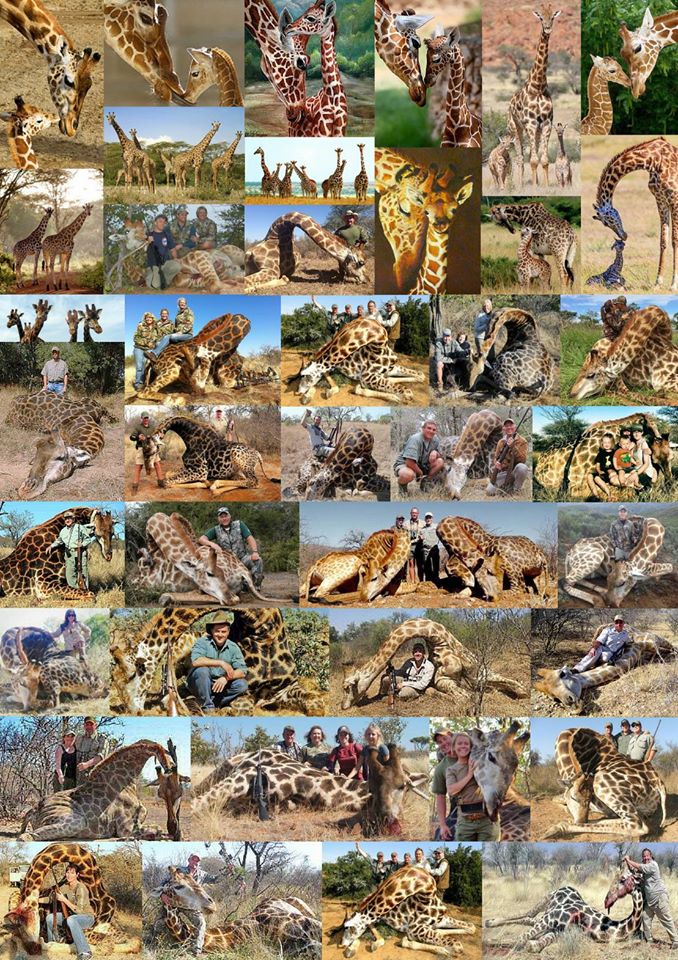
The British comedian-actor, 53, was appalled earlier this week when he saw a photo of Francis lying down – and smiling – next to a dead giraffe she just killed. “What must’ve happened to you in your life to make you want to kill a beautiful animal & then lie next to it smiling?” he wrote via Twitter on April 13.

PHOTOS: Celebs and their pets

Francis began to receive death threats following Gervais’ post, which has garnered over 30,000 retweets. On April 14, Francis released a statement saying she preserved the animal by providing locals with its meat. On Friday, she gave a second statement to Hunting Life.

“Ricky Gervais has used his power and influence to specifically target women in the hunting industry and has sparked thousands of people to call for my death, the death of my family and many other women who hunt,” she said, via The Telegraph. “This has evolved into an issue about the morality of threatening human lives over disagreeing with someone else’s beliefs. It shocks me that people who claim to be so loving and caring for animals can turn around and threaten to murder and rape my children.”

PHOTOS: Celebs fight back on Twitter

Gervais, however, doesn’t seem to be backing down. He’s continued to show his love for animals all week. “Enjoy the lovely weather and don’t leave your dog in the car. Have a great day,” he tweeted on April 17. On Friday, he gushed about his adorable “furry bagpipe” cats and snapped a selfie with his “new duck friends” near a lake.

Read more: http://www.usmagazine.com/celebrity-news/news/ricky-gervais-men-and-women-who-hunt-animals-are-equally-vile-2015184#ixzz3XmRYOAMn
Follow us: @usweekly on Twitter | usweekly on Facebook

Also See: http://www.huffingtonpost.com/2015/04/17/vet-kristen-lindsey-kills-cat-with-arrow_n_7090630.html

Hunter Ian Gibson Trampled To Death By Elephant He Was Tracking To Kill For Ivory

http://www.huffingtonpost.co.uk/2015/04/17/hunter-ian-gibson-trampled-death-elephant-tracking-kill_n_7085374.html?ncid=fcbklnkushpmg00000063

A professional game hunter has been trampled to death by an elephant he was attempting to kill.

Ian Gibson was leading a hunt in Chewore North in the lower Zambezi Valley of Zimbabwe, when the bull elephant “began a full charge. ”

In an online note on the website of his employers Safari Classics, the company explained Gibson had been tracking the elephant for five hours with a client when they stopped for a rest.

ian gibson

Ian Gibson was killed by a charging African bull elephant

It adds: “Feeling he was quite close to the elephant, Ian and his tracker Robert continued to follow the tracks in hopes of getting a look at the ivory as the client stayed with the game scout.”

SEE ALSO:

Gibson’s tracker indicated the elephant was in “musth” – a condition where the animal’s urge to mate goes into overdrive and it becomes overly aggressive, but Gibson continued.

The note continues: “They eventually caught up with the bull, spotting him at about 50-100 metres. The bull instantly turned and began a full charge.

bull elephant zimbabwe

The animal was in a state of ‘musth’ making it aggressive (file picture)

“Ian and Robert began shouting in order to stop the charge. At very close range, Ian was able to get off one shot before the bull killed him. The scene was very graphic.”

It is not known if the animal was injured or killed in the incident.

Gibson is paid tribute to as “a fine man and one of the most experienced professional hunters on the African continent.”

The same company lost a staff member in 2012 when Owain Lewis was killed by a buffalo, NewZimbabwe reports.

Mystery blob in the Pacific messes up US weather and ecosystems

Thousands of seabirds called Cassin’s auklets have been found dead along the Pacific shore, and conservationists have had to rescue scores of starving sea lions on beaches in southern California.

http://www.newscientist.com/article/dn27362-mystery-blob-in-the-pacific-messes-up-us-weather-and-ecosystems.html#.VTFO22d0y1t

16 April 2015 by Eli Kintisch

An unusual threat is looming off the Pacific coast of North America from Juneau in Alaska to Baja California. Now roughly 2000 kilometres wide and 100 metres deep, a mass of warm water that scientists are calling “the blob” has lingered off the coast for a year and a half and has set temperature records, with waters between 1 °C and 4 °C warmer than normal.

Fresh research published in Geophysical Research Letters has examined the causes and impacts of this area of water, which has grown more recently.

The blob has changed water-circulation patterns, affected inland weather and reshuffled ecosystems at sea. Although scientists say the planet’s warming oceans may not be responsible for the mysterious and long-lived anomaly, some see it as an early warning of changes that might be coming to the Pacific in the next few decades.

Satellite imagery first alerted scientists to the strange formation in August 2013, when the roundish blob was seen over the Gulf of Alaska. Researchers think that a long-lasting weather pattern called a high-pressure “ridge” deflected winds that stir up cool waters from the deep and bring cool air and water from high latitudes.


<a href=”http://ad.doubleclick.net/N6831/jump/NewScientist/ns_section_environment;key=environment+dn27362+nologin+News+blob+Pacific+US+thunderstorms+salmon+sea-lions+marine-ecosystem+Pacific-Decadal-Oscillation+climate-change;tile=7;sz=450×250;ord=1234567890?”><img src=”http://ad.doubleclick.net/N6831/ad/NewScientist/ns_section_environment;key=environment+dn27362+nologin+News+blob+Pacific+US+thunderstorms+salmon+sea-lions+marine-ecosystem+Pacific-Decadal-Oscillation+climate-change;tile=7;sz=450×250;ord=1234567890?” /></a>

Unusually warm sea-surface temperatures are being observed in the North Pacific. The darker the red colouring, the more above average the temperature (Image: NOAA)

Months later, fishermen and officials around Alaska reported sightings of species found in more temperate or even tropical waters, including skipjack tuna, thresher sharks and sunfish. Other marine species showed up thousands of kilometres north of their normal ranges, including pygmy killer whales and tropical species of copepods – tiny crustaceans that are key to marine food webs.

“I’ve never seen some of these species here before,” says plankton expert Bill Peterson of the Northwest Fisheries Science Center in Seattle, Washington – part of the National Oceanic and Atmospheric Administration.

Spreading warmth

The anomaly has spread out over the last 12 months, with warm water showing up all the way from Alaska to the central Mexican coast. Physical oceanographers have speculated that the blob is influenced by a major climate pattern known as the Pacific Decadal Oscillation (PDO), a combination of several phenomena that have the effect of warming water across the eastern Pacific for periods of 4 to 20 years.

Yet the patterns of warming seem to be different this time round, says oceanographer Mark Ohman of Scripps Institution of Oceanography in San Diego, California. “This is a phenomenon beyond the typical PDO-like oscillations we’ve seen for the recent decades,” he adds. “I’m in a state of confusion.”

Inland, the blob contributed to a number of unusual weather events along the Pacific Northwest last summer, including an uptick in thunderstorms and lightning – and the resulting forest fires.

But the biggest impacts so far have concerned marine species. Peterson fears that a big drop in copepod populations in waters off the Pacific Northwest could doom harvests of various species of salmon – a multibillion-dollar industry – for years to come. “They had nothing to eat,” he says of juveniles that ventured out from rivers into the blob last year.

Thousands of seabirds called Cassin’s auklets have been found dead along the Pacific shore, and conservationists have had to rescue scores of starving sea lions on beaches in southern California.

Journal reference: Geophysical Research Letters, DOI: 10.1002/2015GL063306

Also See: http://www.grindtv.com/wildlife/wind-sailors-litter-west-coast-beaches/#6kzccAsk8UihaDOz.97

The Gravest Problem Animals Face: Man’s Self-Appointed Supremacy Over Them

1451324_650954518277931_1616731734_n

“Time is running out” (A final message from John A. Livingston)

The following thoughts appear in the last chapter of the late John A. Livingston’s 1973 book, One Cosmic Instant; Man’s Fleeting Supremacy (a book I can especially relate to in that it dissects and begins to dismantle the entrenched, arrogant attitude that humans are apart from, and even superior to, the rest of life here on Earth). Livingston begins by comparing this complex, arrogant, human attitude to an ecosystem:

“In their natural environment, living beings face an infinity of survival problems—food shortages, predators, diseases, competitors, population stresses, and so on. The gravest problem they now face, however—man’s self-appointed supremacy over them—is strangely like an ecosystem. It has a vast and complicated array of interlocking components…

“As any naturalist knows, the quickest and neatest way to destroy an eco-system is to simplify it, to reduce its complexity and thus short-circuit the equilibrium maintained by the mutual interdependence of its component parts. Perhaps the traditional, cultural, institutional, conceptual eco-construct can be decomplexified by our deliberate manipulation—by the exercise of our conscious choice. Intervention in its workings will require degrees of courage, sacrifice, imagination and generosity which have not frequently been displayed in the course of man’s relationship with his environment. One hesitates to predict whether we will be willing to undertake it. The destruction of the power hierarchy over nature will require a shift in attitudes more profound than we can presently imagine.

“The process of simplification or decomplexification will be drastic. Suppose one were to elect to have an initial go at the “rights of man”—the God-given rights of man the individual and man the species. Suppose it were feasible to actually remove some of those rights, one after the other. The consequences might be astonishing… Environmental forces are already ‘eroding’ traditional rights.

“Then there is the right to have children. Suppose people were no longer permitted to reproduce beyond the replacement level. Replacement level means one adult, one child—zero population growth…The environmentalist must look hard at traditional human freedoms.

“There are other ‘rights’ such as the imagined right of man to kill non-human animals for amusement. Clearly the environment itself will deal with this tradition, simply as the effect of men having joyfully massacred so many ducks, geese, rhinos, elephants and Cape buffaloes that there will not be enough of them to go round. A similar end will come to the fashion industry’s apparent determination to exploit to the bitter end the final stocks of leopard, tiger, jaguar, and the rest.

“What of the more fundamental, unquestioned rights of man the species? The right to populate at will must certainly be removed, either by our own conscious choice or by a natural backlash on the part of the biosphere itself. The right to dominate animals of other species, and to dominate landscapes, will not be subverted as readily. Other beings, as species and as landscapes, do not have the ‘clout’ of the combined forces of the biosphere. But that right, too, will disappear. It will be a sad process, for we will not give up the right to dominate without a struggle—a struggle which will cost both human and non-human nature exorbitantly.

“It will not be in our best interests to allow the environment to dismantle our conceptual power structure for us. In such an eventuality, cosmic forces would make life devastating. We should not expect the environmental counter attack to be nearly so dramatic or spectacular as the ancient vision of the Apocalypse, but it would be equally disastrous. Because it would not be sudden, it would be even more agonizing…

“Time is running out for the dismantling of the institutions which have kept us so grimly locked in step with ‘progress.’ There is even less time for reflection on the merits of the traditional components of our culture which have brought us—and all of nature—to the present point of departure. A point of departure it is, either from the narrow and egocentric culture course we have adopted, or premature departure from the blue planet itself. If we are not capable of identifying the specific threads in the fabric of our beliefs which have sustained the entire tapestry upon which the myth of human dominance is emblazoned, then it may be too late already.

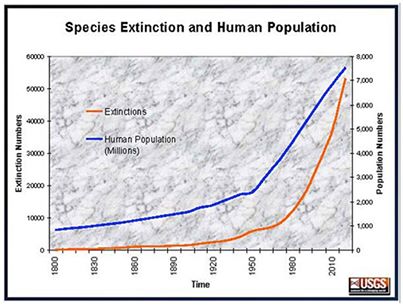
“The hope for survival of non-human nature is dim. There is a familiar scenario. As conditions worsen for human populations—as they will, initially, in underprivileged parts of the world—every ounce and erg of our most refined technological skills and energies will be brought into play to extract from Earth and its non-human inhabitants the basic ingredients for human survival. We will first destroy all of the larger animals, either for meat or because they compete with us for space, together with those which may be intolerant of our activities because of their specific natural specializations. Extinctions of non-human species, without replacement, will continue at an accelerating rate, until the only non-human beings remaining will be those who are willing to share their squalor with us—rats, gutter curs, and parasites and micro-organisms which thrive in time environmental dislocation.

“Our capacity for seeing into the future—and we do not want to know about futures of that kind. We withdraw behind the opaqueness of closed imaginations and familiar fancies. We acknowledge that, yes, the situation is bad, but human ingenuity, creativity, enterprise and good will overcome all difficulties.

“While we should be unravelling the threads of tradition, we are weaving ever more elaborate curtains of rationalization. Every avenue of questioning closed off is another route to intellectual and spiritual freedom barricaded forever.

“There is no engineering answer to a problem created by culture. The worst in humanistic ways of thinking opened and kept open the conceptual man/nature dichotomy, and only mature wisdom and insight that categorize the best in natural philosophic tradition can mend it.”

Hunter Killed by Bull Elephant!

http://africageographic.com/blog/hunter-killed-bull-elephant-musth/

Ian Gibson, a professional hunter for Chifuti Safaris, was killed by an elephant bull while guiding an elephant hunt in Chewore North in the lower Zambezi Valley. 

Ian Gibson hunter

A message shared on africahunting.com by Safari Classics said:

“It is with deep sadness to announce the passing of Chifuti Safaris professional hunter Ian Gibson. Ian was tragically killed by an elephant bull earlier today while guiding and elephant hunt in Chewore North (lower Zambezi Valley).

The details are just starting to emerge as we write this. However it appears that Ian and his client had been on the tracks of an elephant bull for approximately five hours when they decided to take a break and allow the client to rest. Feeling he was quite close to the elephant, Ian and his tracker Robert continued to follow the tracks in hopes of getting a look at the ivory as the client, stayed with the game scout to rest. Robert indicated the bull was in musth. They eventually caught up to the bull, spotting him at about 50-100 meters. The bull instantly turned and began a full charge. Ian and Robert began shouting in order to stop the charge. At very close range, Ian was able to get off one shot before the bull killed him. The scene was very graphic.”

– See more at: http://africageographic.com/blog/hunter-killed-bull-elephant-musth/#sthash.u6QkEGCu.dpuf

Sign on Letter to Congress

Sign on date by Friday April 17th

Attachments report and letter and list of signatures to date

Hello friends and colleagues,

Some of you have helped me in the past by signing onto a letter to request a ban on carnivore hunting in the National Seashore. I am writing again to ask for your help in signing another important letter.

As you know, federal protection for Wyoming wolves was restored September 2014. Then in December 2014, federal protections for wolves in the Great joh States was restored through judicial  action (HSUS v. Jewell).  In response to the decisions, two separate bills have been introduced: The Western Great Lakes Wolf Management Act (HR 843), introduced by Representative John Kline (R MN) now has 11 co-sponsors and Reissuing Final Rules Regarding Gray Wolves in the Western Great Lakes (HR (884) introduced by Representative Reid Ribble (R WI) now has 11 co-sponsors.

We have every reason to fear these bills since a bad precedent was set in 2011 when federal protections for wolves was removed through Congressional intervention in the Western states when legislation was attached as a rider to the “must pass” budget bill.  It could happen again.

Although several sign-on letters have been circulated, this one is different as it asks for a NO vote for each of the two bills but also offers two alternatives: 1) the HSUS petition to downgrade wolves from endangered to threatened and 2) to ask Congress to do some real work and use the Bruskotter/Vucetich Framework for Recovery as a start to address ambiguities in the ESA.

We are asking that you sign on to the attached document by submitting:

YOUR NAME

YOUR ORGANIZATION + ONE LINE SUMMARY OF EITHER YOU IF SIGNING AS AN INDIVIDUAL OR BUSINESS OR ORGANIZATION

CITY& STATE

YOUR EMAIL (Your email will not be included in the document, it will only be used in case we need to contact you)

DO NOT PUT YOUR NAME IN THE DOCUMENT, WE WILL DO THAT.  DO NOT ALTER THE DOCUMENT, IF YOU SEE AN ERROR, NOTIFY US.

SEND TO louise@kaneproductions.net BY Friday, APRIL 17 , 2015

We plan to send the letter with all the signatories to members of Congress, their aids and USFWS along with Secretary Jewell when Congress returns from spring break.

Below is the link to the document (if you need a link to share) that is on the carnivore conservation act website.

http://www.carnivoreconservationact.com/wp-content/uploads/ReportCongressAgainstHR843and884_2.pdf

Please distribute this message to colleagues and/or organizations or businesses that would be willing to sign. Our goal is to get a minimum of 150 signatories.  Please be one!

copyrighted wolf in river