Exposing the Big Game

Forget Hunters' Feeble Rationalizations and Trust Your Gut Feelings: Making Sport of Killing Is Not Healthy Human Behavior

Exposing the Big Game

Trapping, the barbaric “sport”

Wolf Advocates Warn U.S. Fish and Wildlife Service of Coming Lawsuit
When the Montana FWPs is offering five tags to every wolf hunter and Idaho Fish and Game is putting sharpshooters in the Frank Church-River of No Return Wilderness and funding aerial gunning in the Lolo Zone, we feel renewing protection is needed
**Extra Links Included** ‪#‎SaveWolves‬
Animals (tags: endangered, Wolves, Idaho, Trappers, Bantraps, SaveWolves, wildlife, slaughter, killing, law, cruelty, animals, AnimalWelfare, abuse, habitat, environment, protection, humans, investigation, conservation, crime, death, sadness, society, suffering, wildanimals )
http://www.care2.com/news/member/123562948/3964602

Wolf advocates warn U.S. Fish and Wildlife Service of coming lawsuit

Montana Fish Wildlife and Parks
Wolves from the Welcome Creek pack prowl the Sapphire Mountains south of Missoula in this Montana Fish, Wildlife and Parks photo from 2011. Research over the past 10 years shows that non-lethal techniques and aggressive early response to livestock killings can effectively manage wolves.

A coalition of wolf advocates has warned the U.S. Fish and Wildlife Service that they plan to sue if the agency doesn’t extend its supervision of wolf populations in Montana and Idaho another five years.

“When the Montana Fish, Wildlife and Parks is offering five tags to every wolf hunter and Idaho Fish and Game is putting sharpshooters in the Frank Church-River of No Return Wilderness and funding aerial gunning in the Lolo Zone, we feel renewing another five years of federal monitoring is warranted,” said Matthew Koehler of Missoula-based Wild West Institute, one of five groups putting FWS on notice. “Given the situation on the ground and the ways state policy is changing, we think the prudent thing to do is keep monitoring wolf populations so they’re not hunted and trapped back to the brink of extinction.

The Center for Biological Diversity, Western Watersheds Project, Friends of the Clearwater and Cascadia Wildlands joined Wild West Institute in the notice. By law, groups objecting to a federal agency must give it 60 days advance warning to offer time to craft a solution before going to court.

Gray wolves were extirpated from the continental U.S. in early 20th century. The Fish and Wildlife Service reintroduced wolves in remote areas of Idaho and Yellowstone National Park in 1994 and 1995. The wolves were protected under the federal Endangered Species Act until 2011, when Congress passed a provision removing their listed status in Idaho and Montana. However, FWS personnel were required to monitor wolf populations for five years after giving state wildlife agencies local control of the species.

Wolves remain a federally protected species in Wyoming, Washington, Oregon and the Great Lakes region. Congress is considering several provisions to change or remove those protections this year.

In early January, Idaho Department of Fish and Game workers improperly collared two wolves in the Frank Church-River of No Return Wilderness along the Montana border while carrying out a helicopter-assisted elk-collaring project. The agency reported the incident to the U.S. Forest Service, which suspended Idaho’s permission for further helicopter work in the wilderness pending a review of the state’s practices.

Idaho has also maintained a state-sponsored wolf-removal program in addition to a public wolf hunting season.

In Montana, resident hunters may buy up to five wolf licenses a season for $19 each. The state removed its annual quotas on wolf seasons in 2012.
https://exposingthebiggame.wordpress.com/…/wolf-advocates-…/

56cf4cdeb817c.image
.
Trapping, the barbaric “sport”
By George Wuerthner

Years ago I was backpacking in Aravaipa Canyon Wilderness with my friend, Rod, and his Malamute, Jake. Like most dogs, Jake was happily running ahead of us investigating this and that. Suddenly Jake let out a sharp cry and began yipping from someplace up ahead in the brush. We rushed to him to find with his leg snared in a giant leg-hold bear trap set by a deer carcass. This trap was the size of a car tire. We desperately tried to free him from the trap, but even with the two of us trying to open the contraption, the springs were just too stiff and we couldn’t get Jake’s leg out. So Rod and I took turns carrying 100 pound Jake on our shoulders, along with the heavy trap plus our backpacks, to our car so we could rush him to a vet.

The vet had to get a special trap opener to compress the springs so we could open the jaws enough to remove Jake’s leg. Jake was lucky. Because the trap’s teeth were so large, Jake’s leg was caught wedged between the teeth instead of having it go through his leg. He fully recovered from the experience. But most pets and nearly all wildlife are not so lucky.

There was no sign indicating the presence of the trap, nor any other effort to warn people of the lurking danger. Had either one of us stepped into the track, we might have suffered serious damage. Unfortunately the trapping of wild animals is a legal activity in all of the United States. In fact, I am not aware of a single state “wildlife” agency that doesn’t promote trapping, instead of questioning its legitimacy. It’s amazing to me that in this day and age we still allow this barbaric activity to be justified in the name of “sport”. Leg-hold traps and snares are particularly treacherous devices. Animals caught in such traps suffer pain, exposure to weather, dehydration and often a long painful death. Snares are even more gruesome with animals slowly strangling to death as the wire noose tightens. How is it that cock and dogfights are now illegal and yet we permit state wildlife agencies to sanction an equally cruel activity?

The statistics are astounding. More than 4 million animals are trapped for “fun” each year, many enduring immense suffering in the process. Millions more are trapped as “nuisances” or die as “non-target” animals. For example more than 700 black bear are snagged each year in Oregon as “nuisance” animals by timber companies (because in the spring bears eat the inner cambium layer of trees).

Only a few states have banned the use of leg-hold traps for sport trapping and then usually only through citizen initiative process. Yet 90 countries around the world have banned these traps and the entire European Union has banned these contraptions. Most trapping targets “fur bearer” animals like lynx, musk rat, beaver, marten, fisher, river otter, weasel, mink, bobcat, red fox, coyote, and bears, and in some states like Idaho and Alaska, trappers also take wolves. Most of these animals are important predators in their own right, and help to promote healthier ecosystems in many, many ways from the way that wolves reduce the negative impact of large herbivores like elk to reduction of rodent populations by coyotes. Thus indiscriminate trapping disrupts natural ecological processes, often in ways we don’t appreciate.

And while most trappers might scoff at the idea, their “enjoyment” of trapping comes at the expense of the pleasure of other wildlife lovers who might rather see a red fox scampering across a field, a river otter swimming in a stream or hear a coyote howling in the night than see it’s skinned and fur used for frivolous purposes like clothing—we have other alternatives to fur.

The major arguments used by trappers to defend the legitimacy of their “sport” can largely be refuted. One argument is that trapping promotes family time, learning about nature and gets people outdoors. However, there are many other ways to spend time together as a family, learn about nature or to get outdoors that does not involve traumatizing animals.

Another argument is that if we don’t kill the animals, they will overpopulate and die of starvation and/or disease. If you believe this line of self-justification, trappers are really acting out of a sense of mission, responsibility and kindness by killing animals to save them from a greater misery. Beyond the obvious rationalization of such assertions, a problem with this logic that not all animals, or animals in all places are in jeopardy of overpopulation. And trapping doesn’t necessarily remove the animals that are most likely to die from these natural events.

A third justification often heard in trapping circles and from state wildlife agencies, is trapping helps to remove “problem” animals—beaver that clog up culverts or coyotes preying on livestock. There are numerous issues with this line of reasoning. The first is that trapping, as practiced by most “sport” trappers, is indiscriminate. They are not taking the specific animals that may be “problematic”. Most trapping is random, killing any animal unfortunate enough to wander into a trap.

Beyond that, because agencies like to promote trapping (some like Wildlife Services entire existence is dependent upon having “problem” animals to kill) there is little incentive to educate or even regulate the public so that conflicts are not created in the first place. In many cases, the “problem” is “problem humans”. So livestock producers who fail to adequately monitor their animals and utilize guard animals along with lambing/calving sheds, have more issues with coyotes. Honey producers who do not use electric fences around their beehives have issues with bears. And so on.

Not every instance can be alleviated by some creative action by humans, but in most case we don’t even try because neither the government wildlife agencies nor the trappers want solutions other than trapping and the broader excuse for trapping that they believe these so called “problems” justify. In those instances, where changing human behavior fails to reduce conflicts, we may have no choice but to rely upon the surgical removal of “specific” animals, not the wholesale killing of any animal that happens to have a fur coat. And such removal should be done in the most humane way possible.

http://www.friendsoftheclearwater.org/trapping-the-barbari…/
.

Idaho must alter lynx trapping, court says

TUESDAY, JAN. 12, 2016, 1:10 P.M.

By Rich Landers

http://www.spokesman.com/blogs/outdoors/2016/jan/12/idaho-must-alter-lynx-trapping-court-says/

Canada lynx. (U.S. Fish and Wildlife Service)

WILDLIFE — In a lawsuit filed by animal protection groups, a federal judge has ruled that Idaho’s regulations for trapping furbearers in North Idaho violate the Endangered Species Act by allowing the inadvertent capture of federally protected Canada lynx.

Here are details from the Associated Press:

The 26-page decision made public Monday in U.S. District Court requires Idaho to propose a plan within 90 days that protects lynx in the Panhandle and Clearwater regions.

“We hope Idaho will now recognize that these rare and beautiful animals need more protection than the state has been willing to grant them,” Andrea Santarsiere, an attorney with the Center for Biological Diversity, said in a statement.

The Center, the Western Watersheds Project, Friends of the Clearwater and WildEarth Guardians filed the lawsuit in June 2014 asking that lethal body-crushing traps and snares be made illegal. The groups also want to limit the size of foothold traps in lynx habitat and require daily checks of traps.

Named in the lawsuit are Idaho Gov. C.L. “Butch” Otter, Idaho Department of Fish and Game Director Virgil Moore, and members of the Idaho Fish and Game Commission.

Fish and Game spokesman Mike Keckler said Monday the agency is reviewing the decision and couldn’t comment.

The Idaho Trappers Association intervened on behalf of the state.

“I believe the judge made a mistake,” said the group’s president, Patrick Carney. He said if all the limits the conservations groups want on trapping are put in place, it would greatly limit trapping in the regions.

“If they implement all that, wolf trapping is over, and so is all of the other trapping,” he said.

Besides wolves, other animals legal to trap in Idaho include coyotes, bobcats, otters, beavers, foxes, marten and mink.

The conservation groups in the lawsuit said trapping in Idaho has increased from about 650 licenses issued in the 2001-2002 season to more than 2,300 in recent years. Officials say that at least four lynx have been trapped in Idaho since 2012. One was killed after a trapper mistook it for a bobcat.

Judge B. Lynn Winmill in his ruling found that trappers likely would capture additional lynx in the Panhandle and Clearwater regions through inadvertent trapping.

The conservation groups sought to limit trapping based on potential lynx encounters in other parts of the state as well. But Winmill rejected that argument, noting that the record didn’t support inadvertent trapping of lynx in those areas.

Canada lynx weigh about 20 pounds and have large paws that give them an advantage in both pursuing prey and eluding predators when traveling across snow. They feed primarily on snowshoe hares and are believed to number in the hundreds in the continental U.S. It’s unclear how many are in Idaho.

The U.S. Fish and Wildlife Service listed lynx in the continental U.S. as threatened with extinction in 2000.

Man ‘sorry’ after snowmobile driven into dogs at Iditarod race

Mushers in 2 teams struck during Alaskan contest; 1 dog killed and 3 others
injured

The Associated Press Posted: Mar 13, 2016 9:13 AM ET Last Updated: Mar 13,
2016 9:13 AM ET

Arnold Demoski faces several charges on allegations he drove his snowmobile
into two Iditarod trail sled dog race teams on Saturday near Nulato, Alaska.

< http://i.cbc.ca/1.3489383.1457873968%21/cpImage/httpImage/image.jpg_gen/der
ivatives/16x9_620/iditarod.jpg>

Arnold Demoski faces several charges on allegations he drove his snowmobile
into two Iditarod trail sled dog race teams on Saturday near Nulato, Alaska.
(Kyle Hopkins/KTUU.com via AP)

A man accused of intentionally driving a snowmobile into teams of two
mushers near the front of the Iditarod Trail Sled Dog Race has apologized
for the incident in a Yukon River village of Alaska, but says he doesn’t
recall what happened.

Arnold Demoski, 26, of Nulato, was arrested Saturday on suspicion of
assault, reckless endangerment, reckless driving and six counts of criminal
mischief.

Demoski spoke to KTUU-TV, saying he was returning home from a night of
drinking when he struck Aliy Zirkle and Jeff King’s teams early Saturday
morning.

USA-IDITAROD/
< http://i.cbc.ca/1.3484255.1457828617%21/fileImage/httpImage/image.jpg_gen/d
erivatives/original_300/usa-iditarod.jpg>

A dog team leaves the start chute of the Iditarod Trail Sled Dog Race in
Willow, Alaska on March 6. (Reuters)

The crashes killed one of King’s dogs and injured at least two others. One
of Zirkle’s dogs also was injured. Iditarod officials at first reported King
had been injured. But the four-time champion said later the snowmobile had
missed both him and his sled.

Demoski said when he woke up Saturday morning and heard what had happened to
the mushers, he checked his snowmobile and realized he had done it. The
snowmobile was missing a part and had rust-colored stains, he said.

Demoski said he doesn’t remember the collisions, which the Iditarod
described as apparently intentional attacks.

“I just want to say I’m sorry,” he said.

Zirkle, 46, who finished second three times from 2012 to 2014, was mushing
from Kokukuk to Nulato, a run of less than 32 kilometres on the Yukon River,
when she was hit, race marshal Mark Nordman said Saturday.

The snowmobile hit the side of Zirkle’s sled about eight kilometres outside
of Koyukuk, turned around multiple times and came back at her before driving
off, Alaska State Troopers spokeswoman Megan Peters said by email.

The snowmobile reappeared 19 kilometres outside of Nulato. The driver revved
up and was pointed at Zirkle before leaving, Peters said.

Demoski told KTUU that he did not return to harass Zirkle. He said he wanted
to check to make sure she was OK.

‘Someone tried to kill me’

One dog on Zirkle’s team was bruised. Officials described the injury as
non-life-threatening.

Zirkle reached Nulato and told a race official the incident had left her
shaken.

“I’m really bad. Someone tried to kill me with a snowmachine,” she said on a
video posted to the Iditarod Insider webpage. Snowmachine is what Alaskans
call snowmobiles.

King, a four-time Iditarod champion, was behind Zirkle and fared worse. When
King reached the vicinity 12 miles outside of Nulato, his team was struck
from behind by the snowmobile.

Snowmobile struck dogs at high speed

Nash, a 3-year-old male, was killed. Crosby, another 3-year-old male, and
Banjo, a 2-year-old male, received injuries and are expected to survive.
King told the Iditarod Insider the snowmobile narrowly missed him and his
sled, but hit his dogs at high speed.

“One of my dogs was killed pretty much on the spot, and a couple others I
gave first aid to the best I could and loaded them into my sled,” he told
the Iditarod camera crew. “I kind of felt like a triage ambulance.”

It did not appear to be an accident, he said. “It seemed like an act of
bravado,” King said.

Rural Alaska communities have many wonderful people, he said, but they also
have serious social problems.

“It is beyond comprehension to me that this was not related to substance
abuse,” King said, adding that “no one in their right mind would do what
this person did.”

Wolf advocates warn U.S. Fish and Wildlife Service of coming lawsuit

http://missoulian.com/news/local/wolf-advocates-warn-fws-of-coming-lawsuit/article_76c1e772-ce25-55bc-9269-272cfd222e1a.html


A coalition of wolf advocates has warned the U.S. Fish and Wildlife Service that they plan to sue if the agency doesn’t extend its supervision of wolf populations in Montana and Idaho another five years.

“When the Montana Fish, Wildlife and Parks is offering five tags to every wolf hunter and Idaho Fish and Game is putting sharpshooters in the Frank Church-River of No Return Wilderness and funding aerial gunning in the Lolo Zone, we feel renewing another five years of federal monitoring is warranted,” said Matthew Koehler of Missoula-based Wild West Institute, one of five groups putting FWS on notice. “Given the situation on the ground and the ways state policy is changing, we think the prudent thing to do is keep monitoring wolf populations so they’re not hunted and trapped back to the brink of extinction.

The Center for Biological Diversity, Western Watersheds Project, Friends of the Clearwater and Cascadia Wildlands joined Wild West Institute in the notice. By law, groups objecting to a federal agency must give it 60 days advance warning to offer time to craft a solution before going to court.

Gray wolves were extirpated from the continental U.S. in early 20th century. The Fish and Wildlife Service reintroduced wolves in remote areas of Idaho and Yellowstone National Park in 1994 and 1995. The wolves were protected under the federal Endangered Species Act until 2011, when Congress passed a provision removing their listed status in Idaho and Montana. However, FWS personnel were required to monitor wolf populations for five years after giving state wildlife agencies local control of the species.

Wolves remain a federally protected species in Wyoming, Washington, Oregon and the Great Lakes region. Congress is considering several provisions to change or remove those protections this year.

In early January, Idaho Department of Fish and Game workers improperly collared two wolves in the Frank Church-River of No Return Wilderness along the Montana border while carrying out a helicopter-assisted elk-collaring project. The agency reported the incident to the U.S. Forest Service, which suspended Idaho’s permission for further helicopter work in the wilderness pending a review of the state’s practices.

Idaho has also maintained a state-sponsored wolf-removal program in addition to a public wolf hunting season.

In Montana, resident hunters may buy up to five wolf licenses a season for $19 each. The state removed its annual quotas on wolf seasons in 2012.

U.S. hunters import 126,000 wildlife ‘trophies’ annually

U.S. hunters import about 126,000 “wildlife trophies” annually and killed about 1.26 million animals between 2005 and 2014, according to the Humane Society International and The Humane Society of the United States.

Trophy hunting is the killing of animals for body parts, such as the head and hide, for display or decor rather than for food and sustenance. A recent study examining the motivation for such hunts found that U.S. hunters glamorize the killing of an animal to demonstrate virility, prowess and dominance.

A report from Humane Society International/Humane Society of the United States titled Trophy Hunting by the Numbers: the United States’ Role in Global Trophy Hunting, uses an analysis of hunting trophy import data obtained from the U.S. Fish and Wildlife Service.

Some findings:

<!–/*
* The backup image section of this tag has been generated for use on a
* non-SSL page. If this tag is to be placed on an SSL page, change the
* 'http://ads.wisconsingazette.com/www/delivery/…&#039;
* to
* 'https://ads.wisconsingazette.com/www/delivery/…&#039;
*
* This noscript section of this tag only shows image banners. There
* is no width or height in these banners, so if you want these tags to
* allocate space for the ad before it shows, you will need to add this
* information to the tag.
*
* If you do not want to deal with the intricities of the noscript
* section, delete the tag (from … to ). On
* average, the noscript tag is called from less than 1% of internet
* users.
*/–>

&amp;amp;lt;a href=’http://ads.wisconsingazette.com/www/delivery/ck.php?n=aab34001&amp;amp;amp;amp;cb=INSERT_RANDOM_NUMBER_HERE&#8217; target=’_blank’&amp;amp;gt;&amp;amp;lt;img src=’http://ads.wisconsingazette.com/www/delivery/avw.php?zoneid=6&amp;amp;amp;amp;cb=INSERT_RANDOM_NUMBER_HERE&amp;amp;amp;amp;n=aab34001&#8242; border=’0′ alt=” /&amp;amp;gt;&amp;amp;lt;/a&amp;amp;gt;

• Trophies are primarily imported from Canada and South Africa, followed by Namibia, Mexico, Zimbabwe, New Zealand, Tanzania, Argentina, Zambia and Botswana.

• Trophy hunters most want to kill American black bears, impalas, common wildebeests, greater kudus, gemsboks, springboks and bonteboks.

• Trophy hunters highly covet the so-called “African big five” — lions, elephants, leopards, white rhinos and buffalo. All of these species, except the African buffalo, are classified as near threatened or vulnerable on the IUCN Red List of Threatened Species.

• The U.S. ports of entry that received the most wildlife trophies in the past decade were New York City; Pembina, North Dakota; Chicago; Dallas/Fort Worth, Texas; and Portal, North Dakota.

“This report clearly shows the dire impact American trophy hunters are having on wildlife in other countries,” said Teresa M. Telecky, director of the wildlife department at HSI.

She continued, “It’s outrageous that every year hunters take the lives of thousands of animals, many threatened with extinction, just to win a prize and show off. These animals need protection, not to be mounted on a wall. The fact that rare, majestic species are entering the U.S. in large and small ports of entry should alarm lawmakers and the public concerned about trophy hunting.”

Hunting groups promote the hunts, offering accolades and awards to club members. The largest of these groups, Safari Club International, recently concluded its convention in Las Vegas, where more than 300 mammal hunts for more than 600 animals were auctioned off, and other hunts were arranged privately on the exhibit floor. An African lion trophy hunt can cost $13,500–$49,000. An African elephant hunt can cost $11,000–$70,000.

SCI often uses the revenue from hunt sales to lobby against wildlife protection measures.

U.S. “trophy hunters” highly covet the African big five. The import numbers for 2005–14 are 17,200 African buffalo, 5,600 African lions, 4,600 African elephants, 4,500 African leopards and 330 southern white rhinos. Photo: GraphicStock

U.S. “trophy hunters” highly covet the African big five. The import numbers for 2005–14 are 17,200 African buffalo, 5,600 African lions, 4,600 African elephants, 4,500 African leopards and 330 southern white rhinos. Photo: GraphicStock

For certain species, including lions, elephants, leopards and rhinos, the U.S. is the largest trophy-importing country.

HSI and The HSUS, in a statement on the report, pledged to continue to seek new protection under the U.S. Endangered Species Act for species that meet the criteria for listing.

The African lion is the latest species to receive ESA protection, after a multi-year effort by animal protection organizations, including HSI and The HSUS.

The groups are seeking increased ESA protections for species currently listed in a lower category of protection, as was recently done for the African elephant. HSI and The HSUS are also urging corporations — such as Swarovski Optik  — to end sponsorship of trophy-hunting advocacy organizations.

Negative NPM Here to Stay?

alaskawx's avatarAlaska “Blob” Tracker

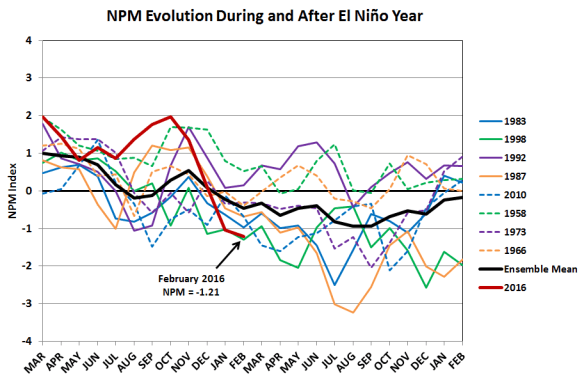
In my post last month I mentioned that the recent reversal of the North Pacific Mode (NPM) phase was related to this winter’s El Niño event.  In other words, when we saw El Niño developing last year, we might have anticipated that “the Blob” would probably lose some of its surface signature over the course of the winter; it wasn’t a surprise.  The chart below illustrates that this is a typical course of events by showing the evolution of the NPM index in 8 previous winters with the strongest El Niño conditions since 1950 (based on the bivariate ENSO index from November through March).

npm_enso_analogs_201603

The thick black line in the chart shows the mean of the 8 similar past years, and we can see that it’s normal for the NPM index to decline quite significantly from the spring prior to an El Niño winter to the summer after an El Niño winter.  This…

View original post 417 more words

Bi-State Sage-Grouse Lawsuit Filed!


March 10, 2016
Online Messenger #331
Yesterday, Western Watersheds Project and our allies at the Center for Biological Diversity, Desert Survivors, and WildEarth Guardians filed a lawsuit over the U.S. Fish and Wildlife Service’s failure to afford Endangered Species Act protection for the Bi-State population of greater sage-grouse. These genetically-distinct sage-grouse occur only on the California-Nevada border north and south of Mono Lake and face multiple threats to their survival.

The Service’s September 2015 finding that the Bi-State sage-grouse did not warrant protection was an abrupt about-face from its 2013 decision to protect the bird. That itself was a hard-fought outcome of a 2010 lawsuit, and now, we’re in court again seeking meaningful conservation for a population that remains at risk while the agency dithers.

In refusing to protect the bird, the Service relied upon new funding for measures in the Bi-State Action Plan. But that would fund activities on a mere 40,000 acres of private lands – less than one percent of the bird’s habitat.

Most of the 4.5 million acres of Bi-State sage-grouse habitat is on public lands, the bulk of which are grazed by livestock. Not a single federal land management plan has been amended to protect Bi-State sage-grouse, and the few proposed amendments will not conserve the bird. Ongoing livestock grazing on public lands will continue to threaten the grouse’s survival – from nest trampling, fenceline deaths, increased predation, vegetation composition changes, increased invasive species proliferation and increased fire risks.

Yesterday’s challenge seeks to remand the recent decision back to the Service so it can make an objective decision based on science, not politics.

Thanks to Stanford Law Clinic and the Center for Biological Diversity for representing us in this case.

The complaint is available online here.

Mangled Jet Stream, River of Moisture Set to Deliver Extreme Flooding to Mississippi Valley

robertscribbler's avatarrobertscribbler

The potential rainfall totals for a broad region centering just west of the Mississippi River Valley are absolutely extraordinary. For even a strong spring storm, this event may hit unprecedented levels. It’s the kind of abnormal event we’ve now come to expect in a world driven 1 C + warmer than 1880s levels by a merciless burning of fossil fuels that just won’t quit.

****

Mangled Jet Stream Aims River of Moisture at Central US and Gulf Coasts

Over the past few weeks, a record warm El Nino has been slowly cooling down in the Equatorial Pacific. One of the top three strongest events on record, this particular warming of sea surfaces in the Pacific coincided with never before seen global heat as atmospheric CO2 levels spiked to above 405 parts per million on some days during February and March. The record warm sea surface and atmosphere held…

View original post 648 more words

Northern Polar Melt Re-Asserts With A Vengeance — Arctic Sea Ice Volume Closed on New Record Lows During February

robertscribbler's avatarrobertscribbler

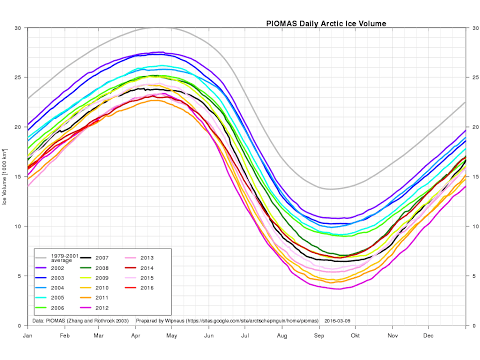
Arctic sea ice volume hit near new record lows during February. That’s kinda a big deal. What it means is that whatever sea ice resiliency was recovered during 2013 and 2014 are now mostly gone. That record all-time lows for sea ice set in September of 2012 are likely to see a serious new challenge during 2016 and 2017.

*****

A flood of severe Arctic heat — flowing up through the Barents and Greenland seas in the East and over Alaska and the Bering Sea in the West — has been hammering the Arctic Sea Ice all Winter long. During February of 2016, new record lows in sea ice extent and area were breached. Meanwhile, sea ice volume — as measured by PIOMAS — also greatly declined to hover just above previous record lows for this time of year set in 2011.

PIOMAS Daily Volume

(Arctic sea ice volume, as measured by the…

View original post 1,033 more words