Ten Times Faster Than a Hothouse Extinction — Human Carbon Emission is Worst in at Least 66 Million Years

robertscribbler's avatarrobertscribbler

“If you look over the entire … last 66 million years, the only event that we know of … that has a massive carbon release and happens over a relatively short period of time is the PETM. We actually have to go back to relatively old periods. Because in the more recent past, we don’t see anything [even remotely] comparable to what humans are currently doing.” Richard Zeebe of the University of Hawaii in a recent paper published in Nature.

*****

carbon-emissions

(Annual human carbon emissions are about 150 times that of all the volcanoes on the Earth, 10 times faster than a hothouse extinction that occurred 55.8 million years ago. Image source: La Rosa Rossa.)

Let’s be very clear. The human fossil fuel emission is outrageous and unprecedented on geological timescales. An insult the Earth has likely never seen before. For the pace at which we are…

View original post 844 more words

Swan killers attack animal rights activist

Photo   Jim Robertson

Photo Jim Robertson

http://www.nltimes.nl/2016/03/21/swan-killers-attack-animal-rights-activist/
“Swan protector Saskia van Rooy was attacked by hunters in Stolwijk on
Saturday, she said to Dutch newspaper AD.
“According to Van Rooy, she was filming dead geese when two men were
suddenly behind her. “Dressed in army suits and camouflage nets over
their heads, they yelled at me”, she said to the newspaper. One swung
the butt of a rifle towards here face, but she managed to duck in
time.”

623-ft vessel hits object, grounded in Columbia River

http://koin.com/2016/03/21/623-foot-vessel-grounded-in-columbia-river/

Sparna hit submerged object

The motor vessel Sparna, a 623-foot Panamanian-flagged bulk carrier sits aground in the Columbia River near Cathlamet, Wash., March 21, 2016.

ASTORIA, Ore. (KOIN) – Multiple agencies are monitoring a 623-foot merchant ship that has become grounded in the main shipping channel of the Columbia River.

The motor vessel Sparna, a 623-foot Panamanian-flagged bulk carrier sits aground in the Columbia River near Cathlamet, Wash., March 21, 2016.

The U.S. Coast Guard says “Sparna” went aground at 12:16 a.m. on Monday in a narrow part of the river near Cathlamet, Wash. It reportedly hit a submerged object.

The vessel took on water in void spaces, but the fuel tanks were not damaged, the Coast Guard said.

“The positive news so far is that responders have not observed any oil in the water,” said Capt. Dan Travers, Coast Guard Captain of the Port for the Columbia River.

The Sparna is fully loaded with grain and was heading west in the Columbia River, towards the ocean, with a river pilot still on-board when it ran into trouble.

The Sparna is weighed down with 218,380 gallons of high sulfur fuel and 39,380 gallons of marine diesel. Two tug boats are on scene to keep the Sparna stabilized, according to the Coast Guard.

The Coast Guard, Washington Department of Ecology and Oregon Department of Environmental along with other state and county agencies are on scene monitoring the situation. They say the Coast Guard will need to approve a salvage plan.

The vessel isn’t blocking the navigation channel so it is open to other vessels.

Cathlamet, Wash. is about 1.5 hours from downtown Portland.

World Meteorological Organization — Dangerous Climate Future Has Arrived

robertscribbler's avatarrobertscribbler

The alarming rate of change we are now witnessing in our climate as a result of greenhouse gas emissions is unprecedented in modern records. — Petteri Taalas, Secretary General of the World Meteorological Organization

*****

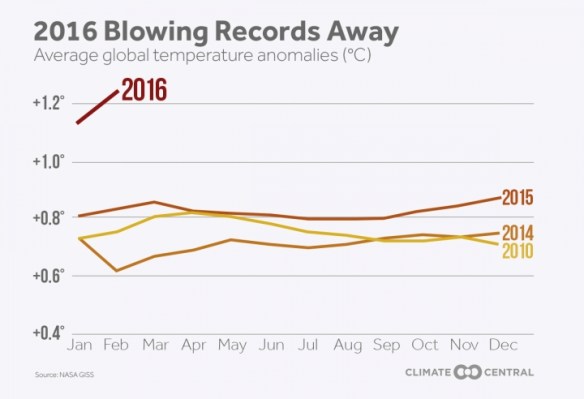
It would be a bit of an understatement to say that the global scientific community is reeling. Sure, the various scientists and researchers knew that a massive accumulation of greenhouse gasses in the Earth’s atmosphere and oceans was beginning to take a serious toll. They knew that ocean heat content in the top 2,000 meters of the world ocean system (accounting for 93 percent of Earth System warming) was going through the roof. And they knew that this warmth was going to bleed out in a seriously big and bad way as a record El Nino swept through the global climate system during 2014, 2015 and 2016.

2016 Blowing Records Away

(Temperature averages for 2016 are…

View original post 930 more words

Bulk carrier runs aground

http://www.dailyastorian.com/Free/20160321/eagle-dies-after-attack-by-mating-rival?utm_source=Daily+Astorian+Updates&utm_campaign=754ffa1e27-TEMPLATE_Daily_Astorian_Newsletter_Update&utm_medium=email&utm_term=0_e787c9ed3c-754ffa1e27-109860249
Pollution responders are watching a ship that ran aground just after midnight.

The Daily Astorian

Published on March 21, 2016 9:19AM

Last changed on March 21, 2016 12:20PM

Photo by Petty Officer 1st Class Levi ReadA tug boat helps stabalize the motor vessel Sparna, a 623-foot Panamanian-flagged bulk carrier that ran aground Monday in the Columbia River near Cathlamet, Washington. The Sparna is loaded with grain and fuel and was headed west on the Columbia River when it grounded.

Photo by Petty Officer 1st Class Levi ReadA tug boat helps stabalize the motor vessel Sparna, a 623-foot Panamanian-flagged bulk carrier that ran aground Monday in the Columbia River near Cathlamet, Washington. The Sparna is loaded with grain and fuel and was headed west on the Columbia River when it grounded.

Buy this photo

<!–

–>

CATHLAMET, Wash. — The U.S. Coast Guard is closely monitoring a bulk carrier that ran aground in the main shipping channel of the Columbia River just after midnight today near Cathlamet.

Pollution responders from the Coast Guard alerted local and federal agencies and established an incident command with the Washington Department of Ecology and Oregon Department of Environmental Quality.

“The positive news so far is that responders have not observed any oil in the water,” Capt. Dan Travers, commander of Sector Columbia River, said in a statement. “The vessel quickly activated its plan and all federal, state, and county responders mobilized immediately. This is a joint effort with both states and hopefully will just turn out to have been an exercise in mobilizing pollution response resources.”

The cause of the grounding is under investigation. The bulk carrier — the Sparna — was outbound, fully loaded with grain, and heading west in the Columbia with a river pilot still on board when it ran aground. The vessel is also filled with more than 218,000 gallons of high-sulfur fuel and more than 39,000 gallons of marine diesel.

The Maritime Fire & Safety Association and Clean Rivers Cooperative deployed response vessels, booms and personnel. The tugs PJ Brix and Pacific Escort are on scene to keep the Sparna stabilized. The Coast Guard has not closed the river channel.

Patricia Randolph’s Madravenspeak: End hunting and give half the world back to wildlife

dvoight09's avatarWisconsin Wildlife Ethic-Vote Our Wildlife

031816_image

PHOTO COURTESY OF BING IMAGES

“We fail to label the unnecessary killing of animals as gun violence, and instead we euphemize and romanticize it as ‘sportsmanship.’” ~ Jay Shooster, Huffington Post

Shooster, an animal and human rights advocate, continues on the blog: “But hunting is gun violence. “A bullet ripping through flesh, puncturing arteries, taking a life is violence to matter the victim’s species”.

Killers enjoy killing repeatedly and are enabled by citizen inaction. The suffering is unimaginable. It is baffling why people do not care enough to stop it when our pets have taught us the loving, curious, loyal and healing nature of our brothers and sisters in our animal fraternity.

There has been a lot of concern about lead poisoning of Flint, Michigan, residents. Lead affects wildlife too. Lead shot kills over a million songbirds annually, just in Wisconsin, according to Madison Audubon testimony at a Conservation Congress…

View original post 771 more words

AK Murre Die-Off

Dan Joling | Associated Press

Dan Joling / Associated Press

Lake Iliamna in Southwest Alaska is North America’s eighth-largest lake, but nobody would mistake it for the Pacific Ocean. Not even a seabird.

So when thousands of common murres were found dead at the lake — part of a massive die-off of a species whose preferred winter habitat is at sea — seabird experts were puzzled.

“We’ve talked about unprecedented things about this die off. That’s another one,” said John Piatt, research wildlife biologist for the U.S. Geological Survey.

Murres occasionally land in fresh water, Piatt said.

“You figure it’s a misguided individual. To have 6,000, 8,000 birds in the lake is pretty mind-blowing, really,” he said. “I’ve never heard of any such a thing anywhere in the world.”

Abnormal numbers of dead common murres, all apparently starved, began washing ashore on Alaska beaches in March 2015. After late-December storms, 8,000 were found at the Prince William Sound community of Whittier. The confirmed carcass count is now up to 36,000, but most don’t wash ashore. Also, Alaska has more coastline than the rest of the United States put together and relatively few beaches have been surveyed.

Common murres catch finger-length fish to feed their young in summer and can forage on krill. Less is known about what they eat in winter. Because of a high metabolism rate, they can use up fat reserves and drop to a critical threshold for starvation in three days of not eating.

Researchers trying to find out the cause of the deaths would not have thought to look on a freshwater lake but were alerted to the Iliamna carcasses by Randy Alvarez, a member of the Lake and Peninsula Borough Assembly.

A commercial fisherman, Alvarez has lived in Igiugig on the west end of 77-mile long Lake Iliamna since 1983.

He had seen a few dead murres on the beach, but on a mid-February flight with the borough mayor and manager, they saw thousands.

“We came up with a guess of 6,000 to 8000 birds in about 12 miles,” Alvarez said.

Nobody he knows remembers common murres at the lake. Alvarez speculates the birds could not find food in the Pacific and flew to the lake to eat salmon smolt. Lake Iliamna has not frozen the last two winters, which itself is strange.

His friends and relatives in Naknek, a Bristol Bay port, in normal winters catch smelt, another small, silvery fish.

“This was the worst anybody had ever seen it for smelt,” he said, and he wonders if it’s connected to the North Pacific’s third-straight year of above-normal temperatures. If seabirds can’t find enough to eat, he worries that salmon won’t either.

“I think something is not right,” he said.

Scientists in multiple federal agencies are trying to determine if the murre deaths are connected to lack of food, parasites, disease, weather or something else, but they keep being pitched curves, like birds showing up in surprising places.

“This is the thing about this die-off,” Piatt said. “We don’t even know what we don’t know.”

Yellowstone Grizzlies by the Numbers

http://www.yellowstonepark.com/grizzly-bear-facts/?utm_source=YSnewsletter&utm_medium=email&utm_campaign=YS

The grizzly bears that inhabit the Greater Yellowstone Ecosystem have played an important role in one of the nation’s greatest endangered species success stories. Since 1975, the bears have been beneficiaries of the Endangered Species Act that enabled the grizzly population to beat all odds after teetering on the brink of extinction. It grew from 136 bears in 1975 to around 700 in 2016, although estimates range from 674 to 839.

On March 3, 2016, the United States Fish and Wildlife Service announced its proposal to delist the Yellowstone area grizzlies, which includes Grizzly 399, from the federal threatened species list. It is expected to make a final decision by the end of 2016.

The Numbers

50,000
The number of grizzly bears that roamed between the Pacific Ocean and the Great Plains during Lewis and Clark Expedition, 200 years ago.

674-839
The approximate number of grizzly bears in the Greater Yellowstone Ecosystem according to the National Park Service in 2016. No one knows the exact number.

150
The number of grizzlies that live within the boundaries of Yellowstone National Park in 2016.

More than 524
Of Greater Yellowstone Ecosystem grizzlies live outside Yellowstone National Park.

22,500 square miles
Is the range of the Yellowstone area grizzly bears, which has doubled since 1975 – that’s an area larger than Massachusetts, Rhode Island and New Hampshire combined.

37
Grizzly bear populations were present in the lower 48 states in 1922.

31
Grizzly bear populations were extirpated by 1975.

136
Grizzlies lived in the Greater Yellowstone Ecosystem in 1975.

10
is number of years it takes a female grizzly to replace herself in the population.

1,000
Grizzly bears live in the Northern Continental Divide Ecosystem, which stretches from Kalispell, Mont., all the way up into Canada and includes Glacier National Park.

DSC_0033