Monster African Thunderstorm Hurls Enormous Haboob at Europe, 100 + Degree (F) Heat to Follow

robertscribbler's avatarrobertscribbler

An expansion of the Sahara Desert northward into Europe. A scenario that has long been a concern raised by scientists modeling potential extreme weather and climate scenarios related to human-caused climate change. And this week, it appears that Southern and Eastern Europe are going to get a taste of Sahara Desert-type weather conditions. It’s just unfolding a bit more dramatically than scientists at first anticipated.

Haboob the Size of England Ireland and Scotland Combined

(Monster thunderstorm explodes over Northwestern Africa last night, hurling a huge dust storm or Haboob northward toward Europe. Image source: The Met Office.)

Last night, a massive thunderstorm large enough to cover the England, Scotland and Ireland combined blew up over western Africa. The storm, larger than most hurricanes, drew in strong, hot winds from North Africa and the Sahara Desert. These winds bore upon them a great load of dust. Dust which the strong outflow of the storm then turned northward along a…

View original post 582 more words

Pipeline leak fouls creek near grizzly management area in northwestern Alberta

DSC_0033

http://www.metronews.ca/news/canada/2016/06/14/pipeline-leak-fouls-creek-near-grizzly-protection-area-in-northwestern-alberta.html


Reddit this!

CALGARY — A pipeline leak has spilled an estimated 380,000 litres of light petroleum within five kilometres of a provincially designated grizzly bear management zone in northwestern Alberta, and an undetermined amount of it has reached a nearby creek.

Producer ConocoPhillips Canada said in a statement posted on its website Tuesday that the leak of condensate, a liquid produced with natural gas, was seen at a pipeline right-of-way near its Resthaven gas plant about 65 kilometres northeast of Grande Cache last Thursday afternoon.

It said its staff also observed condensate in nearby Webb Creek.

The Alberta Energy Regulator said condensate was visible as a sheen on the surface of the creek for about 4.5 kilometres below the pipeline leak.

The creek flows to a beaver dam and then into the Simonette River. While no sheen was visible on the river, an analysis indicated hydrocarbons present at slightly above minimum detection limits, the provincial agency said.

The AER said it was the largest hydrocarbon leak from a pipeline since Nexen, a subsidiary of China’s CNOOC Ltd., spilled five million litres of bitumen emulsion in July 2015.

Meanwhile, the company said the pipeline, which along with the gas plant is jointly owned  by ConocoPhillips and Calgary producer Paramount Resources (TSX:POU), has been shut down and isolated and the company has activated its emergency response plan.

“We have deployed over 150 responders to the site with equipment to contain the release and mitigate any environmental impact,” the company said, adding that it had reported the leak to the regulator after discovering it last Thursday.

Fencing and amphibian barriers have been erected to keep wildlife away and a wildlife biologist is on site, it said.

Spokeswoman Michelle McCullagh defended the five-day lag between discovering the leak and beginning what it promises will be daily updates on its website.

“Our first priority was making sure there were no residents in the area, notifying the trappers, the First Nations and all the authorities and then, of course, our continued safety for all of our responders on site and then protecting the environment,” she said.

No residents were found in the isolated area and the company has seen no evidence of animals or fish hurt by the spill as yet, McCullagh said, adding that the company doesn’t know how long it will take to clean up the spill.

The gas plant is still operating, she said.

Mike Hudema of Greenpeace Canada described the number of pipeline spills in Alberta as “alarming.”

“While we learn the details of this latest incident we need to ask ourselves how many more spills will it take before we begin to move away from pipelines and make the renewable energy transition other countries are already implementing,” he said in a email.

The regulator said in a statement Tuesday that staff members were at the site, which is in the Little Smoky caribou range and near a core grizzly bear management zone.

It said it has issued an environmental protection order to ConocoPhillips directing the company to contain the release and prevent it from spreading, while controlling access, collecting water and soil samples and submitting a final report to the AER.

The regulator said no cause has been established and an investigation is underway.

One of the key uses of condensate is to dilute raw Alberta oilsands crude to allow it to flow in a pipeline to market.


Animal rights group call on China’s president to stop ‘shocking’ dog meat festival

http://www.sbs.com.au/news/article/2016/06/13/animal-rights-group-call-chinas-president-stop-shocking-dog-meat-festival

By

Peter Theodosiou
14 Jun 2016
 

Humane Society International has condemned the Yulin Dog Meat festival, which is set to take place in China’s southern province of Guangxi on June 21.

During the 10-day event, dogs are paraded in cages on their way to be slaughtered and then cooked for eating by festival attendees and local residents.

Protesters presented a petition with 11 million signatures to the representative office of Yulin city on Friday.

<img alt=”File image from the 2015 festival showing a butcher preparing cuts of dog meat for sale in Yulin (Getty)” title=”File image from the 2015 festival showing a butcher preparing cuts of dog meat for sale in Yulin (Getty)” class=”media-element file-full” src=”http://www.sbs.com.au/news/sites/sbs.com.au.news/files/styles/full/public/yulin4.jpg?itok=35f0zVWm&mtime=1465806756″ itemprop=”image” />File image from the 2015 festival showing a butcher preparing cuts of dog meat for sale in Yulin (Getty)

File image from the 2015 festival showing a butcher preparing cuts of dog meat for sale in Yulin (Getty)

This picture taken on June 17, 2015 shows a butcher preparing cuts of dog meat for sale in Yulin, in southern China’s Guangxi province. (Getty)

The petition, which was created by Humane Society International and addressed to China’s president Xi Jinping, asks for the end of the festival where animals “suffer enormously”.

“With the dog meat festival in Yulin causing such severe animal suffering, risking human health, damaging China’s global reputation, and involving widespread illegal behaviour, as well as breaching China’s own food safety laws, it is time for the Chinese Government to take firm action to end this event for good,” the petition stated.

In 2014, the Yulin government distanced itself from the festival, saying it was staged by private business people and did not have official backing.

<img alt=”File image of dogs in cages sold by vendors at the 2015 edition of the festival (AAP)” title=”File image of dogs in cages sold by vendors at the 2015 edition of the festival (AAP)” class=”media-element file-full” src=”http://www.sbs.com.au/news/sites/sbs.com.au.news/files/styles/full/public/yulin111.jpg?itok=3QHBf34y&mtime=1465876118″ itemprop=”image” />File image of dogs in cages sold by vendors at the 2015 edition of the festival (AAP)

File image of dogs in cages sold by vendors at the 2015 edition of the festival (AAP)

File image of dogs in cages sold by vendors at the 2015 edition of the festival (AAP)

Humane Society International’s China policy specialist Peter J. Li told SBS the festival was a liability for the Asian country.

“Modern governments are fully aware that they cannot endorse social and morally questionable acts,” he said.

“Instead, the Yulin government has the responsibility to foster new culture and to build the city into a truly modern society.

“Endorsing mass dog slaughter and dog eating as a festival shows that the local officials are out of touch with the changes in China.”

Launched in 2009 to celebrate the summer solstice, the festival celebrates the consumption of dog meat, which reached its height in China during the Han Dynasty (202 – 220 AD).

Mr Li said dog eating had been rejected as an indecent habit during the Sui-Tang dynasties (581 -907 AD) and that subsequent dynasties valued canines as hunting buddies.

<img alt=”endors tie a dog in preparation to butcher it at the Yulin Dog Meat Festival, in Yulin, in southern China's Guangxi province, 22 June 2015.” title=”File image from the 2015 festival of vendors restraining a dog (AAP)” class=”media-element file-full” src=”http://www.sbs.com.au/news/sites/sbs.com.au.news/files/styles/full/public/yulin444.jpg?itok=rSf4Z0hI&mtime=1465806964″ itemprop=”image” />endors tie a dog in preparation to butcher it at the Yulin Dog Meat Festival, in Yulin, in southern China's Guangxi province, 22 June 2015.

File image from the 2015 festival of vendors restraining a dog (AAP)

endors tie a dog in preparation to butcher it at the Yulin Dog Meat Festival, in Yulin, in southern China’s Guangxi province, 22 June 2015. (AAP)

He noted that dog eaters represented a minority of China’s 1.3 billion population and the dog meat industry constituted “an insignificant part of the Chinese economy”.

“It is an eating habit limited to older males of lower social and economic status,” he said.

“It is a dying eating habit and a distasteful business.”

The campaign against the festival has received celebrity backing from British comedian Ricky Gervais and US actor Ian Somerhalder.

The hashtag #StopYulin2016 has been popular on social media.

Claire Fryer, from People for the Ethical Treatment of Animals Australia (PETA), told SBS any situation where animals were slaughtered was unacceptable.

“The thought of killing, cooking, dismembering and eating dogs is enough for most of us to lose our lunch, but there’s no rational reason why that same revulsion shouldn’t exist at the thought of eating a pig,” she said.

“All animals about to be slaughtered feel terrified, and none want to die.”

Ms Fryer said Australians needed to take note of all animals that are slaughtered.

“Right here in Australia, sensitive, scared lambs, chickens, cows and pigs are killed as we willfully turn a blind eye to the fact that they are no different from the dogs we cry for,” she said.

“It’s easy to point the finger at other cultures, but let’s be honest enough and decent enough to question our own cruel habits.

SBS has sought response from the Chinese Embassy in Australia.

Death Valley Like Heat Predicted to Blanket the Southwest By Next Week

robertscribbler's avatarrobertscribbler

Drought is again expanding over the US West. Oregon, after a very rapid April and May snowmelt, is being advised to conserve water. And with high pressure building in over the Southwest, weather models are predicting the emergence of an extreme heatwave by late this weekend. One that current guidance is indicating will bring 100 to 120 degree (F) temperatures to a wide region stretching from California’s Central Valley, through Southern California, Northwestern Mexico, Arizona, Nevada and into Southern Utah.

Strong High Pressure System

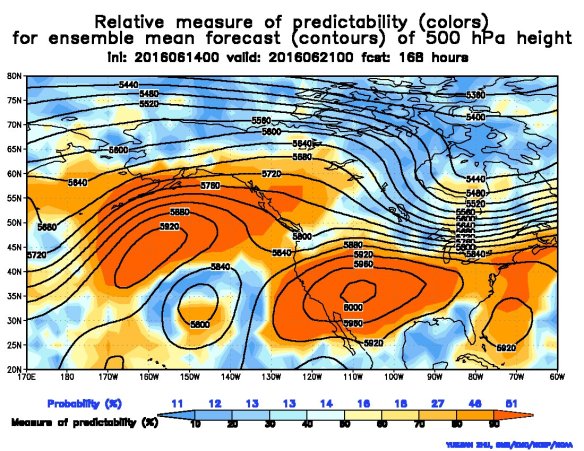
(The US is expected to swelter under a heat dome that is predicted to form this weekend and expand on into next week. Record heat is predicted to first impact the US Southwest before building into the Central US by late next week. Image source: NCEP/NOAA.)

The trigger for what may become a record-shattering heatwave is the predicted development of a powerful atmospheric ridge. Model guidance now…

View original post 479 more words

Ten Mile Wide Chunks of Arctic Sea Ice are Disintegrating North of Svalbard

robertscribbler's avatarrobertscribbler

Over the past 10 days, the rate of sea ice extent loss in the Arctic has slowed down somewhat. And as a result sea ice extent measures, though maintaining in record low ranges, are much closer now to the 2012 line. Low pressure systems have come to dominate the Arctic Ocean zone. And the outwardly expanding counter-clockwise winds from these systems have tended to cause the ice to spread out and to thin. In the past, such events were seen as an ice preserving feature. But this year, there’s cause for a little doubt.

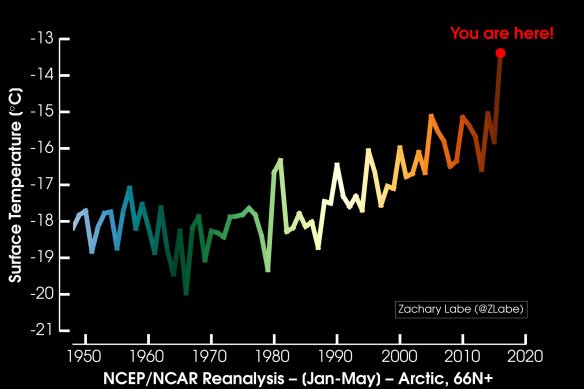
The first cause comes in the form of record Arctic temperatures for all of 2016. As Zack Labe shows in the compelling graphic below, not only has the first half of 2016 been a record warm six months for the Arctic, it’s been a record warm half-year like no other.

Zach Labe

(The first half of…

View original post 1,008 more words

May Marks 8th Consecutive Record Hot Month in NASA’s Global Temperature Measure

robertscribbler's avatarrobertscribbler

According to NASA, the world has just experienced another record hot month.

May of 2016 was the warmest May since record keeping began for NASA 137 years ago. It is now the 8th record hot month in row. In other words, since October, every month has been the hottest such month ever recorded (October vs October comparison, November vs November etc). And May’s record is just the most recent high mark during a period that has now vastly exceeded all previous measures for global temperature tracking.

The month itself was 0.93 C above NASA’s 1951-1980 baseline measure. It’s the first month since October that readings fell below the 1 C anomaly mark. A range that before 2015 had never before been breached in the 136 year climate record and likely during all of the approximate 12,000 year period that marks the Holocene geological epoch.

It’s a reading…

View original post 1,226 more words

Trophy hunting of grizzly bears to continue in British Columbia

A grizzly bear is photographed in the Orford River, in British Columbia, in this 2011 file photo. (JOHN LEHMANN/THE GLOBE AND MAIL)A grizzly bear is photographed in the Orford River, in British Columbia, in this 2011 file photo. (JOHN LEHMANN/THE GLOBE AND MAIL)

British Columbia is cracking down on the use of sheep and goats as pack animals for big game hunters in its latest set of hunting and trapping regulations. But the contentious trophy hunting of grizzly bears will continue unchanged.

The provincial ministry responsible for hunting produced updated regulations on Monday, and although it has rejected a proposal to increase the number of grizzly hunting permits for resident hunters in the Peace River region, environmentalists are disappointed that the status quo remains in place.

The major changes include additional record-keeping requirements for butchers, and a new ban on bringing domesticated sheep or goats along on big game hunts to act as beasts of burden because of fears that the animals may pass on disease to wildlife. The report did not say whether this was a common practice. Steve Thomson, the Minister of Forests, Lands and Natural Resource Operations, says in the report released Monday his major concern in wildlife management right now is around the declining moose population, and he promised a new BC Moose Tracker app that will allow people to record moose sightings.

Mr. Thomson could not be reached for comment, but in a statement, ministry officials maintained that the current grizzly bear hunt is sustainable.

Auditor-General Carol Bellringer has announced she will conduct a performance audit to determine whether the province is effectively managing the grizzly bear population . The province says there are 15,000 grizzlies in B.C. and that hunting is allowed only after conservation targets and aboriginal harvests for food, social and ceremonial uses are met.

Ms. Bellringer’s report is not expected until next spring, and Ian McAllister, executive director of Pacific Wild, an environmental organization, said that means the B.C. Liberal government’s current approach won’t be effectively challenged until the May, 2017, provincial election.

“This institutionalizes the trophy hunt in wildlife practices,” Mr. McAllister said. “It’s an indication of what Premier Christy Clark is thinking about this file and that is almost inconceivable given the unprecedented input over the past year.”

Pacific Wild has led opposition to the grizzly bear hunt, particularly in the newly proclaimed Great Bear Rainforest. Mr. McAllister says the Coastal First Nations, along with a large majority of British Columbians, are opposed to trophy hunting of grizzlies. (Polls suggest anywhere between 88 and 95 per cent of British Columbians are against trophy hunting.)

The provincial government has been reluctant to curtail the hunt, however, saying it is confident in the science behind its quotas. As well, the province maintains that hunting in general is good for the economy: The province is home to 100,000 resident hunters who, along with guide outfitters, put $350-million into the economy each year by the province’s reckoning.

Mr. McAllister said he is hopeful the Auditor-General will agree that the province is not adequately managing the population of grizzly bears. He said the timing of her report at least will help raise the profile of the issue in next year’s provincial election.

“It will be a high-profile issue in the run-up to the next election.”

However, it is not clear the New Democratic Party will offer an alternative position. The party has said it is still consulting before deciding whether it would promise to restore the moratorium on trophy hunting that it put in place in 2001, when it last help power.

The lone Green Party MLA in B.C., Andrew Weaver, last year introduced a bill to ban the trophy killing of grizzly bears. That bill would treat grizzlies the same as black bears, so hunters would be required to harvest edible portions of a bear.

Poe on a Mountaintop


Excerpt from “A Tale of the Ragged Mountains” by Edgar Allen Poe:

…Upon a dim, warm, misty day, towards the close of November, and during the strange interregnum of the seasons which is termed the Indian Summer Mr. Bedloe departed, as usual, for the hills. The day passed, and still he did not return.

About eight o’clock at night, having become seriously alarmed at his protracted absence, we were about setting out in search of him, when he unexpectedly made his appearance, in health no worse than usual, and in rather more than ordinary spirits. The account which he gave of his expedition, and of the events which had detained him, was a singular one indeed:

“You remember,” said he, “that is was about nine in the morning when I left Charlottesville. I bent my steps immediately to the mountains, and, about ten, entered a gorge which was entirely new to me. I followed the windings of this pass with much interest–The scenery which presented itself on all sides, although scarcely entitled to be called grand, had about it an indescribable, and to me, a delicious aspect of dreary desolation. The solitude seemed absolutely virgin. I could not help believing that the green sods and the grey rocks upon which I trod, had been trodden never before by the foot of a human being. So entirely secluded, and in fact inaccessible, except through a series of accidents, is the entrance of the ravine, that it is by no means impossible that I was indeed the first adventurer–the first sole adventurer who had ever penetrated its recesses.

“The thick and peculiar mist, which distinguishes the Indian Summer, and which now hung over all objects, served, no doubt, to deepen the argue impressions which these objects created. So dense was the pleasant fog, that I could at no time see more than a dozen yards of the path before me. This path was excessively sinuous, and as the sun could not be seen, I lost all idea of the direction in which I journeyed. In the meantime the morphine had its customary effect–that of enduing all the external world with an intensity of interest. In the quivering of a leaf–in the hue of a blade of grass–in the shape of a tree foil–in the humming of a bee–in the gleaming of a dew drop–in the breathing of the wind–in the faint odors that come from the forest–there came a whole universe of suggestion–a gay a motley train of rhapsodical and immethodical thought.

“Busied in this, I walked for several hours, during which the mist deepened around me to so great an extent, that at length I was reduced to an absolute groping of the way. And now an indescribable uneasiness possessed me–a species of nervous hesitation and tremor.–I feared to tread, lest I should be precipitated into some abyss. I remembered, too, strange stories told about these Ragged Hills, and of the uncouth and fierce races of men who tenanted their groves and caverns. A thousand vague fancies oppressed and disconcerted me–fancies more distressing because vague. Very suddenly my attention was arrested by the loud beating of a drum.

“My amazement was, of course, extreme. A drum in these hills was a thing unknown. I could not have been more surprised at the sound of the trump of an Archangel. But a new still more astounding source of interest and perplexity arose. There came a wild rattling or jingling sound, as if a bunch of large keys–and upon the instant a dusky-visaged and half-naked man rushed past me with a shriek. He came so close to my person that I felt his hot breath upon my face. He bore in one hand an instrument composed of an assemblage of steel rings, and shook them vigorously as he ran. Scarcely had he disappeared into the mist, before, panting after him, with open mouth and glaring eyes, there darted a huge beast. I could not be mistaken in its character. It was a hyena. …”

(continued)


The only thing more upsetting than Harambe the gorilla’s death was the reality of his life

http://www.independent.co.uk/voices/the-only-thing-more-upsetting-than-harambe-the-gorillas-death-was-the-reality-of-his-life-a7057981.html

Surely we can begin to agree that animals which share 98 per cent of our DNA should not be kept as entertainment for us to gawk at in a zoo

Yet again, captivity has taken an animal’s life. The latest victim: a 17-year-old gorilla named Harambe, who was gunned down after a young boy managed to crawl through a fence before falling into his enclosure at the Cincinnati Zoo.

The incident (which could have been prevented by surrounding the enclosure with a secondary barrier) has generated a great deal of debate online, some extreme – one tweet said, “[I]f you have to shoot – aim for the least endangered one,” while an Express columnist took the view that “zoo staff did what you might think all people would want: they put the human life first”. But arguing over whose life is more valuable misses the point. What we should be asking is why intelligent, self-aware animals are still being displayed as living exhibits for humans to gawk at.

Harambe and other animals serving life sentences in zoos are leading lives of quiet desperation. They are denied the most basic freedoms, including being able to choose where to roam, when and what to eat, and whom to socialise with. It’s no wonder that these magnificent animals frequently exhibit signs of extreme depression and related psychological conditions, such as pacing, rocking and eating their own vomit, which is unheard of in their wild counterparts, as they struggle with the confines of their captivity. They’re also prone to cardiac disease: in 2011, the Smithsonian Institution revealed that 30 of its gorillas were on heart medication.

Fullscreen
 

Cincinnati zoo gorilla shot dead as boy falls into enclosure

Zoos try to justify their existence in the name of “conservation”, but warehousing animals in these facilities does nothing to help protect endangered animals in the wild. In fact, some say doing so actually harms wild populations because it diverts much-needed funds away from the protection of animals in their natural habitats.

After all, capturing (yes, some zoos still snatch animals out of their natural habitats), transporting and maintaining non-human animals for the professed purpose of “conserving” them is enormously expensive. It costs about 50 times as much to keep one African elephant in a zoo as it would to safeguard sufficient natural habitat to sustain that elephant and countless others.

When, in 2007, the Zoological Society of London spent £5.3m on a new gorilla enclosure, Ian Redmond, the chief consultant to the UN Great Apes Survival Partnership, said: “£5m for three gorillas [seems a huge amount] when national parks are seeing [three gorillas] killed every day for want of some Land Rovers, trained men and anti-poaching patrols. It must be very frustrating for the warden of a national park to see”. Clearly, the same amount of money a zoo spends on buying expensive animals could benefit so many more of the same animals living in the wild. Our need for entertainment is expensive, unnecessary and without discernible benefit, then, to the animals involved.

While zoos spend millions on keeping animals in captivity, wild animals continue to experience habitat destruction and poaching. Virtually none of the captive-bred species that do face extinction in the wild – including gorillas, elephants, polar bears, gorillas, tigers, chimpanzees and pandas – will ever be released back into their natural environments to bolster dwindling populations. The truth is that most zoos have no contact of any kind with reintroduction programmes.

Perhaps the only thing more tragic than Harambe’s death was his life. While the debate about whether Cincinnati Zoo should have killed him or not rages on, surely we can all agree that animals deserve better than a life sentence in a zoo.


Sea Shepherd Announces Operation Jairo II

baby sea turtle trying to make it to the seababy sea turtle trying to make it to the seaLOS ANGELES, CA – JUNE 8, 2016:  Today, on World Oceans Day, Sea Shepherd Conservation Society is proud to announce its latest campaign to defend, conserve and protect our oceans.

The campaign, Operation Jairo II, will span three countries including the United States, Honduras and Costa Rica to protect endangered sea turtles. The launch comes on the heels of Sea Shepherd’s announcement of its first full-length feature film, Why Just One?, chronicling the organization’s successful 2015 Operation Jairo campaign.

The crowd-funded documentary Why Just One? raised its goal of $18,000 in one day to complete the production and has a star-studded list of names supporting it. Like its predecessor, Operation Jairo II is named after Jairo Mora Sandoval, a Costa Rican turtle defender who was brutally murdered on May 31, 2013 while attempting to protect leatherback turtle nests.

There are seven species of sea turtles in the world. Four have been identified as “endangered” or “critically endangered,” and two are classed as “vulnerable,” by the IUCN Red List of Endangered species. Sea turtles are some of the oldest living creatures, one of the few who’ve watched dinosaurs evolve and become extinct. They are now facing the same fate as their predecessors.

“This species which has survived so much, may not survive us,” commented Sea Shepherd founder Captain Paul Watson.

Sea Shepherd Conservation Society is requesting donations to fund Operation Jairo II by asking fans to become monthly donors. To donate, visit http://my.seashepherd.org/DAC.

Baby sea turtles on their march to the sea

About Operation Jairo II

Operation Jairo II will launch in Ft. Lauderdale, Florida on July 15 until September 1, with volunteers working to protect green, loggerhead, and leatherback sea turtles. Sea Shepherd will work with Sea Turtle Oversight Protection (S.T.O.P.) to protect sea turtle nests and guide hatchlings to the sea, away from the commercial lighting that disorients them.

The Honduras campaign will be held in Utila from August 1 to November 1, where Sea Shepherd volunteers will protect hawksbill, green, and loggerhead sea turtles. Partnering with Bay Island Conservation Association (B.I.C.A.), Sea Shepherd will protect nesting females and nests from poachers. The Honduran Navy will provide security for beach patrols.

From September 1 to December 1, Operation Jairo II will move to Costa Rica where ground campaign volunteers will work in Jaco to protect primarily olive ridley and green sea turtles. The Jaco police are teaming with Sea Shepherd volunteers to protect nesting females and nests from poachers. Nests will be relocated to a hatchery run by the Jaco police force.

Campaign volunteers will conduct weekly beach cleanups in all three locations.

Click here to volunteer for Operation Jairo II.  Email the completed application to campaigns@seashepherd.org